Contract Interpretation Disputes: A Beginner’s Guide to Fighting Over What an Agreement Really Means
Type
Great Grandchild
Status
Approved
Title (YouTube)
Images Failed (Social)
Images Failed (Social)
Do not index
Parent item
Publish Date (TikTok)
Jan 6, 2027 12:45
Videos Post IDs (Social)
Hashtags (Social)
#LegalAdvice #LegalHelp #BusinessLitigation #ContractInterpretation
Caption
Caption X
Cover

OG Image

Alt Image Text
Flat vector illustration of a contract interpretation disputes scenario, with two business people disagreeing over the meaning of a contract agreement clause, highlighted by legal and business symbols.
Images

Videos
Publish Date (Social)
Dec 16, 2026 14:30
Scheduled (Social)
Scheduled (Social)
Images Posted (Social)
Images Posted (Social)
Videos Posted (Social)
Videos Posted (Social)
Videos Failed (Social)
Videos Failed (Social)
Featured
Created time
Apr 3, 2026 10:12 PM
Sub-item
Authors
CTA Practice Area (Social)
Business Litigation
TikTok Failed (Social)
TikTok Failed (Social)
Videos Post Links (Social)
YT Auto Captions Removed
TikTok Post Links (Social)
Images Post IDs (Social)
YT Post ID
Video Pending Manual (Social)
TikTok Posted (Social)
TikTok Posted (Social)
TikTok Post IDs (Social)
Video Cover (Social)
Images Post Links (Social)
First Comment (Social)
YT Embedded
Images Delete (Social)
Videos Delete (Social)
Carousel Video URL (Social)
Contract Interpretation Disputes: A Beginner’s Guide to Fighting Over What an Agreement Really Means
Contracts are supposed to create clarity. In real life, they often become the start of an argument.
One side says a clause is obvious. The other says the same words point in a completely different direction. A payment term, renewal provision, exclusivity promise, indemnity clause, delivery requirement, or termination right can suddenly turn into a high-stakes business dispute. And once money, timing, or liability is on the line, “that’s not what we meant” tends to show up fast.
If you’re dealing with a disagreement over what a contract really says, you’re not alone. Federal courts reported that civil filings increased to 303,563 in fiscal year 2025, and the courts specifically noted increases in contract actions among the categories that have grown in recent years. The same report said the median time from filing to disposition for civil cases was 15.6 months in 2025, up from 13.7 months in 2024 — a reminder that business disputes can become expensive and time-consuming once they move into formal litigation (U.S. Courts). The cost pressure is real too: an ABA article discussing commercial dispute resolution noted that litigation partner billing rates at large firms exceeded $1,122 per hour on late-2024 billing data, with associate rates at $726 per hour (American Bar Association).
That’s part of why interpretation fights matter so much. A dispute over “meaning” can quickly become a dispute over leverage, damages, lost business relationships, and litigation strategy.
This post is for beginners. You’ll learn what contract interpretation disputes are, why they happen, what courts often look at, what kinds of evidence may matter, and when an attorney’s documented experience with highly-similar matters may make a meaningful difference. If you want a broader overview of the doctrine behind these fights, this deeper piece on how courts unpack unclear contract language and business disputes can help add context.
Scroll to the bottom for every post in this series.
What Is A Contract Interpretation Dispute?
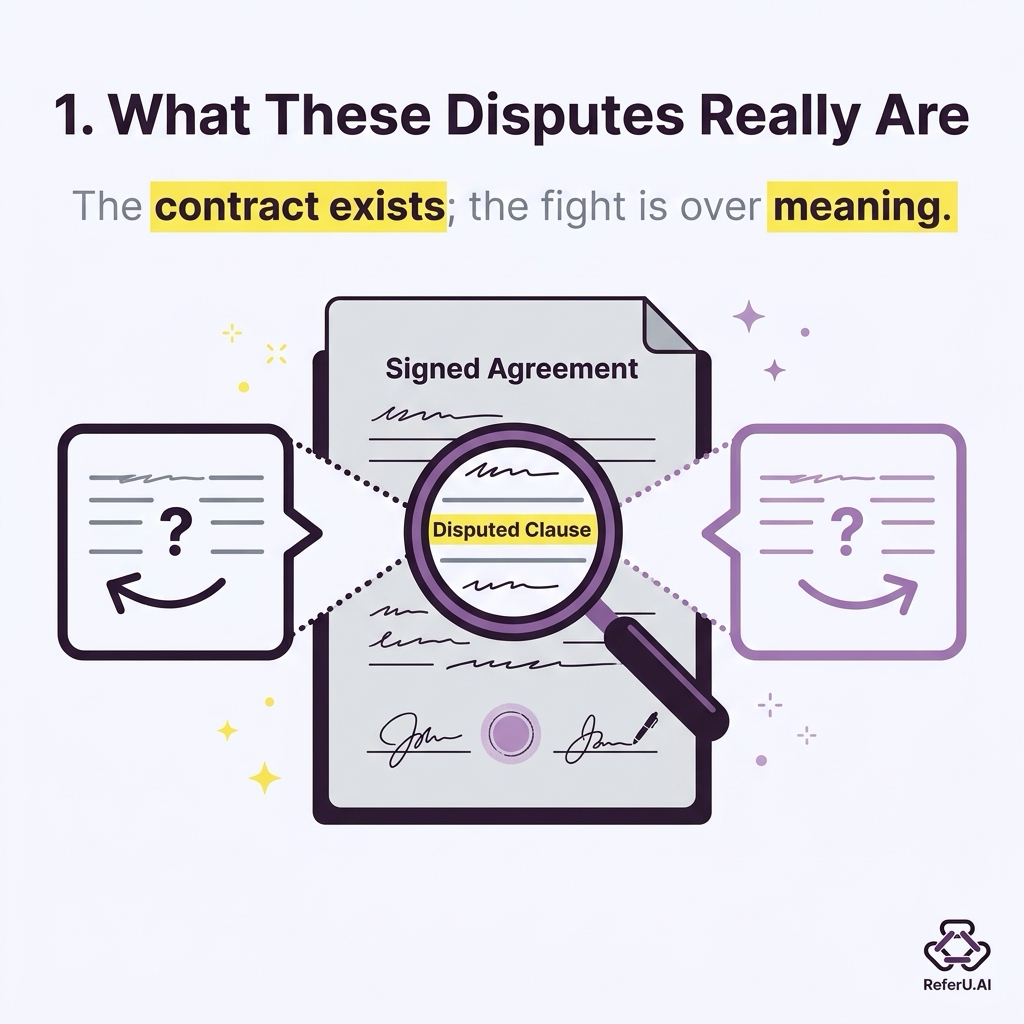
A contract interpretation dispute is a disagreement about what an agreement means.
Usually, both sides agree that a contract exists. The fight is over what a word, sentence, clause, or section actually requires. Common examples include disputes over:
- when payment is due
- whether a deadline was strict or flexible
- whether exclusivity really applied
- what counts as “commercially reasonable efforts”
- who bears risk for delays, defects, or third-party claims
- whether the contract renewed automatically
- whether one side had the right to terminate
In general terms, these disputes are less about whether someone signed a contract and more about how the language is read.
That distinction matters. In an interpretation fight, one party may argue the contract is plain and unambiguous. The other may argue the language is ambiguous and that outside evidence helps explain what the parties intended. Courts often start with the words on the page, but they do not always stop there.
Why Do Businesses End Up Fighting Over Meaning?
A lot of contract language sounds precise until something goes wrong.
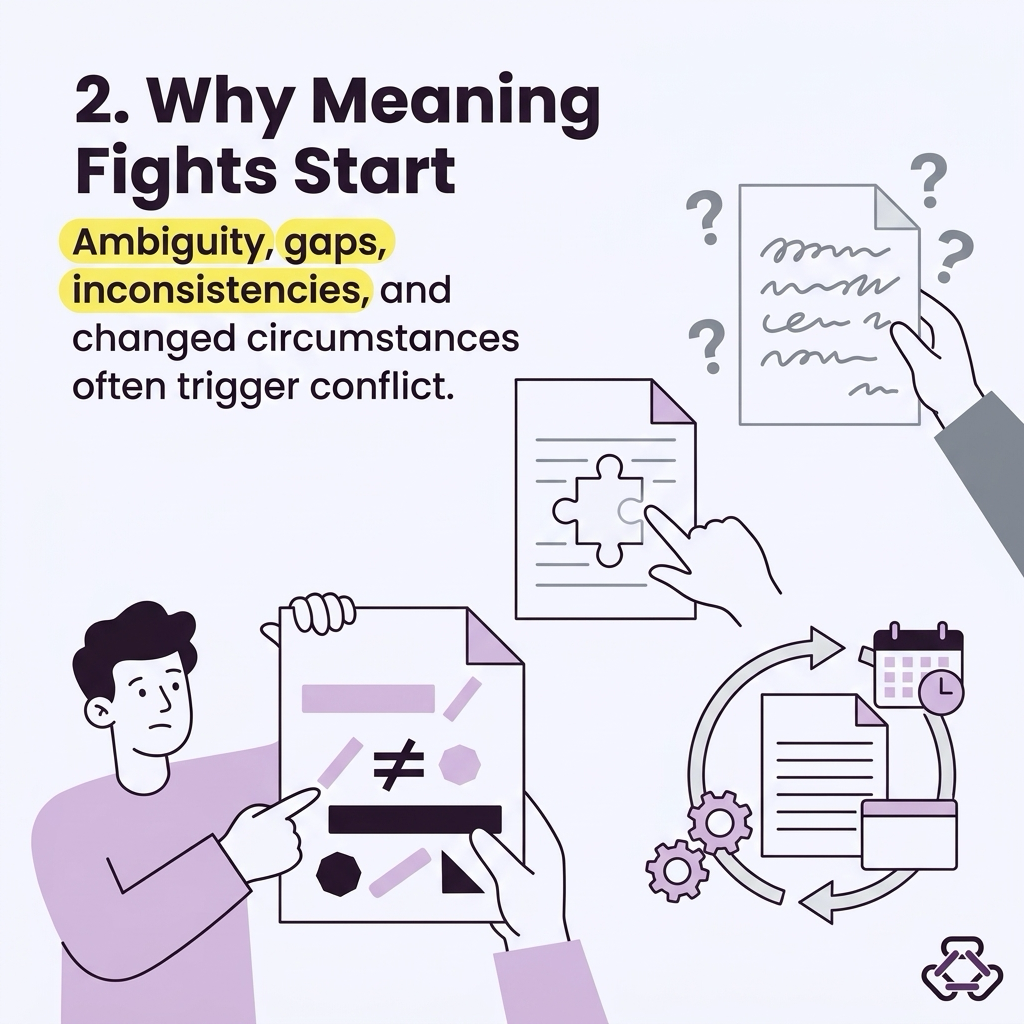
When the relationship is healthy, broad phrases can feel efficient. Once money is withheld, deadlines slip, or performance falls apart, those same phrases can become battlegrounds. Interpretation disputes often arise because of:
Ambiguous Language
Words like “reasonable,” “timely,” “material,” “substantial,” or “best efforts” can sound businesslike while leaving room for argument.
Incomplete Drafting
Sometimes the contract simply does not address the exact problem that later develops. Parties then try to fit the dispute into language that was drafted for a different purpose.
Internal Inconsistencies
One clause appears to give broad rights, while another narrows them. Reading the contract as a whole becomes critical.
Changed Business Circumstances
Supply chain problems, new regulations, staffing changes, market volatility, and evolving project conditions can expose gaps in old contract language. In the construction context, the ABA recently highlighted how documentation gaps and evolving project records are intensifying disputes, citing a 2025 report that average dispute values in North America surged 40% in 2024 to $60.1 million (American Bar Association).
Different Assumptions At Signing
Each side may have walked into the deal with a different understanding, but neither side translated that understanding into exact language.
How Do Courts Usually Start Interpreting A Contract?
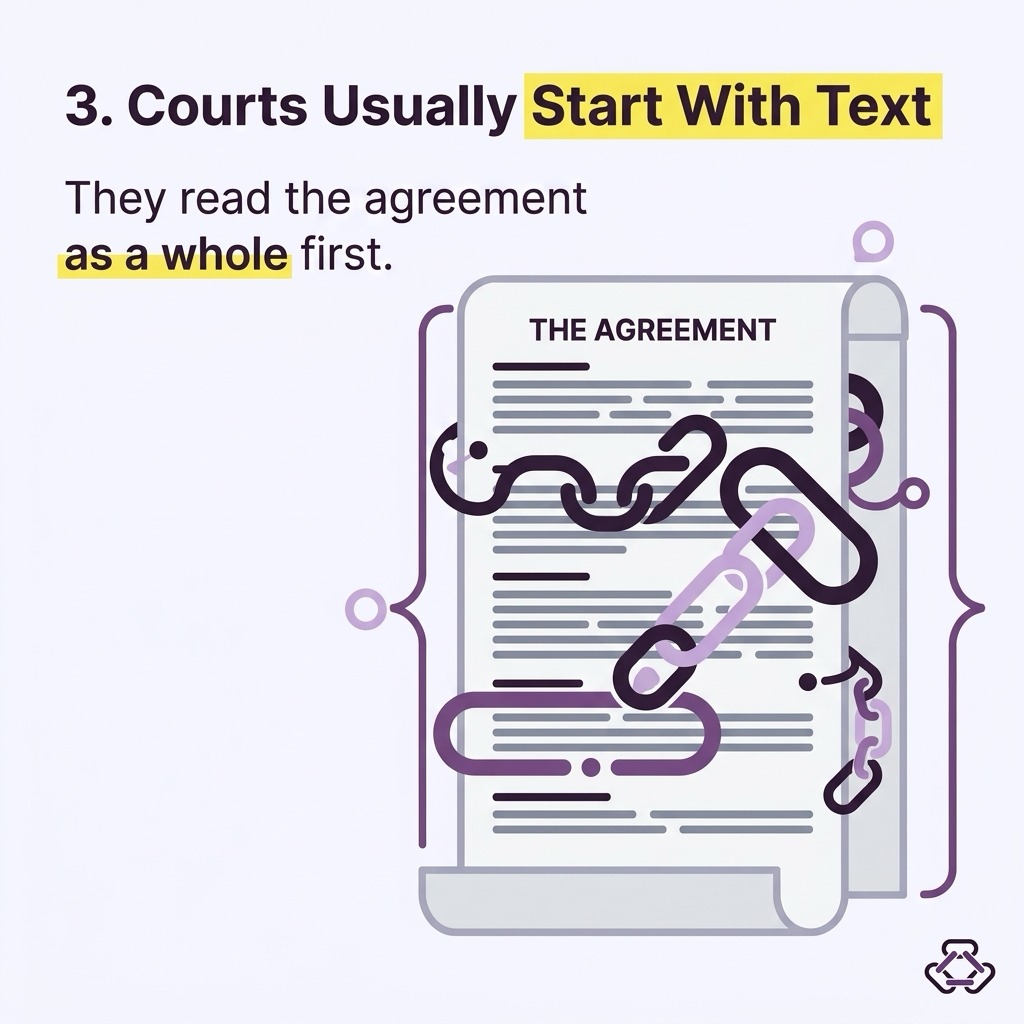
Courts generally begin with the text.
That sounds simple, but the real issue is how the text is evaluated. Many courts apply familiar principles: read the agreement as a whole, give words their ordinary meaning, and try to avoid an interpretation that makes part of the contract meaningless.
For example, New York’s high court has explained that a written agreement that is clear, complete, and subject to only one reasonable interpretation is enforced according to its plain meaning, and that the contract is read as a whole rather than by isolating one phrase (New York State Unified Court System). That same opinion also explains that ambiguity is determined within the four corners of the document, and extrinsic evidence may be considered only if the agreement is ambiguous (New York State Unified Court System).
So the early fight in many contract cases is this: Is the agreement clear, or is it ambiguous?
If a judge thinks the language has one reasonable meaning, the case may turn heavily on the text itself. If the judge thinks the language can reasonably support more than one reading, the door may open to outside evidence.
What Counts As “Ambiguous” Contract Language?
A contract is often called ambiguous when its language is reasonably susceptible to more than one interpretation.
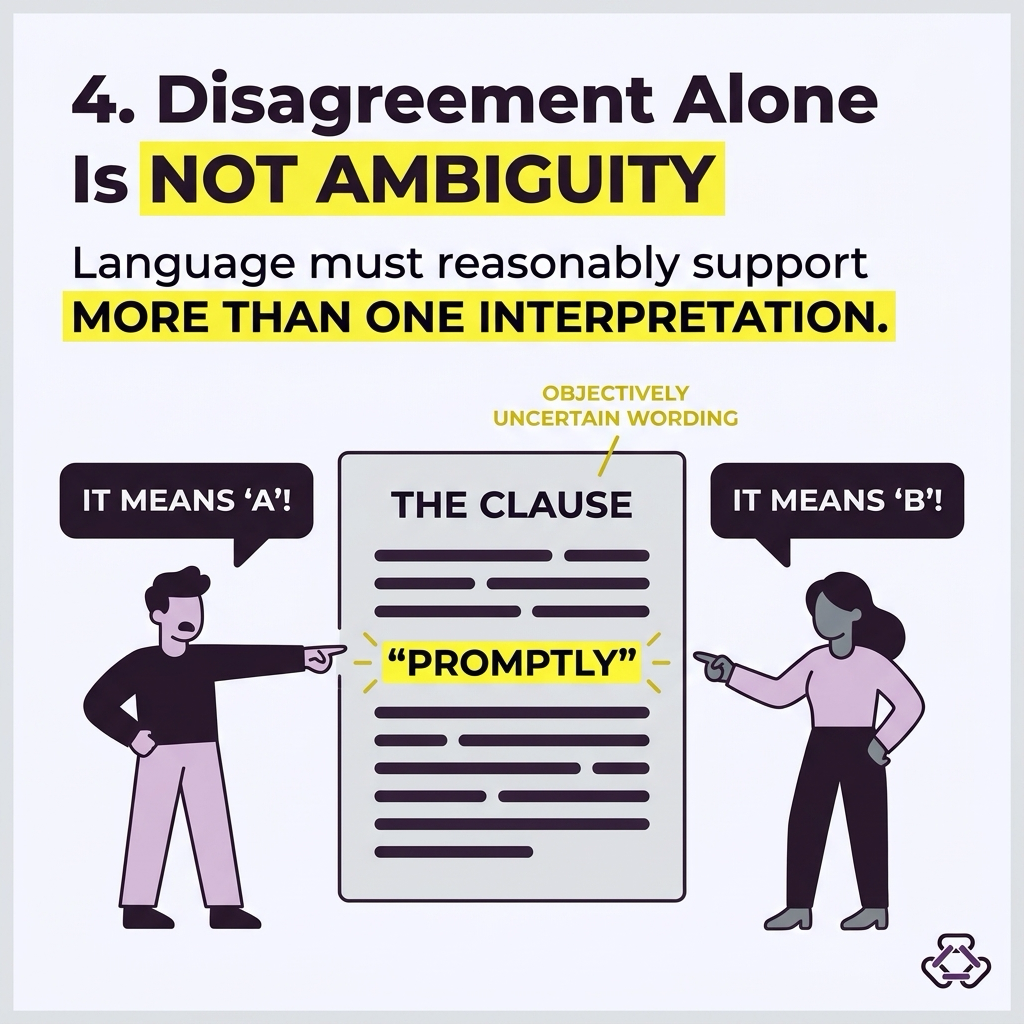
That does not mean a clause becomes ambiguous just because two parties disagree about it. Courts commonly look for a genuine, reasonable uncertainty in the language itself.
A New York Court of Appeals decision put it this way: ambiguity exists when language is written so imperfectly that it is susceptible to more than one reasonable interpretation, and disagreement alone does not create ambiguity if the contract, read as a whole, is clear (New York State Unified Court System).
Here’s what that often looks like in practice:
- a pricing formula that can be read two ways
- a renewal clause that conflicts with a termination clause
- a defined term used inconsistently throughout the agreement
- a scope-of-work section that does not match later amendments
- an indemnity clause that is broad in one sentence and narrow in the next
If your dispute centers on language like that, the battle may focus less on emotions and more on whether the wording can plausibly bear multiple meanings.
What Evidence Might Matter Beyond The Contract Itself?
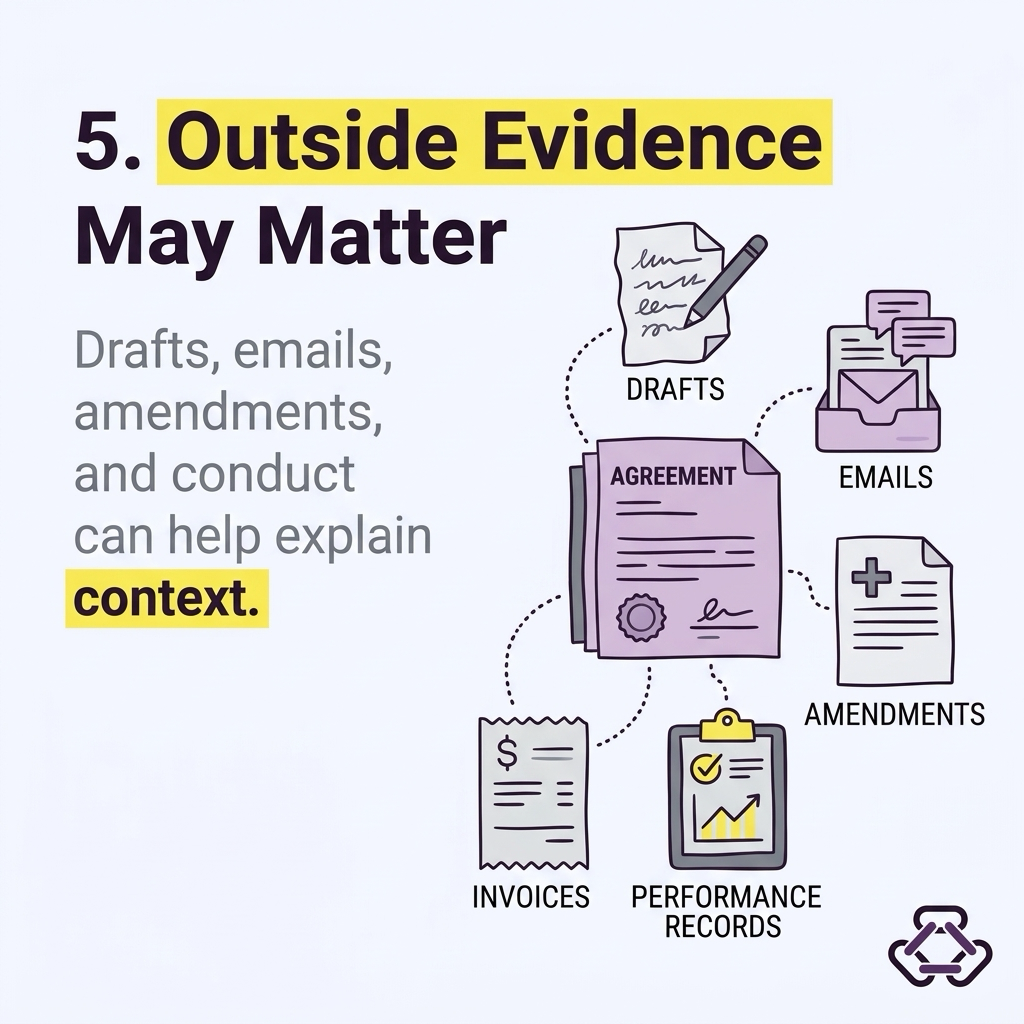
When ambiguity is in play, outside evidence can become important. Lawyers often call this extrinsic evidence.
That may include:
- drafts exchanged during negotiation
- emails or letters discussing the clause
- prior versions of the agreement
- amendments
- statements made during deal negotiations
- the parties’ actual conduct after signing
- industry custom or trade usage
But not all outside evidence is treated equally, and not all of it comes in automatically.
A useful starting point is the parol evidence rule, which generally bars prior or contemporaneous outside agreements from contradicting a writing the parties intended as a complete final agreement. At the same time, under the Uniform Commercial Code, written terms may still be explained or supplemented by course of dealing, usage of trade, or course of performance, and by consistent additional terms in some circumstances (Cornell Legal Information Institute).
That combination is where many business disputes get interesting: one side argues the contract is final and speaks for itself; the other argues the surrounding record helps explain what the words meant in context.
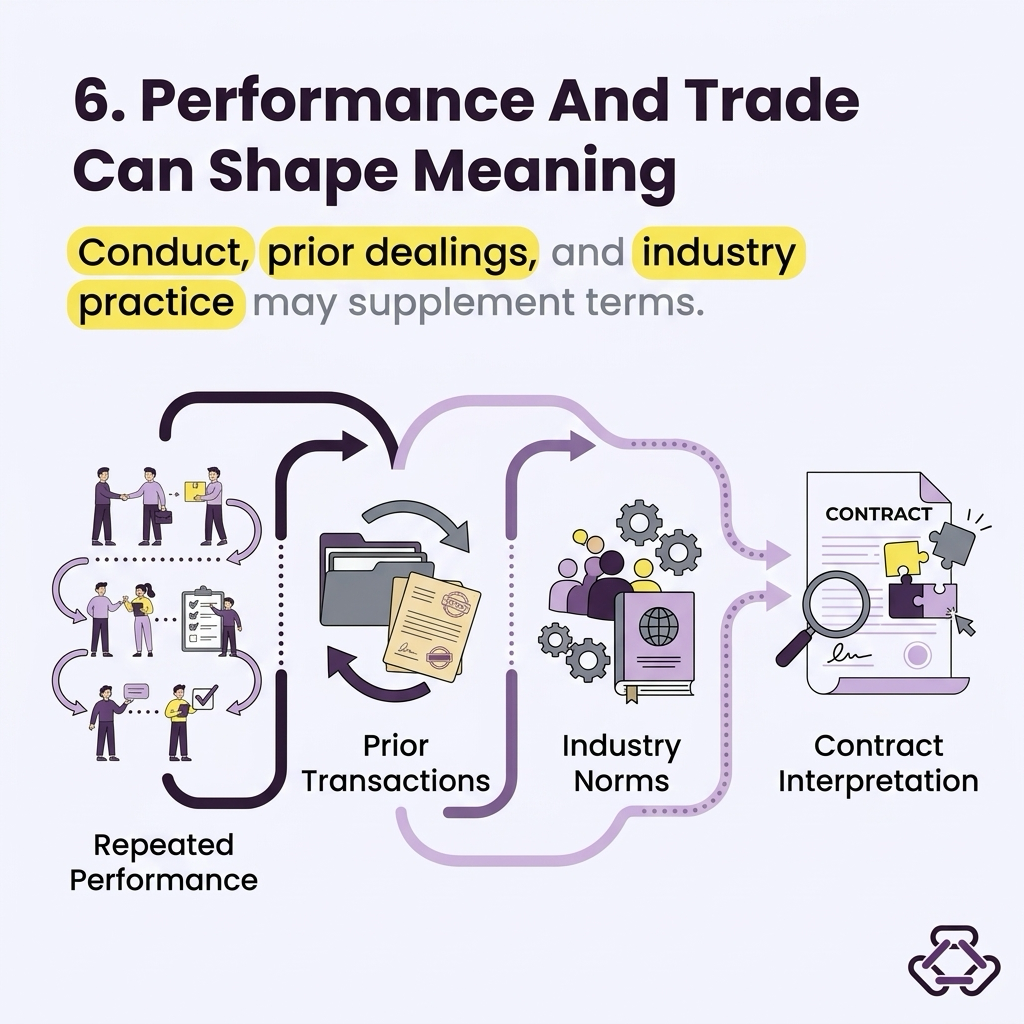
What Are Course Of Performance, Course Of Dealing, And Usage Of Trade?
These are three of the most important concepts in commercial interpretation fights.
Under UCC § 1-303, a course of performance is how the parties behaved under the current agreement when there were repeated occasions for performance; a course of dealing is a sequence of conduct from previous transactions between the parties; and usage of trade refers to a regular practice in a particular place, vocation, or trade that justifies an expectation it will apply to the transaction (Cornell Legal Information Institute).
That same section says these sources are relevant in figuring out the meaning of the agreement and may supplement or qualify contract terms. It also sets a hierarchy: when consistency is impossible, express terms prevail over course of performance, course of dealing, and usage of trade; course of performance prevails over course of dealing and usage of trade; and course of dealing prevails over usage of trade (Cornell Legal Information Institute).
In plain English:
- Course of performance asks: How did both sides actually act under this deal?
- Course of dealing asks: How did these same parties handle similar issues before?
- Usage of trade asks: What does this language usually mean in this industry?
If your disagreement involves repeated invoices, accepted late deliveries, waived milestones, or long-running business practices, these concepts may be central.
Does The Parol Evidence Rule Always Block Outside Evidence?
No. It limits some evidence, but it does not erase context from every case.
Cornell’s Legal Information Institute explains that the parol evidence rule bars extrinsic evidence that contradicts or varies a term in a writing intended as a completely integrated agreement. But the same summary notes that courts may allow evidence to explain ambiguity, and the UCC expressly allows explanation or supplementation through course of dealing, usage of trade, and course of performance (Cornell Legal Information Institute).
This is one reason interpretation disputes can become very document-heavy. The question is often not simply “Is there an email?” It is more like:
- Is the agreement fully integrated?
- Is the outside evidence consistent or contradictory?
- Is the clause ambiguous?
- Is the dispute governed by common law, the UCC, or both?
- Does the evidence explain context, or does it try to rewrite the deal?
Those distinctions may sound technical, but they often drive the outcome of an early motion.
Why Does Reading The Contract “As A Whole” Matter So Much?
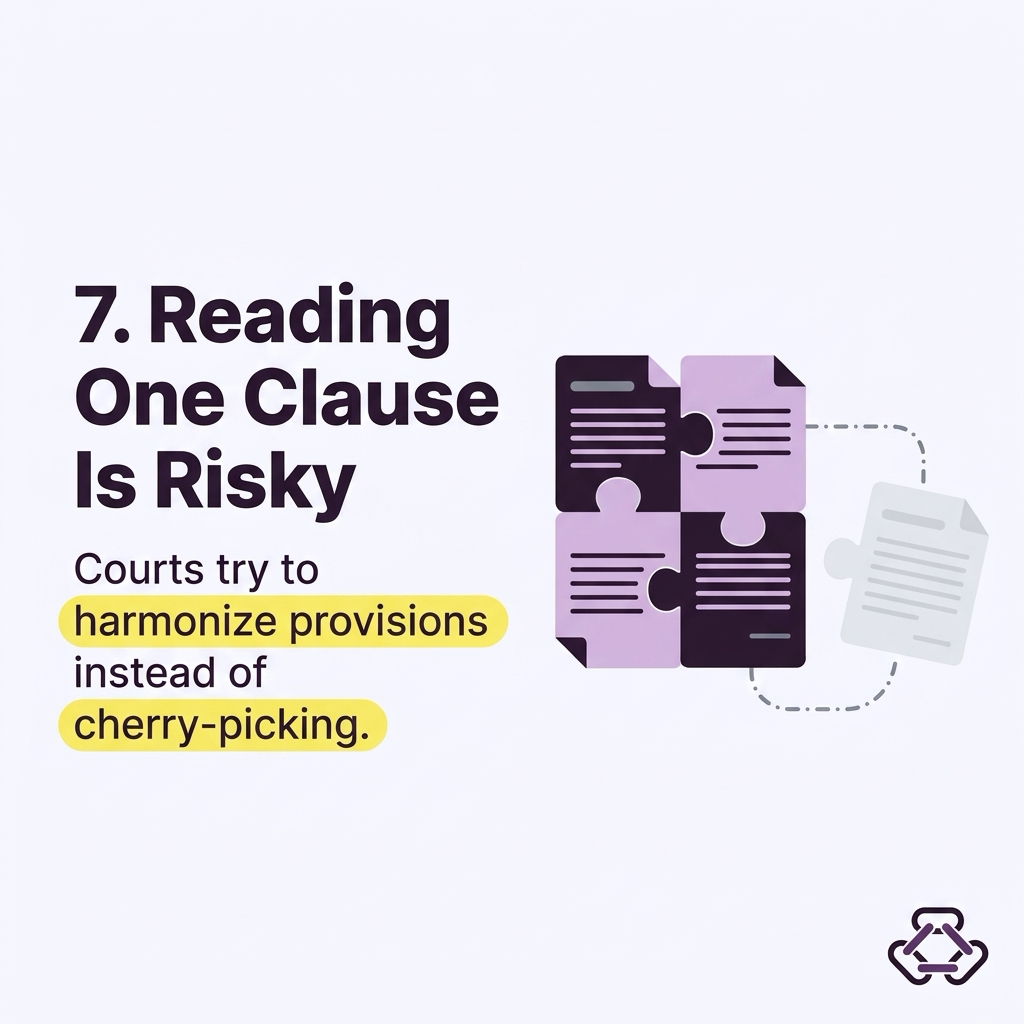
Because cherry-picking one sentence rarely tells the full story.
Courts often try to harmonize provisions instead of letting one clause swallow another. New York’s Court of Appeals has said language should not be read in isolation and that the contract must be considered as a whole (New York State Unified Court System).
That matters in disputes involving:
- notice clauses versus termination clauses
- payment timing versus acceptance procedures
- limitations of liability versus indemnity obligations
- statement-of-work provisions versus boilerplate language
- schedules and exhibits versus the body of the agreement
A business owner may focus on the sentence that feels most favorable. A court may ask how that sentence fits with every other section. Sometimes that broadens a party’s reading. Other times it narrows it sharply.
What Makes These Disputes So Expensive?
Interpretation fights can look narrow at first, but they often expand quickly.
A few reasons:
The Stakes Are Often Hidden In One Clause
A single phrase can affect six or seven figures in payment, delay exposure, exclusivity rights, or indemnity risk.
The Evidence Burden Can Grow Fast
Once ambiguity is alleged, parties may begin collecting drafts, email chains, project records, board materials, invoices, prior contracts, and witness testimony.
Timing Matters
According to the U.S. Courts, the median time from filing to disposition for civil cases was 15.6 months in fiscal year 2025 (U.S. Courts). If the case survives early motions and moves through discovery, the practical burden can increase substantially.
Legal Fees Add Up
The ABA’s 2025 discussion of commercial arbitration cited late-2024 billing data showing litigation partner rates above $1,122 per hour and associate rates at $726 per hour at the largest firms (American Bar Association).
For many companies, that means a “simple meaning dispute” can become a major operational event.
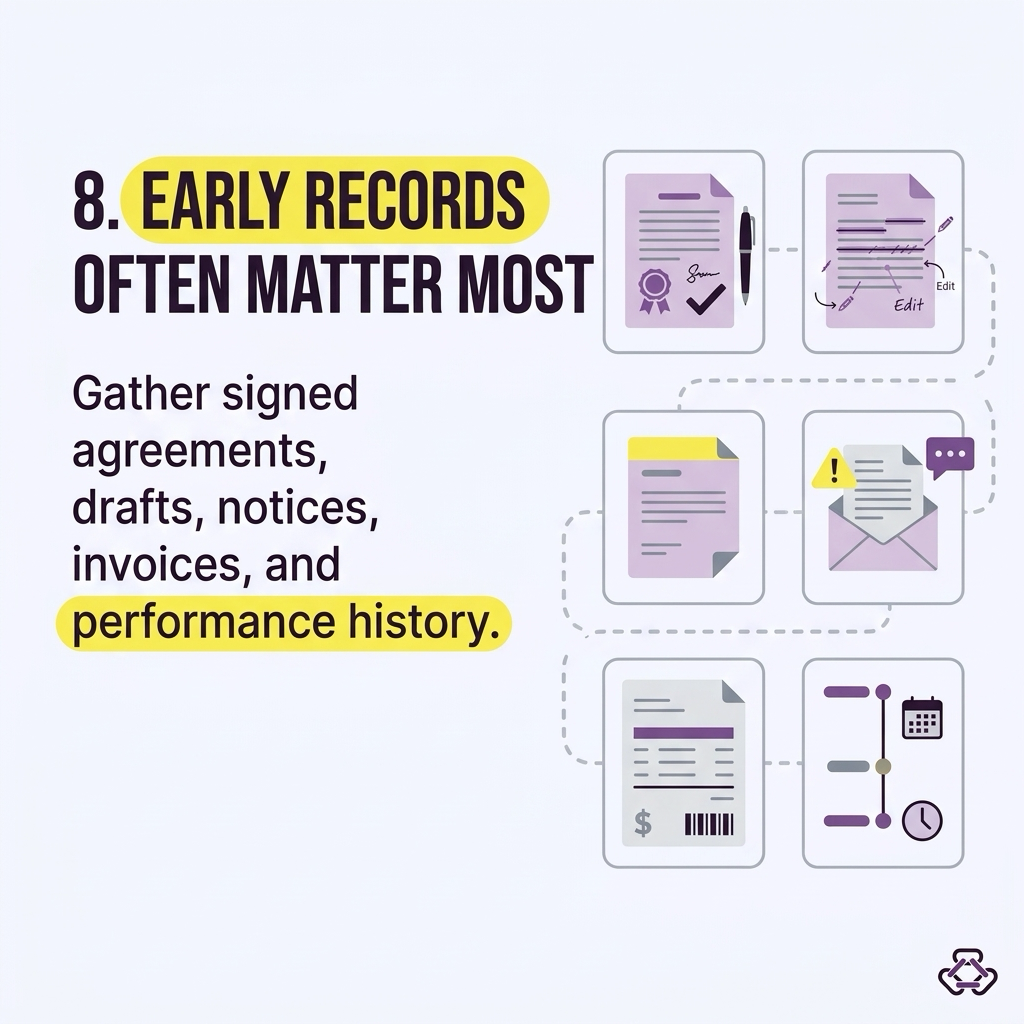
What Should A Business Gather Early In An Interpretation Fight?
While every situation is different, certain categories of information often become important early:
- the final signed agreement and all exhibits
- amendments, change orders, renewals, and side letters
- earlier drafts with tracked changes
- emails discussing disputed terms
- invoices, payment records, and notices
- internal communications showing how the deal was understood
- evidence of how both sides actually performed
- prior contracts between the same parties
- industry standards or trade materials that may explain terminology
In similar disputes, people often discover that the most important evidence is not the dramatic email. It’s the quiet pattern: months of accepted conduct, unchanged invoice practices, repeated waivers, or prior drafts showing language was deliberately added or removed.
If you want a closer look at how those records can shape the dispute, it may help to read more about using drafts, amendments, and performance history when contract meaning is contested.
Can One Side Win Just Because They Drafted The Contract?
Not automatically.
There is a well-known doctrine called contra proferentem, which generally means ambiguity may be construed against the drafter. But courts often treat that more like a tie-breaker than a first move. Many courts first try ordinary interpretation tools — plain meaning, structure, context, and other canons — before turning to a rule against the drafter.
That’s one reason the facts behind the drafting process matter. If both sides negotiated language heavily, the “one-sided drafter” story may become less persuasive. If a clause came from a standard form with little negotiation, that may be framed differently.
Are These Cases Really About Meaning, Or About Leverage?
Often both.
A contract interpretation dispute may look technical on paper, but it usually sits inside a broader commercial conflict. One side may want payment. The other may want leverage in renegotiation. One party may be preserving a customer relationship. The other may be laying groundwork for termination, offset, indemnity, or a future business tort claim.
That commercial backdrop affects everything:
- whether the case settles early
- whether declaratory relief is filed
- whether injunctive issues arise
- whether experts on industry custom are retained
- whether arbitration is preferable to court
- whether a quick business solution is still realistic
This is also where lawyer fit matters. A lawyer with demonstrable experience in highly-similar matters may spot patterns in billing structures, SaaS contracts, supply agreements, franchise documents, construction agreements, licensing deals, or asset purchase agreements that a generalist might approach more slowly.
When Does It Make Sense To Talk With An Attorney?
A lot of businesses wait until the dispute has hardened into a demand letter, lawsuit, or arbitration filing. Sometimes the more useful point is earlier — when the disagreement first shifts from “let’s clarify this” to “we read the contract differently, and money or rights are now at stake.”
Some common moments when businesses start exploring counsel include:
- the other side sends a formal breach notice
- payment is withheld based on a disputed reading of the contract
- a renewal or termination deadline is approaching
- performance is ongoing, but the parties disagree on what the contract requires next
- one side is citing industry custom or prior drafts
- a merger clause or no-oral-modification clause becomes part of the argument
- the dispute may affect operations, customers, financing, or insurance
An attorney might help evaluate whether the language is actually ambiguous, what evidence is likely to matter, whether early motion practice is realistic, and what resolution path fits the business objective.
Why Attorney Selection Matters In Contract Interpretation Cases
Not every commercial litigator handles interpretation fights the same way.
These cases often turn on a mix of doctrine, drafting detail, factual record-building, and industry context. A lawyer who has handled highly-similar disputes may be better positioned to identify:
- which provisions are truly doing the work
- what extrinsic evidence is likely to matter
- how your jurisdiction treats ambiguity
- whether the UCC may apply
- whether the dispute is headed toward litigation, arbitration, or negotiated resolution
- what record is worth building now versus later
That kind of fit is hard to evaluate from advertising copy alone. Many people looking for counsel care less about slogans and more about documented experience, relevant experience, and a match based on objective criteria.
A Short Summary For Beginners
Contract interpretation disputes happen when both sides agree there is a contract but disagree about what it means.
Courts often begin with the text, read the agreement as a whole, and ask whether the language is clear or ambiguous. If ambiguity exists, outside evidence may become important. In commercial cases, that can include course of performance, course of dealing, and usage of trade. The practical stakes can be large, especially when one disputed clause affects payment, termination, indemnity, or exclusivity.
For businesses, these cases are rarely “just semantics.” They are often about money, risk allocation, timing, and leverage. And because litigation can stretch well beyond a year and fee pressure remains high, many companies look for counsel with demonstrable experience in contract disputes involving closely comparable facts, records, and legal issues.
Visit ReferU.AI to get matched with an attorney who has demonstrable experience in cases like yours — for free.