Table of Contents
- How to Gather Evidence of Self-Dealing, Corporate Waste, or Opportunity Diversion
- What Counts As Self-Dealing, Corporate Waste, And Opportunity Diversion?
- Self-Dealing
- Corporate Waste
- Opportunity Diversion
- Why Evidence Matters More Than Accusations
- Step 1: Build A Timeline Before You Build A Theory
- Step 2: Identify The Records That Usually Matter Most
- Corporate Governance Records
- Financial Records
- Communications
- Third-Party Records
- Step 3: Look For Related-Party Transactions Hiding In Plain Sight
- Step 4: Compare The Deal To The Market
- Step 5: Track Whether The Company Was Offered The Opportunity First
- Step 6: Preserve Electronic Evidence Early
- Step 7: Separate Bad Business Judgment From Disloyal Conduct
- Evidence Of A Conflict
- Evidence Of Unfair Process
- Evidence Of Unfair Price Or Harm
- Step 8: Use Public Filings And Indirect Sources
- Step 9: Document Damages The Same Time You Document Misconduct
- Common Mistakes That Can Weaken The Evidence
- When An Attorney’s Investigation Changes The Case
- The Bottom Line

Type
Great Grandchild
Status
Approved
Title (YouTube)
Images Failed (Social)
Images Failed (Social)
Do not index
Parent item
Publish Date (TikTok)
Jan 8, 2027 13:15
Videos Post IDs (Social)
Hashtags (Social)
#LegalAdvice #LegalHelp #BusinessLitigation #BreachFiduciaryDuty
Caption
Caption X
Cover

OG Image

Alt Image Text
Flat vector illustration of gathering evidence for self-dealing and corporate waste, with corporate records, timelines, and insider benefit compared against company assets.
Images

Videos
Publish Date (Social)
Dec 18, 2026 07:30
Scheduled (Social)
Scheduled (Social)
Images Posted (Social)
Images Posted (Social)
Videos Posted (Social)
Videos Posted (Social)
Videos Failed (Social)
Videos Failed (Social)
Featured
Created time
Apr 3, 2026 10:11 PM
Sub-item
Authors
CTA Practice Area (Social)
Business Litigation
TikTok Failed (Social)
TikTok Failed (Social)
Videos Post Links (Social)
YT Auto Captions Removed
TikTok Post Links (Social)
Images Post IDs (Social)
YT Post ID
Video Pending Manual (Social)
TikTok Posted (Social)
TikTok Posted (Social)
TikTok Post IDs (Social)
Video Cover (Social)
Images Post Links (Social)
First Comment (Social)
YT Embedded
Images Delete (Social)
Videos Delete (Social)
Carousel Video URL (Social)
How to Gather Evidence of Self-Dealing, Corporate Waste, or Opportunity Diversion
When company money, assets, or business opportunities seem to be benefiting insiders instead of the business, the hardest part is often separating suspicion from proof. That is especially true in disputes involving managers, officers, directors, majority owners, or partners who control the records and communications.
In general terms, these disputes often turn on documents, timelines, conflicts disclosures, and what the company gave up compared with what an insider gained. Courts often look closely at loyalty, fairness, authorization, and whether the company received real value in return. Delaware law remains especially influential in this area because many businesses are formed there, and its courts frequently shape how fiduciary-duty claims are analyzed across the country. For example, Delaware corporate law recognizes the duty of loyalty, scrutinizes conflicted transactions, and addresses interested-director transactions by statute through DGCL Section 144. The SEC also requires many public companies to disclose certain related-party transactions under Item 404 of Regulation S-K.
If you are trying to understand the larger fiduciary-duty framework first, it may help to start with this overview of loyalty breaches and management misconduct.
In this post you’ll learn how to gather evidence, what kinds of records often matter most, how self-dealing differs from waste and opportunity diversion, and where an attorney may help turn scattered red flags into a structured claim.
Scroll to the bottom for every post in this series.
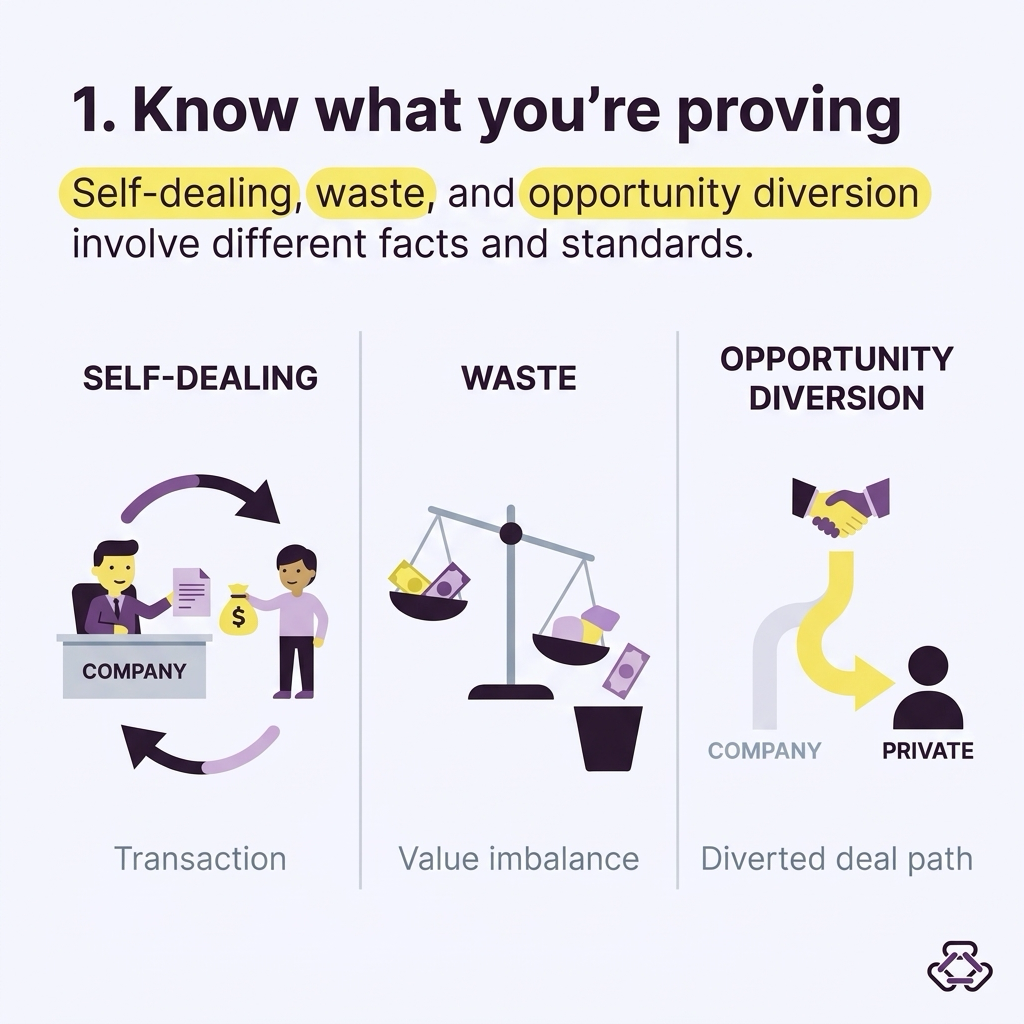
What Counts As Self-Dealing, Corporate Waste, And Opportunity Diversion?
Before collecting records, it helps to know what you are trying to prove.
Self-Dealing
Self-dealing usually refers to a transaction where a fiduciary stands on both sides of the deal or receives a material personal benefit not shared with the company or owners generally. Delaware authorities describe loyalty-based limits on unfair interested transactions, and Delaware courts often require defendants in true self-dealing cases to show entire fairness, including fair dealing and fair price. The Delaware judiciary’s overview of fiduciary duties explains that the duty of loyalty bars directors from causing the corporation to engage in an unfair transaction in which they have an interest, and that self-dealing transactions may be reviewed for entire fairness rather than receiving ordinary deference (Delaware Corporate Law).
Corporate Waste
Corporate waste is narrower and harder to prove. In Delaware, courts have described waste as a transaction so one-sided that no person of ordinary, sound business judgment could view the corporation as receiving adequate value. That standard appears in cases like Saxe v. Brady, and later Delaware decisions repeat that waste is an “onerous” theory because courts generally avoid second-guessing ordinary business decisions absent extreme facts (Gagliardi v. TriFoods).
Opportunity Diversion
Opportunity diversion, often called usurpation of a corporate opportunity, generally involves an officer or director taking for themselves a deal, customer, line of business, acquisition, lease, license, or investment opportunity that belonged to the company or that the company had an interest or expectancy in. Delaware’s classic corporate-opportunity doctrine is associated with Guth v. Loft, and SEC filings often summarize the doctrine in similar terms: whether the corporation could financially exploit the opportunity, whether it was within the company’s line of business, whether the corporation had an interest or expectancy in it, and whether taking it placed the fiduciary in conflict with duties owed to the company (SEC filing summarizing Delaware doctrine).
Why Evidence Matters More Than Accusations
Many business owners can spot unfairness. Fewer can prove it in a way that survives a motion to dismiss, supports emergency relief, or drives settlement value.
A useful way to think about these cases is this: the legal claim often follows the paper trail. Records may show:
- who knew about a conflict,
- when the opportunity first appeared,
- whether the board approved anything,
- whether disinterested decision-makers reviewed it,
- what alternatives existed,
- what the company paid or lost,
- and whether insiders hid the transaction in the books or disclosures.
That is one reason public-company filings can be revealing. SEC rules require disclosure of certain related-person transactions over specified thresholds when a related person has a material interest, and Item 404 also addresses policies and procedures for review, approval, or ratification of related-party transactions (LII’s text of Item 404; SEC staff interpretation).
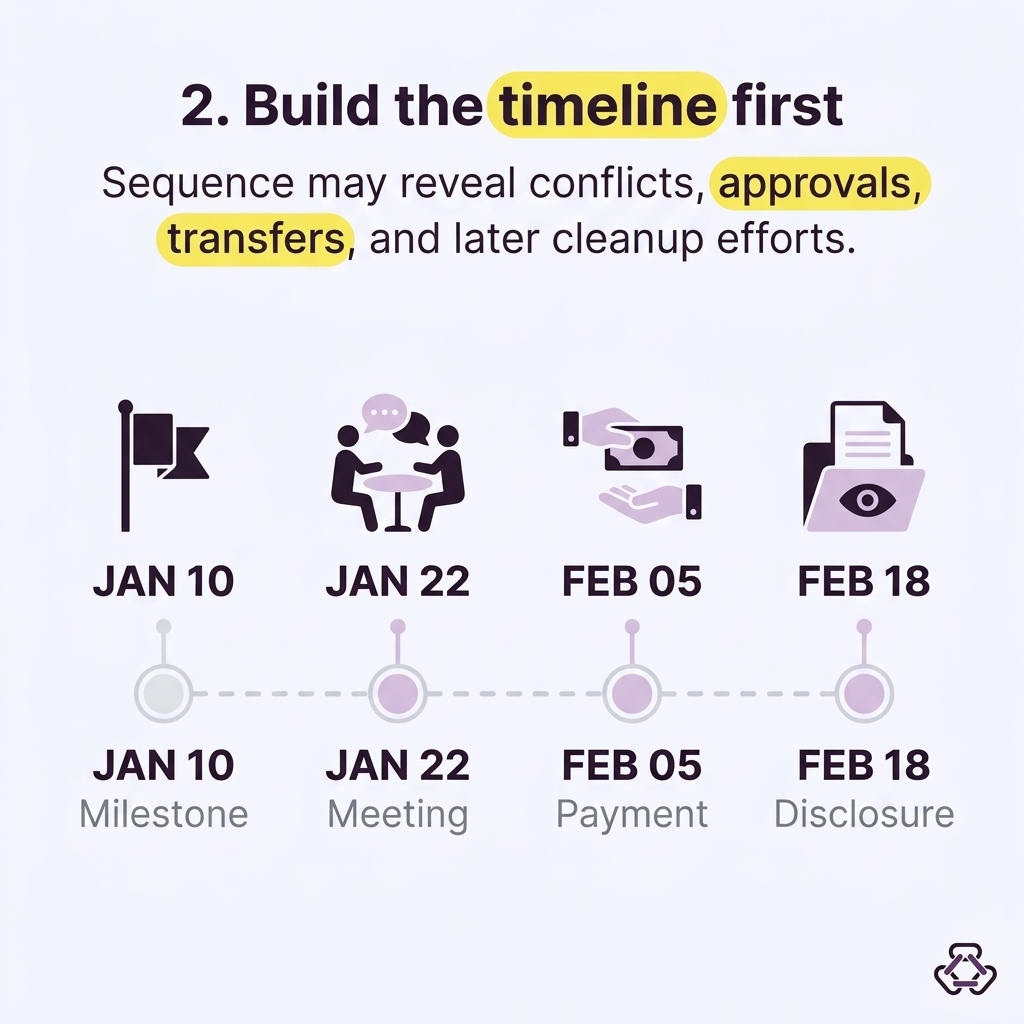
Step 1: Build A Timeline Before You Build A Theory
The first practical step is often a chronology.
That timeline may include:
- formation documents and ownership changes,
- hiring or appointment of officers and directors,
- board and member meetings,
- dates of challenged payments or transfers,
- dates bids, customers, or opportunities first appeared,
- disclosures to the board,
- approvals or abstentions,
- competitor launches by insiders,
- and any later cleanup efforts, amended books, or revised disclosures.
Why does this matter? Because self-dealing and opportunity-diversion cases often hinge on sequence. If an executive first learned about a deal through company channels and then moved it into a personal entity, the timing may matter. If a board approved a transaction only after money had already changed hands, that timing may matter too. And if no one disclosed a relationship until after questions were raised, that can become part of the evidentiary picture.
A simple spreadsheet with columns for date, event, people involved, source document, and open questions can be more useful than a stack of unorganized PDFs.
Step 2: Identify The Records That Usually Matter Most
Not every company record carries the same evidentiary weight. In disputes involving insider misconduct, a few categories tend to matter again and again.
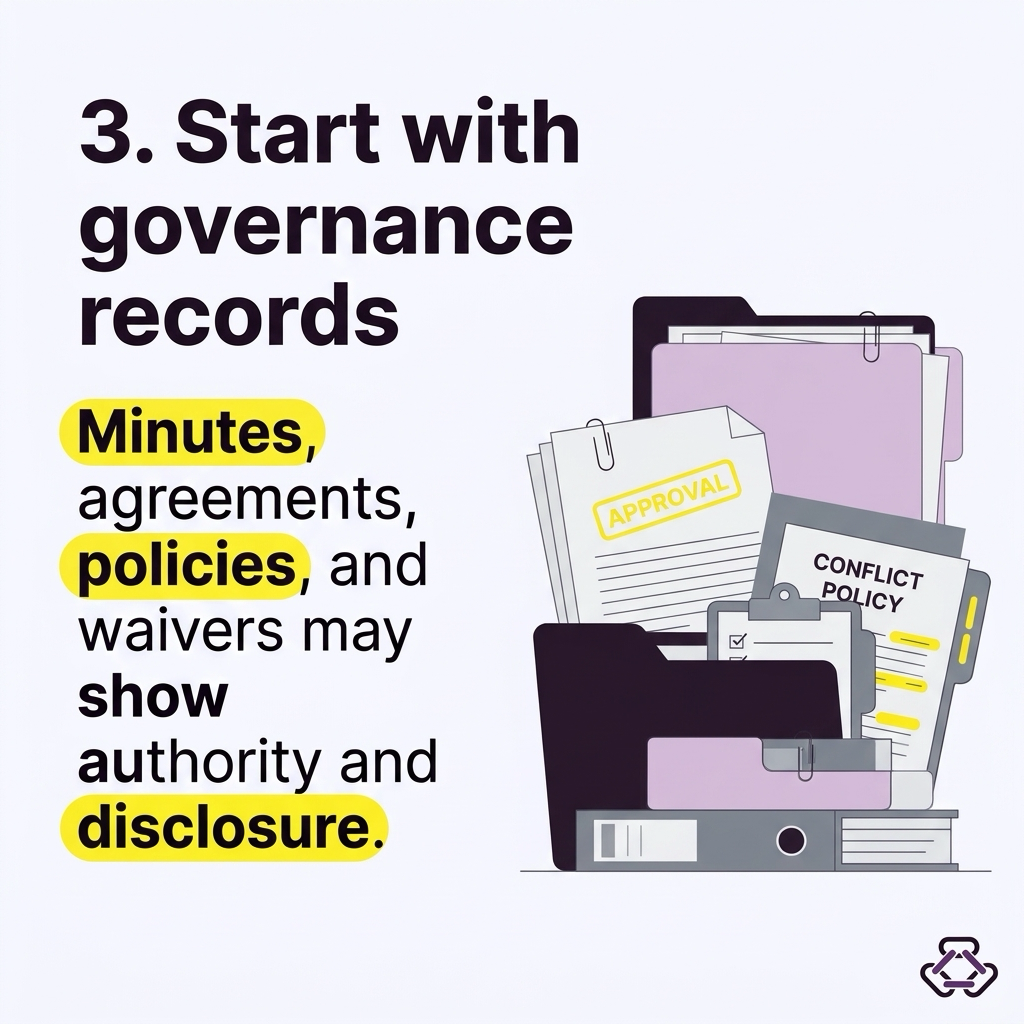
Corporate Governance Records
Start with the records that show who had authority and what procedures applied:
- certificate of incorporation or articles
- bylaws or operating agreement
- shareholder, member, or partnership agreements
- board consents and minutes
- committee minutes
- conflict-of-interest policies
- related-party transaction policies
- corporate opportunity waivers or renunciations, if any
This matters because Delaware law allows corporations, in some circumstances, to renounce interest in specified business opportunities under DGCL Section 122(17). If a company validly renounced a category of opportunities, that can affect how an opportunity-diversion claim is analyzed. Likewise, DGCL Section 144 focuses on disclosure, approval by disinterested directors or stockholders, and fairness when interested transactions are challenged.
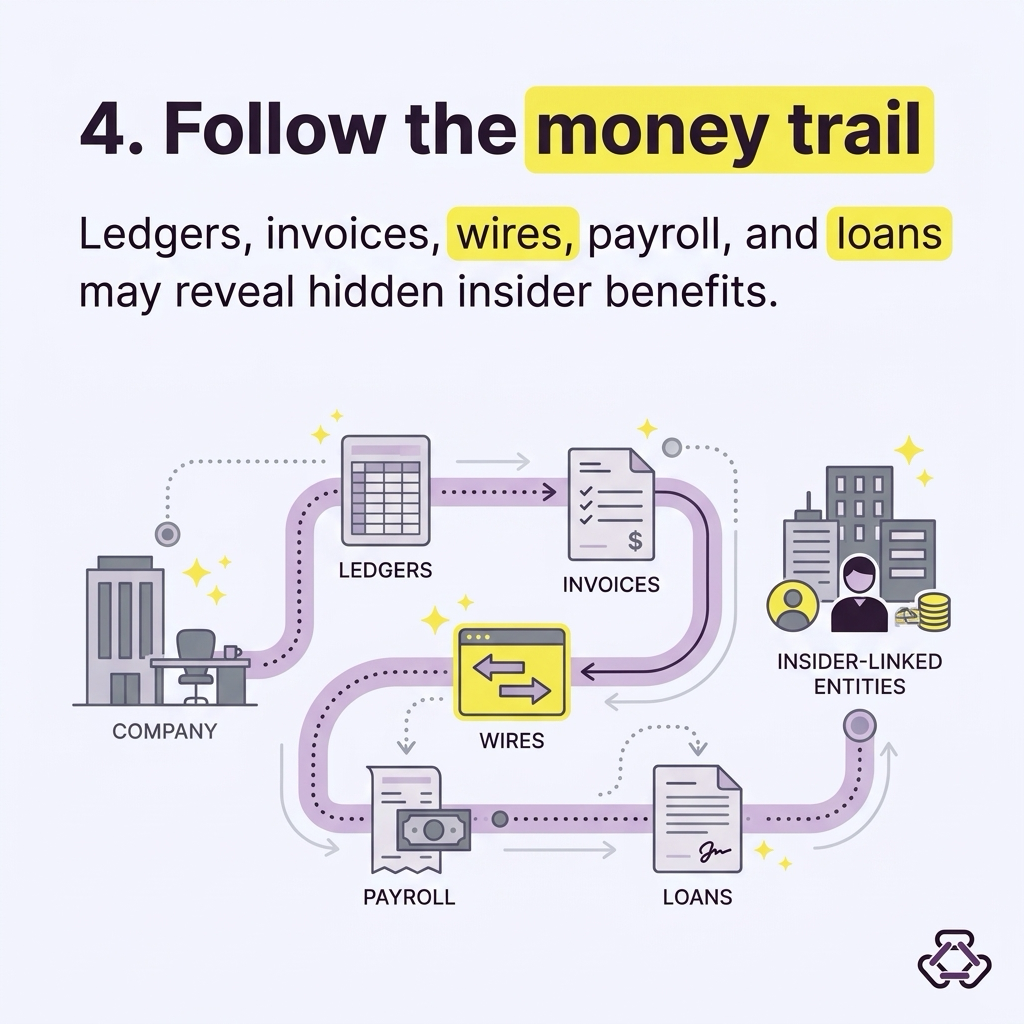
Financial Records
If you suspect waste or hidden insider benefit, financial records are often central:
- general ledger entries
- accounts payable and receivable
- expense reimbursements
- invoices and purchase orders
- wire transfers and ACH records
- payroll records
- consulting agreements
- loans and promissory notes
- valuations and fairness opinions
- cap table records
- tax returns and workpapers
These documents may help show whether payments were real business expenses, disguised distributions, inflated vendor contracts, duplicate reimbursements, below-market leases, sweetheart loans, or no-show consulting arrangements.
Communications
Communications can show intent, knowledge, concealment, and pretext:
- text messages
- Slack, Teams, Signal, or WhatsApp messages
- calendar invites
- drafts with comments
- forwarded deal memos
- discussions with bankers, brokers, or consultants
- instructions to accounting staff
In federal litigation, electronically stored information is part of ordinary discovery, and the federal rules expressly address documents, ESI, and subpoenas for production and testing (Rule 26; Rule 45 notes). If potentially relevant ESI is lost after litigation is reasonably anticipated, Rule 37(e) may become important in disputes about preservation and sanctions, as reflected in the federal rules materials maintained by the U.S. Courts.
Third-Party Records
Sometimes the clearest evidence sits outside the company:
- bank statements from counterparties
- signed engagement letters
- escrow records
- appraisals
- customer communications
- vendor bids
- title records
- UCC filings
- property records
- SEC filings
- government licensing records
- trademark or patent filings
Third-party records can help when insiders control the company’s books or when internal files look incomplete.
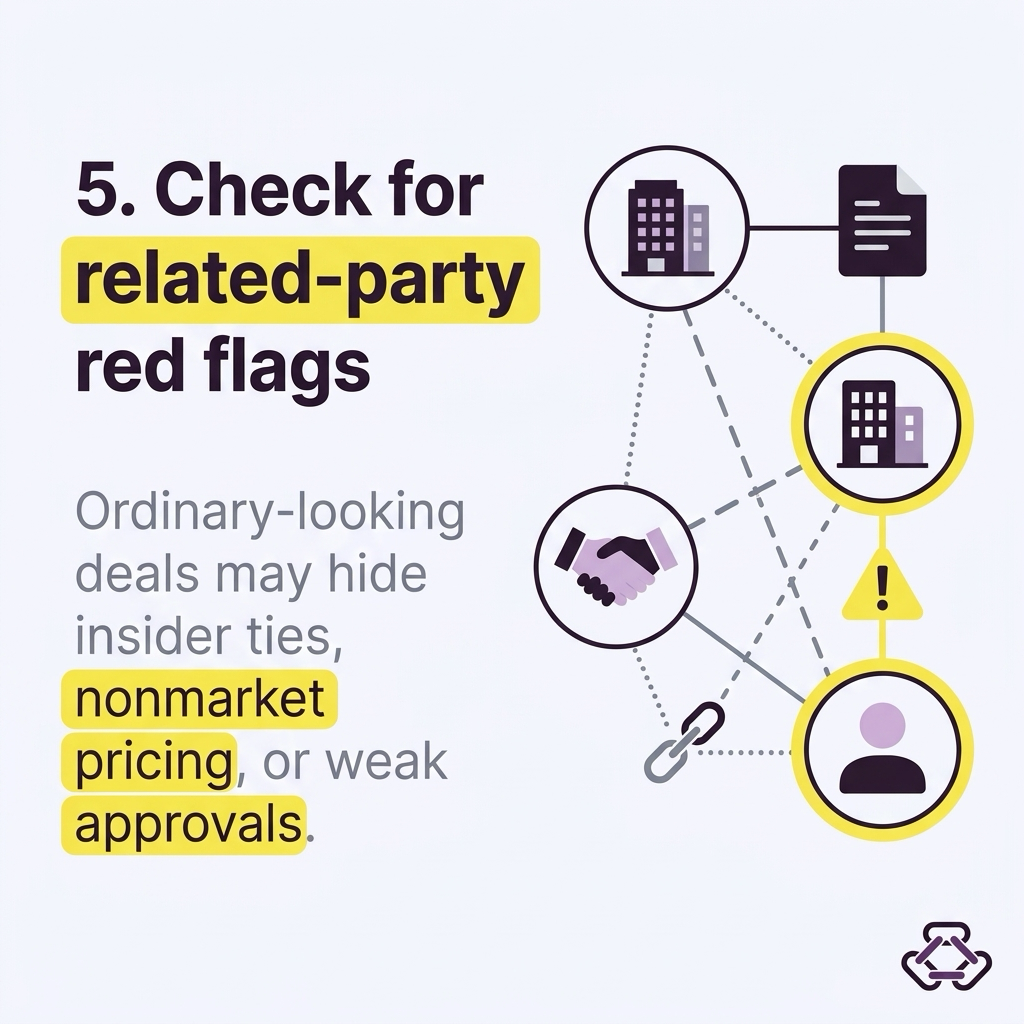
Step 3: Look For Related-Party Transactions Hiding In Plain Sight
Many self-dealing cases start with something that looked ordinary at first:
- a vendor contract,
- a lease,
- a loan,
- a consulting arrangement,
- a recruiting fee,
- an acquisition,
- or a sale of company assets.
The question often becomes: Who was really on the other side of the deal?
Red flags may include:
- payments to entities tied to officers, directors, relatives, or close associates,
- pricing that differs sharply from market terms,
- contracts approved without bids,
- round-dollar invoices,
- missing scopes of work,
- unusual amendments after the fact,
- and payments to entities formed shortly before the transaction.
For public companies, proxy statements and annual filings can offer clues because Item 404 of Regulation S-K requires disclosure of certain transactions involving related persons and material interests (LII). Even in private-company disputes, using that framework can be useful: identify the related person, the amount involved, the nature of the interest, the approval process, and what the company received.
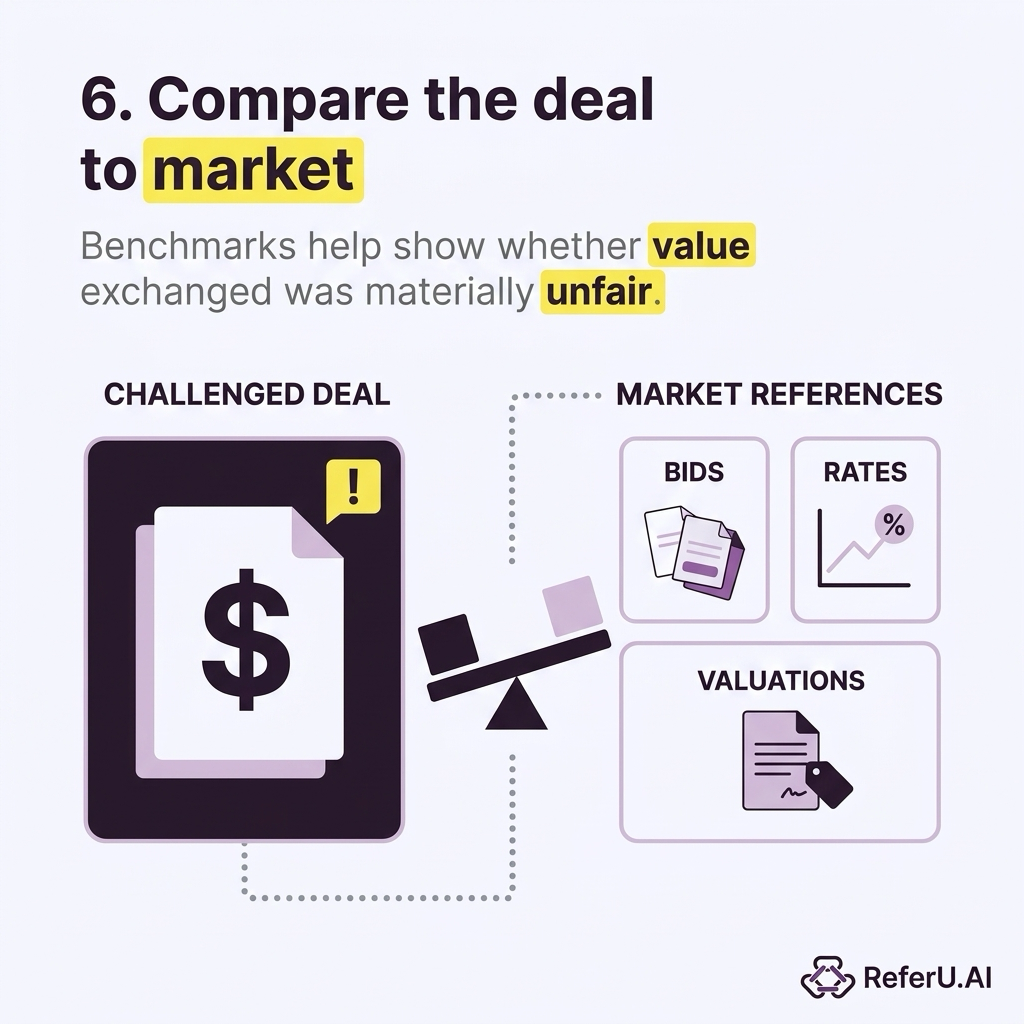
Step 4: Compare The Deal To The Market
A claim of corporate waste or unfair self-dealing often gets stronger when you can compare the challenged deal to real-world benchmarks.
Possible comparison points include:
- other bids the company received,
- comparable vendor pricing,
- market compensation data,
- lease rates for similar properties,
- interest rates on similar loans,
- acquisition multiples in similar transactions,
- and internal budgets or board presentations.
This is where evidence moves from “that felt wrong” to “the company paid materially above market” or “the company sold an asset materially below fair value.”
Waste claims can be difficult because courts generally do not treat every bad deal as waste. Delaware cases explain that waste involves a far more extreme mismatch between what the corporation gave and what it received (Saxe v. Brady; Sample v. Morgan). That means evidence of valuation, alternatives, and lack of consideration can become especially important.
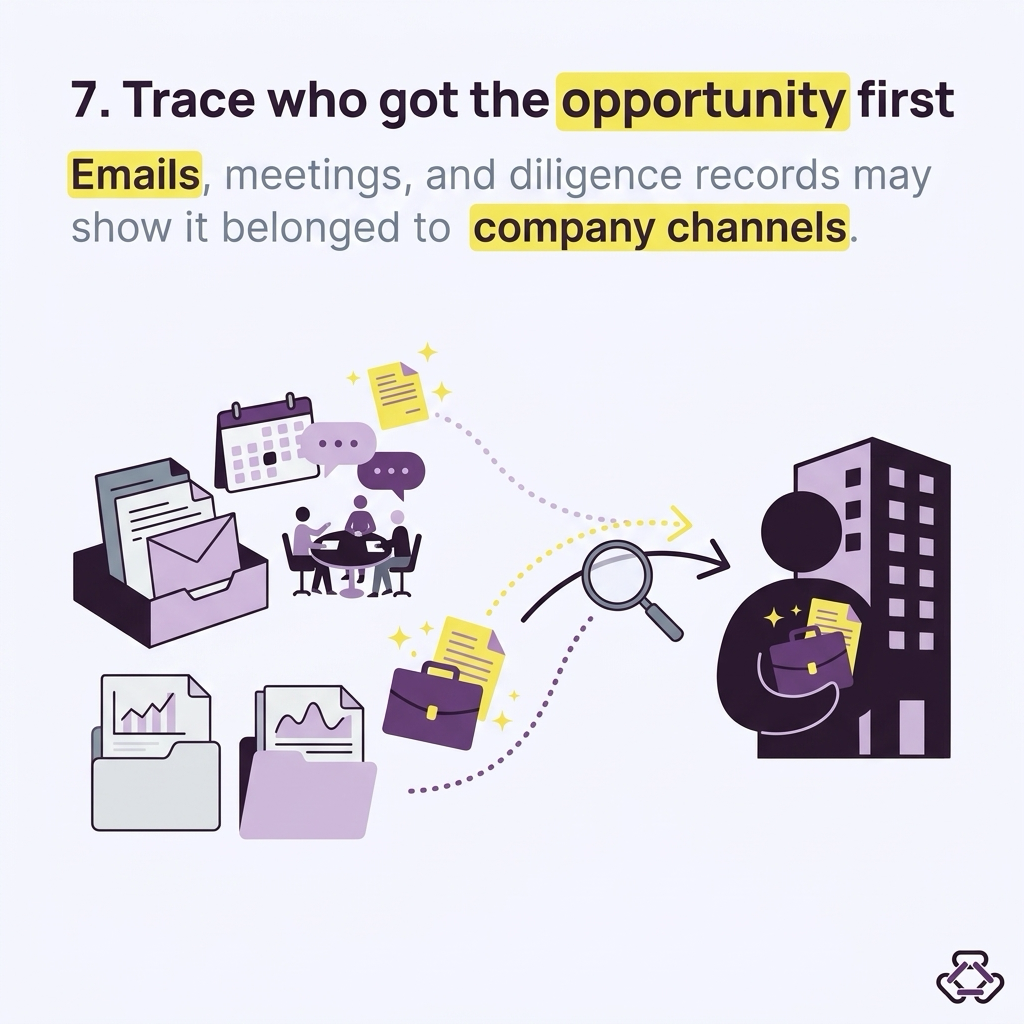
Step 5: Track Whether The Company Was Offered The Opportunity First
In opportunity-diversion cases, a core factual issue is often whether the opportunity came to the fiduciary because of the company role.
Questions that often matter include:
- Who first received the lead?
- Was it sent to a company email?
- Was it discussed at a company meeting?
- Did company staff develop it?
- Did the company spend money evaluating it?
- Did the company have the financial ability to pursue it?
- Was it within the company’s line of business?
- Did the company reasonably expect to pursue similar deals?
That framework tracks long-standing Delaware doctrine on corporate opportunities (Guth v. Loft; Schreiber v. Bryan). In practice, the evidence often includes emails, pitch decks, banker contacts, NDAs, diligence folders, travel records, and calendar entries showing that the opportunity moved through company channels before it ended up elsewhere.
If a separate insider-owned entity later completed the same deal, compare the names, addresses, deal terms, counterparties, and timing. Seemingly small overlaps can matter.
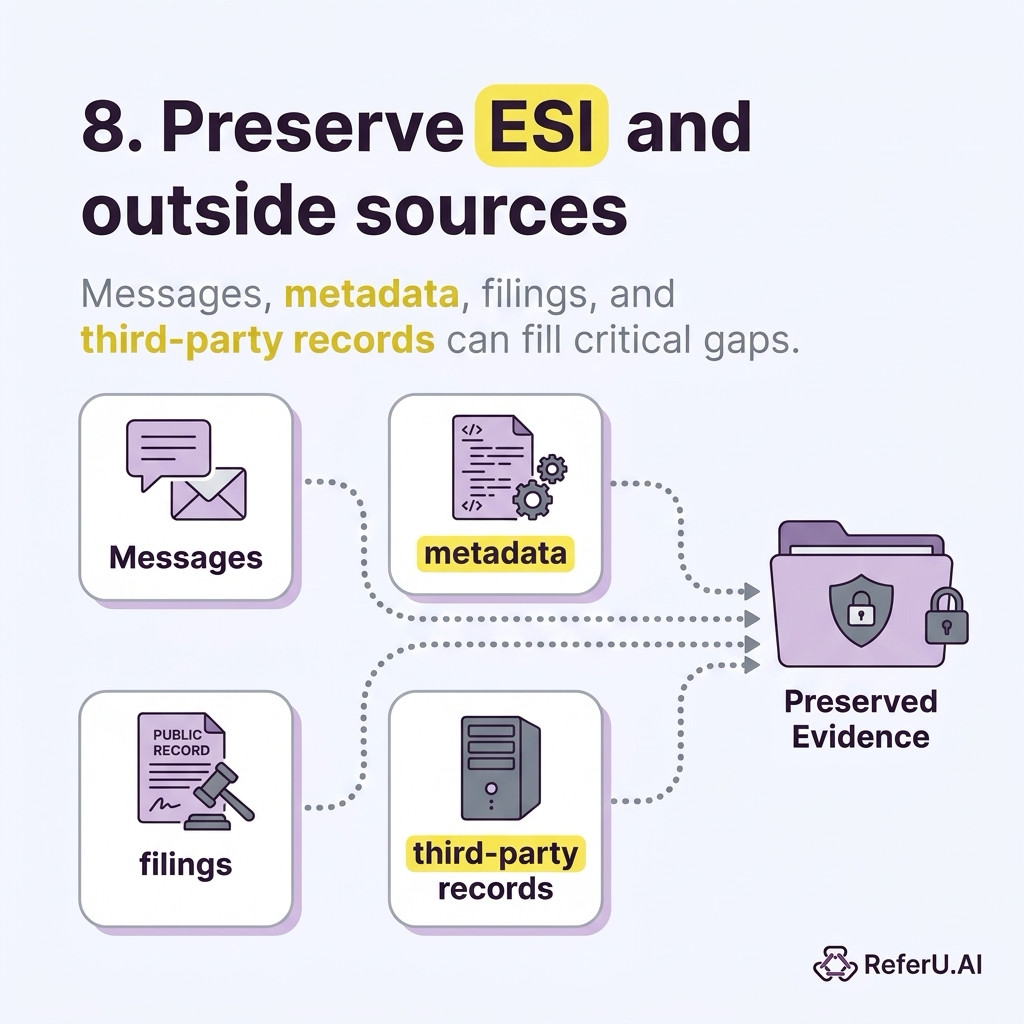
Step 6: Preserve Electronic Evidence Early
One of the most common problems in business disputes is that key evidence lives in phones, inboxes, and cloud apps — and disappears.
In general terms, once litigation is reasonably anticipated, parties often face preservation obligations regarding relevant documents and ESI. Federal discovery rules expressly contemplate the production of ESI, and Rule 37(e) addresses failures to preserve electronically stored information in litigation (U.S. Courts rules page; Rule 26). Government litigation-hold guidance also commonly identifies a broad range of records for preservation, including emails, drafts, data, notes, and unofficial versions when relevant (HHS litigation hold policy).
Practically speaking, evidence preservation may involve:
- stopping auto-delete settings where possible,
- preserving phones and laptops,
- exporting cloud-based messages,
- retaining native files and metadata,
- and documenting where data lives.
An attorney may help structure this process so preservation efforts are broad enough to protect evidence without creating avoidable missteps.
Step 7: Separate Bad Business Judgment From Disloyal Conduct
Not every questionable decision is self-dealing, waste, or diversion.
That distinction matters because courts often protect directors’ ordinary business decisions through deference principles when they act loyally, carefully, and without disabling conflicts. Delaware’s own explanation of business-judgment review emphasizes that courts generally do not second-guess board decisions merely because they turned out poorly, while conflicted or disloyal conduct receives much closer scrutiny (Delaware Corporate Law).
So as you gather evidence, try to sort facts into categories:
Evidence Of A Conflict
- undisclosed ownership in a counterparty
- family relationship with the vendor
- side payments or consulting fees
- personal guarantees or kickbacks
- insider equity in the buyer
Evidence Of Unfair Process
- no independent review
- no disinterested vote
- incomplete disclosures
- rushed approval
- no valuation work
- altered minutes
- missing agenda materials
Evidence Of Unfair Price Or Harm
- overpayment
- underpriced asset sale
- lost revenue
- diverted customer
- company-funded diligence for an insider’s deal
- dilution or transfer of value to insiders
That structure can help reveal whether the issue is simply a failed strategy or something closer to a loyalty breach.
Step 8: Use Public Filings And Indirect Sources
When direct access to internal records is limited, public and semi-public sources can still be useful.
Depending on the business, those sources may include:
- SEC filings
- UCC searches
- secretary of state records
- real property records
- court dockets
- bankruptcy filings
- press releases
- archived webpages
- LinkedIn role histories
- patent and trademark records
A proxy statement may disclose a related-party arrangement that was barely mentioned internally. A newly formed LLC in state records may line up with a diverted opportunity. A UCC filing may show a loan from an insider or affiliate. Court dockets may reveal earlier allegations by other stakeholders involving the same transaction pattern.
These sources rarely tell the whole story by themselves, but they can point you toward the right subpoenas and document requests.
Step 9: Document Damages The Same Time You Document Misconduct
Evidence of wrongdoing matters, but so does evidence of economic harm.
Possible damages categories may include:
- the amount overpaid in a conflicted transaction,
- profits captured by an insider from a diverted opportunity,
- the value of a corporate opportunity the business lost,
- dilution from insider-favorable issuances,
- compensation paid for no meaningful services,
- and costs caused by concealment or cleanup.
Under the federal rules, parties are generally expected to disclose damages computations and the documents supporting them (Rule 26). That means a good evidentiary file often links each damage theory to supporting records from the beginning.
Common Mistakes That Can Weaken The Evidence
Even where misconduct may have occurred, a case can become harder to prove if the evidence is handled poorly.
Common problems include:
- focusing only on motives instead of records,
- collecting screenshots without context,
- failing to preserve metadata,
- overlooking board materials and draft documents,
- ignoring third-party evidence,
- and assuming an unfair result automatically proves waste.
Another issue is tunnel vision. A case that first looks like waste may turn out to be stronger as a self-dealing or opportunity-diversion claim once the relationships and approvals are mapped out.
When An Attorney’s Investigation Changes The Case
A lot of people can identify red flags. Fewer can convert those red flags into admissible evidence, targeted demands, and a litigation strategy that fits the company’s structure.
An attorney handling these matters may help by:
- identifying the right claims and the right plaintiff posture,
- evaluating derivative versus direct issues,
- sending preservation correspondence,
- seeking books-and-records inspection where available,
- drafting focused subpoenas,
- working with forensic accountants,
- tracing affiliate entities,
- and framing the facts around loyalty, fairness, and damages rather than suspicion alone.
That matters because many fiduciary-duty cases rise or fall on how precisely the evidence is assembled. A vague allegation that “management stole from the company” often goes nowhere. A documented chronology showing undisclosed affiliations, non-market pricing, missing approvals, and insider profit can look very different.
The Bottom Line
If you suspect self-dealing, corporate waste, or opportunity diversion, the strongest next step is often not a dramatic accusation. It is a careful record-based investigation.
In general terms, the most useful evidence usually answers a few practical questions: Who benefited? What did the company give up? What was disclosed? Who approved it? Was the process fair? Was the price fair? Did the opportunity belong to the business first?
Those answers usually live in board materials, financial records, communications, third-party documents, and preserved electronic data. When the records are scattered or controlled by the people under scrutiny, attorney-guided investigation can make a major difference in identifying relevant experience, framing the issues, and pursuing the right sources of proof.
Visit ReferU.AI to get matched with an attorney who has demonstrable experience in cases like yours — for free.
