Table of Contents
- Breach of Contract Explained: Material Breach, Damages, Defenses, and Commercial Risk
- What Counts As A Breach Of Contract?
- What Makes A Breach “Material”?
- Common Examples Of Potentially Material Breach
- Why Materiality Matters So Much
- Minor Breach Vs. Material Breach
- What Damages Are Available In A Breach Of Contract Case?
- Expectation Damages
- Reliance Damages
- Incidental And Consequential Damages
- Liquidated Damages
- Specific Performance And Injunctive Relief
- What Usually Limits A Damages Claim?
- Foreseeability
- Causation
- Reasonable Certainty
- Mitigation
- What Defenses Commonly Show Up In Breach Of Contract Cases?
- No Valid Contract Was Formed
- The Plaintiff Breached First
- Substantial Performance
- Waiver, Estoppel, Or Course Of Performance
- Failure To Mitigate
- Statute Of Frauds
- Statute Of Limitations
- Impossibility, Impracticability, And Frustration Of Purpose
- Contractual Defenses Built Into The Agreement
- Why Commercial Risk Often Matters As Much As Legal Merit
- The Main Commercial Risk Categories
- Evidence Risk
- Business Relationship Risk
- Counterclaim Risk
- Collection Risk
- Reputation And Market Risk
- How Businesses Lose Leverage Early
- When A Breach Of Contract Dispute Starts Looking Litigation-Worthy
- How Contract Drafting Shapes Future Breach Claims
- A Practical Way To Think About Breach, Damages, Defenses, And Risk
- 1. What Exactly Was Promised?
- 2. What Exactly Failed?
- 3. How Serious Was The Failure?
- 4. What Is The Full Risk Picture?
- Final Thoughts

Type
Grandchild
Status
Approved
Title (YouTube)
Images Failed (Social)
Images Failed (Social)
Do not index
Publish Date (TikTok)
Jan 12, 2027 08:15
Videos Post IDs (Social)
Hashtags (Social)
#LegalAdvice #LegalHelp #BusinessLitigation #BreachOfContract
Caption
Caption X
Cover

OG Image

Alt Image Text
Flat vector illustration of breach of contract and commercial risk with two business parties, a broken agreement, missed delivery, and legal dispute symbols.
Images

Videos

Publish Date (Social)
Dec 20, 2026 09:00
Scheduled (Social)
Scheduled (Social)
Images Posted (Social)
Images Posted (Social)
Videos Posted (Social)
Videos Posted (Social)
Videos Failed (Social)
Videos Failed (Social)
Featured
Created time
Apr 3, 2026 10:10 PM
Authors
CTA Practice Area (Social)
Business Litigation
TikTok Failed (Social)
TikTok Failed (Social)
Videos Post Links (Social)
YT Auto Captions Removed
TikTok Post Links (Social)
Images Post IDs (Social)
YT Post ID
Video Pending Manual (Social)
TikTok Posted (Social)
TikTok Posted (Social)
TikTok Post IDs (Social)
Video Cover (Social)

Images Post Links (Social)
First Comment (Social)
YT Embedded
YT Embedded
Images Delete (Social)
Videos Delete (Social)
Carousel Video URL (Social)
Breach of Contract Explained: Material Breach, Damages, Defenses, and Commercial Risk
Contracts are supposed to create predictability. In business, they often do—until a deadline slips, goods arrive late, payment never shows up, or one side starts acting like the deal no longer matters. That is where breach of contract disputes begin.
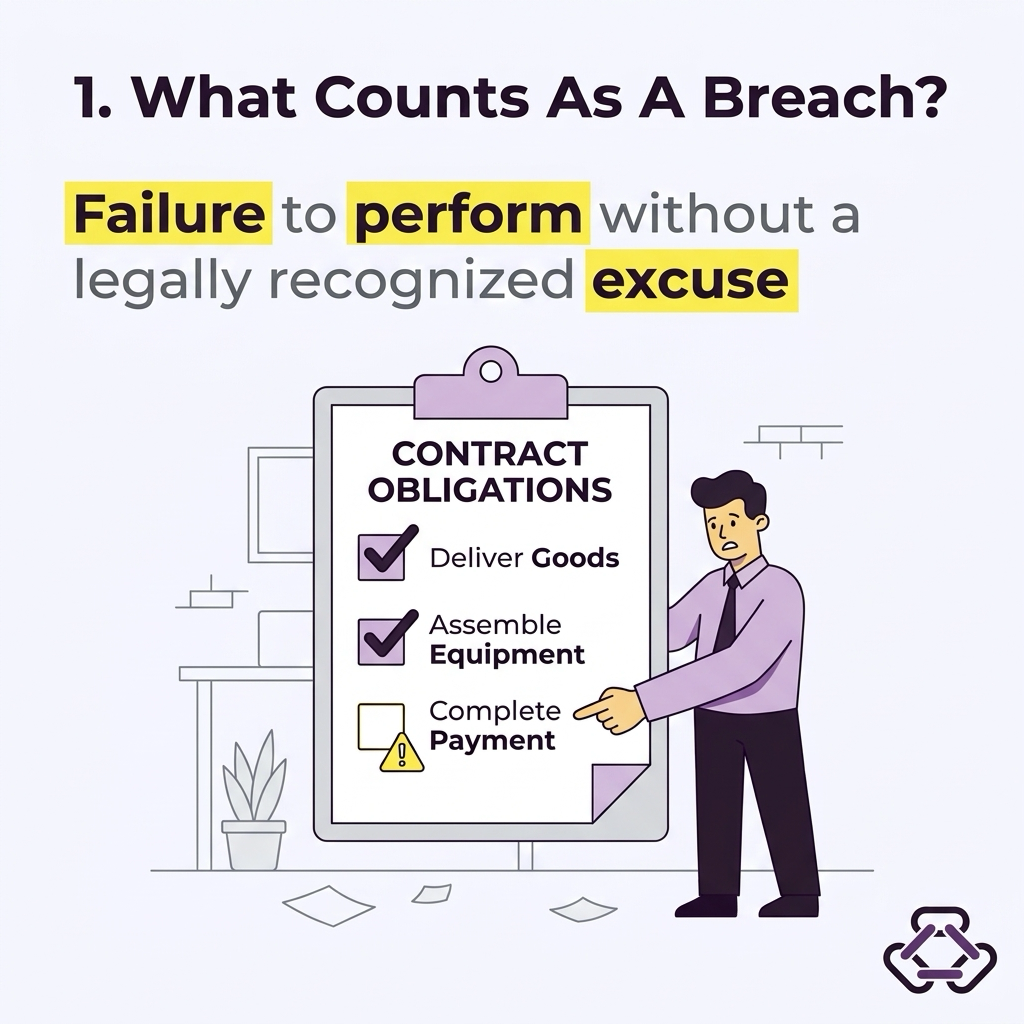
Breach of contract is the failure to perform a contractual obligation without a legally recognized excuse. In commercial settings, that simple definition can turn into complicated questions: Was the breach serious enough to justify termination? What damages are actually recoverable? What defenses may reduce or defeat the claim? And how much business risk comes from waiting too long, overreacting, or documenting the dispute poorly?
This post breaks those issues down in plain language. You’ll learn how courts often think about material breach, the main categories of contract damages, several common defenses, and the practical commercial risk that can make even a legally valid claim expensive. If you want broader context on how these disputes fit into larger business lawsuits, our guide to business and contract litigation issues companies face when deals unravel gives the bigger picture.
Scroll to the bottom for every post in this series.
What Counts As A Breach Of Contract?
In general terms, a breach happens when one party does not do what the contract requires. That may involve:
- failing to deliver goods or services,
- delivering nonconforming goods,
- refusing to pay,
- missing deadlines,
- violating exclusivity, confidentiality, or notice provisions,
- terminating without contractual grounds, or
- clearly stating in advance that performance will not happen.
Under the Uniform Commercial Code, which governs many sales-of-goods transactions, an anticipatory repudiation can arise when a party repudiates performance not yet due and the loss substantially impairs the value of the contract to the other side. The aggrieved party may wait for performance for a commercially reasonable time or pursue remedies. Cornell’s Legal Information Institute explains that rule here.
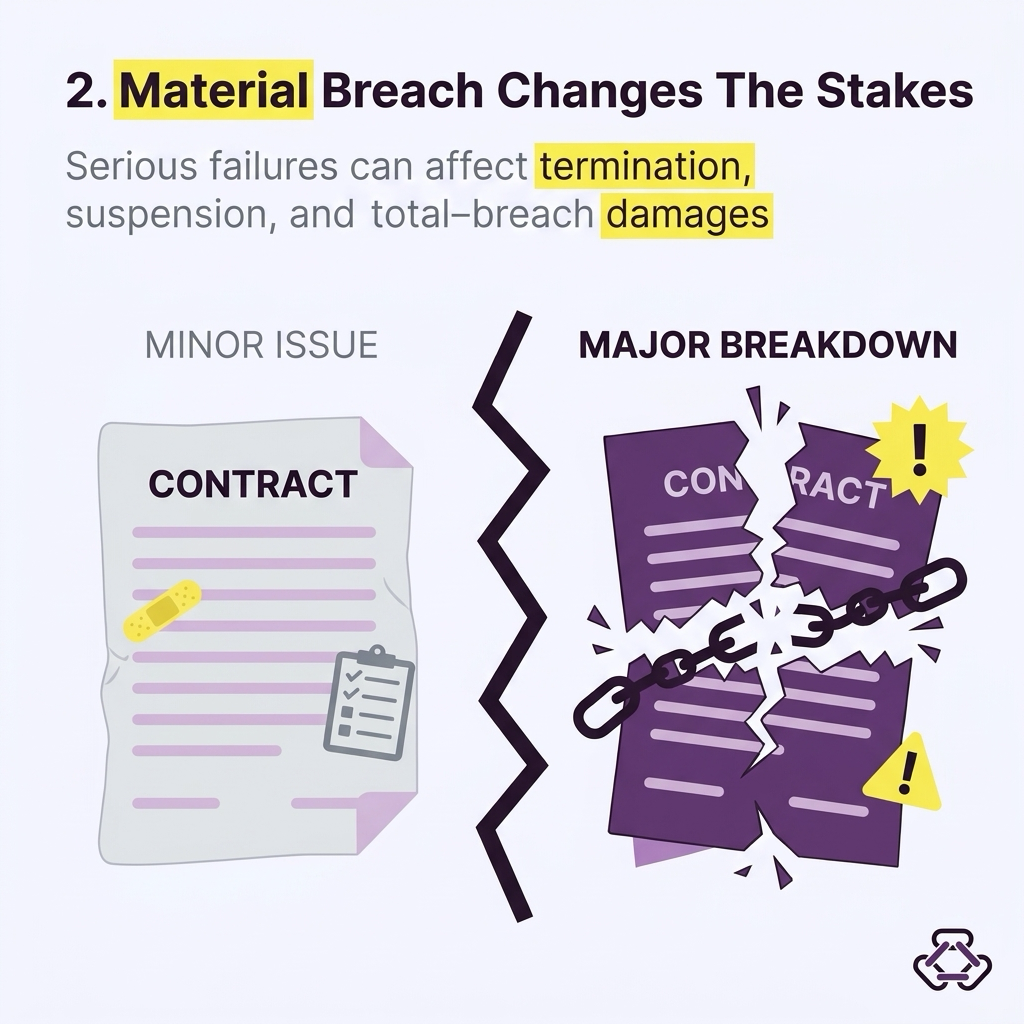
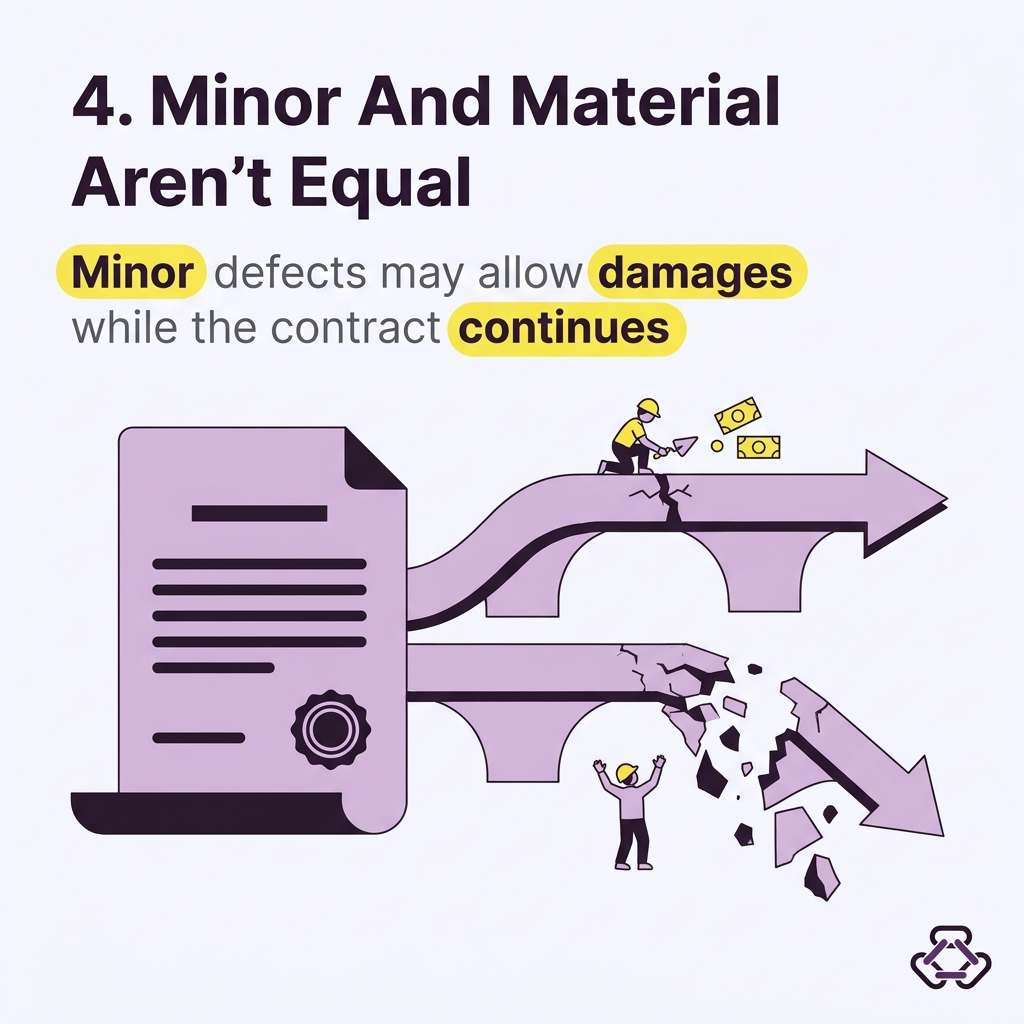
Not every broken promise creates the same legal consequences. Some breaches are minor and may lead to a damages claim while the contract stays in place. Others are serious enough that the non-breaching party may treat the agreement as effectively broken. If you want a more basic walkthrough before getting into the deeper issues, this overview of how broken business agreements turn into lawsuits can be a helpful starting point.
What Makes A Breach “Material”?
The phrase material breach comes up constantly because it often affects remedies, leverage, and termination rights.
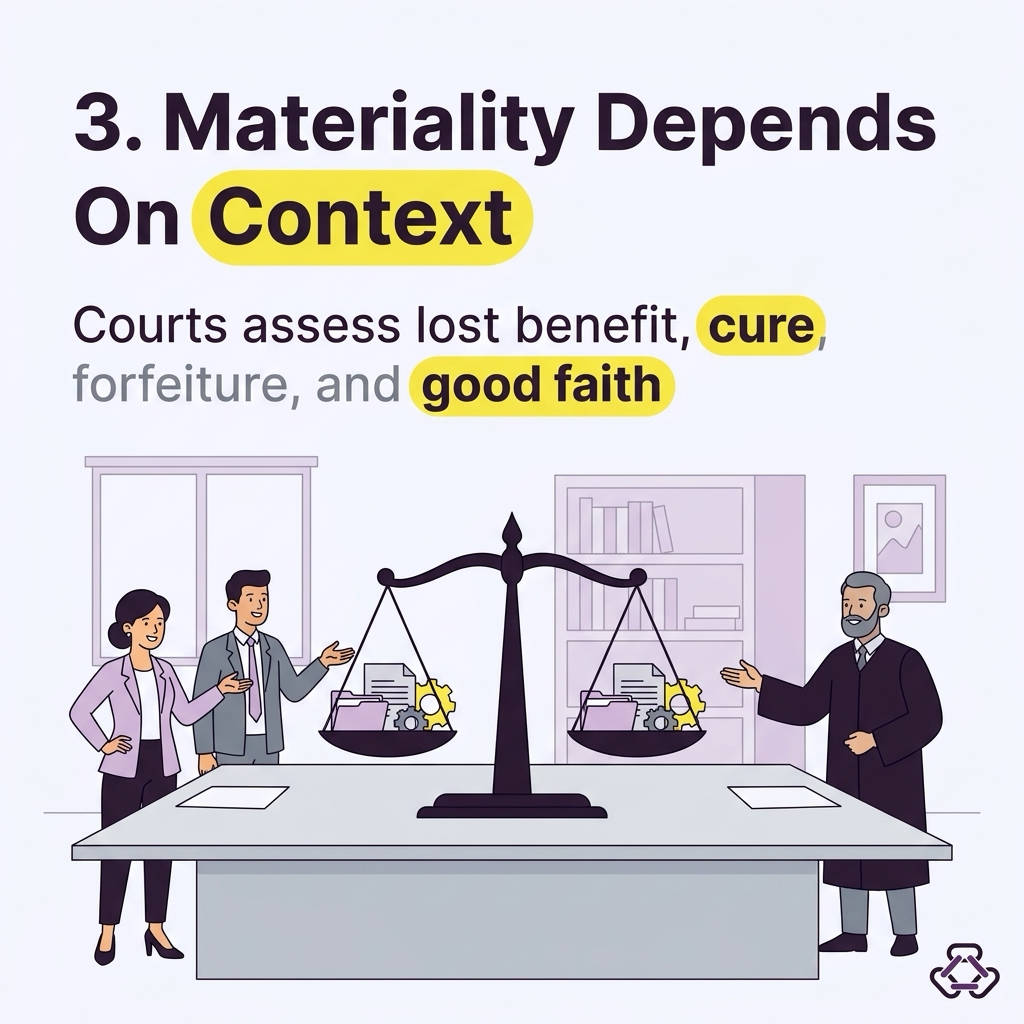
A material breach is generally a failure serious enough to go to the essence of the deal. Courts often look at factors summarized in Restatement (Second) of Contracts § 241, including the extent to which the injured party is deprived of the benefit reasonably expected, whether that loss can be adequately compensated, the extent of forfeiture to the breaching party, the likelihood the breaching party will cure, and whether the conduct reflects good faith. An accessible summary of Section 241 appears in the H2O/Open Casebook reproduction of the Restatement text.
That usually means materiality is context-driven, not mechanical. A one-day delay may be trivial in one supply relationship and devastating in another. A missing signature may be fixable. A refusal to deliver the core product, transfer key assets, or make a major payment may look very different.
Common Examples Of Potentially Material Breach
A breach is more likely to be treated as material when it involves:
- nonpayment of a major amount due,
- failure to deliver the central product or service,
- shipment of unusable or substantially nonconforming goods,
- repeated failures after notice and opportunities to cure,
- violation of exclusivity or non-disclosure obligations that undermines the deal,
- repudiation before performance is due,
- missing a deadline that was essential to the transaction.
Why Materiality Matters So Much
Materiality can affect whether a party may:
- suspend its own performance,
- terminate the contract,
- sue immediately,
- seek damages for total breach rather than partial breach,
- argue that it was excused from further performance.
That is one reason businesses often underestimate how risky it can be to declare default too quickly. If a court later views the breach as minor rather than material, the party that terminated first may end up defending its own conduct. If you are sorting through that question, this article on whether the breach is serious enough to justify a lawsuit goes deeper into that decision point.
Minor Breach Vs. Material Breach
The line between a minor breach and a material breach is often where commercial disputes become expensive.
A minor breach usually means the essential purpose of the contract was still substantially performed, even though one party did not comply perfectly. In common-law contracts, courts often use a substantial-performance framework rather than requiring perfection in every detail.
A material breach usually suggests the non-breaching party did not receive the benefit of the bargain in any meaningful commercial sense.
For sales of goods, the analysis may differ because Article 2 of the UCC includes the famous perfect tender concept, while also limiting and qualifying that concept through acceptance, cure, and other doctrines. That is part of why goods disputes can look different from service, construction, licensing, or partnership-related agreements.
In real-world disputes, parties often fight over labels because the label can shift leverage. “Minor” may support a narrower damages theory. “Material” may support termination, replacement sourcing, rescission arguments, or emergency motion practice.
What Damages Are Available In A Breach Of Contract Case?
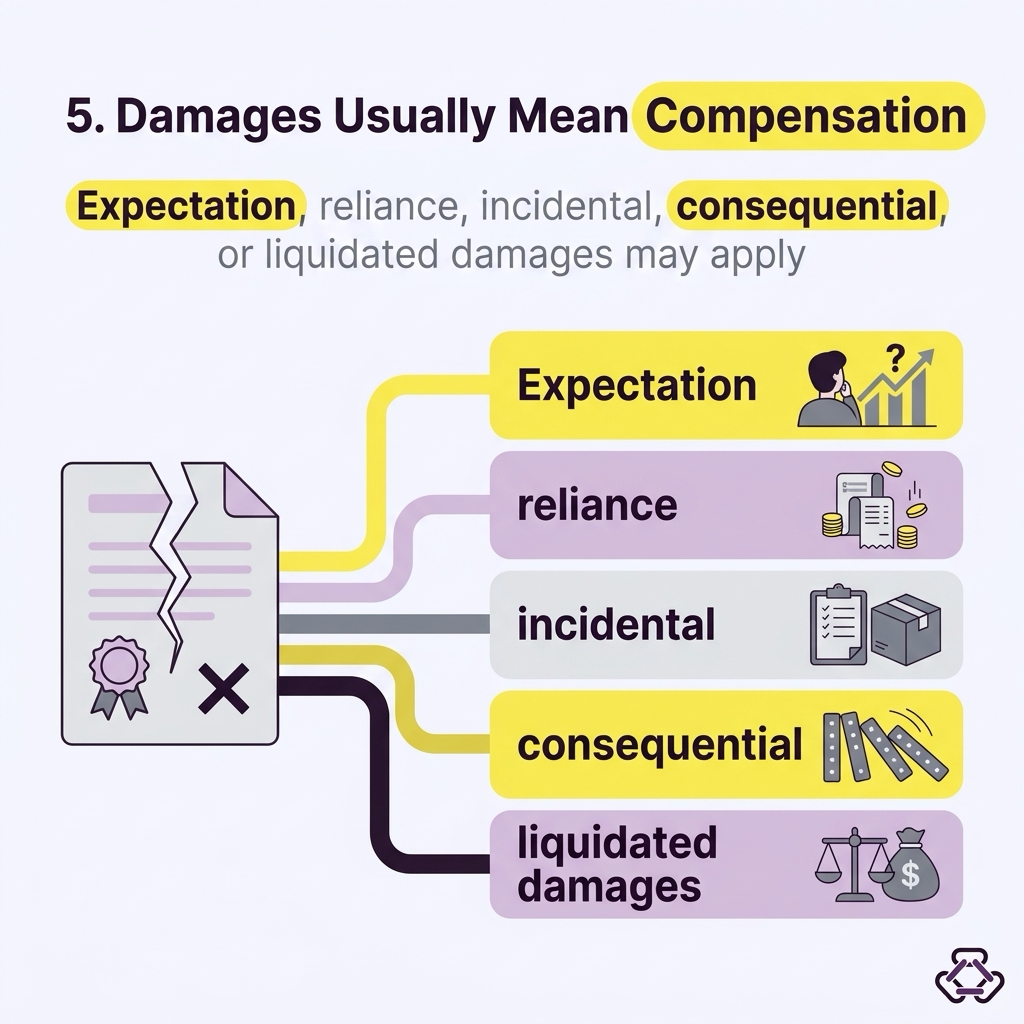
The headline goal of contract damages is usually compensation, not punishment. Courts often frame the remedy as putting the non-breaching party in the position it would have occupied had the contract been performed, subject to limits such as causation, foreseeability, certainty, and mitigation. Contract-law teaching materials and casebooks commonly describe this as the expectation interest, including Open Casebook’s remedies discussion.
Expectation Damages
These are the classic contract damages. They try to capture the value of the promised performance.
Examples may include:
- unpaid contract amounts,
- the cost difference between the agreed deal and substitute performance,
- lost profits in some cases,
- repair or completion costs,
- diminished value.
For goods contracts, the UCC expressly provides important buyer remedies. If the seller repudiates or fails to deliver, a buyer may “cover” by making a reasonable substitute purchase and recover the difference between the cost of cover and the contract price, plus allowable incidental or consequential damages, minus expenses saved. Cornell LII’s UCC discussion on repudiation and New York’s codified UCC § 2-715 on incidental and consequential damages reflect those principles.
Reliance Damages
Reliance damages focus on losses incurred because a party relied on the contract.
Examples may include:
- startup costs,
- mobilization costs,
- vendor onboarding expenses,
- payroll or staffing tied to expected performance,
- preparatory expenditures.
These damages often matter when lost profits are disputed, uncertain, or hard to prove.
Incidental And Consequential Damages
Incidental damages often involve costs of dealing with the breach itself—storage, inspection, transportation, substitute arrangements, and related transaction costs.
Consequential damages are the downstream business harms resulting from the breach, such as lost resale opportunities, production shutdown losses, or customer penalties, if those losses were foreseeable and otherwise recoverable. UCC § 2-715 describes buyers’ incidental and consequential damages in goods cases, including losses resulting from requirements and needs the seller had reason to know at contracting and that could not reasonably be prevented by cover or otherwise. That rule is summarized in the statute here.
Consequential damages are often heavily negotiated in commercial contracts because they can dwarf the base contract value.
Liquidated Damages
Some contracts set a predetermined amount payable upon breach. Courts often examine whether the amount was a reasonable estimate of anticipated or actual harm rather than a penalty. A concise overview of that general framework appears in Faegre Drinker’s discussion of liquidated-damages provisions.
Specific Performance And Injunctive Relief
Money is not always enough. In some disputes—unique goods, confidential information, business-sale covenants, or irreplaceable assets—a party may seek equitable relief instead of, or alongside, damages.
That remedy is less common in routine payment disputes, but it becomes much more important where timing, exclusivity, or competitive harm matters.
What Usually Limits A Damages Claim?
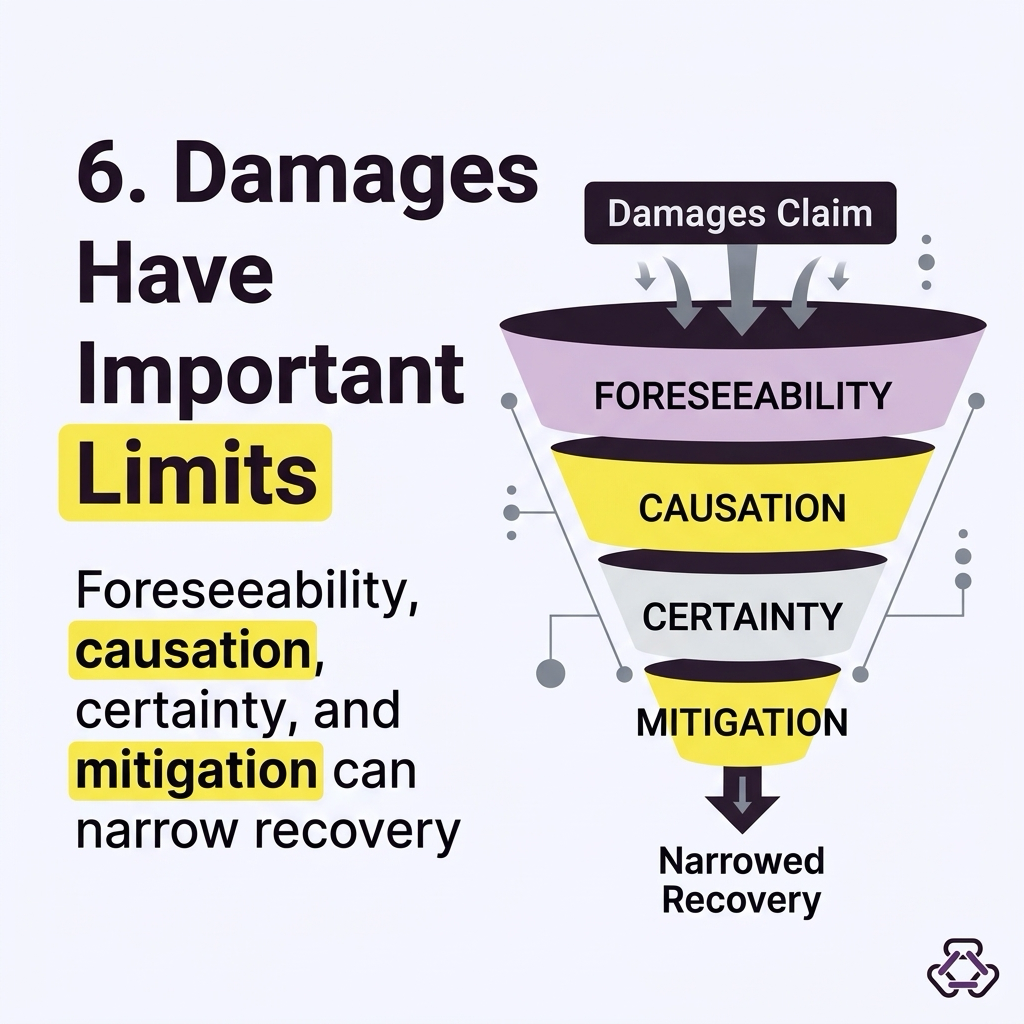
Even where a breach is clear, the amount recoverable may be much narrower than the injured party expects.
Foreseeability
Contract damages are generally limited to losses that were foreseeable at the time of contracting. In practical terms, that often leads to disputes over what each side knew about production schedules, resale plans, dependency on a single supplier, or downstream customer commitments.
Causation
The claimant usually has to connect the breach to the loss with more than speculation. If revenue dropped for five different reasons, the defendant may argue the contract issue was only one small piece.
Reasonable Certainty
Lost profits claims often rise or fall on proof. Courts frequently look for historical performance, reliable projections, market evidence, contemporaneous records, and a coherent damages model.
Mitigation
The injured party is generally expected to take reasonable steps to reduce avoidable losses. That can include sourcing replacement goods, preserving projects, limiting accrual of late fees, or finding substitute business. The mitigation principle is widely recognized in contract remedies discussions, including the Open Casebook remedies materials.
In commercial terms, a party that waits too long to replace a supplier, lets inventory sit idle, or ignores a chance to reduce losses may face arguments that some damages were avoidable.
What Defenses Commonly Show Up In Breach Of Contract Cases?
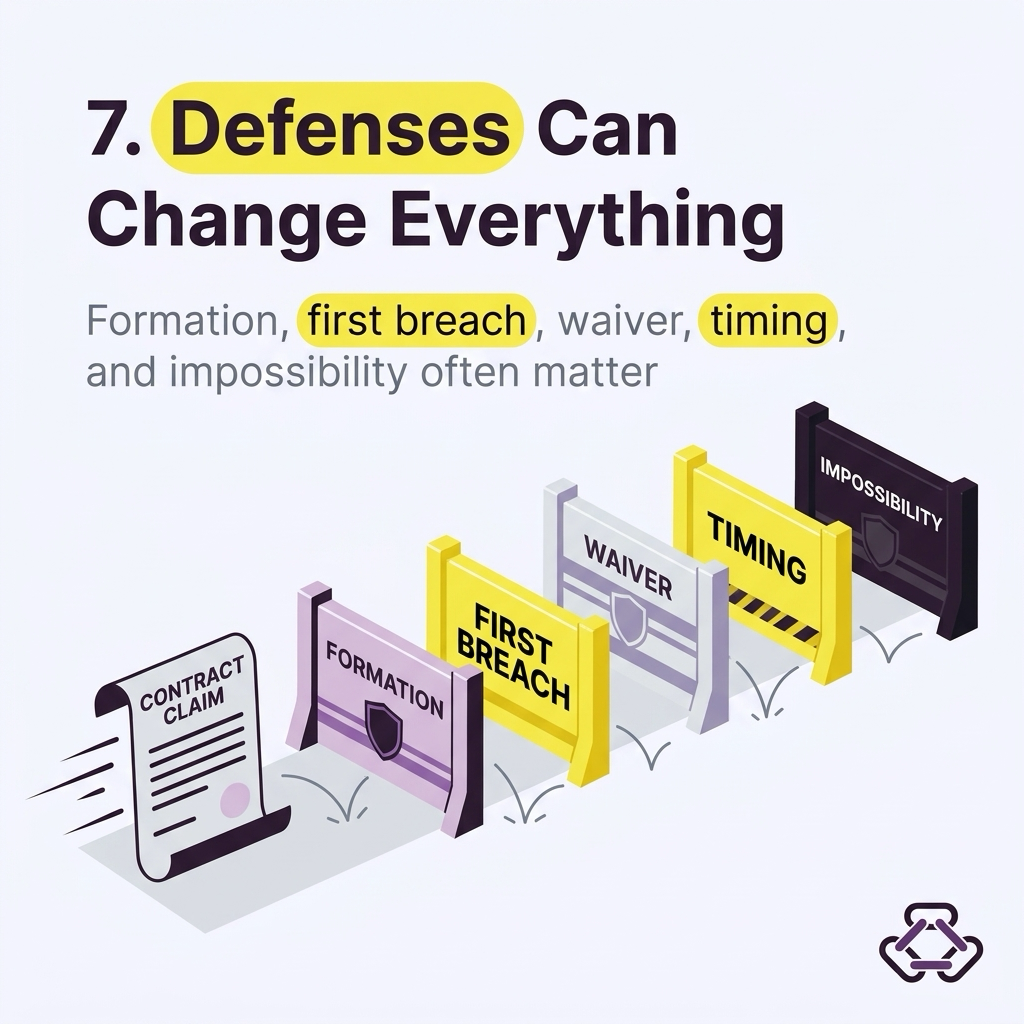
Many contract disputes are not really about whether something went wrong. They are about whether the claimant can prove an enforceable contract, full performance, materiality, damages, and timely filing. Common defenses include the following.
No Valid Contract Was Formed
A defendant may argue there was no enforceable agreement because of missing essential terms, lack of assent, lack of authority, indefiniteness, or failed conditions precedent.
The Plaintiff Breached First
This is one of the most common commercial defenses. If the claimant materially breached first, the defendant may argue its own performance was excused.
Substantial Performance
Where performance was largely completed and only minor defects remain, a defendant may argue the breach was partial rather than material.
Waiver, Estoppel, Or Course Of Performance
If one side repeatedly accepted late payment, approved deviations, or kept performing without objection, the other side may argue the claimant waived strict compliance or altered the contract through conduct.
Failure To Mitigate
As noted above, recoverable losses may be reduced if the claimant did not act reasonably after the breach.
Statute Of Frauds
Some agreements require a writing to be enforceable. For sales of goods of $500 or more, UCC § 2-201 contains a statute-of-frauds rule, subject to exceptions. The codified rule is summarized here. State law variations can matter a great deal.
Statute Of Limitations
Even a strong claim may fail if filed too late. Limitations periods vary by jurisdiction and claim type, and contracts sometimes contain shorter contractual limitations periods.
Impossibility, Impracticability, And Frustration Of Purpose
These defenses come up when events outside the parties’ control fundamentally disrupt performance or the value of the deal. Cornell LII explains commercial frustration as applying when an unforeseeable event destroys the agreement’s principal purpose, while distinguishing it from impossibility and impracticability. That overview is here.
Contractual Defenses Built Into The Agreement
A contract may itself include defenses or limits, such as:
- force majeure clauses,
- cure periods,
- notice requirements,
- limitation-of-liability provisions,
- exclusive-remedy clauses,
- liquidated-damages clauses,
- forum-selection or arbitration provisions.
For businesses, many of the most important defenses are hiding in the contract language long before a lawsuit is filed.
Why Commercial Risk Often Matters As Much As Legal Merit
A breach of contract dispute is not only a legal question. It is also a business-risk problem.
A company may be legally right and still face expensive outcomes because of timing, proof issues, collectability problems, operational disruption, or counterclaims. Federal courts continue to see a meaningful volume of contract litigation. According to the Judiciary’s published table for U.S. district courts, 31,372 contract actions were commenced in the 12-month period reflected in the 2024 table. The federal table is available from the U.S. Courts here. That number does not capture the full universe of state-court commercial contract disputes, where many business cases are filed.
The Main Commercial Risk Categories
Evidence Risk
Contract cases are won and lost through documents: final agreements, amendments, purchase orders, change requests, invoices, notices, delivery records, QA logs, text messages, and email threads. If the file is disorganized, proof gets harder and settlement leverage often weakens. This guide on getting contracts, emails, invoices, and performance records in order before the dispute grows focuses on that practical side.
Business Relationship Risk
Sometimes the real question is not “Can we sue?” but “What happens to the customer, supplier, project, or distribution channel if we do?” Preserving leverage while keeping optionality often matters.
Counterclaim Risk
The other side may respond with its own breach theory, fraud allegations, chargeback claims, offset defenses, or business tort counterclaims. A simple receivables case can turn into a broader commercial lawsuit very quickly.
Collection Risk
A judgment is not always the end of the problem. If the defendant is insolvent, heavily leveraged, dissolving, or moving assets, the economics of litigation may change dramatically.
Reputation And Market Risk
Certain disputes affect vendor credibility, investor confidence, financing relationships, or customer retention. That is particularly true in industries where missed deadlines and supply interruptions ripple outward.
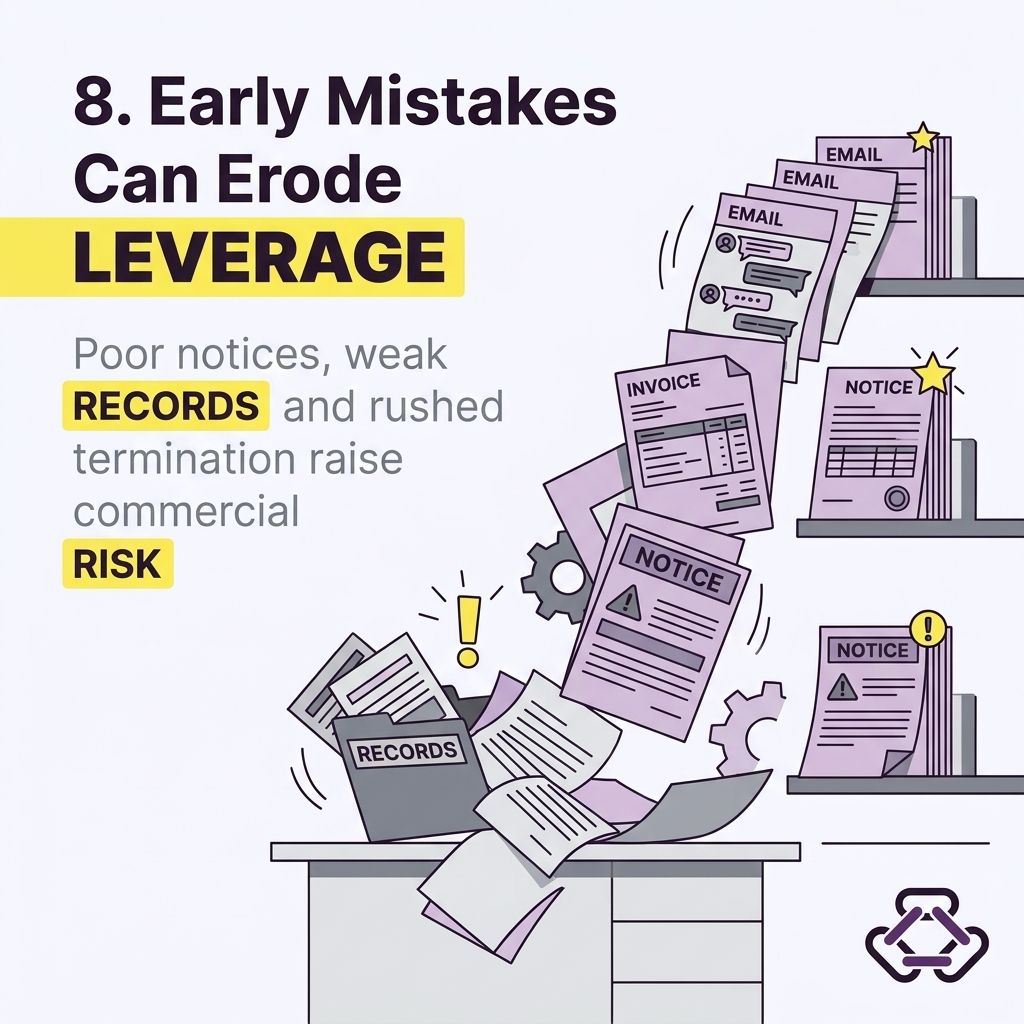
How Businesses Lose Leverage Early
A surprising number of contract cases become harder because of avoidable early mistakes, not because the legal theory was weak.
Common leverage-damaging moves include:
- sending emotional accusations instead of precise notices,
- terminating before confirming whether the breach is material,
- continuing performance without reserving rights,
- failing to follow contractual notice procedures,
- deleting or failing to preserve key records,
- making admissions in email,
- waiting too long to source replacements or calculate losses.
If that sounds familiar, this roundup of early contract-dispute mistakes that tend to reduce leverage covers the problem in more detail.
When A Breach Of Contract Dispute Starts Looking Litigation-Worthy
Not every breach becomes a lawsuit. But certain patterns often signal growing litigation exposure:
- a large unpaid balance,
- a denied or ignored cure demand,
- substitute performance at materially higher cost,
- supply interruption affecting customer commitments,
- repeated nonperformance across multiple milestones,
- disputed termination rights,
- significant downstream losses,
- records showing the other side knew the risk and pressed ahead anyway.
At that stage, business leaders often have the same practical questions: How strong is the documentation? Are damages provable? Did we preserve our own defenses? What forum controls? What does the contract say about fees, venue, arbitration, or exclusive remedies? This article collecting the questions businesses usually ask before filing a contract case may help frame that analysis.
How Contract Drafting Shapes Future Breach Claims
Many breach disputes are really drafting disputes in disguise. Commercial risk often turns on whether the agreement clearly addressed:
- material breach definitions,
- cure rights,
- delivery deadlines,
- milestone acceptance procedures,
- documentation requirements,
- change-order mechanics,
- limitation of liability,
- consequential-damages exclusions,
- indemnity,
- attorneys’ fees,
- governing law,
- venue and dispute-resolution clauses.
For example, a contract that labels certain failures as material may improve clarity, but even then litigation can still arise over notice, cure, waiver, and interpretation. Likewise, a consequential-damages waiver may narrow exposure dramatically, but parties often still fight over whether a claimed loss is truly consequential, direct, or a disguised completion cost.
A Practical Way To Think About Breach, Damages, Defenses, And Risk
A useful commercial framework is to ask four questions:
1. What Exactly Was Promised?
Start with the signed contract, amendments, incorporated documents, purchase orders, and performance history.
2. What Exactly Failed?
Was it nonpayment, delay, defective performance, repudiation, nonconforming goods, or wrongful termination?
3. How Serious Was The Failure?
Did it deprive the business of the core benefit of the bargain, or was it a fixable deviation?
4. What Is The Full Risk Picture?
That includes provable damages, defenses, mitigation, collectability, reputational effects, and operational fallout.
That broader framing often matters more than a narrow “breach or no breach” debate.
Final Thoughts
Breach of contract disputes often look simple from a distance: one side promised, one side failed, money is owed. In practice, the hard questions usually involve materiality, damages, defenses, and commercial risk. A business may have a legitimate grievance but still face difficult issues around proof, causation, mitigation, contractual limitations, and the consequences of its own response.
For companies dealing with a serious contract breakdown, one of the most important variables is often attorney fit. In these cases, documented experience with highly similar matters, industry-specific agreements, and the relevant procedural posture can make a meaningful difference in how risk is evaluated and presented.
Visit ReferU.AI to get matched with an attorney who has demonstrable experience in cases like yours — for free.


