Table of Contents
- How to Wind Down a Business Without Creating New Litigation Problems
- Why Business Closures Often Trigger New Lawsuits
- 1. Start With Formal Authority To Shut Down
- 2. Separate “Stopping Operations” From “Dissolving The Entity”
- 3. Build A Creditor Plan Before Money Starts Moving
- 4. Treat Contracts As Litigation Files Waiting To Happen
- 5. Handle Employees With Extra Care
- 6. Preserve Records Before Anybody Starts “Cleaning Up”
- 7. File Final Tax Returns And Close Accounts The Right Way
- 8. Be Careful With Asset Sales, IP Transfers, And Customer Lists
- 9. Don’t Forget Data Security On The Way Out
- 10. Document The Wind-Down Like Someone Will Read It In Court
- 11. Know When A Wind-Down Is Drifting Into Bankruptcy Territory
- 12. Use Counsel Early Enough To Prevent The Preventable
- A Short Summary

Type
Great Grandchild
Status
Approved
Title (YouTube)
Images Failed (Social)
Images Failed (Social)
Do not index
Parent item
Publish Date (TikTok)
Jan 1, 2027 13:15
Videos Post IDs (Social)
Hashtags (Social)
#LegalAdvice #LegalHelp #BusinessLitigation #BusinessDissolution
Caption
Caption X
Cover

OG Image

Alt Image Text
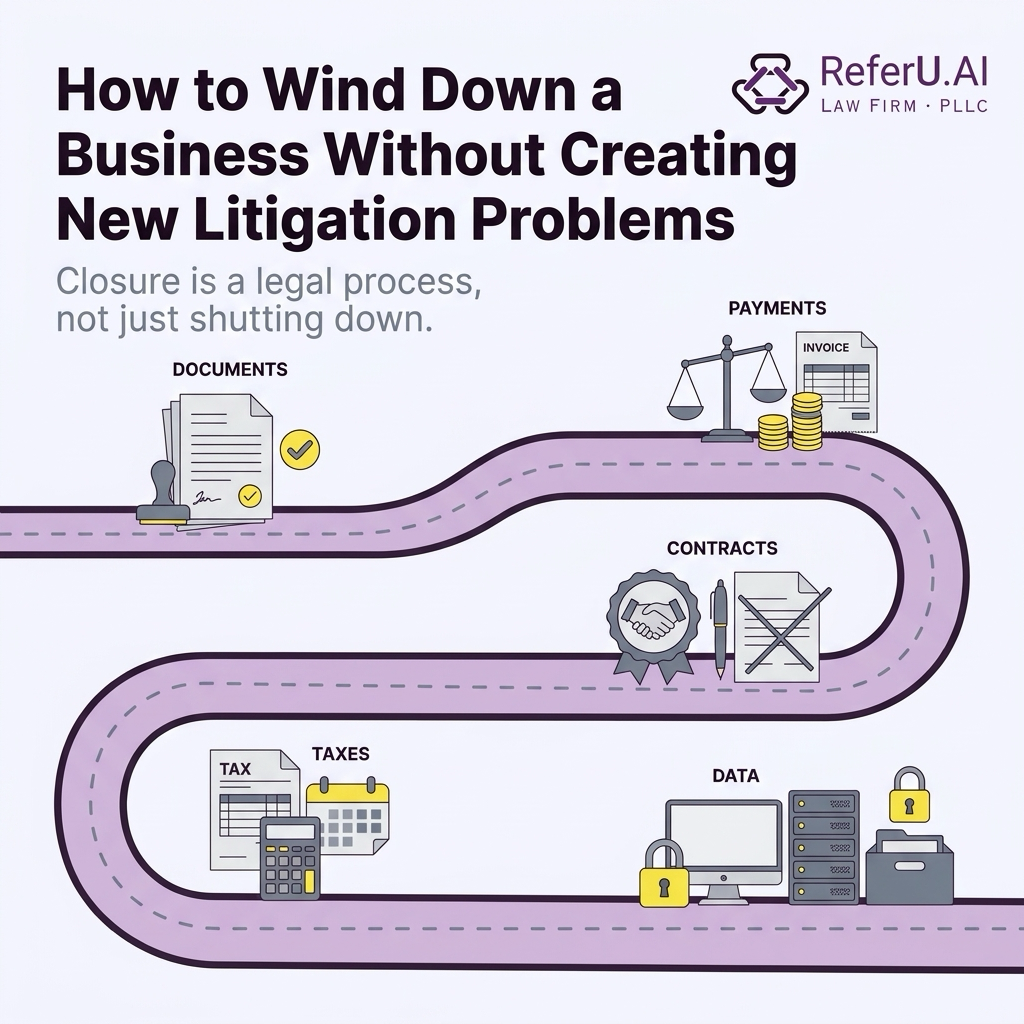
Flat vector illustration of winding down a business without creating new litigation problems, showing legal documents, final filings, creditor and employee obligations, and risk management steps.
Images

Videos
Publish Date (Social)
Dec 13, 2026 14:30
Scheduled (Social)
Scheduled (Social)
Images Posted (Social)
Images Posted (Social)
Videos Posted (Social)
Videos Posted (Social)
Videos Failed (Social)
Videos Failed (Social)
Featured
Created time
Apr 3, 2026 10:14 PM
Sub-item
Authors
CTA Practice Area (Social)
Business Litigation
TikTok Failed (Social)
TikTok Failed (Social)
Videos Post Links (Social)
YT Auto Captions Removed
TikTok Post Links (Social)
Images Post IDs (Social)
YT Post ID
Video Pending Manual (Social)
TikTok Posted (Social)
TikTok Posted (Social)
TikTok Post IDs (Social)
Video Cover (Social)
Images Post Links (Social)
First Comment (Social)
YT Embedded
Images Delete (Social)
Videos Delete (Social)
Carousel Video URL (Social)
How to Wind Down a Business Without Creating New Litigation Problems
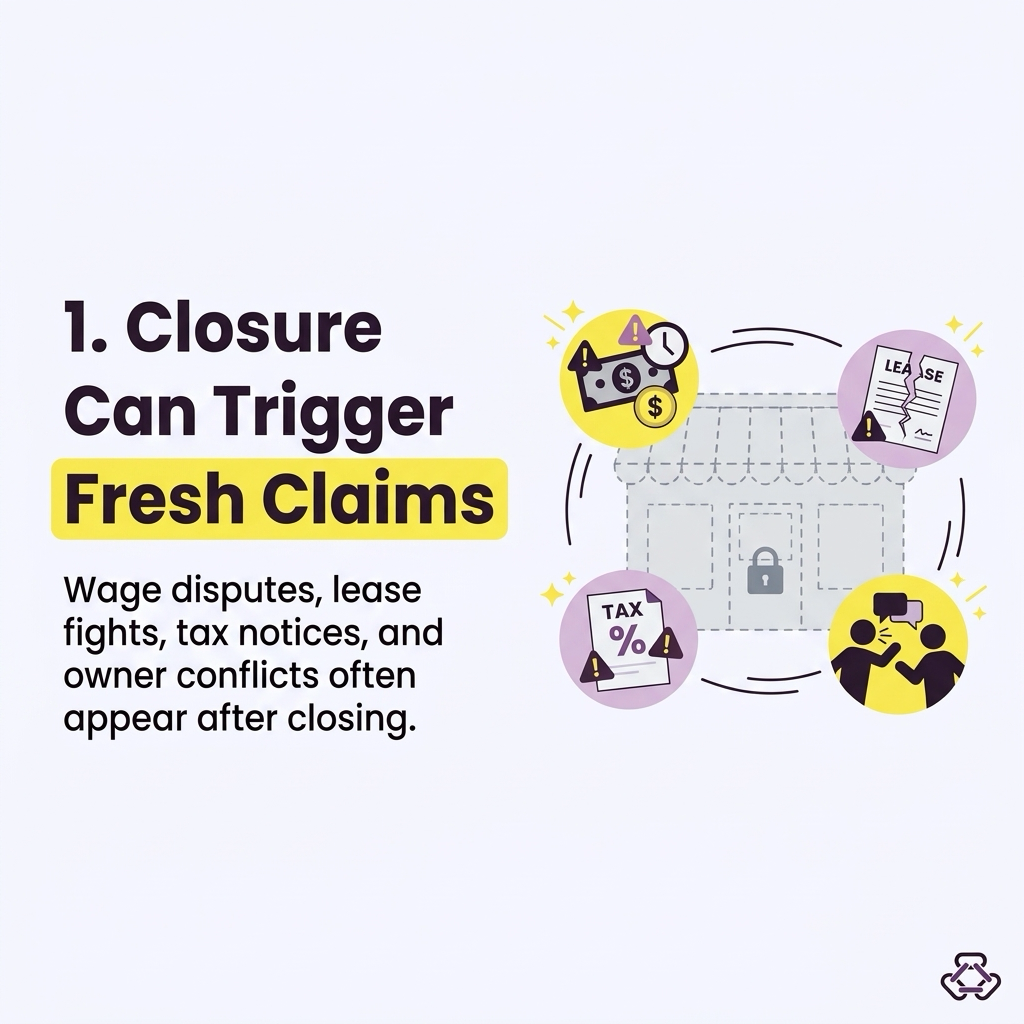
Closing a business can feel like the final chapter. In practice, it often becomes a second phase of risk management. Owner disputes, unpaid vendors, wage claims, lease fights, tax notices, data-security issues, and post-closing contract demands often show up after operations stop, not before.
That is why “winding down” and “locking the doors” are not the same thing.
A formal wind-down usually involves more than shutting off payroll and canceling subscriptions. It can include dissolving the entity with the state, preserving records, wrapping up contracts, dealing with creditors, handling employee obligations, filing final tax returns, protecting customer data, and documenting who approved what and when. The U.S. Small Business Administration notes that businesses often face ongoing taxes and filing requirements if they stop operating without legally dissolving the entity, while the IRS separately outlines final-return, contractor-reporting, EIN, and record-retention steps tied to closure. SBA guidance and IRS closure guidance both frame closure as a structured legal and tax process rather than a simple shutdown.
In this post you’ll learn how a careful wind-down can reduce the odds of creating brand-new claims while the business is trying to end old ones. If you want a broader overview of the legal landscape first, this guide on wrapping up a company while dealing with assets, creditors, and owner tensions gives helpful context before diving into the step-by-step process.
Scroll to the bottom for every post in this series.
Why Business Closures Often Trigger New Lawsuits
Many business owners picture litigation risk as something tied to the active life of the company: a customer sues, a vendor threatens breach, or partners fight about money. But closure itself can create fresh conflict.
That happens because a shutdown changes incentives. Employees worry about final pay and benefits. Landlords look for leverage. Vendors worry they will be pushed to the back of the line. Co-owners become more sensitive to valuation, distributions, and access to records. Regulators may keep expecting filings until the entity is formally dissolved. The SBA specifically warns that failing to legally dissolve an LLC or corporation can leave the business exposed to continuing taxes and filing obligations even after operations stop. SBA
Another common trigger is speed. When owners are exhausted, they sometimes stop paying attention to process. They sell equipment informally, transfer customer lists without documentation, empty accounts before resolving creditor priorities, or delete records to “clean things up.” Those shortcuts can become the basis for fraud allegations, fiduciary-duty claims, wage disputes, or spoliation arguments if litigation later follows.
In general terms, the safest wind-downs tend to look less like a panic response and more like a controlled project with a legal checklist, a document trail, and a clear chain of authority.
1. Start With Formal Authority To Shut Down
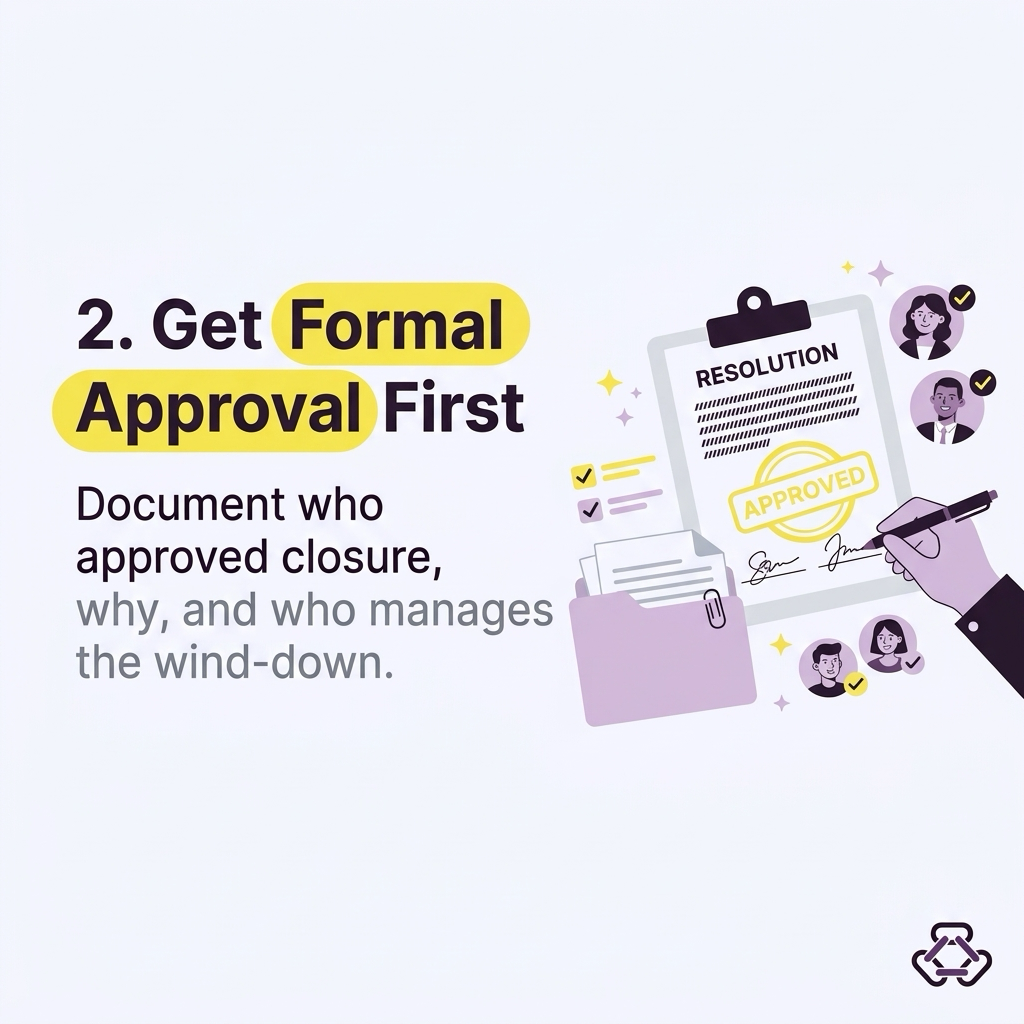
The first litigation question is often simple: who decided to close the business, and was that decision properly approved?
For a sole proprietorship, that issue may be straightforward. For an LLC, corporation, or partnership, it can become a major fight. Governing documents often spell out voting thresholds, manager authority, buyout provisions, notice requirements, and procedures for dissolution. The SBA notes that partnerships generally require co-owner agreement and written documentation consistent with organizational documents. SBA
This step matters because later claims often center on process, not just outcome. A minority owner may argue the closure was unauthorized. A former manager may claim assets were sold without approval. One member may say the company was dissolved to freeze them out or redirect customers to a competing business.
Some businesses reduce that risk by creating a written record at the start of the wind-down, such as:
- member, shareholder, or board resolutions;
- meeting minutes reflecting the reasons for closure;
- written consent approving a plan of dissolution or liquidation;
- a timeline for notices, asset sales, tax filings, and creditor communications;
- designation of one person or committee to manage the wind-down.
An attorney can often help translate the operating agreement, bylaws, partnership agreement, and state law into a closure process that is easier to defend later if someone challenges it.
2. Separate “Stopping Operations” From “Dissolving The Entity”
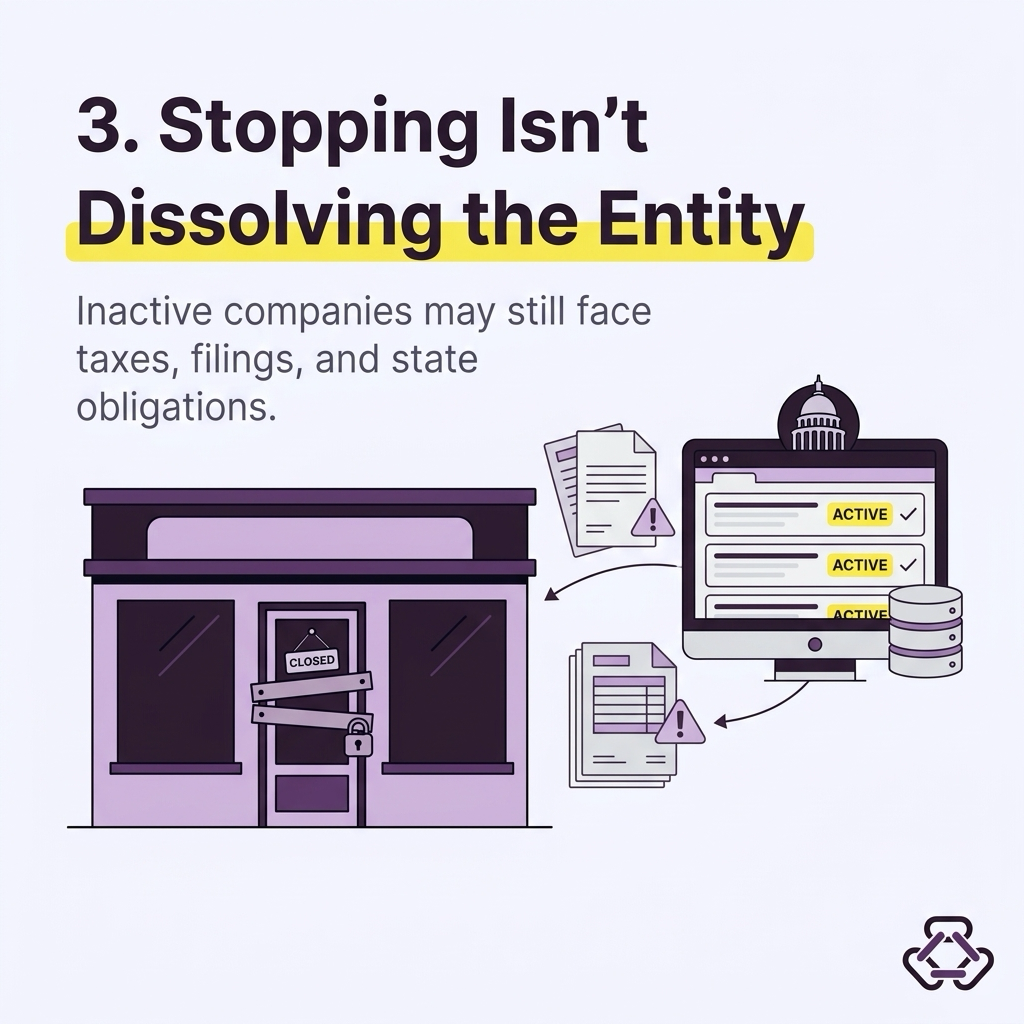
A business can stop operating and still legally exist. That gap creates a surprising amount of trouble.
The SBA states plainly that if an LLC or corporation is not legally dissolved in every state where it is registered, the business may continue to face taxes and filing requirements. SBA That can mean annual reports, franchise-tax obligations, registered-agent costs, and state notices long after the business thought it was done.
This matters for litigation because an “inactive” company can still accumulate administrative problems that later complicate distributions, asset transfers, and settlements. It can also undermine an owner’s argument that everything was wrapped up properly.
The exact filing process depends on state law and entity type. Delaware, for example, provides statutory procedures for dissolved corporations to give notice to claimants and manage claims during the winding-up period. Its corporate dissolution statutes describe creditor-notice mechanics, deadlines, rejection procedures, and publication requirements in certain situations. Delaware Code
Here’s what this often looks like in practice:
- filing dissolution or cancellation documents with the state of formation;
- withdrawing foreign registrations in other states;
- identifying whether the entity remains alive for winding-up purposes under state law;
- evaluating whether statutory notice procedures to creditors or claimants make sense;
- preserving authority for specific people to finish the wind-down.
A business lawyer may help determine whether simply filing dissolution papers is enough or whether a more formal claims process could reduce future exposure.
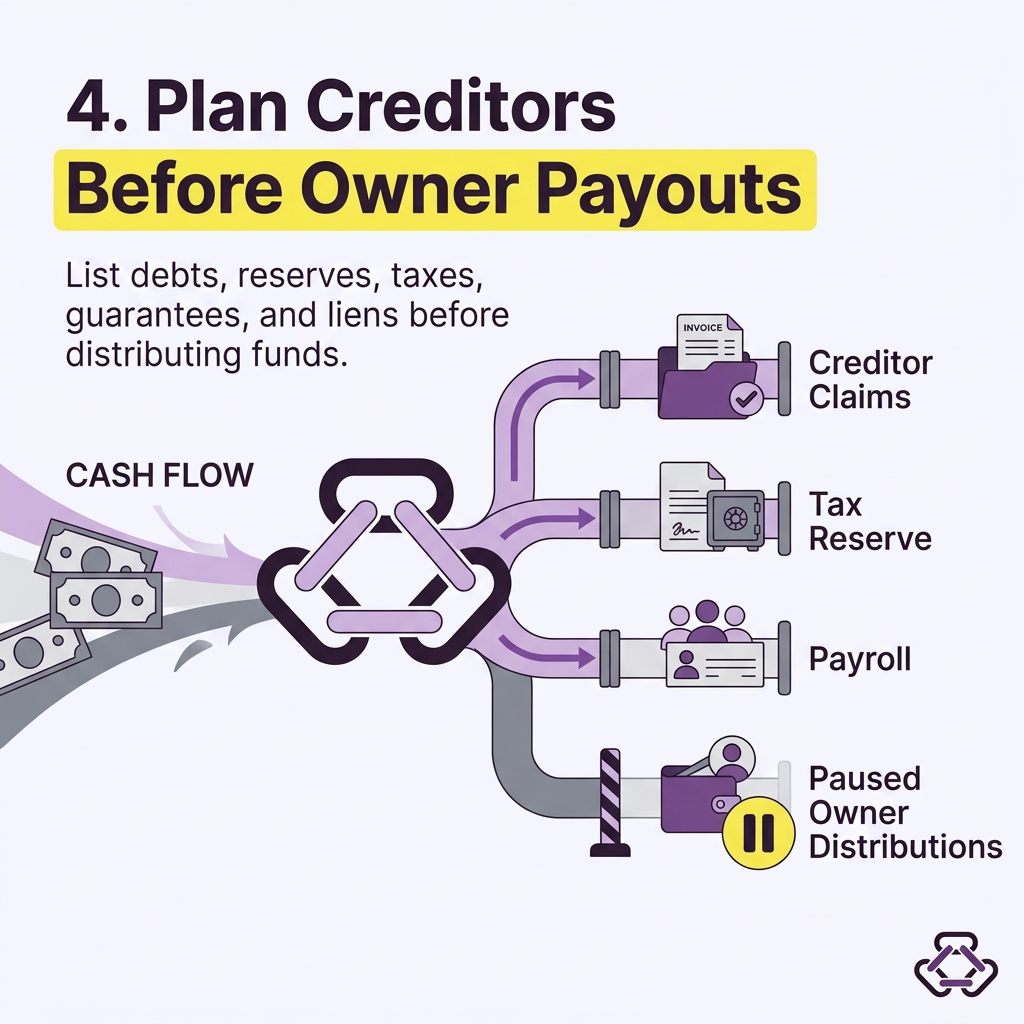
3. Build A Creditor Plan Before Money Starts Moving
One of the fastest ways to create fresh litigation is to distribute money to owners too early.
When a business is winding down, available cash often feels like “leftover” money. Legally, though, that money may still be needed for payroll, taxes, lease obligations, secured debt, refunds, chargebacks, litigation reserves, or disputed vendor claims. State law and governing documents often affect the order and method of distributions.
That is one reason creditor planning often happens before any owner payout. A careful process may include:
- listing all secured and unsecured debts;
- identifying disputed, contingent, or unmatured claims;
- estimating taxes still due;
- checking personal guarantees;
- separating debts of the business from debts of owners;
- creating reserves for claims not yet fully liquidated.
For businesses with secured loans, lien cleanup also matters. Under UCC Article 9, a termination statement can end the effectiveness of a financing statement when the secured obligation has been satisfied. LII UCC 9-513 State filing offices likewise explain that UCC-3 termination filings are commonly used to terminate the public notice of a secured party’s interest. New York Department of State FAQ If old liens remain on file after payoff, asset sales and final distributions can get messy fast.
Some owners also create problems by paying “friendly” creditors first, especially insiders, relatives, or affiliated companies. Even outside bankruptcy, those payments can become focal points in later fraud, fiduciary-duty, or veil-piercing claims. An attorney can often help evaluate whether the payment sequence is defensible and well documented.
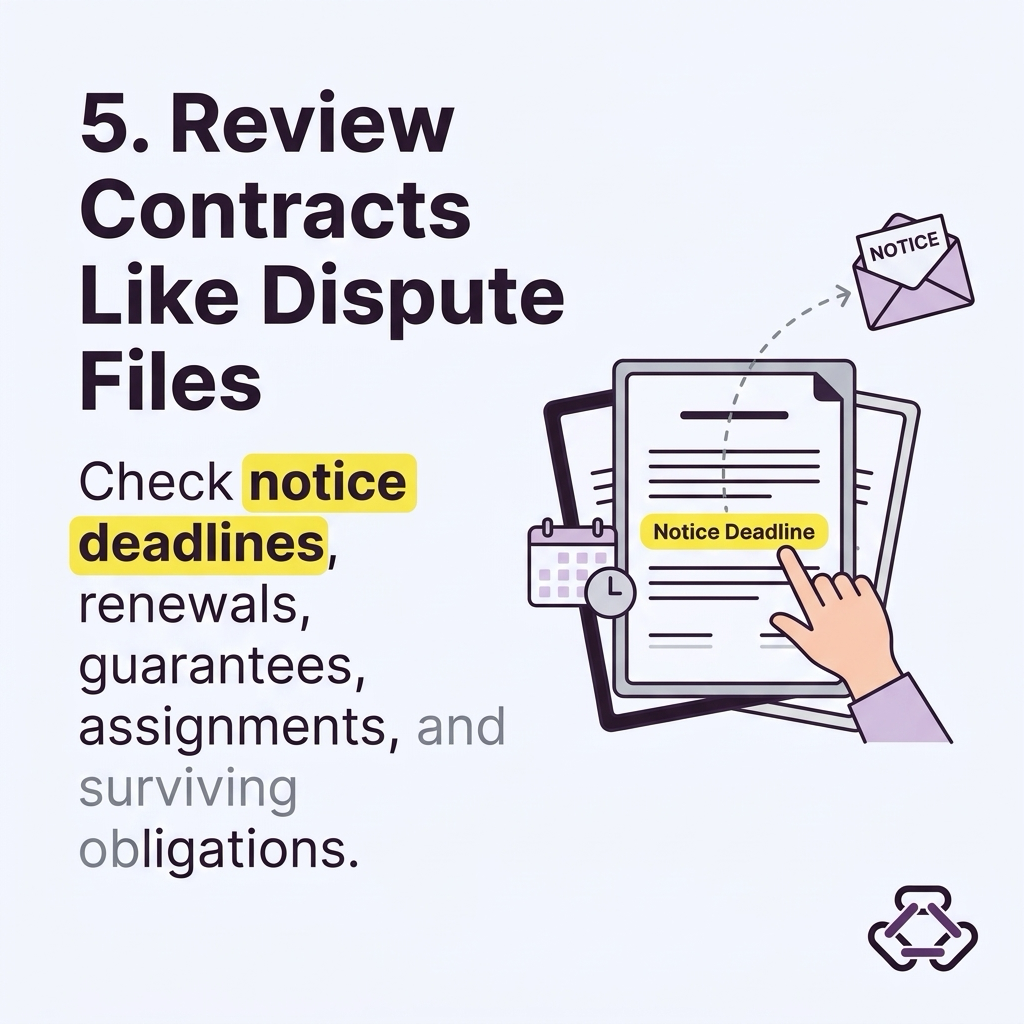
4. Treat Contracts As Litigation Files Waiting To Happen
Contracts rarely disappear just because revenue does.
Leases, software agreements, vendor minimums, exclusivity arrangements, loan covenants, service contracts, franchise obligations, and customer commitments may all survive the decision to shut down. The Federal Trade Commission notes that exclusive dealing and requirements contracts are common and often lawful, which is a reminder that businesses can remain bound by restrictive commercial terms even during a wind-down. FTC
A structured contract review can help identify:
- termination rights and notice deadlines;
- automatic-renewal provisions;
- personal-guarantee exposure;
- cure periods for alleged defaults;
- assignment restrictions;
- confidentiality and non-use obligations;
- return-of-property requirements;
- indemnity clauses that survive termination;
- dispute-resolution provisions, including venue and arbitration.
This is where rushed communications can create new claims. For example, sending a vague “we’re closed” email instead of a contract-compliant termination notice may open the door to breach arguments. Selling assets without checking anti-assignment clauses can create disputes with licensors, landlords, or customers. Telling one counterparty they will be paid “next week” while knowing the business may not have funds can later become a fraud allegation.
Some companies reduce risk by routing all closure-related contract communications through one person and preserving every notice sent and received.
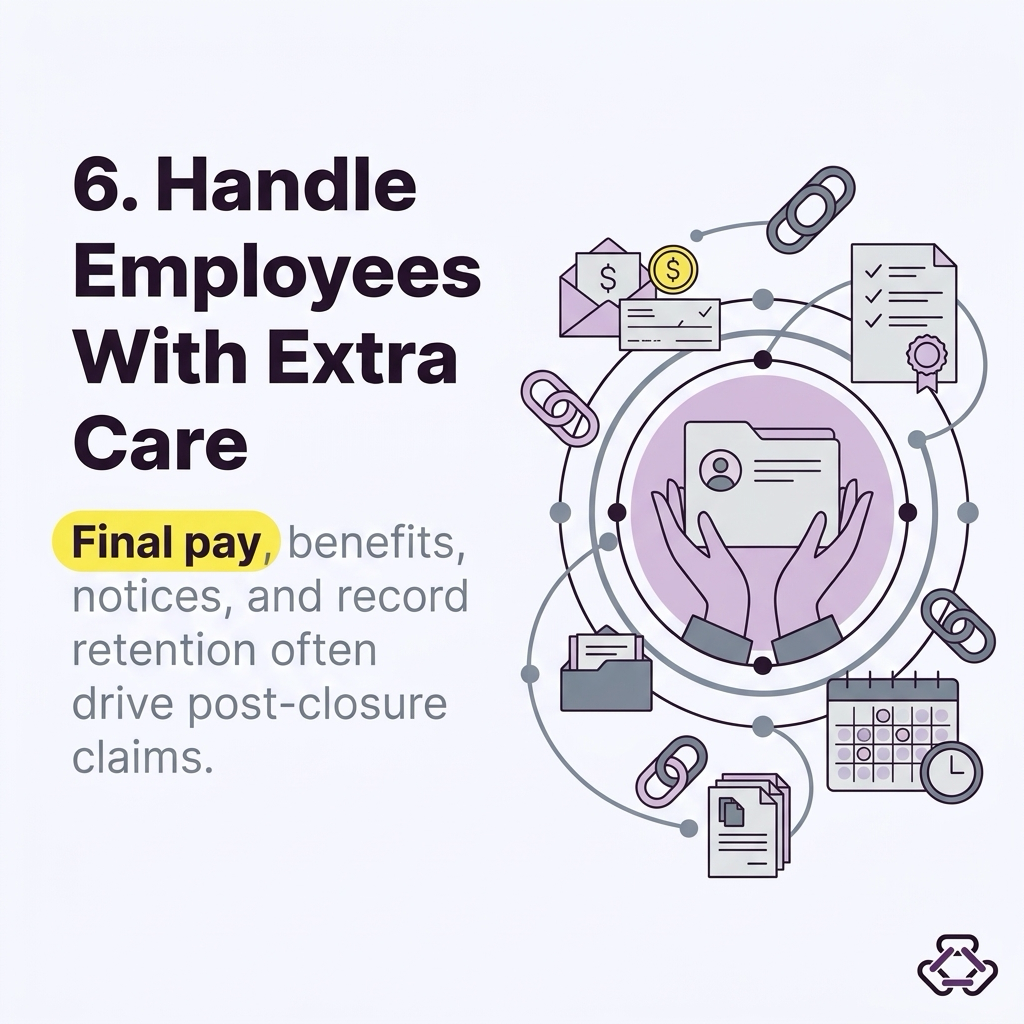
5. Handle Employees With Extra Care
Employment claims are among the most common post-closure disputes, and they often involve facts that are easy to document badly.
The Department of Labor explains that the federal WARN Act generally requires certain employers with 100 or more employees to provide 60 days’ written notice before a covered plant closing or mass layoff, subject to exceptions such as unforeseeable business circumstances, faltering company situations, or natural disasters. DOL WARN overview State mini-WARN laws may create additional requirements depending on where the business operates.
Beyond notice issues, a wind-down can raise questions about:
- final wages and timing of payment;
- accrued vacation or PTO, depending on state law and policy;
- commissions and bonuses;
- severance promises;
- COBRA or benefit continuation issues;
- WARN applicability;
- nondisparagement or release language;
- employee expense reimbursements;
- classification disputes involving contractors.
Recordkeeping is also critical. The EEOC states that employers generally must keep personnel or employment records for one year, that personnel records for involuntarily terminated employees must be retained for one year from termination, and that certain payroll records are subject to longer retention periods. If an EEOC charge is filed, relevant records generally must be kept until final disposition of the charge or resulting lawsuit. EEOC recordkeeping requirements The IRS separately says employment tax records generally should be kept for at least four years. IRS
In practical terms, deleting HR files, deactivating email, or wiping payroll platforms too early can make an ordinary wage dispute much harder to defend.
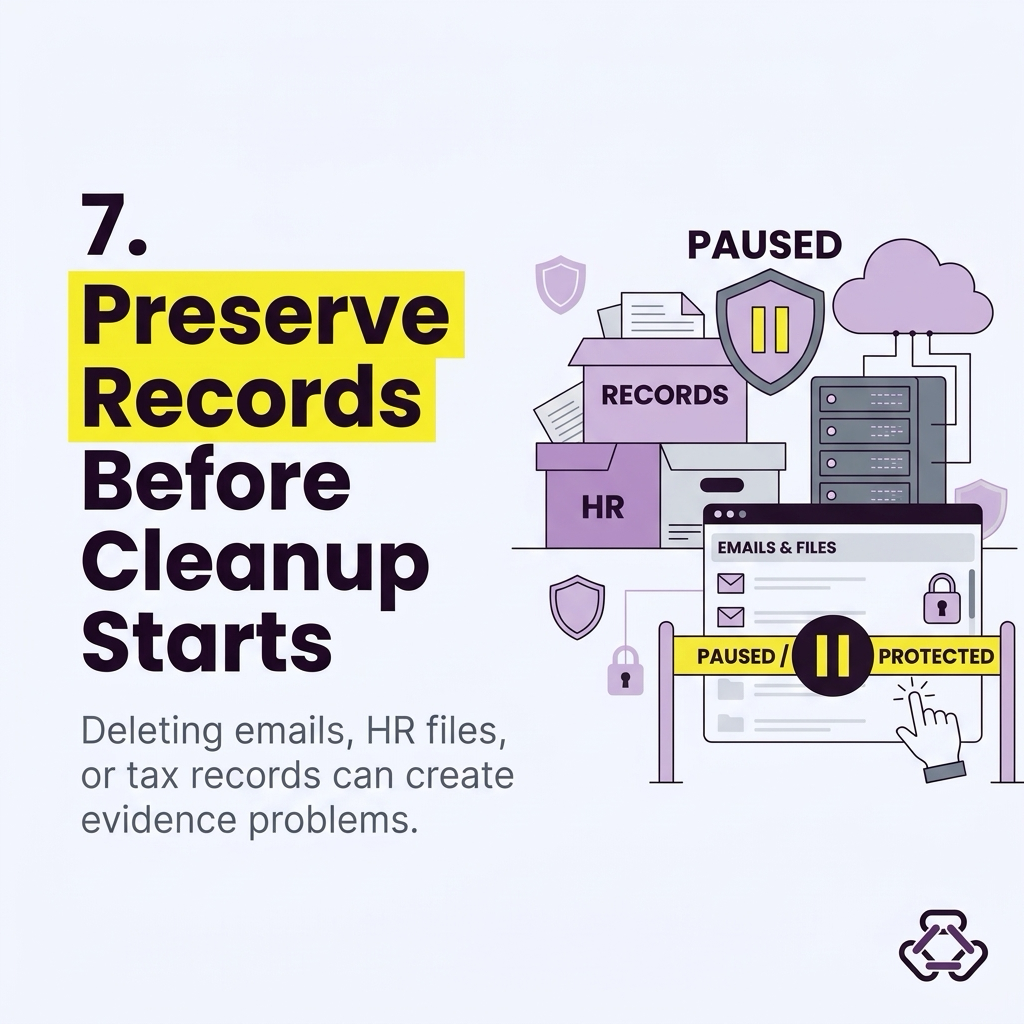
6. Preserve Records Before Anybody Starts “Cleaning Up”
One of the most expensive closure mistakes is destroying evidence while trying to reduce clutter.
When owners decide to close, they often start canceling cloud subscriptions, wiping laptops, purging email, and shredding paper files. That can be risky if the business has open disputes, threatened claims, pending audits, chargebacks, employment complaints, or facts suggesting litigation is reasonably foreseeable.
Even outside a formal lawsuit, record-retention rules continue to matter. The IRS states that how long records are kept depends on the document type and that property records may need to be retained until the relevant limitation periods expire, while employment tax records generally stay for at least four years. IRS The EEOC’s retention requirements add another layer for employment records. EEOC
This often means a business may want a closure-specific preservation plan covering:
- accounting files and general ledgers;
- tax returns and supporting workpapers;
- contracts and amendments;
- HR and payroll records;
- board or member consents;
- email and messaging data;
- customer complaints and support tickets;
- insurance policies and claims correspondence;
- litigation, demand, or settlement files;
- IP registrations and assignment documents.
If a dispute is already pending or reasonably anticipated, attorneys often evaluate whether a litigation hold is appropriate so evidence is not lost through ordinary shutdown steps.
7. File Final Tax Returns And Close Accounts The Right Way
Tax loose ends can become litigation problems when penalties pile up, trust-fund taxes are disputed, or owners later discover the business account never really closed.
The IRS says a business closing typically involves filing a final federal tax return, making final federal tax deposits, reporting payments to contractors on Form 1099-NEC where applicable, and sending a letter to close the IRS business account connected to the EIN after all required returns are filed and taxes are paid. The IRS also notes that an EIN itself is permanent, but the IRS business account can be closed. IRS closing-a-business page
Sales-tax and state-tax issues can continue after operations stop too. For example, New York’s tax guidance states that a business closing in New York must file a final sales tax return and account for sales tax due on the sale of business assets. New York Tax Bulletin Washington similarly states that when a business is sold, a final tax return with payment is due within ten days of the sale. Washington Department of Revenue
The broader point is that taxes are not just accounting cleanup. Unpaid payroll taxes, sales taxes, or missing final returns can trigger personal exposure arguments, collection actions, and owner-versus-owner blame later on.
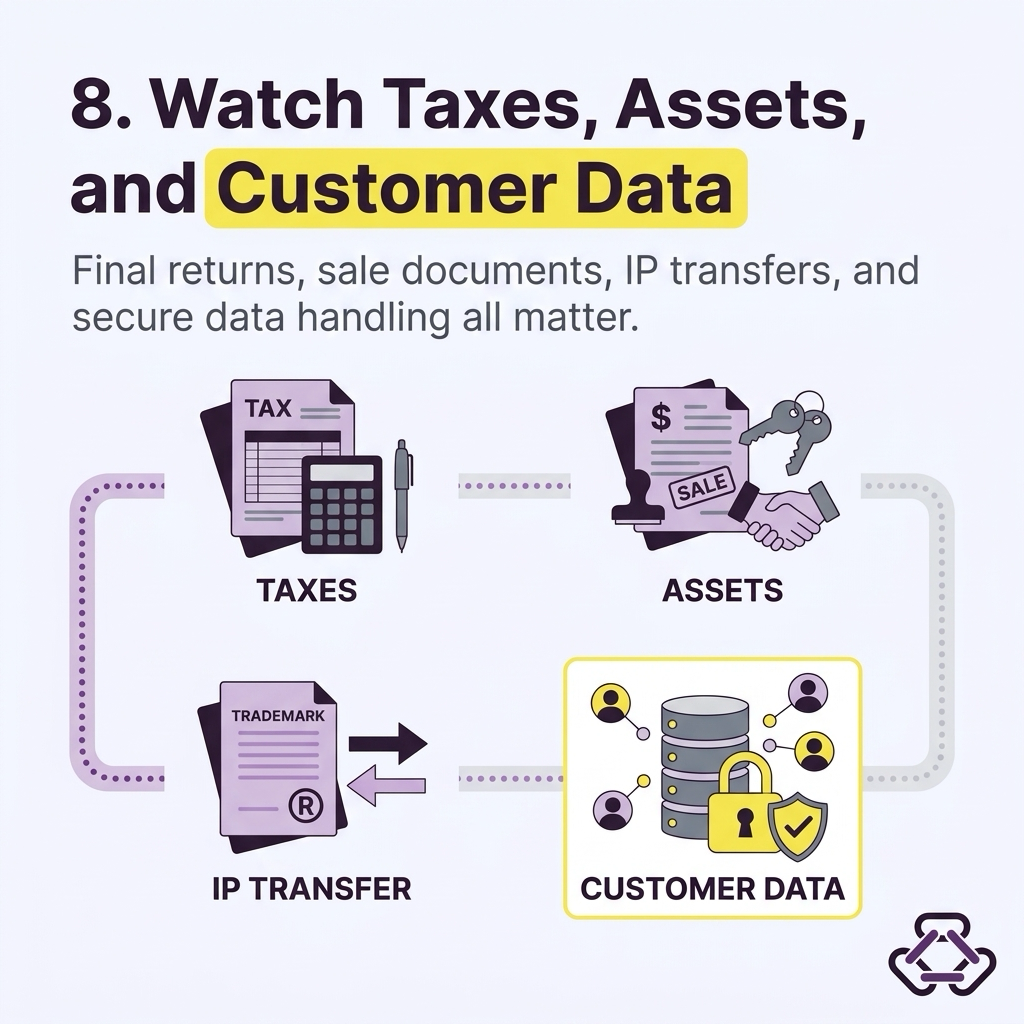
8. Be Careful With Asset Sales, IP Transfers, And Customer Lists
A wind-down often includes selling equipment, inventory, accounts, or intangible assets. That is another point where brand-new disputes can arise.
The SBA advises businesses to value assets carefully and use a formal sales agreement when selling the business or its assets. SBA If trademarks are involved, the USPTO explains that trademark ownership changes and assignments should be properly recorded, and that transfer issues can arise when the chain of title is not handled correctly. USPTO trademark assignment guidance
Common litigation flashpoints include:
- assets sold below fair value to insiders;
- unclear ownership of software, trademarks, or domain names;
- customer lists transferred in violation of privacy terms or contracts;
- equipment sold subject to existing liens;
- proceeds diverted before creditors are addressed;
- one owner using old company assets in a new venture without consent.
This is especially sensitive when the buyer is related to an owner, manager, or family member. Even if the transaction is legitimate, weak documentation can make it look like value was stripped from the company before creditors or minority owners were paid.
9. Don’t Forget Data Security On The Way Out
Data risk does not end when the business closes. In some industries, it becomes more serious.
The FTC’s Safeguards Rule guidance says covered financial institutions must maintain an information security program and securely dispose of customer information no later than two years after the most recent use to serve the customer, unless a legal requirement or legitimate business need supports retention or targeted disposal is not feasible. FTC Safeguards Rule Separately, the FTC’s Disposal Rule guidance explains that businesses using consumer reports for a business purpose are required to dispose of covered information through reasonable measures protecting against unauthorized access or use. FTC Disposal Rule guidance
For a wind-down, that can translate into questions like:
- Who still has access to customer data?
- Are former employees still logging into systems?
- Are old laptops, phones, and backup drives being wiped properly?
- Are records being retained because of legal obligations, or just forgotten?
- Does any contract require notice before data is transferred or destroyed?
A closure can be chaotic, and chaos tends to be bad for privacy and security. A business that ignores customer data on the way out may trade one set of problems for another.
10. Document The Wind-Down Like Someone Will Read It In Court
That “someone” may eventually be a judge, arbitrator, regulator, trustee, creditor, or angry co-owner.
Documentation often becomes the difference between a manageable dispute and a credibility problem. A well-documented wind-down can help show that the company acted consistently, preserved value, communicated honestly, and followed a reasoned process.
Useful documents often include:
- approvals and resolutions;
- a written dissolution timeline;
- creditor and claimant lists;
- asset inventories and valuations;
- payoff letters and lien releases;
- contract termination notices;
- employee notices and final payroll records;
- tax filings and confirmations;
- record-retention instructions;
- data-disposal logs;
- owner distribution schedules and supporting calculations.
This is not about creating paperwork for its own sake. It is about making later accusations easier to test against an objective record.
11. Know When A Wind-Down Is Drifting Into Bankruptcy Territory
Sometimes the key litigation-avoidance move is recognizing that an out-of-court shutdown may no longer fit the facts.
If the business cannot pay debts in an orderly way, creditor pressure is escalating, insiders have been paid unevenly, or there are significant lease, tax, or lawsuit exposures, bankruptcy may become part of the conversation. The SBA acknowledges that some closures move into bankruptcy or liquidation and notes that owners often benefit from legal and accounting guidance before taking those steps. SBA
In general terms, owners often get into the most trouble when they try to “finish the shutdown first” and only later ask whether the company was already too distressed for an informal process.
12. Use Counsel Early Enough To Prevent The Preventable
By the time a demand letter arrives, a lot of the important decisions may already be locked in: distributions have been made, records deleted, notices missed, and contracts mishandled.
That is why many business owners look for counsel during the planning stage instead of after a post-closure claim appears. An attorney may help evaluate dissolution formalities, review owner authority, structure creditor communications, preserve evidence, analyze employee issues, coordinate tax-related cleanup, and flag problem transfers before they trigger accusations.
And fit matters. A general business attorney may be useful, but a company facing creditor pressure, owner conflict, employment exposure, or asset-transfer questions often benefits from someone with documented experience in highly-similar matters, based on objective evidence rather than advertising language.
A Short Summary
Winding down a business without creating new litigation problems often comes down to one theme: closure is a legal process, not just an operational decision.
A careful wind-down usually involves:
- formal approval to dissolve;
- state dissolution and withdrawal filings;
- a creditor and reserve plan;
- contract-by-contract review;
- careful handling of employees and payroll;
- record preservation;
- final federal and state tax compliance;
- disciplined asset and IP transfers;
- secure data retention and disposal;
- written documentation at every major step.
When those pieces are handled informally or out of order, the closure itself can become the source of new claims.
Visit ReferU.AI to get matched with an attorney who has demonstrable experience in cases like yours — for free.
