Table of Contents
- Emergency Business Injunctions: A Beginner’s Guide to Fast Court Relief
- What Is An Emergency Business Injunction?
- What Is The Difference Between A TRO And A Preliminary Injunction?
- Temporary Restraining Order
- Preliminary Injunction
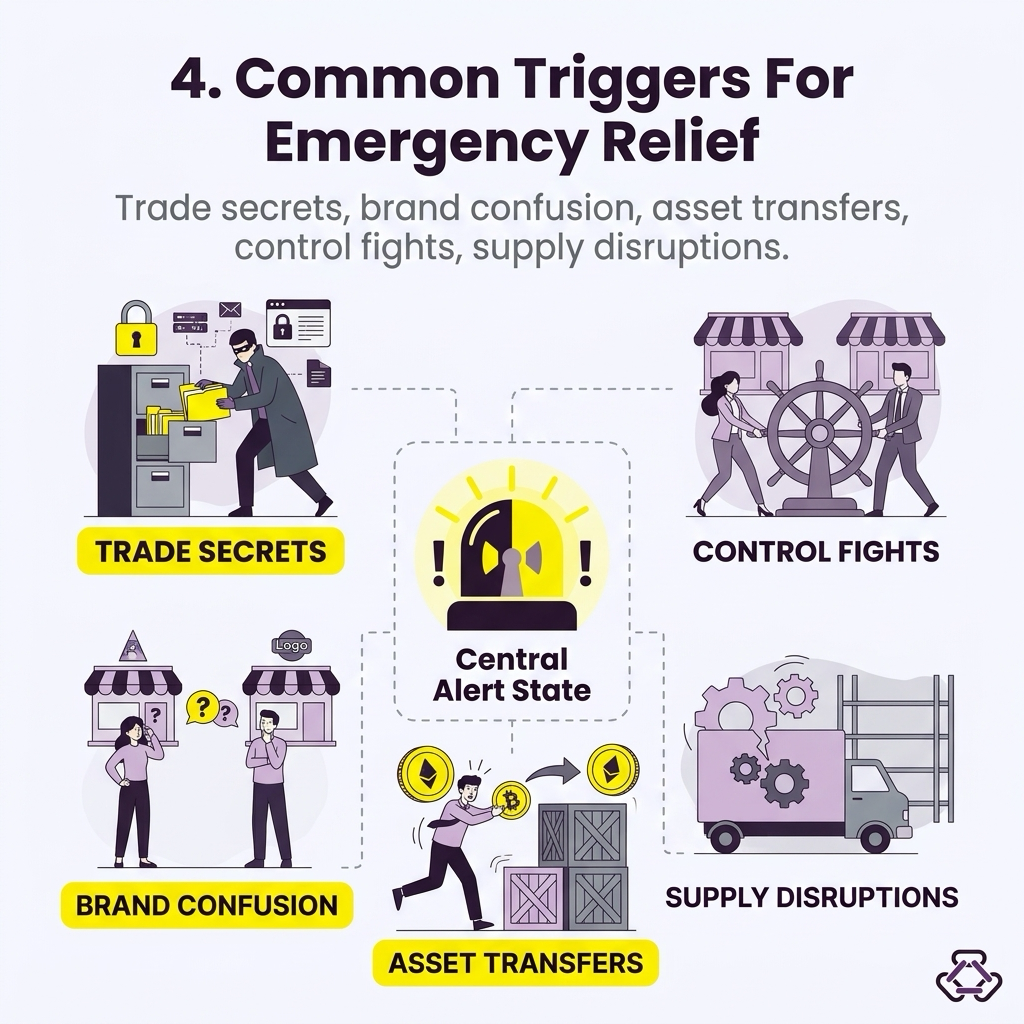
- When Do Businesses Usually Ask For Emergency Relief?
- Misuse Of Trade Secrets Or Confidential Information
- Customer Poaching In Violation Of Restrictive Covenants
- Brand Confusion Or Unfair Competition
- Threatened Asset Transfers Or Control Disputes
- Supply Chain Or Contract Breach Crises
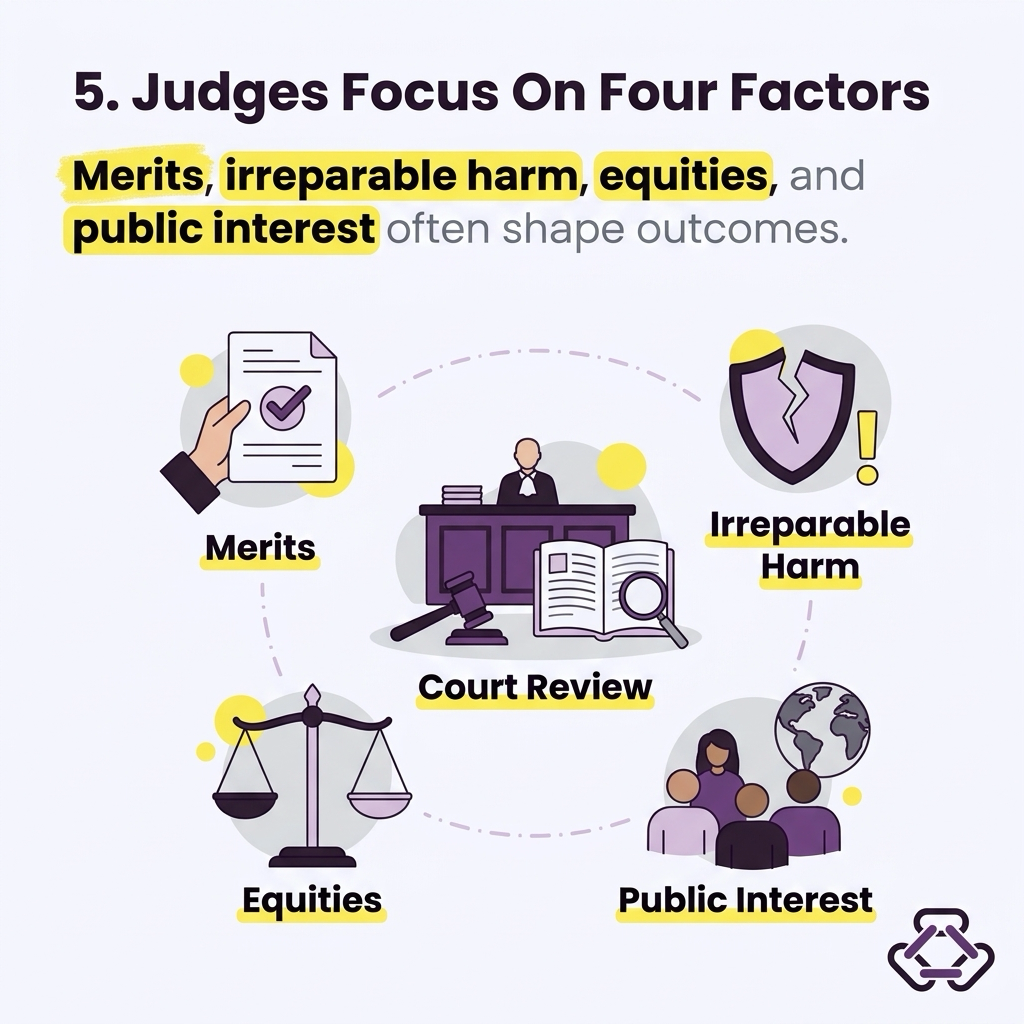
- What Do Judges Usually Look For?
- 1. Likelihood Of Success On The Merits
- 2. Irreparable Harm
- 3. Balance Of Equities
- 4. Public Interest
- 5. Adequacy Of Money Damages
- How Fast Can An Emergency Injunction Move?
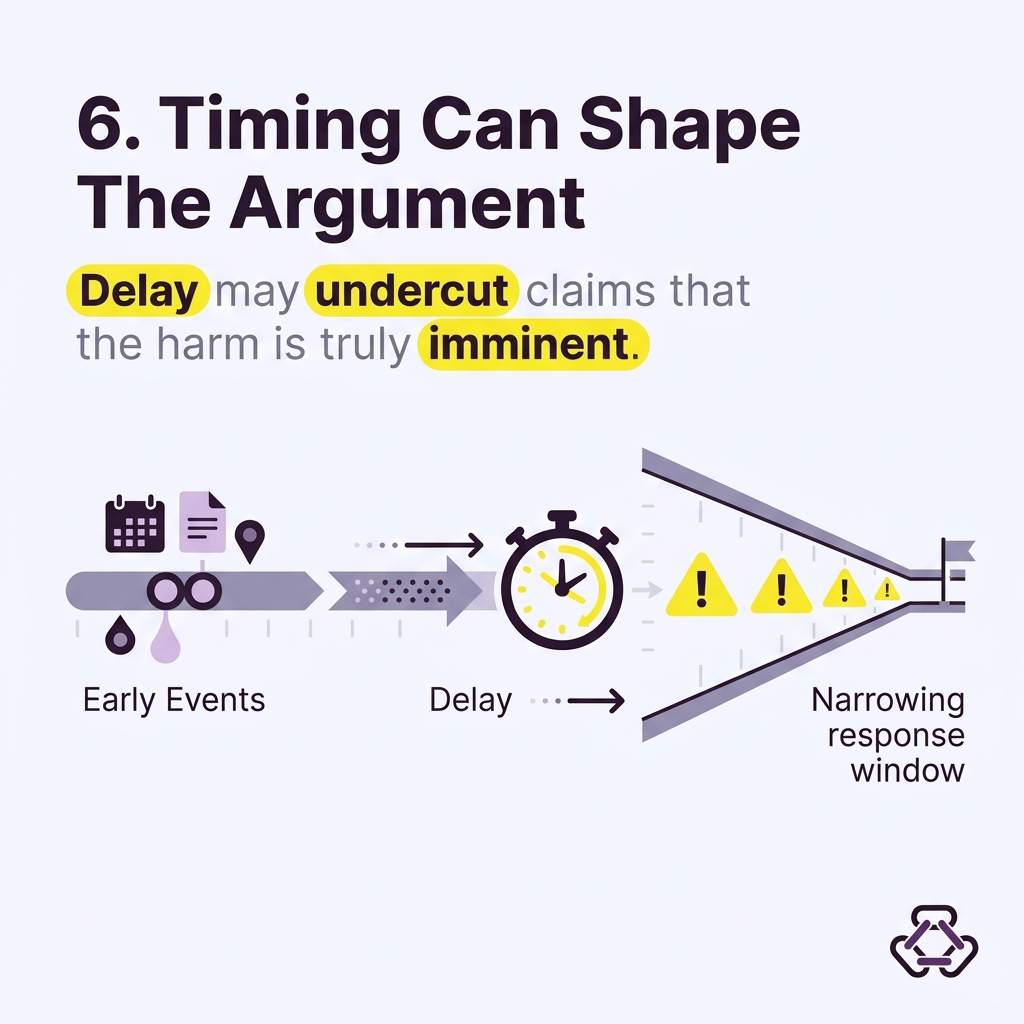
- Why Timing Matters So Much
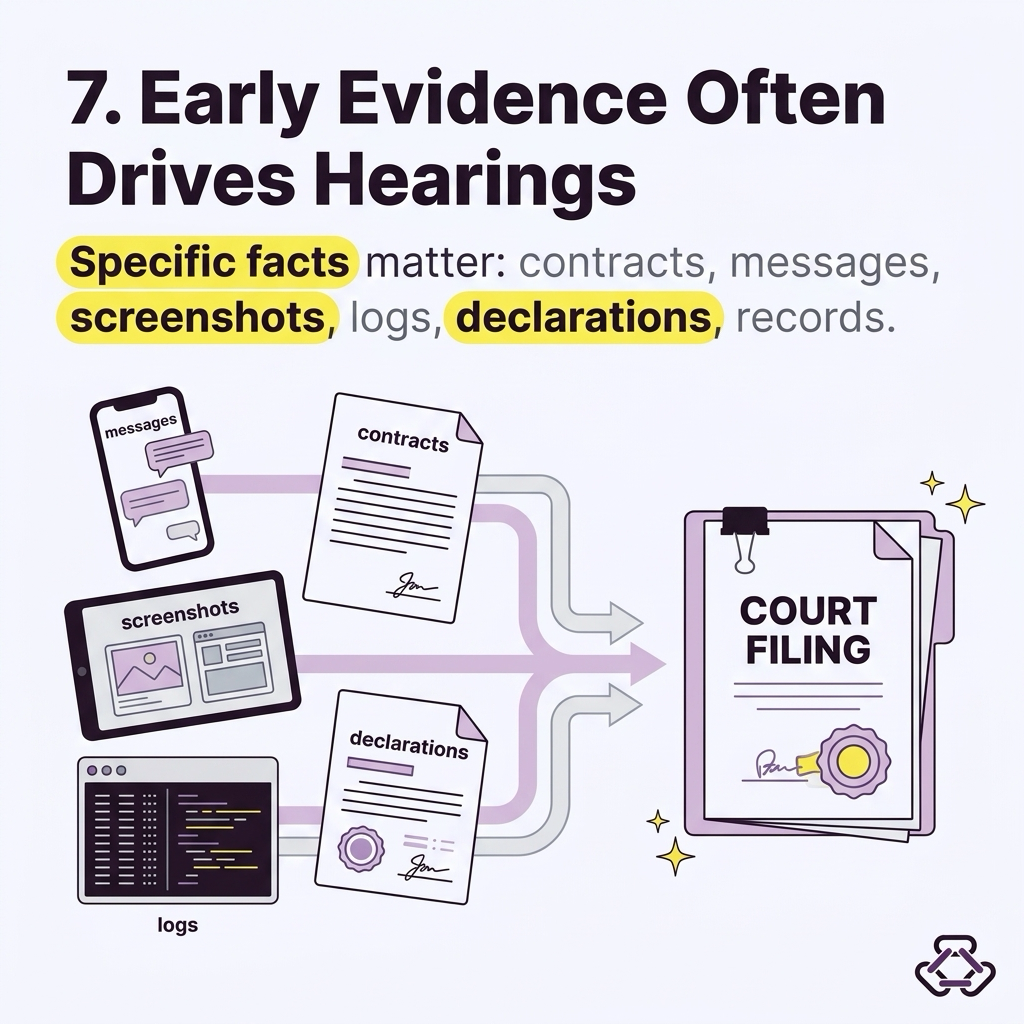
- What Evidence Often Matters Most?
- Can A Court Grant Relief Without Telling The Other Side First?
- Does The Business Seeking An Injunction Have To Post A Bond?
- Are Emergency Business Injunctions Common In Delaware And Other Business Courts?
- What Makes These Cases So High-Stakes?
- What Are Some Common Misunderstandings?
- “If The Harm Is Financial, An Injunction Is Impossible”
- “If It Is Urgent, The Court Will Automatically Intervene”
- “A Strong Underlying Claim Automatically Produces Fast Relief”
- “The First Filing Can Be Fixed Later”
- What Should A Business Owner Keep In Mind Early?
- Why Attorney Fit Matters In Emergency Injunction Cases
- Final Thoughts

Type
Great Grandchild
Status
Approved
Title (YouTube)
Images Failed (Social)
Images Failed (Social)
Do not index
Publish Date (TikTok)
Jan 7, 2027 13:45
Videos Post IDs (Social)
Hashtags (Social)
#LegalAdvice #LegalHelp #BusinessLitigation #EmergencyInjunctions
Caption
Caption X
Cover

OG Image

Alt Image Text
Flat vector illustration of emergency business injunctions and fast court relief, with a courthouse, attorney, business owner, and protective barrier stopping urgent business threats.
Images

Videos
Publish Date (Social)
Dec 17, 2026 11:30
Scheduled (Social)
Scheduled (Social)
Images Posted (Social)
Images Posted (Social)
Videos Posted (Social)
Videos Posted (Social)
Videos Failed (Social)
Videos Failed (Social)
Featured
Created time
Apr 3, 2026 10:12 PM
Sub-item
Authors
CTA Practice Area (Social)
Business Litigation
TikTok Failed (Social)
TikTok Failed (Social)
Videos Post Links (Social)
YT Auto Captions Removed
TikTok Post Links (Social)
Images Post IDs (Social)
YT Post ID
Video Pending Manual (Social)
TikTok Posted (Social)
TikTok Posted (Social)
TikTok Post IDs (Social)
Video Cover (Social)
Images Post Links (Social)
First Comment (Social)
YT Embedded
Images Delete (Social)
Videos Delete (Social)
Carousel Video URL (Social)
Emergency Business Injunctions: A Beginner’s Guide to Fast Court Relief
When a business threat is unfolding in real time, ordinary litigation can feel too slow. A supplier cuts off critical deliveries without warning. A former executive starts contacting customers with confidential pricing data. A competitor launches with branding that looks confusingly close to yours. In moments like these, business owners often start asking about emergency court relief.
That is where injunctions come in.
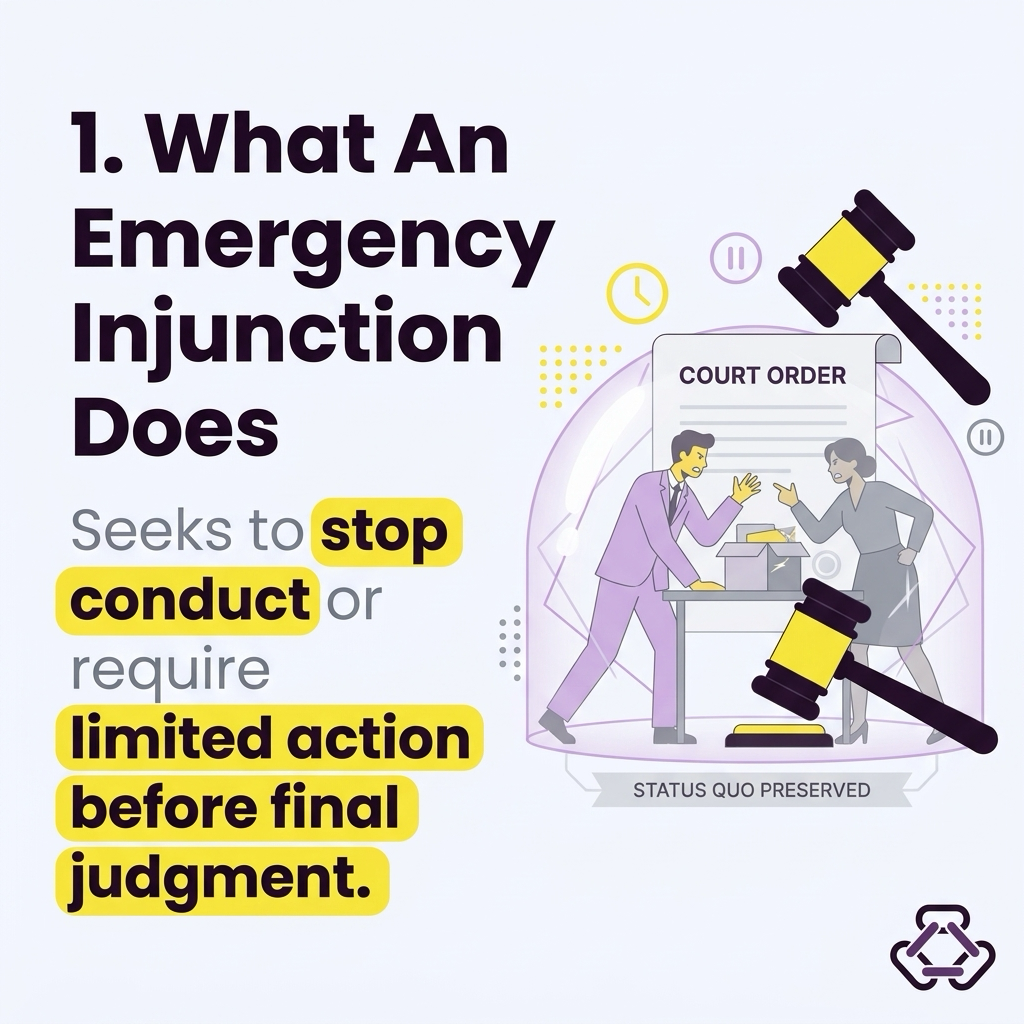
In general terms, an emergency business injunction is a court order aimed at preserving the status quo or preventing serious harm before a full case can be resolved. Depending on the court and the facts, that relief may take the form of a temporary restraining order (TRO) or a preliminary injunction. In federal court, both are governed by Rule 65 of the Federal Rules of Civil Procedure, and courts commonly treat them as extraordinary remedies rather than routine case management tools. The Supreme Court has also described a preliminary injunction as an “extraordinary remedy” and emphasized that a plaintiff has to make a clear showing on the required factors in Winter v. NRDC.
If you want a broader foundation first, it may help to start with this overview of urgent court orders that can keep a business problem from getting worse.
In this post you’ll learn what emergency business injunctions are, when they may come into play, what judges often look for, how fast these cases can move, and why finding counsel with demonstrable experience in highly similar matters can matter early.
Scroll to the bottom for every post in this series.
What Is An Emergency Business Injunction?
An emergency business injunction is a request for a court order designed to stop conduct or require limited action before the underlying lawsuit reaches a final judgment.
In practical terms, businesses often seek this kind of relief when money alone may not fully repair the harm. Courts frequently focus on whether the alleged injury is immediate and irreparable—meaning the damage may not be adequately fixed later through a standard damages award. That framework appears throughout federal injunction law and is summarized by the Legal Information Institute’s explanation of injunctive relief and preliminary injunctions.
In the business context, emergency injunctions often arise in disputes involving:
- trade secrets
- non-compete or non-solicit issues
- breaches of confidentiality agreements
- franchise disputes
- partnership or shareholder conflicts
- brand misuse or unfair competition
- supply chain disruption
- disputed control of bank accounts, inventory, or digital assets
- threatened asset transfers
- violations of exclusivity agreements
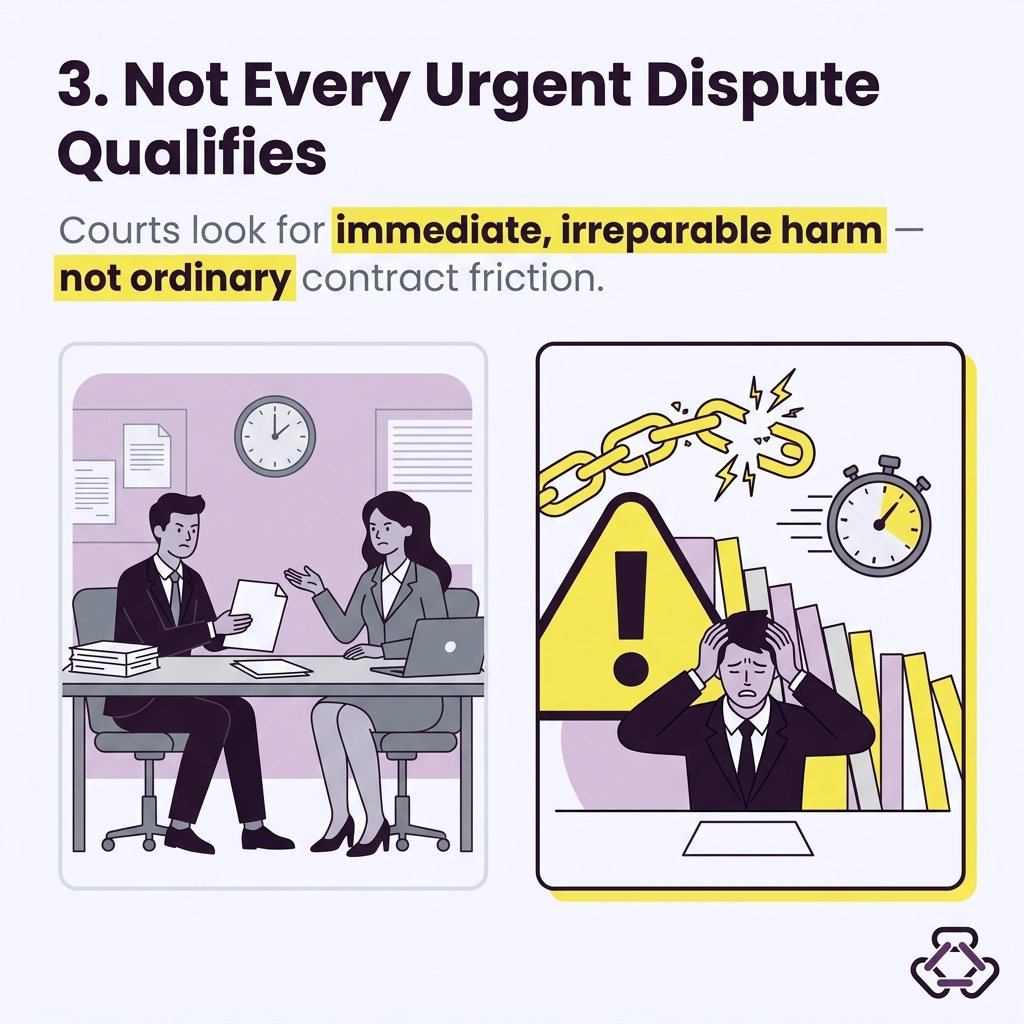
Not every urgent business dispute qualifies for emergency relief. Courts generally look for more than inconvenience, lost leverage, or ordinary contractual friction.
What Is The Difference Between A TRO And A Preliminary Injunction?
This is one of the first questions business owners ask, and for good reason.
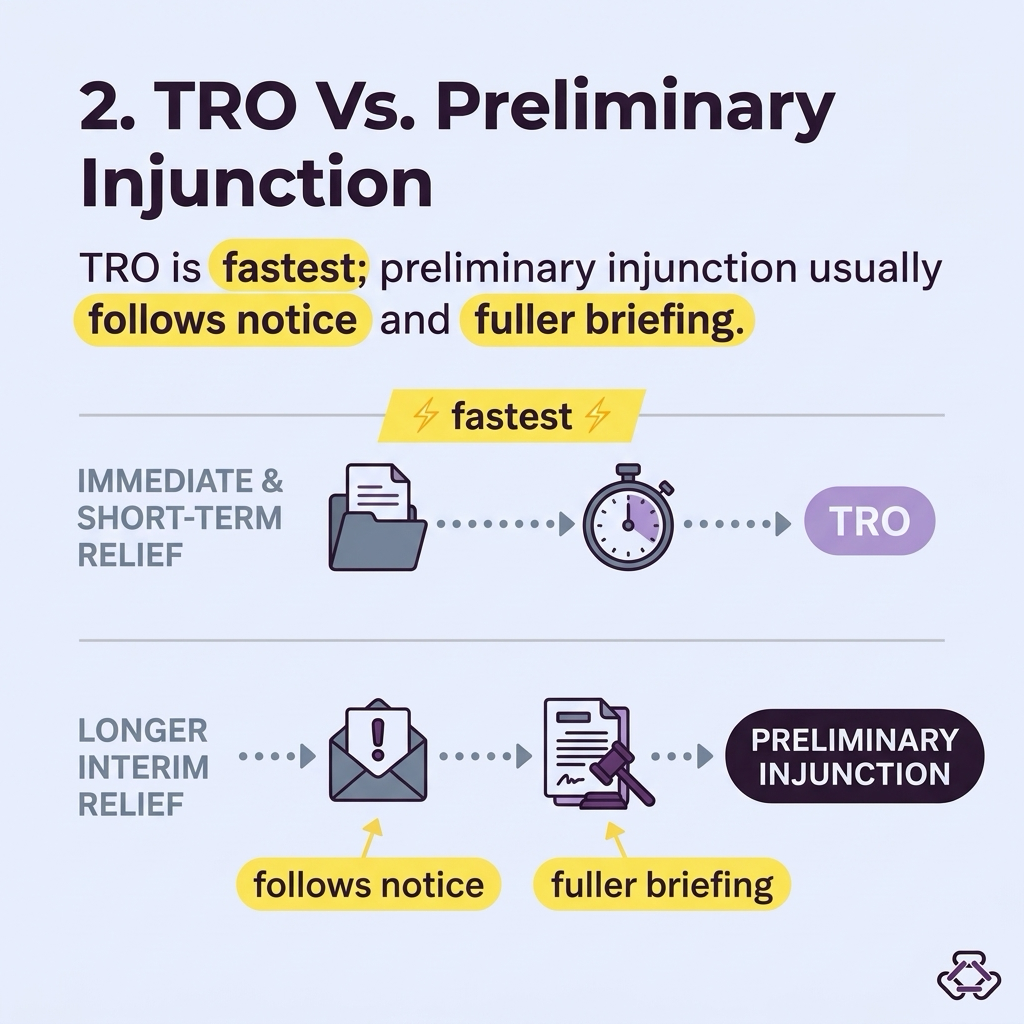
Temporary Restraining Order
A temporary restraining order, or TRO, is typically the fastest form of injunction relief. Under Rule 65(b), a federal court may issue a TRO without notice only if specific facts in an affidavit or verified complaint clearly show that immediate and irreparable injury will occur before the other side can be heard, and counsel certifies efforts to give notice and why notice should not be required.
A TRO issued without notice in federal court generally expires within 14 days, unless extended for good cause or by consent under Rule 65(b)(2). That short duration reflects the emergency nature of the remedy.
Preliminary Injunction
A preliminary injunction usually lasts longer than a TRO and is entered after notice to the opposing party. Rule 65(a)(1) states that a federal court may issue a preliminary injunction only on notice to the adverse party. The goal is often to preserve the situation until the court can reach a final decision on the merits.
In many business disputes, the TRO is the immediate stopgap, while the preliminary injunction becomes the next, more developed hearing.
Here’s what this often means in plain language:
- TRO: fastest, narrowest, most urgent
- Preliminary injunction: still fast, but usually more developed and with notice
- Permanent injunction: considered later, often after trial or final merits rulings
When Do Businesses Usually Ask For Emergency Relief?
Emergency injunction requests tend to appear when time pressure collides with hard-to-repair harm.
Some common examples include:
Misuse Of Trade Secrets Or Confidential Information
If a departing employee or former business partner is allegedly taking customer lists, pricing models, source code, formulas, or internal strategy documents, a business may argue that the ongoing disclosure itself is the harm.
Customer Poaching In Violation Of Restrictive Covenants
In disputes involving non-solicitation or non-compete agreements, the timing can be central. If key accounts are being moved quickly, a company may try to preserve customer relationships before they are permanently altered.
Brand Confusion Or Unfair Competition
If a competitor launches a product, website, or branding campaign that allegedly confuses customers, the requesting business may argue that reputational harm and marketplace confusion are hard to quantify precisely later.
Threatened Asset Transfers Or Control Disputes
In shareholder fights, partnership breakups, and business divorce matters, emergency relief may be sought to stop a transfer of funds, freeze access to systems, preserve records, or maintain control structures until the court hears both sides.
Supply Chain Or Contract Breach Crises
Sometimes a contract dispute becomes an emergency because the breach threatens to shut down operations, trigger regulatory problems, or destroy a time-sensitive commercial relationship.
If your situation sounds broader than a single contract issue, it may also help to read about business disputes that can escalate into immediate court action, since emergency relief often turns on context rather than labels.
What Do Judges Usually Look For?
The exact legal test can vary by jurisdiction and claim, but several themes appear repeatedly.
Federal courts commonly analyze four core factors: likelihood of success on the merits, likelihood of irreparable harm without relief, balance of equities, and public interest. That framework is reflected in the Supreme Court’s discussion in Winter v. NRDC and the Legal Information Institute’s summaries of preliminary injunctions and injunctive relief.
1. Likelihood Of Success On The Merits
The court often wants an early look at whether the legal claim appears viable. This does not usually mean proving the entire case at the opening stage, but it often involves presenting a coherent legal theory backed by evidence.
2. Irreparable Harm
This factor is often the center of the fight. Courts commonly ask whether waiting for the normal pace of litigation would allow harm that money damages may not adequately fix.
For businesses, that may involve:
- loss of goodwill
- disclosure of confidential information
- customer confusion
- destruction of unique business relationships
- loss of control over governance or assets
3. Balance Of Equities
Judges often compare the hardship on each side. If the requested order would impose severe operational restrictions, the court may scrutinize tailoring closely.
4. Public Interest
In some cases, public interest is not a major driver. In others—healthcare, regulated industries, employment, consumer safety, infrastructure, IP, or public company disputes—it may carry real weight.
5. Adequacy Of Money Damages
Although phrased differently across jurisdictions, courts often look at whether a later damages award would realistically solve the problem. If it would, emergency relief can become harder to obtain.
In Delaware’s Court of Chancery, which handles many high-stakes business disputes, the court regularly addresses whether the movant has shown irreparable harm and that legal remedies are inadequate, along with a sufficient basis on the merits and a favorable balance of equities, as reflected in Chancery materials and opinions such as the court resources on preliminary injunction scheduling and recent Chancery decisions discussing interim equitable relief.
How Fast Can An Emergency Injunction Move?
Sometimes very fast.
Emergency injunction practice can move on a same-day, next-day, or same-week basis depending on the facts, the court, and the procedural posture. Federal courts and state business courts often maintain special procedures for urgent filings.
For example, the U.S. District Court for the Eastern District of New York states that after-hours emergency applications, including new cases seeking a TRO or preliminary injunction, follow dedicated emergency filing procedures and may require paper delivery rather than waiting for routine next-business-day processing, according to the court’s after-hours emergency application procedures. Other districts similarly direct filers to separately alert chambers or the clerk when a TRO is being sought, such as the Northern District of California’s civil local rules and the Eastern District of California’s TRO procedures.
That said, “emergency” does not always mean immediate relief is granted. It often means the court is willing to look quickly, not that it will agree with the request.
Why Timing Matters So Much
Delay can complicate an emergency motion.
If a business waits too long after learning about the problem, the other side may argue that the situation was not truly urgent. Courts sometimes view delay as inconsistent with claims of imminent irreparable harm, even where the underlying claim might still be legally valid.
That does not mean every short delay is fatal. Businesses often spend time investigating, preserving evidence, reviewing contracts, or trying to resolve the dispute informally. But in emergency injunction practice, the timeline itself can become part of the argument.
This is one reason many companies focus early on organizing facts, communications, and documents. In similar situations, business litigators often work quickly to build a record showing what happened, when the threat emerged, and why ordinary litigation may not be fast enough.
What Evidence Often Matters Most?
Emergency injunction hearings are often won or lost on the early evidentiary record.
Depending on the case, that may include:
- contracts and amendments
- confidentiality, non-compete, or non-solicit agreements
- emails, texts, and internal messages
- customer communications
- screenshots of websites, product listings, or account changes
- access logs and download records
- sworn declarations or affidavits
- corporate governance records
- invoices, purchase orders, and delivery records
- proof of impending transfers or withdrawals
Because TRO practice can unfold on a compressed timeline, courts often require specific facts, not broad accusations. Rule 65(b)(1) expressly refers to specific facts shown by affidavit or a verified complaint when relief is sought without notice.
For that reason, many businesses find themselves racing to collect a clean factual record in the first 24 to 72 hours.
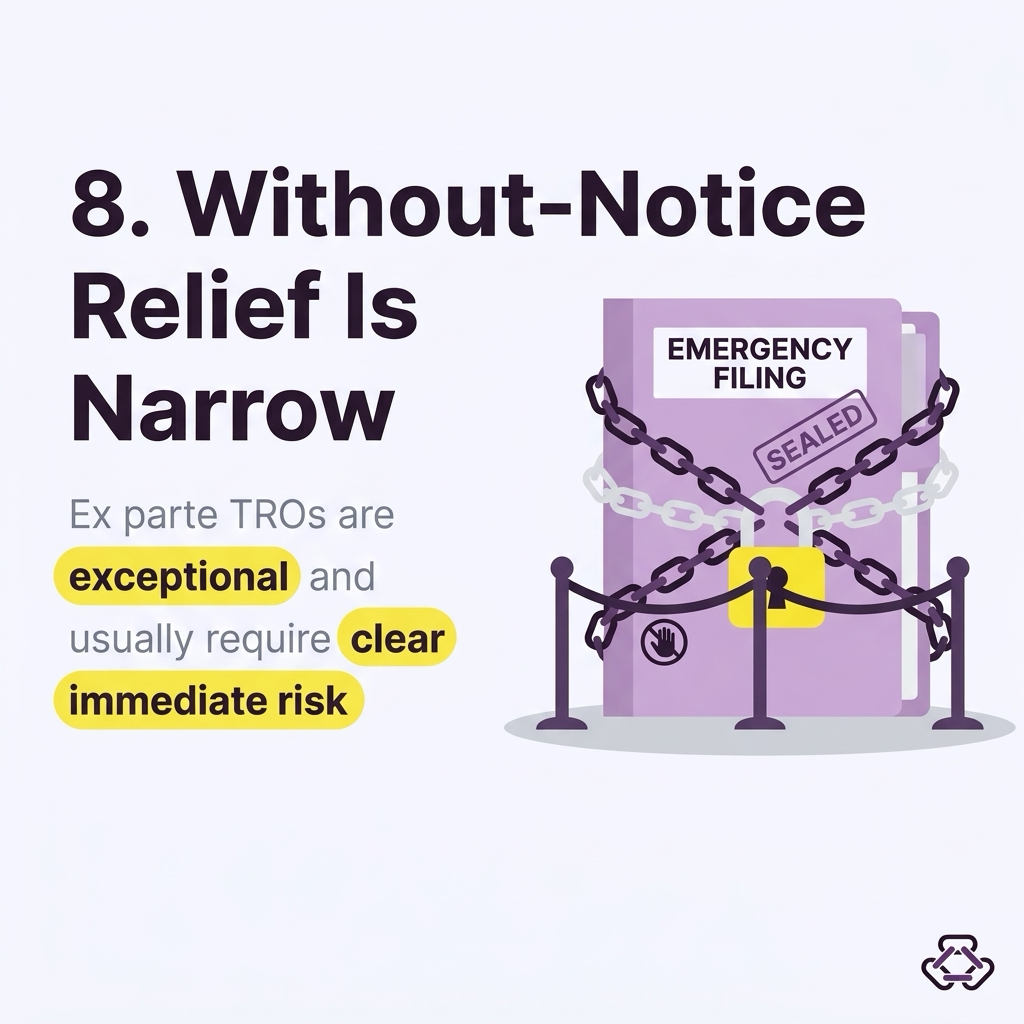
Can A Court Grant Relief Without Telling The Other Side First?
Sometimes, but only in narrow circumstances.
Federal Rule 65 allows a TRO without notice only where immediate and irreparable injury is clearly shown and counsel certifies notice efforts and the reasons notice should not be required. Courts generally treat that as exceptional, not routine. Some courts openly note that ex parte TRO practice is disfavored and reserved for genuine urgency, as reflected in district court emergency-motion procedures such as the District of Utah’s emergency motion order and the Western District of Louisiana’s after-hours ex parte TRO procedures.
In plain terms, if the concern is that advance notice would trigger asset flight, data deletion, or some other irreversible harm, a without-notice request may be considered. If the situation can safely proceed with notice, courts often prefer that path.
Does The Business Seeking An Injunction Have To Post A Bond?
Often yes.
Rule 65(c) states that a federal court may issue a TRO or preliminary injunction only if the movant gives security in an amount the court considers proper to cover costs and damages sustained by a party later found to have been wrongfully enjoined. In practice, this is commonly called an injunction bond.
The amount can vary dramatically. Sometimes it is nominal. Sometimes it is substantial. The court’s view of the potential harm from a wrongful injunction often drives the number.
For businesses, this can become a major strategic consideration. A company may feel pressure to move immediately, but the bond issue can affect cash flow, leverage, and the scope of relief requested.
Are Emergency Business Injunctions Common In Delaware And Other Business Courts?
Yes—especially in jurisdictions with active commercial dockets.
Delaware’s Court of Chancery remains one of the most prominent forums for corporate and business injunction litigation. The court’s own materials highlight its concentration in business law matters, and its guidelines include sample scheduling stipulations for preliminary injunction practice in Chancery cases, available through the court’s guidelines for litigating in Chancery and the Court of Chancery information page.
Beyond Delaware, emergency business injunctions also appear frequently in:
- federal district courts
- state commercial divisions
- intellectual property courts
- franchise and distribution disputes
- partnership and LLC control fights
The exact procedures can differ a lot from court to court. That is one reason lawyers with documented experience in the relevant forum and motion practice may bring meaningful value at the outset.
What Makes These Cases So High-Stakes?
Because the first hearing can shape the rest of the case.
A TRO or preliminary injunction hearing often arrives before full discovery, before expert work is complete, and before either side has had months to refine the record. Yet the result may influence negotiations, operations, investor relations, customer behavior, and litigation leverage almost immediately.
That front-loaded pressure is part of what makes emergency injunction cases different from ordinary business lawsuits.
It also explains why businesses often look for counsel with:
- relevant courtroom experience
- familiarity with emergency motion procedure
- demonstrated work in highly similar matters
- a record of handling fast-moving evidentiary disputes
- comfort with the specific court involved
In high-value commercial disputes, litigation spending can be significant. Norton Rose Fulbright’s 2025 litigation trends survey reported that large organizations were spending substantial sums annually on litigation, with average annual spend in the millions, underscoring how quickly business disputes can become expensive when they escalate. Even if your dispute is smaller than that, the survey is a reminder that speed, scope, and forum can change the cost profile fast.
What Are Some Common Misunderstandings?
“If The Harm Is Financial, An Injunction Is Impossible”
Not exactly. Courts often distinguish between ordinary financial loss and business harm that is difficult to quantify or unwind, such as loss of goodwill, confidentiality, control, or unique opportunities.
“If It Is Urgent, The Court Will Automatically Intervene”
Not necessarily. Courts move quickly on true emergencies, but the legal burden remains demanding.
“A Strong Underlying Claim Automatically Produces Fast Relief”
Not always. A strong claim can still fail at the emergency stage if the irreparable-harm showing is weak, the delay is hard to explain, or the requested order is too broad.
“The First Filing Can Be Fixed Later”
Sometimes it can, but emergency proceedings often place unusual weight on the initial papers, declarations, exhibits, and requested form of order.
What Should A Business Owner Keep In Mind Early?
When companies first start exploring emergency relief, a few practical themes tend to matter:
- the exact timeline of events
- whether the harm is ongoing right now
- what evidence already exists
- whether notice to the other side creates additional risk
- which court and forum rules apply
- whether a bond may be required
- whether the requested relief is narrow enough to be realistic
In many cases, the biggest early question is not simply “Do we have a lawsuit?” It is “Can we prove a present emergency in a way this court will recognize?”
That is a different question, and it often calls for a different kind of preparation.
Why Attorney Fit Matters In Emergency Injunction Cases
Emergency business injunctions are highly procedural, fact-specific, and forum-sensitive. The attorney who handles a long-form contract dispute well is not always the same attorney who is built for a 24-hour TRO application, a rapid declaration package, and a contested hearing on a limited record.
That is where objective fit becomes especially important.
Some businesses start by looking for a commercial litigator. That can be a useful starting point, but in urgent injunction matters, many people also want to know whether counsel has demonstrable experience with TROs, preliminary injunctions, trade secret disputes, control fights, restrictive covenant litigation, or emergency Chancery or federal motion practice.
A platform built around case similarity, court records, and documented experience can help surface lawyers whose background is relevant to the emergency at hand—not based on advertising, and not based on broad claims, but based on evidence from prior matters.
Final Thoughts
Emergency business injunctions exist for moments when waiting may carry its own risk. They are powerful tools, but also narrow, demanding, and intensely fact-driven. The key issues often include timing, irreparable harm, the quality of the evidence, the scope of the requested order, and the experience of the attorney presenting the request.
If your business is facing a fast-moving legal threat, you may want to consider finding counsel with verified experience in highly similar emergency matters and in the specific court where relief may be sought.
Visit ReferU.AI to get matched with an attorney who has demonstrable experience in cases like yours — for free.
