Table of Contents
- 9 Questions Companies Ask When a Key Vendor Stops Performing
- Why These Questions Matter Early
- 1. Is This Actually A Breach, Or Just A Business Problem?
- 2. Can We Reject The Goods Or Refuse Further Performance?
- 3. Do We Have To Give The Vendor A Chance To Cure?
- 4. Is The Vendor Protected By Force Majeure Or Some Other Excuse?
- 5. Can We Buy From Someone Else Right Now?
- 6. What Damages Can The Company Realistically Try To Recover?
- 7. Did We Do Anything That Could Hurt Our Position?
- 8. Is It Better To Negotiate, Terminate, Or File A Claim?
- 9. What Kind Of Attorney Handles A Vendor Performance Dispute?
- A Final Thought On Timing

Type
Great Grandchild
Status
Approved
Title (YouTube)
Images Failed (Social)
Images Failed (Social)
Do not index
Parent item
Publish Date (TikTok)
Jan 5, 2027 14:15
Videos Post IDs (Social)
Hashtags (Social)
#LegalAdvice #LegalHelp #BusinessLitigation #VendorSupplyAgreement
Caption
Caption X
Cover

OG Image

Alt Image Text
Flat vector illustration of a company team assessing a key vendor stops performing scenario with supply delays, defective goods, contract review, and vendor dispute questions.
Images

Videos
Publish Date (Social)
Dec 16, 2026 09:30
Scheduled (Social)
Scheduled (Social)
Images Posted (Social)
Images Posted (Social)
Videos Posted (Social)
Videos Posted (Social)
Videos Failed (Social)
Videos Failed (Social)
Featured
Created time
Apr 3, 2026 10:12 PM
Sub-item
Authors
CTA Practice Area (Social)
Business Litigation
TikTok Failed (Social)
TikTok Failed (Social)
Videos Post Links (Social)
YT Auto Captions Removed
TikTok Post Links (Social)
Images Post IDs (Social)
YT Post ID
Video Pending Manual (Social)
TikTok Posted (Social)
TikTok Posted (Social)
TikTok Post IDs (Social)
Video Cover (Social)
Images Post Links (Social)
First Comment (Social)
YT Embedded
Images Delete (Social)
Videos Delete (Social)
Carousel Video URL (Social)
9 Questions Companies Ask When a Key Vendor Stops Performing
When a key vendor starts missing deliveries, shipping defective goods, going dark, or failing service levels, the business impact can spread fast. Production slows. Customer commitments get harder to meet. Finance starts tracking losses. Operations looks for workarounds. Leadership wants to know what the contract actually allows.
That is usually when the questions begin.
In this post you’ll learn the nine questions companies often ask when a vendor stops performing, what those questions often mean in practical terms, and where legal and operational issues tend to overlap. If you’re dealing with recurring delays, quality failures, short shipments, or a breakdown in a commercial supply relationship, it may also help to start with a broader overview of how vendor and supply agreement disputes usually unfold.
Scroll to the bottom for every post in this series.
Why These Questions Matter Early
Vendor failures are rarely just procurement problems. They can trigger contract disputes, customer claims, inventory shortages, expedited freight costs, compliance issues, and internal finger-pointing.
That broader risk environment is one reason supply disruption remains such a major business concern. In Gartner’s October 2024 survey of procurement leaders, 42% identified supply disruptions as the top risk to procurement’s future success (Gartner). McKinsey’s 2024 global survey also found that when companies experience a supply chain disruption, it takes them an average of two weeks to plan and execute a response (McKinsey).
That lag can become expensive. The earlier a company identifies the legal and factual issues, the easier it often becomes to preserve leverage, document losses, and evaluate alternatives.
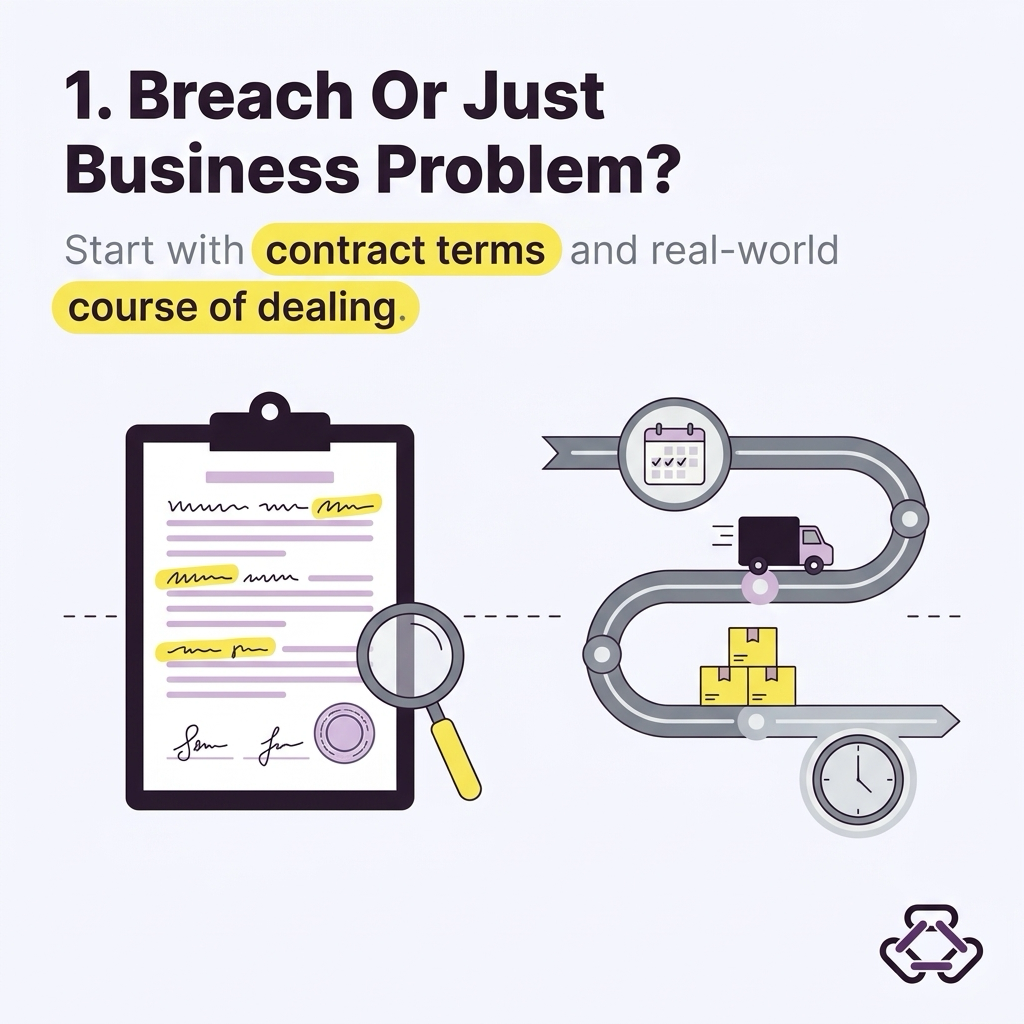
1. Is This Actually A Breach, Or Just A Business Problem?
This is often the first question because not every frustrating vendor issue amounts to a legal breach.
In general terms, the answer usually starts with the contract. Companies often look at:
- delivery dates and lead-time commitments
- specifications and quality standards
- service levels or KPIs
- quantity commitments and allocation language
- notice provisions
- cure periods
- force majeure clauses
- exclusivity, requirements, or minimum-purchase terms
For contracts involving the sale of goods, Article 2 of the Uniform Commercial Code often becomes part of the analysis under state law. Cornell’s Legal Information Institute explains the perfect tender rule as allowing a buyer to reject goods if the seller’s delivery fails to conform exactly to the contract terms (Cornell LII). In real disputes, though, that is rarely the end of the story. Acceptance, waiver, course of dealing, cure rights, and installment-contract rules can all affect the outcome.
This is why many companies ask a more practical follow-up question: what did the parties actually agree to, and how have they operated in the real world? If a vendor has been late for months and the buyer kept accepting shipments without objection, that history may become part of the dispute.
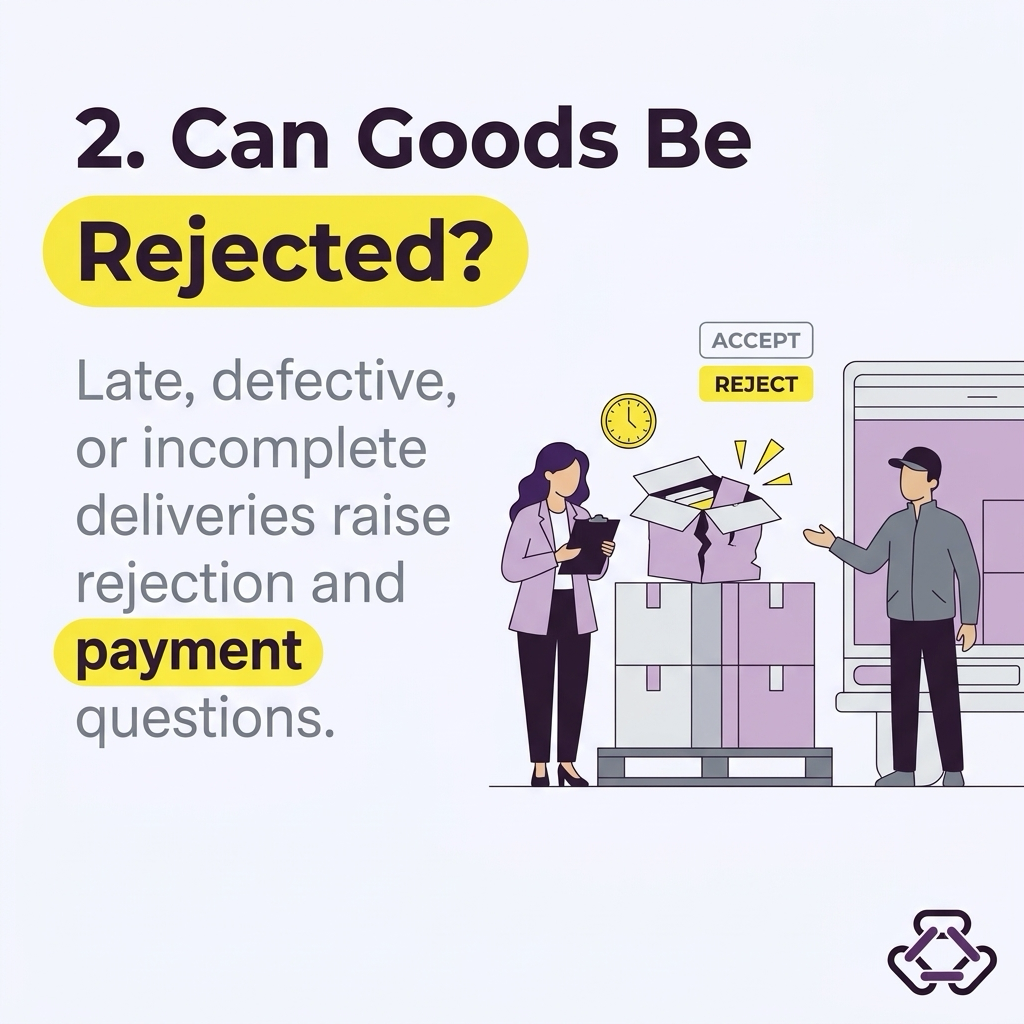
2. Can We Reject The Goods Or Refuse Further Performance?
If goods are late, defective, or incomplete, companies often want to know whether they can reject the shipment, withhold payment, suspend performance, or stop placing orders.
Sometimes the contract answers that directly. Sometimes state commercial law fills in the gaps. Cornell’s summary of the perfect tender rule notes that a buyer may reject nonconforming goods under Article 2 in many goods transactions (Cornell LII). But installment arrangements are often treated differently, and repeated acceptance can complicate later rejection arguments.
This is one area where facts matter a lot:
- Were the goods inspected?
- Were they accepted?
- Was notice of nonconformity sent?
- Did the vendor offer a cure?
- Is the problem isolated, or part of a pattern?
- Is the item mission-critical to ongoing operations?
A company may also want to separate rejection rights from practical business risk. Rejecting a shipment may preserve a position in the dispute, but it can also deepen a supply shortfall. That tradeoff is one reason businesses often evaluate legal options and contingency sourcing at the same time.
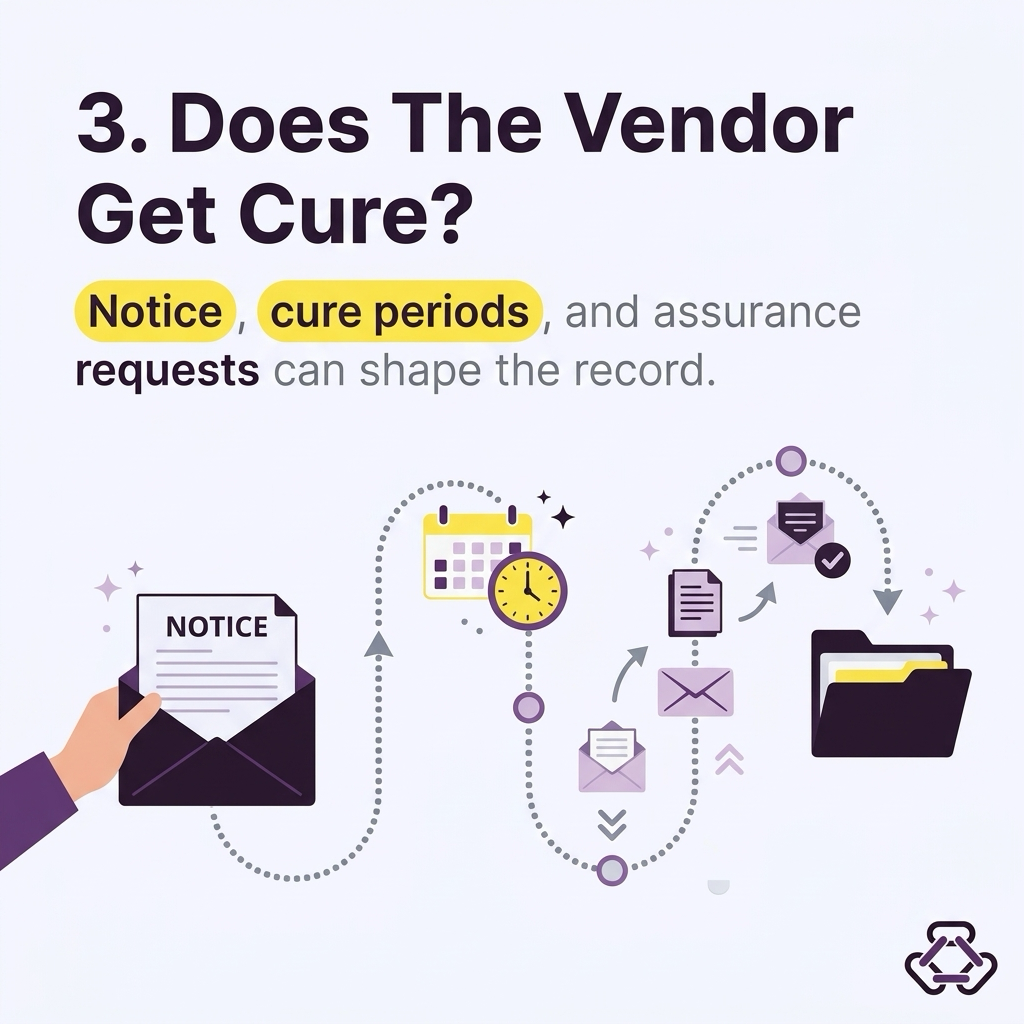
3. Do We Have To Give The Vendor A Chance To Cure?
A lot of companies assume that once a vendor misses the mark, the relationship can be terminated immediately. Sometimes that is true. Often it is more complicated.
Many commercial agreements include notice-and-cure provisions requiring written notice of default and a specified period to fix the issue. Even where the contract language is less explicit, commercial law often gives weight to whether the alleged breaching party was told what the problem was and whether it had a meaningful chance to respond.
There is also a related concept known as adequate assurance. Under the UCC framework, when reasonable grounds for insecurity arise, a party may demand written assurance of due performance; if adequate assurance is not provided within a reasonable time, that can support a repudiation analysis (Cornell LII, UCC § 2A-401). While that cited section is from the lease article, the broader commercial principle is familiar in supply disputes: if the other side is signaling trouble, a formal written demand can become an important part of the record.
In practice, companies often ask:
- What exactly do we say in the notice?
- How much detail is enough?
- Who has to receive it?
- Does email count under the contract?
- Are we preserving rights, or accidentally waiving them?
Those questions can matter more than they look at first glance.
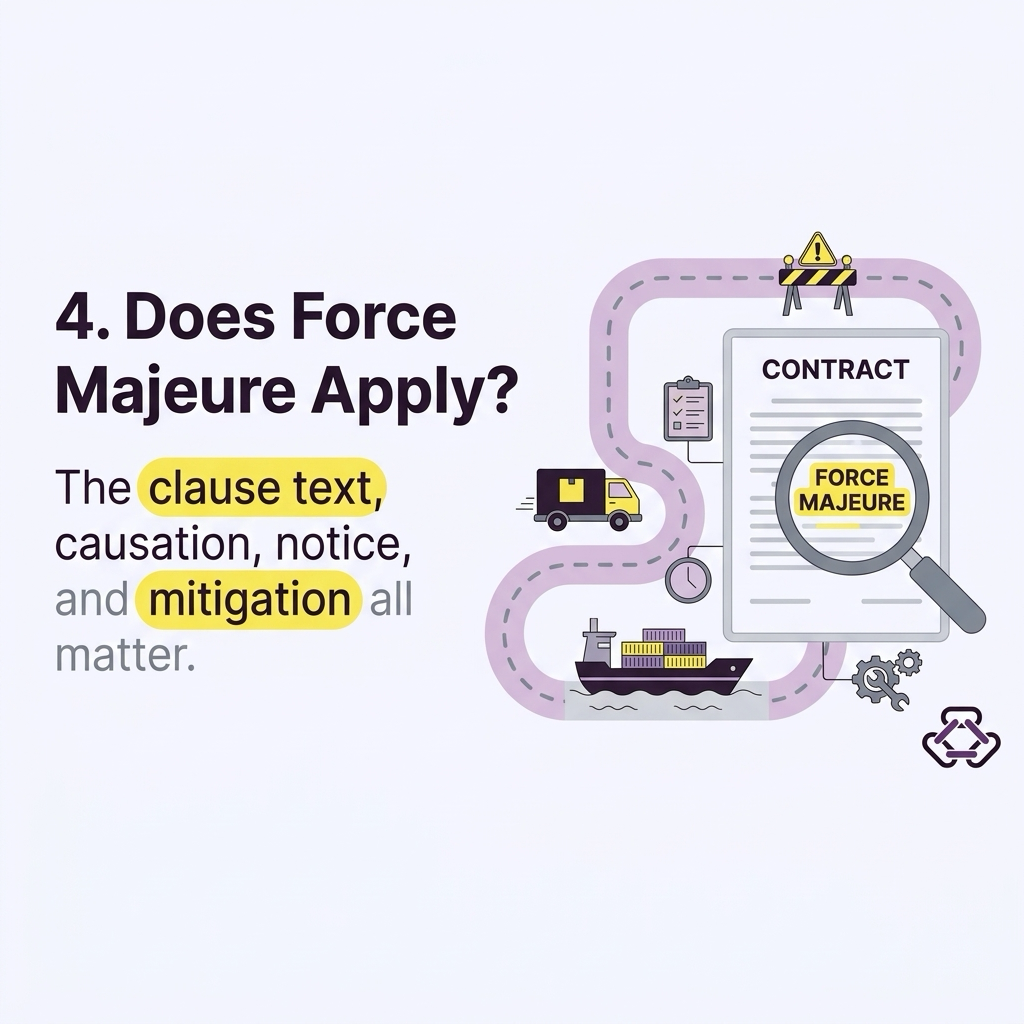
4. Is The Vendor Protected By Force Majeure Or Some Other Excuse?
When performance breaks down, vendors commonly point to labor shortages, transportation bottlenecks, raw-material scarcity, tariffs, cyber incidents, government action, or extreme weather. The legal issue is usually whether the contract actually excuses the nonperformance.
A force majeure clause is not a magic shield. The text matters. Some clauses are narrow and event-specific. Others are broader. Some excuse only delay, while others allow suspension or termination after a prolonged event. Some require prompt notice and mitigation efforts.
Operational guidance also reflects how common these risk-mapping issues have become. NIST notes that supply chain mapping and risk assessment can help companies identify sources of risk and build plans around alternative suppliers and safety stock (NIST). NIST has also emphasized the importance of supplier metrics and performance review systems in managing supplier relationships before a disruption becomes a legal conflict (NIST).
From a dispute perspective, companies often want to know:
- Is the cited event covered by the clause?
- Did the event actually cause the failure?
- Was the vendor already underperforming before the event?
- Did the vendor give the required notice?
- Did the vendor try to mitigate the impact?
- Is allocation among customers allowed?
Those details often determine whether “force majeure” is a valid defense or just a label attached after the fact.
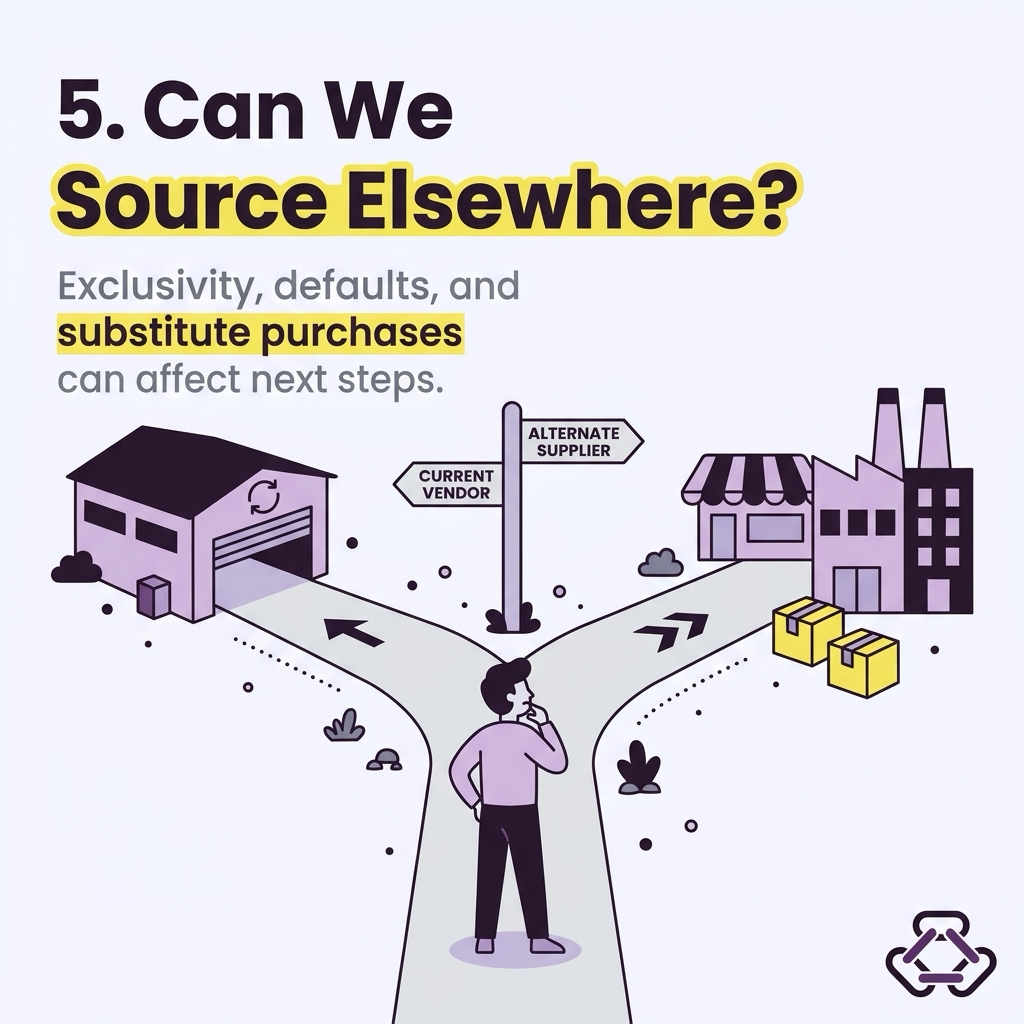
5. Can We Buy From Someone Else Right Now?
Once a key vendor becomes unreliable, business teams typically ask a simple question with major legal consequences: Can we source elsewhere immediately?
Sometimes the answer depends on exclusivity terms, minimum-volume commitments, approved-supplier restrictions, or intellectual property limitations. In other situations, the buyer may be free to obtain substitute goods or services, especially after a breach, repudiation, or uncured default.
From a damages standpoint, substitute sourcing can also become central to the claim. Commercial law often recognizes “cover” concepts, meaning reasonable substitute purchases after a seller’s failure. That is one reason companies usually document replacement pricing, expedite fees, engineering rework, and timing impacts carefully.
McKinsey’s 2024 survey found that 73% of respondents reported progress on dual-sourcing strategies, reflecting how many companies are trying to build resilience before the next disruption arrives (McKinsey). NIST likewise highlights secondary or alternative suppliers as part of supply chain risk planning (NIST).
If your team is trying to balance legal rights with business continuity, it may help to read more about handling a supply contract dispute before operations absorb even more damage. The operational timeline often moves faster than the legal one.
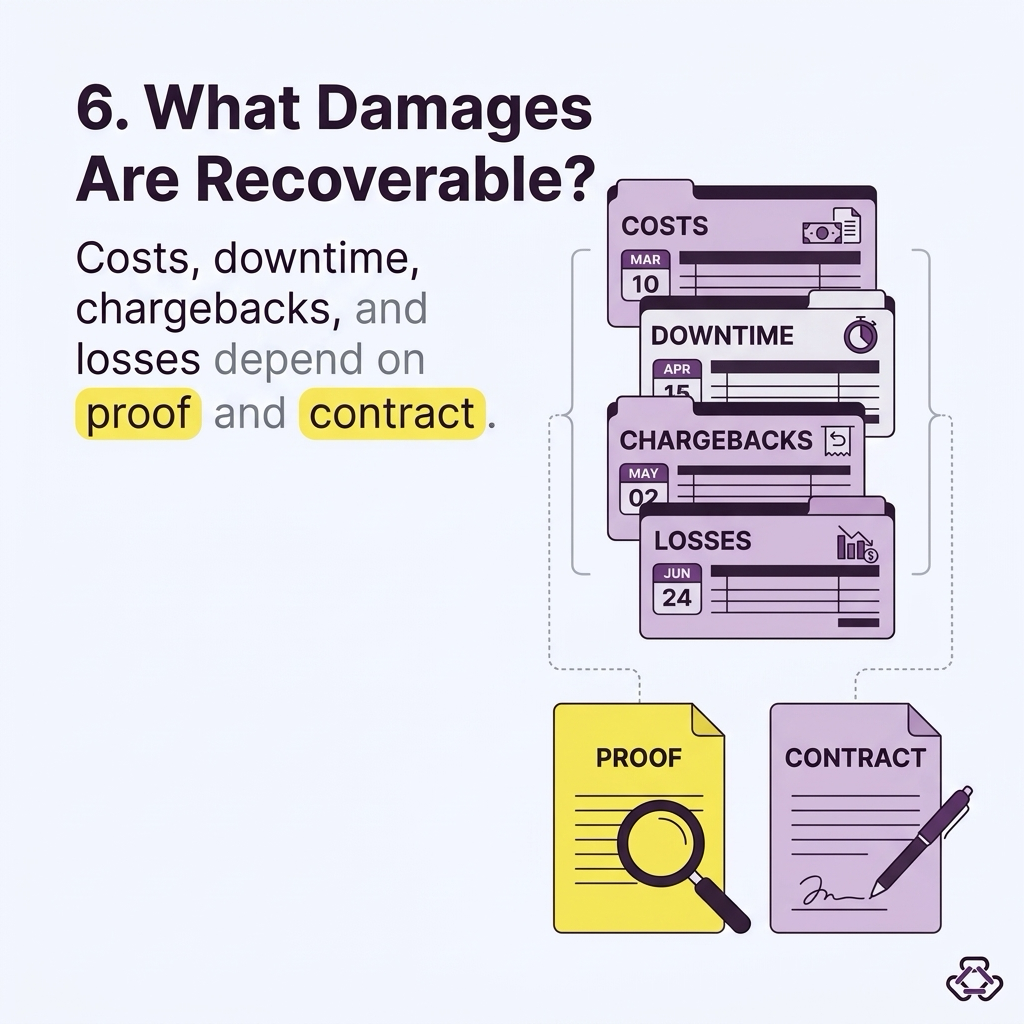
6. What Damages Can The Company Realistically Try To Recover?
This is usually where executives start focusing hard. The direct price difference is often only part of the picture.
In vendor nonperformance disputes, companies frequently ask about:
- increased replacement costs
- expedited shipping and logistics expenses
- extra labor and overtime
- rework, testing, or inspection costs
- production downtime
- lost inventory value
- customer chargebacks
- lost sales or lost profits
- reputational harm
- internal administrative costs
Whether those items are recoverable usually depends on the contract, state law, proof, and causation. Many supply agreements limit consequential, incidental, special, or indirect damages. Some carve out exceptions for confidentiality breaches, indemnity obligations, willful misconduct, or unpaid invoices. Others are silent, leaving default legal rules to do more work.
This is where documentation becomes the backbone of the case. Finance may have one number. Operations may have another. Sales may describe customer fallout that has not yet been quantified. A legal claim often gets stronger when the company can connect each category of loss to dated records, substitute purchases, missed deliveries, quality reports, internal escalation emails, and customer impacts.
That is also why businesses in this situation often spend time on documenting delivery failures, quality issues, and downstream losses in a way that supports a vendor claim. In many disputes, the paper trail shapes the leverage.
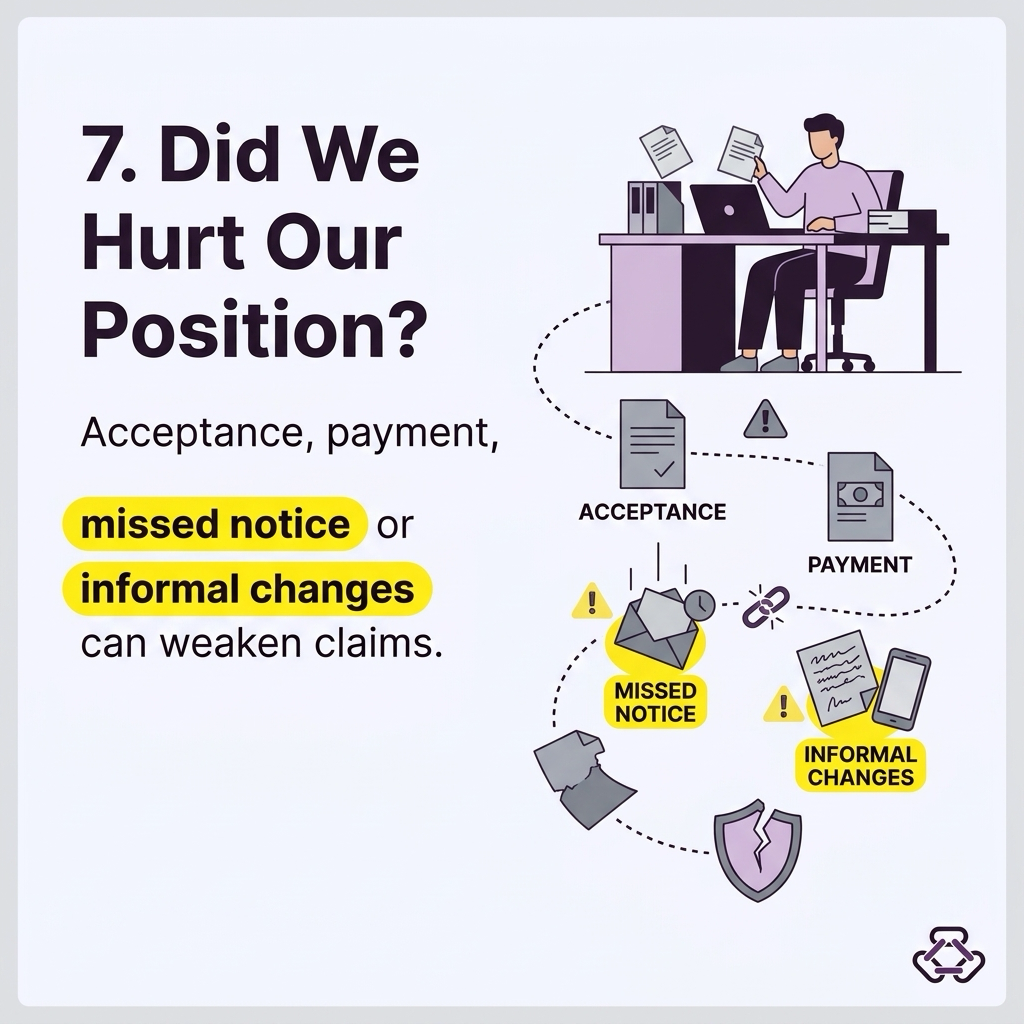
7. Did We Do Anything That Could Hurt Our Position?
This can be an uncomfortable question, but it is one companies ask for a reason.
A buyer’s own conduct can affect the dispute. Common issues include:
- continuing to accept late or defective shipments without clear objection
- paying invoices despite known defaults
- failing to follow contractual notice procedures
- missing inspection deadlines
- modifying terms informally by email or phone
- failing to mitigate losses after the breach becomes clear
- making internal statements that undercut causation or damages
Commercial disputes are often not clean “good party versus bad party” stories. They are records-based arguments about who said what, who knew what, what was accepted, what was waived, and what losses actually flowed from the breach.
This is one reason companies often review their own contract administration practices after a vendor breakdown. If that sounds familiar, it may be worth exploring some of the common supply agreement mistakes that can quietly weaken a later recovery effort. Sometimes the issue is not the original default alone. Sometimes it is how the default was handled internally afterward.
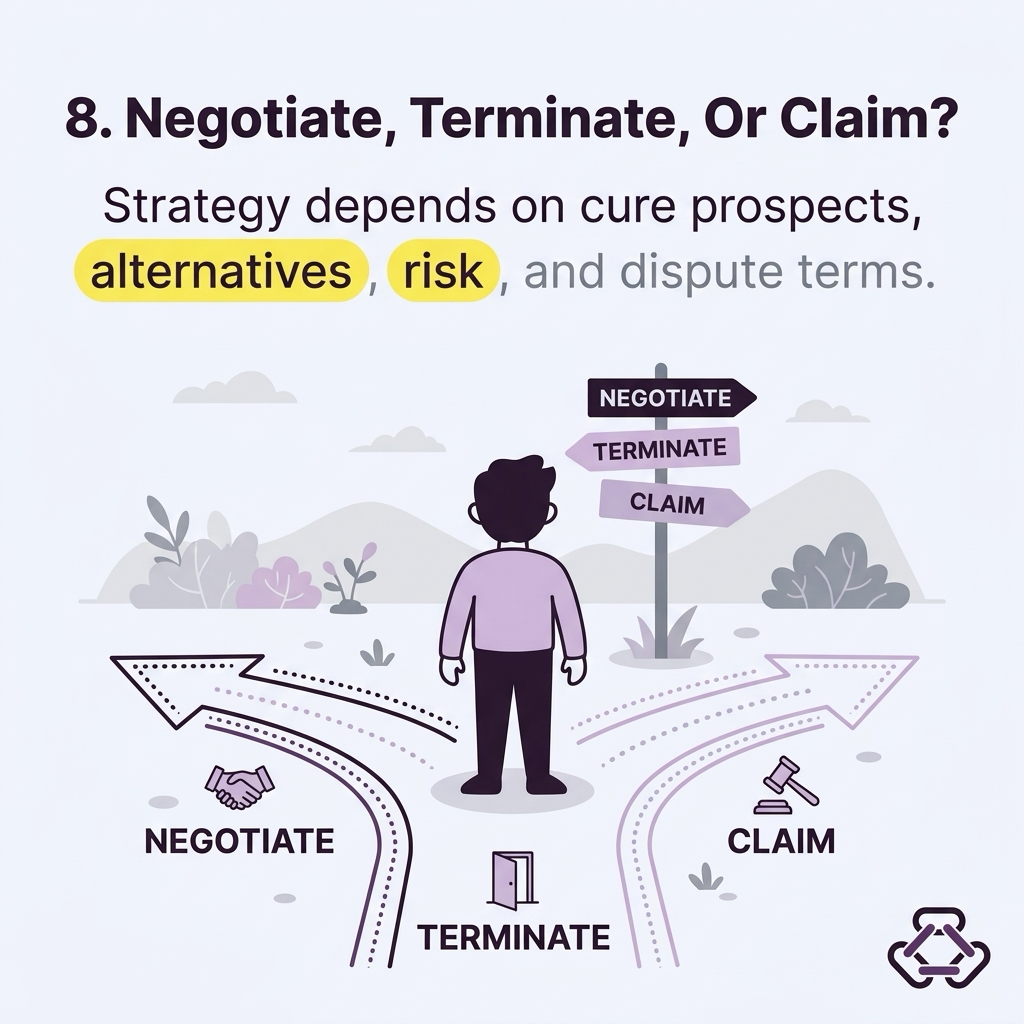
8. Is It Better To Negotiate, Terminate, Or File A Claim?
Not every vendor failure turns into litigation, and not every commercial dispute benefits from immediate escalation.
A lot depends on the answers to earlier questions:
- Is the vendor strategically important?
- Is there a realistic cure plan?
- Has trust broken down?
- Are there alternative sources?
- Is the company trying to preserve the relationship or replace it?
- Is the damage ongoing?
- Does the contract require mediation, arbitration, or a particular forum?
- Are there insurance, indemnity, or pass-through issues in the background?
NIST’s supply chain guidance emphasizes structured supplier evaluation, metrics, and relationship management as part of a broader procurement strategy (NIST; NIST). That operational perspective often overlaps with dispute resolution strategy: sometimes the best result comes from a negotiated recovery plan with tighter controls; other times the facts point toward exit and formal claims.
Legal counsel can help translate those business realities into a strategy that matches the contract, the evidence, and the company’s tolerance for ongoing risk.
9. What Kind Of Attorney Handles A Vendor Performance Dispute?
This is the question many companies ask after they have already spent weeks trying to solve the issue internally.
In general terms, a vendor nonperformance dispute often falls into the world of commercial litigation, business litigation, contract disputes, or supply chain and procurement disputes. Depending on the industry, it may also touch product liability, manufacturing, distribution, technology transactions, construction supply, government contracts, or cross-border trade.
The more useful question is often not “Who is a business lawyer?” but “Who has relevant, documented experience with highly similar matters?”
That can include experience with:
- UCC sales disputes
- defective goods and rejection claims
- delayed delivery and shortfall disputes
- supplier termination issues
- force majeure and allocation disputes
- warranty and indemnity provisions
- consequential-damages limitations
- emergency injunction requests
- complex damages models involving lost production or customer fallout
When legal issues are moving alongside operational disruption, many companies are not looking for general familiarity. They are looking for fit based on evidence — counsel with demonstrable experience handling disputes involving similar contract structures, similar industries, and similar breakdowns in vendor performance.
A Final Thought On Timing
When a key vendor stops performing, the questions above tend to appear in clusters, not in sequence. Operations wants product. Procurement wants leverage. Finance wants damage numbers. Leadership wants options. Legal wants a clean record.
That is exactly why these disputes can turn messy fast.
The earlier a company gets clarity on the contract, the factual timeline, the notice record, and the damage model, the easier it often becomes to make informed decisions about cure, replacement sourcing, negotiation, or formal claims. And when the dispute is already affecting production, customer relationships, or revenue, attorney selection often becomes part of the business response — not just the legal response.
Visit ReferU.AI to get matched with an attorney who has demonstrable experience in cases like yours — for free.
