Table of Contents
- 9 Questions Victims Ask After an Assault on Unsafe Property
- Why These Cases Come Up So Often
- 1. Can The Property Owner Be Held Responsible For What Another Person Did?
- 2. What Makes Property “Unsafe” In A Negligent Security Case?
- 3. Do Prior Incidents Matter?
- 4. What Evidence Helps Show The Property Was Negligently Secured?
- 5. Does It Matter If I Didn’t Report Everything Right Away?
- 6. What Damages Are Usually Part Of These Cases?
- 7. Who Can Be Named In A Claim Besides The Property Owner?
- 8. How Long Do I Have To Bring A Claim?
- 9. Do I Really Need A Lawyer For This Type Of Case?
- What Victims Often Overlook In The First Few Days
- The Scene Changes Quickly
- Management May Minimize Prior Problems
- The Criminal Case And Civil Case Are Different
- Emotional Injuries Matter Too
- A Short Summary

Type
Great Grandchild
Status
Approved
Title (YouTube)
Images Failed (Social)
Images Failed (Social)
Do not index
Parent item
Publish Date (TikTok)
Apr 1, 2027 06:15
Videos Post IDs (Social)
Hashtags (Social)
#LegalAdvice #LegalHelp #PersonalInjury #NegligentSecurity
Caption
Caption X
Cover

OG Image

Alt Image Text
Flat vector illustration of a victim on unsafe property near broken security features, representing negligent security after an assault.
Images

Videos
Publish Date (Social)
Feb 4, 2027 11:30
Scheduled (Social)
Scheduled (Social)
Images Posted (Social)
Images Posted (Social)
Videos Posted (Social)
Videos Posted (Social)
Featured
Created time
Apr 7, 2026 01:42 PM
Sub-item
Authors
CTA Practice Area (Social)
Personal Injury
TikTok Failed (Social)
TikTok Failed (Social)
Videos Post Links (Social)
TikTok Post Links (Social)
Images Post IDs (Social)
YT Post ID
Video Pending Manual (Social)
TikTok Posted (Social)
TikTok Posted (Social)
TikTok Post IDs (Social)
Video Cover (Social)
Images Post Links (Social)
First Comment (Social)
Videos Failed (Social)
Videos Failed (Social)
YT Embedded
Images Delete (Social)
Videos Delete (Social)
Carousel Video URL (Social)
9 Questions Victims Ask After an Assault on Unsafe Property
An assault on unsafe property can leave people dealing with far more than physical injuries. There may be shock, fear, lost work, medical bills, and a long list of questions about what happened and who may be legally responsible. In many cases, victims are not just asking what the attacker did. They are also asking whether the apartment complex, hotel, bar, parking garage, shopping center, or event venue ignored obvious safety risks.
This is where negligent security issues often come into focus. If a property owner or operator failed to address foreseeable dangers, civil liability may become part of the conversation. For a broader look at how these cases work, it may help to start with our guide on when unsafe property conditions can become a negligent security claim.
In this post, you’ll learn the nine questions victims often ask after an assault on unsafe property, what those questions often mean legally, and how an attorney may help evaluate whether the facts point to a negligent security case.
Scroll to the bottom for every post in this series.
Why These Cases Come Up So Often
Assault-related injuries remain a major public health and legal issue in the United States. The CDC reports an annual average of about 1.5 million emergency department visits for assault injuries in 2019–2021, with higher rates in metropolitan areas than non-metro areas. That matters because many negligent security cases arise in places like apartment complexes, retail centers, hotels, nightclubs, and parking facilities in densely populated areas (CDC). The Office for Victims of Crime also notes that every state has victim assistance and compensation resources that may help with medical care, counseling, lost wages, and other crime-related costs (OVC).
Against that backdrop, here are the questions many victims ask first.
1. Can The Property Owner Be Held Responsible For What Another Person Did?
This is usually the first question, and it is also the one that causes the most confusion.
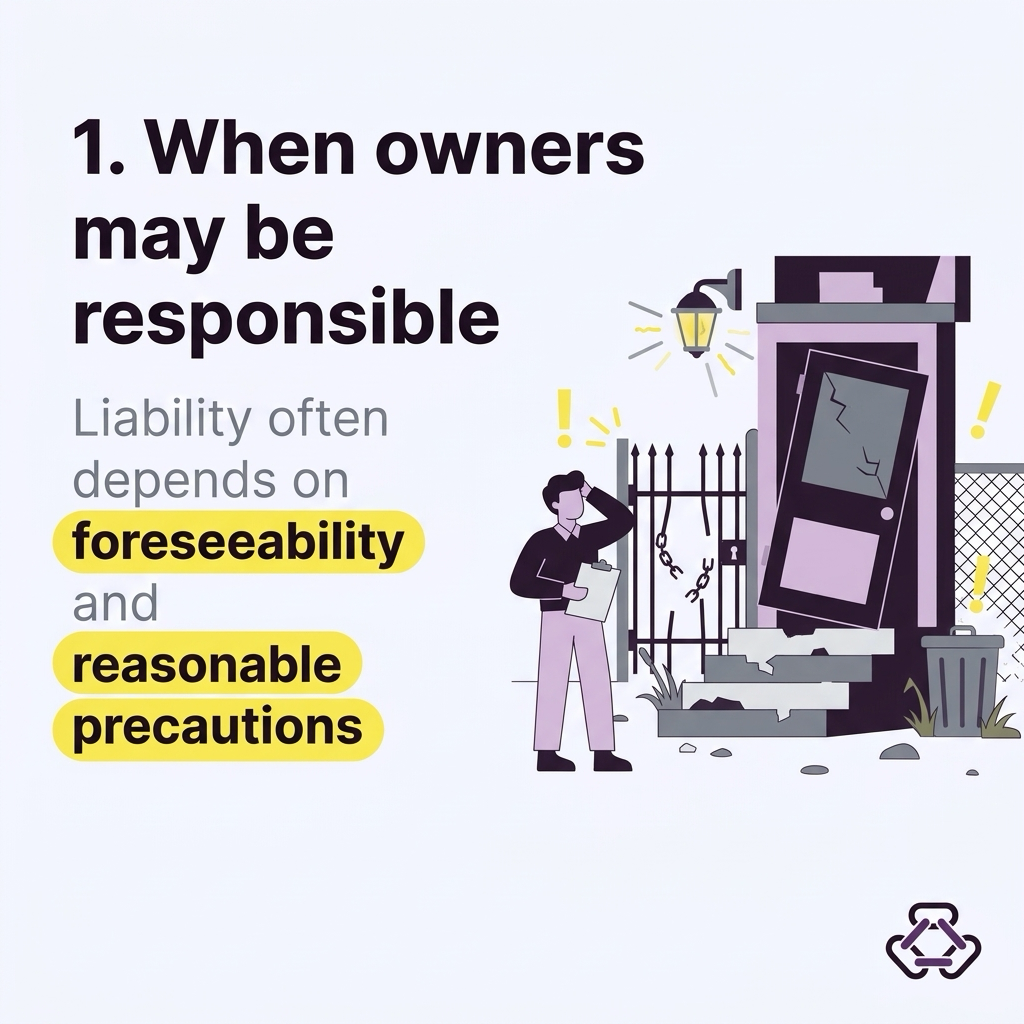
In general terms, a property owner is not automatically responsible for every criminal act committed by a third party on the premises. These cases usually turn on foreseeability. The central issue is often whether the owner, landlord, business, management company, or security contractor knew or had reason to know that violent crime was a real risk and failed to take reasonable precautions.
The American Bar Association explains that, in most jurisdictions, a business owner is not liable for third-party criminal acts unless those acts were foreseeable. The ABA also discusses the common legal principle that an owner may have a duty to take precautions when the place, character, or past experience of the property indicates criminal conduct could reasonably be anticipated (American Bar Association).
Here’s what this often means in everyday language: if a property had repeated fights, robberies, break-ins, shootings, sexual assaults, or trespassing complaints, and the owner still left gates broken, lights out, locks unrepaired, cameras nonfunctional, or security absent, that fact pattern may raise serious legal questions.
2. What Makes Property “Unsafe” In A Negligent Security Case?
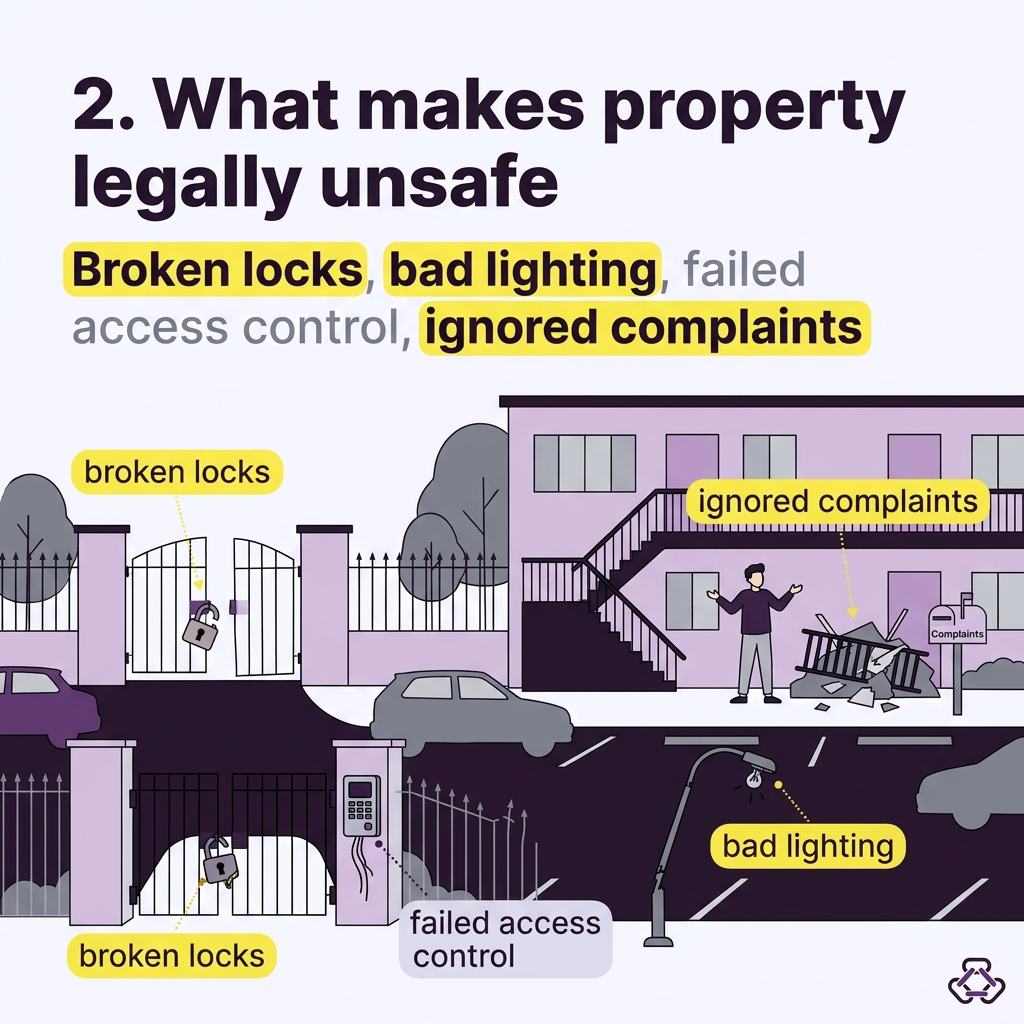
“Unsafe” does not just mean dangerous in a general sense. In negligent security cases, unsafe property often involves a specific failure to provide reasonable protection against foreseeable crime.
That can include things like:
- broken access gates
- defective door locks
- poor lighting in parking lots or stairwells
- missing security guards where guards were warranted
- malfunctioning surveillance cameras
- uncontrolled access to residential buildings
- failure to respond to prior tenant or customer complaints
- lack of security policies for known high-risk events or locations
Not every missing safety measure creates liability. A property owner is not an insurer of everyone’s safety. But when known risks go unaddressed, the condition of the property can become a major part of the case.
If you want to go deeper on what evidence tends to matter, our related article on building a case against a property owner after a violent incident would normally be the next step. And if the issue involves complaints, maintenance logs, photos, or missing cameras, our piece on collecting the right records and evidence after unsafe security failures is the kind of follow-up many readers look for.
3. Do Prior Incidents Matter?
Very often, yes.
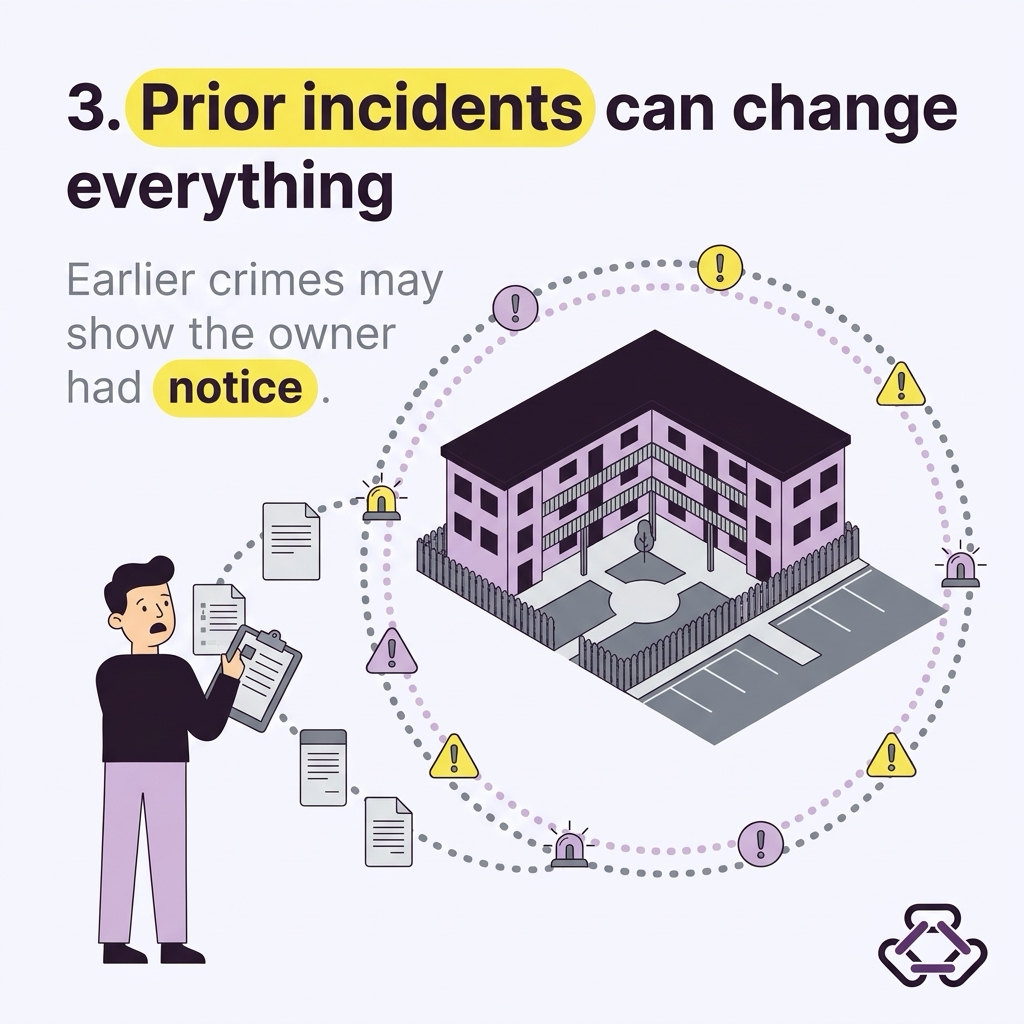
Prior incidents are one of the most important parts of many negligent security claims because they can help show the assault was foreseeable. If similar crimes happened before in the same complex, on the same block of the property, or in nearby common areas, a victim’s attorney may try to use that pattern to show the owner had notice of the danger.
Courts do not always require identical prior crimes. The exact rule varies by state. But the general question is whether earlier incidents were enough to put the owner on notice that stronger security measures may have been necessary.
That is why police calls for service, 911 logs, incident reports, tenant complaints, internal emails, maintenance requests, and private security records can become so important. In many cases, what happened before the assault says a lot about what the owner knew beforehand.
If you are trying to understand the bigger framework around prior incidents and owner responsibility, the broader discussion in our negligent security overview may help connect those dots.
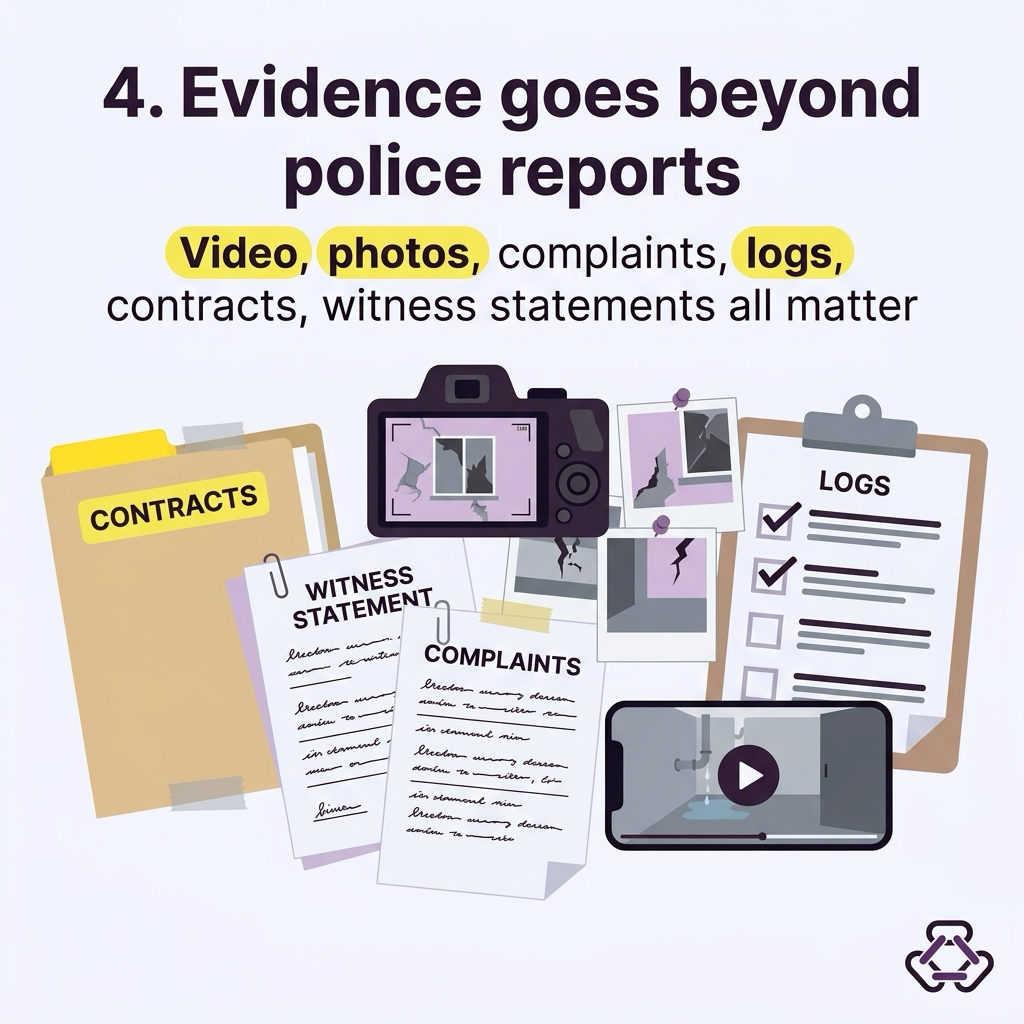
4. What Evidence Helps Show The Property Was Negligently Secured?
Victims often assume the case will depend only on medical records or a police report. Those records matter, but negligent security cases usually involve a much wider set of evidence.
Common examples include:
- police reports and 911 dispatch records
- surveillance footage from the property or nearby businesses
- photographs of broken locks, bad lighting, damaged gates, or blind spots
- lease documents, guest policies, or event security plans
- prior incident logs
- emails or texts complaining about trespassers, threats, or broken security features
- witness statements from tenants, employees, patrons, or neighbors
- repair records showing long-term safety problems
- contracts with private security companies
- staffing records showing whether guards were missing or untrained
In some situations, evidence disappears quickly. Video may be overwritten in days. Physical conditions may be repaired. Employees may leave. That is one reason many victims look for legal help early, even while they are still figuring out whether they want to pursue a claim.
For a more detailed breakdown, people often look for practical guidance on documenting complaints, missing security measures, and injury evidence, especially when management is already denying there was a problem.
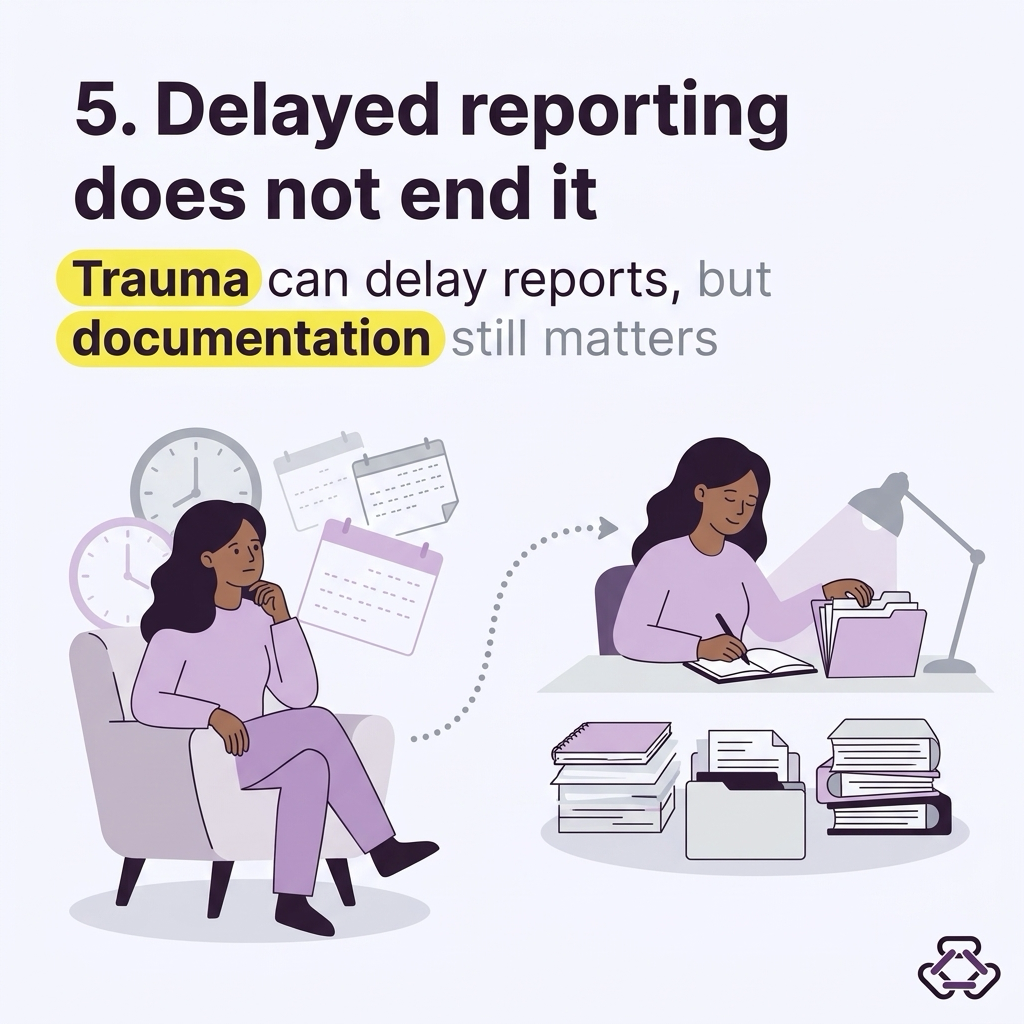
5. Does It Matter If I Didn’t Report Everything Right Away?
Many victims worry that a delayed police report, delayed medical visit, or delayed complaint to management will ruin the case.
In reality, trauma does not always produce a clean timeline. People may leave the scene in shock, focus on immediate safety, seek help from family before police, or avoid reporting because they are overwhelmed. That does not automatically end a potential claim.
Still, timing can affect evidence. Police reports, medical evaluations, and property incident reports often create a clearer record of what happened. Medical documentation can also connect injuries to the assault. For sexual assault survivors in particular, the Office for Victims of Crime notes that a forensic medical exam can be performed without requiring cooperation with law enforcement, and in many jurisdictions the exam is paid for by the state or another governmental entity (OVC).
Some survivors also worry about privacy. OVC materials discuss options that may help protect confidentiality, including limits on disclosure and requests for notice if records are subpoenaed (OVC).
So if reporting was delayed, the legal issue often becomes how the facts can still be documented, not whether the experience “counts.”
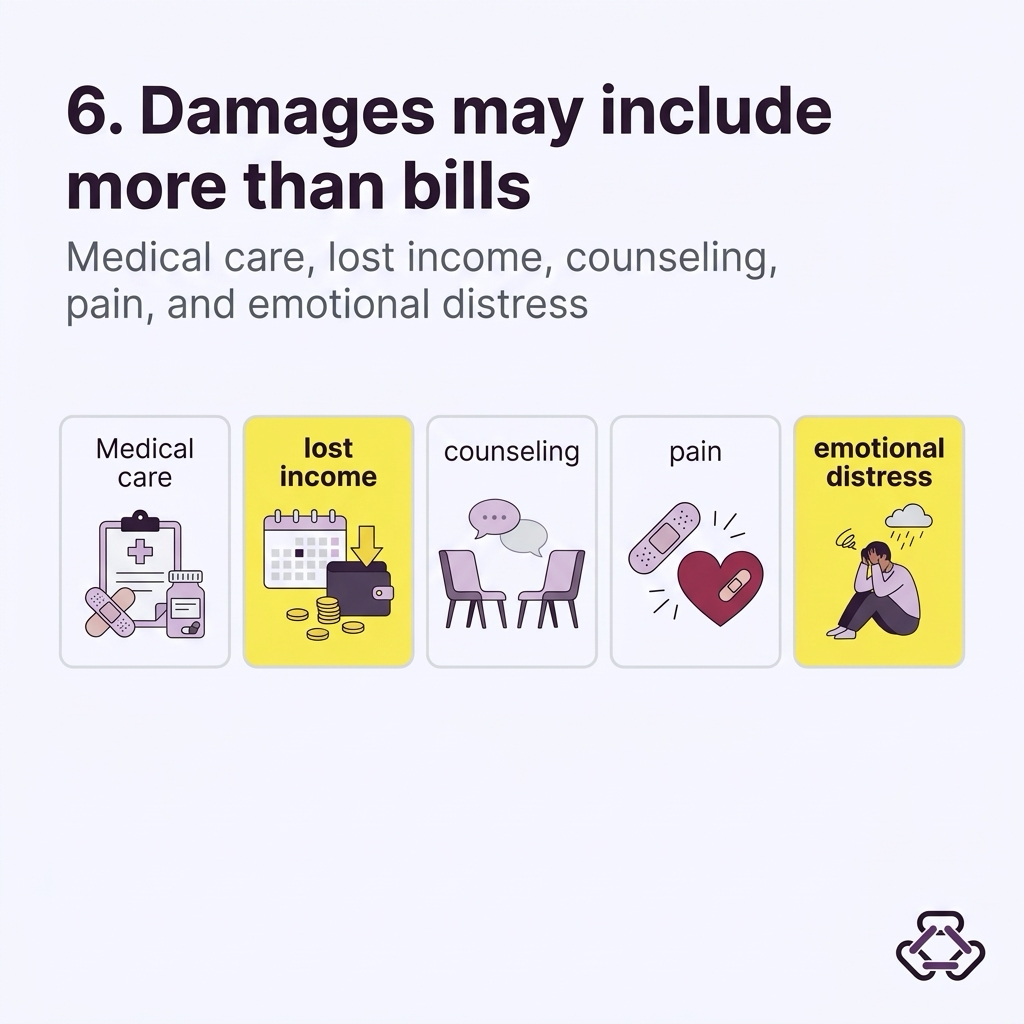
6. What Damages Are Usually Part Of These Cases?
Victims often ask this question carefully, because it can feel uncomfortable to talk about money after a violent event. But damages are a central part of any civil claim.
Depending on the facts and state law, damages in an unsafe-property assault case may include compensation related to:
- emergency medical treatment
- hospitalization
- surgery or follow-up care
- therapy and trauma counseling
- prescription costs
- lost income
- reduced ability to work
- pain and suffering
- emotional distress
- long-term disability or scarring
Separate from any lawsuit, victims also may have access to crime victim compensation programs. The Office for Victims of Crime explains that state compensation programs may reimburse medical services, mental health counseling, lost wages, and other costs incurred as a result of the crime (OVC). OVC reporting has also shown large categories of compensation payments going toward medical expenses, forensic exams, and economic support (OVC).
That does not mean every victim will qualify for every category, or that compensation programs replace a civil case. But it does mean there may be more than one path to financial support.
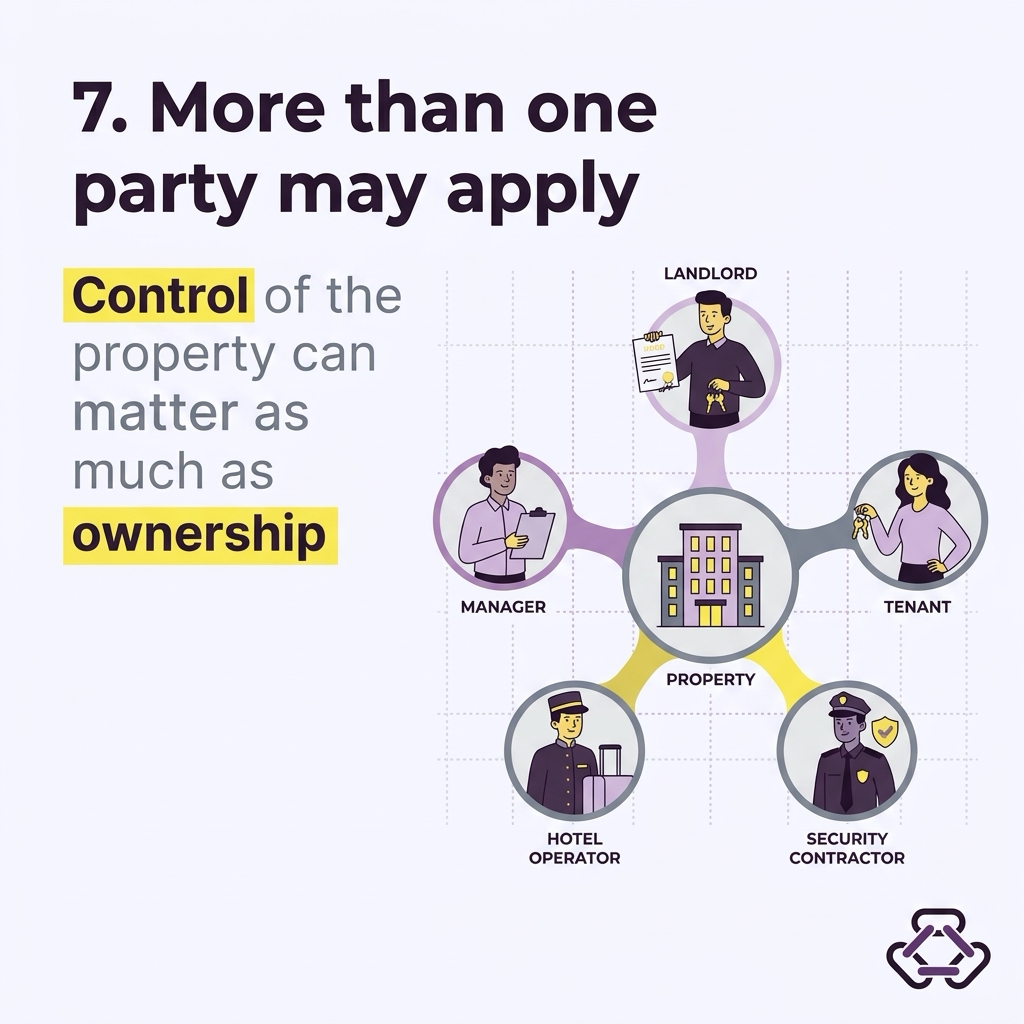
7. Who Can Be Named In A Claim Besides The Property Owner?
A lot of victims assume the only possible defendant is the person or company listed as the property owner. In many cases, the real picture is more complicated.
Depending on control of the premises, potential parties can include:
- the landlord
- the apartment management company
- the business operating on the property
- a commercial tenant
- a hotel operator
- an event promoter
- a property management company
- a security contractor
- in some cases, a homeowners’ or condominium association
Who had possession and control over the area where the assault happened often matters as much as who technically held title. That issue can become especially important in shopping centers, mixed-use properties, apartment communities, and leased commercial spaces.
This is one reason negligent security claims can become more complex than they first appear. If you want to see why some cases get harder fast, our related discussion of the problems that often complicate unsafe security lawsuits explores how ownership structures, missing records, and disputed control can affect the case.
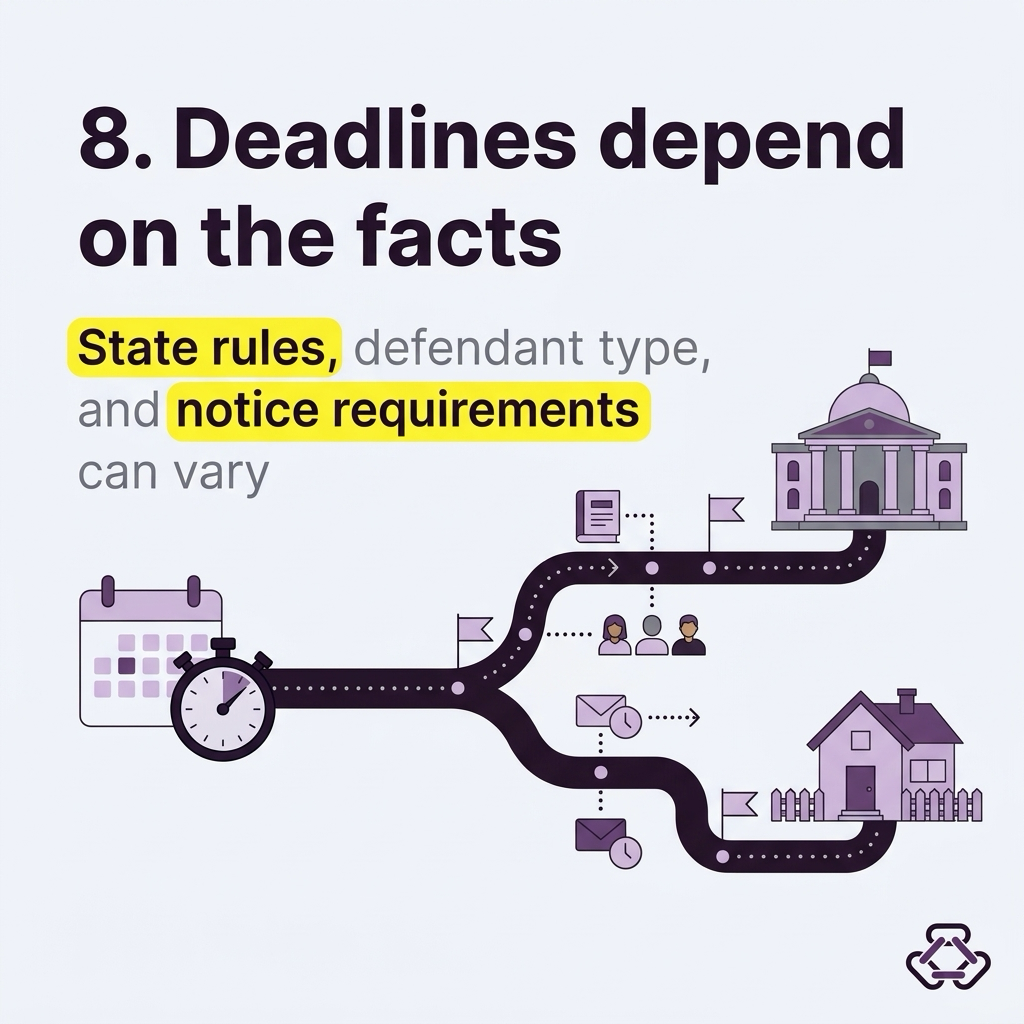
8. How Long Do I Have To Bring A Claim?
This is one of the most important questions, because deadlines can affect a case before the victim has fully recovered.
The exact time limit usually depends on state law, the legal theory involved, and the identity of the defendant. A claim against a private apartment complex may have one deadline, while a claim involving a city-owned parking facility or public housing authority may involve shorter notice requirements and different procedural rules.
There is no reliable national one-size-fits-all answer here. Statutes of limitation and notice rules vary widely. Some states also have special rules for minors, wrongful death claims, and claims involving sexual assault.
Here’s what this often means in practical terms: waiting too long can reduce access to both evidence and legal options, even when the underlying facts are serious. An attorney can usually identify the controlling deadlines quickly and determine whether any special notice requirements apply.
9. Do I Really Need A Lawyer For This Type Of Case?
This question usually comes from people trying to balance a lot at once. They may be injured, missing work, dealing with fear, or unsure whether the assault was “bad enough” to justify legal action.
Negligent security cases tend to be document-heavy and fact-intensive. They often require proof about prior incidents, foreseeability, property control, industry standards, security practices, camera coverage, repair records, and witness testimony. The property owner and its insurer may also move quickly to frame the event as random, unavoidable, or unrelated to any security failure.
An attorney may help by:
- identifying all potentially responsible parties
- preserving surveillance footage and records
- investigating prior incidents
- reviewing leases, contracts, and maintenance logs
- coordinating with experts when appropriate
- valuing medical, wage-loss, and trauma-related damages
- handling insurer communications
- evaluating whether the facts support a negligent security theory at all
For many victims, the key issue is not simply finding “a lawyer.” It is finding someone with demonstrable experience in highly-similar matters. Unsafe property assault cases sit at the intersection of premises liability, personal injury, and third-party criminal act litigation. Relevant experience can make a real difference in how the facts are investigated and presented.
What Victims Often Overlook In The First Few Days
After an assault, people are often focused on immediate survival and basic logistics. That is completely understandable. But from a legal and evidentiary standpoint, the first days can shape the rest of the case.
Some commonly overlooked issues include:
The Scene Changes Quickly
Lights get repaired. Gates get fixed. Signs go up. Video gets erased. Employees forget details. A property that looked dangerous on the night of the assault may look very different a week later.
Management May Minimize Prior Problems
Victims are sometimes told the incident was isolated, unforeseeable, or impossible to prevent. Sometimes that is true. In other cases, later investigation uncovers repeated complaints, prior police activity, or internal knowledge of ongoing safety problems.
The Criminal Case And Civil Case Are Different
Even if the attacker is never identified or convicted, a civil negligent security claim may still be evaluated on its own facts. The question is not only what the assailant did. The question may also include whether the property owner failed to take reasonable precautions against a foreseeable risk.
Emotional Injuries Matter Too
The legal system often focuses heavily on visible injuries, but trauma, anxiety, sleep disturbance, depression, and fear of returning to similar places can also be significant parts of the harm. OVC resources recognize that victim compensation may include mental health counseling and other crime-related costs (OVC).
A Short Summary
Victims of assaults on unsafe property usually ask the same core questions: who may be responsible, what counts as negligent security, whether prior incidents matter, what evidence helps, and how deadlines work. Those questions are not just emotional reactions. They are often the foundation of a potential civil claim.
In general terms, these cases often turn on foreseeability, notice, property control, and documentation. They can involve apartment complexes, hotels, bars, parking lots, retail centers, office buildings, and other places where owners or operators may have ignored known security risks. They can also become time-sensitive quickly.
If you’re trying to make sense of what happened, it may help to talk with someone who can evaluate the facts based on objective criteria and documented experience in similar cases.
Visit ReferU.AI to get matched with an attorney who has demonstrable experience in cases like yours — for free.
