Table of Contents
- How to Identify Ambiguous Clauses That Trigger Beneficiary Litigation
- Why Ambiguous Trust Language Leads To Litigation
- What “Ambiguous” Usually Means In A Trust Dispute
- Patent Ambiguity
- Latent Ambiguity
- 1. Watch For Vague Distribution Standards
- 2. Look For Broad Discretion Without A Clear Limit
- 3. Identify Class Terms That Can Mean More Than One Thing
- 4. Examine Timing Clauses Closely
- 5. Flag Precatory Language That Sounds Like A Command
- 6. Compare Specific Clauses Against General Clauses
- 7. Review Trustee Removal, Successor, And Deadlock Provisions
- 8. Do Not Overlook No-Contest And Exculpatory Clauses
- 9. Check Whether Real-World Facts Expose A Hidden Ambiguity
- 10. Notice When The Trust Uses Personalized Language Without Definitions
- What Attorneys Often Look For When Evaluating A Potential Interpretation Lawsuit
- Signs The Problem Is Bigger Than A Simple Misunderstanding
- The Bottom Line

Type
Great Grandchild
Status
Approved
Title (YouTube)
Images Failed (Social)
Images Failed (Social)
Do not index
Parent item
Publish Date (TikTok)
Feb 24, 2027 16:15
Videos Post IDs (Social)
Hashtags (Social)
#LegalAdvice #LegalHelp #ProbateLitigation #TrustInterpretation
Caption
Caption X
Cover

OG Image

Alt Image Text
Flat vector illustration of ambiguous clauses causing beneficiary litigation, with a trustee reviewing unclear trust language that splits into conflicting interpretations for beneficiaries.
Images

Videos
Publish Date (Social)
Jan 15, 2027 07:30
Scheduled (Social)
Scheduled (Social)
Images Posted (Social)
Images Posted (Social)
Videos Posted (Social)
Videos Posted (Social)
Featured
Created time
Apr 3, 2026 04:14 PM
Sub-item
Authors
CTA Practice Area (Social)
Probate Litigation
TikTok Failed (Social)
TikTok Failed (Social)
Videos Post Links (Social)
TikTok Post Links (Social)
Images Post IDs (Social)
YT Post ID
Video Pending Manual (Social)
TikTok Posted (Social)
TikTok Posted (Social)
TikTok Post IDs (Social)
Video Cover (Social)
Images Post Links (Social)
First Comment (Social)
Videos Failed (Social)
Videos Failed (Social)
YT Embedded
Images Delete (Social)
Videos Delete (Social)
Carousel Video URL (Social)
How to Identify Ambiguous Clauses That Trigger Beneficiary Litigation
Trust disputes often start with one uncomfortable sentence: “That’s not what Mom meant.”
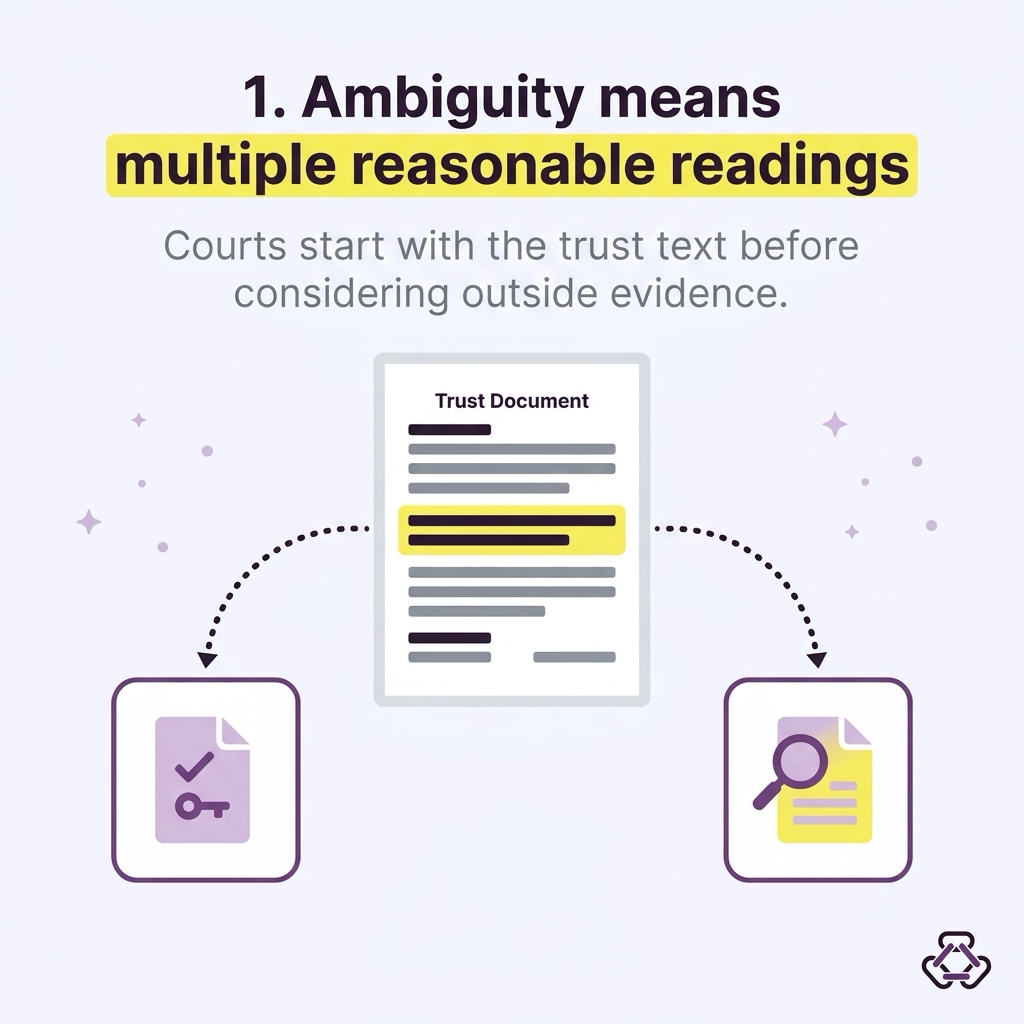
When a trust contains unclear language, beneficiaries, trustees, and family members may read the same clause in completely different ways. That is where interpretation fights begin. Courts generally start with the text itself and look for the settlor’s intent within the “four corners” of the document, but when the wording is genuinely ambiguous, judges may end up considering outside evidence and issuing a construction ruling to resolve the dispute. Cornell Law’s Wex on the four-corners rule, Matter of Piel, and the federal regulations’ example of a trust construction suit over an ambiguous distribution clause all reflect that basic framework. Learn more about how courts read unclear trust language in this broader overview of trust interpretation disputes.
In this post, you’ll learn how to spot the kinds of clauses that often trigger beneficiary litigation, why certain words create so much friction, what documents and facts attorneys often examine when ambiguity appears, and when a trust interpretation problem starts looking like a lawsuit rather than a routine administration issue.
Scroll to the bottom for every post in this series.
Why Ambiguous Trust Language Leads To Litigation
A trust is supposed to guide administration and distributions. If the text leaves room for multiple reasonable meanings, the people involved may disagree about who gets what, when they get it, and how much discretion the trustee actually has. That tension can grow quickly when large sums, blended families, unequal treatment, tax concerns, or long-running sibling dynamics are involved.
Under the Uniform Trust Code framework adopted in many states in some form, trustees generally administer the trust in good faith, in accordance with its terms and purposes, and in the interests of beneficiaries. When the terms are fuzzy, even a diligent trustee can end up accused of favoritism, delay, or abuse of discretion. The ambiguity itself becomes the fuel for litigation. Cornell’s Wex entry on trust intent and ABA commentary on drafting conflicts and contradictory clauses both underscore how intent and document clarity drive administration.
In general terms, a clause becomes litigation-prone when it answers an important question in a way that sounds specific but is not actually precise.
What “Ambiguous” Usually Means In A Trust Dispute
In legal settings, ambiguity does not always mean “poorly written.” Sometimes the sentence looks fine until real-world facts expose a problem.
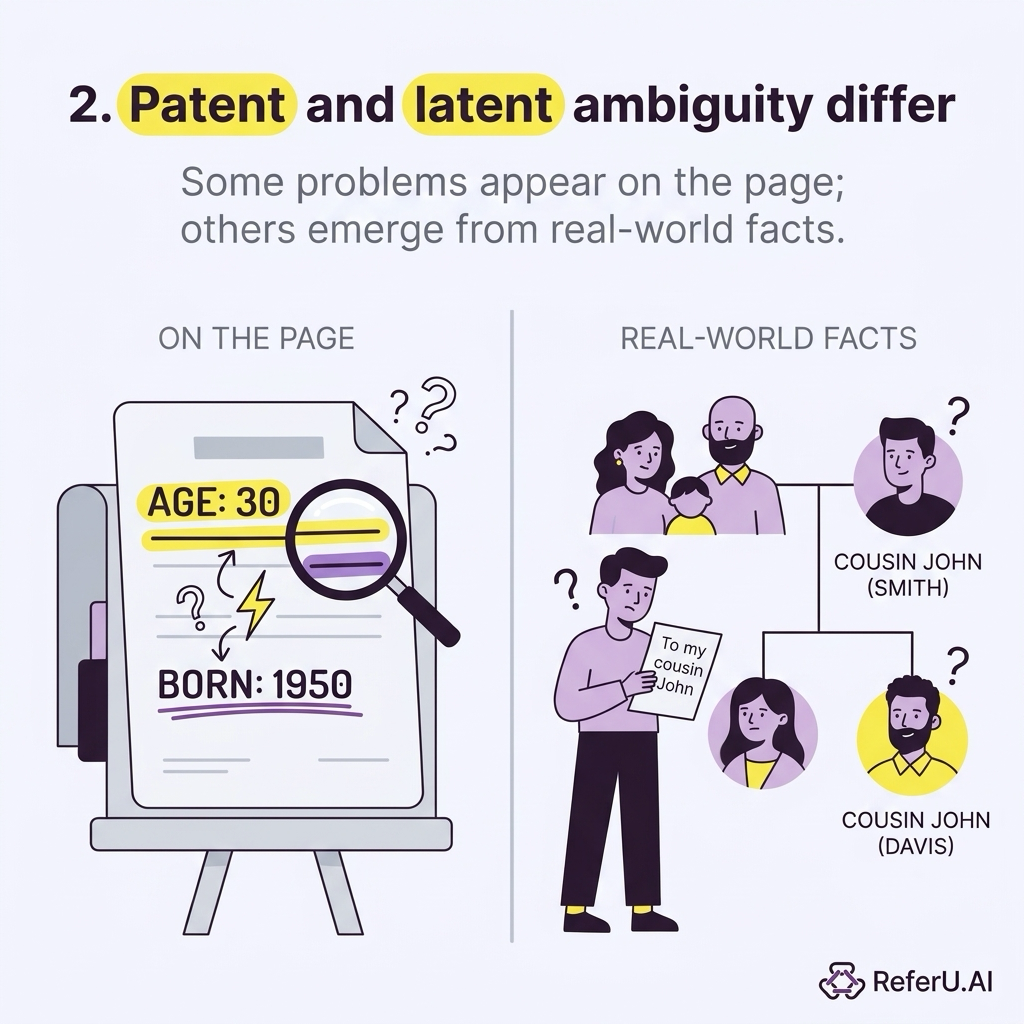
Patent Ambiguity
A patent ambiguity appears on the face of the document. The wording itself is unclear or internally inconsistent. An example might be a trust saying one child receives full distribution at age 35 in one article and age 50 in another. The ABA has highlighted exactly this kind of conflicting drafting as a source of litigation and administrative difficulty. ABA source
Latent Ambiguity
A latent ambiguity appears only when the clause is applied to facts outside the document. Cornell explains that latent ambiguity arises when language seems clear on its face but extrinsic evidence reveals more than one possible meaning. A classic example is a gift to a person or organization whose description fits more than one real-world target. Cornell Wex on latent ambiguity
That distinction matters because a family may not notice a problem until a trustee is about to distribute money, interpret a class gift, or respond to a beneficiary demand.
1. Watch For Vague Distribution Standards
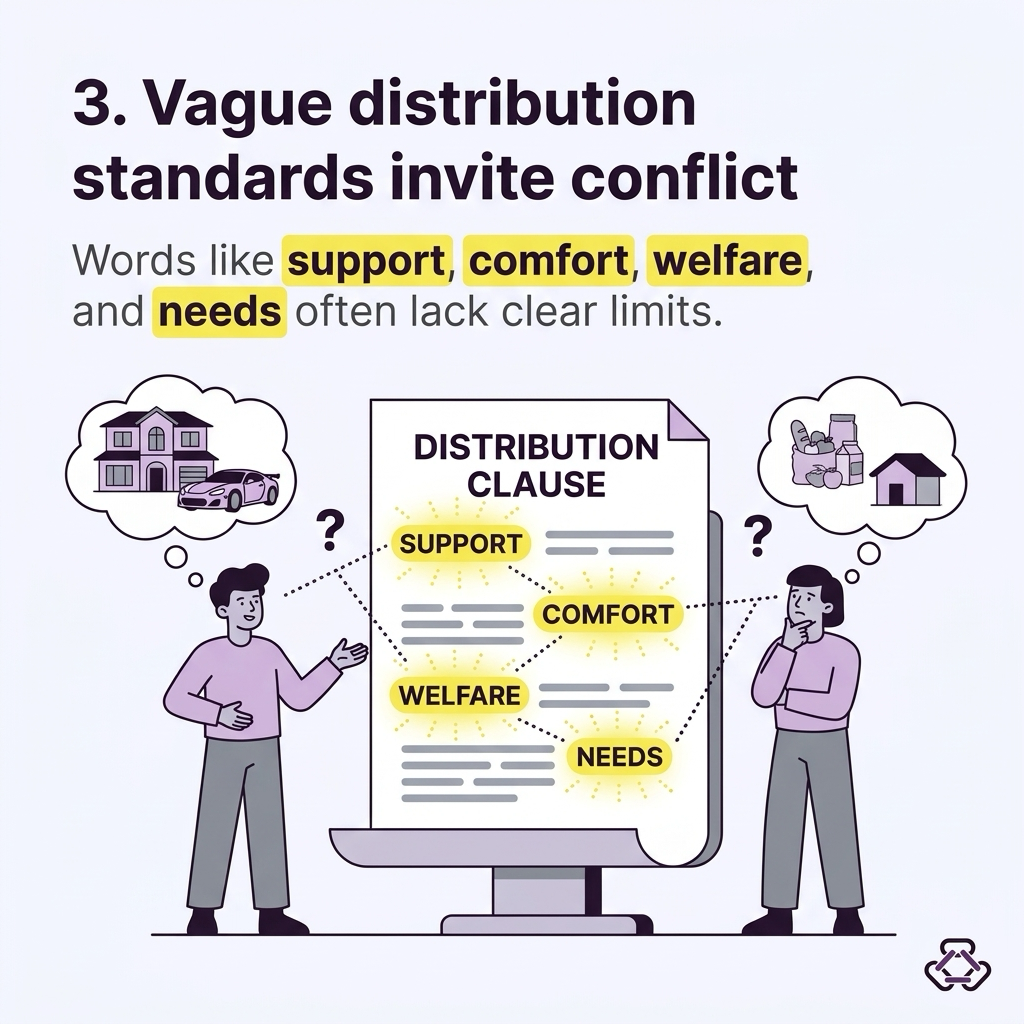
One of the most common sources of trust litigation is a clause giving the trustee power to make distributions for a beneficiary’s “support,” “best interests,” “comfort,” “welfare,” or “needs” without defining those words.
Some terms are more established than others. Tax law has long recognized the familiar health, education, maintenance, and support framework, often called an ascertainable standard. IRS materials discussing trustee distribution powers repeatedly reference that standard. IRS source
The trouble usually starts when the trust mixes precise and imprecise language, such as:
- “for support and happiness”
- “as the trustee deems advisable for comfort”
- “for emergencies and special opportunities”
- “for lifestyle maintenance consistent with prior expectations”
Those phrases may sound compassionate, but they can invite disagreement over whether a distribution covers tuition, a first home, business capital, addiction treatment, luxury travel, or private caregiving.
If a beneficiary says a distribution was wrongly denied, and the trustee says the trust gave broad discretion, ambiguity can become the core issue in the case. This is one reason families often end up fighting over standards of distribution in disputes involving unclear trust wording.
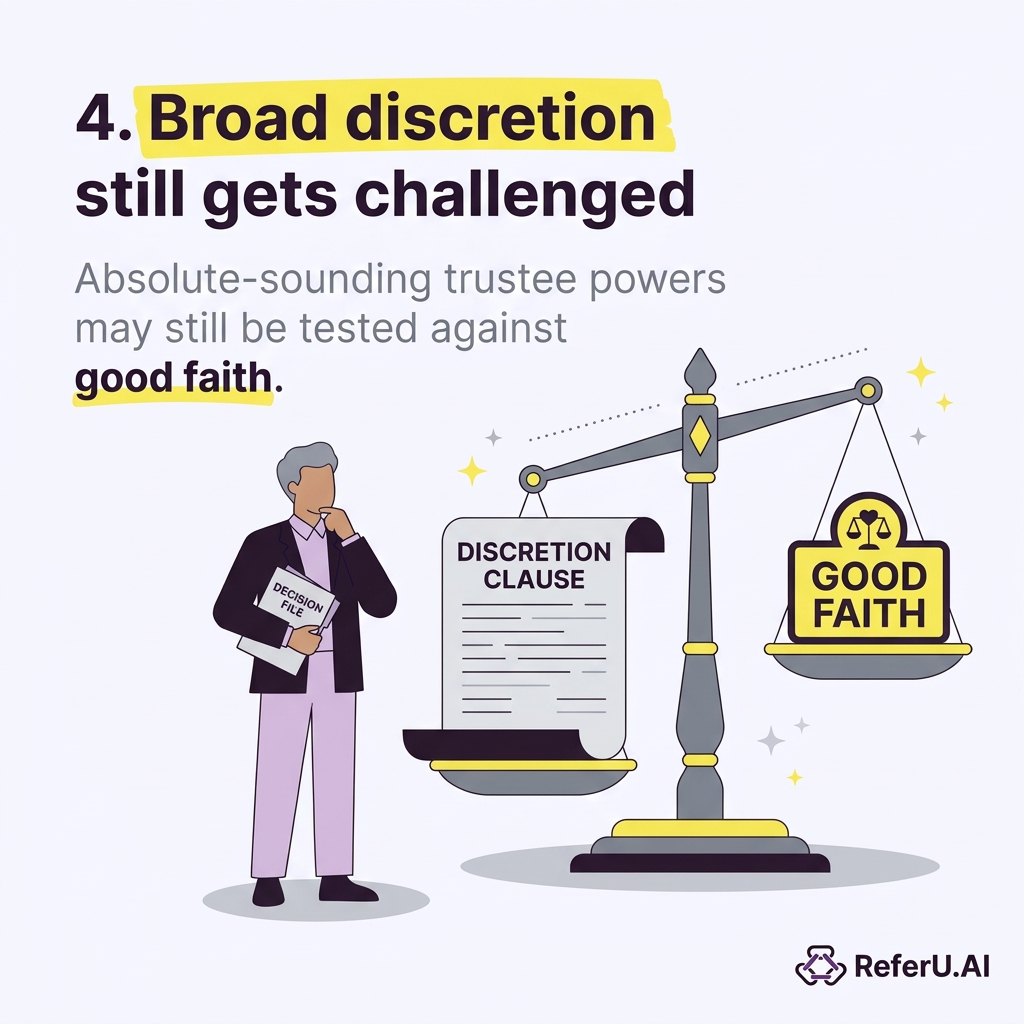
2. Look For Broad Discretion Without A Clear Limit
A trust may give a trustee “sole,” “absolute,” or “uncontrolled” discretion. Those words sound decisive, but they do not always end the analysis. Many states still evaluate whether the trustee acted in good faith and consistent with the trust’s purposes. That means litigation can arise even where a trustee believes the clause is ironclad.
The risk increases when the document says things like:
- “Trustee may distribute as trustee sees fit”
- “Trustee may favor one beneficiary over another”
- “Trustee may withhold distributions for any reason”
- “Trustee’s decision shall be final”
Clauses like these often trigger fights about whether discretion was exercised neutrally, whether the trustee misunderstood the settlor’s intent, or whether one sentence conflicts with another part of the trust. The ABA has noted that custom language around distributions and trustee powers can create serious interpretation problems if it conflicts with the rest of the instrument. ABA source
When you see broad power plus emotional family history plus no definition section, that combination often signals litigation risk.
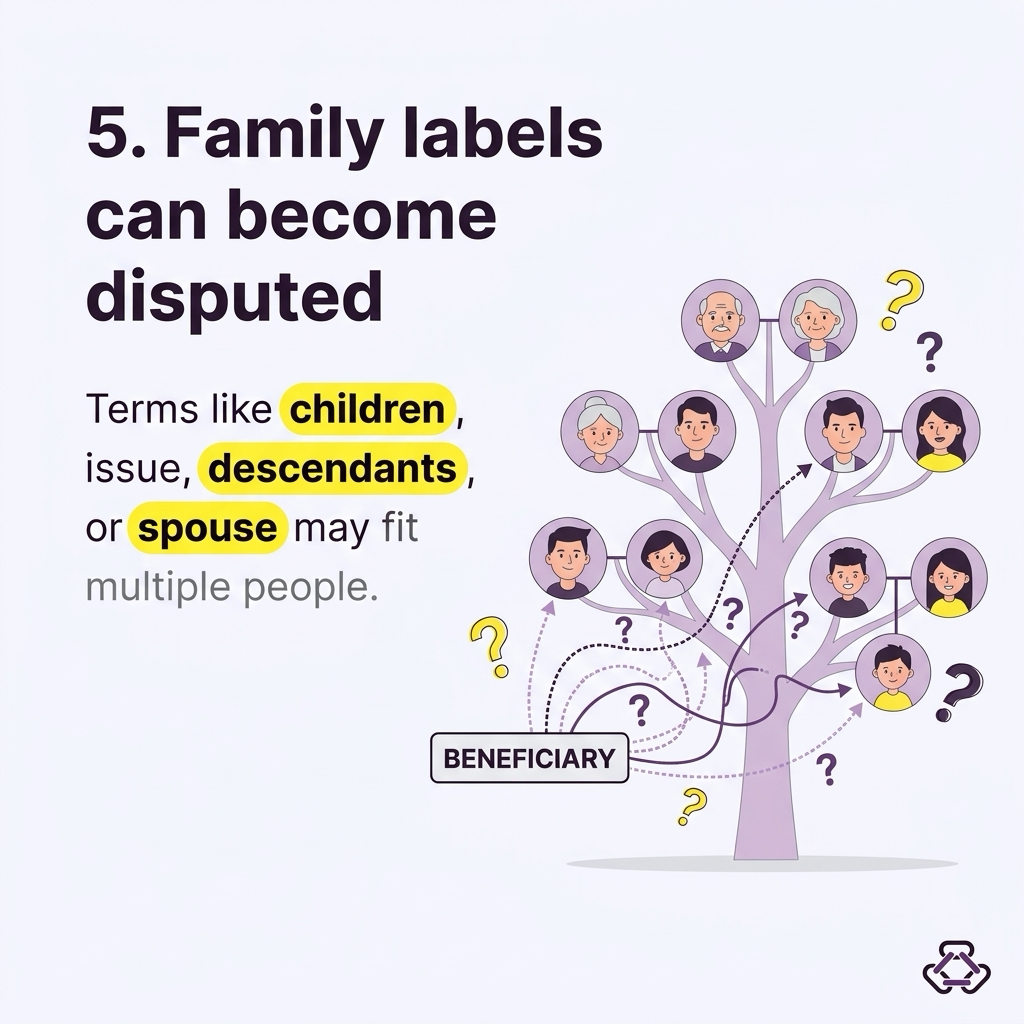
3. Identify Class Terms That Can Mean More Than One Thing
Terms describing beneficiaries often look simple until someone asks who exactly is included.
Examples include:
- “children”
- “issue”
- “descendants”
- “family”
- “heirs”
- “surviving spouse”
- “my lineal descendants then living”
These words can become contested in cases involving adoption, stepchildren, posthumous children, assisted reproduction, half-siblings, remarriage, and blended families. Courts often begin with the trust text itself, and only when ambiguity exists do they move beyond the document. Matter of Piel
A phrase like “to my children in equal shares” may seem straightforward until one child was adopted out, another is deceased with children of their own, and a third is a stepchild treated as family for decades but never formally adopted.
In practice, if a clause uses a family label without a definition section, attorneys often ask whether the trust was drafted before major family changes and whether the settlor updated related estate documents after those changes.
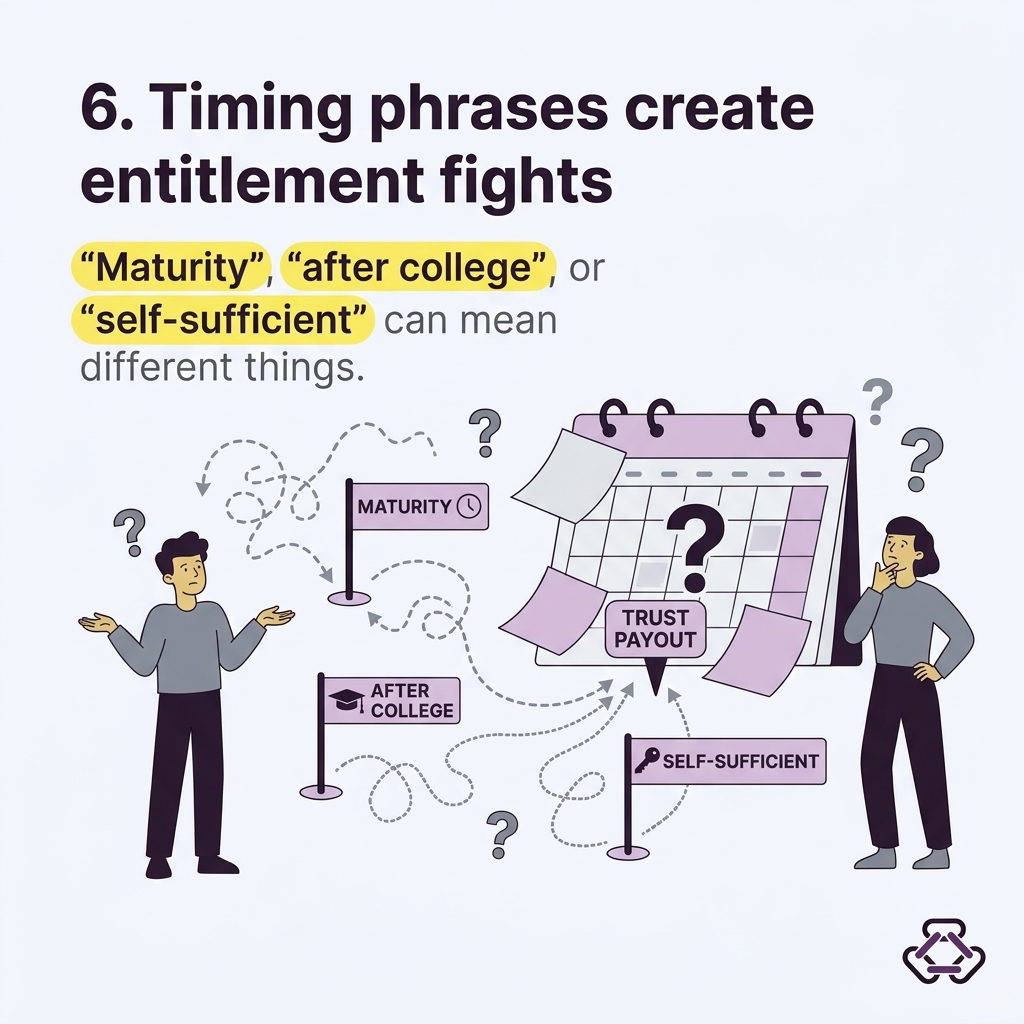
4. Examine Timing Clauses Closely
Timing provisions often generate beneficiary litigation because they affect control, taxes, and entitlement. Common examples include:
- distribution “upon reaching maturity”
- payment “when financially responsible”
- termination “after college”
- support “until self-sufficient”
- division “when the youngest child is established”
Each of those phrases can create genuine disputes. What counts as maturity? Does “after college” include graduate school? Does “self-sufficient” mean employed, debt-free, or no longer dependent on family support?
Even apparently technical timing language can become unclear if different sections point in different directions. The ABA’s drafting guidance gives examples where one article set one termination age while another article used a different age. ABA source
If one clause affects when a beneficiary gets control of money, expect close scrutiny.
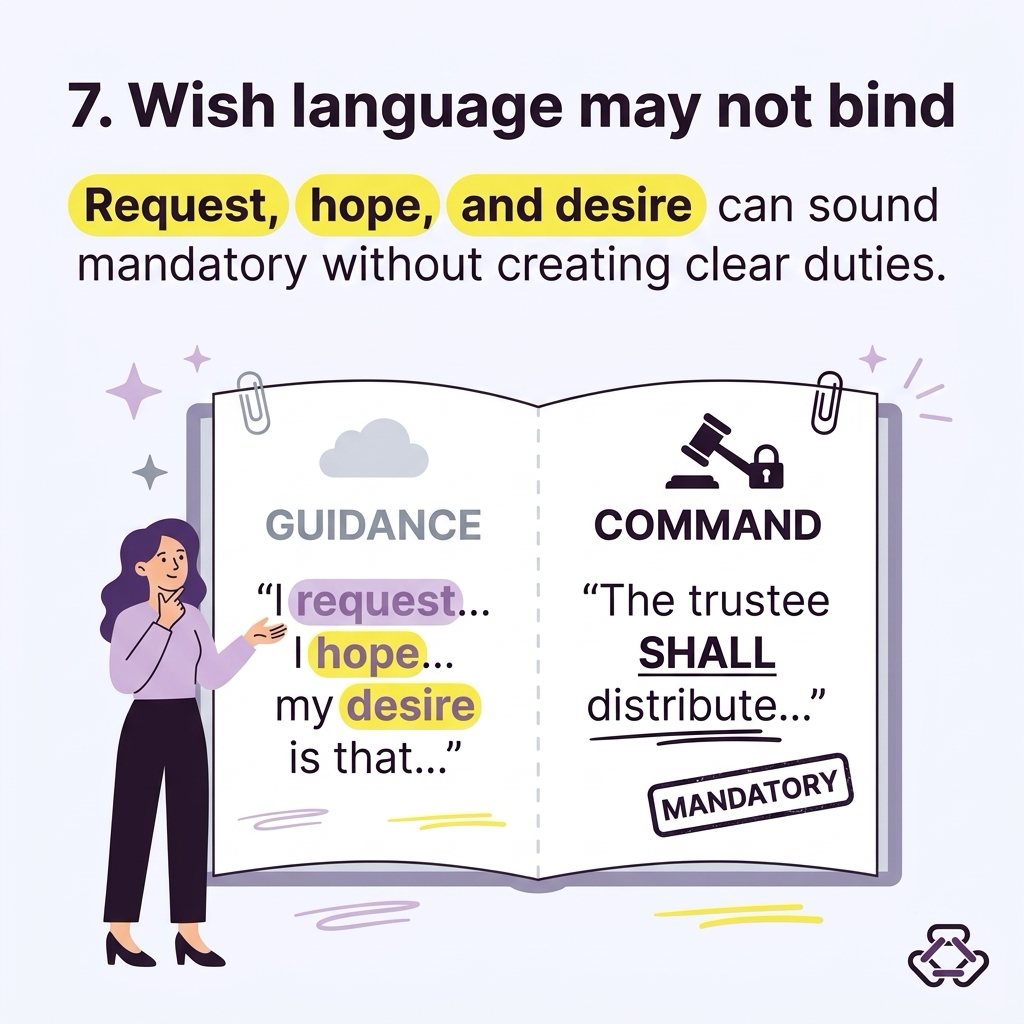
5. Flag Precatory Language That Sounds Like A Command
One of the oldest problems in trust and estate disputes is the difference between wish language and mandatory language.
Words that often create trouble include:
- “wish”
- “hope”
- “request”
- “desire”
- “recommend”
- “it is my expectation”
A settlor may write, “I request that the trustee provide generously for my daughter’s medical needs,” or “I hope my children will keep the beach house.” Those statements may reflect heartfelt intention, but they may not operate as enforceable commands in the way beneficiaries assume.
This issue appears in older case law on so-called precatory language, and it still matters because families often read moral language as binding legal language. Colton v. Colton
When a trust mixes “shall” and “wish” in the same article, litigation risk rises because one side may argue the settlor imposed a duty while the other says the sentence was only aspirational.
6. Compare Specific Clauses Against General Clauses
Another major red flag is inconsistency between a narrow instruction and a broad “catch-all” clause.
For example:
- A specific article says the trustee may invade principal only for medical emergencies.
- Another article says the trustee may distribute principal for a beneficiary’s welfare and best interests.
Or:
- One clause says equal treatment among children.
- Another says the trustee may make unequal distributions.
When both clauses cannot comfortably operate together, a beneficiary dispute often becomes a document-construction case. The ABA explicitly recommends reviewing custom provisions to make sure they do not contradict the rest of the instrument and notes that drafters sometimes use language like “notwithstanding any provision herein to the contrary” to clarify priority. ABA source
If you want a useful gut check, ask: Which clause controls if both cannot be true at the same time? If the answer is unclear, litigation exposure may be significant.
7. Review Trustee Removal, Successor, And Deadlock Provisions
Ambiguous administrative clauses can trigger beneficiary litigation just as quickly as distribution clauses.
Watch for uncertainty around:
- who can remove a trustee
- whether removal requires cause
- how a successor trustee is chosen
- whether co-trustees act unanimously or by majority
- how disputes between fiduciaries get resolved
- whether a trust protector or trust director has override authority
Administrative ambiguity can paralyze a trust. If one branch of the family thinks a trustee may be removed without cause and another says the trust allows removal only for misconduct, a petition for instructions or removal may follow.
These cases often look procedural at first, but they can become deeply personal because trustee control affects information access, investment decisions, and distribution approvals.
8. Do Not Overlook No-Contest And Exculpatory Clauses
Families sometimes assume a no-contest clause prevents litigation. In reality, these provisions often become part of the litigation.
Recent ABA probate updates have discussed cases where courts distinguished between an impermissible contest and a beneficiary’s good-faith effort to enforce fiduciary duties or challenge trust funding issues. ABA probate update, ABA probate update
Likewise, exculpatory clauses limiting trustee liability can create fresh ambiguity if they are broad, internally inconsistent, or appear to conflict with mandatory fiduciary obligations. The ABA has examined the ethical and legal limits of blanket exculpatory language for trustees. ABA article
In general terms, these provisions do not eliminate interpretation disputes. They often change the shape of the fight.
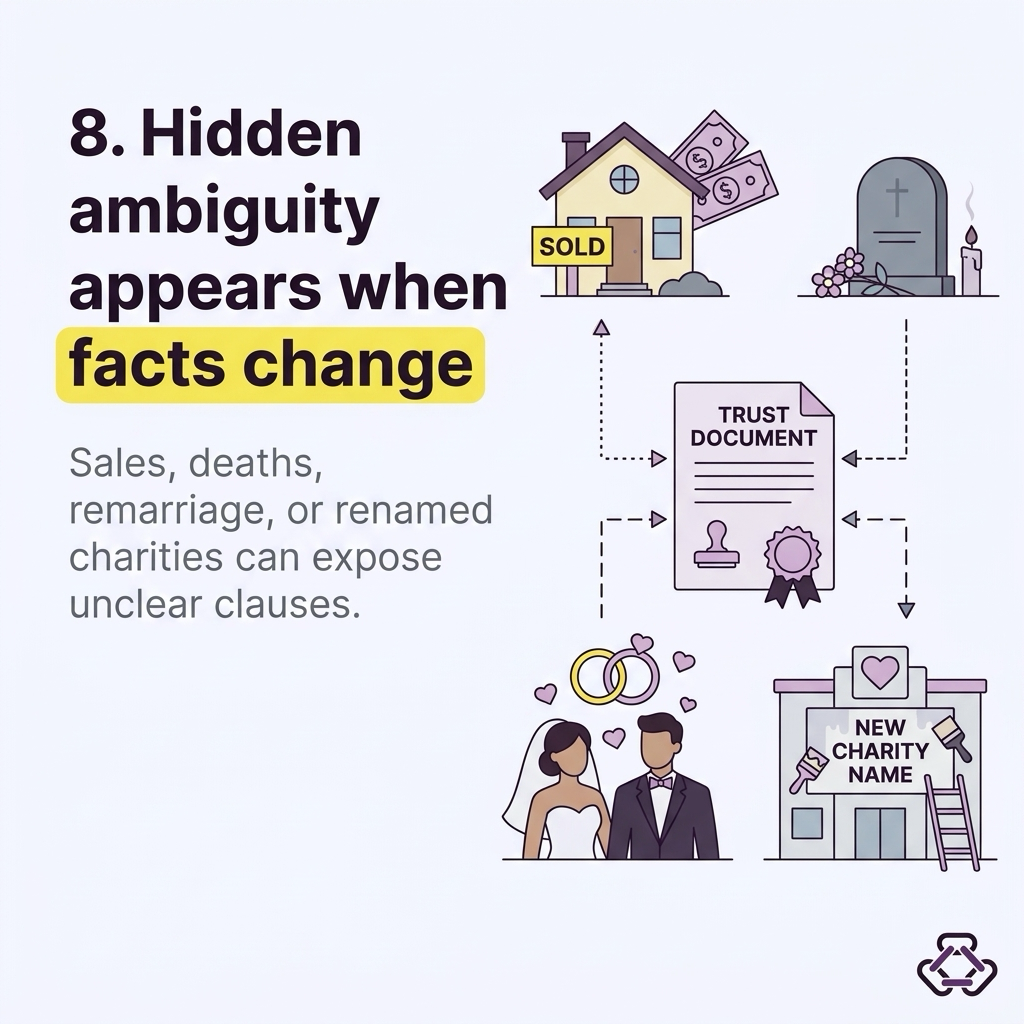
9. Check Whether Real-World Facts Expose A Hidden Ambiguity
Some clauses become explosive only when an actual event happens. Examples include:
- the family home is sold before death
- a named charity changes its legal name
- a beneficiary divorces, remarries, or dies
- a business interest is transferred into or out of the trust imperfectly
- a class description matches more than one person
- an asset referenced in the trust no longer exists in the same form
Cornell’s material on latent ambiguity and older Supreme Court authority both reflect the principle that extrinsic evidence may be relevant when facts reveal uncertainty not obvious on the face of the document. Cornell Wex on latent ambiguity, Gilmer v. Stone
That is why attorneys in these cases often look beyond the trust itself to amendments, schedules, correspondence, prior drafts, transfer documents, beneficiary designations, and records showing how the settlor described the plan over time.
10. Notice When The Trust Uses Personalized Language Without Definitions
Customized trust language can be helpful, but it can also create interpretation problems when it borrows everyday family language instead of legal definitions.
Examples include:
- “my longtime partner”
- “the child who helps with my care”
- “the family business”
- “our vacation property”
- “those descendants active in the faith”
- “any beneficiary with special needs”
These phrases may capture emotion or family culture, but they often leave key questions unanswered. Which partner? What level of caregiving counts? What if there are multiple vacation properties? What qualifies as “active”?
ACTEC has also emphasized that vague or imprecise wording can fail to carry out intent, particularly when language can bear multiple meanings. ACTEC discussion
A practical clue: the more a clause relies on unstated family context, the more likely it is to produce a dispute after the settlor is gone.
What Attorneys Often Look For When Evaluating A Potential Interpretation Lawsuit
When ambiguous language appears, attorneys often start with a structured review rather than jumping directly to a courtroom filing.
They may look at:
- the exact trust language and all amendments
- whether the ambiguity is patent or latent
- whether state trust law supplies a default rule
- whether the trustee has already taken a position
- whether the beneficiaries’ competing readings are both reasonable
- whether a construction petition, surcharge claim, removal action, or declaratory judgment route fits the dispute
- whether extrinsic evidence may be admissible under the governing state’s law
- whether a no-contest clause changes litigation strategy
- whether tax consequences could follow from one interpretation over another
Federal regulations even use a trust construction suit as an example of a court resolving a bona fide issue regarding interpretation of an ambiguous distribution provision. Cornell e-CFR
If you are also trying to understand why some trust fights escalate while others stay manageable, this discussion of common interpretation mistakes that can intensify a family dispute is a useful next step.
Signs The Problem Is Bigger Than A Simple Misunderstanding
Not every unclear clause becomes a lawsuit. But some patterns often suggest a higher-risk dispute:
- a trustee and beneficiary are already exchanging formal accusations
- one side claims the other is ignoring the settlor’s intent
- distributions have been delayed because no one agrees on authority
- family factions are forming around different readings
- there is a blended family or unequal treatment issue
- trust assets are significant or income-producing
- a beneficiary believes the trustee is using “ambiguity” as cover for favoritism
- one clause appears to conflict with another clause directly
In those situations, a general estate-planning lawyer may not always be the only relevant fit. Some people in similar situations look for counsel with documented experience in highly similar trust interpretation and beneficiary dispute matters, because the case can turn on both technical trust-construction issues and the practical dynamics of fiduciary litigation.
The Bottom Line
Ambiguous clauses tend to trigger beneficiary litigation when they affect money, timing, discretion, family status, or trustee power and leave room for two or more reasonable readings. The highest-risk language is often not obviously dramatic. It is usually ordinary-sounding wording like “support,” “best interests,” “equal,” “family,” or “when appropriate” that becomes contested once real people and real dollars are involved.
In general terms, the earlier these issues are analyzed, the easier it is to separate a drafting problem from a fiduciary misconduct claim, a family disagreement from a legal ambiguity, and a manageable interpretation dispute from full-scale litigation.
Visit ReferU.AI to get matched with an attorney who has demonstrable experience in cases like yours — for free.
