Table of Contents
- 6 Business Divorce Mistakes That Turn Negotiation Into War
- Why Business Divorce Disputes Escalate So Quickly
- 1. Treating The Operating Agreement Like A Technicality
- 2. Fighting About “Value” Before Defining What “Value” Means
- 3. Using The Business As A Weapon During The Dispute
- 4. Ignoring Tax, Compensation, And Cash-Flow Consequences
- 5. Assuming Noncompetes And Restrictive Covenants Will Solve The Breakup
- 6. Waiting Too Long To Bring In Litigation Counsel
- What A More Productive Business Divorce Process Often Looks Like
- Clear Identification Of Governing Documents
- Early Preservation Of Financial And Operational Records
- Realistic Framing Of Valuation
- Temporary Rules For Running The Company
- Separate Analysis Of Restrictive Covenants
- Litigation Readiness Without Litigation Theater
- The Real Cost Of Turning Negotiation Into War
- Final Takeaway

Type
Great Grandchild
Status
Approved
Title (YouTube)
Images Failed (Social)
Images Failed (Social)
Do not index
Parent item
Publish Date (TikTok)
Jan 10, 2027 08:15
Videos Post IDs (Social)
Hashtags (Social)
#LegalAdvice #LegalHelp #BusinessLitigation #BusinessDivorce
Caption
Caption X
Cover

OG Image

Alt Image Text
Flat vector illustration of business divorce mistakes turning negotiation into war, with two business owners in conflict over a split deal, valuation, and control.
Images


Videos
Publish Date (Social)
Dec 19, 2026 07:00
Scheduled (Social)
Scheduled (Social)
Images Posted (Social)
Images Posted (Social)
Videos Posted (Social)
Videos Posted (Social)
Videos Failed (Social)
Videos Failed (Social)
Featured
Created time
Apr 3, 2026 10:11 PM
Sub-item
Authors
CTA Practice Area (Social)
Business Litigation
TikTok Failed (Social)
TikTok Failed (Social)
Videos Post Links (Social)
YT Auto Captions Removed
TikTok Post Links (Social)
Images Post IDs (Social)
YT Post ID
Video Pending Manual (Social)
TikTok Posted (Social)
TikTok Posted (Social)
TikTok Post IDs (Social)
Video Cover (Social)
Images Post Links (Social)
First Comment (Social)
YT Embedded
Images Delete (Social)
Videos Delete (Social)
Carousel Video URL (Social)
6 Business Divorce Mistakes That Turn Negotiation Into War
When a business relationship breaks down, most owners start in the same place: they want a deal, not a courtroom battle. They want a buyout, a separation plan, a path forward that protects revenue, employees, customers, and whatever personal relationship is still salvageable.
But business divorces often escalate fast. A disagreement over money becomes a fight over control. A debate about valuation becomes an accusation of bad faith. A temporary operating issue becomes a petition for dissolution, claims of oppression, or allegations of fiduciary misconduct.
That pattern is not unusual. In the U.S., small businesses account for 99.9% of all businesses, which means closely held companies and owner-managed entities are everywhere, and owner disputes can put a very large share of the economy at risk (U.S. Small Business Administration). Courts and legal commentators continue to report business-divorce cases involving deadlock, disputed buyouts, fiduciary-duty claims, and fights over whether dissolution is the only remaining option (American Bar Association, American Bar Association).
In this post, you’ll learn six common mistakes that turn a negotiable ownership split into full-scale war, why they matter, and how an attorney can help lower the temperature before the dispute starts destroying value.
If you want a broader overview of what these cases usually involve, it may help to start with this deeper look at ownership separation, buyouts, valuation, and litigation strategy.
Scroll to the bottom for every post in this series.
Why Business Divorce Disputes Escalate So Quickly
A business divorce is rarely just about one issue. It often combines several at once:
- ownership rights
- management authority
- compensation
- access to records
- valuation methodology
- customer and employee relationships
- restrictive covenants
- fiduciary-duty allegations
- tax consequences
- exit timing
That combination is why even a “simple buyout” can become complicated. In many LLC and close-corporation disputes, the governing documents do not fully answer what happens when owners stop trusting each other. ABA analysis has noted that when agreements lack workable deadlock-breaking mechanisms, parties often end up considering judicial remedies such as injunctions, custodianship, or dissolution (American Bar Association). Delaware law, which influences business law nationally, also allows a court to dissolve an LLC when “it is not reasonably practicable to carry on the business in conformity with a limited liability company agreement” (Delaware Code, 6 Del. C. § 18-802).
That is one reason negotiation can collapse so fast: once one side starts thinking in terms of injunctions, dissolution, or control of the books, the tone changes.
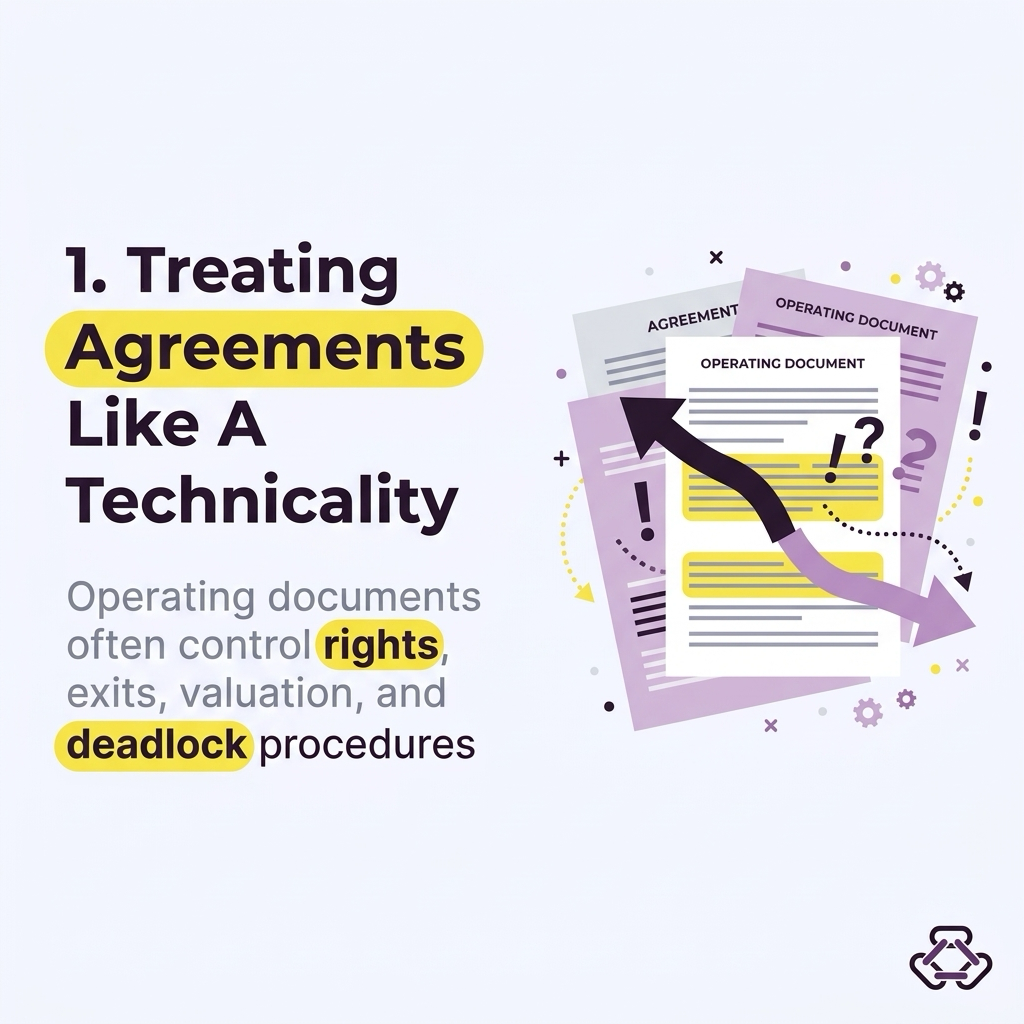
1. Treating The Operating Agreement Like A Technicality
The first mistake is surprisingly common: one or both owners assume the governing documents are secondary because “we already know what the deal was.”
In real disputes, that assumption often falls apart.
For LLCs, shareholder agreements, partnership agreements, bylaws, side letters, employment agreements, and buy-sell provisions often shape the entire conflict. They may address:
- transfer restrictions
- buyout triggers
- valuation procedures
- deadlock procedures
- manager authority
- voting thresholds
- noncompete or nonsolicit provisions
- indemnification rights
- access to records
And when those documents are silent, outdated, internally inconsistent, or poorly drafted, negotiation gets harder. ABA coverage of recent business-divorce litigation shows courts repeatedly dealing with agreements that lacked a clean exit mechanism or clear dispute-resolution process, leaving the parties to fight over control and remedies later (American Bar Association).
This mistake often turns negotiation into war because each side starts arguing from a different version of the company’s “real” rules:
- one relies on the signed agreement,
- one relies on oral understandings,
- one relies on past practice,
- and one relies on what feels fair now.
An attorney may help by identifying what actually governs, which provisions are enforceable, and which gaps are likely to become pressure points in negotiation or litigation.
2. Fighting About “Value” Before Defining What “Value” Means
Owners often say, “Let’s just get a valuation.” That sounds practical. In reality, it can be the start of a much larger fight.
The reason is simple: valuation is not one thing.
In business-divorce disputes, legal and valuation professionals may disagree over:
- fair market value versus fair value
- whether discounts apply
- whether personal goodwill matters
- whether control premiums matter
- what date is used
- whether compensation has been normalized
- whether insider transactions affected earnings
- whether the company is being valued as a going concern or under distress assumptions
The ABA has highlighted that “fair value” is not synonymous with “fair market value,” and courts do not always treat discounts the same way in judicial buyout disputes (American Bar Association). NACVA’s standards resources also note that valuation analysts work within state-specific definitions and legal contexts, which means the same term can function differently depending on jurisdiction and the kind of dispute involved (NACVA).
That is why an ownership split can implode even when both sides say they are “open to a valuation.” They may be talking about entirely different legal and financial concepts.
This mistake escalates conflict because a number gets exchanged before the underlying assumptions are discussed. Once that happens, the other side may read the figure as an insult, a bad-faith anchor, or an attempt to force a fire-sale exit.
In similar disputes, attorneys and valuation experts often help frame the real questions first:
- What standard of value applies?
- What documents will the expert review?
- What is the valuation date?
- Are owner perks or related-party transactions being adjusted?
- Is the company being valued with or without a marketability or minority discount?
That kind of early framing can change the tone of the entire negotiation.
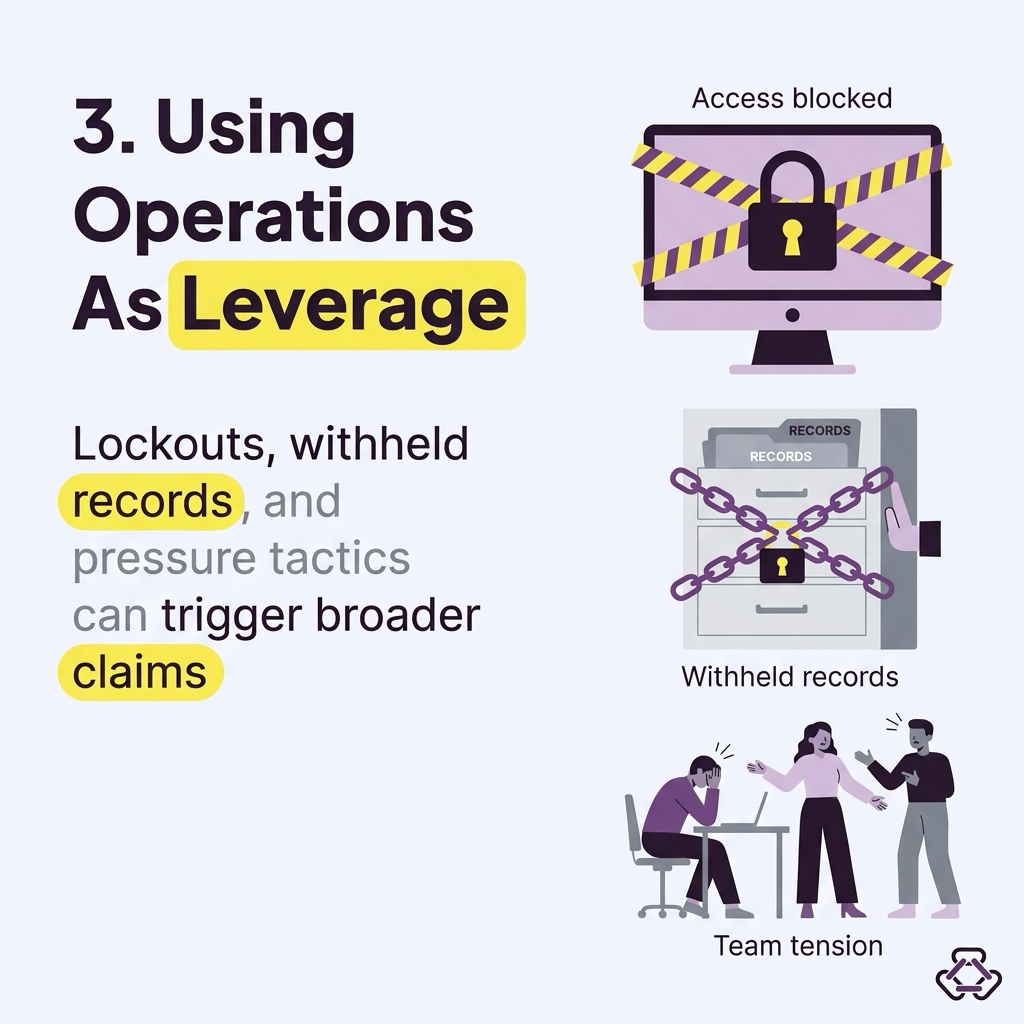
3. Using The Business As A Weapon During The Dispute
Some of the fastest-escalating business divorces involve owners who start using company operations as leverage.
That can include allegations such as:
- freezing the other owner out of bank access
- changing passwords
- withholding records
- unilaterally increasing compensation
- hiring family members
- diverting opportunities
- moving customers or vendors
- pressuring employees to take sides
- starting a competing entity
- embedding restrictive covenants or other terms without full disclosure
ABA summaries of recent business-divorce cases show exactly these kinds of operational conflicts surfacing in litigation, including disputes over compensation, missing funds, separate side businesses, misuse of assets, and allegations involving fiduciary duties (American Bar Association, American Bar Association).
Once business operations are being used as bargaining chips, negotiation tends to harden. The dispute stops being “What is a fair separation?” and becomes “Who is sabotaging the company?”
This is also where legal exposure can expand beyond contract issues into fiduciary-duty claims, record-access claims, injunction requests, emergency motions, and accounting disputes.
From a practical standpoint, this kind of conduct often damages the very asset both sides are fighting over. Customers get nervous. Employees leave. Vendors tighten terms. Revenue drops. And then both parties argue over whether the decline was market-driven or intentionally caused by the other owner.
Some owners in this situation find it helpful to work through temporary standstill arrangements, document-preservation measures, neutral record-sharing processes, or interim operating protocols negotiated through counsel. Those tools do not solve the case by themselves, but they can slow down the spiral.
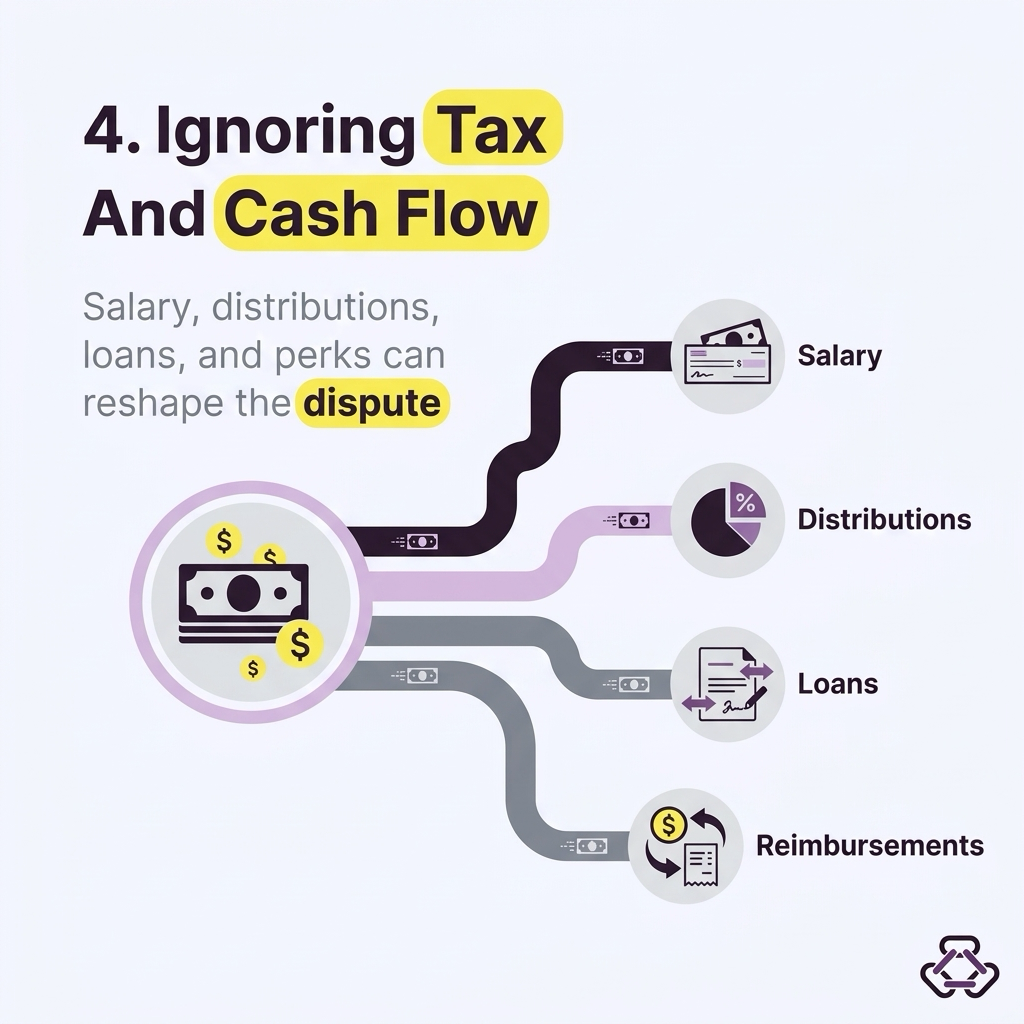
4. Ignoring Tax, Compensation, And Cash-Flow Consequences
Many ownership disputes are framed as control fights. Later, the parties discover the real pain point is tax exposure or cash extraction.
That can happen when one owner has been taking salary, draws, distributions, loans, reimbursements, perks, or expense payments in a way the other side now challenges. It can also happen when a buyout is being discussed without clarity on structure:
- asset purchase or equity redemption
- installment payments or lump sum
- compensation versus purchase price
- treatment of shareholder loans
- tax treatment of ongoing benefits
- whether prior distributions were equalized correctly
The IRS continues to emphasize that shareholder-employees in S corporations who provide more than minor services may be treated as employees, and that S corporations generally are expected to pay reasonable compensation before non-wage distributions are made to shareholder-employees (IRS, IRS, IRS).
Why does that matter in a business divorce? Because compensation disputes are often really valuation disputes in disguise. If one owner has reduced salary and taken distributions, or inflated salary and reduced distributable profit, each side may argue that the company’s earnings picture has been distorted.
That can turn negotiation into war for two reasons:
- The parties are no longer arguing only about future exit terms.
- They are also fighting about whether past money movements were legitimate.
An attorney working alongside a tax professional or valuation expert may help separate ordinary tax structuring from claims that certain payments were improper, manipulative, or economically unfair in the context of a buyout.
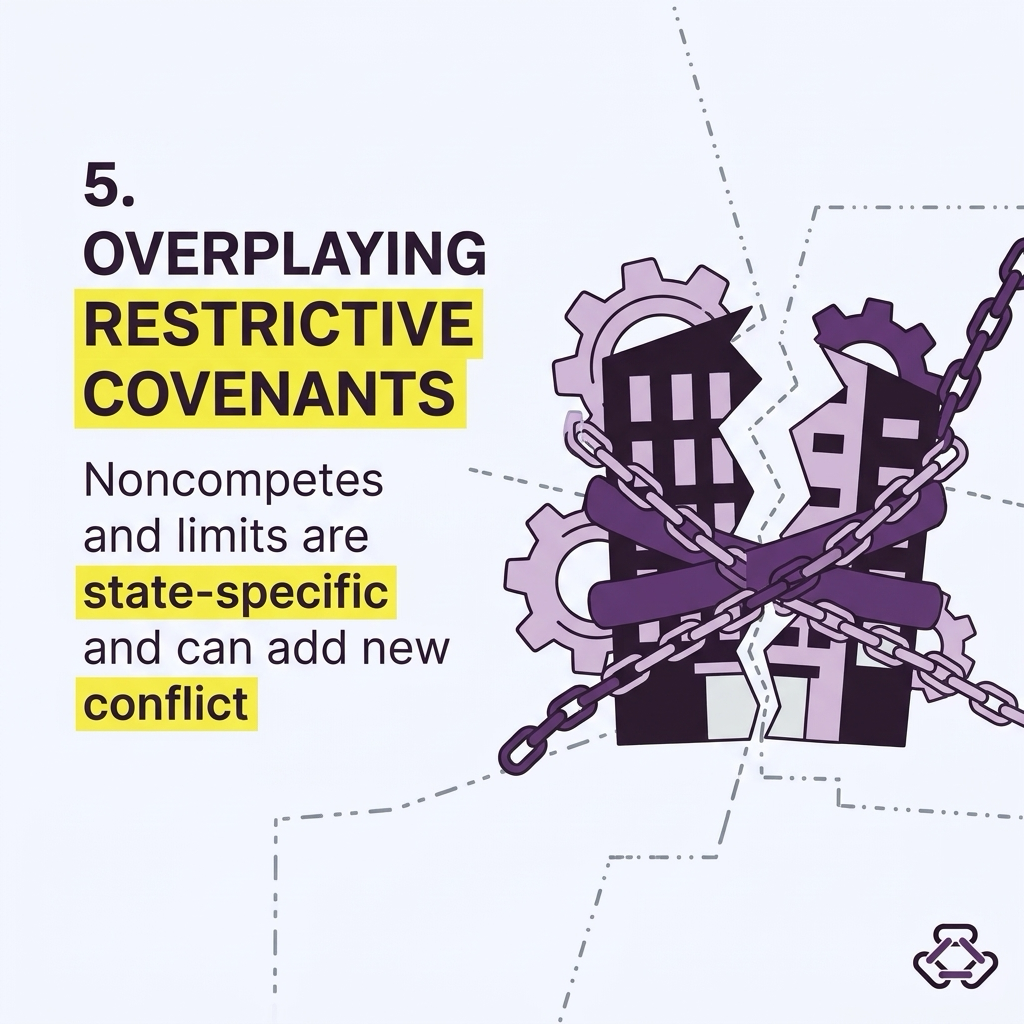
5. Assuming Noncompetes And Restrictive Covenants Will Solve The Breakup
When trust breaks down, one side often reaches for restrictive covenants. The thinking is easy to understand: “If we are splitting, I want protection.”
Sometimes that protection is reasonable. Sometimes it adds another layer of conflict.
Restrictive covenants in a business-divorce setting can involve:
- noncompetes
- nonsolicitation clauses
- confidentiality provisions
- customer restrictions
- employee raiding restrictions
- IP use limits
- social-media or branding limitations
But enforceability is highly state-specific, highly fact-specific, and changing. The FTC’s 2024 noncompete rule never took effect, and the agency states that the rule is not in effect and not enforceable after court action stopped enforcement; in September 2025, the FTC took steps to dismiss its appeal (FTC). That does not mean noncompetes are uniformly enforceable. It means the national landscape remains unsettled and state law still matters enormously.
ABA reporting on recent business-divorce litigation has also described disputes where restrictive covenants embedded in an LLC agreement became part of the fiduciary-duty and disclosure fight itself (American Bar Association).
This mistake escalates conflict when one side tries to use broad restrictions as a negotiating hammer rather than a carefully tailored protection for legitimate business interests. The other side may then respond with challenges based on overbreadth, lack of disclosure, public policy, fiduciary misconduct, or invalid drafting.
In many business breakups, the more productive question is not “How broad can the restriction be?” but “What protection is actually tied to the deal being made?” That can include focused customer protections, transition obligations, IP boundaries, notice provisions, or compensation for agreed restrictions.
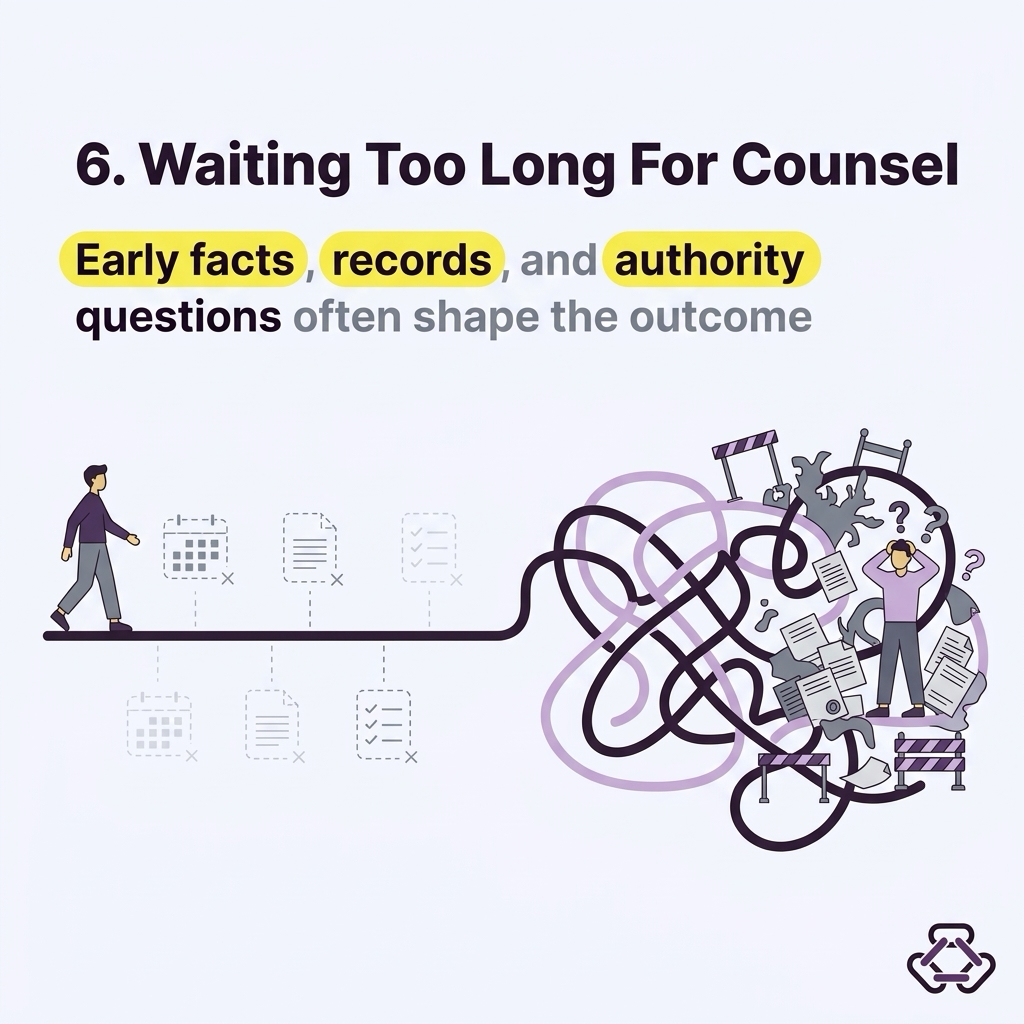
6. Waiting Too Long To Bring In Litigation Counsel
A lot of owners call a lawyer only after negotiations have already collapsed. By then:
- records may be incomplete,
- key communications may look careless,
- unilateral decisions may already have been made,
- employees may have been pulled into the dispute,
- and one side may already be preparing for emergency relief.
That delay matters because business-divorce cases often turn on early facts:
- who had authority to act,
- whether notice was given,
- whether records were preserved,
- whether compensation changed,
- whether one party blocked access,
- whether a buy-sell mechanism was followed,
- whether dissolution standards might be met.
Delaware’s LLC dissolution statute and similar state-law remedies do not wait for the dispute to become emotionally “official.” If the company cannot function in conformity with its governing agreement, a court may be asked to intervene (Delaware Code, 6 Del. C. § 18-802). ABA commentary similarly notes that where agreements lack practical deadlock-breaking tools, judicial relief can become the default battleground (American Bar Association).
Bringing in counsel early does not automatically mean filing suit. In many cases, it can mean the opposite. An attorney may help:
- define leverage realistically,
- preserve evidence,
- stop avoidable escalation,
- coordinate with valuation and tax experts,
- propose a negotiation structure the other side takes seriously,
- and prepare for court only if court becomes unavoidable.
That preparation often changes the quality of the conversation. Negotiation tends to go better when both sides understand the legal terrain before they start improvising threats.
What A More Productive Business Divorce Process Often Looks Like
No two ownership disputes are identical, but negotiations tend to stay more stable when the parties address a few recurring issues early:
Clear Identification Of Governing Documents
That includes every agreement, amendment, side letter, employment arrangement, and buy-sell provision that may affect rights and exit terms.
Early Preservation Of Financial And Operational Records
Business-divorce disputes often become evidence disputes. Clean record handling can lower suspicion and reduce later motion practice.
Realistic Framing Of Valuation
It may help to define the legal standard, valuation date, information set, and expert process before numbers start flying around.
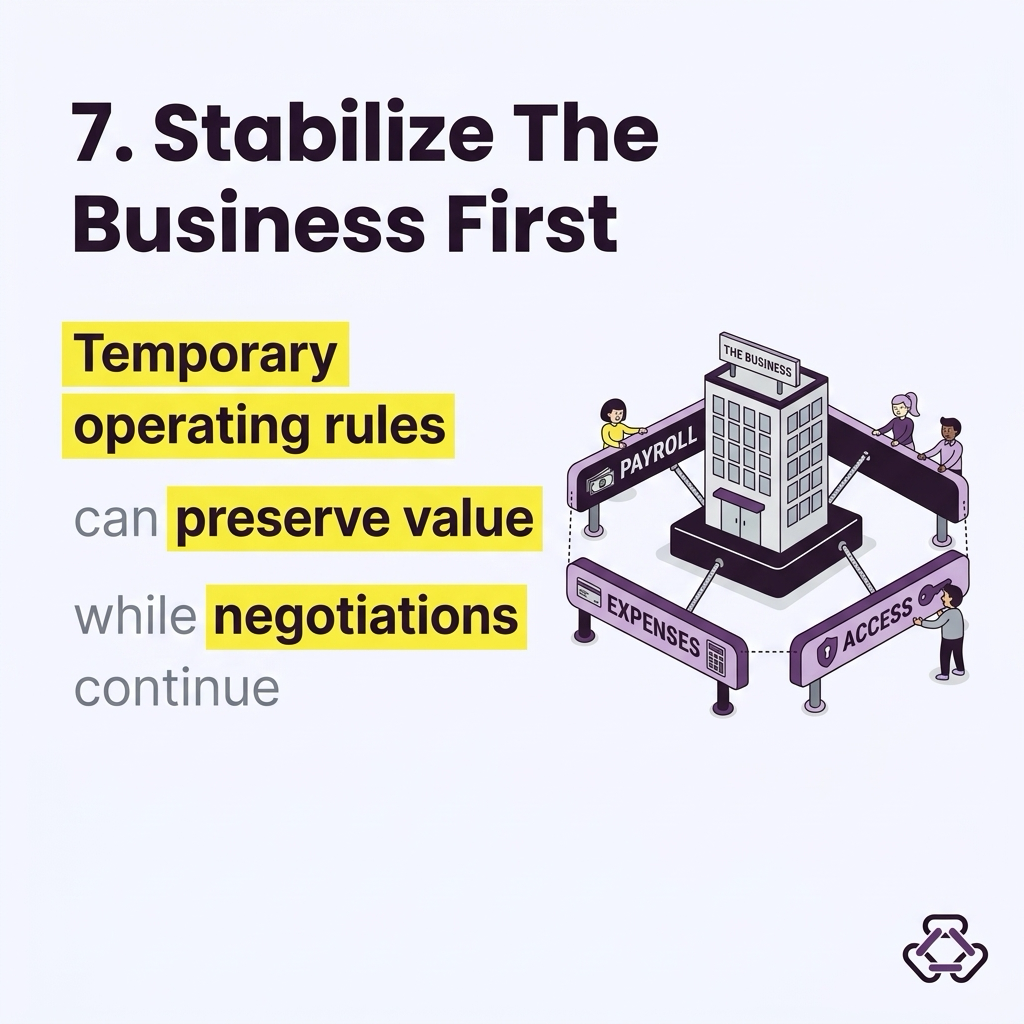
Temporary Rules For Running The Company
In some cases, interim protocols about payroll, distributions, expenses, customer communications, and information access can help preserve value while negotiations continue.
Separate Analysis Of Restrictive Covenants
Instead of treating restrictions as automatic, parties often benefit from a focused analysis of enforceability, scope, and business purpose.
Litigation Readiness Without Litigation Theater
Sometimes the existence of a real legal strategy makes settlement easier. Empty threats usually do the opposite.
If you’re also thinking about prevention, the issues in this post connect closely with planning topics like document cleanup, valuation preparation, and exit design before a split becomes public.
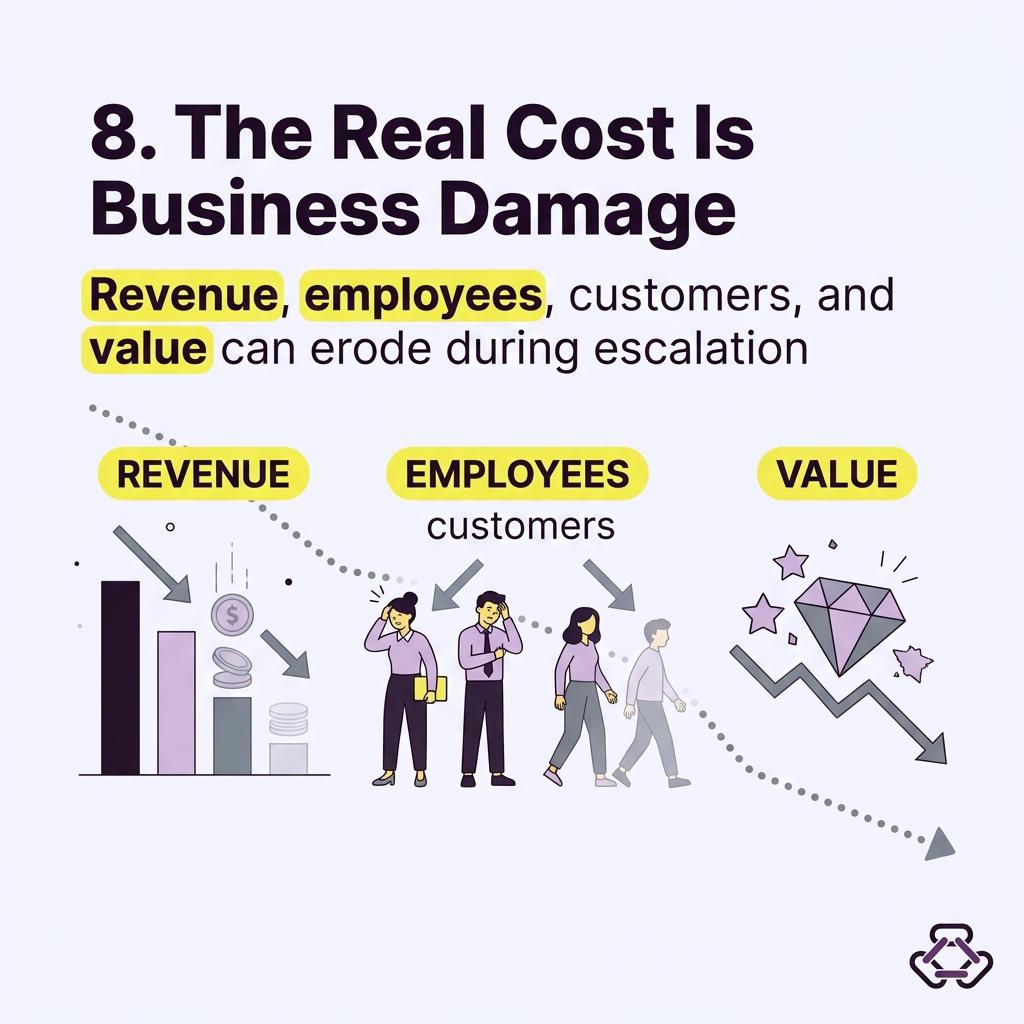
The Real Cost Of Turning Negotiation Into War
The obvious cost is legal fees. But in many business divorces, the deeper losses are elsewhere:
- revenue instability
- damaged customer relationships
- employee attrition
- delayed financing or transactions
- tax problems
- reputational spillover
- lower business value at the exact moment value matters most
That is why business-divorce strategy is not only about who has the stronger legal argument. It is also about preserving the company long enough to make a fair and workable separation possible.
In general terms, owners often benefit from counsel who can see both sides of that equation:
- how to negotiate from a position grounded in the governing documents, financial facts, and applicable law, and
- how to prepare for litigation if the other side keeps escalating.
Final Takeaway
Most business divorces do not begin as wars. They become wars when the parties misread the documents, skip the valuation groundwork, use operations as leverage, ignore tax and compensation issues, overplay restrictive covenants, or wait too long to get legal guidance.
If your ownership dispute is starting to feel personal, urgent, or structurally unstable, an attorney may help you figure out what rights actually exist, what evidence matters, and what kind of exit path is still realistically on the table.
Visit ReferU.AI to get matched with an attorney who has demonstrable experience in cases like yours — for free.
