Table of Contents
- How to Evaluate Buyout Rights, Company Valuation, and Exit Terms in an Ownership Split
- Why Ownership Splits Become Valuation Fights
- 1. Start With The Governing Documents
- 2. Identify Whether The Exit Right Is Contractual, Statutory, Or Negotiated
- Contractual Rights
- Statutory Rights
- Negotiated Rights
- 3. Understand The Difference Between Fair Market Value And Fair Value
- 4. Ask What Valuation Date Applies
- 5. Examine Which Valuation Method The Agreement Uses
- Income Approach
- Market Approach
- Asset Approach
- 6. Look Closely At Discounts And Premiums
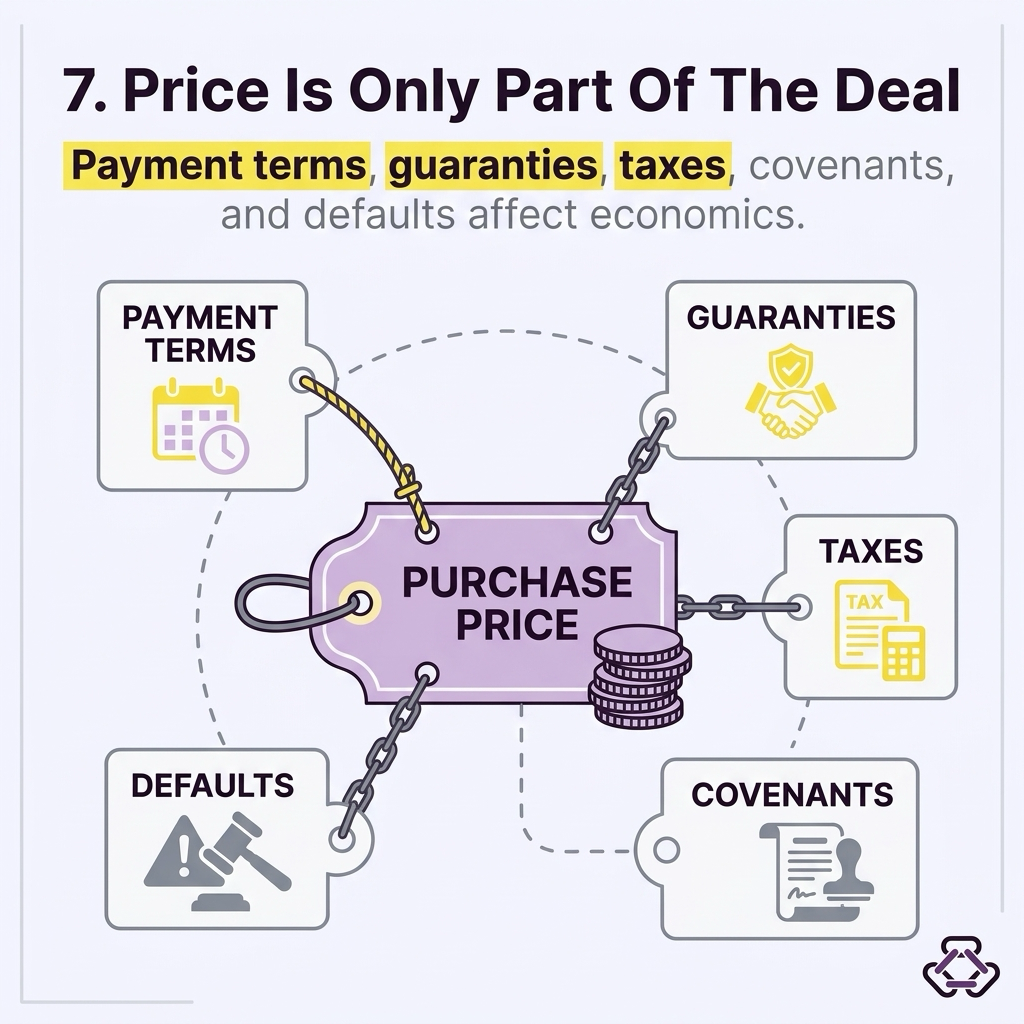
- 7. Separate The Headline Price From The Real Economic Deal
- 8. Check Whether The Company Can Actually Fund The Buyout
- 9. Review How Misconduct Allegations Affect The Exit
- 10. Pay Attention To Process Clauses
- 11. Consider Tax Consequences Early
- 12. Compare Litigation Leverage Against Settlement Terms
- 13. Know When A Valuation Expert Is Not Enough
- 14. What Owners Often Miss In Exit Terms
- Personal Liability Does Not Always End At Closing
- Books And Records Access Can Matter After The Deal
- Restrictive Covenants Can Change The Entire Deal
- Boilerplate Provisions Are Not Really Boilerplate
- 15. When It May Be Time To Speak With A Business Divorce Attorney
- Short Summary

Type
Great Grandchild
Status
Approved
Title (YouTube)
Images Failed (Social)
Images Failed (Social)
Do not index
Parent item
Publish Date (TikTok)
Jan 10, 2027 09:15
Videos Post IDs (Social)
Hashtags (Social)
#LegalAdvice #LegalHelp #BusinessLitigation #BusinessDivorce
Caption
Caption X
Cover

OG Image

Alt Image Text
Flat vector illustration of buyout rights and company valuation in an ownership split, showing co-owners negotiating exit terms with legal and financial symbols.
Images





Videos
Publish Date (Social)
Dec 19, 2026 07:30
Scheduled (Social)
Scheduled (Social)
Images Posted (Social)
Images Posted (Social)
Videos Posted (Social)
Videos Posted (Social)
Videos Failed (Social)
Videos Failed (Social)
Featured
Created time
Apr 3, 2026 10:11 PM
Sub-item
Authors
CTA Practice Area (Social)
Business Litigation
TikTok Failed (Social)
TikTok Failed (Social)
Videos Post Links (Social)
YT Auto Captions Removed
TikTok Post Links (Social)
Images Post IDs (Social)
YT Post ID
Video Pending Manual (Social)
TikTok Posted (Social)
TikTok Posted (Social)
TikTok Post IDs (Social)
Video Cover (Social)
Images Post Links (Social)
First Comment (Social)
YT Embedded
Images Delete (Social)
Videos Delete (Social)
Carousel Video URL (Social)
How to Evaluate Buyout Rights, Company Valuation, and Exit Terms in an Ownership Split
When business co-owners stop seeing the future the same way, the hardest part often is not deciding to separate. It is figuring out who can buy whom out, what the company is actually worth, and what the exit terms really say once money, control, taxes, and timing are on the line.
That is where many ownership splits go sideways.
A founder may assume the operating agreement gives an automatic buyout right. Another may assume the valuation formula is fixed and final. Someone else may focus on the headline purchase price while overlooking payment terms, personal guaranties, earnouts, restrictive covenants, or what happens if the company cannot fund the deal. In general terms, those details often shape the real outcome more than the first number anyone says out loud.
This post walks through how to evaluate buyout rights, company valuation, and exit terms in an ownership split. You’ll learn what documents matter most, which valuation concepts tend to drive conflict, and where legal help often becomes especially important. If you want broader context first, this overview of a company-owner breakup and the major issues it raises can help frame the larger picture.
Scroll to the bottom for every post in this series.
Why Ownership Splits Become Valuation Fights
An ownership split is rarely just about arithmetic. It is usually about control, leverage, risk, and competing stories about the future.
One owner may view the company as a growing asset with strong recurring revenue and strategic value. The other may focus on customer concentration, debt, owner dependence, pending claims, or a declining market. Both may point to numbers that sound reasonable in isolation.
That tension is common in closely held company disputes. The American Bar Association has noted in recent summaries of business divorce litigation that valuation battles often turn on the exact language of the governing agreement, whether the dispute involves a statutory “fair value” standard or a contractual “fair market value” standard, and whether discounts apply at all in the specific setting at issue (ABA Business Law Today; ABA Business Law Today).
That is one reason ownership splits often become legal disputes even when both sides say they want a “businesslike” resolution.
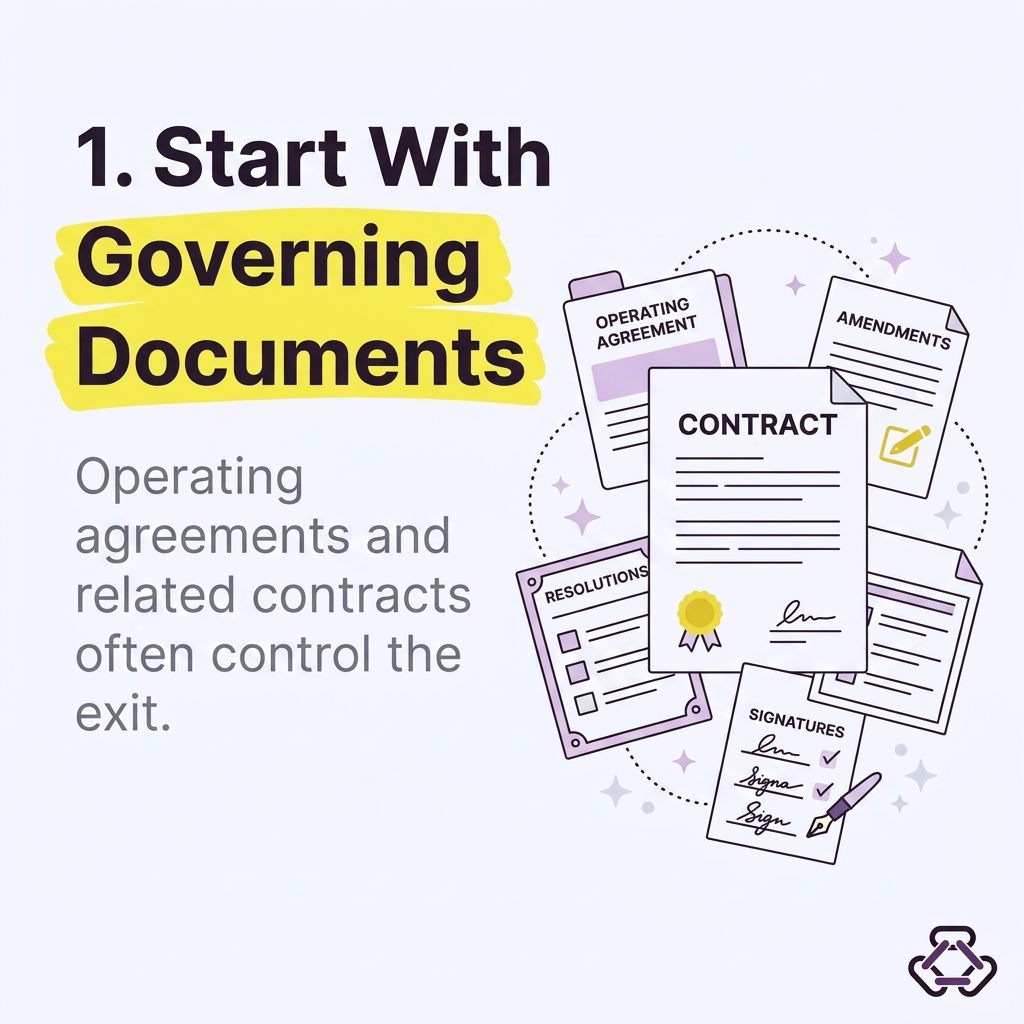
1. Start With The Governing Documents
Before anyone argues about price, it helps to identify which document actually controls the exit.
Depending on the entity, that may include:
- the LLC operating agreement
- the shareholders’ agreement
- the partnership agreement
- buy-sell agreements
- equity award agreements
- employment agreements
- loan documents and guaranties
- amendments, side letters, and board or member resolutions
In many disputes, the key question is not “What feels fair?” It is “What did the parties already agree would happen if an owner left, deadlocked, retired, breached duties, got divorced, became disabled, filed bankruptcy, or triggered dissolution?”
For LLCs in particular, buyout agreements often include a right of first refusal, meaning the departing owner has to offer the interest to the company or remaining owners before selling to an outsider (Nolo). Agreements also often address whether the company merely has an option to buy, or whether someone is actually obligated to buy.
That distinction matters. An owner may think they have a guaranteed exit, while the document may only create a purchase option. If no one exercises it, the departing owner may still be stuck holding an illiquid minority interest.
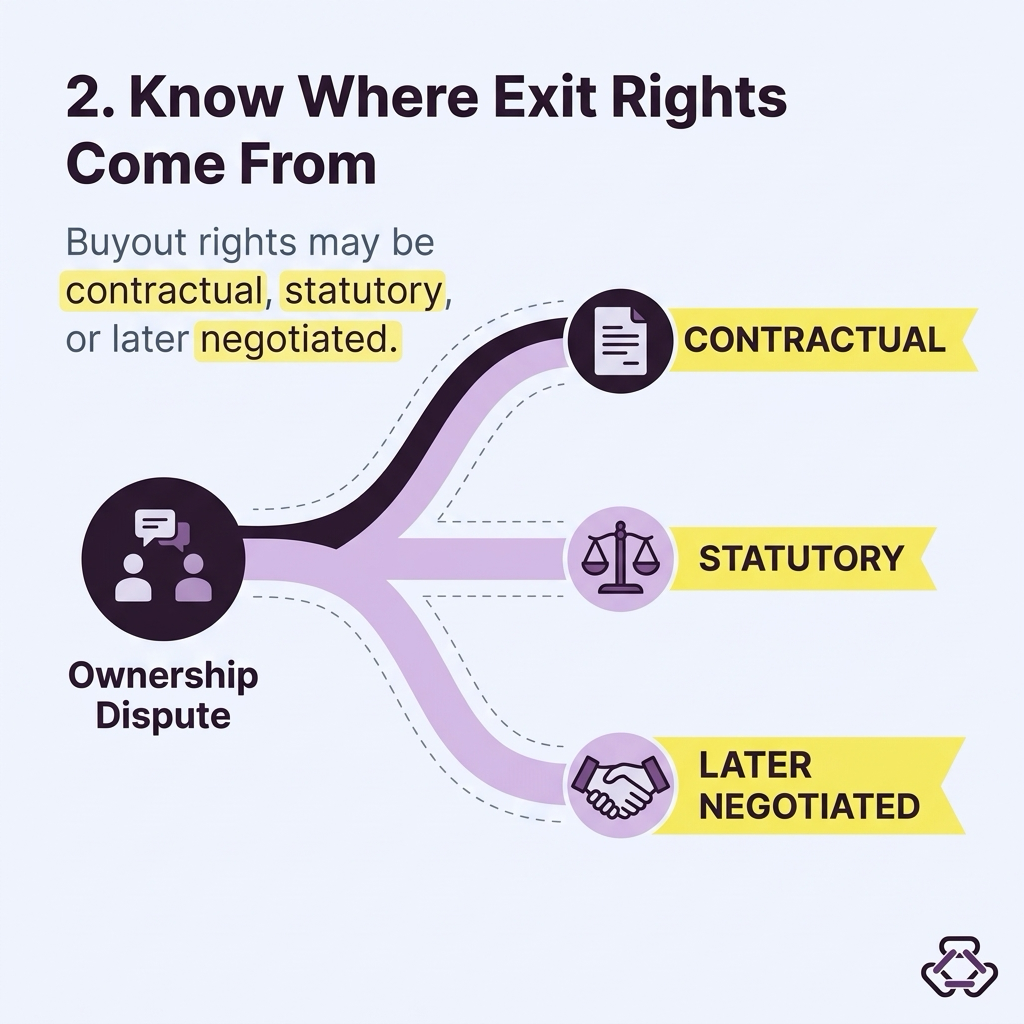
2. Identify Whether The Exit Right Is Contractual, Statutory, Or Negotiated
Not every buyout comes from the same source.
Contractual Rights
Many ownership splits are driven primarily by contract. The governing agreement may contain a put right, call right, shotgun clause, forced-sale provision, deadlock mechanism, expulsion clause, or formula for valuing interests. Courts often enforce those provisions as written, even where one side later views the result as harsh or outdated (ABA Business Law Today).
Statutory Rights
Some rights arise from state law instead. In corporations, dissenting shareholders may have appraisal rights in certain major transactions. Under the Model Business Corporation Act, appraisal rights are tied to specific corporate actions, and “fair value” is determined using customary valuation concepts immediately before the transaction’s effectiveness, without minority-status or marketability discounts in the Model Act definition (American Bar Association).
State law varies. Delaware, for example, has its own appraisal statute in Section 262 of the Delaware General Corporation Law, and the availability of appraisal can depend on transaction structure and statutory exceptions (Delaware General Assembly).
Negotiated Rights
A large number of exits happen because the parties negotiate one after the relationship breaks down. In those situations, the legal baseline still matters because it shapes bargaining power. An owner with a strong contractual repurchase right often negotiates differently from an owner whose only path may be litigation.
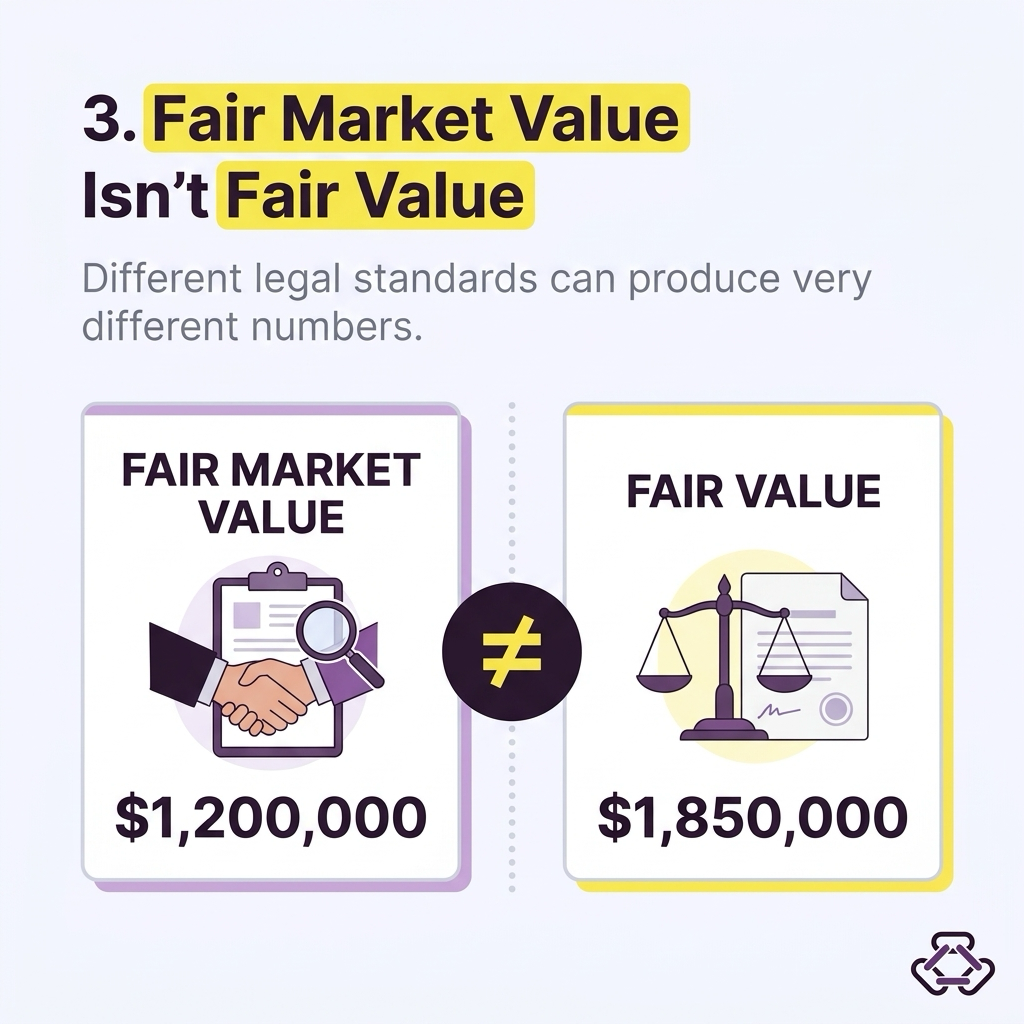
3. Understand The Difference Between Fair Market Value And Fair Value
This is one of the most misunderstood parts of an ownership split.
Fair market value and fair value are not always the same thing.
The IRS’s classic definition of fair market value, from Revenue Ruling 59-60, describes it as the price at which property would change hands between a willing buyer and willing seller, neither under compulsion and both having reasonable knowledge of relevant facts (IRS). Revenue Ruling 59-60 remains a foundational reference point in business valuation work involving closely held companies (IRS).
Fair value, by contrast, is often a statutory or agreement-defined concept. In many appraisal settings, fair value focuses on the owner’s proportionate share of the company as a going concern and may exclude discounts for minority status or lack of marketability, depending on the statute or agreement (American Bar Association).
That difference can be enormous.
If an owner’s 25% interest is valued using a fair market value framework with discounts, the number may look very different from a fair value analysis that does not apply those reductions. Some of the largest fights in business divorce cases come from parties using the same words casually while meaning very different legal standards.
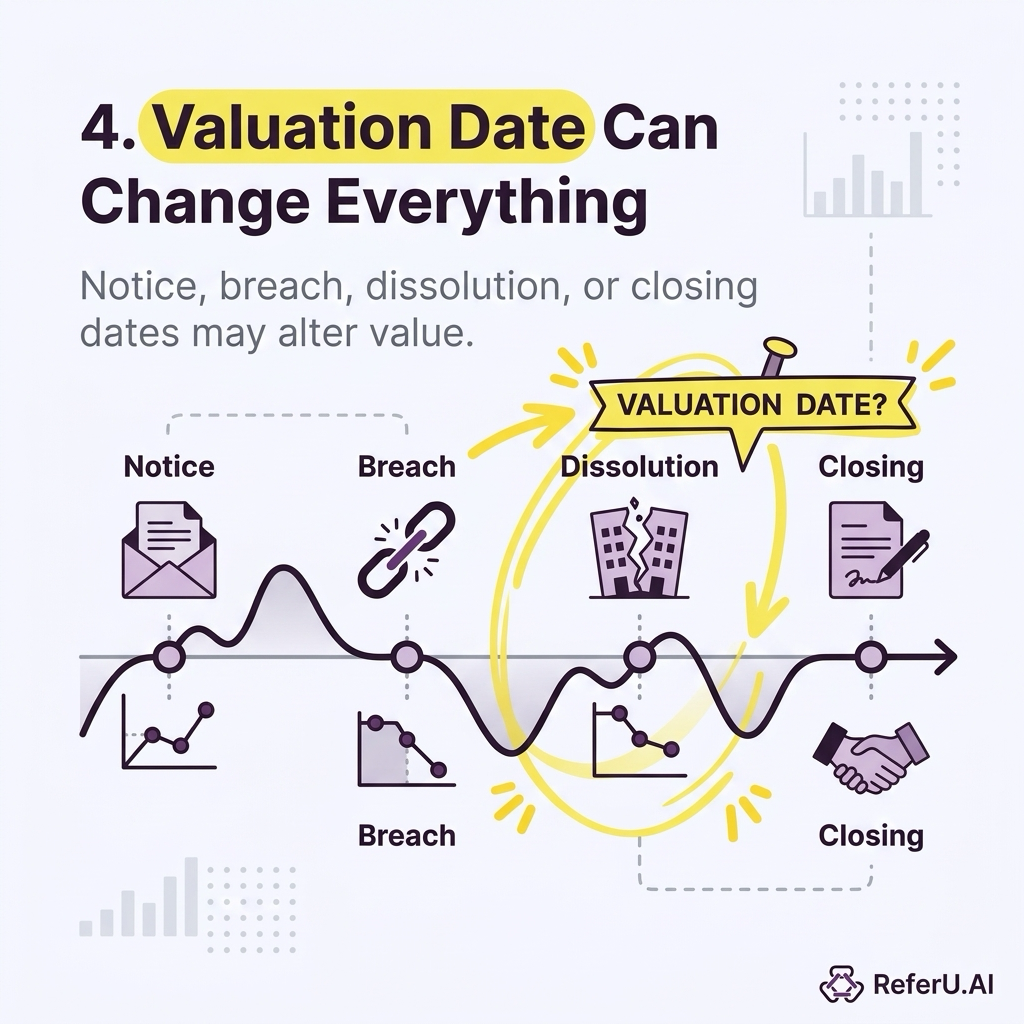
4. Ask What Valuation Date Applies
Even when everyone agrees on the valuation method, the valuation date can change the outcome dramatically.
Possible dates include:
- the date of notice of withdrawal
- the date of breach
- the date of expulsion
- the date of filing suit
- the date of dissolution
- the closing date of the buyout
- another date stated in the agreement
The ABA’s recent discussion of Model Act appraisal amendments notes that fair value under the amended provisions is measured immediately before the effectiveness of the corporate action, not necessarily the shareholder vote date (American Bar Association). In private company splits, a few months can matter a lot if the business is seasonal, project-based, rapidly growing, or already declining.
A date issue may sound technical, but it often drives seven-figure differences.
5. Examine Which Valuation Method The Agreement Uses
Some agreements specify a method. Others stay silent. Some include formulas that looked sensible years ago but no longer reflect the business reality.
Common methods include:
Income Approach
This often looks at expected future cash flow and discounts it back to present value. It is frequently used for operating businesses with predictable earnings.
Market Approach
This compares the business to comparable company transactions or public companies, while adjusting for size, growth, risk, and other factors.
Asset Approach
This focuses on the value of assets minus liabilities. It may matter more for asset-heavy businesses, holding companies, or distressed companies.
Revenue Ruling 59-60 explains that valuing closely held stock is not purely mechanical and calls for consideration of factors such as the nature of the business, earning capacity, dividend-paying capacity, goodwill, prior sales, and the market prices of comparable companies where relevant (IRS).
In practical terms, if the agreement says “book value,” “formula value,” or “fair market value as determined by the company’s CPA,” that wording may trigger a very different process than a full litigation-grade valuation by an independent appraiser.
6. Look Closely At Discounts And Premiums
This is where many owners first realize that “percentage ownership” does not automatically equal “percentage of total value.”
Valuation professionals use terms like:
- minority discount
- discount for lack of marketability
- control premium
- lack of control discount
The National Association of Certified Valuators and Analysts glossary defines a minority discount as a discount for lack of control and a discount for lack of marketability as a reduction reflecting the absence of liquidity or ready saleability (NACVA).
Whether those concepts apply in an ownership split is often a legal question as much as a valuation question.
For example, the ABA’s summary of recent developments notes cases where the contract’s use of “fair market valuation” affected whether discounts could be considered, while the Model Business Corporation Act’s definition of fair value does not permit minority-status or marketability discounts (ABA Business Law Today; American Bar Association).
In other words, “Do discounts apply?” is rarely a one-size-fits-all question.
7. Separate The Headline Price From The Real Economic Deal
A buyout offer is not just a number. It is a package of terms.
Owners often focus on valuation while overlooking exit terms such as:
- down payment amount
- installment payments
- interest rate
- security for deferred payments
- seller financing risk
- offsets for alleged misconduct
- tax treatment
- earnout provisions
- indemnity obligations
- personal guaranty release
- noncompete and nonsolicit terms
- continued employment or consulting arrangements
- access to books and records during payout
- remedies if either side defaults
A $2 million buyout payable over five years without strong security may be economically very different from a lower cash-at-closing deal. Likewise, an owner who signs away claims, accepts restrictive covenants, and remains liable on bank debt may be giving up far more than the purchase price suggests.
This is one reason people facing a split often benefit from treating the exit as both a valuation issue and a contract-risk issue.
8. Check Whether The Company Can Actually Fund The Buyout
A buyout right is only as useful as the business’s ability to finance it.
The company may be dealing with:
- lender covenants
- thin cash reserves
- customer concentration
- tax liabilities
- personal guaranties
- partner debt
- lines of credit that restrict distributions
- insurance gaps for death or disability buyouts
The U.S. Small Business Administration regularly identifies business valuation, succession planning, and buy-sell agreements as core business continuity concerns because ownership changes can threaten value if they are not planned carefully (SBA).
In a contested split, funding questions often become leverage points. A controlling owner may offer a lower price while arguing the company cannot borrow more. A departing owner may worry that a long payout leaves them exposed to future insolvency or manipulation.
9. Review How Misconduct Allegations Affect The Exit
Many ownership splits are not clean retirements. They involve accusations such as:
- self-dealing
- excessive compensation
- diversion of customers
- hiding books and records
- misuse of company funds
- breach of fiduciary duty
- oppression of minority owners
- deadlock
- fraud or misrepresentation
These allegations can affect both value and leverage.
Sometimes they change the valuation itself by requiring normalization adjustments, forensic accounting, or review of insider transactions. Sometimes they change the legal posture by creating claims for damages, dissolution, accounting, or injunctive relief. And sometimes they are raised mainly to influence the buyout price.
If the ownership breakup is already becoming hostile, this is often where reading about mistakes that turn a business split into a full-blown legal war can help frame what tends to escalate conflict, even before a court gets involved.
10. Pay Attention To Process Clauses
A surprising number of fights are caused by process, not principle.
The agreement may require:
- written notice in a specific form
- appraisal by one designated accountant
- each side selecting an appraiser, with a third as tiebreaker
- strict deadlines to object
- mediation or arbitration first
- closing within a fixed number of days
- mandatory confidentiality
- venue and governing law provisions
These clauses can be outcome-determinative. The ABA has highlighted cases where courts enforced appraisal and buy-sell procedures closely, including disputes over whether the parties followed the agreement’s selected valuation mechanism (ABA Business Law Today).
In general terms, owners often focus on “fairness” while the court starts with “What does the contract say happened next?”
11. Consider Tax Consequences Early
The same nominal buyout can produce very different after-tax results.
Tax treatment may depend on:
- whether the entity is an LLC, partnership, S corporation, or C corporation
- whether the buyout is a redemption by the company or a cross-purchase by the other owner
- basis allocation
- hot assets or ordinary income items
- installment-sale treatment
- treatment of goodwill
- compensation recharacterization issues
- state and local tax consequences
Because tax structure can affect both sides differently, valuation discussions sometimes stall when the parties realize they are not comparing equivalent after-tax outcomes. A business divorce attorney often works closely with tax counsel and valuation professionals to understand the real economics before papering the deal.
12. Compare Litigation Leverage Against Settlement Terms
Not every disputed ownership split belongs in court. But many negotiated exits are shaped by what litigation might look like if negotiations fail.
Possible claims may include:
- judicial dissolution
- shareholder oppression
- breach of fiduciary duty
- accounting
- declaratory judgment
- contract claims
- books-and-records actions
- derivative claims
- appraisal proceedings
That does not automatically mean litigation is the right path. It does mean the viability of those claims often affects the buyout discussion. An owner with access to meaningful statutory remedies may negotiate from a different position than one whose agreement sharply limits exit options.
For readers trying to think through the broader pre-dispute strategy, this guide on getting ready for an owner breakup without destroying business value connects many of these issues to timing, records, and negotiation posture.
13. Know When A Valuation Expert Is Not Enough
A credentialed valuation professional can be essential. But valuation expertise alone does not resolve:
- whether a buyout right exists
- which legal standard applies
- whether discounts are legally allowed
- whether fiduciary breaches altered the books
- whether the agreement is enforceable
- whether the process requirements were met
- whether the payout structure is collectible
- whether claims should be released or preserved
That is why many ownership splits call for a coordinated team rather than a single professional. The legal question and the financial question are often intertwined.
14. What Owners Often Miss In Exit Terms
Here are some of the most overlooked issues in ownership split documents:
Personal Liability Does Not Always End At Closing
If the departing owner guaranteed leases, loans, or vendor obligations, the business breakup alone may not release them. A separate lender or landlord consent may still be required.
Books And Records Access Can Matter After The Deal
If purchase payments are tied to future performance, tax returns, or earnout calculations, access rights may matter long after the ownership transfer.
Restrictive Covenants Can Change The Entire Deal
A broad noncompete or customer nonsolicit clause can reduce the practical value of the exit, especially if the departing owner’s skills and relationships are the business.
Boilerplate Provisions Are Not Really Boilerplate
Attorney-fee clauses, governing law, venue, integration clauses, and dispute-resolution provisions can heavily influence later enforcement.
15. When It May Be Time To Speak With A Business Divorce Attorney
Some ownership splits stay manageable for a while, then become far more serious once one of these happens:
- the company stops sharing financial information
- one owner changes passwords, payroll, or bank access
- a buyout offer arrives with a short fuse
- distributions stop without a clear explanation
- the majority claims the minority interest is worth far less than expected
- lenders, customers, or employees are pulled into the dispute
- one side alleges misconduct or threatened dissolution
- the agreement is vague, outdated, or internally inconsistent
In situations like those, an attorney may help determine which rights are actually enforceable, what valuation standard is likely in play, and how to evaluate settlement terms against litigation risk.
Short Summary
Evaluating buyout rights, company valuation, and exit terms in an ownership split is rarely just about finding a single “correct” number. It usually involves contracts, state law, valuation standards, discounts, timing, tax structure, payment risk, and control issues all at once.
A fair-looking price can become far less favorable once the agreement’s process clauses, payout terms, guaranties, and release language are fully understood. And a buyout right that sounds clear in conversation may look much narrower once the governing documents and applicable law are read closely.
If you’re dealing with a founder dispute, shareholder breakup, LLC member exit, or closely held company conflict, you may want to consider getting the situation reviewed by counsel with documented experience in highly similar matters. Visit ReferU.AI to get matched with an attorney who has demonstrable experience in cases like yours — for free.
