Table of Contents
- How to Respond When a Client Refuses to Pay or Claims You Failed to Perform
- Why These Disputes Escalate So Quickly
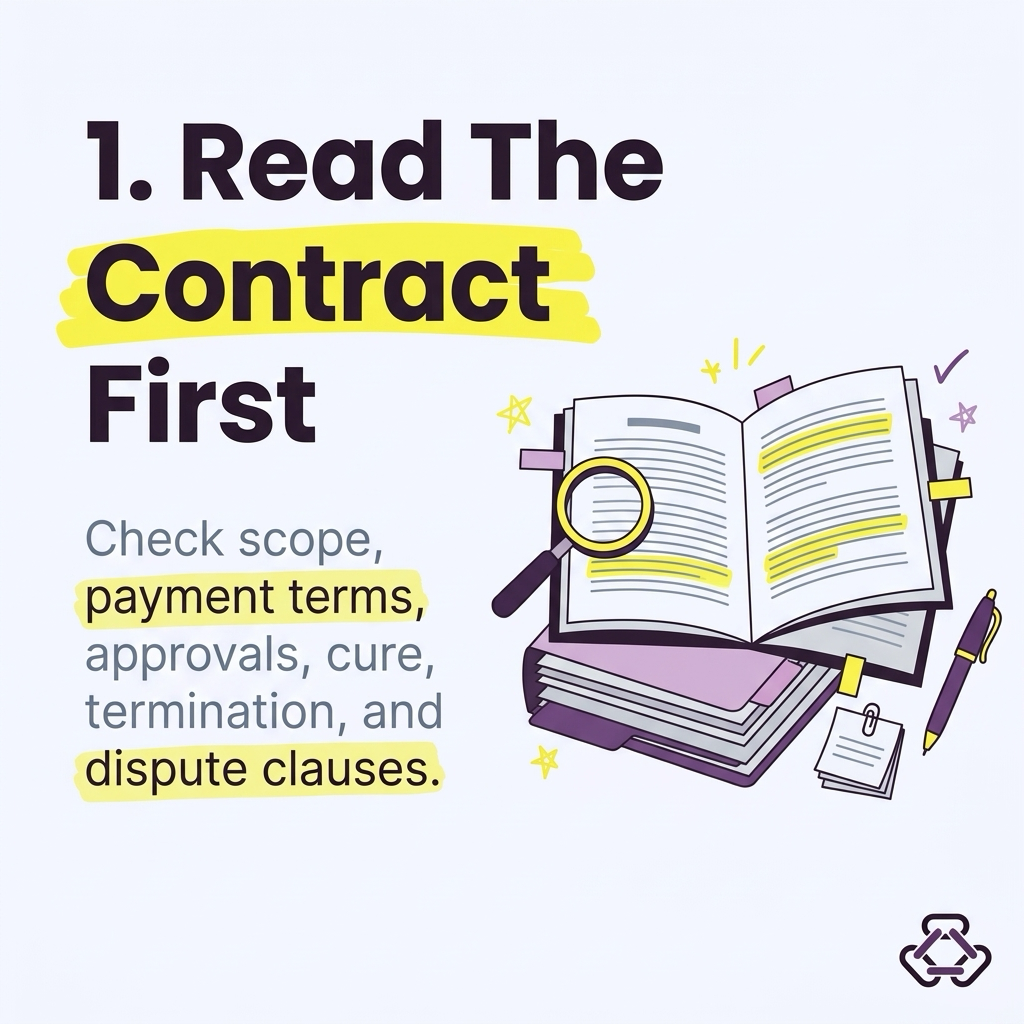
- Step 1: Pause The Emotional Response And Read The Contract Closely
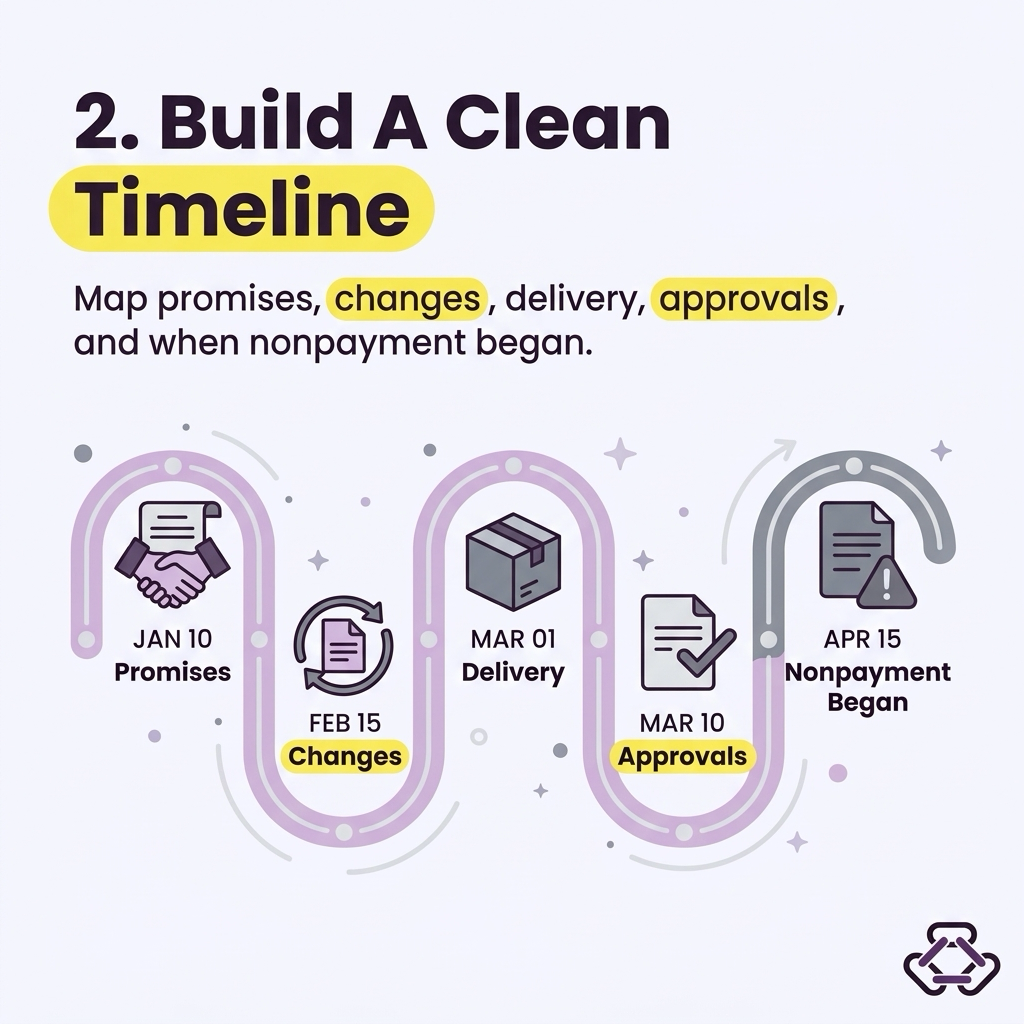
- Step 2: Build A Clean Timeline Before You Send A Strong Response
- What Was Promised?
- What Was Requested Later?
- What Did You Actually Deliver?
- What Did The Client Say Along The Way?
- When Did The Payment Problem Start?
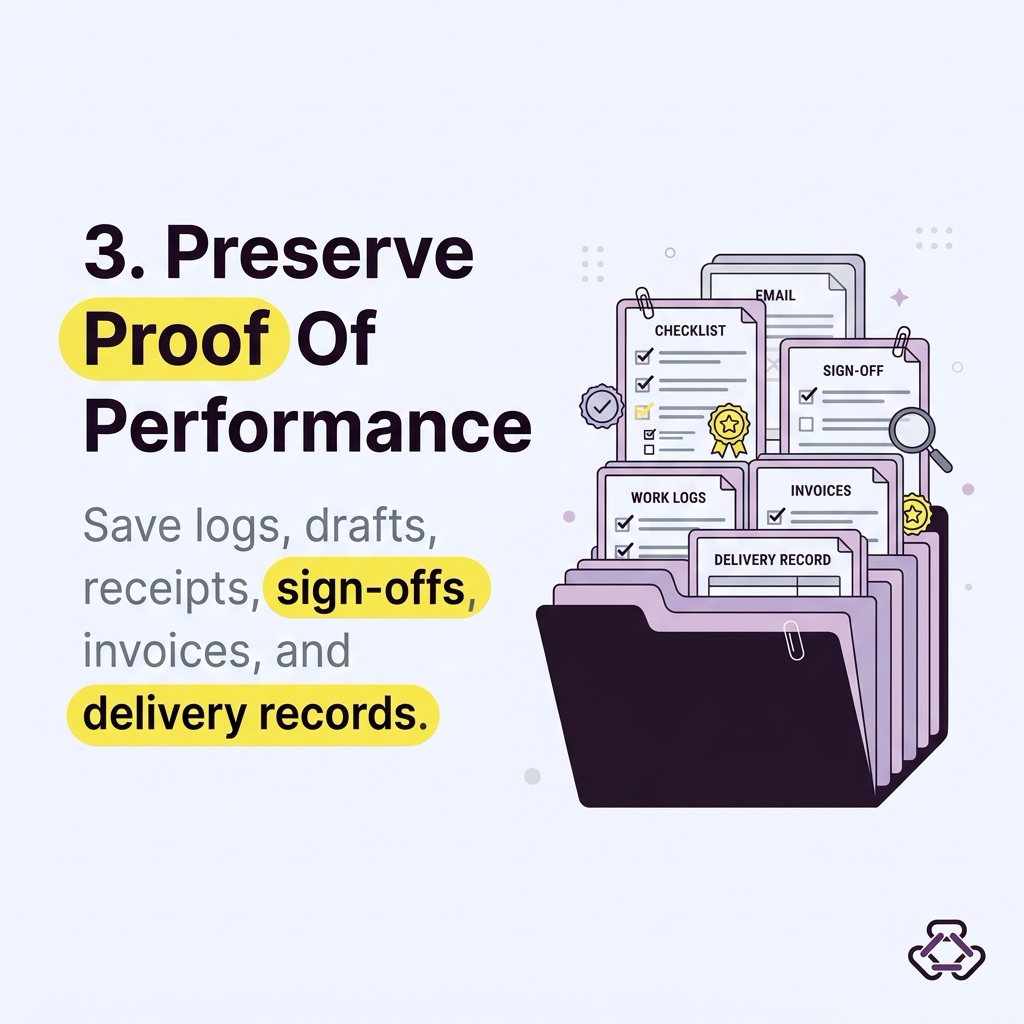
- Step 3: Preserve Evidence Of Performance And Acceptance
- Step 4: Respond In Writing, But Keep The Tone Professional
- Step 5: Watch Out For The “Paid In Full” Trap
- Step 6: Evaluate Whether The Dispute Is Really About Scope Creep
- Step 7: Consider Commercial Resolution Options Before Filing Suit
- Step 8: Think About Defenses And Counterclaims Early
- Step 9: Review Whether You Can Suspend Work Or Terminate
- Step 10: Bring In Counsel When The Facts Start Affecting Leverage
- Common Mistakes That Can Make The Dispute Harder
- A Short Summary

Type
Great Grandchild
Status
Approved
Title (YouTube)
Images Failed (Social)
Images Failed (Social)
Do not index
Publish Date (TikTok)
Jan 5, 2027 11:15
Videos Post IDs (Social)
Hashtags (Social)
#LegalAdvice #LegalHelp #BusinessLitigation #CustomerClientDisputes
Caption
Caption X
Cover

OG Image

Alt Image Text
Flat vector illustration of a client refuses to pay dispute with contract records and proof of failed to perform claims under review.
Images

Videos
Publish Date (Social)
Dec 16, 2026 08:00
Scheduled (Social)
Scheduled (Social)
Images Posted (Social)
Images Posted (Social)
Videos Posted (Social)
Videos Posted (Social)
Videos Failed (Social)
Videos Failed (Social)
Featured
Created time
Apr 3, 2026 10:12 PM
Sub-item
Authors
CTA Practice Area (Social)
Business Litigation
TikTok Failed (Social)
TikTok Failed (Social)
Videos Post Links (Social)
YT Auto Captions Removed
TikTok Post Links (Social)
Images Post IDs (Social)
YT Post ID
Video Pending Manual (Social)
TikTok Posted (Social)
TikTok Posted (Social)
TikTok Post IDs (Social)
Video Cover (Social)
Images Post Links (Social)
First Comment (Social)
YT Embedded
Images Delete (Social)
Videos Delete (Social)
Carousel Video URL (Social)
How to Respond When a Client Refuses to Pay or Claims You Failed to Perform
When a client stops paying, or suddenly says your team “didn’t do the work,” the dispute can feel personal fast. It also tends to create immediate pressure on cash flow, project schedules, and internal morale. For many businesses, the problem is not just the unpaid invoice. It is the risk that a routine billing issue turns into a contract fight about scope, quality, delays, approvals, or termination.
That scenario is common enough that it helps to think about it as a process problem, not just a personality conflict. According to Intuit QuickBooks’ 2025 U.S. small business late-payments report, 47% of surveyed small businesses had invoices overdue by 30+ days, which helps explain why even well-run companies end up dealing with nonpayment disputes from time to time (Intuit QuickBooks). In this post you’ll learn how to respond in a structured way, how to preserve the records that often matter most, and when a business contract attorney may help you evaluate collection, defense, settlement, mediation, or litigation options.
If you want broader context on the full range of these revenue-threatening conflicts, it may help to start with this overview of business contract disputes involving nonpayment, performance fights, scope changes, and termination.
Scroll to the bottom for every post in this series.
Why These Disputes Escalate So Quickly
A client who refuses to pay rarely frames the issue as “we just do not want to pay.” More often, the explanation sounds like one of these:
- “The work was incomplete.”
- “The deliverables were defective.”
- “This was outside the original scope.”
- “We never approved that extra work.”
- “You missed the deadline.”
- “Your invoice does not match the agreement.”
- “We accepted part of the work, but not all of it.”
In general terms, those statements point to a few core legal themes: contract interpretation, proof of performance, notice of objections, damages, and whether either side waived rights through its conduct. The facts often matter more than the outrage. A dispute may turn on a signed proposal, a statement of work, a change order, an email approval, a project-management log, a timesheet, a delivery confirmation, or a message where the client praised the work before refusing to pay.
That is one reason many contract disputes become evidence contests. Courts and arbitrators often spend significant time comparing the written agreement to the project history. The American Bar Association has noted that in commercial disputes, conflicts often revolve around contract interpretation and whether the parties followed the agreed procedures for resolving disagreements, including mediation or arbitration if the contract requires it (American Bar Association; AAA Guide).
Step 1: Pause The Emotional Response And Read The Contract Closely
The first productive move is usually to go back to the actual contract documents. That may include:
- the master services agreement
- proposal or estimate
- statement of work
- change orders
- payment terms
- milestone definitions
- approval language
- warranty or cure provisions
- termination provisions
- limitation-of-liability language
- attorney’s fees clause
- dispute resolution clause
- governing law and venue clause
In many cases, the contract says more than either side remembers. A payment obligation may be tied to milestones, acceptance, time-and-materials billing, or completion of a defined task. There may also be a requirement that objections be raised in writing within a certain time, or that disputes go to mediation before a lawsuit or arbitration proceeds. Courts do sometimes enforce contractual mediation-first provisions, depending on the clause and the jurisdiction (American Bar Association).
If the client claims failure to perform, it also helps to separate true nonperformance from disputes about quality, delay, extra work, or changing expectations. Under common-law contract principles, the doctrine of substantial performance can matter in some service disputes, meaning minor or immaterial deviations do not always erase the right to payment, though they may affect offsets or damages (Cornell Legal Information Institute). The exact effect depends heavily on state law and the contract language.
Step 2: Build A Clean Timeline Before You Send A Strong Response
A rushed accusation usually creates more heat than leverage. Many businesses get better traction by first assembling a timeline that answers five basic questions:
What Was Promised?
Pull the signed documents and isolate the exact scope, pricing, deadlines, assumptions, exclusions, and client responsibilities.
What Was Requested Later?
List additions, revisions, extra meetings, expanded deliverables, accelerated timelines, and verbal instructions that changed the original work.
What Did You Actually Deliver?
Gather invoices, reports, drafts, final deliverables, shipping records, access logs, punch lists, screenshots, and proof of completion.
What Did The Client Say Along The Way?
Look for approval emails, meeting notes, text messages, portal comments, “looks good” messages, renewal discussions, and requests for more work after the alleged failure.
When Did The Payment Problem Start?
Note the invoice dates, due dates, partial payments, objections, and any point where the client first connected nonpayment to alleged performance problems.
That timeline often becomes the foundation for any attorney demand letter, mediation statement, insurance notice, or court filing later on.
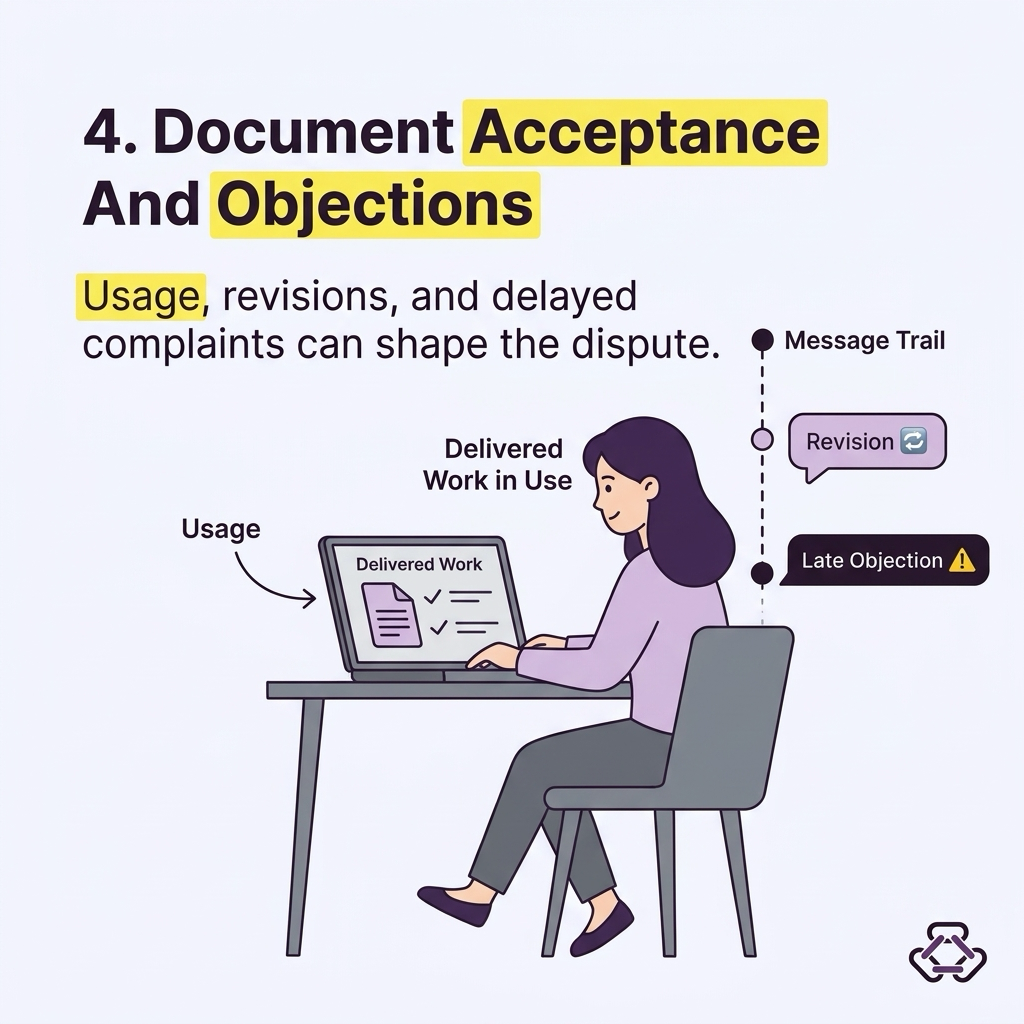
Step 3: Preserve Evidence Of Performance And Acceptance
When a client says you failed to perform, the next issue is usually proof. In many disputes, the client accepted the work in practice long before objecting to the invoice. They may have used the deliverable, launched the design, relied on the report, occupied the space, deployed the code, or continued asking for revisions after receiving the original work product.
For goods, Article 2 of the Uniform Commercial Code provides that acceptance can limit rejection rights, while still allowing remedies for breach in some situations, and it places importance on notice of breach after acceptance (Cornell Legal Information Institute). Service contracts are often governed by common law rather than the UCC, but similar factual questions still arise: Did the client accept the benefit? Did they object promptly? Did they continue using the work? Did they ask for cure? Did they waive strict compliance through conduct?
Useful evidence often includes:
- approved proposals and SOWs
- signed change orders
- timesheets and work logs
- issue trackers and revision history
- delivery receipts and transmittal emails
- invoices and aging reports
- client approvals and sign-offs
- messages requesting additional work after delivery
- internal notes about client-directed changes
- records showing the client caused delay or blocked completion
When these disputes are building, documentation is often the difference between “he said, she said” and a clearer contract record.
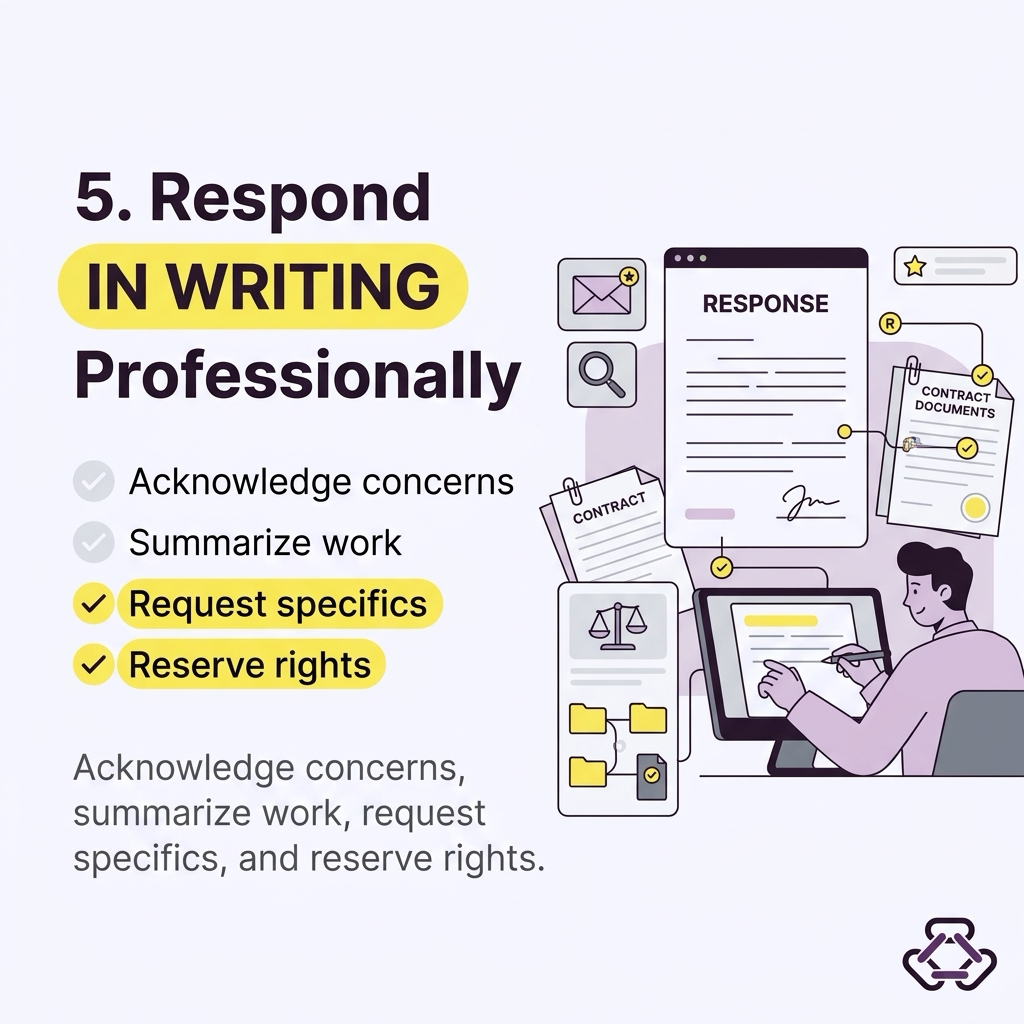
Step 4: Respond In Writing, But Keep The Tone Professional
A written response helps frame the dispute before the facts get blurred. The goal is usually not to “win the argument” in one email. The goal is to create a calm, accurate record.
A practical response often includes:
- acknowledgment of the client’s position
- a reference to the governing agreement
- a concise summary of the work performed
- invoice and balance details
- a request that the client specify any alleged deficiencies
- a reservation of rights
- a proposed next step, such as a call, cure process, or mediation discussion if the contract mentions it
If the client’s complaint is vague, asking for a specific written list of alleged defects, omissions, or contract provisions they believe were breached may help narrow the dispute. In many cases, broad accusations become more fragile once the other side has to identify exact missed obligations.
The American Bar Association has also noted, in the collection context, that consistency and clear communication around billing and delinquency can make a meaningful difference before a matter reaches collections or formal litigation (American Bar Association; American Bar Association).
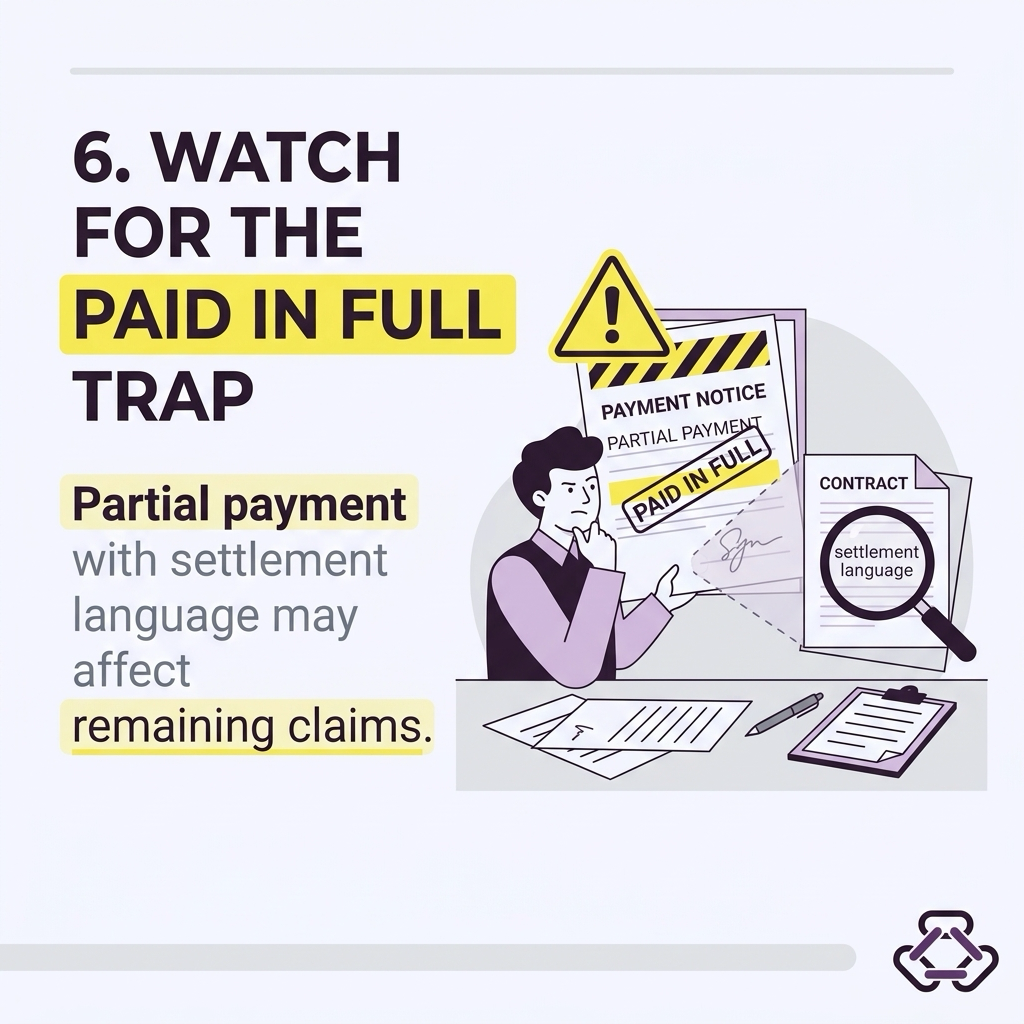
Step 5: Watch Out For The “Paid In Full” Trap
Some clients try to convert a disputed invoice into a discounted settlement by sending a reduced check marked “paid in full” or language to that effect. That issue can create problems if the payment is deposited without reviewing the accompanying communication.
Under UCC 3-311, a claim can be discharged by accord and satisfaction by use of an instrument if certain conditions are met, including a good-faith tender of the instrument as full satisfaction of a disputed claim and the claimant obtaining payment of it (Cornell Legal Information Institute). More broadly, an accord and satisfaction is an agreement for alternative performance that discharges a pre-existing obligation once the substitute performance occurs (Cornell Legal Information Institute).
In practical terms, if a client sends partial payment with settlement language, an attorney may help assess whether depositing it could affect the remaining claim, and whether your contracts and payment-handling procedures reduce that risk.
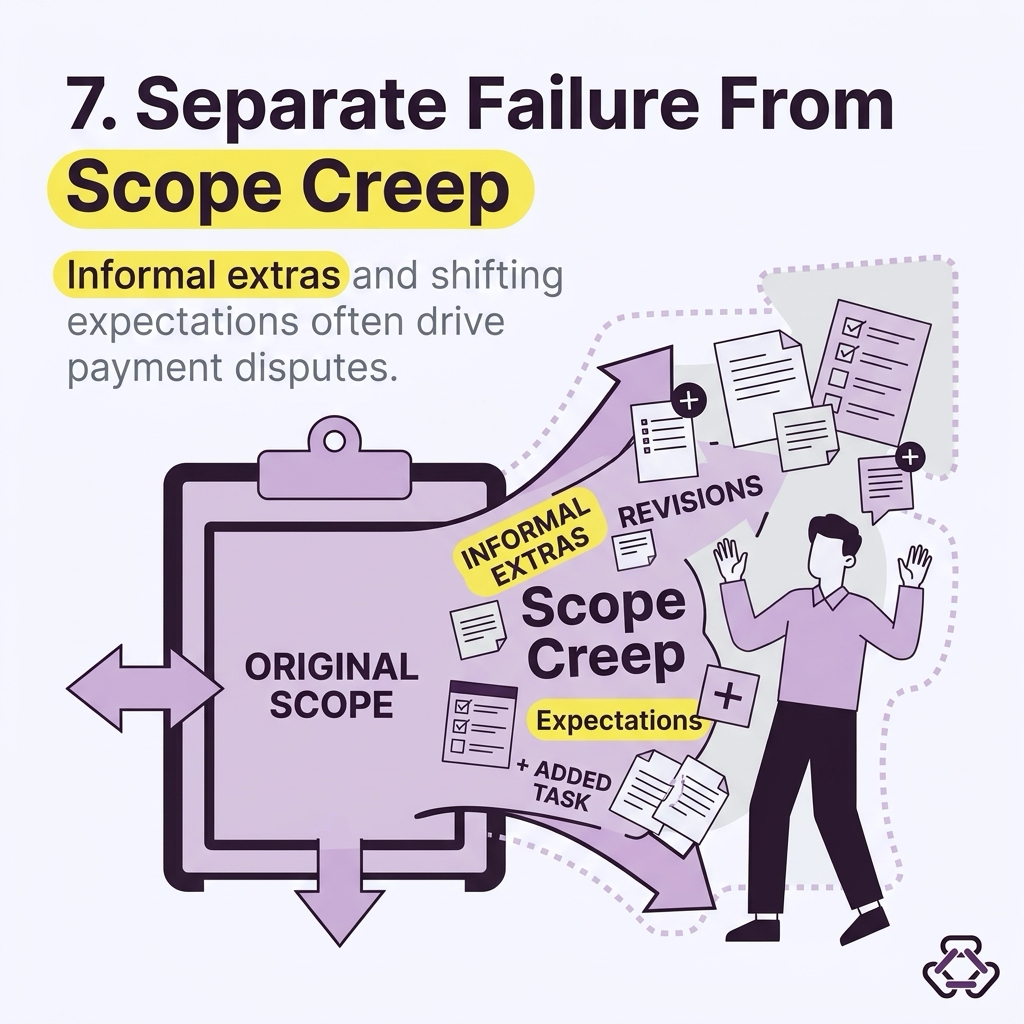
Step 6: Evaluate Whether The Dispute Is Really About Scope Creep
A surprising number of “you failed to perform” disputes are really unpriced expansion disputes. The client may believe the added work was included. The vendor may view it as extra work authorized informally through meetings, Slack threads, or phone calls. By the time the invoice arrives, both sides are relying on different versions of the project.
That is why scope control documents matter so much. If your project involved revisions, additions, client delays, design changes, or moving targets, the core issue may be less about failure and more about whether the work fell inside or outside the original bargain.
This is also where businesses often discover that informal approvals helped keep the client happy in the short term but made the dispute harder later. If that sounds familiar, it may help to compare your process to a more systematic approach for gathering statements of work, approvals, and change documentation in client conflicts. Even where the dispute has already started, organizing those records can reshape the negotiating posture.
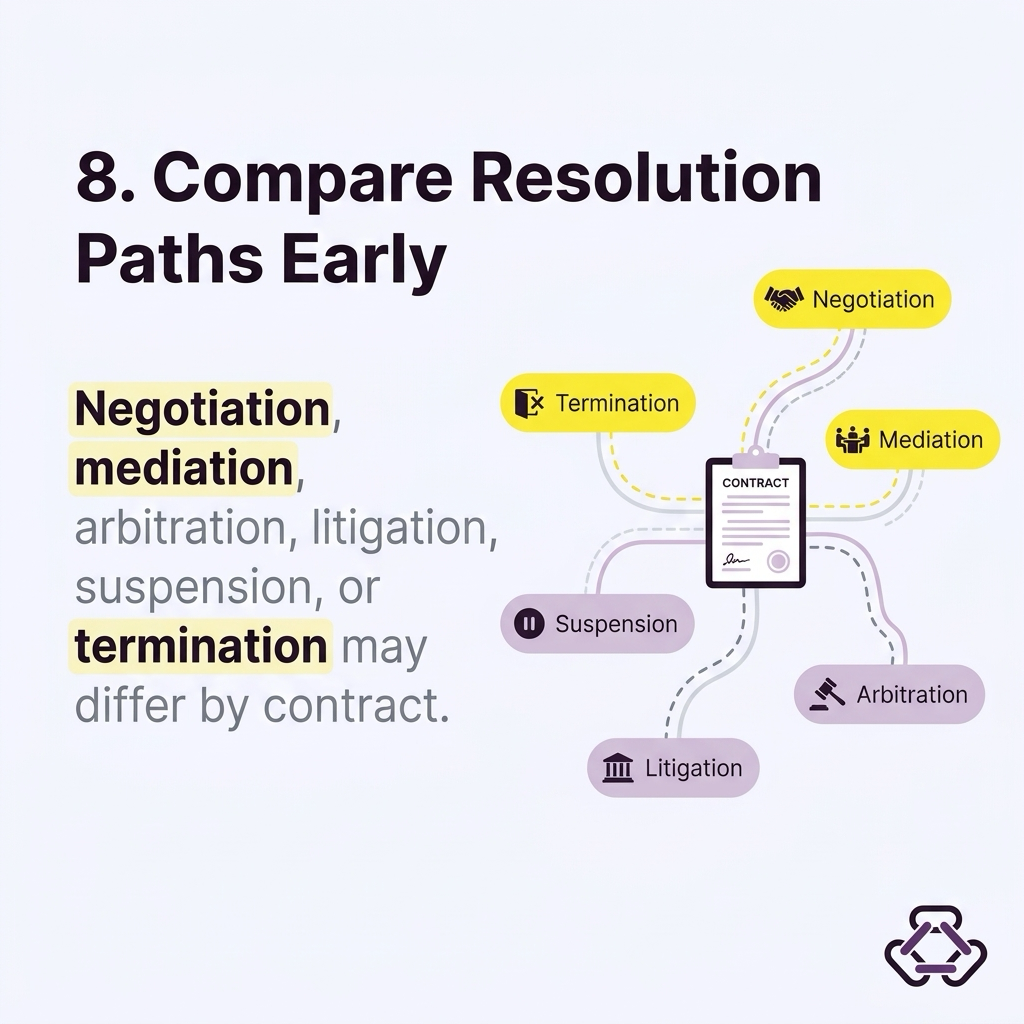
Step 7: Consider Commercial Resolution Options Before Filing Suit
Not every unpaid invoice dispute belongs in court right away. Depending on the contract amount, the relationship, the evidence, and the client’s defenses, common options include:
- direct business negotiation
- attorney demand letter
- structured cure process
- payment plan
- negotiated discount with release
- mediation
- arbitration
- litigation
- collections activity, where legally appropriate
The American Arbitration Association describes mediation and arbitration as tools businesses can use for contract disputes, and its commercial guidance emphasizes that parties often build these procedures into contracts in advance (AAA). AAA also reported in February 2026 that its mediation caseload had grown 14% since 2022, with commercial filings up 15% year over year in 2025, suggesting continued demand for ADR in business conflicts (AAA).
Mediation can be especially useful when:
- both sides want to preserve the relationship
- the facts are messy
- each side carries some risk
- the contract has gaps
- reputational concerns matter
- the cost of full litigation may exceed the likely recovery
Arbitration may come into play if the contract requires it. Litigation may make more sense where there is a larger balance, strong documentary proof, a solvent defendant, or a counterclaim that needs a formal forum.
Step 8: Think About Defenses And Counterclaims Early
If a client refuses to pay and alleges poor performance, the dispute may quickly move beyond “collecting the invoice.” They may assert counterclaims such as:
- breach of contract
- negligence or professional negligence
- misrepresentation
- breach of warranty
- unjust enrichment
- deceptive trade practices, in some industries or states
An attorney may help evaluate not only the collection claim, but also potential exposure on the defense side. This becomes especially important if your industry involves licensing requirements, professional standards, regulated services, or technical deliverables where a standard of care may apply. For example, in the design-professional context, the ABA has noted that the contractually defined standard of care can become the measurement used in a dispute if the contract addresses it (American Bar Association).
The broader point applies outside that field too: the agreement often supplies the measuring stick.
Step 9: Review Whether You Can Suspend Work Or Terminate
Some contracts allow suspension of services for nonpayment after notice. Others require continued performance during a dispute. Some allow termination for material breach only after an opportunity to cure. If your team keeps working after prolonged nonpayment without documenting reservations, the account balance can grow while leverage shrinks.
That does not mean immediate termination is always the best business move. It means the contract language and the client’s response pattern often deserve close review before more labor, materials, or vendor costs are added to the file.
Step 10: Bring In Counsel When The Facts Start Affecting Leverage
There is a point where an internal collections email stops being enough. That point often arrives when:
- the balance is large
- the client alleges breach in writing
- the client threatens a lawsuit or chargeback
- the contract contains arbitration or fee-shifting language
- the dispute involves technical performance questions
- partial payment is offered as “full satisfaction”
- termination rights are in play
- the client appears to be building a paper trail against you
- multiple project documents conflict with each other
A business contract attorney may help analyze the contract, preserve claims and defenses, draft a demand letter, structure settlement terms, evaluate arbitration clauses, and identify whether recovery of attorney’s fees or interest may be available under the contract or applicable law.
Just as important, counsel can help separate recoverable legal claims from frustration that feels valid but may not change the outcome. That distinction matters when deciding whether to push for payment, compromise, or defend aggressively.
Common Mistakes That Can Make The Dispute Harder
Businesses in this position often lose ground through preventable missteps, including:
- arguing by phone without a written follow-up
- failing to gather all versions of the contract
- overlooking email approvals and informal scope changes
- depositing a “paid in full” check too quickly
- threatening suit before understanding the counterclaim risk
- continuing extra work without updated pricing
- making admissions in anger
- deleting internal communications or project records
- waiting too long to involve counsel
In many cases, the strongest file is not the one with the angriest emails. It is the one with the clearest paper trail.
A Short Summary
When a client refuses to pay or says you failed to perform, the dispute often turns on a small set of practical questions: What did the contract require? What changed? What was delivered? What did the client approve or accept? When did objections begin? Those answers shape the collection claim, the defense, and the settlement range.
A calm timeline, organized project records, and a contract-focused response can change the direction of the dispute quickly. And when the amount at stake is meaningful, or the client’s allegations are becoming more formal, a business attorney may help clarify options before the matter gets more expensive.
Visit ReferU.AI to get matched with an attorney who has demonstrable experience in cases like yours — for free.
