Table of Contents
- Customer Contract Disputes: A Beginner’s Guide to Revenue-Critical Business Conflicts
- What Is A Customer Contract Dispute?
- Why These Disputes Are Revenue-Critical
- What Types Of Customer Contract Disputes Are Most Common?
- Nonpayment And Partial Payment
- Scope Creep And Change-Order Fights
- Performance And Quality Disputes
- Termination Disputes
- Why Customer Contract Disputes Escalate So Quickly
- Ambiguous Contract Language
- Informal Project Management
- Internal Business Pressure
- Delay
- What Evidence Often Matters Most?
- The Contract Stack
- Performance Records
- Payment History
- Notice And Cure Communications
- Damages Proof
- What Legal Issues Often Show Up In These Cases?
- Was There A Material Breach?
- Did The Customer Accept The Work?
- Are There Contractual Limits On Liability?
- Is There An Attorney’s Fees Clause?
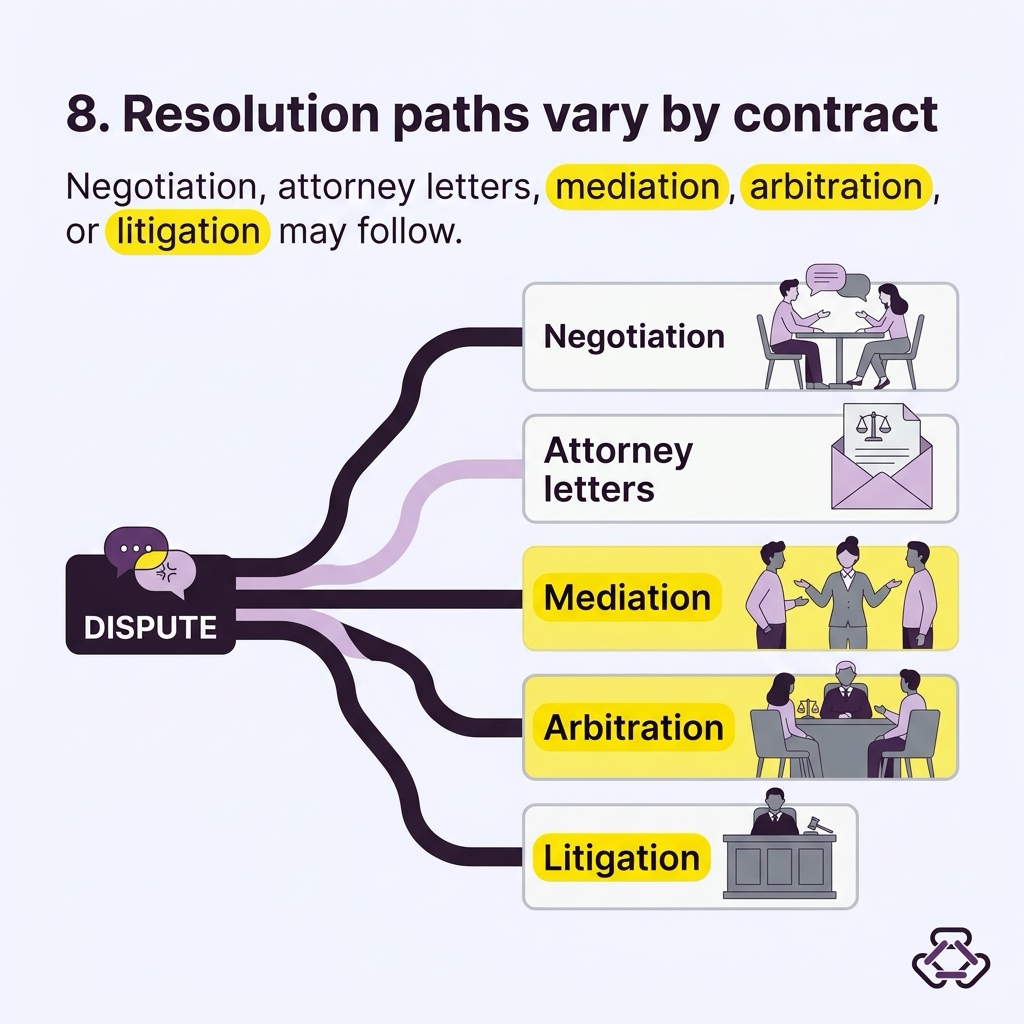
- How Are Customer Contract Disputes Usually Resolved?
- Direct Business Negotiation
- Attorney Demand And Response Letters
- Mediation
- Arbitration
- Litigation
- When Does It Make Sense To Involve An Attorney?
- What Can Businesses Do At The First Sign Of A Dispute?
- Clarify The Contract Documents
- Build A Clean Timeline
- Preserve Internal Records
- Separate Business Goals From Legal Claims
- Why Attorney Fit Matters In A Revenue-Critical Contract Fight
- Final Thoughts

Type
Great Grandchild
Status
Approved
Title (YouTube)
Images Failed (Social)
Images Failed (Social)
Do not index
Publish Date (TikTok)
Jan 5, 2027 11:45
Videos Post IDs (Social)
Hashtags (Social)
#LegalAdvice #LegalHelp #BusinessLitigation #CustomerClientDisputes
Caption
Caption X
Cover

OG Image

Alt Image Text
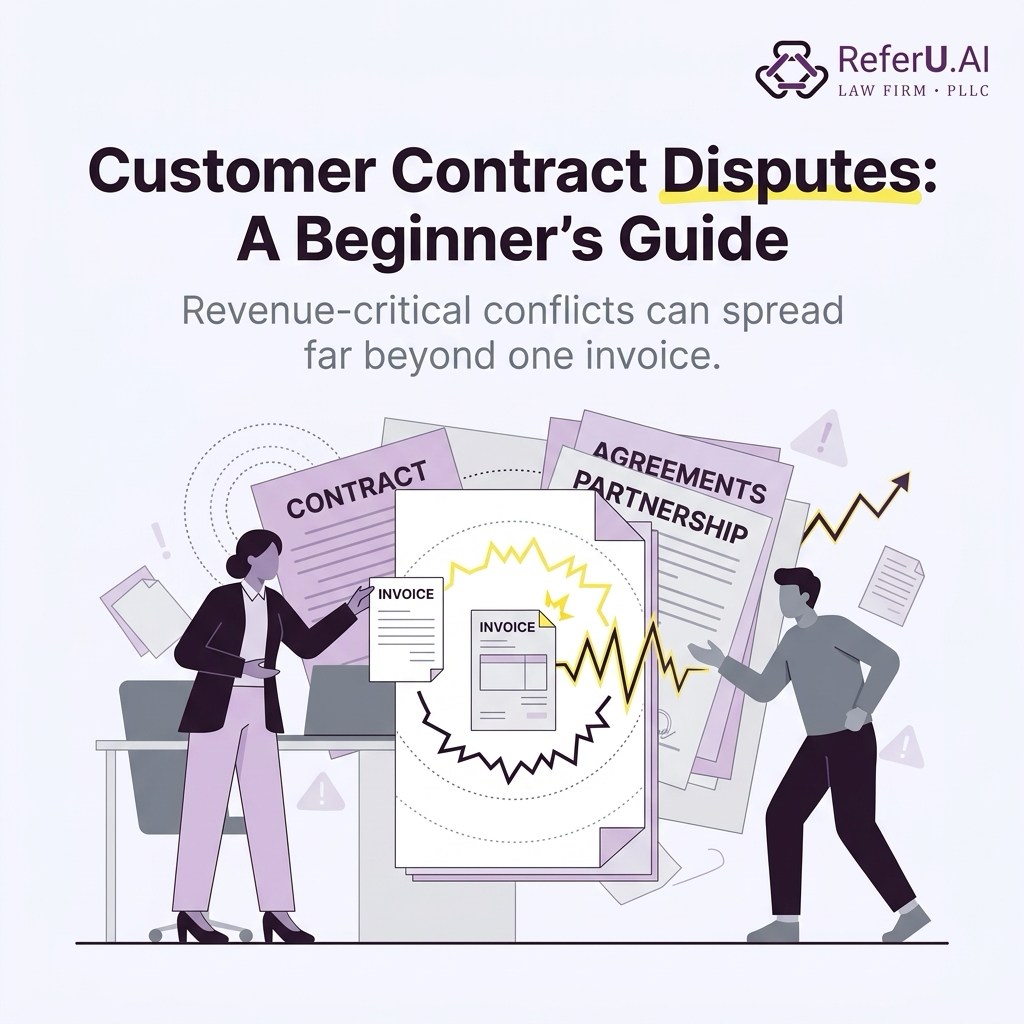
Flat vector illustration of customer contract disputes and revenue-critical business conflicts, showing a business and customer in disagreement over a contract, invoice, and delayed revenue.
Images

Videos
Publish Date (Social)
Dec 16, 2026 08:30
Scheduled (Social)
Scheduled (Social)
Images Posted (Social)
Images Posted (Social)
Videos Posted (Social)
Videos Posted (Social)
Videos Failed (Social)
Videos Failed (Social)
Featured
Created time
Apr 3, 2026 10:12 PM
Sub-item
Authors
CTA Practice Area (Social)
Business Litigation
TikTok Failed (Social)
TikTok Failed (Social)
Videos Post Links (Social)
YT Auto Captions Removed
TikTok Post Links (Social)
Images Post IDs (Social)
YT Post ID
Video Pending Manual (Social)
TikTok Posted (Social)
TikTok Posted (Social)
TikTok Post IDs (Social)
Video Cover (Social)
Images Post Links (Social)
First Comment (Social)
YT Embedded
Images Delete (Social)
Videos Delete (Social)
Carousel Video URL (Social)
Customer Contract Disputes: A Beginner’s Guide to Revenue-Critical Business Conflicts
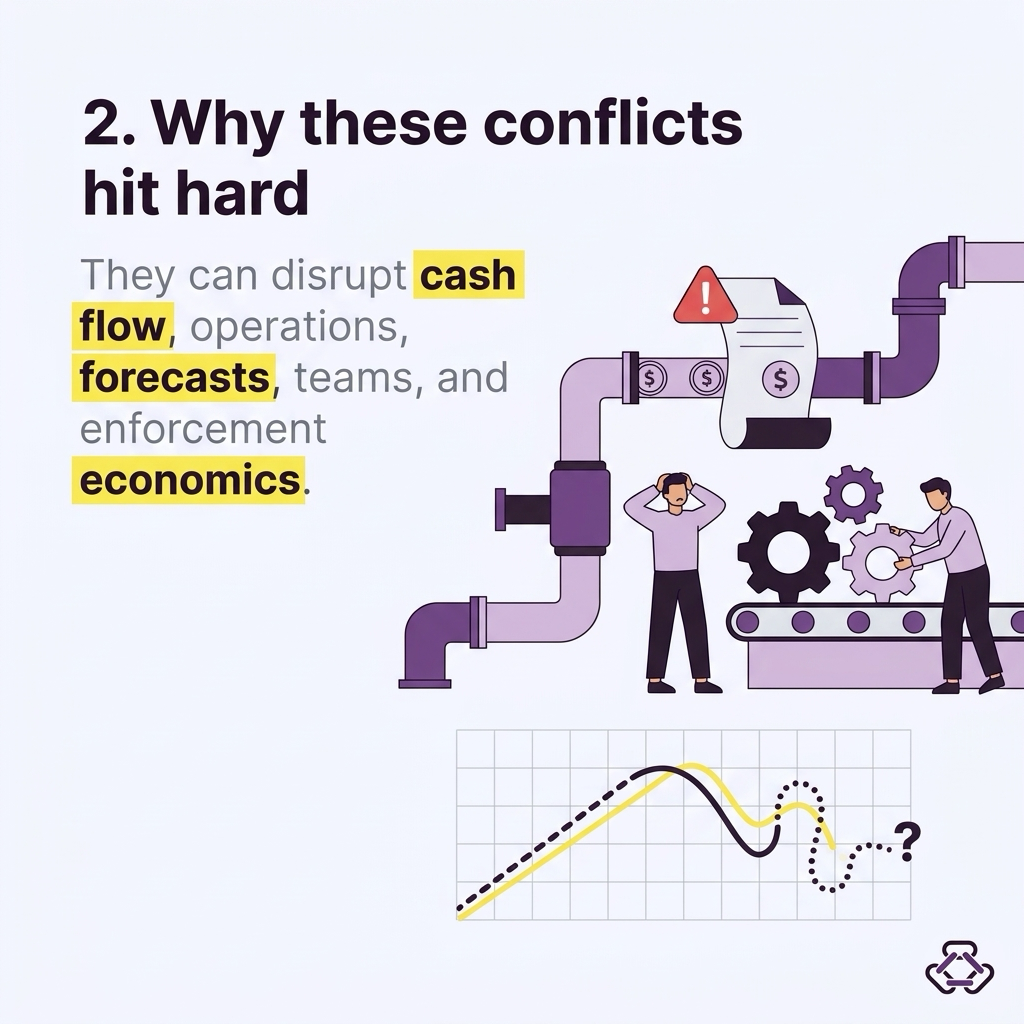
When a major customer relationship starts to break down, the problem rarely stays confined to one invoice or one project milestone. It can spread into delayed cash flow, internal disruption, strained teams, damaged forecasts, and months of uncertainty. For many businesses, a customer contract dispute is not just a legal issue. It is a revenue-critical business conflict.
If you are new to this topic, you are not alone. Payment fights, scope disagreements, acceptance disputes, termination arguments, and finger-pointing over performance are among the most common forms of commercial conflict. Recent industry research from World Commerce & Contracting found that disputes frequently grow out of mismatches around scope of work, performance, and what the customer expected the contract to deliver. The same research also highlights how often customer disputes emerge from ambiguity rather than outright bad faith (WorldCC).
In this post you’ll learn what customer contract disputes are, why they become so expensive, the most common pressure points, what evidence often matters, how resolution paths usually work, and where an attorney may help you assess leverage and risk early.
You can also explore a broader overview of business contract fights involving scope, payment, performance, and termination if you want more context around the full lifecycle of these conflicts.
Scroll to the bottom for every post in this series.
What Is A Customer Contract Dispute?
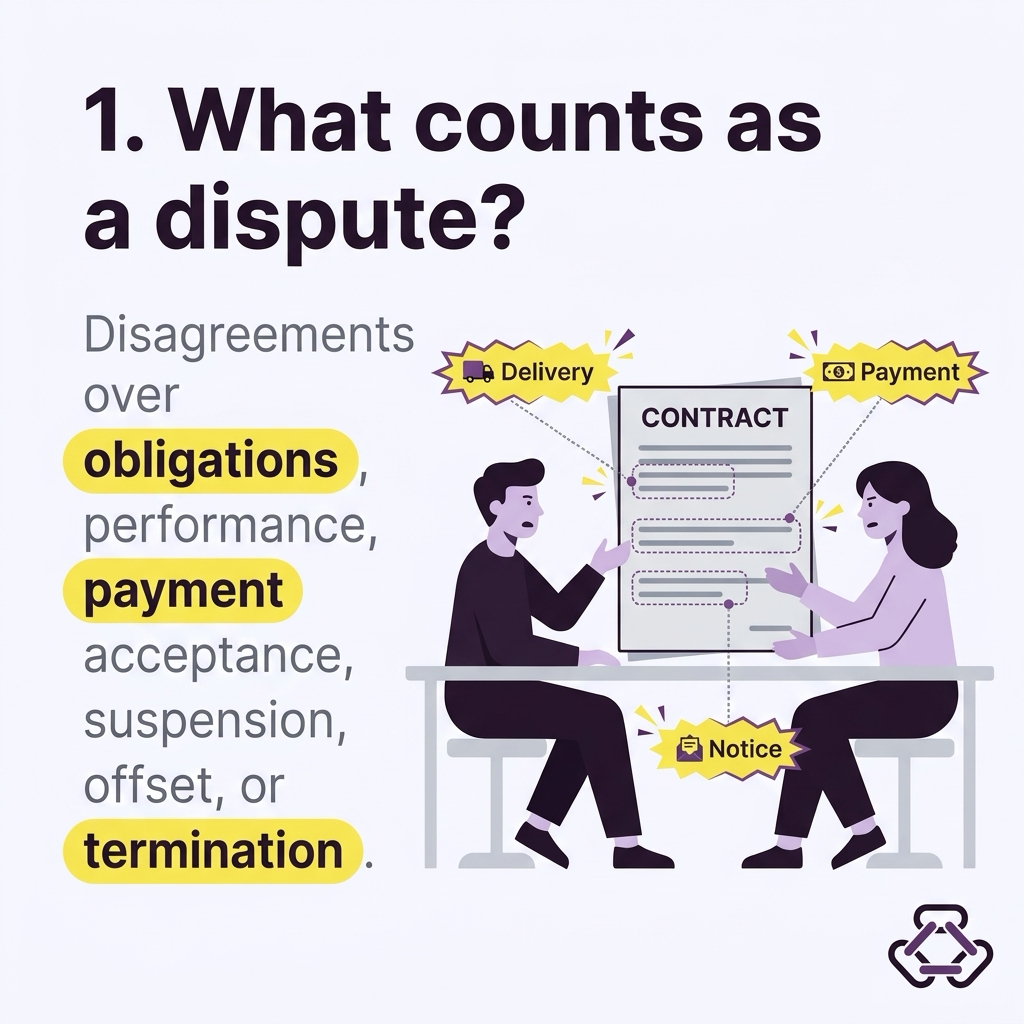
A customer contract dispute is a disagreement between a business and its customer about what the contract required, whether each side performed, whether payment is owed, or whether one side had the right to suspend, reject, offset, or terminate.
In general terms, these disputes often center on questions like:
- What exactly was promised?
- Was the work or product delivered on time?
- Did the deliverable meet the contract standard?
- Was there a valid change in scope?
- Did the customer accept the work?
- Is nonpayment justified?
- Did either side properly follow notice, cure, or termination procedures?
Under basic U.S. contract principles, breach-of-contract claims commonly turn on the existence of a contract, the parties’ obligations, alleged nonperformance, and provable damages. Remedies in contract cases often focus on expectation damages, which aim to place the non-breaching party in roughly the position it would have occupied if the contract had been performed as agreed (Cornell Legal Information Institute).
That may sound straightforward. In practice, it often becomes messy very quickly.
Why These Disputes Are Revenue-Critical
A customer dispute can affect much more than the amount listed on the unpaid invoice.
For smaller and mid-sized businesses, delayed payment alone can put real pressure on operations. Intuit QuickBooks reported in its 2025 U.S. Small Business Late Payments Report that 56% of surveyed small businesses were owed money from unpaid invoices, with an average amount outstanding of $17,500 (Intuit QuickBooks). Separate 2026 survey data from Bluevine found that 29% of SMB owners had delayed paying themselves because customers paid late, and 59% said late payments happen at least occasionally (Bluevine).
On the legal side, unresolved commercial disputes can become economically irrational to pursue, even when the underlying claim is valid. A 2025 study highlighted by the International Chamber of Commerce described unresolved low-value commercial disputes as an economic imperative, especially for SMEs, because the cost of enforcement can outstrip the value of the claim itself (ICC).
That is part of what makes customer contract disputes so dangerous. The contract may say one thing, the invoices may say another, the email trail may suggest something else, and the economics of enforcement may change the entire conversation.
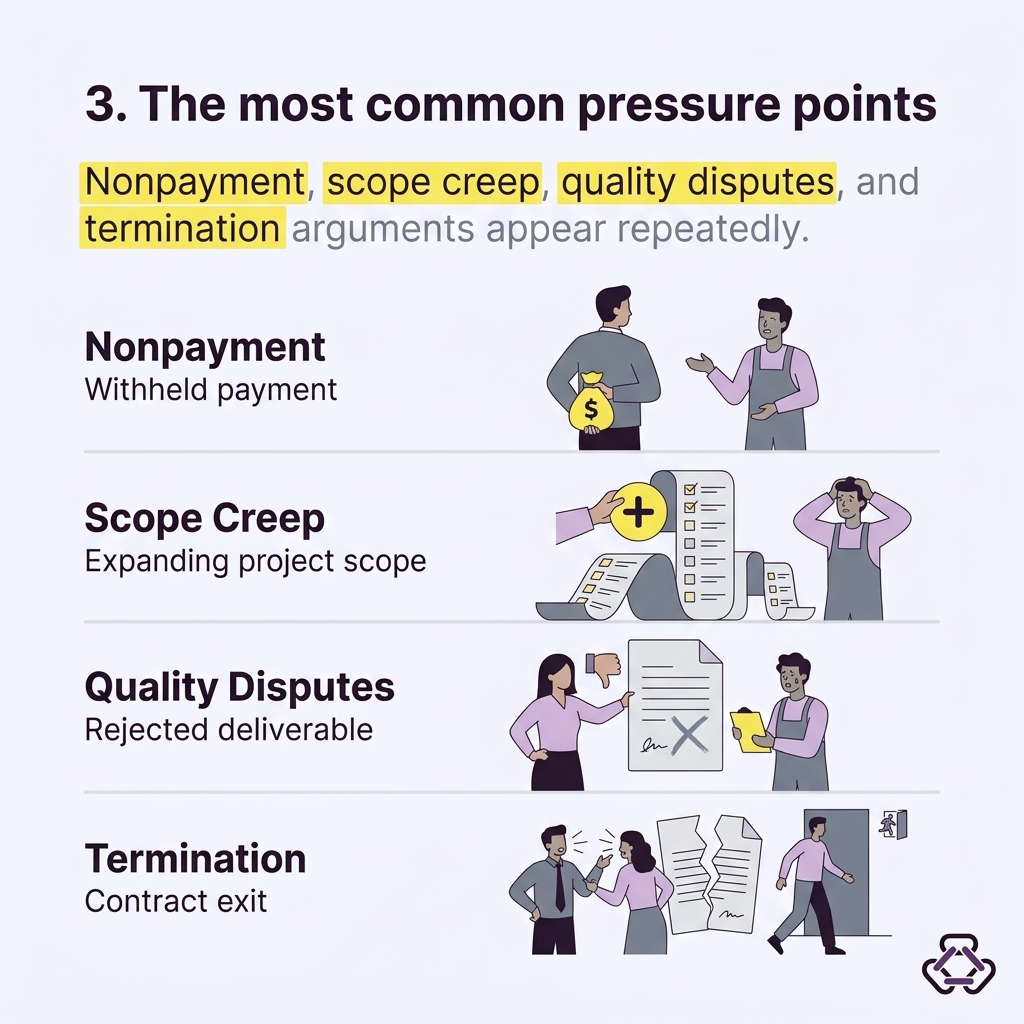
What Types Of Customer Contract Disputes Are Most Common?
Nonpayment And Partial Payment
This is often the issue businesses notice first. A customer receives the product or service, raises concerns later, and withholds all or part of payment. In some situations, the dispute is genuine. In others, quality complaints appear only after the invoice comes due.
Common variations include:
- “We never approved this extra work.”
- “The deliverable was incomplete.”
- “Your team missed the deadline.”
- “We incurred damages, so we are offsetting payment.”
- “The milestone was not accepted.”
- “We terminated before the final invoice accrued.”
Scope Creep And Change-Order Fights
A project starts under one set of assumptions, then expands through calls, emails, Slack messages, meetings, and informal approvals. Later, one side treats those changes as billable additions while the other treats them as included work.
WorldCC’s reporting points to scope-of-work issues as one of the leading causes of disputes in commercial relationships (WorldCC). That tracks with what many businesses experience on the ground: the bigger the project, the more likely scope drift becomes a legal problem.
Performance And Quality Disputes
Performance fights are common in service, software, manufacturing, distribution, and professional-services relationships. The customer may argue the result fell below the contract standard. The business may argue it substantially performed and any remaining issue was minor, correctable, or caused by the customer.
For contracts involving the sale of goods, Article 2 of the Uniform Commercial Code can matter. Under the UCC’s “perfect tender” framework, a buyer may reject goods if the delivery fails to conform to the contract, although other UCC provisions can also give the seller an opportunity to cure in some situations (Cornell Legal Information Institute).
For service contracts, the analysis is often less mechanical and more fact-intensive. Courts frequently look at the language of the agreement, the nature of the alleged defect, whether the issue was material, and whether the customer accepted or continued using the work.
Termination Disputes
Termination can trigger a cluster of follow-on issues:
- Was the termination for cause or convenience?
- Was notice proper?
- Was there a contractual cure period?
- What fees survived termination?
- What work-in-progress was compensable?
- Did the customer terminate too early?
- Did the business stop performance before it had the right to do so?
Termination clauses often look simple until a dispute starts. Then every defined term, deadline, and notice method can suddenly matter.
Why Customer Contract Disputes Escalate So Quickly
A customer contract dispute often starts as an operational disagreement and becomes a legal conflict because the parties are arguing on different tracks.
One side may be focused on delivery history. The other may be focused on the contract text. One may be talking about fairness. The other may be talking about notice provisions, acceptance language, and limitation-of-liability clauses.
Several factors tend to accelerate escalation:
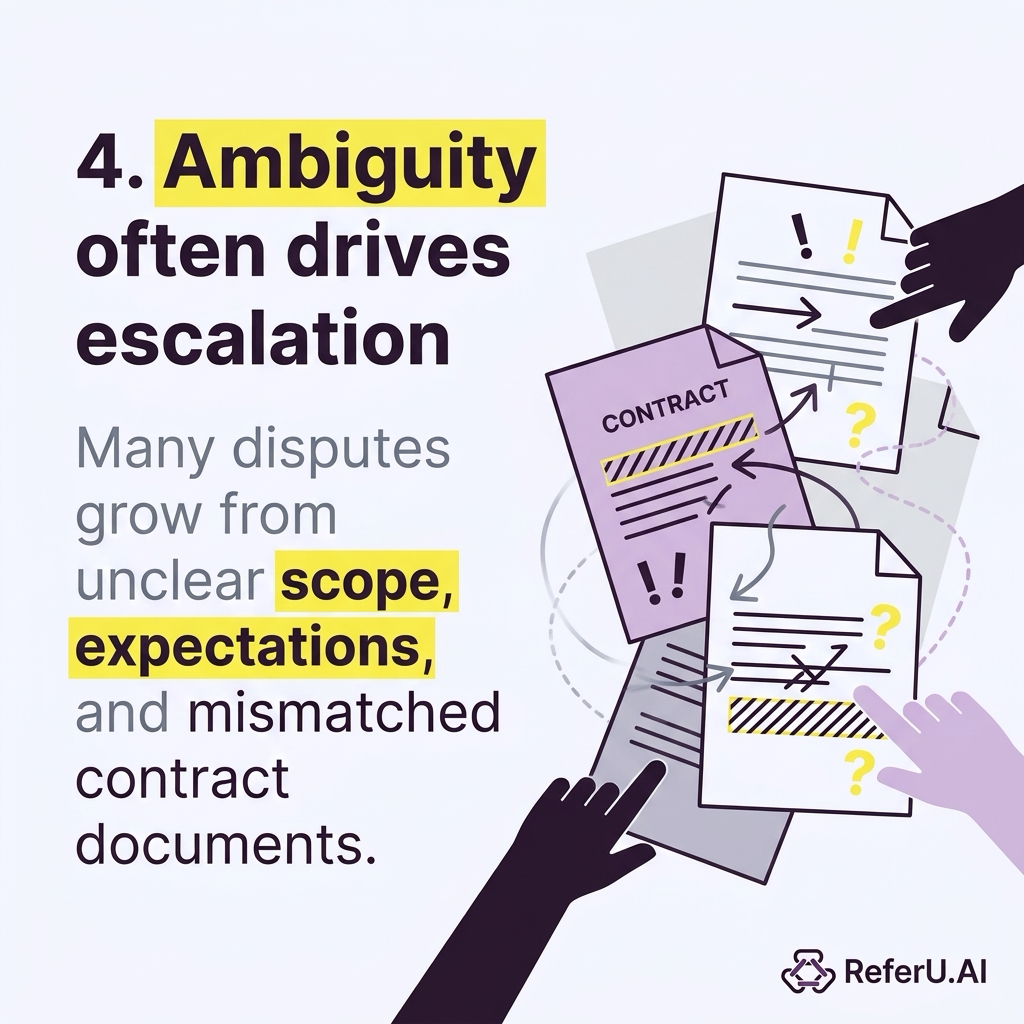
Ambiguous Contract Language
Ambiguity creates room for competing narratives. If statements of work, order forms, change orders, approval criteria, and master agreements do not line up cleanly, both sides may sincerely believe the contract favors them.
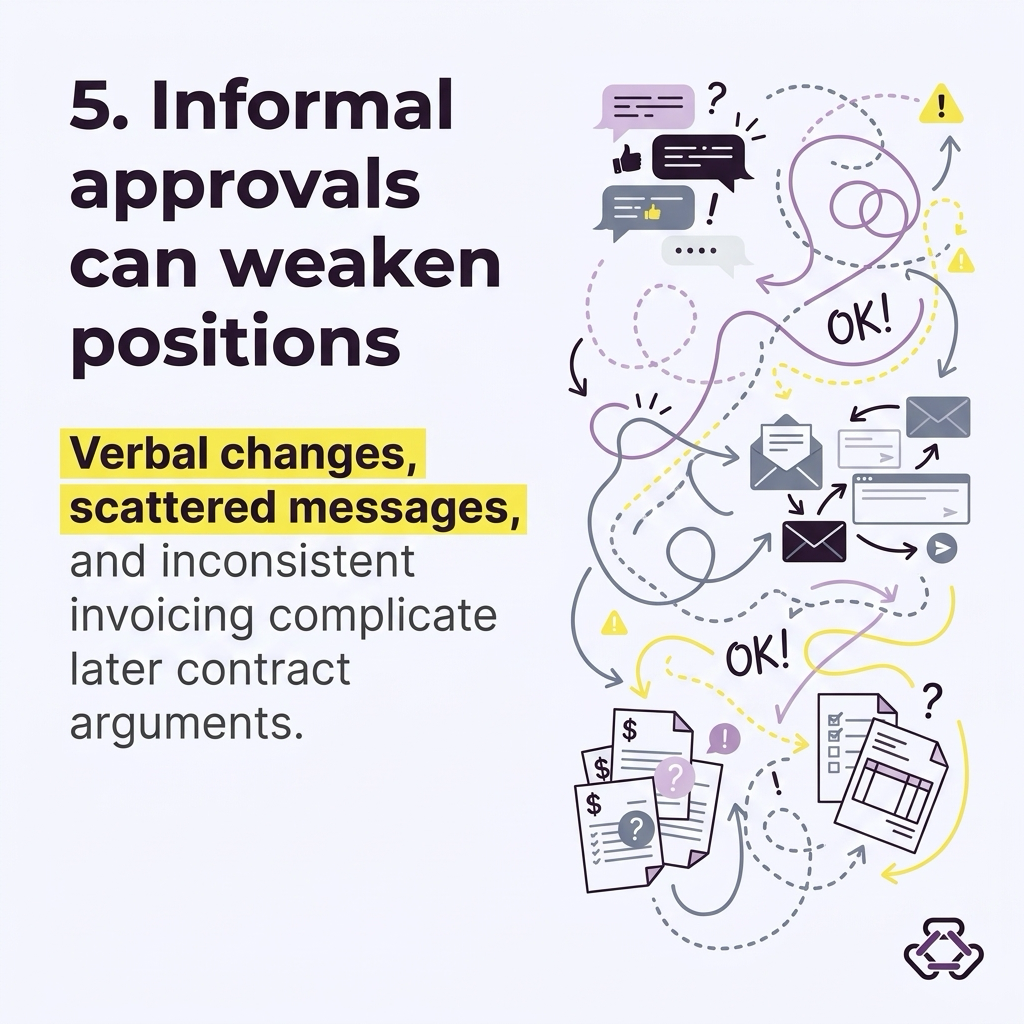
Informal Project Management
A surprising number of disputes are not really about the contract alone. They are about the gap between the written contract and the way the relationship was actually managed. Verbal approvals, undocumented revisions, “just get it done” changes, and inconsistent invoicing can weaken either side’s later position.
Internal Business Pressure
When budgets tighten, customers may scrutinize vendor invoices more aggressively. A contract dispute can become a tool in a larger financial negotiation, particularly where the customer relationship has broader commercial value.
Delay
The longer a dispute sits, the harder it often becomes to reconstruct what happened. Documents get scattered. Employees leave. Memories fade. Positions harden.
What Evidence Often Matters Most?
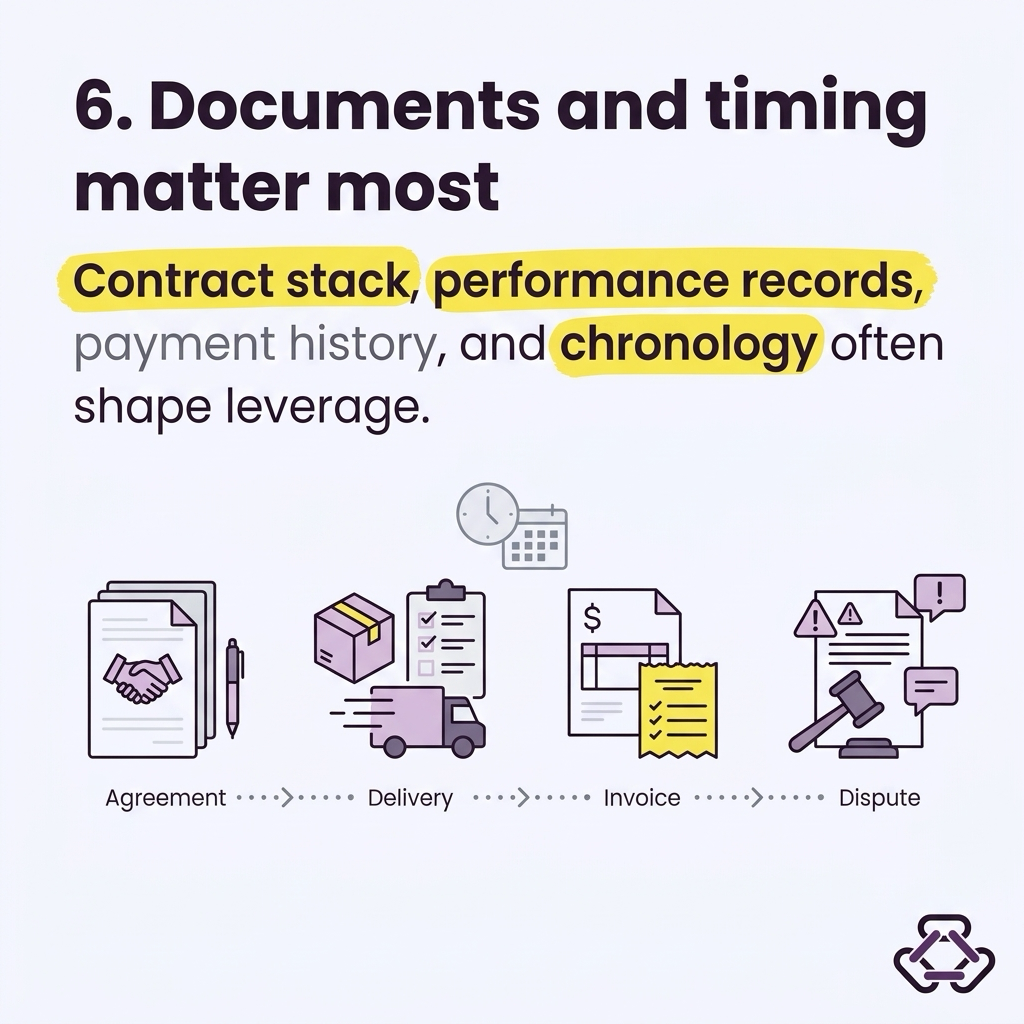
In beginner-friendly terms, customer contract disputes are often won or lost on documents and chronology. A business may feel morally right and still struggle if its records are thin, inconsistent, or incomplete.
Evidence commonly includes:
The Contract Stack
This may include:
- Master service agreement
- Statement of work
- Purchase order
- Order form
- Change orders
- Amendments
- Renewal documents
- Email approvals incorporated by reference
One of the first legal questions is often: what documents actually form the deal?
Performance Records
Examples include:
- Delivery confirmations
- Ticket histories
- milestone sign-offs
- acceptance emails
- implementation logs
- revision requests
- QA reports
- customer usage data
These records often help answer whether the product or service was delivered, whether issues were raised contemporaneously, and whether the customer accepted the work in practice.
Payment History
Prior payments can matter. If a customer paid the same type of invoice repeatedly and later claims the billing model was unauthorized, that history may become relevant. The same is true for prior acceptance of deliverables or long periods of silence before a dispute was asserted.
Notice And Cure Communications
Many contracts require formal notice of breach and a period to cure before suspension or termination. If one side skipped those steps, that detail may affect leverage, defenses, or available remedies.
Damages Proof
Contract damages are not just about alleging harm. They usually require evidence. Depending on the case, this may involve unpaid invoices, lost profits, replacement costs, cover costs, extra labor, chargebacks, or downstream business losses. Contract law also generally expects an injured party to take reasonable steps to reduce avoidable loss, a concept often described as mitigation of damages (Cornell Legal Information Institute).
If your dispute is heavily document-driven, it may help to read more about organizing statements of work, change orders, and approval history in a way counsel can evaluate efficiently.
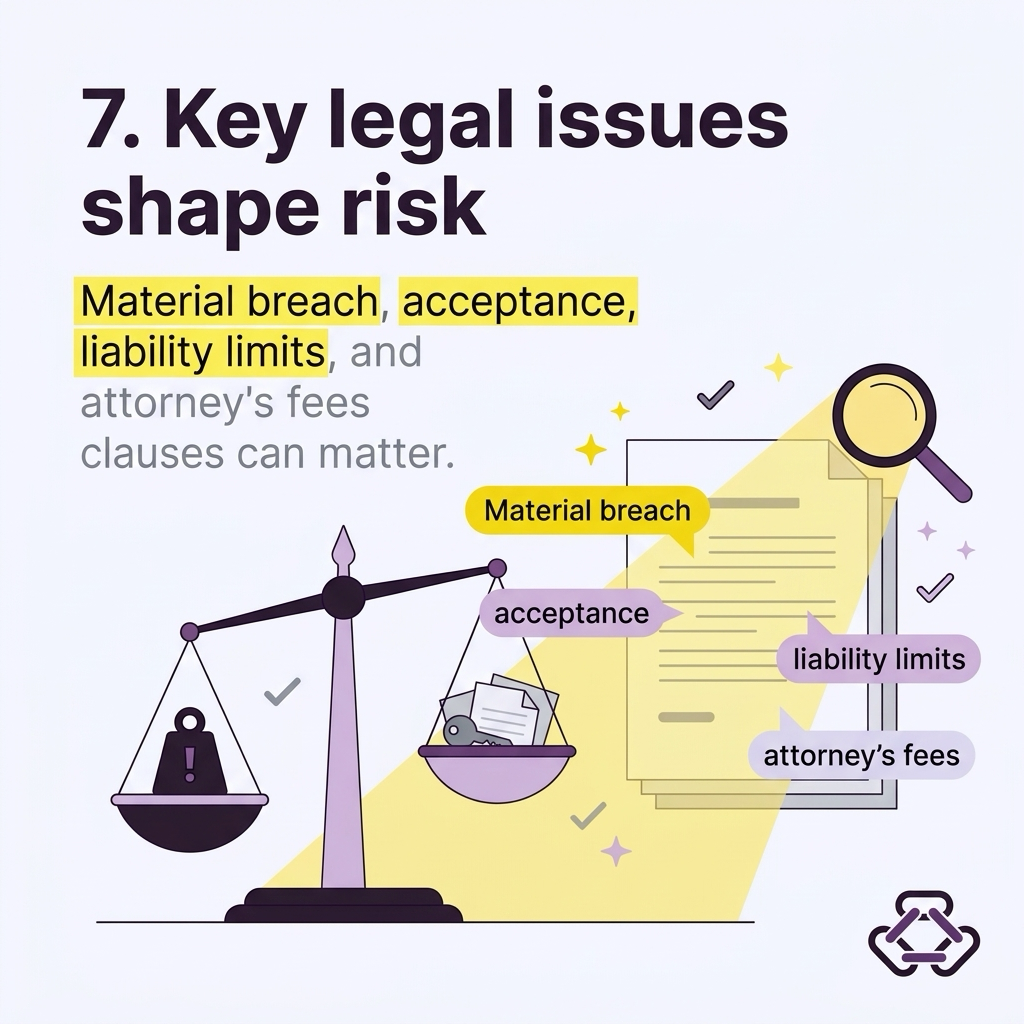
What Legal Issues Often Show Up In These Cases?
Was There A Material Breach?
Not every mistake or delay excuses nonpayment or termination. Many disputes turn on whether the alleged problem was significant enough to qualify as a material breach, or whether the contract was substantially performed with a narrower damages issue remaining.
Did The Customer Accept The Work?
Acceptance can be express or implied, depending on the contract and the facts. Continued use of deliverables, delayed objections, or approvals in project systems may all become relevant.
Are There Contractual Limits On Liability?
Commercial agreements often include clauses addressing:
- caps on damages
- exclusions for consequential damages
- shortened notice periods
- exclusive remedies
- warranty limitations
- venue and governing law
- arbitration requirements
These provisions may not end the dispute, but they can shape strategy and economics from the outset.
Is There An Attorney’s Fees Clause?
In the United States, the default “American Rule” generally means each side pays its own attorney’s fees unless a statute or contract provides otherwise. ABA commentary notes that fee-shifting language can become outcome-determinative in contract litigation, especially when drafting is not explicit (ABA Business Law Today).
That is one reason a dispute over a modest invoice can still carry outsized legal risk: the fee clause, venue clause, or arbitration clause may matter almost as much as the invoice itself.
How Are Customer Contract Disputes Usually Resolved?
Direct Business Negotiation
Many disputes begin with internal escalation between account managers, finance teams, founders, or executives. Sometimes that works. Sometimes it deepens the record in unhelpful ways.
A carefully framed legal analysis early in the process can change the tone of negotiations by identifying where the real leverage points are.
Attorney Demand And Response Letters
Once counsel gets involved, the conversation often becomes more structured. A letter may outline the contract terms, timeline, breach theory, damages position, and demand for payment or cure. A response may assert defenses, counterclaims, or settlement parameters.
Mediation
Mediation is a common middle path when the parties want a negotiated result without a final adjudication. It is not a binding decision unless the parties reach an agreement. By contrast, litigation ends in a court judgment and arbitration ends in an arbitral award (Mediation Authority; AAA).
Some businesses prefer mediation where the relationship may still be salvageable, or where both sides see litigation cost as disproportionate to the dispute value.
Arbitration
If the contract includes an arbitration clause, the case may move out of court entirely. The American Arbitration Association notes that clear commercial arbitration clauses can shape how business disputes are administered and resolved (AAA).
Arbitration may be faster in some cases, but that is not universal. The clause wording, forum rules, scope of discovery, and number of arbitrators can all affect cost and speed.
Litigation
Litigation may make sense where the amount at issue is substantial, emergency relief is relevant, fraud-like facts are alleged, or one side wants court-supervised discovery and motion practice.
For businesses dealing with a major breakdown, it can also help to understand what companies often ask when an important customer relationship collapses, because the legal dispute is often intertwined with collections, operations, reputation, and future contracts.
When Does It Make Sense To Involve An Attorney?
There is no single trigger date that fits every company. But businesses often start looking for counsel when:
- a customer withholds a material payment
- termination is threatened
- a breach notice arrives
- the customer asserts offset or damages
- the project record is scattered
- the contract includes arbitration, fee-shifting, or venue language
- the account is strategically important
- the dispute could affect other customer relationships
In general terms, early attorney involvement may help a business evaluate not just whether a claim exists, but whether the economics, evidence, contract language, and forum make pursuit or defense realistic.
That early review can also help separate emotional frustration from legally relevant facts. A customer may be acting unfairly, but the central legal question is usually narrower: what does the contract say, what happened, what can be proved, and what are the likely paths to resolution?
What Can Businesses Do At The First Sign Of A Dispute?
A few early steps often shape the rest of the matter:
Clarify The Contract Documents
Businesses often discover too late that the “real deal” was spread across an MSA, SOW, purchase order, pricing email, and several change discussions.
Build A Clean Timeline
A simple chronology of contract formation, performance, complaints, approvals, invoices, and nonpayment can reveal strengths and weaknesses quickly.
Preserve Internal Records
Internal chats, project-management exports, ticketing histories, and invoice records may become important. Once positions harden, recreating this history can be much harder.
Separate Business Goals From Legal Claims
Some companies want payment and closure. Others want to preserve the relationship. Others want a precedent-setting response because the same issue is repeating across accounts. The right legal strategy often depends on that underlying business goal.
If process gaps helped create the conflict, it may also be useful to review common contract mistakes that make collection or defense harder so the next dispute is less expensive and less disruptive.
Why Attorney Fit Matters In A Revenue-Critical Contract Fight
Not every business attorney handles customer contract disputes the same way. Some focus on drafting but not active disputes. Some litigate broadly without deep experience in billing architecture, SaaS delivery issues, UCC sales questions, or service-performance records. Some are more comfortable in emergency injunction settings, while others are stronger in negotiated commercial resolutions.
For a business facing a high-stakes customer conflict, attorney fit often turns on documented experience in highly similar matters:
- similar contract structures
- similar industries
- similar dispute size
- similar payment or performance issues
- similar forums, such as arbitration or commercial court
- similar evidentiary problems, such as acceptance history or scope-change disputes
That kind of fit can be hard to evaluate from advertising alone. Many businesses are not looking for slogans. They are looking for demonstrable experience based on evidence.
Final Thoughts
Customer contract disputes can begin with one unpaid invoice or one disagreement over performance, but they often become larger business conflicts involving cash flow, leverage, documentation, and long-term commercial risk. The most common fights tend to involve scope, payment, quality, acceptance, and termination. The legal outcome often depends less on who feels wronged and more on the contract text, the project record, the damages evidence, and the chosen forum.
If your business is dealing with a revenue-critical conflict, an attorney may help you assess the contract, the evidence, the economics, and the practical paths toward resolution.
Visit ReferU.AI to get matched with an attorney who has demonstrable experience in cases like yours — for free.
