Table of Contents
- How to Respond to a Franchise Default Notice Before Termination Hits
- Why A Default Notice Matters More Than Many Owners Expect
- Step 1: Read The Notice Like A Litigation Document
- Step 2: Pull The Governing Documents Immediately
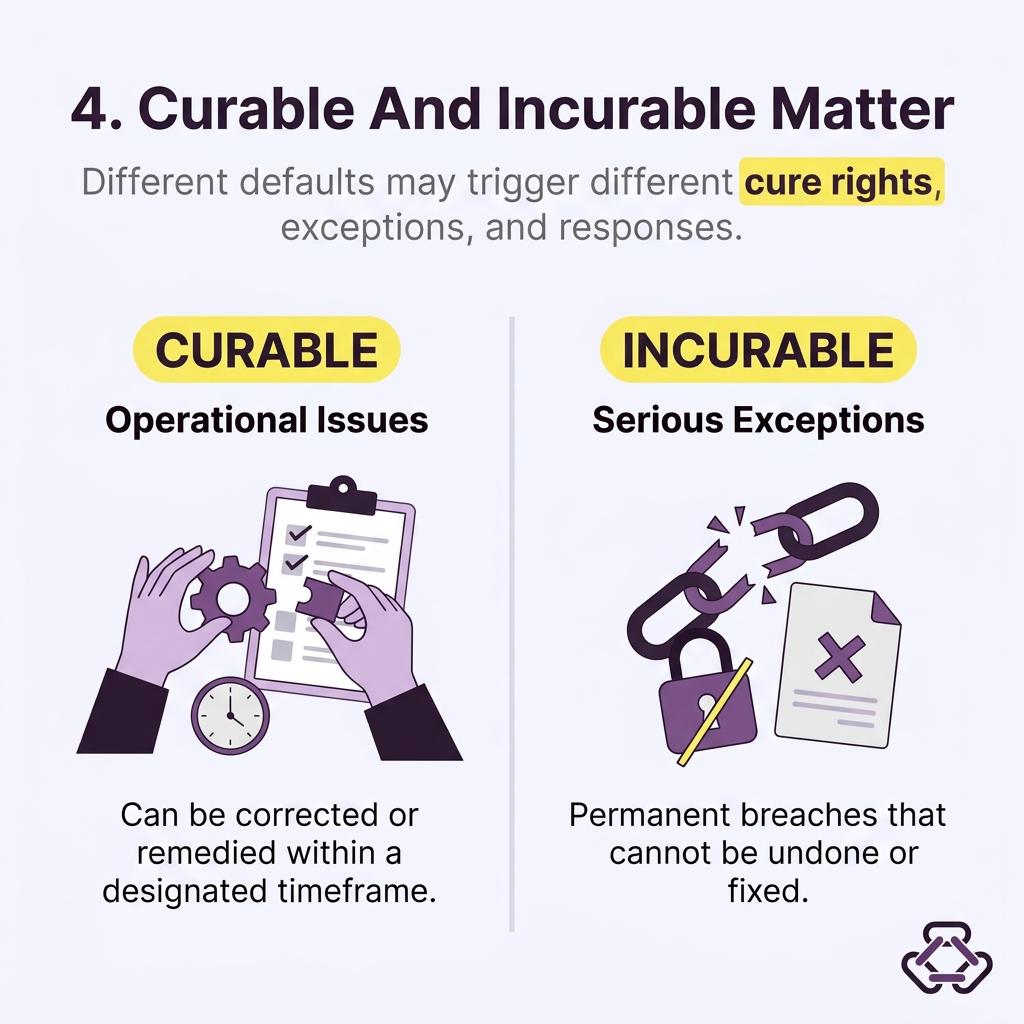
- Step 3: Identify Whether The Alleged Default Is Actually Curable
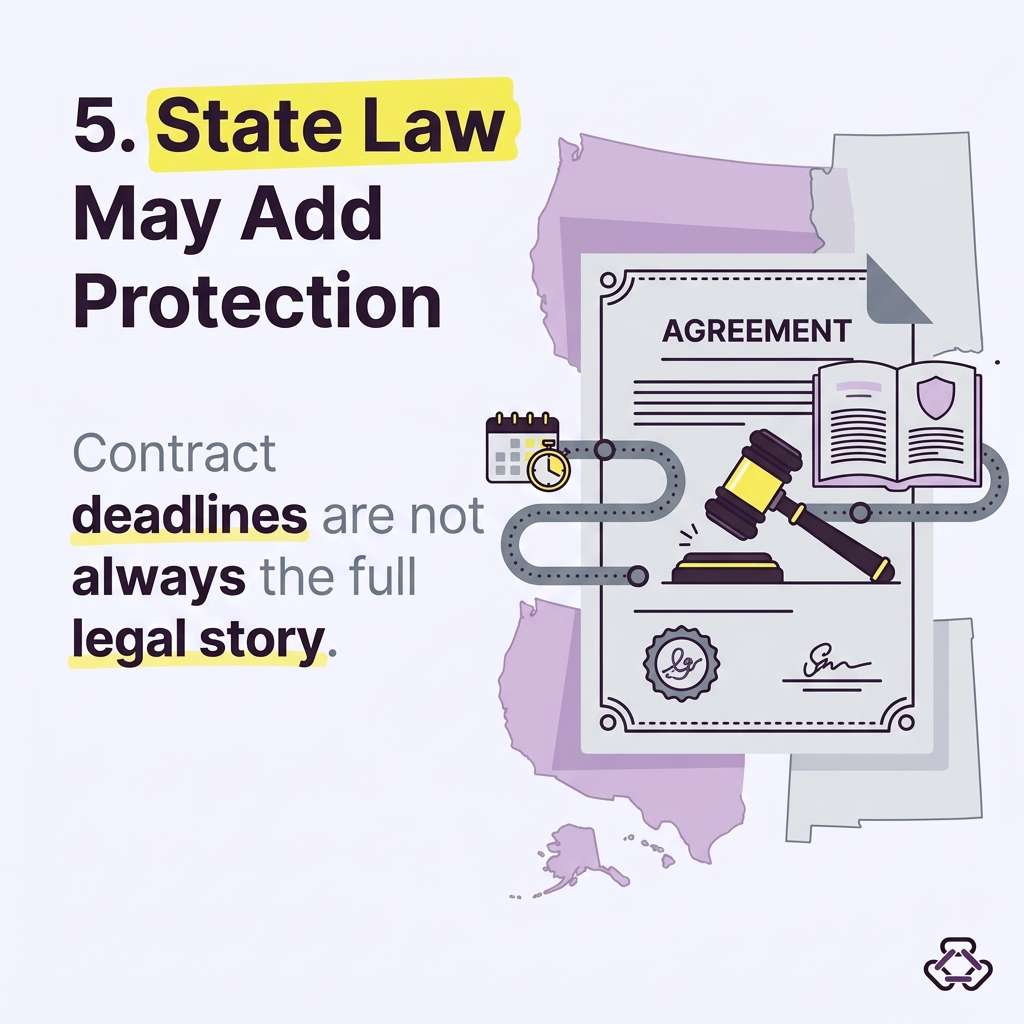
- Step 4: Check Whether State Franchise Relationship Law Adds Protection
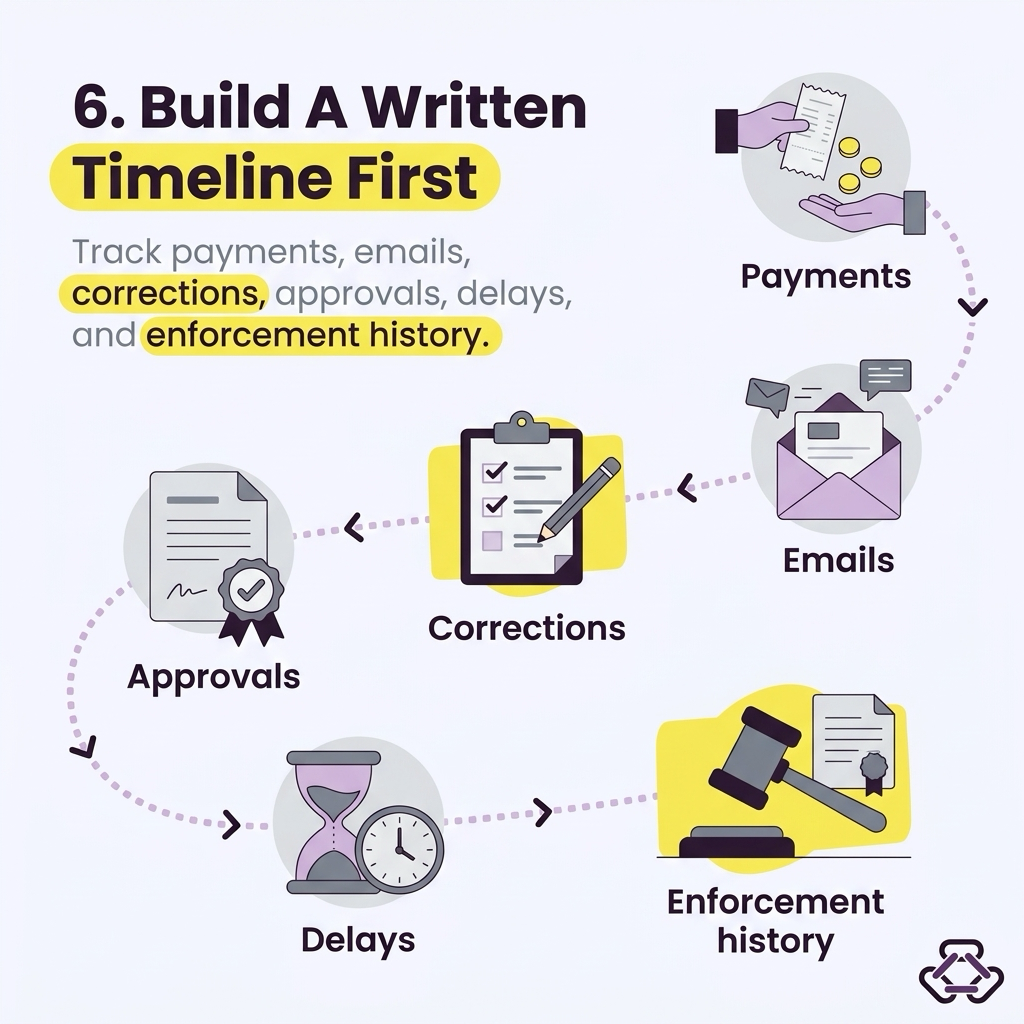
- Step 5: Build A Written Timeline Before You Respond
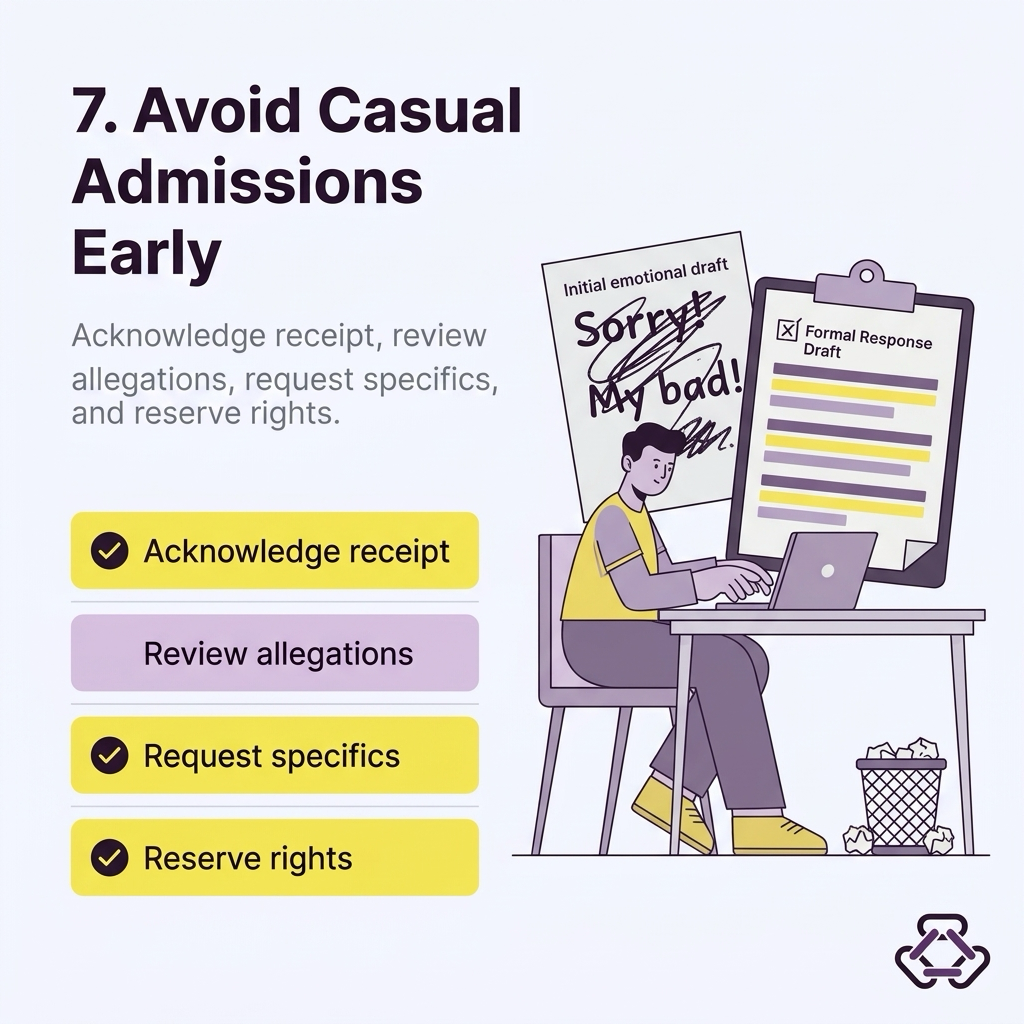
- Step 6: Avoid Casual Admissions In Early Communications
- Step 7: Cure What Can Be Cured, And Document Every Step
- Step 8: Evaluate Whether The Franchisor Followed Its Own Process
- Step 9: Think Beyond The Notice To The Real Endgame
- Step 10: Watch For Mistakes That Increase Exposure Fast
- When It May Be Time To Involve A Franchise Attorney
- What A Strong Early Response Often Looks Like
- Final Thoughts

Type
Great Grandchild
Status
Approved
Title (YouTube)
Images Failed (Social)
Images Failed (Social)
Do not index
Publish Date (TikTok)
Jan 3, 2027 15:15
Videos Post IDs (Social)
Hashtags (Social)
#LegalAdvice #LegalHelp #BusinessLitigation #FranchiseDisputes
Caption
Caption X
Cover

OG Image

Alt Image Text
Flat vector illustration of a franchise owner reviewing a franchise default notice and preparing a franchise termination response before a deadline.
Images

Videos
Publish Date (Social)
Dec 15, 2026 08:00
Scheduled (Social)
Scheduled (Social)
Images Posted (Social)
Images Posted (Social)
Videos Posted (Social)
Videos Posted (Social)
Videos Failed (Social)
Videos Failed (Social)
Featured
Created time
Apr 3, 2026 10:13 PM
Sub-item
Authors
CTA Practice Area (Social)
Business Litigation
TikTok Failed (Social)
TikTok Failed (Social)
Videos Post Links (Social)
YT Auto Captions Removed
TikTok Post Links (Social)
Images Post IDs (Social)
YT Post ID
Video Pending Manual (Social)
TikTok Posted (Social)
TikTok Posted (Social)
TikTok Post IDs (Social)
Video Cover (Social)
Images Post Links (Social)
First Comment (Social)
YT Embedded
Images Delete (Social)
Videos Delete (Social)
Carousel Video URL (Social)
How to Respond to a Franchise Default Notice Before Termination Hits
A franchise default notice can feel like the moment everything starts moving too fast. One letter arrives, and suddenly you are looking at cure deadlines, termination language, brand standards, unpaid fees, operational demands, and the possibility of losing a business you spent years building.
In general terms, a default notice is not always the end of the relationship. It is often the start of a very specific legal and contractual process. The next few days can shape whether the dispute gets resolved, escalates into termination, or turns into litigation or arbitration.
In this post you’ll learn how franchise default notices usually work, what to review right away, how to organize a response, where state law may matter, and when a franchise attorney may help protect leverage before the dispute hardens. If you want broader context on how these conflicts develop, it may help to start with this overview of how franchise disputes tend to unfold across termination, fees, territory, defaults, and brand-control issues.
Scroll to the bottom for every post in this series.
Why A Default Notice Matters More Than Many Owners Expect
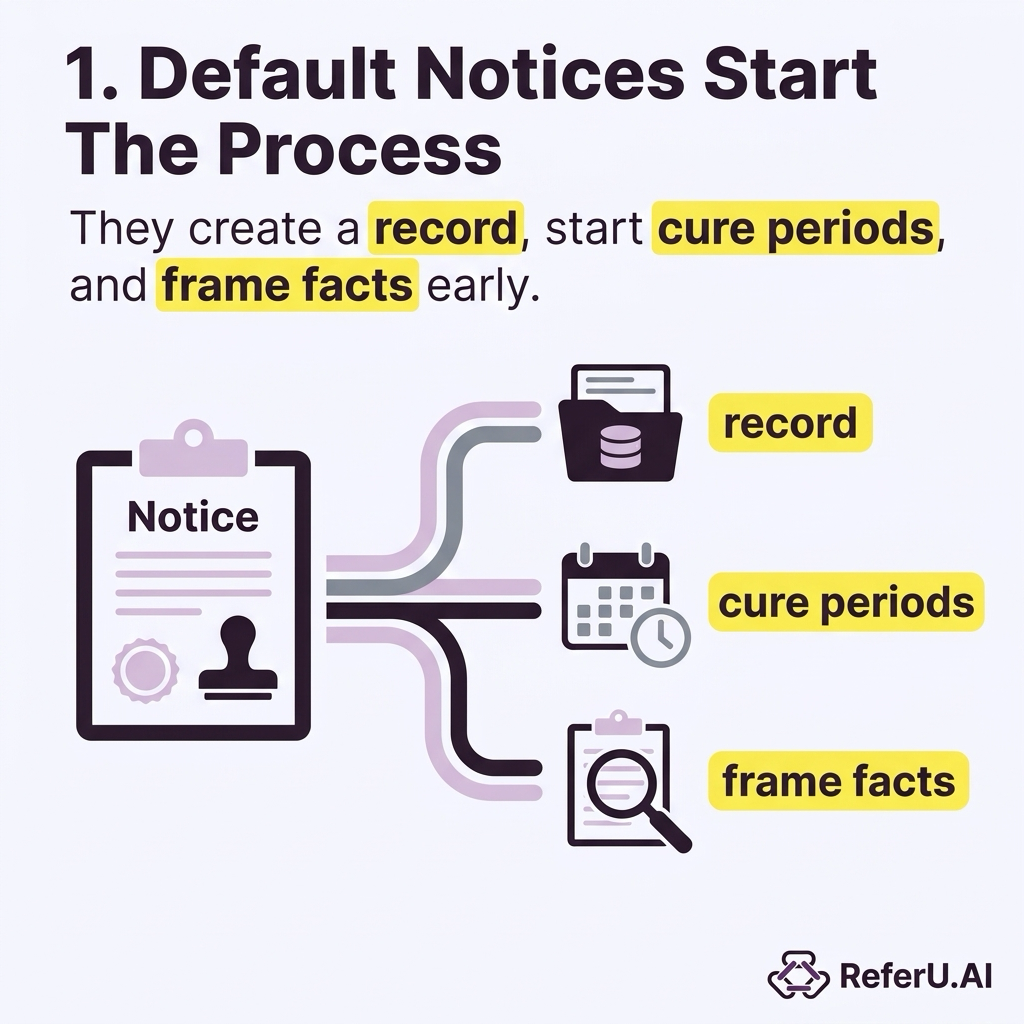
A default notice is often drafted to do several things at once:
- create a record that the franchisor raised the issue;
- start a contractual or statutory cure period;
- preserve the franchisor’s position for termination or nonrenewal later;
- frame the dispute around the franchisor’s version of the facts; and
- put pressure on the franchisee to respond quickly, often without full context.
That matters because franchise law is heavily shaped by the franchise agreement, operations manual, state relationship laws in some jurisdictions, and the exact language used in the notice itself. The Federal Trade Commission’s Franchise Rule focuses primarily on pre-sale disclosure, not day-to-day post-sale dispute resolution, so many termination fights turn on contract terms and state law rather than a single nationwide federal termination standard. The FTC’s Franchise Rule and Franchise Rule Compliance Guide are useful for understanding that bigger framework.
For franchisees, the practical reality is simple: once a notice is issued, silence, informal phone calls, incomplete explanations, or rushed admissions can make later arguments harder to present cleanly.
Step 1: Read The Notice Like A Litigation Document
The first read-through is emotional. The second read-through is strategic.
A franchise default notice often contains clues about where the dispute is headed. Some notices are narrow and curable. Others are written to build toward termination. The document may identify:
- the exact contract provisions allegedly breached;
- a cure deadline;
- a list of factual allegations;
- whether the franchisor claims the default is recurring;
- whether the issue is framed as material, immediate, or incurable;
- whether the franchisor reserves rights to terminate, de-identify, seek damages, or enforce post-termination obligations.
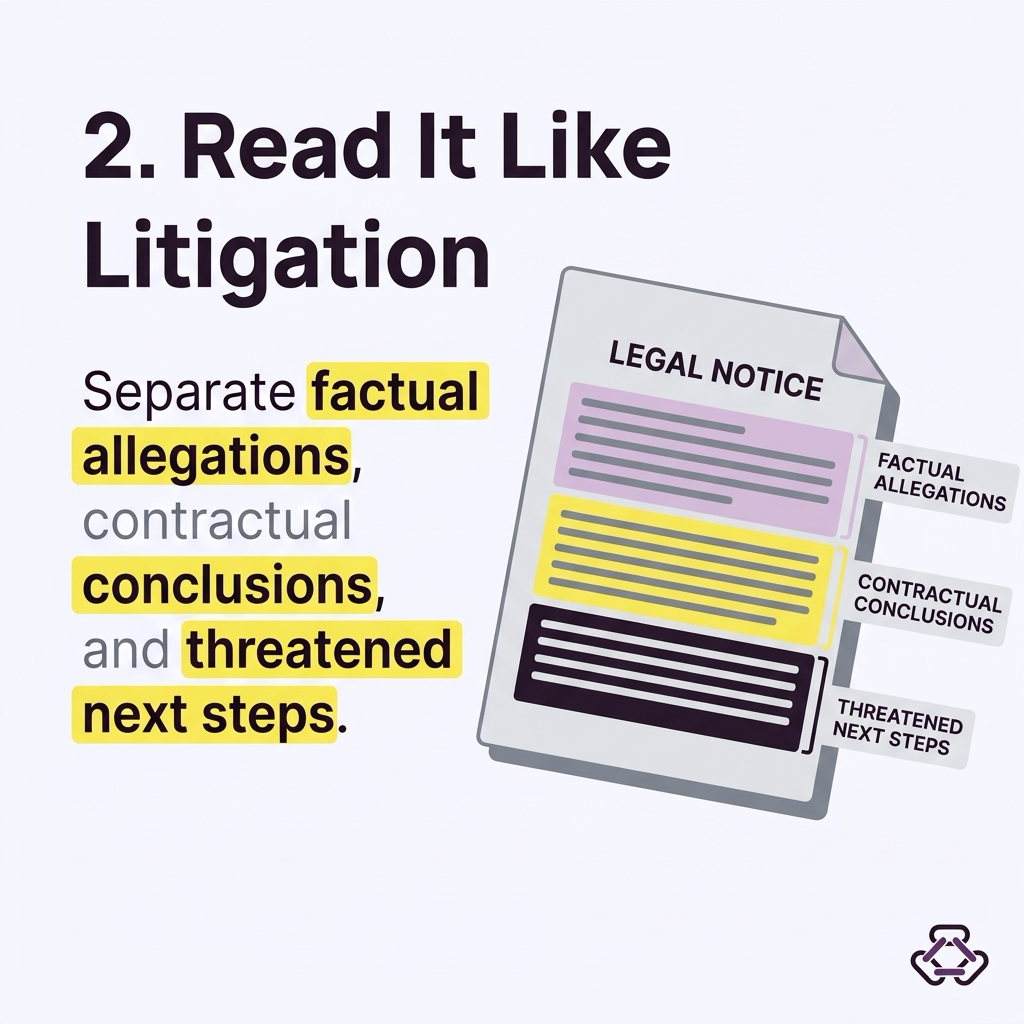
You may want to separate facts, conclusions, and threats.
For example:
- “Royalties for January and February remain unpaid” is a factual allegation.
- “This constitutes a material breach” is a legal or contractual conclusion.
- “Failure to cure may result in immediate termination” is a threatened next step.
That distinction matters because not every assertion in the letter is equally supported. An attorney might help evaluate what is actually documented, what is ambiguous, and what may be overstated.
Step 2: Pull The Governing Documents Immediately
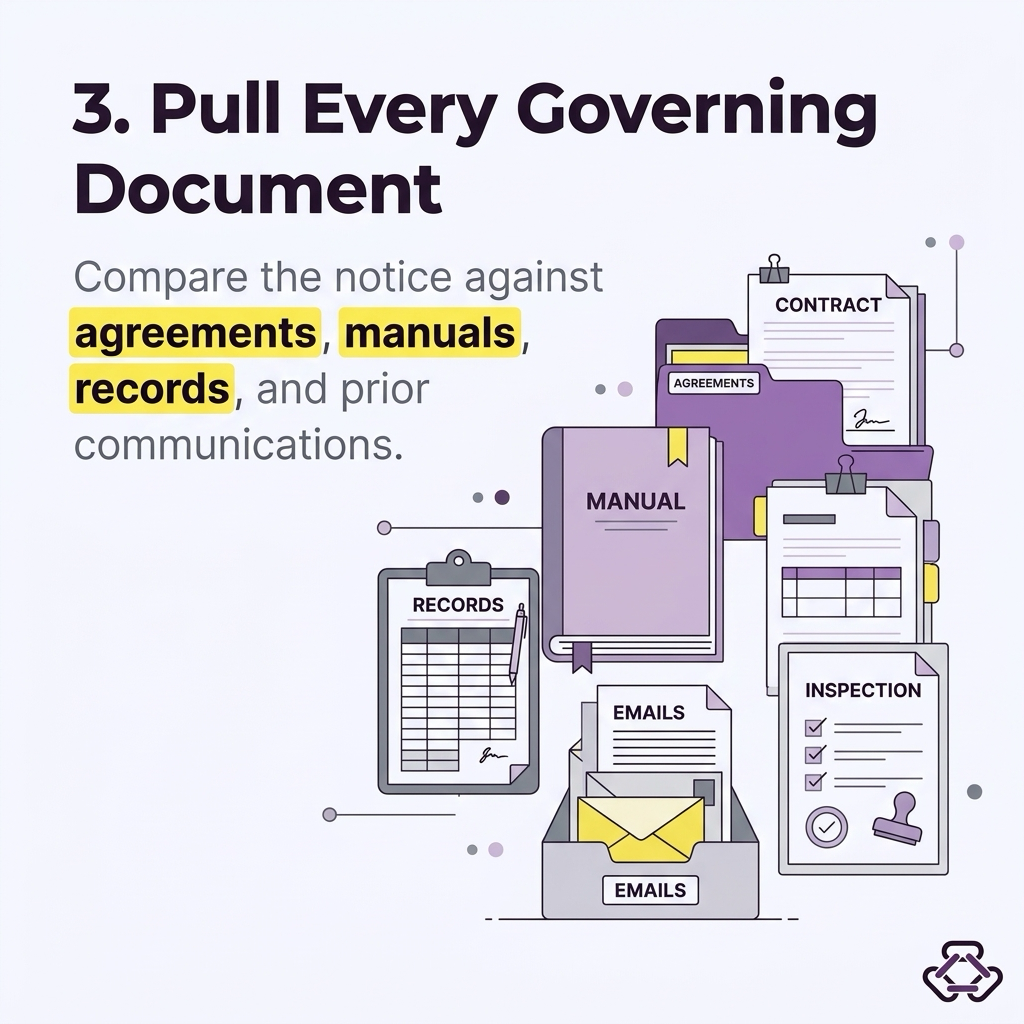
A default notice rarely stands alone. The notice usually makes sense only when compared against the full paper trail. That often includes:
- the franchise agreement;
- amendments, riders, or renewals;
- guaranties;
- development agreements, if any;
- the current operations manual or relevant manual sections;
- recent compliance notices or audit findings;
- prior emails on the same issue;
- payment records;
- inspection reports;
- local regulatory notices, if health, safety, or licensing issues are involved.
In many franchise disputes, the hardest part is not finding a legal principle. It is reconstructing what the parties actually agreed to and whether the franchisor followed its own procedures.
That is especially true because many systems include layered obligations involving brand standards, technology requirements, vendor rules, local marketing contributions, reporting obligations, and performance metrics. If you are trying to understand how franchise agreements and manuals fit into these conflicts, it may help to read more about reviewing contracts, manuals, and performance obligations when a franchise fight starts taking shape.
Step 3: Identify Whether The Alleged Default Is Actually Curable
Not every default is treated the same way.
Some alleged defaults are commonly framed as curable, such as:
- late royalty payments;
- missing reports;
- maintenance or cleanliness issues;
- insurance lapses that can be reinstated;
- incomplete training;
- operational deficiencies;
- inventory or vendor compliance problems.
Other defaults are sometimes framed as “incurable” or subject to immediate action, depending on the agreement and applicable law, such as:
- abandonment of the location;
- bankruptcy or insolvency events;
- fraud or material misrepresentation;
- criminal conduct tied to the business;
- health and safety violations;
- unauthorized transfers;
- misuse of marks;
- repeated breaches of the same provision within a short period.
That distinction matters because some state franchise relationship laws require notice and an opportunity to cure for certain types of defaults, while carving out exceptions for more serious situations. The International Franchise Association’s 2025 legal symposium materials summarize that many states vary significantly on required notice and cure periods, and also note that some statutes exclude certain incurable defaults from ordinary cure rights. Those materials also caution that the agreement still has to be reviewed alongside the statute. See the IFA’s Handling Defaults and Terminations.
The American Bar Association has also noted that many state relationship laws restrict termination and often require notice and an opportunity to cure before termination is effective in covered situations. See the ABA materials on state relationship laws and termination procedures.
Step 4: Check Whether State Franchise Relationship Law Adds Protection
This is one of the most overlooked parts of a franchise default dispute.
Many business owners assume the franchise agreement controls everything. Sometimes it controls a lot. But in some states, franchise relationship statutes add rules about good cause, written notice, cure periods, and termination procedure.
A few examples show how much this can vary:
- California generally limits termination for good cause to a failure to substantially comply with lawful franchise requirements after at least 60 days’ advance notice and a reasonable opportunity to cure of at least 60 days, subject to listed exceptions. See California’s franchise relations law.
- Washington provides that good cause includes failure to comply with lawful material provisions and cure after written notice and a reasonable opportunity, which need not exceed 30 days; if the default cannot reasonably be cured within 30 days, the franchisee may preserve position by initiating substantial and continuing action to cure within that period. See RCW 19.100.180.
- Minnesota is summarized in the IFA materials as requiring 90 days’ notice of termination with a 60-day cure period for certain defaults. See the IFA summary here and the Minnesota materials collected by the state revisor here.
- New Jersey generally requires 60 days’ advance written notice setting forth all reasons before termination or nonrenewal under the New Jersey Franchise Practices Act. The IFA summary collects that requirement here, and secondary summaries track the same framework here.
Here’s what this often means: the deadline printed in the notice is not always the full story. The contract may say one thing, state law may say another, and the dispute may involve threshold questions about whether the statute applies at all.
An attorney might help determine:
- whether your business qualifies for protection under a state franchise relationship law;
- whether the notice contains all required reasons;
- whether the stated cure period is legally sufficient;
- whether the alleged default falls into an exception;
- whether the franchisor’s own prior conduct affects enforcement.
Step 5: Build A Written Timeline Before You Respond
A lot of franchisees respond too quickly with broad explanations and not enough structure.
It often helps to build a timeline first. That timeline may include:
- when the alleged issue started;
- when the franchisor first raised it;
- what was said in emails or calls;
- what payments were made and when;
- what operational corrections were completed;
- whether field consultants approved or tolerated the same conduct before;
- whether comparable locations were treated differently;
- whether the franchisor contributed to the problem by delaying approvals, technology support, training, inventory, or marketing changes.
This timeline does two jobs. First, it helps counsel understand the dispute faster. Second, it may reveal defenses or negotiating points that are easy to miss in a hurried response.
For example, what looks like a simple “noncompliance” issue can sometimes involve:
- conflicting manual instructions,
- unclear brand directives,
- vendor shortages,
- disputed fee calculations,
- waived deadlines,
- inconsistent enforcement,
- prior approval by regional personnel.
That does not automatically resolve the dispute. But it can materially change how the response is framed.
Step 6: Avoid Casual Admissions In Early Communications
One of the most common mistakes is trying to “smooth things over” in an email that unintentionally concedes too much.
Phrases like these can create problems later:
- “We know we breached.”
- “We were in violation.”
- “We just could not comply.”
- “We admit the notice is valid.”
- “We will do whatever you ask.”
Even if the goal is cooperation, broad admissions can undercut later arguments about materiality, timing, waiver, selective enforcement, or adequacy of notice.
A more careful response often focuses on:
- acknowledging receipt;
- confirming that the allegations are being reviewed;
- identifying immediate corrective steps, if appropriate;
- requesting documents or specifics where facts are unclear;
- reserving rights without escalating tone.
In general terms, a response can be constructive without becoming a confession.
Step 7: Cure What Can Be Cured, And Document Every Step
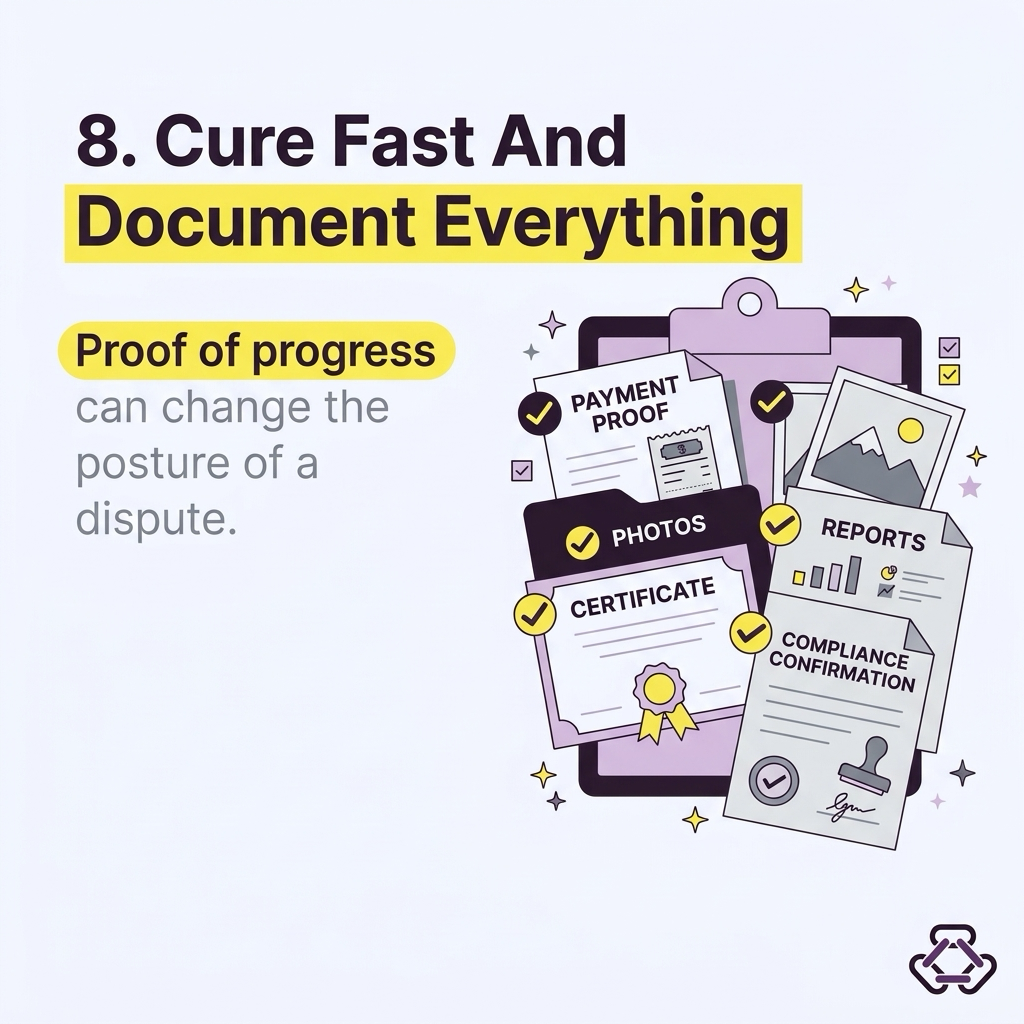
If the notice involves items that can be corrected quickly, documentation matters almost as much as the fix itself.
That may include:
- proof of payment;
- reinstated insurance certificates;
- photos of signage, repairs, or cleanliness corrections;
- training completion records;
- payroll or staffing records;
- vendor invoices;
- point-of-sale reports;
- written confirmation of software or technology compliance;
- health department clearances, where relevant.
Where the default cannot be fully cured within the stated period, some jurisdictions and agreements may place real value on documented progress. Washington’s statute is a good example because it expressly refers to initiating “substantial and continuing action” to cure within 30 days when immediate full cure is not reasonably possible. See RCW 19.100.180.
That kind of framework can matter in practical negotiations even outside Washington, because it highlights a broader principle: progress, proof, and credible remediation often change the posture of a dispute.
Step 8: Evaluate Whether The Franchisor Followed Its Own Process
Franchise systems often require formal steps before termination, including written notices, designated delivery methods, stated cure periods, escalation procedures, and sometimes mediation or arbitration provisions.
An attorney may compare the notice against:
- the default section of the franchise agreement;
- any separate termination or nonrenewal provisions;
- state-law notice requirements;
- any modification, waiver, or amendment provisions;
- dispute-resolution clauses;
- forum-selection and choice-of-law clauses.
The ABA has observed that compliance with notice requirements can be central in termination disputes and that failures in process may themselves become part of the legal fight. See the ABA discussion here.
Sometimes the issue is not only whether a default happened. The issue becomes whether the franchisor gave a legally sufficient notice, identified all grounds with enough specificity, allowed the required cure opportunity, or tried to stack additional allegations later.
Step 9: Think Beyond The Notice To The Real Endgame
A default notice is rarely just about the single item on page one.
It may be part of a larger conflict involving:
- disputed fees;
- declining sales;
- remodel obligations;
- transfer restrictions;
- territory friction;
- online ordering control;
- supplier disputes;
- encroachment concerns;
- pressure to sell or exit;
- system-wide policy shifts.
That is why some owners later realize the first notice was less about cleanliness, audit compliance, or a missed report and more about positioning for a broader separation.
This is also where timing matters. Once termination is issued, leverage often changes fast. De-identification demands, lease issues, employee uncertainty, vendor cutoffs, and customer confusion can all arrive at once. Some franchisors may also pursue injunctive relief or enforce post-termination obligations tied to trademarks and noncompete language, depending on the agreement and current law.
The American Bar Association has also discussed how franchisors sometimes use tools short of termination to force compliance, including territory reduction, operational controls, and other pre-termination mechanisms. See the ABA article on alternatives to termination.
Step 10: Watch For Mistakes That Increase Exposure Fast
When a default notice arrives, some responses make the situation worse quickly. Common examples include:
- missing the cure deadline while trying to negotiate informally;
- stopping communication entirely;
- sending emotional accusations unsupported by records;
- withholding payments without a coordinated legal strategy;
- removing branding or changing operations unilaterally;
- transferring assets or ownership informally;
- deleting emails, texts, or system records;
- assuming the franchisor “won’t really terminate.”
Those patterns often appear in larger franchise fights and can increase both legal and business exposure. If you want a deeper look at the patterns that tend to compound risk, it may help to read about the franchise dispute mistakes that can expand exposure faster than many owners expect.
When It May Be Time To Involve A Franchise Attorney
Some default notices are narrow operational matters that get resolved with a prompt, documented cure. Others are early warning signs of a serious relationship breakdown.
A franchise attorney may be especially useful when:
- the notice threatens termination, nonrenewal, or immediate de-identification;
- the alleged default is described as incurable;
- there are multiple notices in a short period;
- the franchisor is alleging repeated breaches;
- the notice involves unpaid fees, audit disputes, or alleged underreporting;
- the issue touches trademarks, public safety, consumer complaints, or fraud allegations;
- there is a lease problem connected to the franchise location;
- state franchise relationship law may apply;
- the agreement contains arbitration and venue provisions far from the business;
- a sale, transfer, or exit is already being discussed.
In practical terms, early counsel can help with more than courtroom preparation. A lawyer may help evaluate cure strategy, preserve records, coordinate communications, analyze leverage, and assess whether a negotiated resolution is realistic before termination hits.
What A Strong Early Response Often Looks Like
Every case is different, but a thoughtful response often includes a combination of:
- a prompt written acknowledgment of the notice;
- a clear request for clarification where allegations are vague;
- a measured statement of disagreement where appropriate;
- concrete documentation of corrective action already taken;
- a proposed cure plan with dates and proof points;
- a reservation of rights;
- legal analysis if statutory notice or cure issues are in play;
- attorney-to-attorney communications where the relationship is deteriorating.
That approach often puts the franchisee in a better position than either silence or panic. It can also create a cleaner record if the matter later moves into arbitration, injunction proceedings, termination litigation, or settlement talks.
Final Thoughts
A franchise default notice is often the point where an internal business problem becomes a legal one. The agreement matters. State law may matter. The notice language matters. The response timeline matters. And the paper trail can matter more than almost anything else.
If termination language is already on the table, many franchise owners start looking for counsel with demonstrable experience, documented experience, and a record in highly-similar matters. Fit matters in franchise disputes because these cases often turn on a mix of contract interpretation, relationship statutes, operational evidence, and litigation posture.
Visit ReferU.AI to get matched with an attorney who has demonstrable experience in cases like yours — for free.
