Table of Contents
- Franchise Disputes Explained: Termination, Territory, Fees, Defaults, and Brand Control
- What Makes Franchise Disputes Different From Ordinary Contract Cases?
- What Does “Default” Mean In A Franchise Fight?
- How Franchise Termination Disputes Usually Start
- Why Territory Disputes Feel So Volatile
- Fees, Royalties, And Hidden Cost Disputes
- Audit And Reporting Fights
- Marketing And Ad Fund Issues
- Required Vendors And System Purchases
- Remodel, Technology, And Upgrade Costs
- Brand Control Is Often The Real Center Of The Conflict
- Why Manuals And System Standards Matter So Much
- What Happens After A Termination Notice?
- Common Defenses And Counterarguments In Franchise Cases
- Lack Of Good Cause
- Defective Notice Or No Real Opportunity To Cure
- Waiver Or Selective Enforcement
- Pretext
- Contract Interpretation
- Disclosure-Related Claims
- Why Early Legal Analysis Often Changes The Leverage
- The Big Picture: Franchise Disputes Are Really About Control, Value, And Risk
- Final Thoughts

Type
Grandchild
Status
Approved
Title (YouTube)
Images Failed (Social)
Images Failed (Social)
Do not index
Publish Date (TikTok)
Jan 4, 2027 06:15
Videos Post IDs (Social)
Hashtags (Social)
#LegalAdvice #LegalHelp #BusinessLitigation #FranchiseDisputes
Caption
Caption X
Cover

OG Image

Alt Image Text
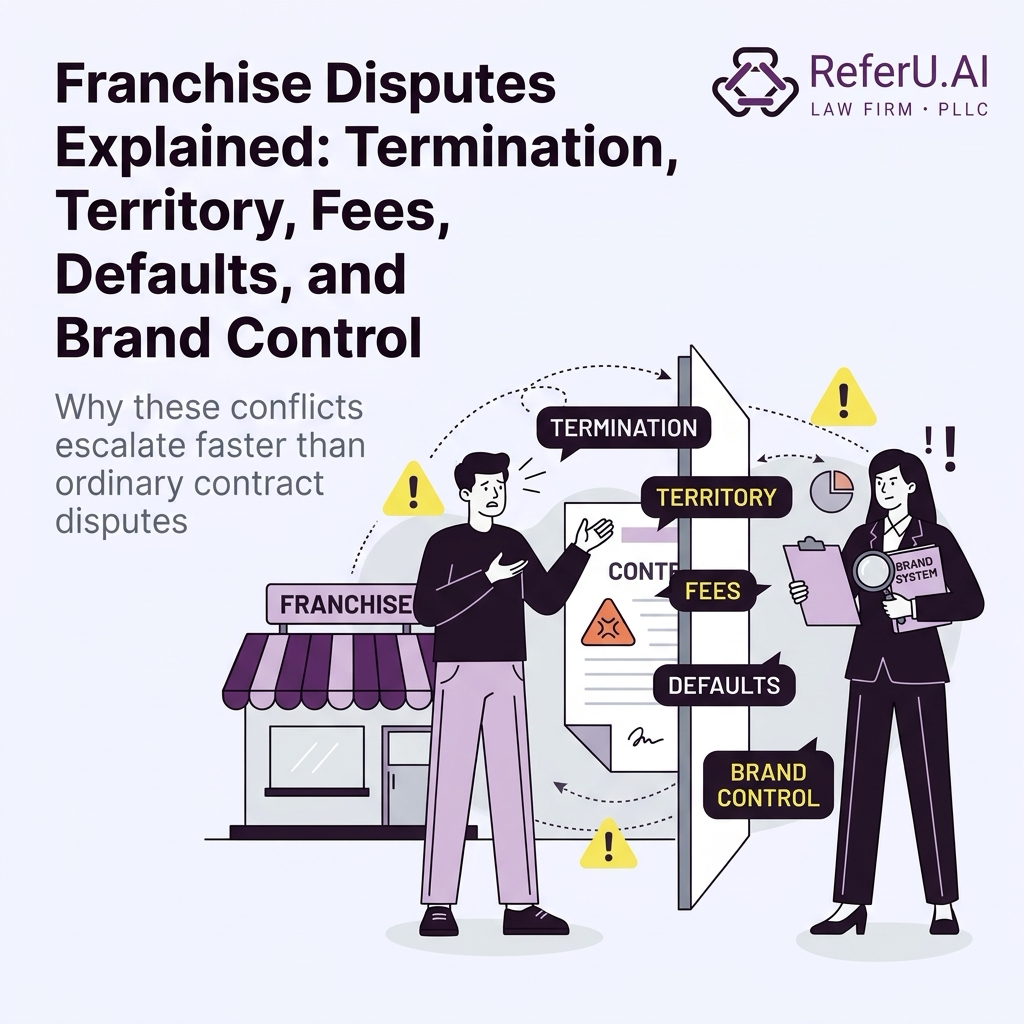
Flat vector illustration of franchise disputes and brand control, showing a franchisor and franchisee in conflict over territory, fees, defaults, termination, and storefront oversight.
Images

Videos

Publish Date (Social)
Dec 15, 2026 09:00
Scheduled (Social)
Scheduled (Social)
Images Posted (Social)
Images Posted (Social)
Videos Posted (Social)
Videos Posted (Social)
Videos Failed (Social)
Videos Failed (Social)
Featured
Created time
Apr 3, 2026 10:13 PM
Authors
CTA Practice Area (Social)
Business Litigation
TikTok Failed (Social)
TikTok Failed (Social)
Videos Post Links (Social)
YT Auto Captions Removed
TikTok Post Links (Social)
Images Post IDs (Social)
YT Post ID
Video Pending Manual (Social)
TikTok Posted (Social)
TikTok Posted (Social)
TikTok Post IDs (Social)
Video Cover (Social)
Images Post Links (Social)
First Comment (Social)
YT Embedded
Images Delete (Social)
Videos Delete (Social)
Carousel Video URL (Social)
Franchise Disputes Explained: Termination, Territory, Fees, Defaults, and Brand Control
Franchise disputes can feel unusually personal. A franchisee may believe they bought into a proven system and a recognizable brand, only to run into fights over royalties, territory overlap, operating standards, vendor rules, or a default notice that suddenly puts the entire business at risk. A franchisor, on the other side, may see the same conflict as a system-wide problem involving trademark protection, consistency, and the economics of an entire network.
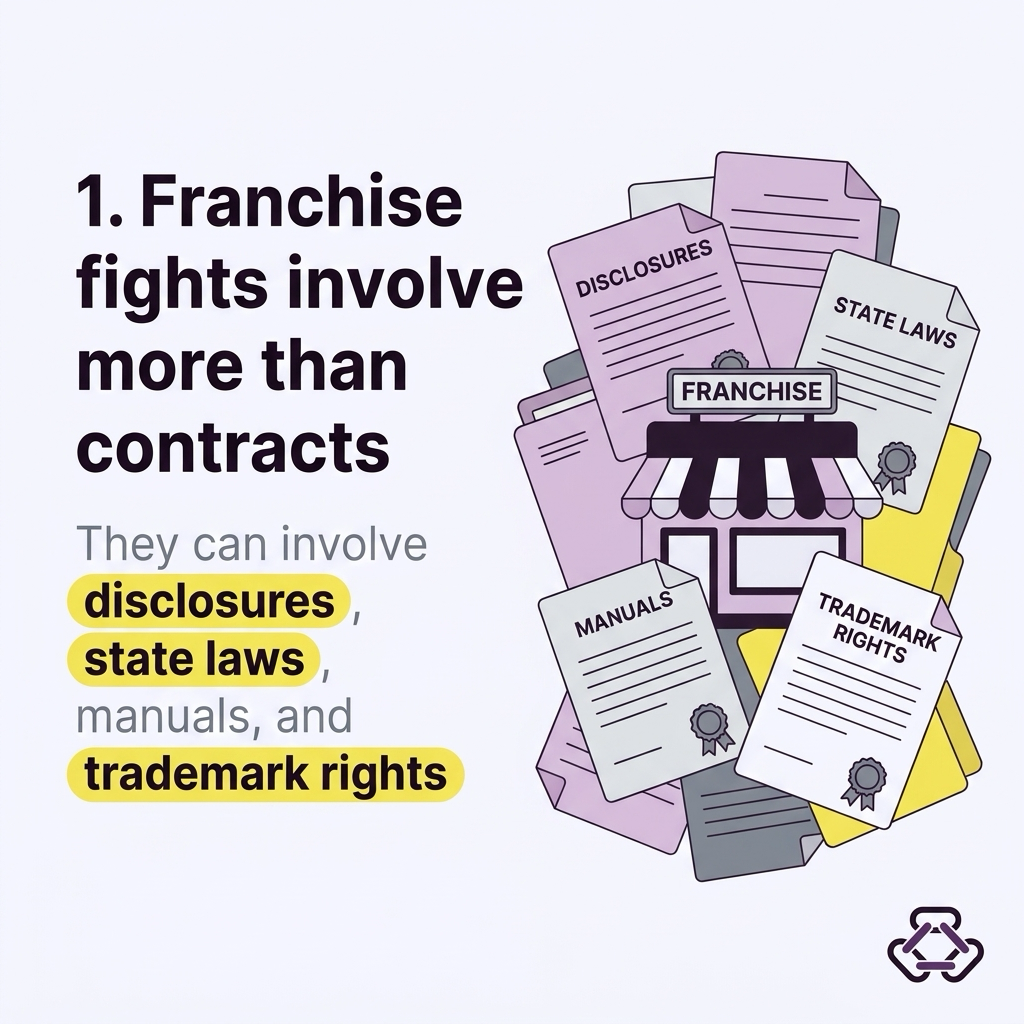
That tension is what makes franchise disputes different from ordinary business disagreements. They are contract disputes, but they also involve brand control, state franchise relationship laws, federal disclosure rules, trademark rights, operating manuals, and the practical reality that one breakdown in the relationship can affect customers, neighboring locations, and future sales. If you want a broader foundation first, this overview of business and contract litigation issues helps place franchise cases inside the larger world of commercial disputes.
This post explains the main pressure points in franchise conflicts: termination, territory, fees, defaults, and brand control. In this post you’ll learn how these disputes typically start, why they escalate so quickly, what legal frameworks often shape the outcome, and where an attorney’s early involvement can change the direction of the case.
Scroll to the bottom for every post in this series.
What Makes Franchise Disputes Different From Ordinary Contract Cases?
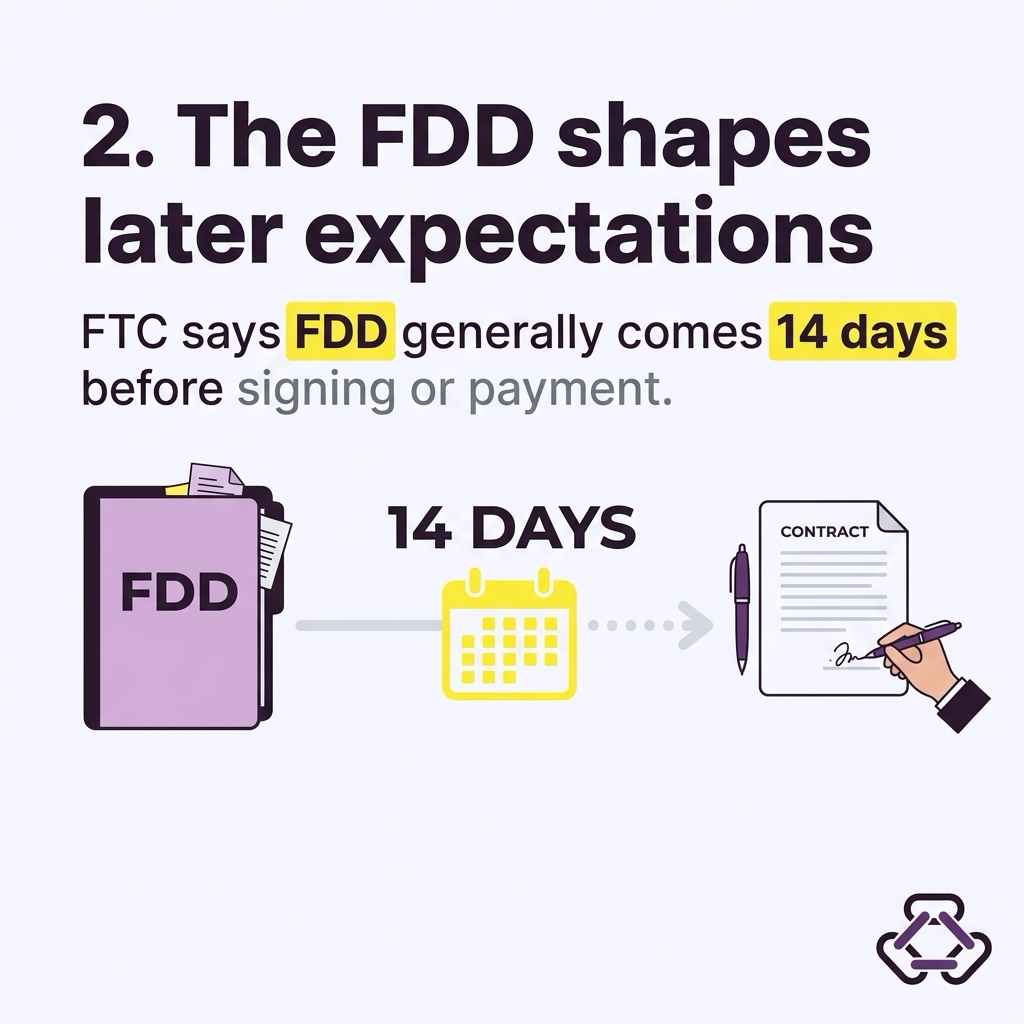
A franchise relationship usually involves far more than a simple exchange of goods or services. The franchisor licenses a brand and business system. The franchisee operates an independent business, but inside that system, often under extensive contractual and operational controls. The Federal Trade Commission’s Franchise Rule requires pre-sale disclosure through the Franchise Disclosure Document, or FDD, and the FTC explains that prospective franchisees are generally entitled to receive the FDD at least 14 days before signing or paying money to the franchisor or an affiliate. That disclosure framework matters because many later disputes trace back to expectations formed during the sales process and terms embedded in the agreement and related documents like manuals and addenda (FTC franchise buying guide; FTC Franchise Rule FAQ).
Franchise disputes are also shaped by a patchwork of state franchise relationship laws. According to the American Bar Association, many of these laws limit termination or nonrenewal without “good cause,” and often require notice and an opportunity to cure, though the details vary widely by state (ABA overview of franchise law; ABA discussion of multistate relationship laws). That variation is one reason the first legal question is often not just what does the contract say? but also which state’s law applies, and does local law override part of the agreement?
For readers looking for a wider primer focused specifically on the franchise context, this guide on how franchisee-franchisor cases usually unfold goes deeper into the litigation side.
What Does “Default” Mean In A Franchise Fight?
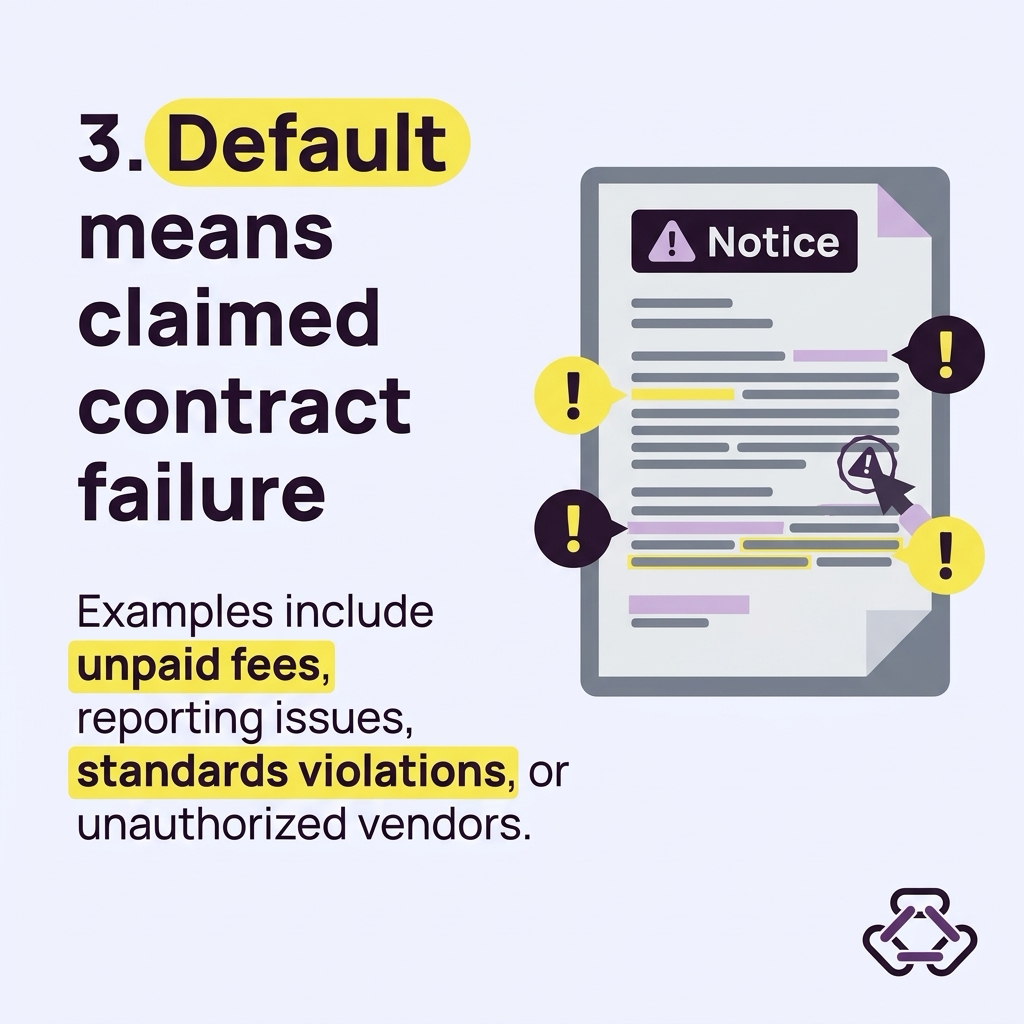
In general terms, a default is a claimed failure to perform a contractual obligation. The International Franchise Association defines default broadly as the failure of either party to meet obligations under the franchise agreement (IFA franchising terms). In practice, most franchise disputes focus on alleged franchisee defaults, such as:
- unpaid royalties, advertising contributions, or technology fees
- late reporting or inaccurate books and records
- failure to meet operational standards
- unauthorized products, vendors, or promotions
- underdevelopment or failure to open on schedule
- abandonment or reduced hours
- misuse of trademarks or online branding
- transfer activity without consent
- refusal to follow manual updates or system changes
Not every default carries the same weight. Some are curable bookkeeping or payment problems. Others are framed as immediate threats to the brand, such as food safety issues, unauthorized competition, or continued trademark use after termination. The legal stakes often turn on whether the alleged breach is material, whether the contract treats it as incurable, and whether state law gives the franchisee additional protections before the franchisor can terminate.
A default notice is often the moment when an ordinary business problem becomes a litigation problem. It creates a timeline, fixes the franchisor’s allegations in writing, and can set up later arguments about waiver, cure, and whether the stated grounds were pretextual. If you’re focused on that stage of the conflict, this article on dealing with a default notice before termination arrives explores the process in more detail.
How Franchise Termination Disputes Usually Start
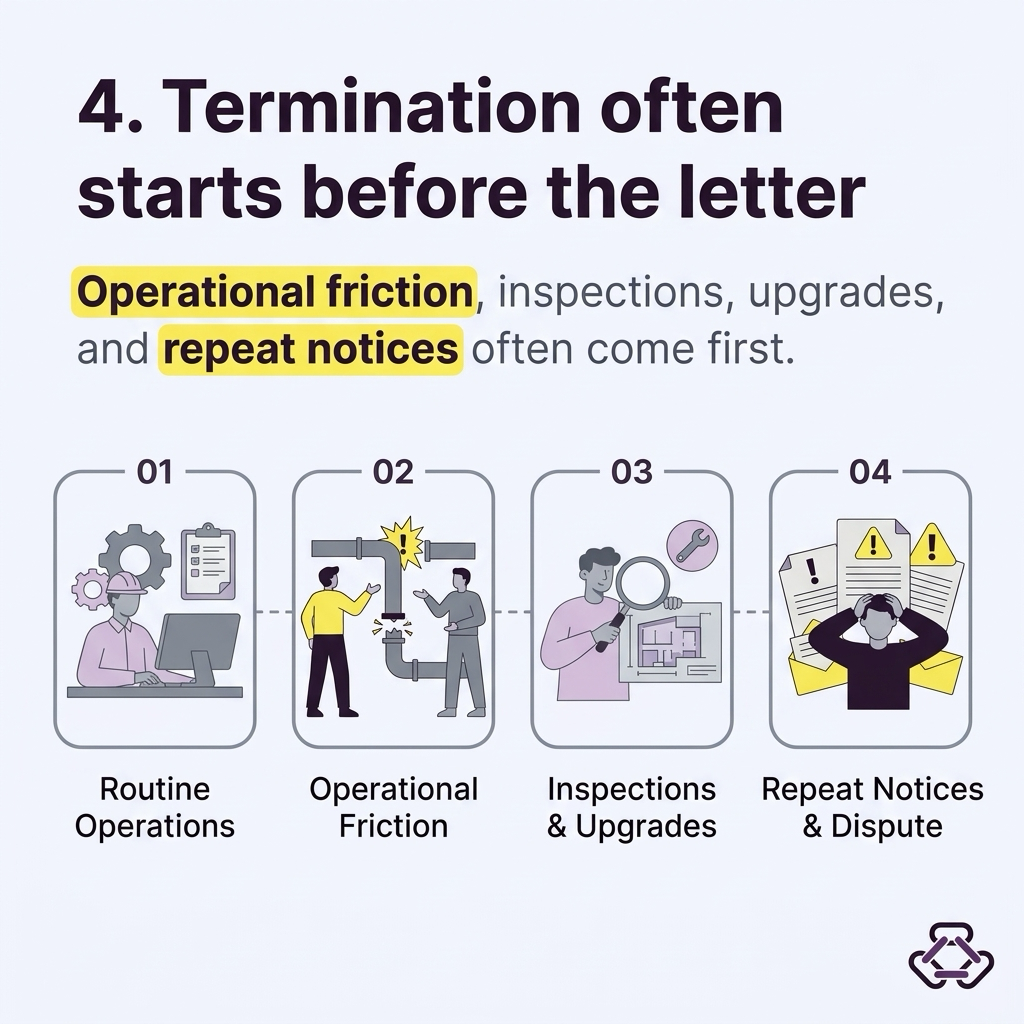
Termination disputes often begin long before the termination letter goes out. The warning signs may include months of operational friction, disputes over required upgrades, arguments over local marketing, pressure tied to inspections, or repeated notices about late fees and reporting deficiencies. Then the relationship reaches a point where one side views the issue as manageable and the other views it as grounds to end the deal.
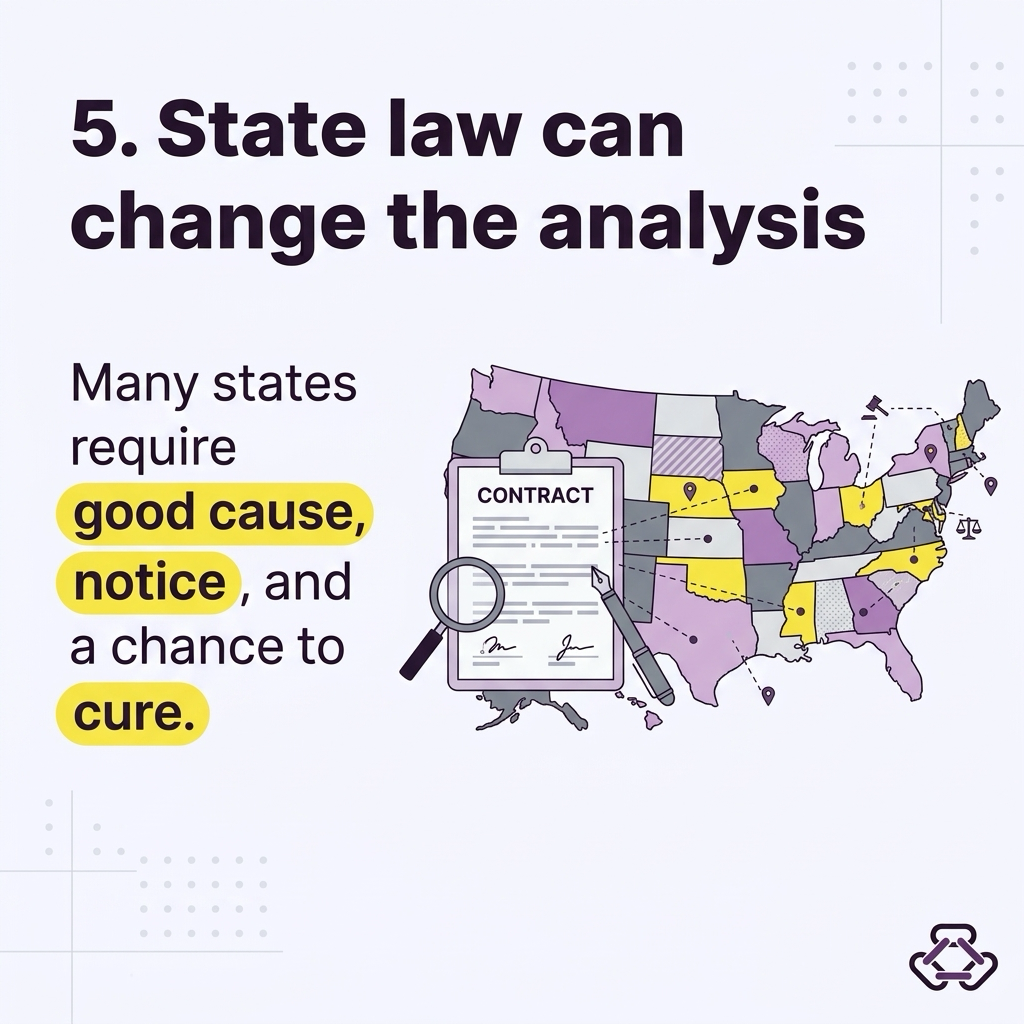
Many states place limits on termination. The ABA notes that state relationship laws commonly require good cause and often include notice and a chance to cure, though the scope of those protections differs from one jurisdiction to another (ABA overview of franchise law; ABA multistate relationship law analysis). In some states, statutes also address whether a franchisor can materially alter the competitive circumstances of the relationship without good cause.
That matters because franchise termination cases are rarely just about whether a breach occurred. They often become disputes over questions like:
- Was the notice legally sufficient?
- Was the alleged default actually material?
- Was there a valid chance to cure?
- Did the franchisor waive earlier breaches?
- Was the default selectively enforced?
- Did state law provide stronger protection than the contract?
- Was termination actually retaliation for unrelated disagreements?
On the franchisor side, termination may be framed as essential to protect the network and trademarks. On the franchisee side, it may be framed as an overreaction, a leverage tactic, or an unlawful attempt to force a sale, surrender, remodel, or market exit.
Why Territory Disputes Feel So Volatile
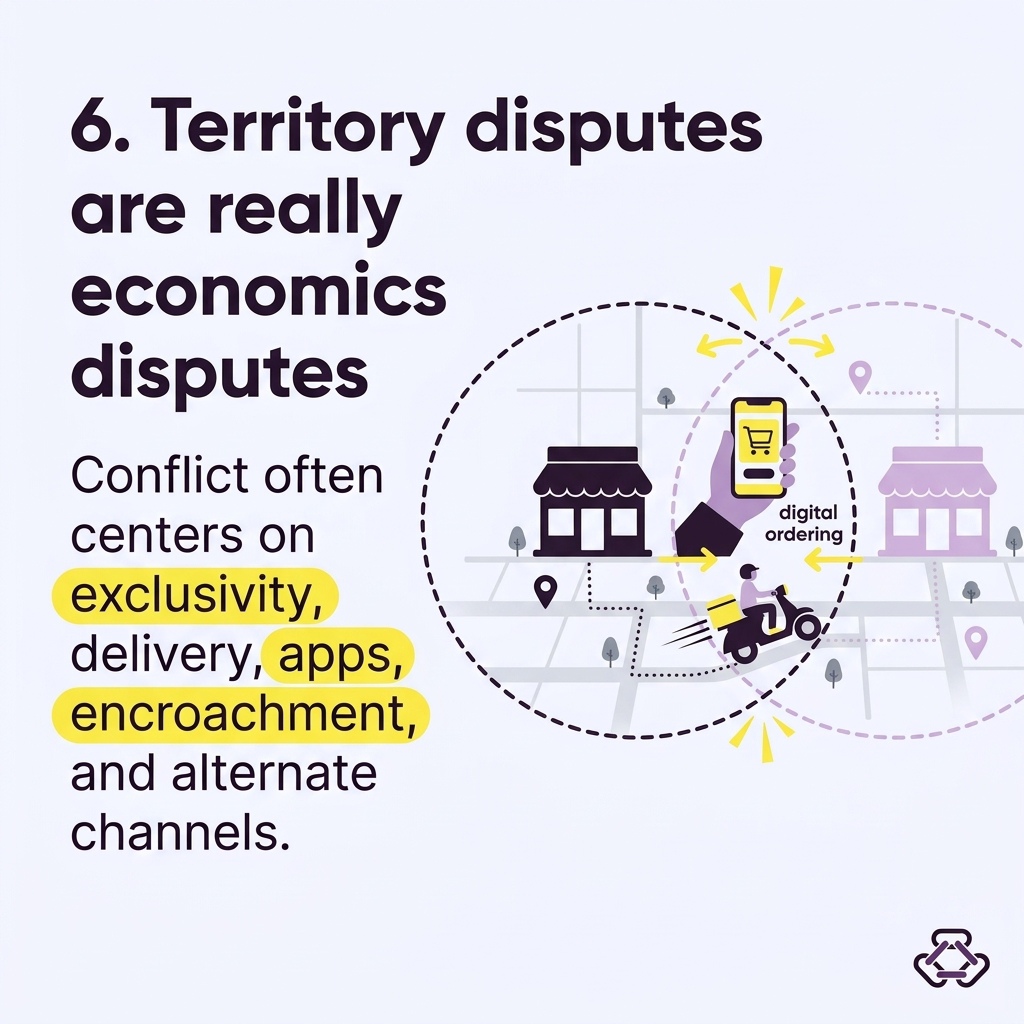
Territory fights hit a nerve because they go straight to the economics of the business. A franchisee may believe they paid for protected geographic opportunity, while the franchisor may view the territory grant as narrower than the franchisee assumed.
These disputes often involve:
- whether the territory is exclusive, protected, or merely designated
- online sales or delivery into the territory
- national accounts and house accounts
- kiosks, mobile units, ghost kitchens, or nontraditional sites
- e-commerce and app-based ordering
- encroachment by affiliate-owned or newly franchised locations
- alternate distribution channels such as grocery, airport, or institutional sales
The wording of the franchise agreement is usually central, but it is not always the only source of conflict. Sales presentations, Item 12 of the FDD, renewal amendments, and years of prior practice can all become part of the dispute narrative. Territory cases are especially fact-sensitive because they often involve changing business models. A protected radius drafted years ago may not map neatly onto app ordering, delivery platforms, or digital customer acquisition.
In many cases, territory disputes are really fights about expectations. One side points to contract language and reserved rights. The other points to how the relationship was sold, operated, and expanded in practice. That’s one reason a careful read of the contract package and operating materials can be so important. This piece on reviewing franchise agreements, manuals, and performance terms in a dispute breaks down where those obligations often hide.
Fees, Royalties, And Hidden Cost Disputes
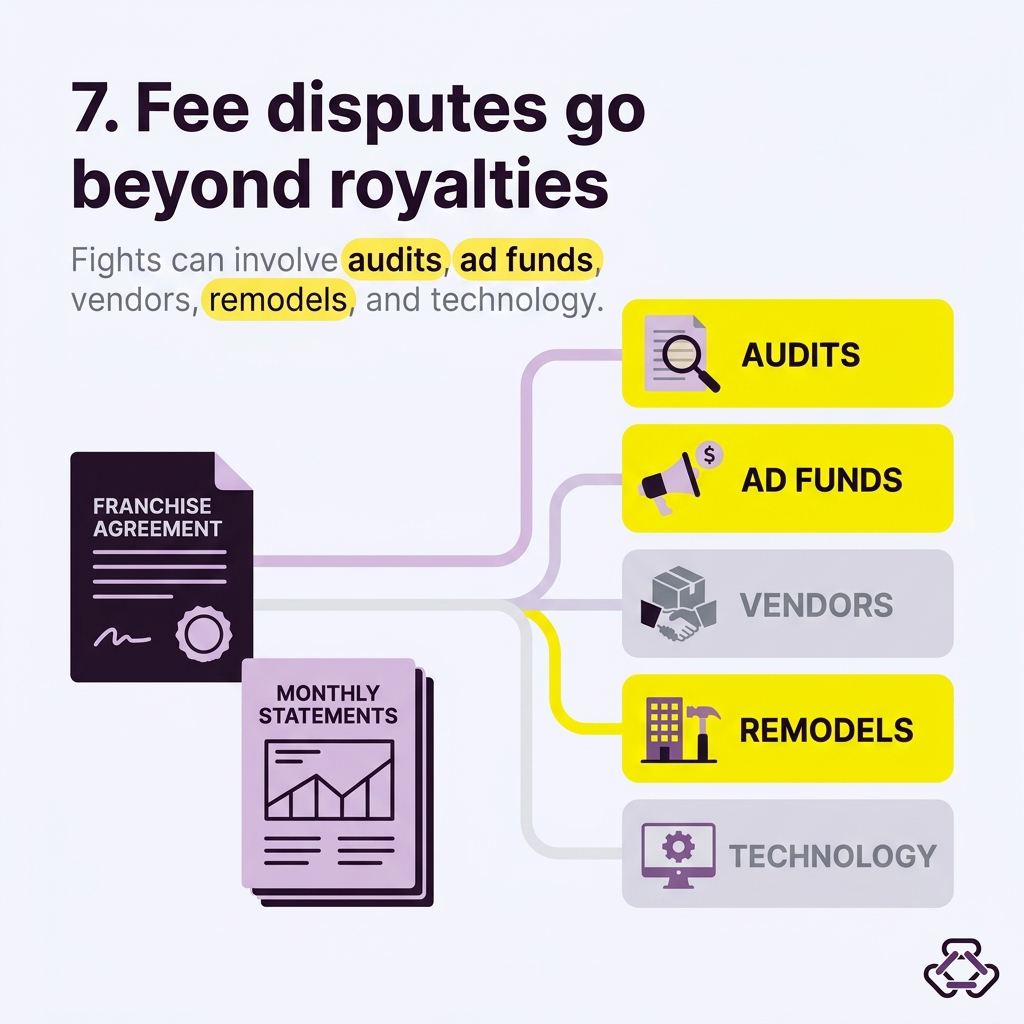
Money disputes in franchising often go well beyond the monthly royalty line item. Franchise agreements and related documents may include a long list of charges: advertising fund contributions, technology fees, software fees, transfer fees, training fees, audit costs, late charges, interest, supplier markups, mandatory remodel spending, local marketing minimums, renewal costs, and liquidated damages.
The FTC’s consumer guidance emphasizes the importance of reviewing the FDD carefully and looking at updates before signing, because disclosures can change and may reveal new litigation, management changes, or updated financial information (FTC consumer franchise guide; FTC guidance on updated FDD information). In a later dispute, those same documents often become evidence in fights over whether the fee structure was fully disclosed, whether certain charges were imposed consistently, and whether the franchisor reserved discretion broad enough to add or modify costs during the relationship.
Fee disputes commonly cluster around a few themes:
Audit And Reporting Fights
If the franchisor believes sales are underreported, an audit clause can open the door to retroactive royalties, interest, penalties, and the franchisor’s audit expenses. What starts as an accounting issue can quickly become a credibility dispute.
Marketing And Ad Fund Issues
Franchisees sometimes question how advertising funds are spent, whether local operators benefit proportionately, or whether mandatory marketing programs favor company-owned outlets or certain regions.
Required Vendors And System Purchases
The ABA has noted that franchisors often require franchisees to buy from designated suppliers in the interest of brand consistency and system control (ABA article discussing franchise controls and standards). The legal friction usually arises when franchisees view those requirements as overpriced, inflexible, or disconnected from local market realities.
Remodel, Technology, And Upgrade Costs
A dispute may emerge when the franchisor requires expensive upgrades tied to rebranding, modernization, point-of-sale systems, or customer experience changes. The language authorizing those demands may be spread across the agreement, addenda, operations manual, and renewal terms.
Brand Control Is Often The Real Center Of The Conflict
Many franchise disputes look like payment or performance cases on the surface, but underneath them sits a deeper issue: who controls the brand, and how far does that control go?
Brand control is not incidental in franchising. It is one of the defining features of the model. The IFA describes franchisees as independent owners who still operate in a way that meets the franchisor’s brand standards (IFA franchising terms). The ABA similarly notes that failure to adhere to minimum brand standards can lead to termination efforts and, after termination, trademark litigation if the former franchisee continues using the marks (ABA overview of franchise law).
That is why operational fights can become high-stakes very quickly. A franchisor may argue that menu deviations, service changes, unauthorized signage, modified store layouts, nonapproved ingredients, or inconsistent customer experience harm the goodwill attached to the mark. A franchisee may respond that the standards are being expanded unfairly, enforced unevenly, or used as leverage rather than genuine quality control.
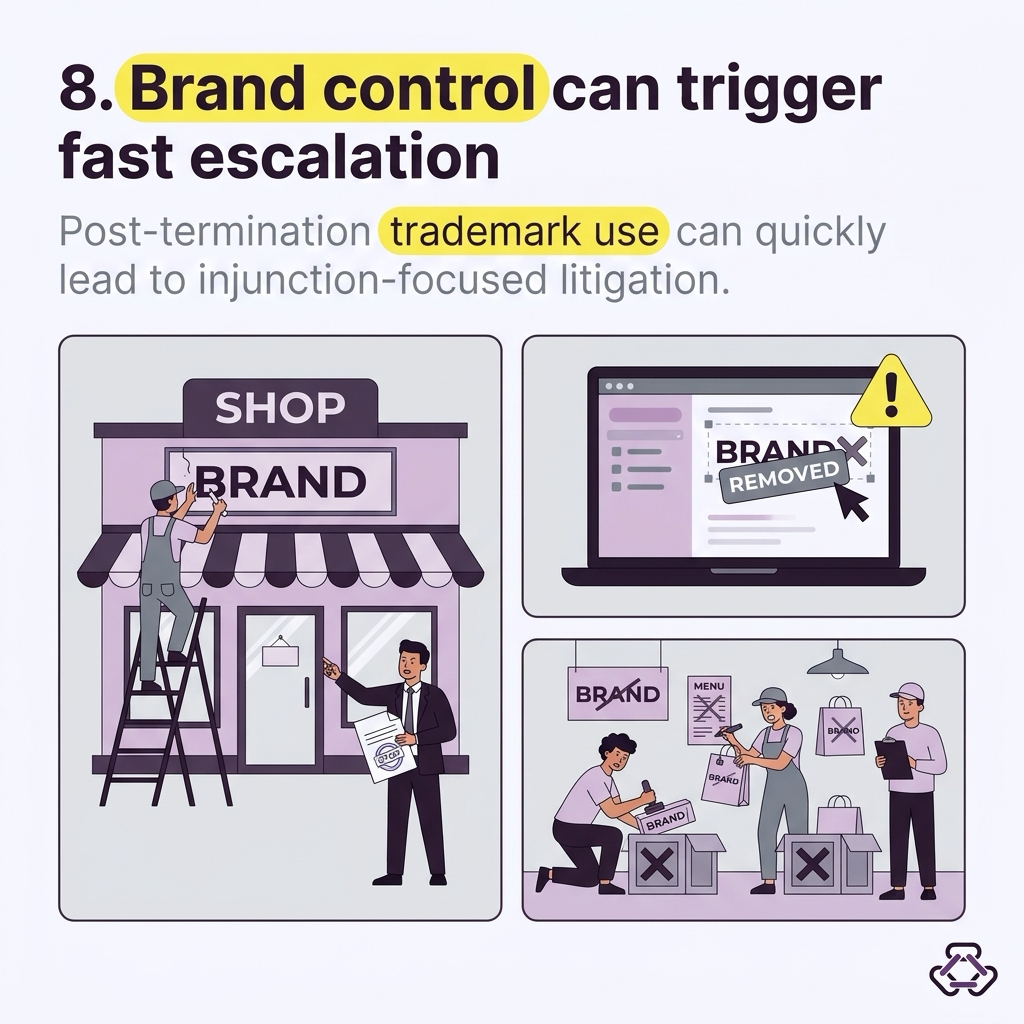
This tension gets even sharper after termination. If the former franchisee continues using brand identifiers, customer-facing materials, trade dress, websites, or confusingly similar marketing, the dispute may move into trademark territory. The Legal Information Institute’s overview of trademark law explains that the Lanham Act protects marks used in commerce, and registered marks carry important legal advantages (Cornell LII trademark overview). In franchise cases, post-termination use of marks is often one of the fastest paths to injunctive litigation because the franchisor may frame it as ongoing consumer confusion and continuing brand damage.
Recent ABA case reporting has highlighted federal court enforcement of post-termination provisions where franchisors presented evidence of ongoing misuse of branding and customer-facing association with the system (ABA franchising case updates).
Why Manuals And System Standards Matter So Much
A common surprise in franchise disputes is that the franchise agreement may be only part of the story. The operations manual, brand standards, vendor bulletins, technology requirements, marketing directives, and system memoranda often supply the day-to-day rules that later become the basis for alleged default.
That can create a difficult legal and factual question: which obligations are fixed by contract, and which ones can be changed by the franchisor through the manual or system updates? Some agreements give broad authority to modify standards over time. Others are narrower. Courts may also examine whether the manuals are properly incorporated, whether changes were applied consistently, and whether the updates were reasonable in relation to brand protection and system needs.
The practical problem is simple: many franchisees focus on the signed agreement, while the actual dispute is built from the entire document ecosystem. If the conflict turns on performance obligations, remodel timing, approved vendors, customer-service scripts, technology adoption, or quality assurance rules, a page-by-page review often becomes central. For a more detailed walkthrough, this post on reading the agreement and manuals when a franchise fight starts is a useful companion.
What Happens After A Termination Notice?
Once termination is formally noticed, the timeline often compresses. There may be contractual deadlines to cure, de-identify the location, stop using trademarks, return confidential materials, assign phone numbers or web assets, comply with post-term covenants, or satisfy repurchase and transfer procedures.
At that point, the case can move in several directions:
- negotiated cure or reinstatement
- temporary standstill while the parties exchange information
- emergency injunction proceedings
- arbitration or court filing over the validity of termination
- claims for unpaid fees, liquidated damages, or future royalties
- trademark infringement and unfair competition claims
- disputes over equipment, inventory, lease rights, or customer data
The speed of this phase is one reason franchise owners often feel blindsided. A letter that looks administrative can trigger brand de-identification demands, accelerated damage claims, and a request for emergency relief within days. This is also the stage where avoidable errors can become expensive, which is why some readers find it helpful to review these common franchise dispute mistakes that can increase exposure quickly.
Common Defenses And Counterarguments In Franchise Cases
Every case is fact-specific, but several recurring defenses and counterarguments appear in franchise litigation:
Lack Of Good Cause
Where state relationship laws apply, a franchisee may argue that the alleged breach does not amount to legally sufficient cause for termination or nonrenewal.
Defective Notice Or No Real Opportunity To Cure
The dispute may focus on whether the notice identified the alleged defaults with enough specificity, whether it complied with contractual and statutory requirements, and whether the cure period was meaningful.
Waiver Or Selective Enforcement
A franchisee may argue that the franchisor tolerated the same conduct for months or years, or enforced the rules inconsistently across operators.
Pretext
Sometimes the stated default is alleged to be a pretext for another objective, such as forcing a resale, clearing territory, reclaiming a location, or retaliating over complaints.
Contract Interpretation
The parties may disagree over what the agreement actually permits regarding fees, territory, suppliers, standards, or termination rights. That’s where broader contract principles begin to overlap with franchising.
Disclosure-Related Claims
In some cases, a franchisee may contend that the dispute traces back to misleading pre-sale information, incomplete disclosures, or omitted litigation and financial context.
Why Early Legal Analysis Often Changes The Leverage
Franchise disputes tend to harden fast because the available remedies can be severe. A franchisor may pursue termination, de-branding, injunctive relief, damages, and enforcement of restrictive covenants. A franchisee may face the loss of the business they built, even if they disagree sharply with the grounds for default.
That makes early legal analysis especially important, not because every conflict ends in court, but because the first review often reframes the entire situation:
- Which documents control?
- Which state laws may apply?
- Is the default curable?
- Is the notice defective?
- Are the alleged breaches documented?
- Are there prior waivers or inconsistent practices?
- What are the post-termination trademark risks?
- Is emergency relief likely?
- What off-ramps exist short of full litigation?
When the relationship starts deteriorating, business owners often have practical questions before they even know whether a lawsuit is likely. This article on the questions franchise owners often ask when the relationship starts coming apart speaks to that stage of uncertainty.
The Big Picture: Franchise Disputes Are Really About Control, Value, And Risk
At a high level, most franchise disputes involve the same three pressures:
Control. The franchisor seeks system consistency, trademark protection, and operational compliance. The franchisee seeks room to run a profitable local business without unexpected interference or one-sided change.
Value. The franchisee may have invested years of labor and capital into the location. The franchisor may see brand value and network integrity as the central asset at stake.
Risk. Termination, encroachment, unpaid fees, or aggressive brand enforcement can alter the economics of the relationship very quickly, and the legal posture can shift from negotiation to injunction on short notice.
That is why franchise disputes often feel bigger than a simple breach-of-contract disagreement. They can affect ownership value, exit options, customer goodwill, neighboring territories, and the ability to keep operating under the brand at all.
Final Thoughts
Franchise disputes are rarely just about one letter, one invoice, or one inspection. They usually grow out of a deeper breakdown over termination rights, territory expectations, fee structures, default allegations, and the extent of brand control. Federal disclosure rules, state relationship laws, contract language, manuals, and trademark principles can all play a role, sometimes at the same time.
If you’re dealing with a franchise conflict, an attorney can help sort out which rights come from the agreement, which may come from state law, which defaults are genuinely material, and where the biggest exposure may sit before the dispute escalates further.
Visit ReferU.AI to get matched with an attorney who has demonstrable experience in cases like yours — for free.


