Table of Contents
- Franchise Litigation: A Beginner’s Guide to Franchisee and Franchisor Disputes
- What Is Franchise Litigation?
- Why Franchise Disputes Become So Intense
- What Usually Triggers Franchise Litigation?
- Termination And Nonrenewal
- Default Notices And Cure Disputes
- Financial Misrepresentation And FDD-Related Claims
- Territory And Encroachment
- Fees, Required Purchases, And Operational Control
- Transfer, Renewal, And Exit Disputes
- What Laws Shape Franchise Litigation?
- Federal Law
- State Franchise Statutes
- Contract Law, Procedure, And Venue Rules
- Court Or Arbitration?
- What Evidence Often Matters Most?
- The Core Documents
- The Timeline
- The System’s Actual Practices
- Sales Process Communications
- Damages Evidence
- What Makes Franchise Litigation Different From Ordinary Business Litigation?
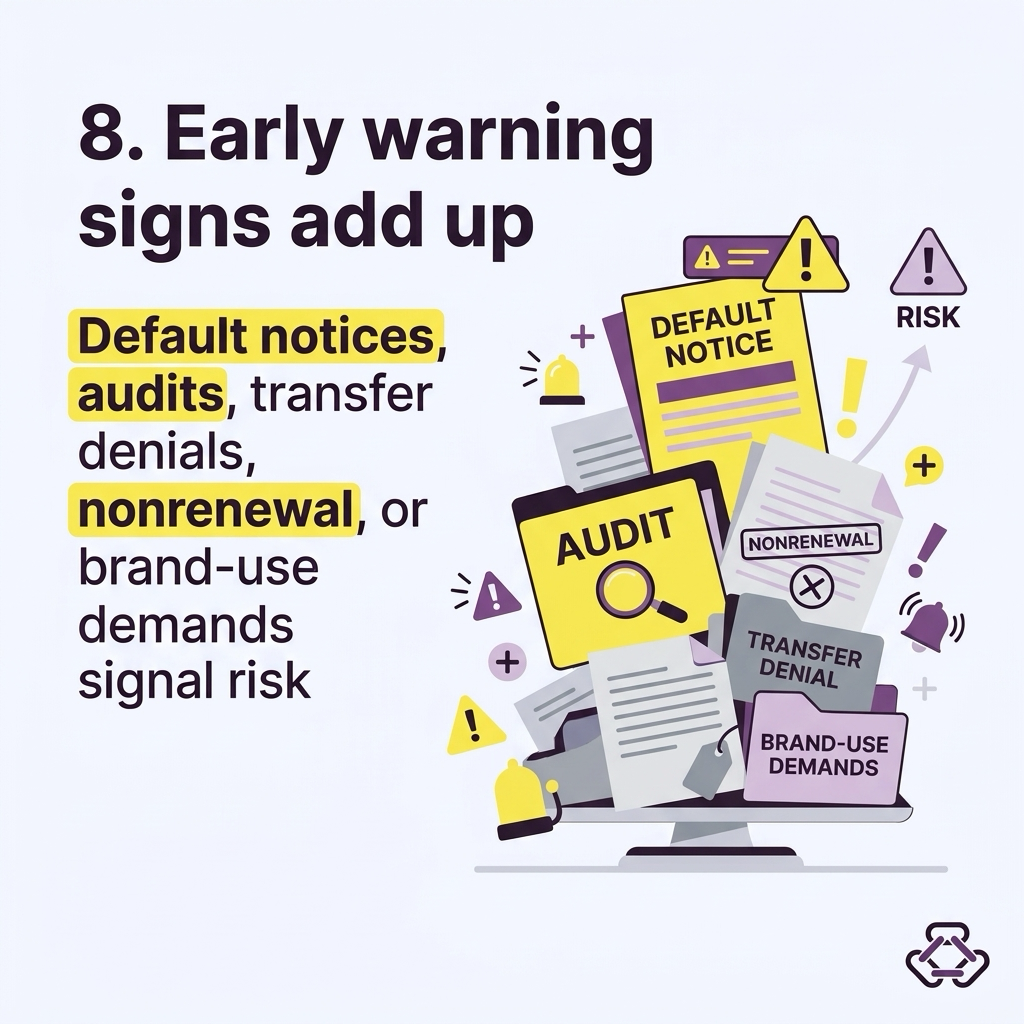
- What Early Warning Signs Often Point To Litigation?
- Why Attorney Fit Matters In Franchise Cases
- A Beginner’s Summary Of How These Cases Usually Unfold

Type
Great Grandchild
Status
Approved
Title (YouTube)
Images Failed (Social)
Images Failed (Social)
Do not index
Publish Date (TikTok)
Jan 3, 2027 15:45
Videos Post IDs (Social)
Hashtags (Social)
#LegalAdvice #LegalHelp #BusinessLitigation #FranchiseDisputes
Caption
Caption X
Cover

OG Image

Alt Image Text
Flat vector illustration of franchise litigation showing a franchisee and franchisor dispute with contracts, storefront, and legal symbols.
Images

Videos
Publish Date (Social)
Dec 15, 2026 08:30
Scheduled (Social)
Scheduled (Social)
Images Posted (Social)
Images Posted (Social)
Videos Posted (Social)
Videos Posted (Social)
Videos Failed (Social)
Videos Failed (Social)
Featured
Created time
Apr 3, 2026 10:13 PM
Sub-item
Authors
CTA Practice Area (Social)
Business Litigation
TikTok Failed (Social)
TikTok Failed (Social)
Videos Post Links (Social)
YT Auto Captions Removed
TikTok Post Links (Social)
Images Post IDs (Social)
YT Post ID
Video Pending Manual (Social)
TikTok Posted (Social)
TikTok Posted (Social)
TikTok Post IDs (Social)
Video Cover (Social)
Images Post Links (Social)
First Comment (Social)
YT Embedded
Images Delete (Social)
Videos Delete (Social)
Carousel Video URL (Social)
Franchise Litigation: A Beginner’s Guide to Franchisee and Franchisor Disputes
Franchise relationships are built on a simple idea: one side provides the brand, system, and operating model, and the other side invests money, time, and day-to-day effort to run the business. When that relationship works, it can be productive for both sides. When it breaks down, the dispute can become expensive, disruptive, and deeply personal.
That is where franchise litigation enters the picture.
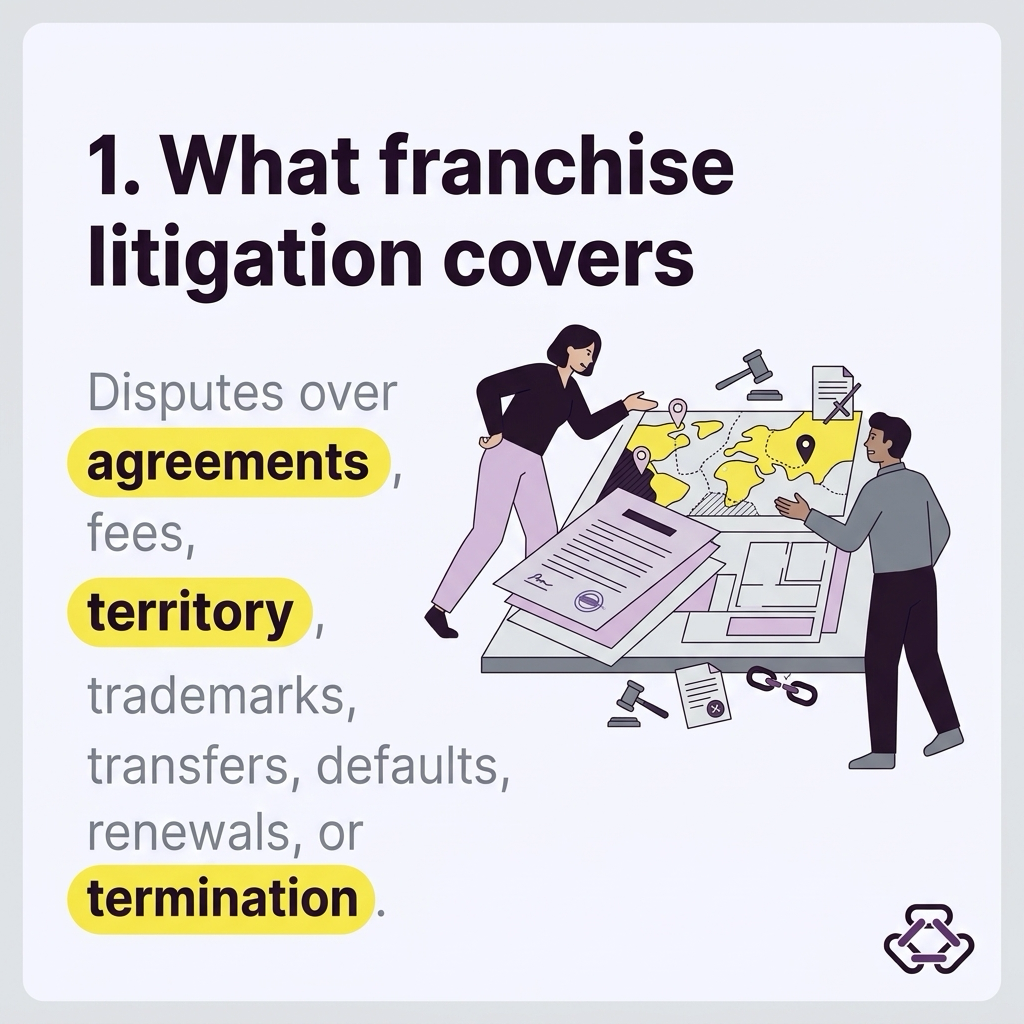
In general terms, franchise litigation refers to legal disputes between franchisors and franchisees involving the franchise agreement, disclosure documents, operating manuals, trademark use, territory, fees, renewals, defaults, transfers, or termination. These cases can also involve fraud or misrepresentation claims, unfair business practices, statutory franchise protections, and emergency requests for court orders.
Because franchising remains a major part of the U.S. economy, these disputes are not rare. The International Franchise Association reported hundreds of thousands of franchise establishments and projected U.S. franchise output above $936 billion in 2025, which helps explain why disagreement over brand control, performance obligations, and termination can quickly turn into high-stakes litigation for both sides (International Franchise Association).
In this post you’ll learn what franchise litigation is, the kinds of disputes that commonly trigger it, how federal and state laws shape these cases, what evidence tends to matter, and when an attorney’s documented experience in highly-similar matters may make a meaningful difference.
If you want a broader overview of the friction points that often lead to these cases, it may help to start with this plain-English breakdown of common franchise conflict issues.
Scroll to the bottom for every post in this series.
What Is Franchise Litigation?
Franchise litigation is the legal process used to resolve disputes connected to a franchise relationship. Some cases are filed in state or federal court. Others are pushed into arbitration because the franchise agreement contains an arbitration clause. Some disputes also begin with emergency motion practice, where one side asks for an injunction to preserve the status quo while the larger case proceeds.
These disputes often arise from documents that work together, including:
- the franchise agreement
- the franchise disclosure document, or FDD
- operating manuals and system standards
- development agreements
- leases and supply agreements
- guaranties signed by owners or principals
The Federal Trade Commission’s Franchise Rule requires franchisors to provide prospective franchisees with a disclosure document containing 23 categories of information about the franchise offering. But disclosure is only one layer of the relationship. Once the business is operating, the franchise agreement and the evolving operating manual often become central in later disputes (FTC, FTC Business Guidance).
Why Franchise Disputes Become So Intense
Franchise disputes tend to escalate for a few reasons.
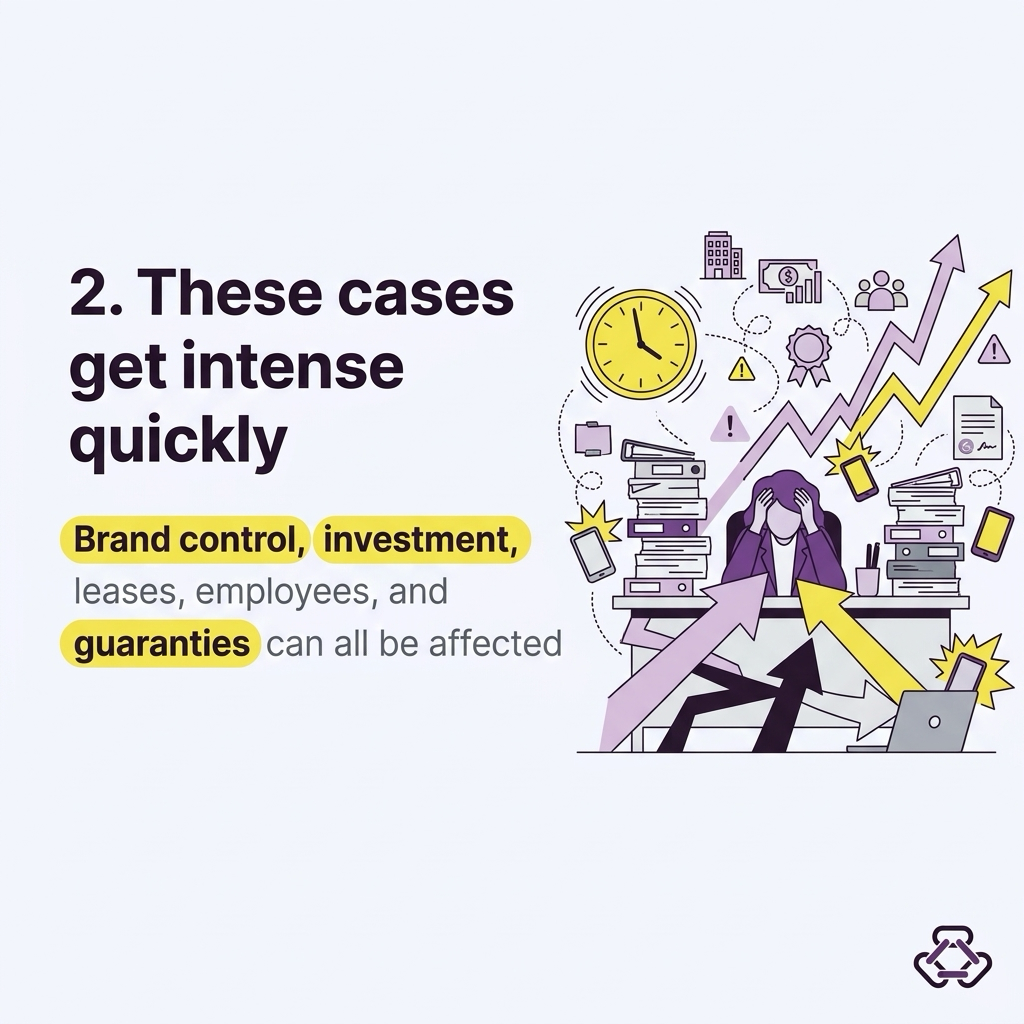
First, both sides often believe they are protecting something essential. A franchisor may view strict enforcement as necessary to protect trademark integrity, system uniformity, and brand reputation. A franchisee may view the same enforcement as overreach that threatens years of investment, local goodwill, employees, and lease obligations.
Second, franchise systems are document-heavy. Small wording differences in a default notice, a manual revision, an Item 19 financial performance representation, or a forum-selection clause can shape the entire dispute.
Third, these cases frequently involve urgent business consequences. A threatened termination can affect:
- the right to use the brand
- continued access to systems, software, and suppliers
- customer relationships
- financing and lease exposure
- resale value
- personal guaranty risk
That combination of operational pressure and legal complexity is one reason many parties look for counsel with demonstrable experience handling franchise disputes based on evidence and court records, not advertising claims.
What Usually Triggers Franchise Litigation?
Termination And Nonrenewal
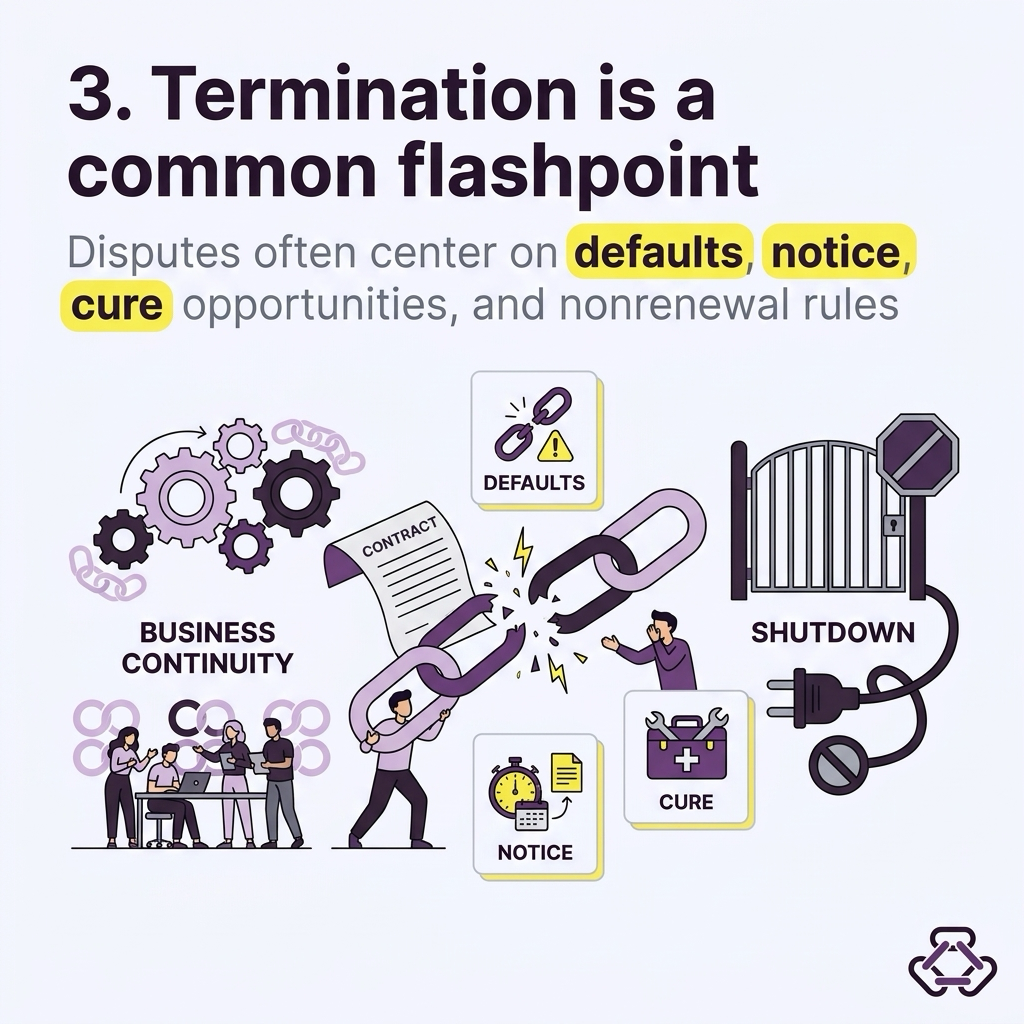
Termination is one of the most common flashpoints. A franchisor may allege repeated defaults, unpaid royalties, operational failures, health or safety problems, or conduct harmful to the brand. A franchisee may respond that the defaults are exaggerated, selectively enforced, or curable.
State law can be very important here. For example, California’s franchise relationship statute generally limits “good cause” for termination to substantial noncompliance with lawful franchise requirements after advance notice and an opportunity to cure, with several statutory exceptions. It also includes repurchase obligations in certain lawful terminations or nonrenewals (California Legislature).
Certain industries have specialized federal rules as well. For motor fuel franchises, the Petroleum Marketing Practices Act contains specific grounds, notice rules, and timing requirements for termination and nonrenewal, including a general 90-day notice framework in many circumstances (Cornell Legal Information Institute, Cornell Legal Information Institute).
Default Notices And Cure Disputes
Many franchise cases begin before termination, with a default notice. That notice may accuse the franchisee of missed payments, audit failures, underreporting, staffing deficiencies, product deviations, or refusal to comply with system standards. The fight then shifts to questions like:
- Was the alleged default real?
- Was the notice specific enough?
- Was there a meaningful chance to cure?
- Did the franchisor apply the same standards to others?
- Did the franchisee actually cure the issue?
These details often become central exhibits later.
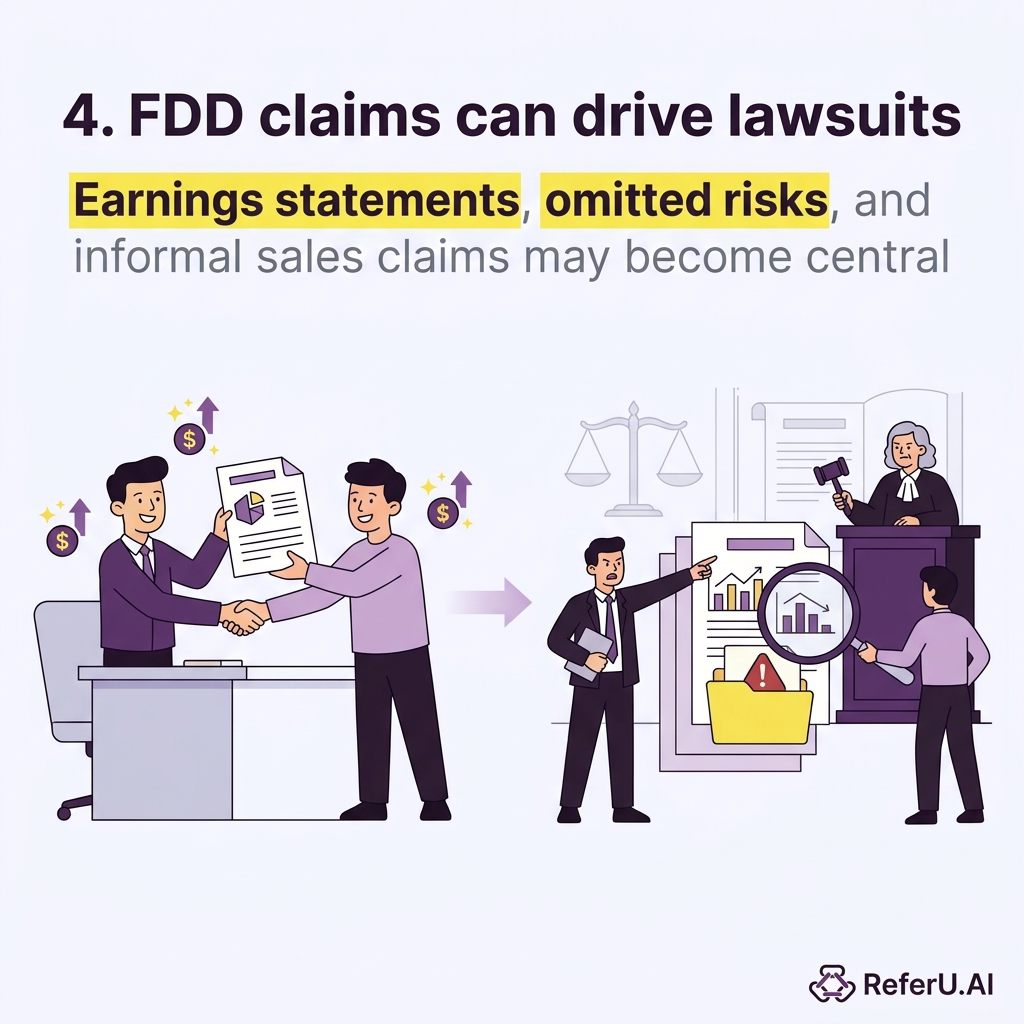
Financial Misrepresentation And FDD-Related Claims
Some cases are filed because the franchisee believes the deal was sold through inaccurate revenue claims, omitted risks, or misleading statements about expected performance.
The FTC explains that Item 19 of the FDD deals with financial performance representations. A franchisor is not required to make those representations, but if it does, the claims are subject to disclosure and substantiation requirements. The FTC also notes that oral or informal earnings claims that do not match the FDD can present serious issues (FTC Business Guidance, FTC Franchise Rule Compliance Guide).
That means franchise litigation can include allegations involving:
- earnings claims not properly disclosed
- overly rosy sales projections
- incomplete cost assumptions
- lack of geographic relevance in performance data
- pressure to sign questionnaires minimizing what was said during the sales process
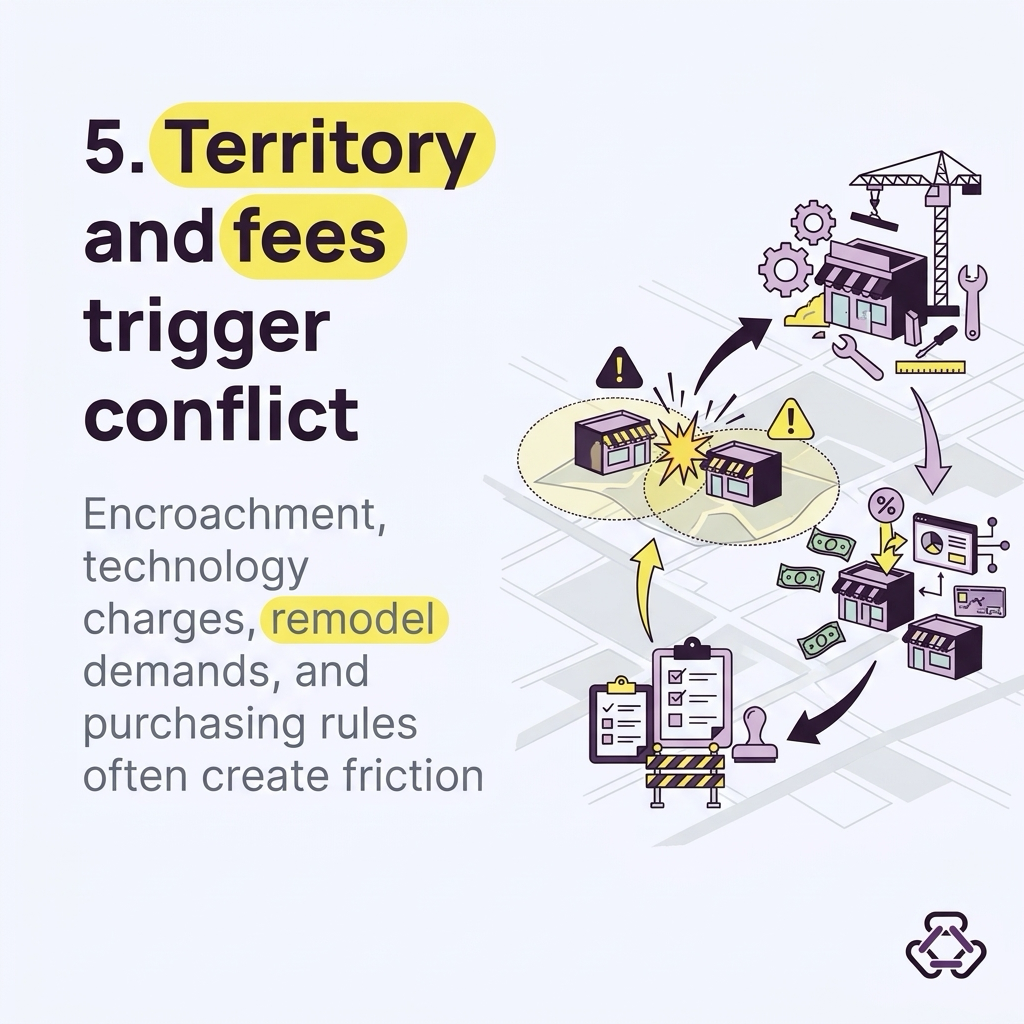
Territory And Encroachment
A franchisee may believe the franchisor opened a competing outlet too close by, flooded the market through alternative channels, or allowed digital sales practices that undermined the value of the original territory. Whether that becomes a legal claim often depends on the exact contract language and any protections or disclaimers in the FDD and agreement.
Fees, Required Purchases, And Operational Control
Franchisees sometimes challenge recurring fees, technology charges, remodel demands, or mandatory purchasing requirements. Franchisors, on the other hand, may argue those obligations were clearly disclosed and are essential to system consistency.
The FTC has also noted that the operating manual can have a major impact on day-to-day business and that some agreements give franchisors broad authority to revise manual requirements over time, which can create unexpected cost pressure later (FTC Business Guidance).
Transfer, Renewal, And Exit Disputes
Another frequent problem involves a franchisee trying to sell the business, transfer ownership, or renew at the end of the term. A franchisor may cite approval standards, cure issues, or system changes. A franchisee may argue the approval process was inconsistent or used as leverage.
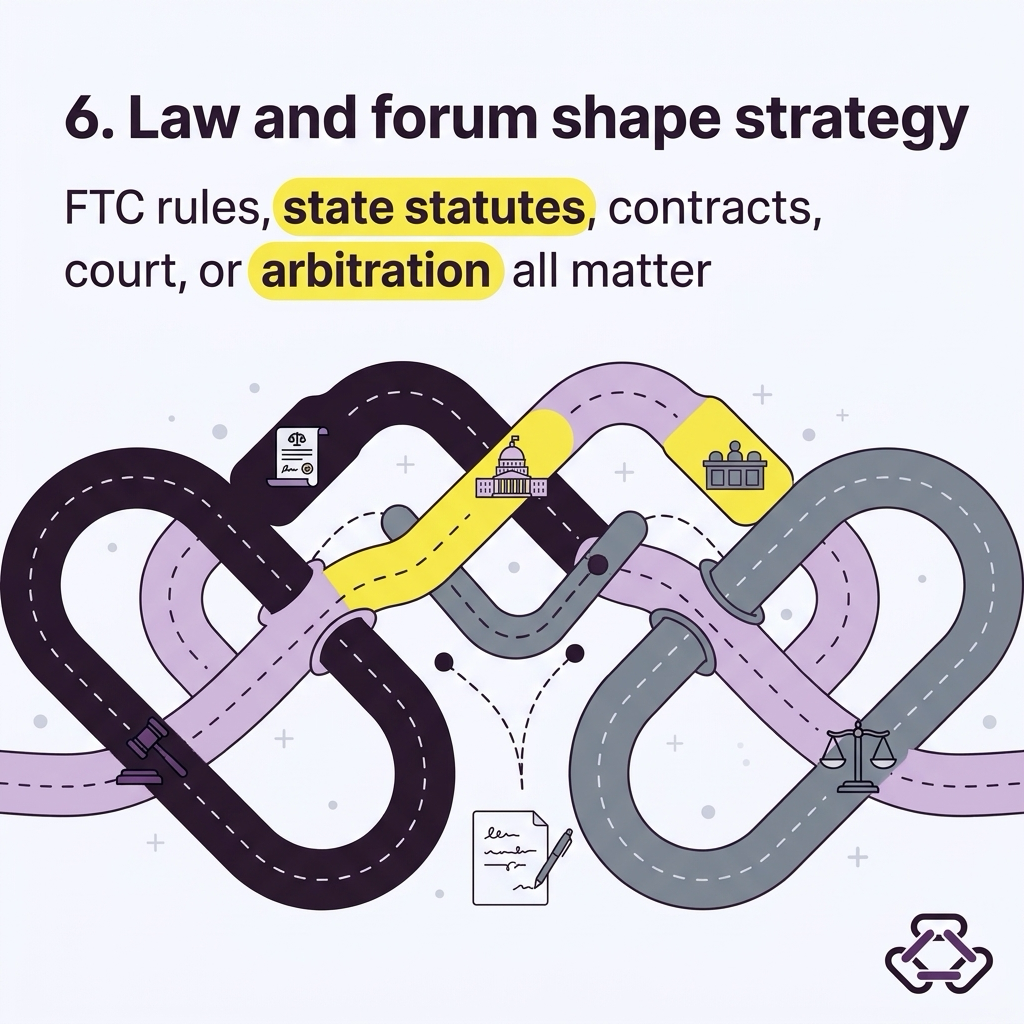
What Laws Shape Franchise Litigation?
Federal Law
At the federal level, the FTC Franchise Rule is mostly a pre-sale disclosure rule. It is highly important, but it does not by itself answer every relationship dispute after the franchise is operating. It requires the FDD and governs certain disclosure practices, including financial performance representations when those are made (FTC).
Other federal laws may enter the picture depending on the dispute, including trademark law under the Lanham Act, which often matters when a terminated franchisee keeps using marks, branding, trade dress, or confidential operating materials after the relationship ends.
In industry-specific settings, federal statutes can become even more central. The Petroleum Marketing Practices Act is a major example because it directly regulates certain termination and nonrenewal disputes involving motor fuel franchises (Cornell Legal Information Institute, Cornell Legal Information Institute).
State Franchise Statutes
State law is where many franchise fights become more complicated. Some states have franchise relationship statutes, registration laws, anti-waiver provisions, or protections affecting termination, renewal, transfer rights, and choice-of-law clauses.
The American Bar Association recently highlighted how multistate franchise operations can run into overlapping state protections, including statutes that may restrict the enforcement of contractual waivers or chosen governing law. That can matter a great deal where the agreement says one state’s law applies, but the franchise operates in another state with stronger franchise protections (American Bar Association).
Some sectors have even more specialized state protections. Massachusetts, for example, has detailed notice, cure, injunction, and repurchase provisions for certain motor vehicle dealership franchise disputes (Massachusetts Legislature).
Contract Law, Procedure, And Venue Rules
A large share of franchise litigation turns on contract interpretation and procedure:
- where the case must be filed
- whether arbitration is required
- which state’s law governs
- whether principals are personally bound
- whether injunctive relief is available
- what limitations periods apply
Forum-selection clauses can be especially important. Recent ABA litigation coverage shows courts may enforce these provisions broadly, in some instances even against closely related non-signatories depending on the facts and agreement structure (American Bar Association).
Court Or Arbitration?
Many franchise agreements send disputes to arbitration rather than court. That does not automatically make the dispute simpler. It just changes the forum, timeline, motion practice, appeal options, and sometimes the leverage points.
The American Arbitration Association maintains a dedicated panel for franchise industry disputes, which reflects how established arbitration has become in this space (AAA).
In practical terms, one of the first questions in any franchise fight is often not “Who is right?” but “Where will this fight happen?”
That one issue can influence strategy from day one.
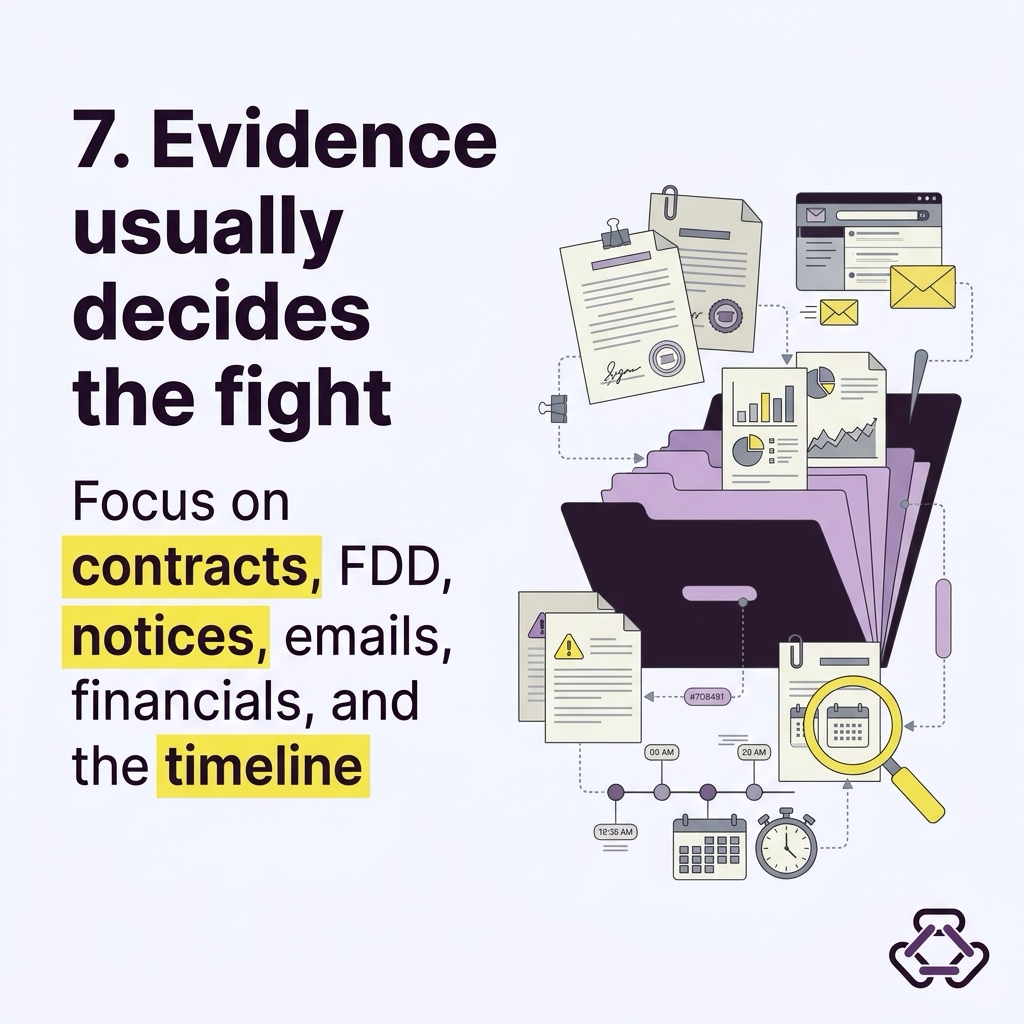
What Evidence Often Matters Most?
Franchise litigation often looks overwhelming from the outside, but the evidence themes are fairly consistent.
The Core Documents
The agreement, FDD, guaranties, amendments, manuals, default notices, inspection reports, emails, and financial records usually form the backbone of the case.
The Timeline
Dates matter. A lot. Who knew what, when they knew it, when a default was noticed, when the cure period ran, and when termination took effect can all become decisive.
The System’s Actual Practices
Many disputes turn on whether a franchisor applied standards consistently across similarly situated franchisees. Selective enforcement arguments often depend on comparators, internal communications, inspection histories, and performance data.
Sales Process Communications
If the case involves alleged inducement or misrepresentation, texts, emails, calls, presentations, discovery day materials, and follow-up explanations may become central. FTC guidance on financial performance representations is especially relevant here because off-the-page earnings talk can create major litigation risk if it does not align with the FDD (FTC Business Guidance).
Damages Evidence
Lost profits, reliance damages, fee disputes, inventory value, repurchase obligations, rent exposure, and de-branding costs often require detailed proof. In some cases, damages experts become important.
What Makes Franchise Litigation Different From Ordinary Business Litigation?
A franchise case may look like a contract case at first glance, but it usually involves more layers than a typical commercial dispute.
Franchise litigation often includes:
- a regulated sales process
- trademark and brand-control issues
- ongoing operational oversight
- manual updates outside the four corners of the agreement
- state franchise protections that may override or complicate contract terms
- emergency requests tied to continued operation under the brand
The result is a hybrid dispute touching contract law, statutory law, unfair competition, intellectual property, and sometimes injunctive relief all at once.
That is one reason parties often look for attorneys with relevant experience in highly-similar matters, rather than relying on a generic commercial-litigation label.
What Early Warning Signs Often Point To Litigation?
Some disputes arrive suddenly. Many others build slowly.
Common warning signs include:
- repeated default notices
- disputes over reporting or royalties
- aggressive audit activity
- friction over remodeling or capital expenditures
- complaints about supplier restrictions
- refusal to approve transfer or sale
- notice of nonrenewal
- accusations of unauthorized products or services
- conflict over territory, e-commerce, or nearby units
- demands to stop using brand materials
When those issues begin piling up, the practical and legal consequences can expand fast.
Why Attorney Fit Matters In Franchise Cases
Franchise disputes are rarely one-size-fits-all. A termination fight in a restaurant system is different from a transfer dispute in a fitness concept, a performance-representation case in an emerging brand, or a petroleum or motor vehicle dispute governed by specialized statutes.
That is why attorney fit is often less about slogans and more about objective criteria:
- Has the attorney handled disputes involving comparable franchise systems?
- Has the attorney litigated similar termination or default issues?
- Has the attorney worked with the same procedural forum, such as arbitration or federal court?
- Is there documented experience with the same state-law framework?
- Is there evidence of handling matters involving similar agreements, notice provisions, or brand-control disputes?
For people dealing with an active franchise fight, those questions often feel urgent because delay can affect operations, deadlines, evidence preservation, and negotiating leverage.
A Beginner’s Summary Of How These Cases Usually Unfold
For beginners, the simplest way to think about franchise litigation is this:
- A disagreement starts over money, control, performance, territory, or termination.
- The contract, FDD, and system records become the center of the dispute.
- Federal law, state franchise statutes, and forum clauses shape where and how the fight proceeds.
- The case may move into court, arbitration, or emergency injunction proceedings.
- The details matter enough that attorney experience with similar franchise disputes can meaningfully affect strategy, speed, and issue-spotting.
Franchise litigation can be intimidating, especially when a business, brand identity, or long-term investment feels at risk. But the process becomes easier to understand when you break it into its basic pieces: the documents, the timeline, the governing law, the forum, and the evidence.
If a franchise relationship is starting to unravel, some people in similar situations look for counsel with documented experience, relevant experience, and demonstrable experience in highly-similar franchise matters based on court records and case similarity.
Visit ReferU.AI to get matched with an attorney who has demonstrable experience in cases like yours — for free.
