Table of Contents
- 10 Questions Franchise Owners Ask When the Relationship Starts Falling Apart
- Why Franchise Disputes Escalate So Quickly
- 1. Can They Really Terminate Me Over This?
- 2. What Counts As “Good Cause” In A Franchise Fight?
- 3. Do I Get A Chance To Fix The Problem Before Termination?
- 4. Can The Franchisor Change The Rules Midstream?
- 5. What If The Real Problem Is Territory Encroachment?
- 6. Can They Refuse To Renew My Franchise Even If I’ve Been Operating For Years?
- 7. Do Arbitration Clauses And Forum Clauses Make It Harder To Fight Back?
- 8. What Happens If I Stop Paying Royalties While We’re Fighting?
- 9. If The Relationship Ends, What Am I Still Obligated To Do?
- 10. How Do I Find A Lawyer Who Actually Understands Franchise Disputes?
- A Final Thought When The Relationship Starts Cracking

Type
Great Grandchild
Status
Approved
Title (YouTube)
Images Failed (Social)
Images Failed (Social)
Do not index
Publish Date (TikTok)
Jan 3, 2027 12:15
Videos Post IDs (Social)
Hashtags (Social)
#LegalAdvice #LegalHelp #BusinessLitigation #FranchiseDisputes
Caption
Caption X
Cover

OG Image

Alt Image Text
Flat vector illustration of a franchise owner facing franchise relationship conflict, reviewing documents about disputes, notices, territory issues, and system standards as the relationship starts falling apart.
Images

Videos
Publish Date (Social)
Dec 15, 2026 06:30
Scheduled (Social)
Scheduled (Social)
Images Posted (Social)
Images Posted (Social)
Videos Posted (Social)
Videos Posted (Social)
Videos Failed (Social)
Videos Failed (Social)
Featured
Created time
Apr 3, 2026 10:13 PM
Sub-item
Authors
CTA Practice Area (Social)
Business Litigation
TikTok Failed (Social)
TikTok Failed (Social)
Videos Post Links (Social)
YT Auto Captions Removed
TikTok Post Links (Social)
Images Post IDs (Social)
YT Post ID
Video Pending Manual (Social)
TikTok Posted (Social)
TikTok Posted (Social)
TikTok Post IDs (Social)
Video Cover (Social)
Images Post Links (Social)
First Comment (Social)
YT Embedded
Images Delete (Social)
Videos Delete (Social)
Carousel Video URL (Social)
10 Questions Franchise Owners Ask When the Relationship Starts Falling Apart
When a franchise relationship starts to break down, the first signs are often subtle. A warning email. A disputed fee. A sudden demand to remodel. A performance conversation that feels less like support and more like a paper trail. For many franchise owners, that is the moment the questions start stacking up fast.
This post takes a practical look at 10 of the most common questions franchise owners ask when conflict with a franchisor starts getting serious. Along the way, we’ll cover contract terms, default notices, territory fights, nonrenewal, system standards, and why state franchise laws sometimes matter just as much as the franchise agreement itself. If you want broader background first, our overview of how franchise conflicts often unfold can help frame the bigger picture.
Scroll to the bottom for every post in this series.
Why Franchise Disputes Escalate So Quickly
Franchise systems are built on consistency. The franchisor wants brand control, operational uniformity, and system-wide standards. The franchisee wants a workable business model, fair enforcement, and room to operate profitably. Those goals can coexist for years. But once one side starts viewing the other as out of alignment, ordinary business disagreements can turn into legal disputes very quickly.
Part of the reason is structural. The FTC Franchise Rule requires franchisors to provide prospective franchisees with a disclosure document containing 23 specific categories of information, but the rule is largely focused on pre-sale disclosure, not ongoing dispute resolution. The FTC’s Franchise Rule Compliance Guide also explains that franchisees are given time to review the disclosures and the franchise agreement before signing, which often becomes important later when each side starts arguing over what the contract actually says. The FTC has also noted that the rule does not require franchisors to provide the operations manual during the sales process, even though that manual may become central once compliance disputes begin, as the agency discussed in its Franchise Fundamentals guidance.
At the same time, many disputes are not governed by contract language alone. According to the American Bar Association, state franchise relationship laws often restrict a franchisor’s power over termination, renewal, transfer, and other key parts of the relationship, and those statutes frequently require good cause, notice, and an opportunity to cure before termination can happen. Recent ABA analysis also notes that these laws vary significantly by state and can affect whether a franchisor may terminate, cancel, fail to renew, or even substantially change competitive circumstances. See the ABA’s discussions of franchising basics and multistate franchise relationship laws.
That combination — contract rights, manuals, default language, and state statutory protections — is why franchise owners often start asking the same urgent questions.
1. Can They Really Terminate Me Over This?
This is often the first question, and it usually comes after a notice of default, a performance warning, or a demand letter.
In general terms, the answer often depends on three things:
- What the franchise agreement says
- What the alleged default actually is
- Whether state franchise relationship law changes the analysis
Many franchise agreements list events of default broadly: unpaid royalties, repeated operational violations, underreporting sales, unauthorized transfers, abandonment, trademark misuse, criminal conduct, bankruptcy events, or health and safety problems. But a contractual default clause is not always the end of the story.
The ABA notes that state relationship laws frequently require good cause for termination and often require notice and an opportunity to cure first. In some states, that can materially change the leverage on both sides. Recent franchise litigation materials published through the International Franchise Association explain that a number of state relationship statutes can limit immediate termination and may impose statutory notice or cure periods, though exceptions often exist for issues like public safety, criminal conduct, or abandonment. See the IFA’s 2025 materials on basic franchise litigation and defaults and terminations.
That often means the real question is not just “Is there a default?” but “Is this the kind of default that legally supports termination here, now, under the governing agreement and applicable state law?”
2. What Counts As “Good Cause” In A Franchise Fight?
“Good cause” is one of those phrases that sounds simple until the dispute becomes personal and expensive.
In many franchise disputes, good cause often refers to a material failure to comply with the agreement or with reasonable franchise system requirements. The ABA describes good cause in state relationship laws as usually tied to a material breach. The IFA’s litigation materials similarly explain that many statutes allow termination when the franchisee has not substantially complied with material and reasonable franchise requirements. See the ABA’s franchising primer and the IFA’s 2025 litigation paper.
Where things get harder is in the gray area:
- Is the missed payment really undisputed?
- Is the performance metric reasonable?
- Is the manual requirement new or inconsistently enforced?
- Is the franchisor treating similarly situated operators differently?
- Did the alleged breach actually harm the brand or just frustrate the field team?
Those questions matter because not every stated reason is automatically good cause in practice. The IFA’s 2025 litigation materials note that franchisees sometimes contest the basis for termination by arguing the franchisor misused discretion, violated the contract, or ran afoul of good-faith principles. That tends to be where experienced franchise counsel becomes especially valuable.
3. Do I Get A Chance To Fix The Problem Before Termination?
Sometimes yes, sometimes no, and the difference can change everything.
Many states provide some form of notice and cure period before termination or nonrenewal, but those rules vary. The ABA notes that some statutes require a reasonable time to cure, while others specify exact periods. The IFA’s 2025 state notice chart shows just how inconsistent the rules can be from one jurisdiction to another. In California, for example, the chart describes 60 days’ notice in advance of termination for many defaults, with shorter or immediate action allowed for certain serious issues, and 180 days’ notice of intention not to renew in some circumstances. In Minnesota, the chart describes 90 days’ notice of termination with 60 days to cure for many defaults, while the state’s statute separately addresses nonrenewal. See the IFA’s state notice requirements chart, California’s legislative materials regarding the California Franchise Relations Act amendments, and Minnesota’s statute at Chapter 80C.
That means a franchise owner who receives a default notice may want to look beyond the letter itself. Some notices are drafted aggressively. Some omit context. Some characterize a disputed issue as incurable when that point is not obvious. Others start the clock on a cure period before the owner fully understands what documents, payments, operational changes, or admissions are being demanded.
For readers dealing with an actual notice, it can help to think of the document as both a business warning and the beginning of a legal record.
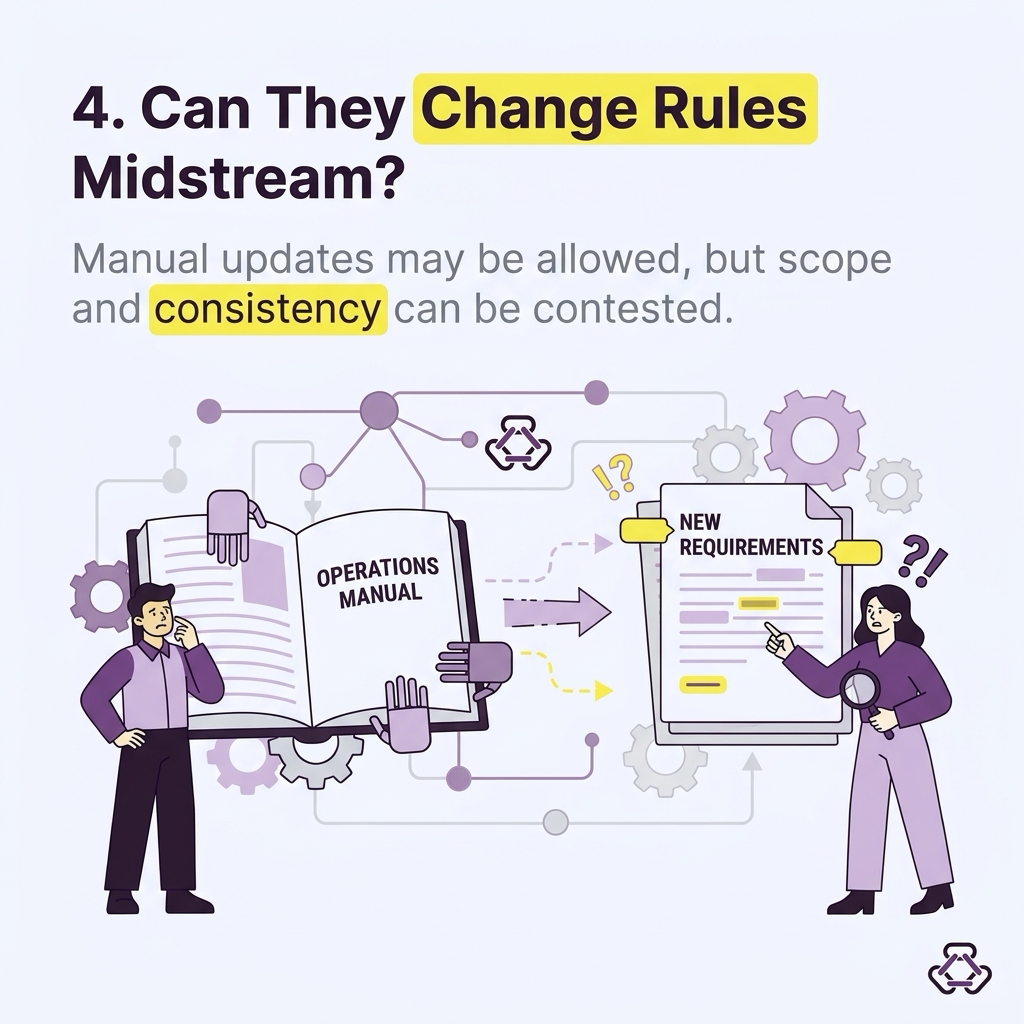
4. Can The Franchisor Change The Rules Midstream?
This is one of the most frustrating questions in a deteriorating franchise relationship, especially when the brand begins rolling out new technology, remodel requirements, vendor mandates, staffing rules, or performance benchmarks.
Often, the franchisor’s argument is that the agreement and operations manual allow system updates. And in many systems, they do. Franchise agreements commonly give franchisors broad authority to revise manuals, standards, approved suppliers, and brand requirements.
But the scope of that power is not always unlimited. The IFA’s 2025 litigation-prevention materials emphasize that clarity in agreements, manuals, training programs, communications, and system practices is central to avoiding internal franchise litigation. That is a strong clue about where disputes often form: not just over the existence of a rule, but over whether it was clearly authorized, consistently applied, properly communicated, and commercially realistic. See the IFA paper on preventing litigation risk in franchise systems.
In some states, a franchisee may also raise arguments that the franchisor has substantially changed competitive circumstances without the protections required by relationship statutes. The ABA’s recent article on multistate laws notes that some state statutes reach not just termination and nonrenewal, but also major changes to competitive conditions. That can become relevant when “system updates” start looking more like a fundamental rewrite of the economic deal.
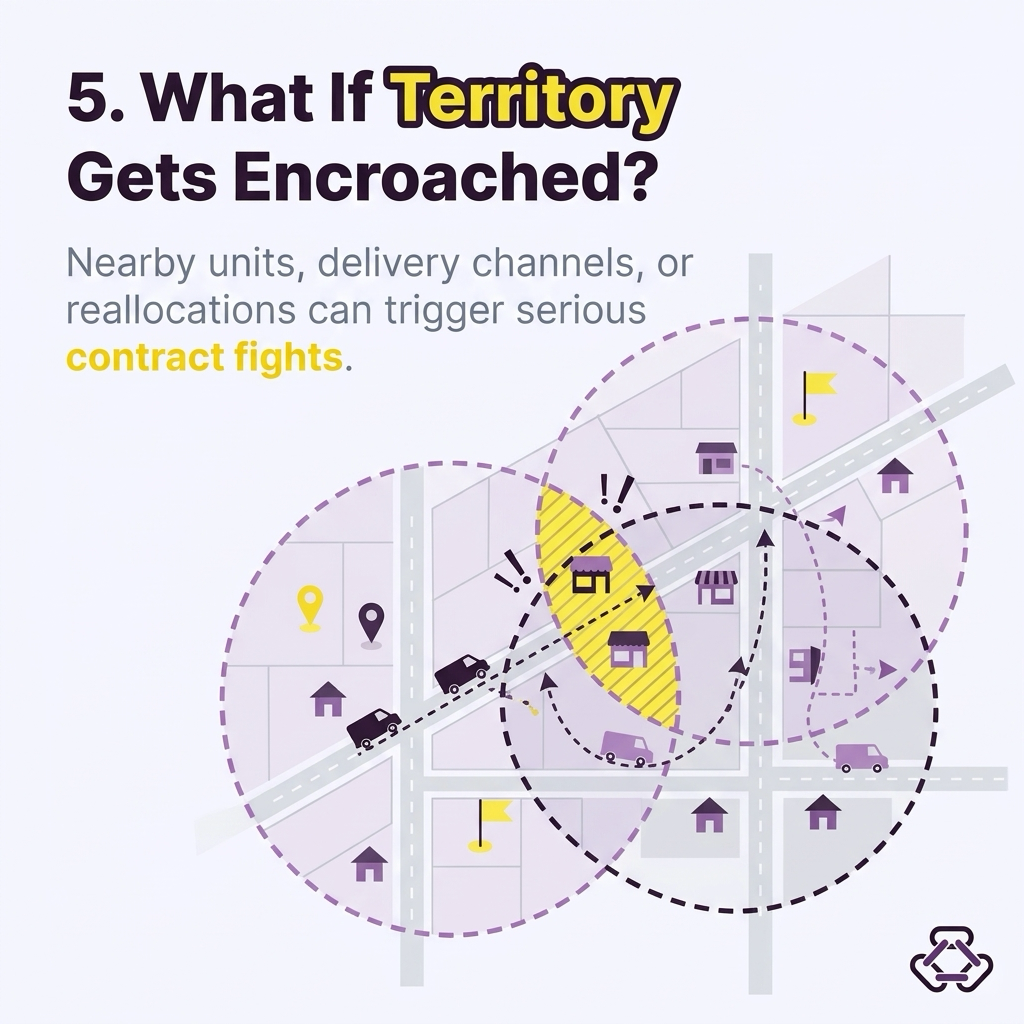
5. What If The Real Problem Is Territory Encroachment?
A franchise owner may not think of encroachment as the beginning of a legal dispute, but it often is. New units nearby, online order reallocation, ghost kitchens, company-owned locations, alternate channels, delivery platforms, or changes in customer assignment can all trigger serious conflict.
Territory fights often turn on contract wording. Some agreements grant an exclusive territory. Many do not. Some reserve broad rights to sell through e-commerce, national accounts, nontraditional venues, or affiliate channels. Others are vague enough to invite a years-long argument.
This is where readers often benefit from stepping back and reviewing the larger framework of territory, fees, defaults, and brand control issues, because encroachment disputes rarely stay isolated. They tend to spill into claims about lost profitability, unfair competition within the system, selective enforcement, failure of support, or pressure to sell.
When a relationship is already strained, territory issues can become the flashpoint that turns chronic frustration into formal litigation or arbitration.
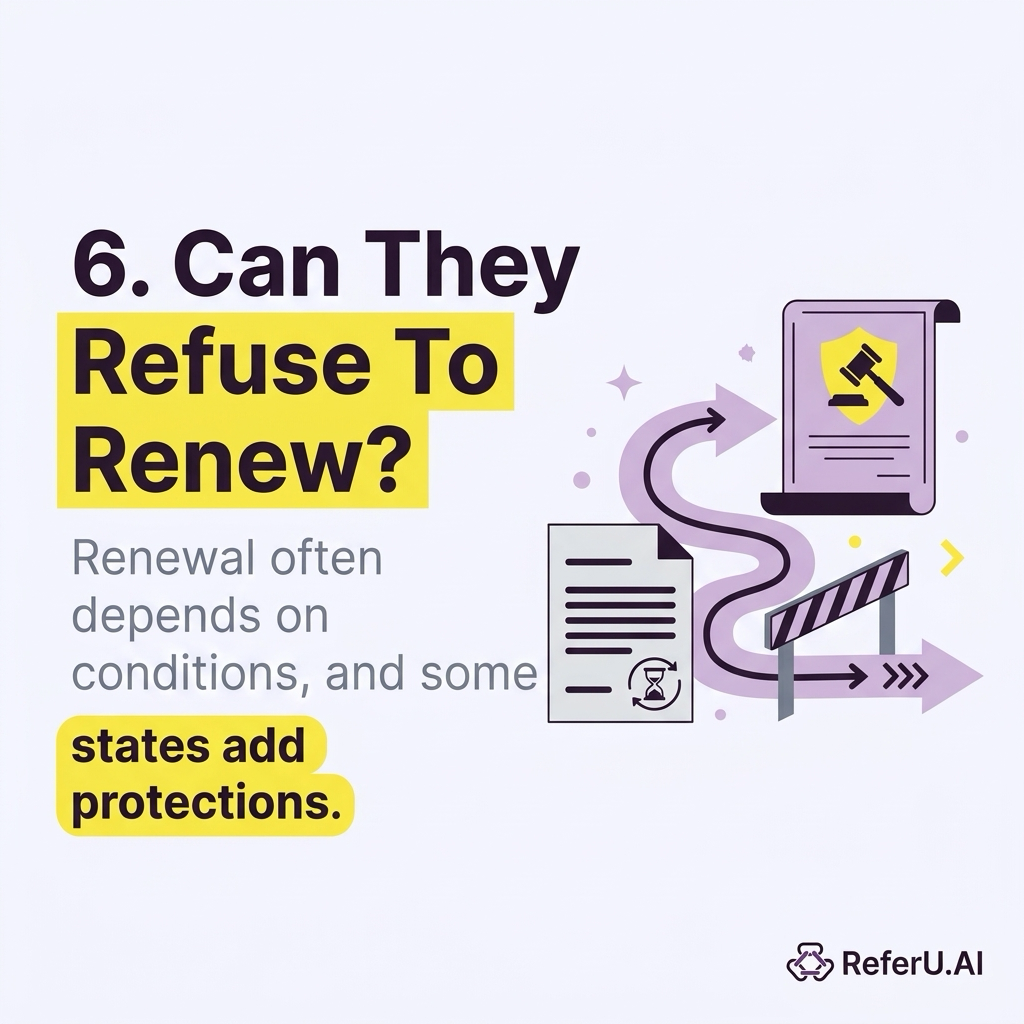
6. Can They Refuse To Renew My Franchise Even If I’ve Been Operating For Years?
Yes, in some circumstances — but long-term operation alone does not always answer the renewal question.
The IFA’s 2025 franchise litigation materials note that franchise agreements often give franchisees a right to renew or obtain a successor agreement only if certain conditions are met, such as compliance throughout the term, payment of amounts due, required upgrades, and signing the then-current form of agreement. The same materials also explain that franchisees sometimes have stronger renewal protections under state relationship laws than under the contract itself. See the IFA’s basic franchise litigation paper.
Minnesota provides one example of how state law can matter. Its statute says that, unless nonrenewal is for good cause and the franchisee failed to correct the reasons for termination, a franchisor generally may not fail to renew without giving at least 180 days’ advance written notice and an opportunity for the franchisee to operate long enough to recover the fair market value of the franchise as a going concern. See Minnesota Statutes Chapter 80C.
That does not mean every state gives those protections. It does mean that “your term is ending” is not always the same thing as “the franchisor can do whatever it wants.”
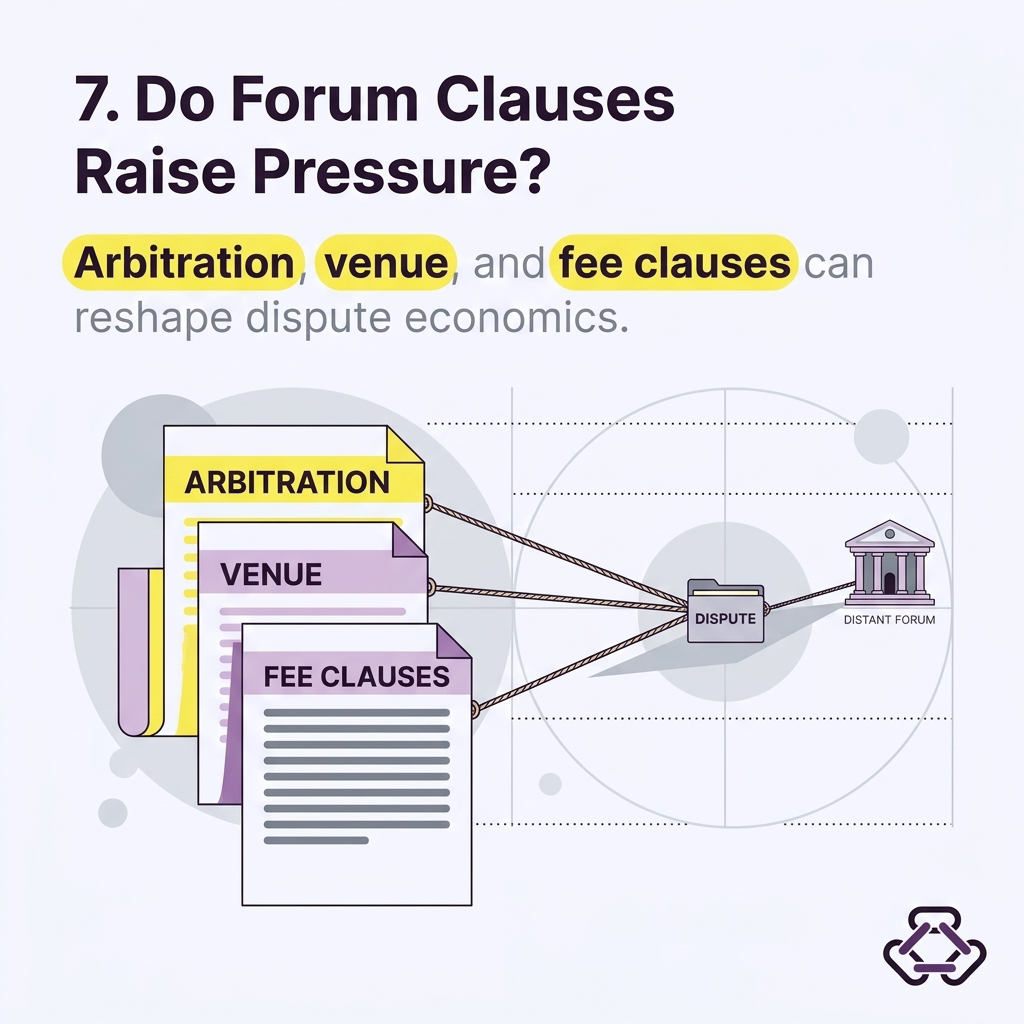
7. Do Arbitration Clauses And Forum Clauses Make It Harder To Fight Back?
Often, yes. And many franchise owners only focus on these clauses after the dispute is already underway.
Franchise agreements frequently require disputes to be resolved in arbitration or in a specific court, often in the franchisor’s home state. Fee-shifting provisions may also require the losing side to pay legal fees, expert fees, or enforcement costs in some scenarios. The ABA’s franchise law publications discuss how forum selection, arbitration provisions, and attorney-fee mechanisms can heavily shape the economics of a dispute, sometimes as much as the merits themselves. See the ABA’s materials on attorney fees in franchise disputes and broader franchise dispute issues in the Franchise Law Journal.
For a franchise owner, that often raises practical questions:
- Where does the case get filed?
- Does the owner have to travel?
- Is discovery limited?
- Are emergency injunctions still available?
- Does the contract favor quick enforcement of post-termination obligations?
- Does state law override any part of the clause?
Those questions may feel procedural, but they often determine how much pressure each side can realistically absorb.
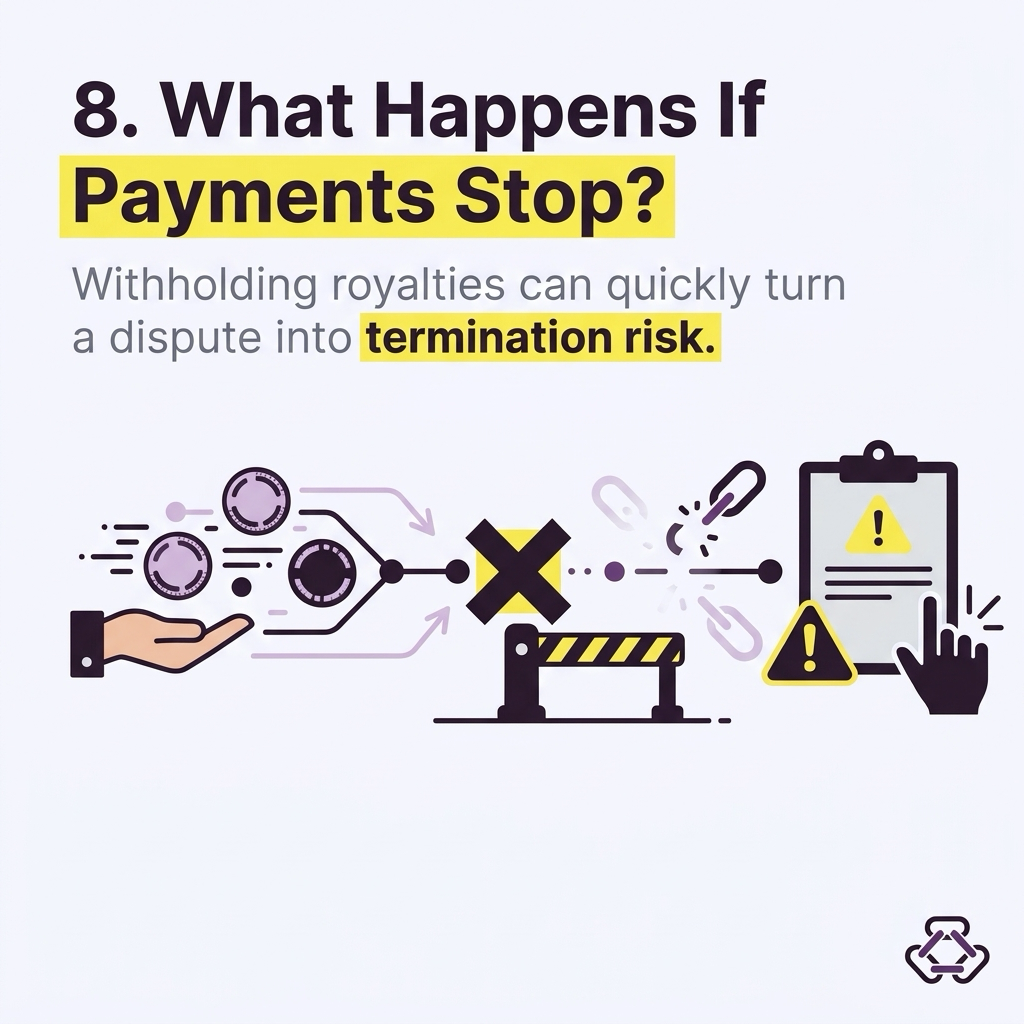
8. What Happens If I Stop Paying Royalties While We’re Fighting?
This is one of the highest-risk moments in a franchise dispute.
From the franchisee’s perspective, withholding royalties may feel like leverage, especially if the franchisor has allegedly breached first, failed to provide support, or damaged the territory. From the franchisor’s perspective, nonpayment is often framed as a clean and easily provable default.
The IFA’s litigation materials discuss cases where wrongful termination arguments become complicated when the franchisor points to unpaid, but disputed, fees. That issue can become especially difficult if the agreement includes strong audit rights, default interest, acceleration provisions, cross-default clauses, or personal guaranties. See the IFA’s 2025 litigation paper.
Here’s what this often means in real life: a business dispute about support or performance can quickly become a termination case if the payment stream breaks down. Some owners view that as a business decision. Franchisors often view it as the easiest path to enforcement.
That is one reason franchise disputes often benefit from early legal analysis before the conflict turns into a pure collections-and-termination matter.
9. If The Relationship Ends, What Am I Still Obligated To Do?
A lot more than many owners expect.
Even after termination, franchise agreements often continue to impose obligations involving:
- De-identification and trademark removal
- Return of manuals and proprietary materials
- Noncompete or non-solicitation restrictions, where enforceable
- Customer data and phone-number transfer
- Confidentiality
- Inventory or equipment handling
- Lease assignments
- Guarantor liability
- Liquidated damages or future-fee claims
These post-term obligations are a major reason franchise breakups can become urgent. A business owner may think the real fight is over whether the relationship survives. But once termination occurs, the dispute often expands into injunction requests, brand de-identification deadlines, damages claims, and battles over whether the owner can keep operating in any related form.
Some states also impose repurchase or buyback obligations in certain situations. The IFA’s defaults-and-terminations materials note that states including California, Washington, and several others have statutory repurchase provisions affecting inventory or supplies in some termination scenarios. Washington’s law, for example, provides that upon termination for good cause, the franchisor shall purchase certain inventory and supplies from the franchisee at fair market value, subject to exceptions. See Washington’s Franchise Investment Protection Act and the IFA’s termination materials.
10. How Do I Find A Lawyer Who Actually Understands Franchise Disputes?
This may be the most important question of all, because franchise disputes are rarely just “business litigation.”
They often involve a mix of:
- Contract interpretation
- State franchise relationship statutes
- Disclosure rules
- Operations-manual issues
- Trademark and brand-control claims
- Injunctive relief
- Arbitration procedure
- Guaranty exposure
- Noncompete and post-term restrictions
- Multi-state conflict-of-law questions
A general commercial litigator may be helpful in some cases. But franchise disputes often move on a specialized track. The legal issues are system-specific, document-heavy, and shaped by statutes that vary from one state to another. The ABA’s recent analysis of multistate franchise laws makes that especially clear: two franchisees in similar factual situations may face very different legal landscapes depending on where the unit is located and which law governs. See the ABA’s article on state-law variation in franchise operations.
Some franchise owners look for attorneys through referrals, bar directories, or broad internet searches. Others want a more evidence-based way to identify lawyers with documented experience in highly similar matters. That is where case similarity, court-record review, and objective matching criteria can become especially useful.
A Final Thought When The Relationship Starts Cracking
Franchise disputes rarely begin with a dramatic courtroom moment. More often, they begin with uncertainty: a notice that feels unfair, a demand that feels impossible, a conversation that suddenly sounds scripted, or a sense that the relationship has shifted from collaborative to adversarial.
If any of the questions above sound familiar, it may help to view the situation in layers. There is the contract. There is the operations manual. There is the factual record. And there may also be state franchise law that changes the leverage in ways that are easy to miss in the first few days of a dispute.
The earlier a franchise owner understands those layers, the easier it becomes to evaluate exposure, preserve options, and find counsel with relevant experience in franchise-specific conflicts.
Visit ReferU.AI to get matched with an attorney who has demonstrable experience in cases like yours — for free.
