Table of Contents
- How to Evaluate Whether a Non-Compete Is Enforceable Before You Sue or Defend
- Why “Enforceable” Is Not A Yes-Or-No Shortcut
- Step 1: Identify Which State’s Law Actually Applies
- Step 2: Check Whether The State Flatly Bans Or Restricts This Category Of Non-Compete
- Step 3: Examine Whether The Worker Falls Into A Protected Category
- Step 4: Review How And When The Agreement Was Presented
- Step 5: Test The Core Reasonableness Factors
- Duration
- Geographic Scope
- Restricted Activities
- Step 6: Ask Whether There Is A Legitimate Business Interest To Protect
- Step 7: Separate Non-Competes From Non-Solicitation And Confidentiality Terms
- Step 8: Evaluate Whether The Court Can Rewrite The Clause
- Step 9: Look At The Remedy The Other Side Is Most Likely To Seek
- Step 10: Gather Facts Like You Are Building Or Defending An Injunction File
- Common Signs A Non-Compete May Be More Vulnerable
- Common Signs The Dispute May Still Be Dangerous Even If The Non-Compete Looks Weak
- Why Early Attorney Review Often Changes The Strategy
- The Bottom Line

Type
Great Grandchild
Status
Approved
Title (YouTube)
Images Failed (Social)
Images Failed (Social)
Do not index
Parent item
Publish Date (TikTok)
Jan 7, 2027 07:15
Videos Post IDs (Social)
Hashtags (Social)
#LegalAdvice #LegalHelp #BusinessLitigation #NonCompeteNonSolicitation
Caption
Caption X
Cover

OG Image

Alt Image Text
Flat vector illustration of non-compete enforceability and state law review, showing professionals evaluating a contract with legal symbols, jurisdiction blocks, and risk assessment elements.
Images

Videos
Publish Date (Social)
Dec 17, 2026 08:00
Scheduled (Social)
Scheduled (Social)
Images Posted (Social)
Images Posted (Social)
Videos Posted (Social)
Videos Posted (Social)
Videos Failed (Social)
Videos Failed (Social)
Featured
Created time
Apr 3, 2026 10:12 PM
Sub-item
Authors
CTA Practice Area (Social)
Business Litigation
TikTok Failed (Social)
TikTok Failed (Social)
Videos Post Links (Social)
YT Auto Captions Removed
TikTok Post Links (Social)
Images Post IDs (Social)
YT Post ID
Video Pending Manual (Social)
TikTok Posted (Social)
TikTok Posted (Social)
TikTok Post IDs (Social)
Video Cover (Social)
Images Post Links (Social)
First Comment (Social)
YT Embedded
Images Delete (Social)
Videos Delete (Social)
Carousel Video URL (Social)
How to Evaluate Whether a Non-Compete Is Enforceable Before You Sue or Defend
Non-compete disputes can feel urgent fast. A former employee gets a demand letter. A business hears a key salesperson joined a competitor. An executive is told a new offer may trigger litigation. In each version of the story, one question usually comes first: is this non-compete even enforceable?
That sounds simple, but it rarely is. Non-compete law is now a patchwork of state statutes, older common-law tests, industry-specific carveouts, wage thresholds, notice rules, and fast-moving injunction practice. Federal headlines have added even more confusion. The Federal Trade Commission adopted a broad non-compete rule in 2024, but the agency later stated in 2026 that it filed to accede to vacatur of that rule, leaving state law as the practical battleground in most disputes today (FTC case status page, FTC press release).
If you are trying to assess risk before filing suit or deciding how to respond, a structured review can save a lot of noise, money, and strategic mistakes. In this post you’ll learn how lawyers often evaluate enforceability on the front end, what facts tend to matter most, and where businesses and workers commonly misread the landscape. If you want broader background first, this overview of how restrictive covenant fights usually work can help frame the bigger picture.
Scroll to the bottom for every post in this series.
Why “Enforceable” Is Not A Yes-Or-No Shortcut
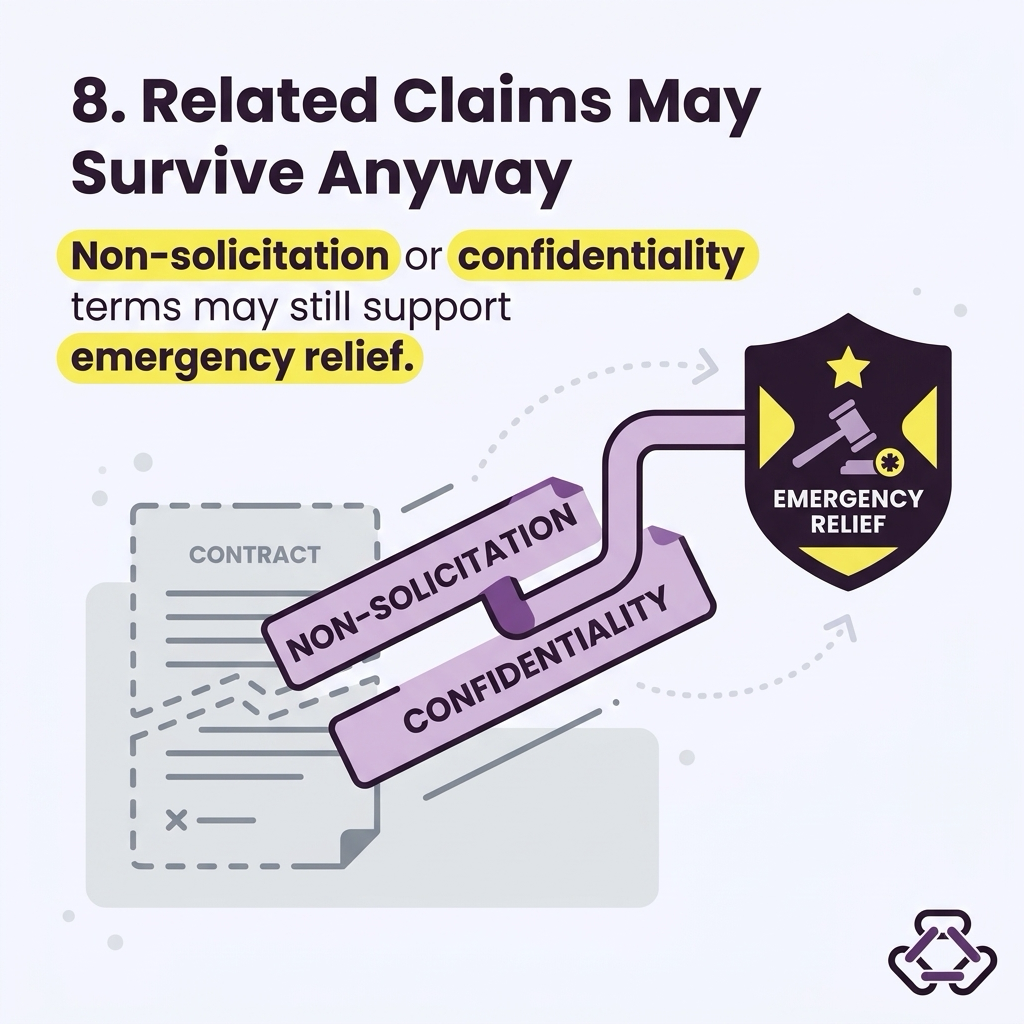
A non-compete may look airtight on paper and still be unenforceable. It may also look overbroad and still create real litigation exposure because some courts can narrow or “reform” parts of the restriction. In other situations, the non-compete itself may fail, but related provisions like confidentiality, trade secret, or non-solicitation clauses may still support an injunction.
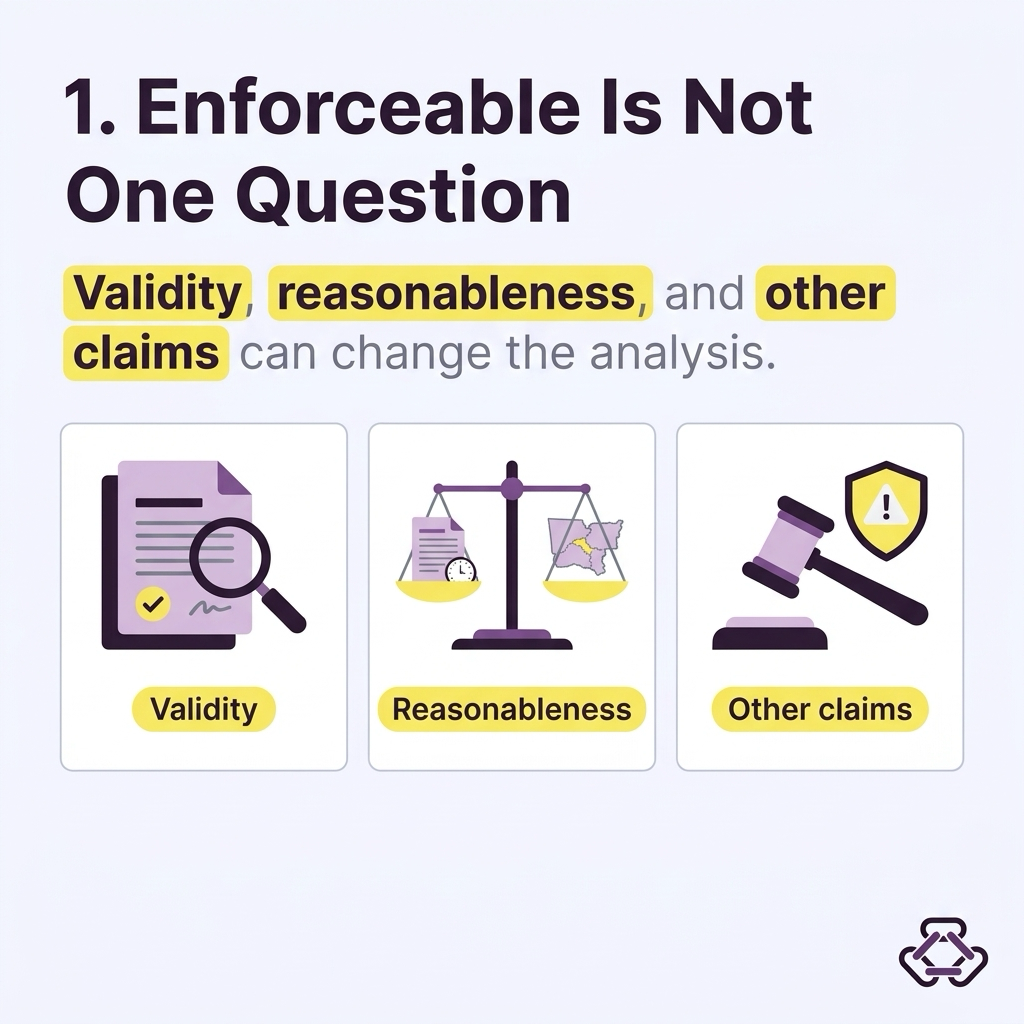
That is why experienced counsel often start by separating three different questions:
- Is the agreement valid under the governing law?
- If valid, is this specific restriction reasonable as written?
- Even if the non-compete is weak, are there other claims that could still support emergency relief?
That distinction matters. For example, California generally treats contracts restraining someone from engaging in a lawful profession, trade, or business as void, subject to narrow statutory exceptions (California Business & Professions Code section 16600, section 16600.1). Minnesota voids non-compete covenants in employment agreements entered into on or after July 1, 2023, with limited exceptions such as sale-of-business contexts (Minnesota Statutes section 181.988). By contrast, states like Texas and Florida still permit some non-competes under more traditional reasonableness frameworks, though the details can be outcome-determinative.
So the first takeaway is simple: “I signed it” and “it looks broad” are both incomplete answers.
Step 1: Identify Which State’s Law Actually Applies
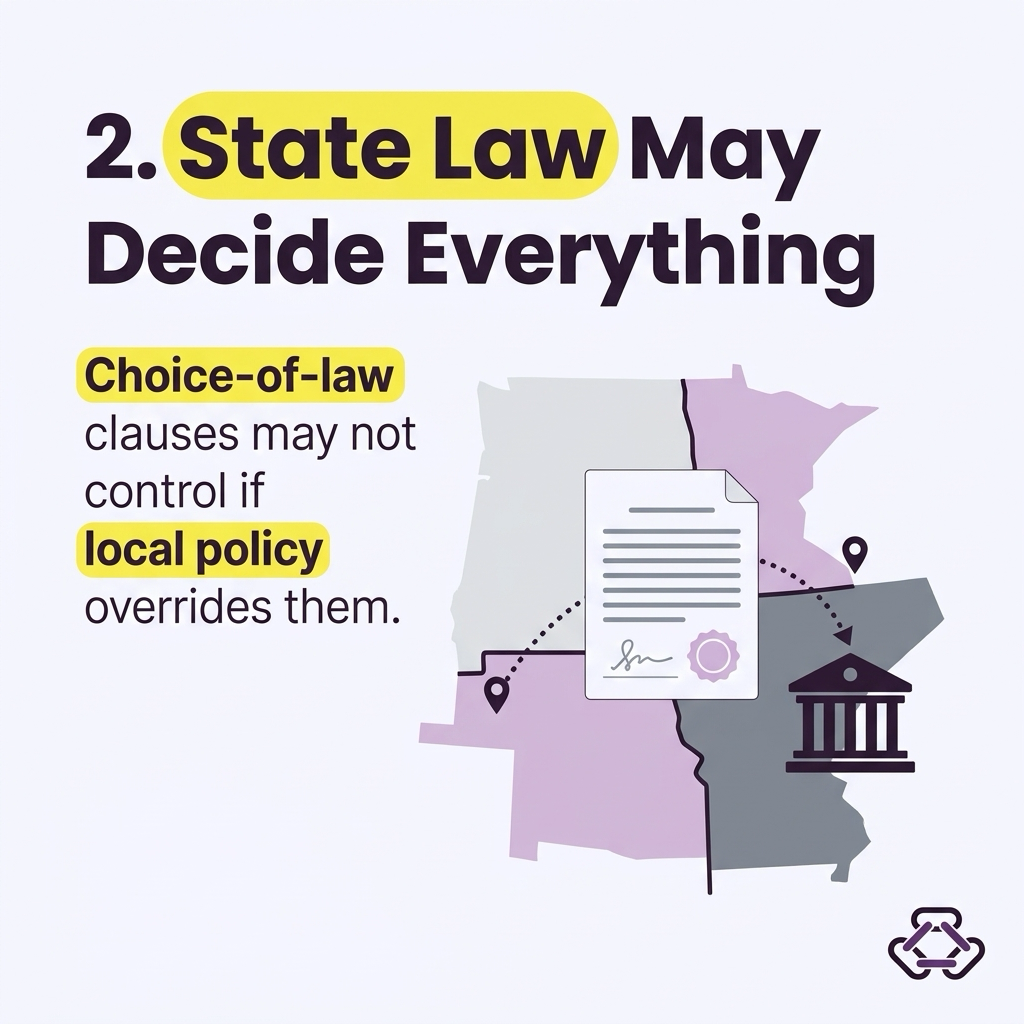
The governing law question can decide the whole dispute before anyone reaches reasonableness.
Many agreements include a choice-of-law clause naming a favorable state. But courts do not always enforce that clause automatically. If the employee worked in another state, lived elsewhere, or the forum state has a strong public policy against non-competes, the selected law may not control.
California is a well-known example. Its statutory framework is unusually hostile to post-employment non-competes, and recent legislation reinforced limits on attempts to impose out-of-state restrictions on California workers (California section 16600, section 16600.1). Minnesota also bars provisions in employment agreements that would require a Minnesota employee to adjudicate outside Minnesota or apply non-Minnesota law to avoid the statute’s protections (Minnesota Statutes section 181.988).
Even Delaware, long viewed as contract-friendly, has seen courts scrutinize restrictive covenants closely rather than treating them as automatically protected by sophisticated drafting alone (ABA Business Law Today, Hightower Holding, LLC v. Gibson).
When lawyers assess this early, they often ask:
- Where did the employee primarily work?
- Where was the agreement signed?
- Does the contract select a forum and governing law?
- Does the forum state have a statute overriding that clause?
- Is this an employment agreement, equity award, partnership agreement, or sale-of-business agreement?
That last point is easy to miss. Courts often analyze non-competes more favorably in the sale-of-business setting than in ordinary employment.
Step 2: Check Whether The State Flatly Bans Or Restricts This Category Of Non-Compete
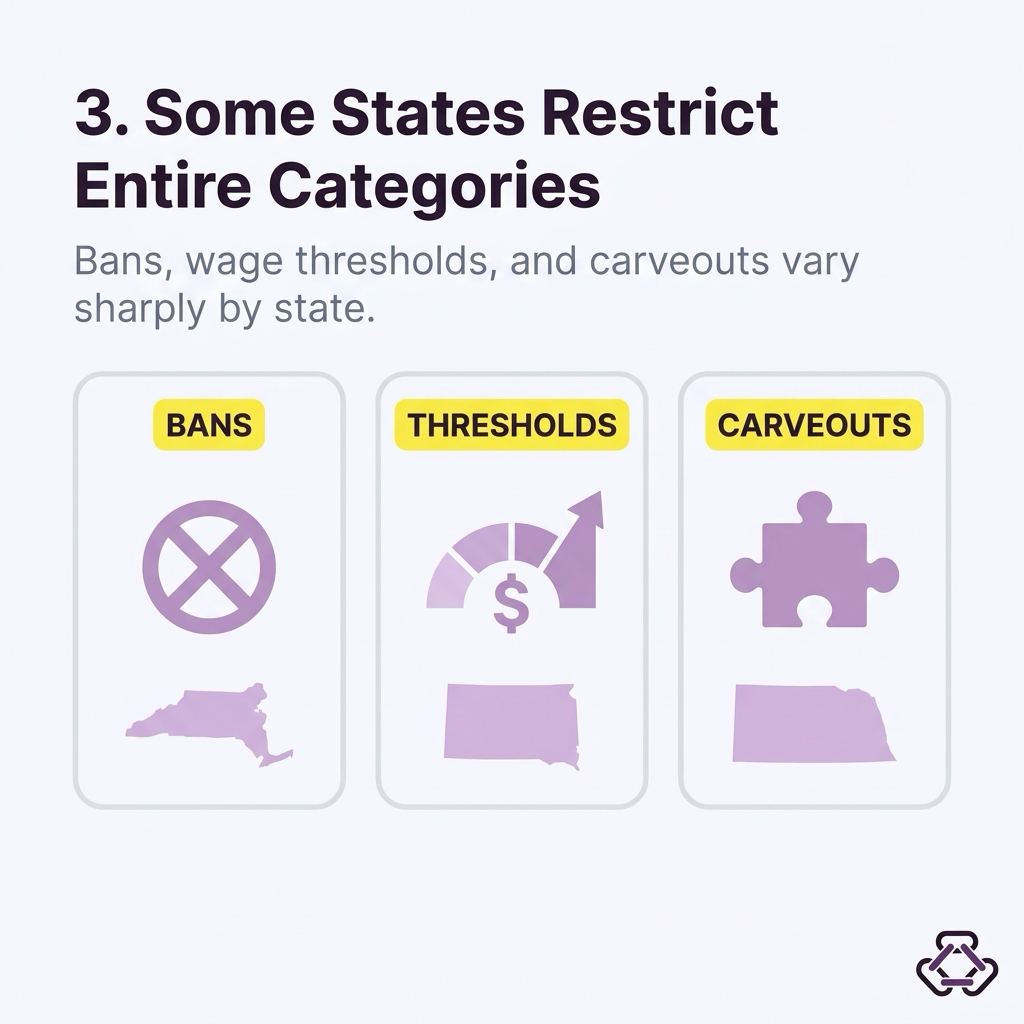
Before debating reasonableness, it helps to confirm whether the state allows this kind of restraint at all.
A few examples show how dramatically the answer can vary:
- California: post-employment non-competes are generally void outside narrow exceptions (California section 16600).
- Minnesota: non-competes in employment agreements entered on or after July 1, 2023 are void, with specific exceptions (Minnesota Statutes section 181.988).
- Washington: non-competes are heavily restricted by statute, including compensation thresholds and presumptions about reasonableness; the state labor agency also publishes threshold guidance and enforcement information (Washington Department of Labor & Industries).
- Massachusetts: non-competes are permitted only if statutory conditions are satisfied, including notice requirements, timing rules, and employee-category limitations (Mass.gov overview).
- Virginia: non-competes are prohibited for “low-wage employees,” and the statute now includes employees entitled to overtime under federal law (Code of Virginia, section 40.1-28.7:8).
This is one reason generic internet advice can be misleading. A clause that might be litigated seriously in one state may be nearly dead on arrival in another.
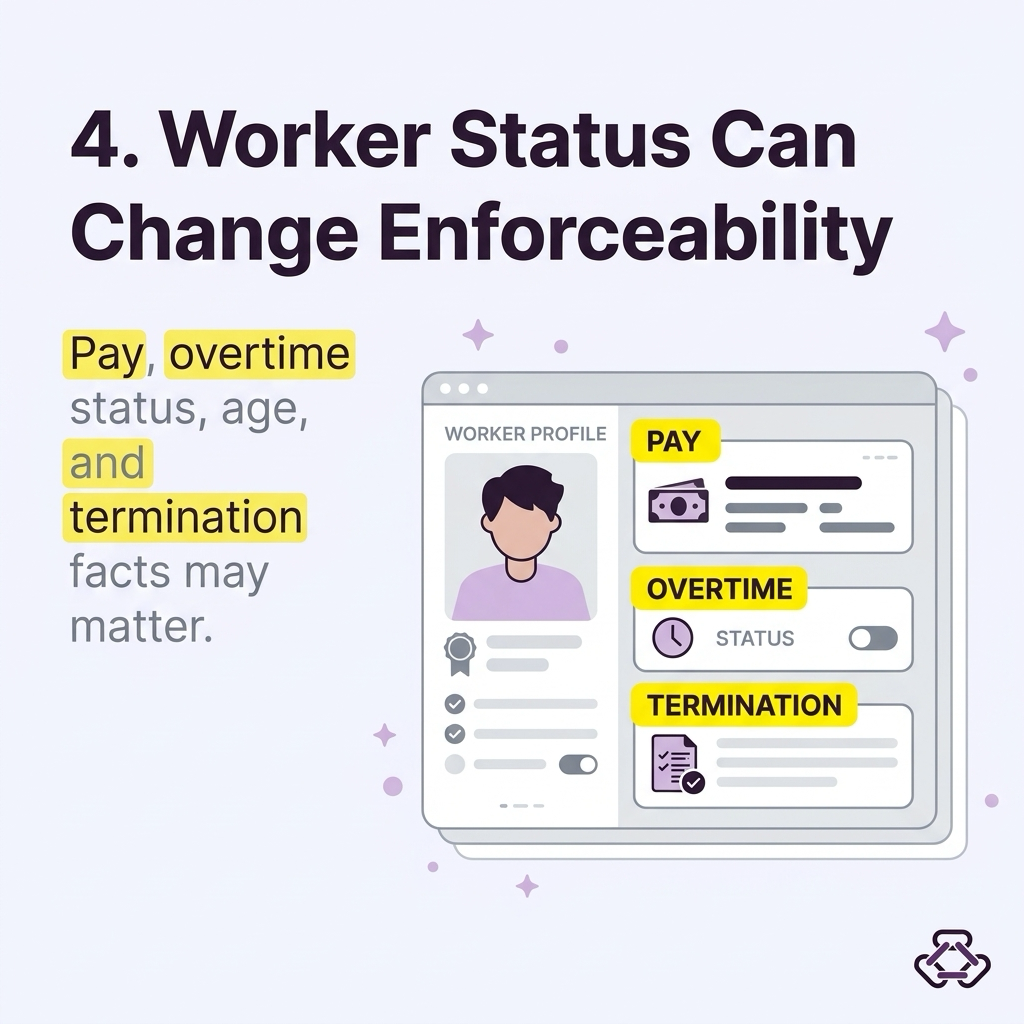
Step 3: Examine Whether The Worker Falls Into A Protected Category
Even in states that still permit non-competes, certain workers may be exempt because of compensation level, overtime status, age, student status, or the way the employment ended.
Washington is a good example. Its law ties enforceability to earnings thresholds and treats non-competes differently depending on whether the worker is an employee or independent contractor (Washington Department of Labor & Industries). Massachusetts excludes several categories from enforceable non-competes, including nonexempt workers, many interns, workers age 18 or younger, and employees terminated without cause or laid off (Mass.gov overview). Virginia’s statute defines “low-wage employee” to include workers whose average earnings fall below the Commonwealth’s average weekly wage and also workers entitled to overtime compensation under federal law (Code of Virginia, section 40.1-28.7:8).
This part of the analysis can change quickly based on payroll records and classification details. For that reason, one of the first practical tasks in a dispute is often gathering:
- pay history,
- exempt/nonexempt classification,
- title and job duties,
- hire date,
- termination date,
- and whether the separation was for cause, without cause, or part of a reduction in force.
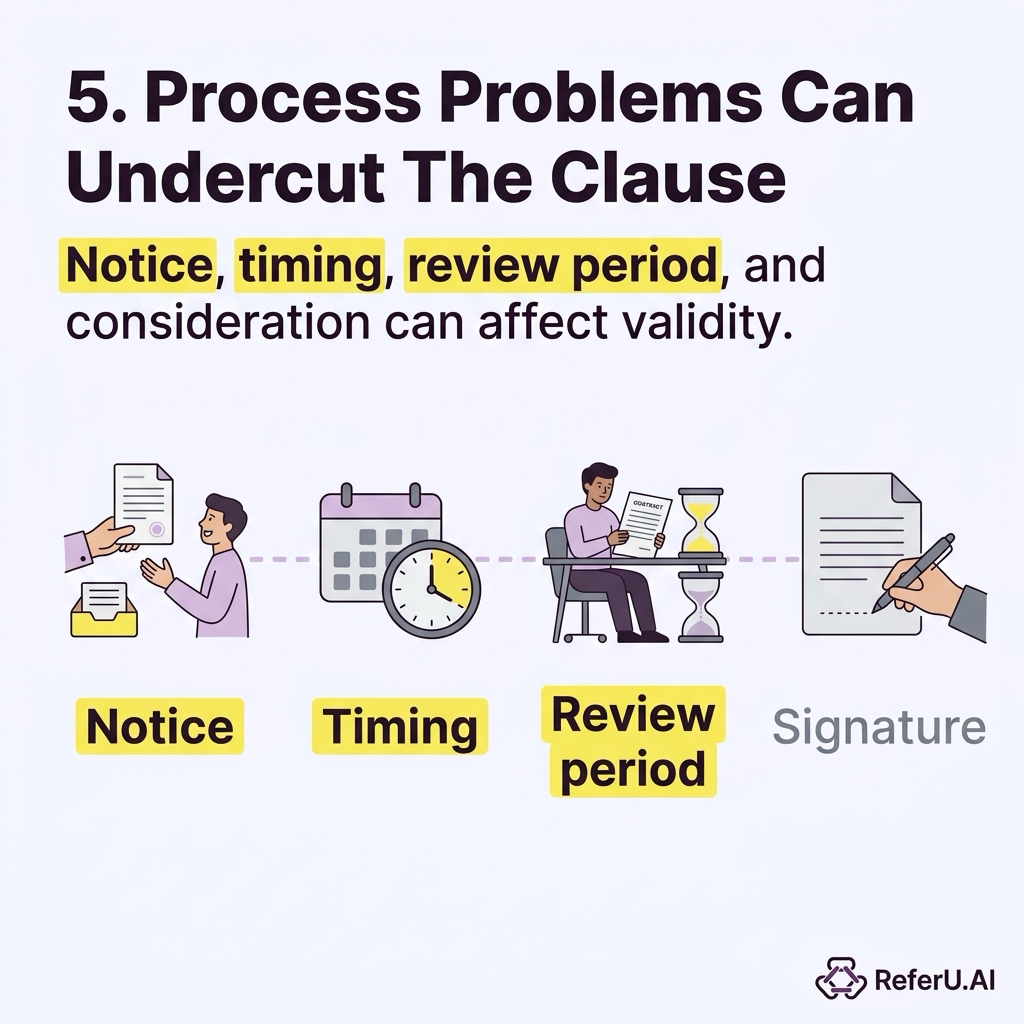
Step 4: Review How And When The Agreement Was Presented
A non-compete can fail because of process, not just substance.
Some states require advance notice, a meaningful review period, or specific language advising the employee to consult counsel. Illinois is a good example. Amendments to the Illinois Freedom to Work Act require, among other things, that the employer advise the employee in writing to consult an attorney and provide at least 14 calendar days to review the covenant (Illinois legislation summary, ABA discussion of the Illinois amendments). Massachusetts similarly requires advance notice and other statutory conditions for agreements entered on or after October 1, 2018 (Mass.gov overview).
Questions that often matter here include:
- Was the agreement presented before the first day of work or after employment started?
- Was there separate consideration for a mid-employment restriction?
- Did the employer allow review time?
- Was the employee told to consult counsel where required?
- Is there evidence of pressure, surprise, or last-minute signing?
In litigation, emails and onboarding records often become more important than the clause itself.
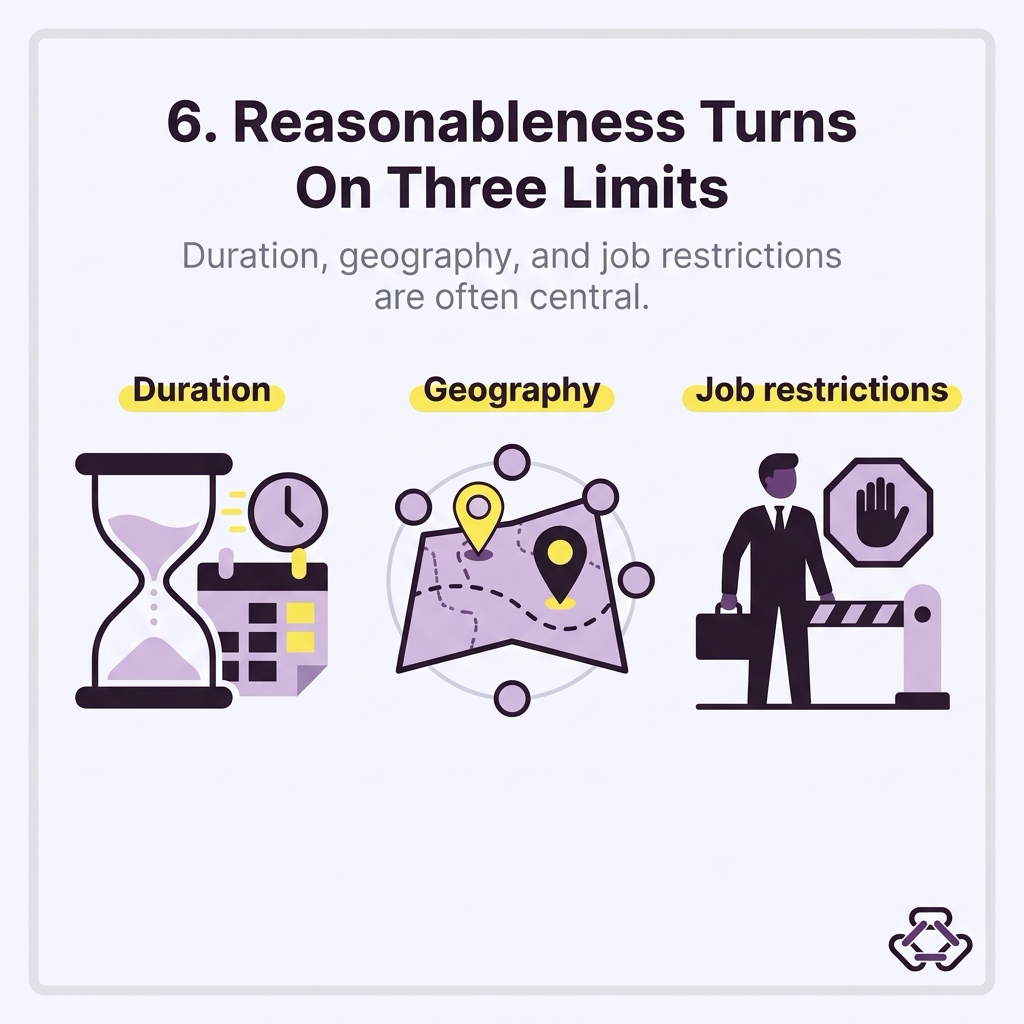
Step 5: Test The Core Reasonableness Factors
In states that still evaluate non-competes under a reasonableness standard, courts often focus on three core limits:
- Duration
- Geographic scope
- Restricted activities
The basic idea is familiar: the restriction has to go no further than necessary to protect a legitimate business interest. But the real work is in the details.
Duration
A six-month restriction may be viewed very differently from a two-year restriction. In Washington, a non-compete lasting more than 18 months is presumed unreasonable unless the party seeking enforcement proves otherwise (Washington Department of Labor & Industries). Massachusetts generally caps employee non-competes at 12 months, absent certain misconduct-related extensions (Mass.gov overview).
Geographic Scope
A worldwide ban on competitive work is harder to justify than a restriction tied to the territory where the employee actually worked or influenced customers. Courts often compare the map in the contract to the employee’s real footprint.
Restricted Activities
This is where many agreements overreach. A clause barring someone from working for a competitor “in any capacity” can be harder to defend than one limited to the employee’s actual role, product line, or customer relationships. Courts often ask whether the restriction blocks unfair competition or simply blocks competition.
If you are evaluating a case pre-suit, one useful exercise is to rewrite the clause in plain English: What jobs, for whom, where, and for how long does this person actually have to avoid? If the answer sounds broader than the company’s legitimate interest, enforceability often gets shakier.
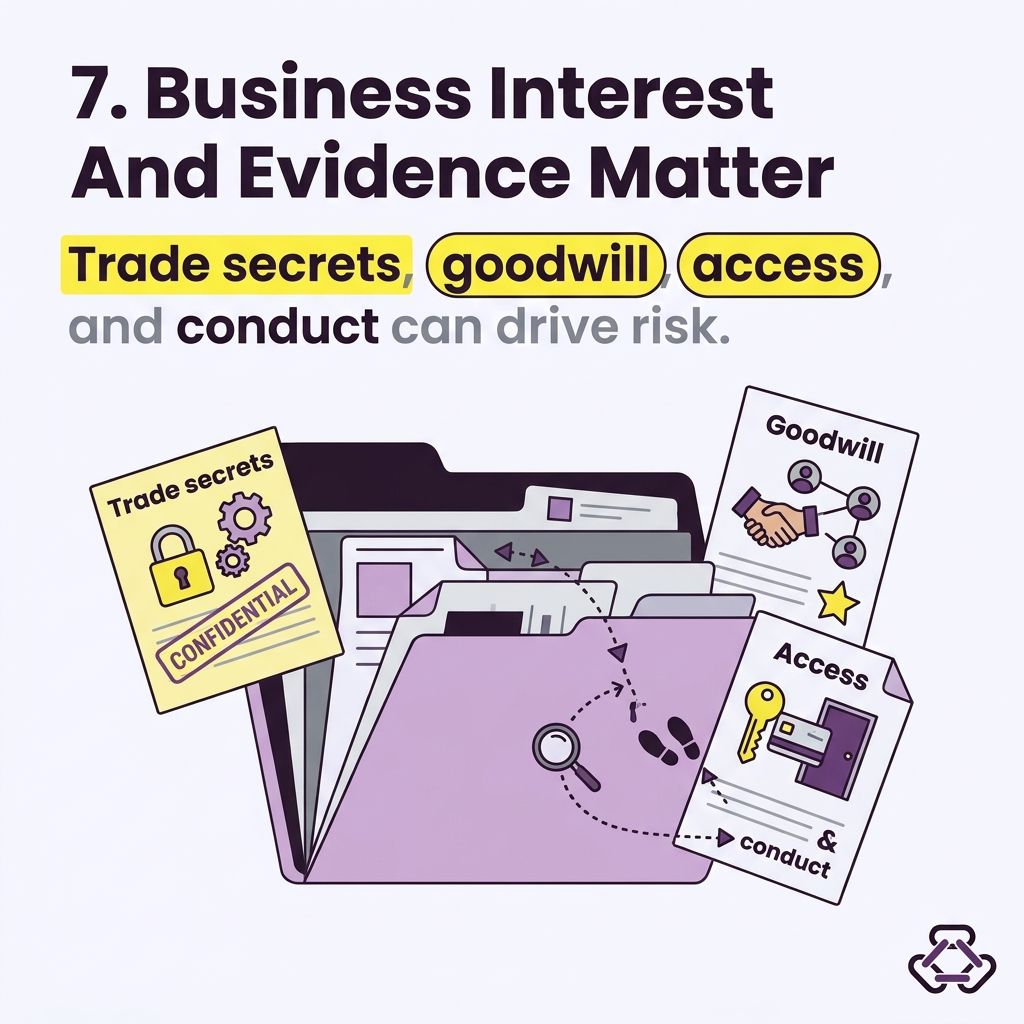
Step 6: Ask Whether There Is A Legitimate Business Interest To Protect
Most states that enforce non-competes do not do so just because an employer wants less competition. They usually look for a protectable interest, such as:
- trade secrets,
- confidential information,
- customer goodwill,
- specialized training,
- or unusually strong client relationships developed through the employer.
That analysis is highly fact-specific. A senior executive with strategic access, pricing visibility, acquisition plans, and direct customer influence presents a different picture than a junior worker with limited access to sensitive information.
This is also why some non-compete cases are really trade secret cases in disguise. If the strongest facts involve downloading files, forwarding customer lists, copying source code, or taking pricing models, the injunction request may lean more heavily on confidentiality and trade secret theories than on the non-compete itself. In practice, that can matter a lot, because even when a non-compete is vulnerable, misappropriation claims may still create serious exposure.
Step 7: Separate Non-Competes From Non-Solicitation And Confidentiality Terms
A common early mistake is treating every restrictive covenant as one thing. Courts usually do not.
Some states that are skeptical of non-competes still treat customer non-solicitation, employee non-raiding, confidentiality, and trade secret provisions differently. Massachusetts is a current example: the Massachusetts Noncompetition Agreement Act does not cover certain non-solicitation covenants, and the Massachusetts Supreme Judicial Court clarified that point in 2025 (Mass.gov overview, analysis of the 2025 decision).
So when someone says, “the non-compete is unenforceable,” an attorney may immediately ask: what about the non-solicit, confidentiality, return-of-property, trade secret, and fiduciary-duty claims? Those companion claims often shape settlement leverage and injunction risk.
Step 8: Evaluate Whether The Court Can Rewrite The Clause
Some states allow judicial modification of overbroad covenants; others are less receptive. This can dramatically affect litigation strategy.
Texas is known for allowing courts to reform overbroad covenants under its statutory framework, which can make a badly drafted clause less useless than an employee might hope and less powerful than an employer might claim (Texas-focused discussion of reformation under the statute, Texas Supreme Court background). Other states may refuse to salvage an aggressively broad restriction or may apply reasonableness review much more strictly.
This question often drives the “sue or negotiate” decision. If a court is likely to narrow and enforce part of the clause quickly, the litigation risk can remain significant even where the original drafting is sloppy.
Step 9: Look At The Remedy The Other Side Is Most Likely To Seek
Non-compete litigation is rarely just about ultimate liability. It is often about speed.
The real pressure point is frequently a temporary restraining order or preliminary injunction filed within days of resignation or notice of a new job. Courts deciding emergency relief usually focus on a narrower set of issues:
- likelihood of success,
- irreparable harm,
- balance of hardships,
- and public interest.
That means the practical question is not only “who wins after discovery?” but also “who looks more credible in the first two weeks?”
If the departing employee lined up a competitor role, downloaded sensitive files, contacted customers immediately, and ignored return-of-property requests, the optics can be difficult even if the non-compete has vulnerabilities. On the other hand, if the clause is obviously void under the governing statute and the former employer waited months to complain, the emergency narrative may weaken.
Step 10: Gather Facts Like You Are Building Or Defending An Injunction File
Before suit, the fastest way to improve the legal analysis is often to improve the factual record.
For businesses, that may include:
- signed agreements and all versions,
- onboarding records,
- compensation records,
- access logs,
- device and email forensics,
- customer assignment history,
- proof of confidential information safeguards,
- and evidence of actual solicitation or competitive activity.
For employees or executives, that may include:
- the full contract packet,
- revisions and emails around signing,
- job descriptions,
- compensation and classification records,
- details of the new role,
- evidence showing different geography, products, or duties,
- and records showing no use of confidential information.
If you are trying to think through the evidence side in more depth, it can help to look at how lawyers build records around competition, solicitation, and business harm in restrictive covenant disputes. The enforceability analysis and the evidence analysis usually move together.
Common Signs A Non-Compete May Be More Vulnerable
No single factor decides every case, but these issues often trigger closer scrutiny:
- The worker is in a state with a statutory ban or strict wage-threshold rule.
- The agreement was presented after employment began without clear new consideration.
- The clause bars work for a competitor in any capacity.
- The territory is national or global even though the employee served a narrow market.
- The duration exceeds local statutory benchmarks.
- The employer cannot clearly identify confidential information or customer goodwill at risk.
- The employee was terminated without cause in a state where that matters.
- The contract chooses another state’s law to avoid the worker’s home-state protections.
- The employer delayed enforcement until after the transition was complete.
These are not automatic defenses, but they often shape the first serious conversation about risk.
Common Signs The Dispute May Still Be Dangerous Even If The Non-Compete Looks Weak
A weak non-compete does not always equal a weak case.
Risk often increases when there is evidence of:
- trade secret access,
- unusual customer influence,
- copying or downloading company data,
- solicitation immediately after departure,
- coordination with co-workers,
- misleading resignation communications,
- or a new role that closely mirrors the old one.
In those situations, companies may proceed under several overlapping theories at once. That changes leverage quickly.
Why Early Attorney Review Often Changes The Strategy
Businesses and departing employees often make the same mistake from opposite directions: they focus on the clause and underweight the forum, the statute, and the evidence.
An attorney experienced with restrictive covenant litigation may be able to sort out:
- whether the contract is likely governed by a favorable or unfavorable state law,
- whether the worker fits inside a protected category,
- whether defects in notice, timing, or consideration matter,
- whether a court in that jurisdiction is likely to reform the covenant,
- and whether the real exposure is the non-compete or the trade secret case sitting behind it.
That kind of early review can influence everything from pre-suit correspondence to whether an injunction fight is likely, how to structure a new role, and what documents to preserve before positions harden.
The Bottom Line
Evaluating a non-compete before you sue or defend usually starts with a disciplined checklist, not a gut reaction. The controlling state law, worker category, contract process, reasonableness of the restrictions, legitimate business interests, and available evidence all matter. So does the possibility that even an unenforceable non-compete may sit next to enforceable confidentiality or non-solicitation obligations.
In general terms, the smartest early question is often not “can someone win?” but “what is the real litigation risk in this jurisdiction, with these facts, in the first few weeks of the case?”
If you are weighing whether to bring a restrictive covenant claim or preparing to respond to one, finding counsel with documented experience in highly similar matters can make the analysis much more concrete. Visit ReferU.AI to get matched with an attorney who has demonstrable experience in cases like yours — for free.
