Table of Contents
- How to Prepare Evidence of Competition, Solicitation, and Business Harm in a Restrictive Covenant Case
- Why Evidence Matters So Much In Restrictive Covenant Litigation
- Step 1: Match The Evidence To The Exact Covenant At Issue
- Evidence Of Competition
- Evidence Of Solicitation
- Evidence Of Business Harm
- Step 2: Build A Clear Timeline Before You Build The Argument
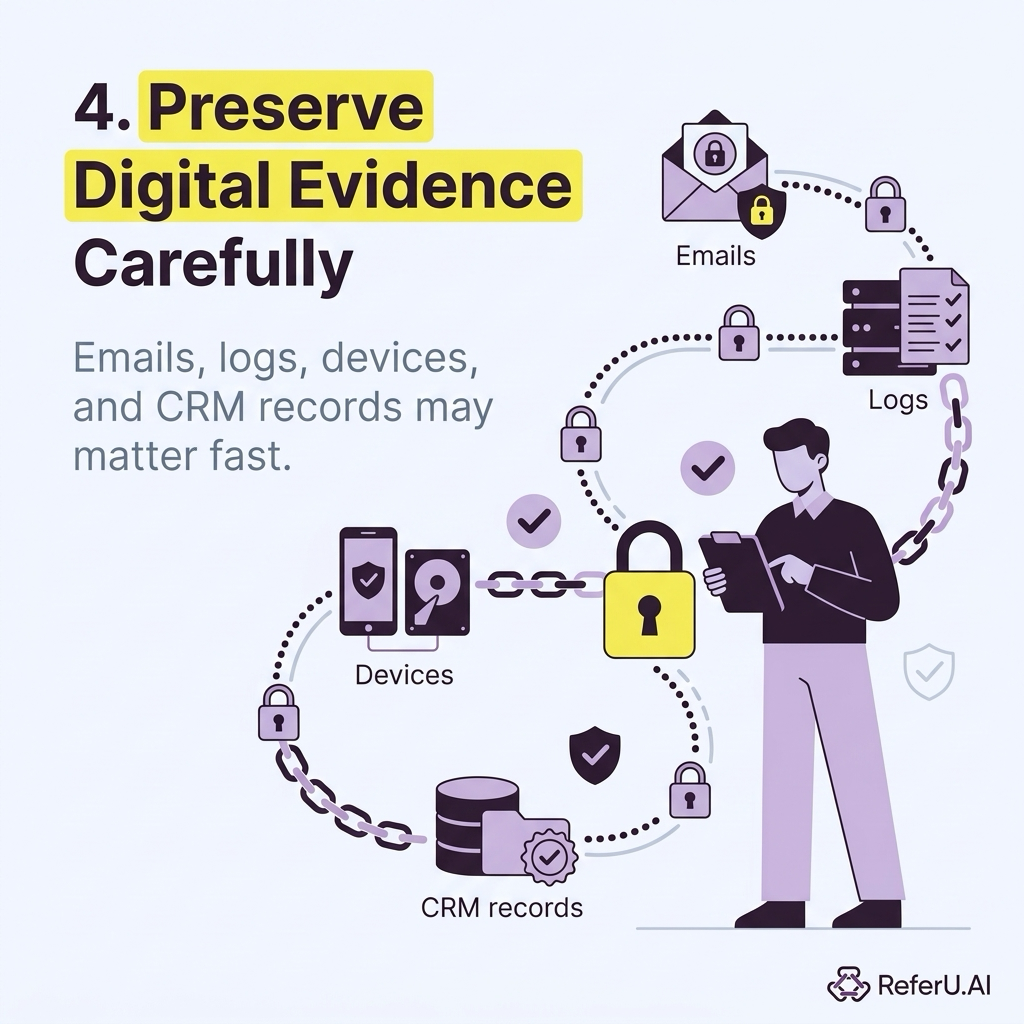
- Step 3: Preserve Digital Evidence Early And Carefully
- What Preservation Often Looks Like
- Step 4: Separate Lawful Competition From Prohibited Conduct
- Step 5: Collect Proof Of Competition In Specific, Verifiable Categories
- Job Function Evidence
- Market Overlap Evidence
- Conduct-Based Evidence
- Step 6: Collect Proof Of Solicitation Without Overreading Routine Communications
- Common Evidence In Customer Solicitation Claims
- Common Evidence In Employee Solicitation Claims
- Step 7: Show Business Harm With More Than Generalized Concern
- Types Of Harm Commonly Asserted
- Evidence Often Used To Support Harm
- Step 8: Do Not Ignore Confidentiality And Trade Secret Proof
- Evidence That Information Was Actually Protected
- Evidence Of Use Or Threatened Use
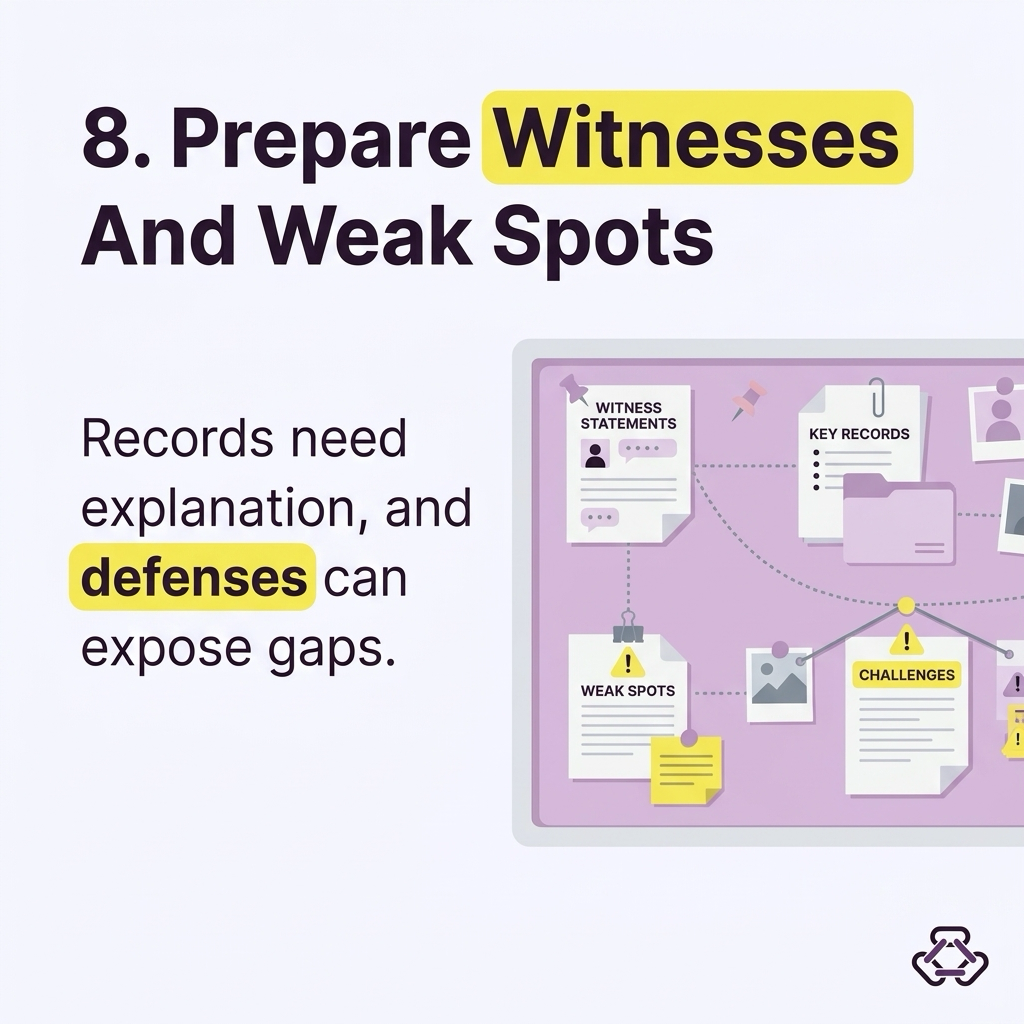
- Step 9: Prepare Witnesses Who Can Explain The Records
- Step 10: Anticipate Defenses And Evidentiary Weak Spots
- Common Defense Themes
- Step 11: Organize The Evidence For Injunction Practice, Not Just For Trial
- Step 12: Keep The Presentation Concrete, Limited, And Credible
- Short Summary

Type
Great Grandchild
Status
Approved
Title (YouTube)
Images Failed (Social)
Images Failed (Social)
Do not index
Parent item
Publish Date (TikTok)
Jan 7, 2027 06:15
Videos Post IDs (Social)
Hashtags (Social)
#LegalAdvice #LegalHelp #BusinessLitigation #NonCompeteNonSolicitation
Caption
Caption X
Cover

OG Image

Alt Image Text
Flat vector illustration of restrictive covenant case evidence preparation showing competition, solicitation, and business harm with legal documents and analysis.
Images

Videos
Publish Date (Social)
Dec 17, 2026 07:30
Scheduled (Social)
Scheduled (Social)
Images Posted (Social)
Images Posted (Social)
Videos Posted (Social)
Videos Posted (Social)
Videos Failed (Social)
Videos Failed (Social)
Featured
Created time
Apr 3, 2026 10:12 PM
Sub-item
Authors
CTA Practice Area (Social)
Business Litigation
TikTok Failed (Social)
TikTok Failed (Social)
Videos Post Links (Social)
YT Auto Captions Removed
TikTok Post Links (Social)
Images Post IDs (Social)
YT Post ID
Video Pending Manual (Social)
TikTok Posted (Social)
TikTok Posted (Social)
TikTok Post IDs (Social)
Video Cover (Social)
Images Post Links (Social)
First Comment (Social)
YT Embedded
Images Delete (Social)
Videos Delete (Social)
Carousel Video URL (Social)
How to Prepare Evidence of Competition, Solicitation, and Business Harm in a Restrictive Covenant Case
Restrictive covenant cases often move fast. A business may believe a former employee is competing too soon, contacting customers, or using confidential information. An executive or employee may feel accused based on assumptions rather than proof. In either situation, the outcome often turns less on general suspicion and more on specific evidence.
That is especially true when someone is asking a court for emergency relief. Courts commonly look for evidence tied to likely success on the merits, irreparable harm, the balance of equities, and the public interest when deciding whether to issue a preliminary injunction or similar relief. In general terms, that makes evidence preparation one of the most important parts of the case. See Cornell’s overview of preliminary injunctions and irreparable harm.
If you are just getting oriented, it may help to start with this broader overview of how non-compete and non-solicitation disputes usually work. In this post, you’ll learn how parties often prepare proof of competition, solicitation, and business harm in a restrictive covenant case, what documents tend to matter most, and where weak evidence can create problems.
Scroll to the bottom for every post in this series.
Why Evidence Matters So Much In Restrictive Covenant Litigation
A restrictive covenant dispute is rarely just about what the contract says. The agreement matters, but courts also tend to focus on what actually happened.
For example, evidence may be used to answer questions like:
- Did the former employee actually compete, or just take a new role that looks similar on paper?
- Did anyone actually solicit customers, employees, or referral sources?
- Did the business suffer measurable harm, or is the alleged harm still speculative?
- Was confidential information involved?
- Is the requested injunction tailored to real facts, or based on broad assumptions?
That fact-intensive approach shows up across jurisdictions. The American Bar Association has noted that restrictive covenant law varies substantially by state, including the treatment of non-competes, non-solicits, and related confidentiality provisions. The ABA also highlights that some states recognize protection of customer goodwill and confidential information as legitimate business interests, while others are far more skeptical of employee restraints. See this ABA discussion of state-by-state differences.
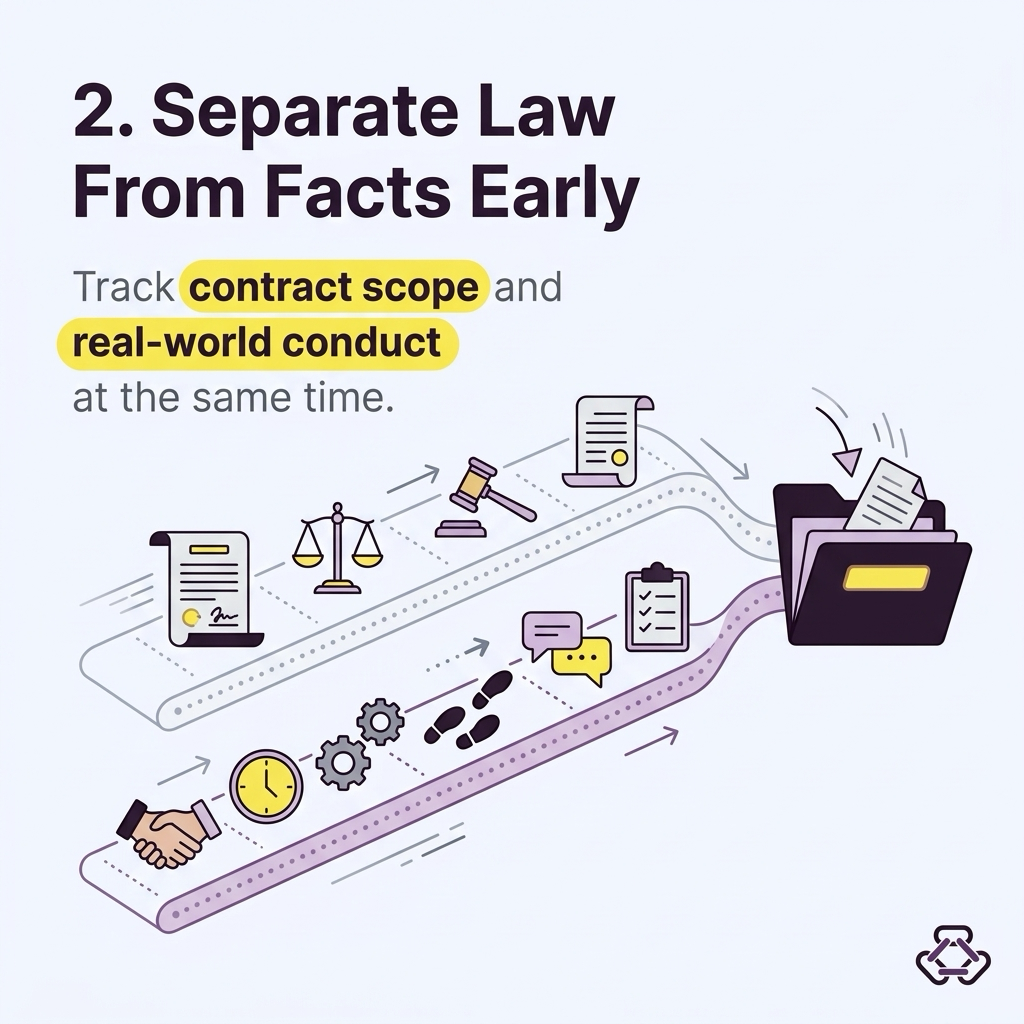
That means evidence preparation usually starts with two tracks running at the same time:
- The legal track: What does the contract prohibit, and what law applies?
- The factual track: What proof exists that the conduct happened and caused harm?
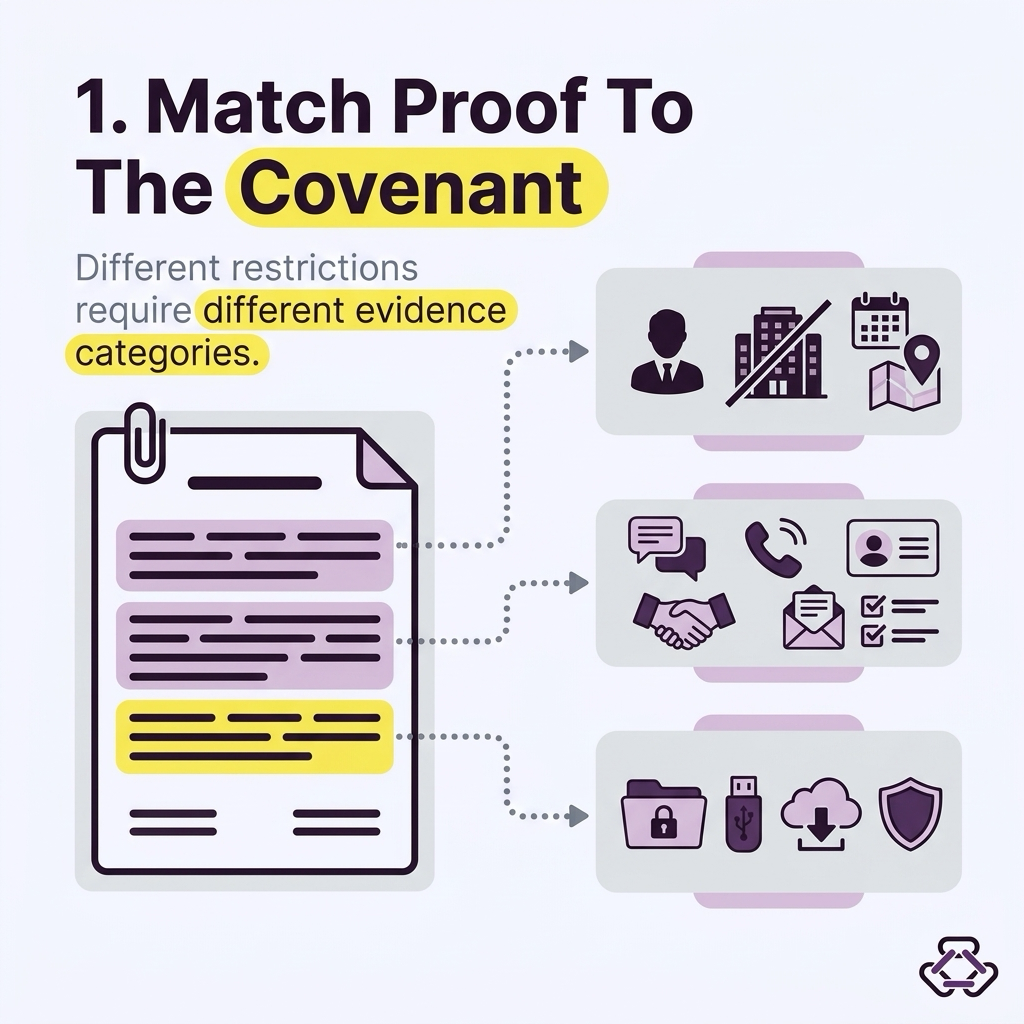
Step 1: Match The Evidence To The Exact Covenant At Issue
The first step is usually to identify which restriction is allegedly in play. Many cases become harder than they need to be because people collect a large volume of records without linking those records to the actual contractual language.
A restrictive covenant case may involve one or more of the following:
- A non-compete
- A customer non-solicitation clause
- An employee non-solicitation clause
- A confidentiality or trade secret provision
- A non-disclosure agreement
- A no-hire or no-poach provision in a business contract
Each type of restriction calls for different proof.
Evidence Of Competition
If the issue is competition, the key question is often whether the former employee is truly performing prohibited competitive work within the covenant’s scope.
That may involve evidence about:
- Job duties at the new company
- The products or services sold
- The geographic territory involved
- The relevant customer segment
- Dates of employment transition
- Whether the person is actively servicing or targeting restricted accounts
This can matter a lot because generalized overlap is not always enough. In a 2024 business-courts update, the ABA described a case where remote work from within a restricted territory, without evidence of servicing or soliciting customers in that territory, was not enough to establish a non-compete violation. See the ABA’s summary.
Evidence Of Solicitation
If the issue is solicitation, the proof usually centers on outbound efforts to win business or recruit people.
That may include:
- Emails, texts, or LinkedIn messages
- CRM notes
- Meeting invitations
- Call logs
- Pitch decks or proposals
- Announcements sent to customers
- Evidence that customers were asked to move business
- Evidence that employees were invited to leave and join a competitor
Evidence Of Business Harm
If the issue is harm, the proof often focuses on what was lost or threatened:
- Lost accounts
- Reduced revenue
- Canceled orders
- Pipeline disruption
- Harm to goodwill
- Disclosure or use of confidential information
- Recruitment-related disruption
- Pricing pressure or market confusion
- Emergency circumstances supporting injunctive relief
In many cases, business harm is where plaintiffs and defendants part ways most sharply. One side may frame the harm as immediate and difficult to undo; the other may frame it as speculative, overstated, or fully measurable in money.
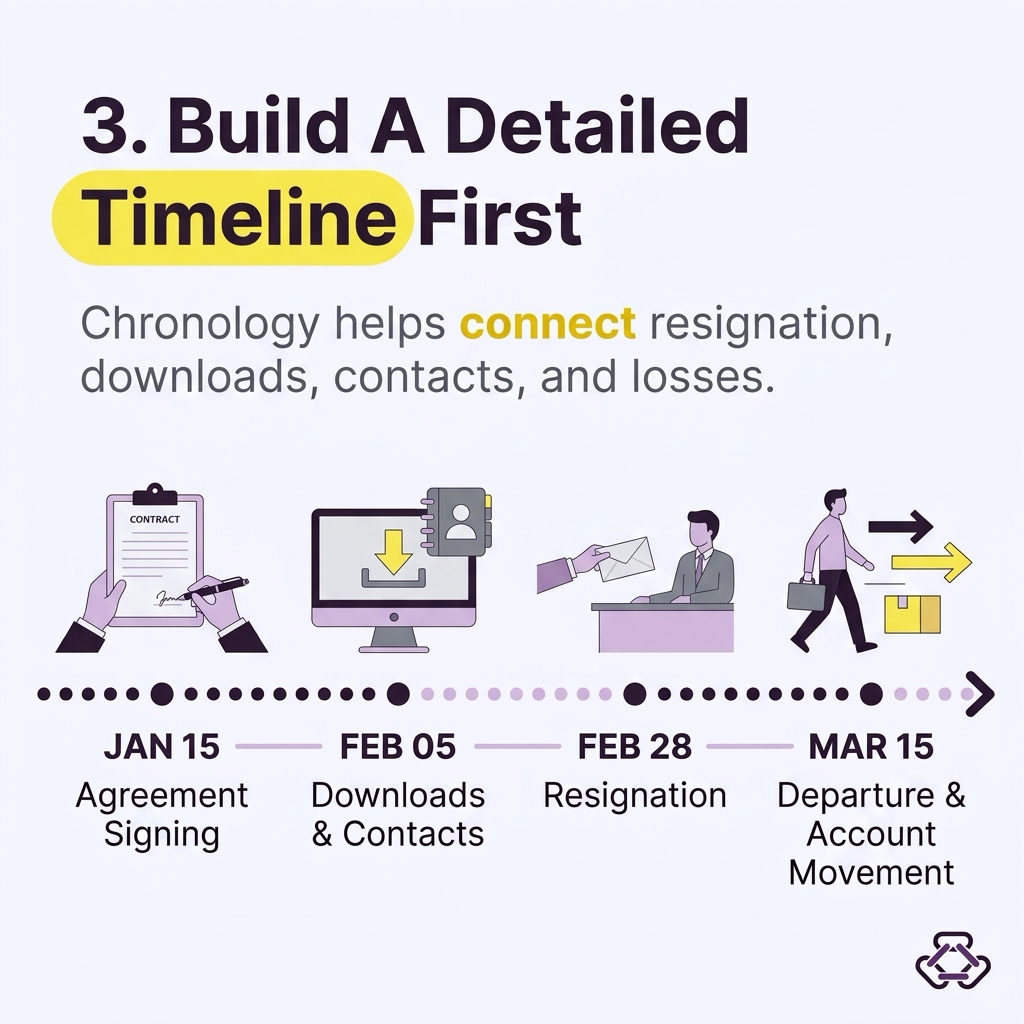
Step 2: Build A Clear Timeline Before You Build The Argument
A detailed timeline can make a restrictive covenant case easier to understand for lawyers, witnesses, and the court. It also helps separate facts from assumptions.
A strong working timeline often includes:
- Date the agreement was signed
- Dates of promotions or role changes
- Date access to sensitive information expanded
- Date notice of resignation was given
- Last day of employment
- Date devices were returned or imaged
- Date the new job began
- Dates of suspicious downloads, transfers, or logins
- Dates of customer contacts
- Dates of employee departures
- Dates of lost business or account movement
This type of chronology can reveal patterns. For example:
- A download of customer lists three days before resignation
- A cluster of messages to customers immediately after departure
- Employee resignations following a manager’s move to a competitor
- Lost accounts shortly after overlapping communications
Where a case also involves confidential information, speed can matter. The ABA has emphasized that the period immediately following a key employee’s departure is often critical for identifying, preserving, collecting, and investigating digital evidence. See this ABA article on digital forensics in trade secret disputes.
Step 3: Preserve Digital Evidence Early And Carefully
In many modern restrictive covenant disputes, the most useful evidence is digital.
That can include:
- Email accounts
- Cloud storage
- Laptop and phone images
- USB access logs
- CRM exports
- Slack or Teams messages
- VPN and login records
- File download logs
- Printing history
- Webmail forwarding records
According to the ABA, when misappropriation is suspected, companies often move through a sequence of identify, preserve, and collect, while documenting chain of custody and collection methodology. See the ABA guidance here.
What Preservation Often Looks Like
Depending on the facts, preservation efforts may include:
- Issuing a litigation hold
- Suspending routine deletion policies
- Securing company-issued devices
- Preserving email boxes and shared folders
- Exporting CRM activity
- Capturing access logs
- Retaining backup data
- Working with forensic vendors under counsel’s direction
For the defense side, preservation can be just as important. A former employee accused of solicitation or data theft may also benefit from preserving:
- Personal call records
- Calendars
- Messages showing who initiated contact
- Job descriptions clarifying actual duties
- Records showing no access to certain accounts or markets
- Documents showing customer movement happened for independent reasons
Step 4: Separate Lawful Competition From Prohibited Conduct
Not every competitive act violates a restrictive covenant. Not every customer move proves solicitation. Not every new job proves unfair competition.
That distinction matters because courts often look for evidence tied to the contract’s actual limits.
For example, a case may become more nuanced when:
- Customers followed a departing employee without being asked
- The new role is in a different territory
- The former employee works on a different product line
- The covenant is limited to customers the employee actually serviced
- The person announced a job change but did not ask for business
- Market loss happened because of pricing, service issues, or merger activity rather than solicitation
This is one reason fact development tends to matter as much as legal argument. If the evidence shows only that someone joined a competitor, that may be very different from evidence showing they used restricted information, targeted named accounts, and moved revenue quickly.
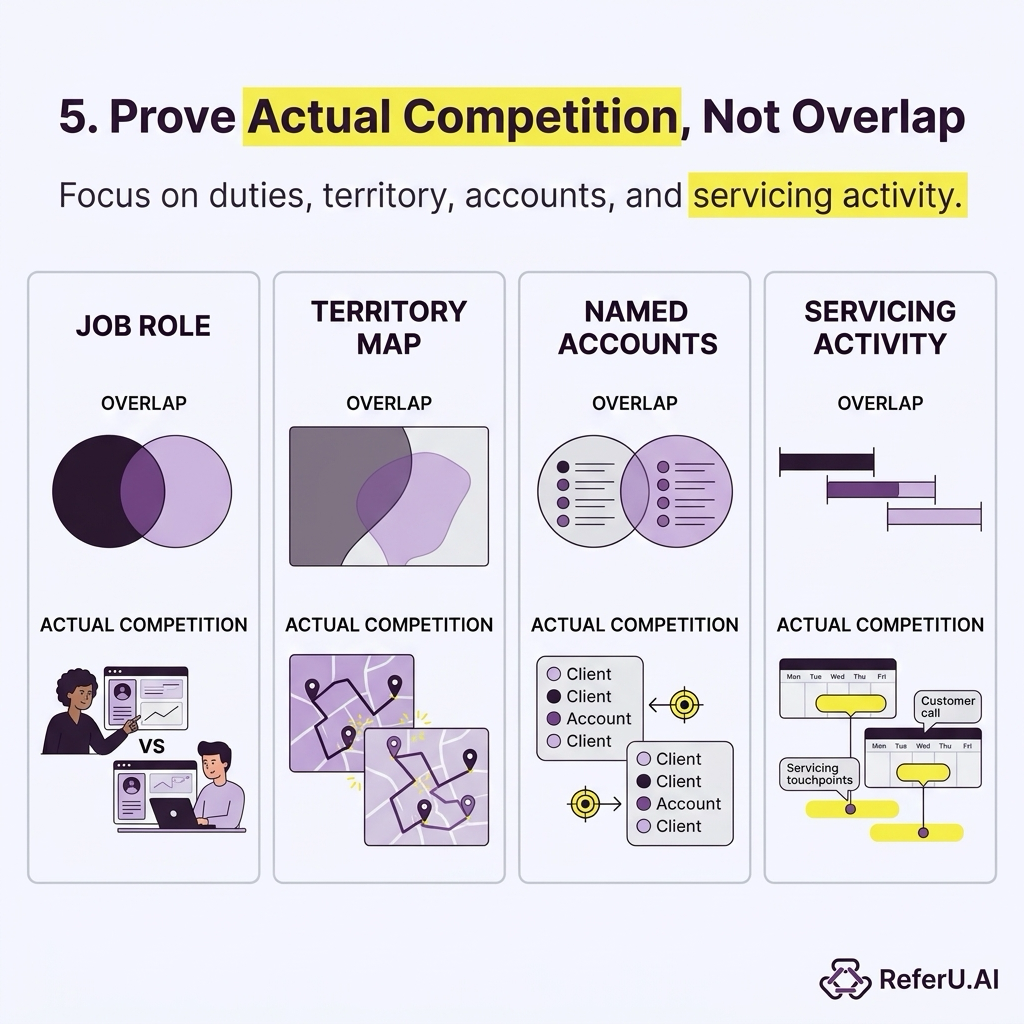
Step 5: Collect Proof Of Competition In Specific, Verifiable Categories
When the alleged breach is competition, the strongest proof usually goes beyond labels and focuses on concrete overlap.
Job Function Evidence
Useful records may include:
- Offer letters
- Public biographies
- Sales territory assignments
- Internal org charts
- Compensation plans
- Product descriptions
- Meeting calendars
- Presentation materials
- Discovery responses about actual duties
Market Overlap Evidence
This may include:
- Customer lists
- Product comparisons
- Industry segment data
- Territory maps
- Account ownership records
- RFP submissions
- Bid histories
- Competitive intelligence reports
Conduct-Based Evidence
This category often carries the most weight:
- Service activity for restricted clients
- Proposals to named accounts
- Recorded demos or presentations
- Calendared meetings with prohibited prospects
- Call notes documenting outreach
- Expense records reflecting customer visits
- Emails coordinating competitive targeting
As the ABA’s 2024 business-courts summary illustrates, evidence that someone was actually servicing or soliciting customers within the restricted area may carry more force than abstract concerns about where the person works from. See the summary here.
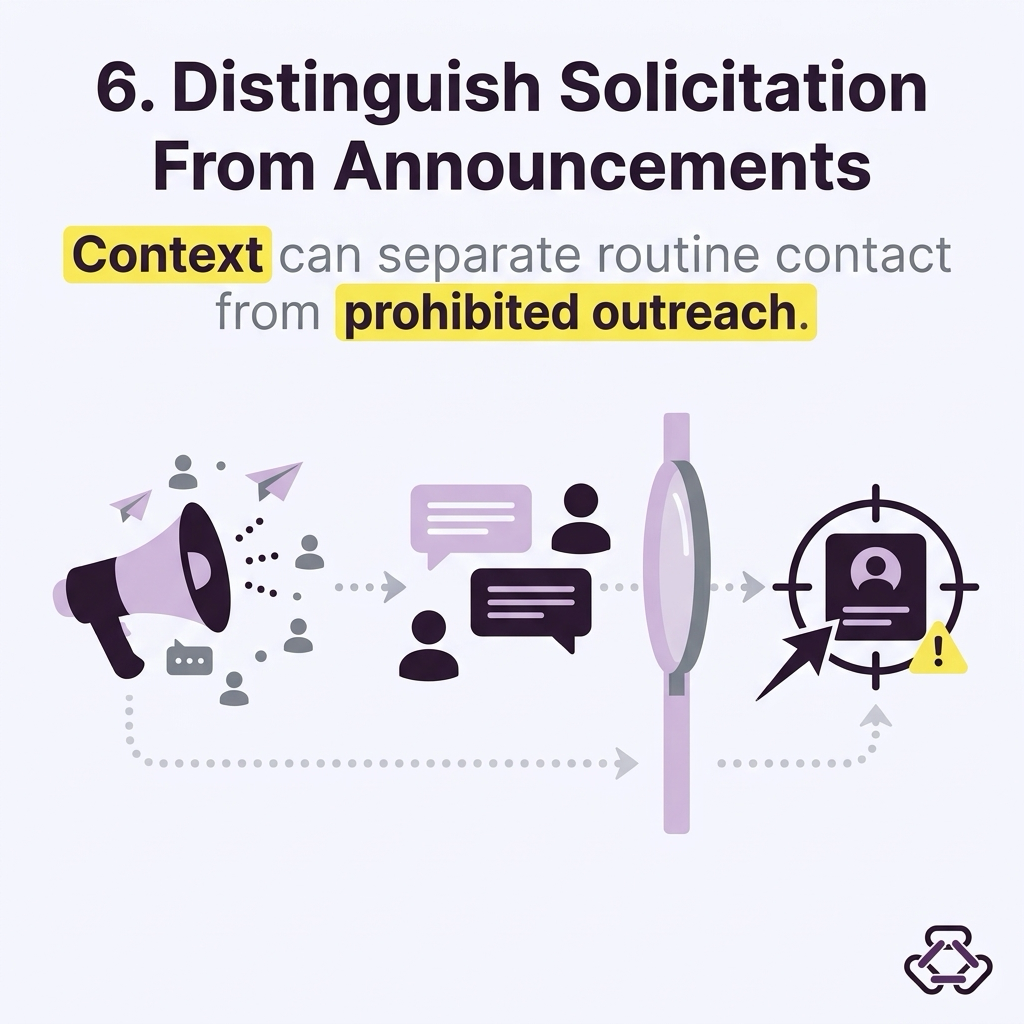
Step 6: Collect Proof Of Solicitation Without Overreading Routine Communications
Solicitation can be one of the most contested issues in these cases because the line between a lawful announcement and prohibited outreach is not always obvious.
Common Evidence In Customer Solicitation Claims
Parties often look for:
- Messages telling customers about the move
- Invitations to continue working together
- Requests for meetings after departure
- Pricing proposals
- Follow-up calls
- CRM notes showing pursuit of the account
- Requests to transfer files or open opportunities
- Instructions to coworkers about how to approach inherited accounts
Common Evidence In Employee Solicitation Claims
This may include:
- Recruiting texts
- LinkedIn messages
- Discussions of compensation or openings
- Messages coordinating timing of departures
- Referrals to recruiters
- Draft offer materials
- Calls immediately preceding resignations
Context matters here. A former colleague saying “let’s stay in touch” may look very different from a sequence of messages discussing openings, compensation, and plans to bring over a team.
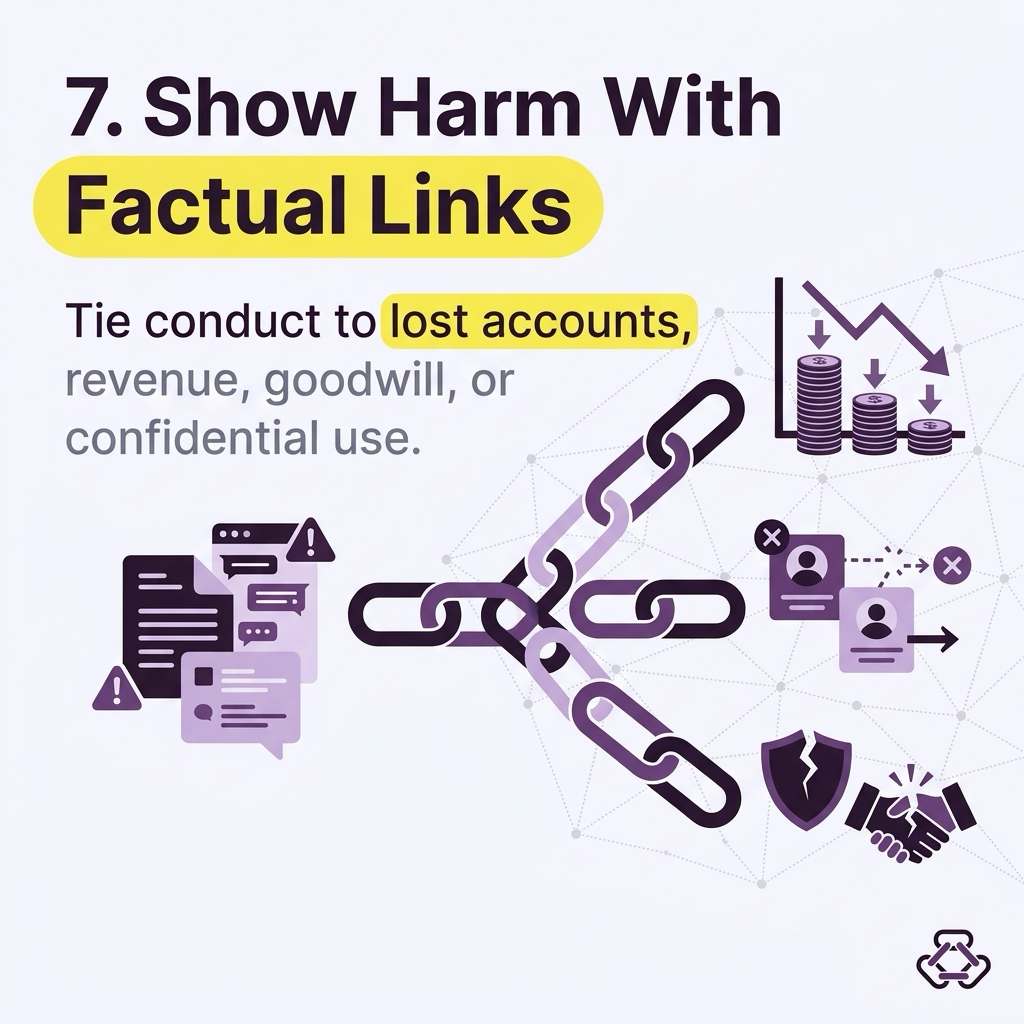
Step 7: Show Business Harm With More Than Generalized Concern
A restrictive covenant plaintiff often alleges harm to revenue, goodwill, competitive position, or confidential information. Courts, however, frequently want a factual bridge between the alleged conduct and the claimed harm.
Types Of Harm Commonly Asserted
- Lost sales or lost accounts
- Damage to customer goodwill
- Unfair head start from confidential information
- Price undercutting using internal knowledge
- Loss of workforce stability
- Trade secret dissemination
- Damage that is difficult to calculate quickly
Cornell’s Wex explains that irreparable harm refers to injury that cannot be adequately remedied by money later, and it is a required component of preliminary injunctive relief. See Cornell’s explanation of irreparable harm.
Evidence Often Used To Support Harm
- Revenue comparisons before and after departure
- Account attrition summaries
- Customer declarations
- Internal notes about account movement
- Forecast changes
- Margin compression evidence
- Pricing shifts after disclosure of internal strategy
- Proof that confidential information gave a timing or bidding advantage
- Referral-source disruption
- Testimony about damage to long-developed relationships
If trade secrets or confidential business information are part of the story, the harm analysis can expand. Congress created a federal civil cause of action under the Defend Trade Secrets Act, which allows injunctions, actual-loss damages, unjust-enrichment damages, and in some cases a reasonable royalty. See 18 U.S.C. § 1836 and Congressional Research Service background summarized by Congress.gov.
Step 8: Do Not Ignore Confidentiality And Trade Secret Proof
Many restrictive covenant disputes overlap with trade secret or confidentiality claims, even where the headline issue sounds like a non-compete or non-solicit fight.
That overlap can matter because federal law permits injunctive relief based on evidence of threatened misappropriation, not merely on what a person happens to know. The DTSA specifically says conditions on employment must be based on evidence of threatened misappropriation and not merely the information the person knows. See 18 U.S.C. § 1836.
Evidence That Information Was Actually Protected
A business often tries to show:
- The information had independent economic value
- It was not generally known
- Access was limited
- NDAs or confidentiality policies were used
- Passwords, permissions, and security controls existed
- The company treated the information as confidential in practice
The U.S. Department of Justice explains that trade secret status depends in part on reasonable security measures commensurate with the value of the information, and that disclosure can destroy trade secret status. See the DOJ manual section here.
Evidence Of Use Or Threatened Use
This may include:
- Downloads of confidential files before departure
- Email forwarding to personal accounts
- USB transfers
- Uploads to cloud storage
- Similar pricing or pitch language at the new employer
- Use of internal customer data to target accounts
- Sales strategies that mirror protected internal plans
- Rapid competitive entry suggesting use of nonpublic information
Step 9: Prepare Witnesses Who Can Explain The Records
Documents rarely speak for themselves. In restrictive covenant cases, witnesses often provide the structure that makes the evidence understandable.
Common witnesses may include:
- The departing employee’s manager
- A company executive
- Sales operations personnel
- HR representatives
- IT or forensic personnel
- Customers or referral partners
- Coworkers who received solicitation messages
- Damages experts, if the case has moved that far
A helpful witness can often explain:
- Why a customer list was sensitive
- How an account was assigned
- What a CRM note means
- Whether a contact was routine or targeted
- How revenue moved after the alleged breach
- Whether the same harm had other likely causes
Step 10: Anticipate Defenses And Evidentiary Weak Spots
Evidence preparation tends to work better when it includes the likely response from the other side.
Common Defense Themes
- The covenant is overbroad or unenforceable
- No solicitation occurred
- Customers moved voluntarily
- The new role is outside the restriction
- The information was not confidential
- The company did not protect the information
- Harm is speculative
- The plaintiff waited too long to seek relief
- The plaintiff is trying to block lawful employment rather than prevent real misuse
That larger enforceability backdrop matters because state law remains highly variable. The ABA notes that some jurisdictions are notably skeptical of restrictive covenants, while others permit enforcement when a legitimate business interest and reasonable scope are shown. See the ABA’s overview.
There is also an evolving federal policy backdrop. The FTC’s Fiscal Year 2026 budget justification says the agency will continue to focus on noncompete-related enforcement and on no-hire and similar labor restraints, regardless of the fate of the prior administration’s nationwide noncompete rule. See the FTC’s FY 2026 budget justification. That does not decide private litigation, but it is part of the current environment surrounding restrictive covenants.
Step 11: Organize The Evidence For Injunction Practice, Not Just For Trial
Many restrictive covenant disputes are effectively shaped in the first weeks, not years later at trial. That means evidence often has to be organized for:
- Verified complaints
- TRO motions
- Preliminary injunction briefs
- Affidavits or declarations
- Short-notice hearings
- Forensic reports
- Early damages summaries
Cornell explains that a preliminary injunction is designed to preserve the status quo before final judgment, and the court evaluates likely success, irreparable harm, equities, and public interest. See Cornell’s preliminary injunction overview.
A practical injunction file often includes:
- A covenant chart with exact contract language
- A chronology
- A witness list
- Key communications in date order
- Customer/account summaries
- A forensic summary
- A harm memo tying facts to requested relief
- A draft proposed order tailored to the conduct actually shown
That last point can be easy to overlook. Evidence tends to be more persuasive when the requested relief closely matches the proven conduct.
Step 12: Keep The Presentation Concrete, Limited, And Credible
Restrictive covenant disputes can become emotional very quickly. A business may feel betrayed. An employee may feel trapped. But the evidence that tends to hold up best is often specific, measured, and well-documented.
That usually means avoiding:
- Overstatement
- Vague accusations
- Overbroad confidentiality claims
- Unsupported estimates of loss
- Assumptions that every customer departure proves solicitation
- Arguments based only on fear of future competition
Instead, a credible record often focuses on:
- What happened
- When it happened
- Who was involved
- What documents show it
- How the conduct fits the contract
- What harm followed
- Why the requested relief matches the facts
Short Summary
Preparing evidence in a restrictive covenant case often comes down to discipline. The strongest records are usually the ones that connect contract language, actual conduct, and measurable harm without asking the court to fill in too many gaps.
If the dispute involves competition, the proof often centers on actual market overlap and prohibited activity. If it involves solicitation, the focus tends to be on messages, calls, account movement, and recruiting efforts. If it involves business harm, the most persuasive evidence usually ties the conduct to lost revenue, damaged goodwill, or misuse of confidential information. And if trade secrets are in the mix, preservation, security measures, and digital forensics may become especially important.
For people sorting through a potential non-compete or non-solicitation dispute, the hardest part is often finding a lawyer whose experience truly fits the facts at issue. Visit ReferU.AI to get matched with an attorney who has demonstrable experience in cases like yours — for free.
