Table of Contents
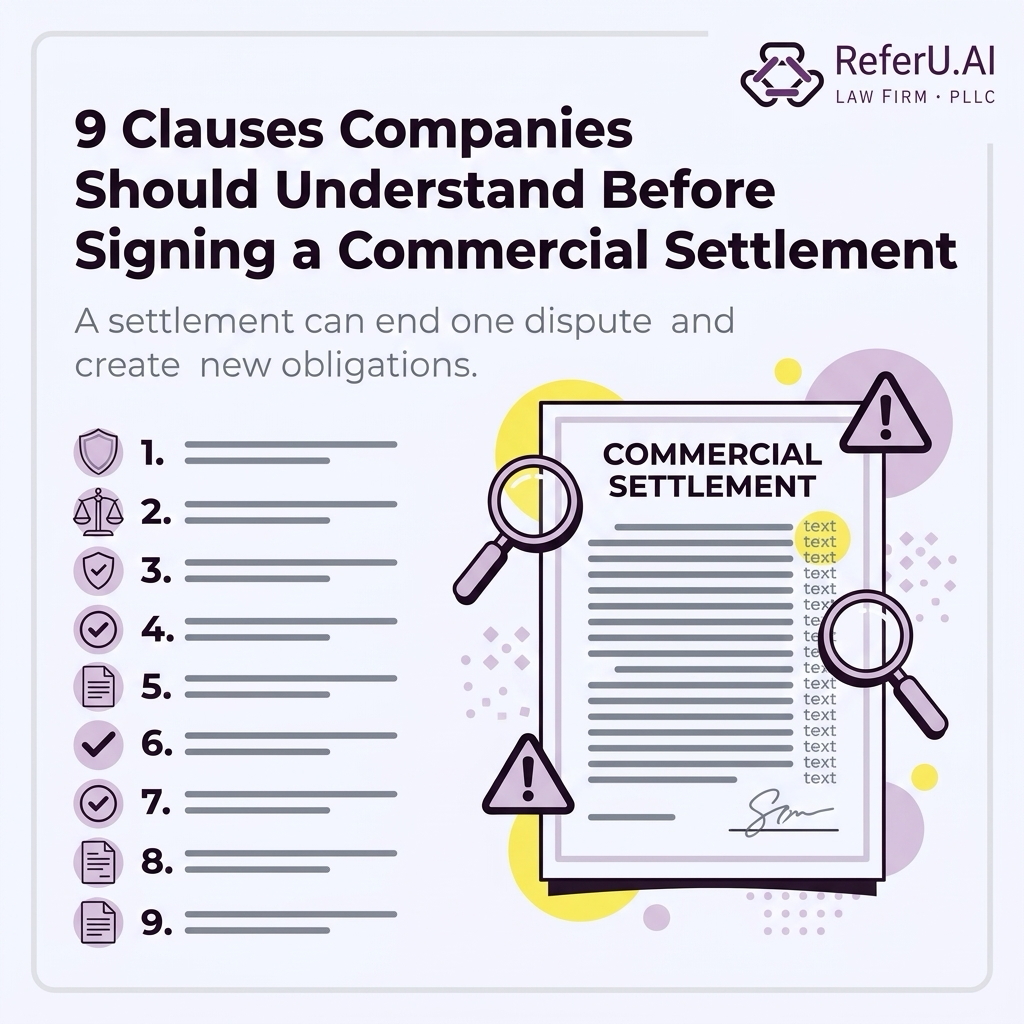
- 9 Clauses Companies Should Understand Before Signing a Commercial Settlement
- 1. Release Of Claims
- 2. Payment Terms
- 3. Confidentiality And Permitted Disclosures
- 4. No-Admission And Statement Clauses
- 5. Authority To Sign And Bind The Company
- 6. Default, Cure Period, And Remedies
- 7. Dispute Resolution, Venue, And Governing Law
- 8. Future Conduct And Operational Obligations
- 9. Tax Allocation, Reporting, And Integration Clauses
- Tax Allocation And Reporting
- Entire Agreement, Amendment, And Reliance Language
- Why These Clauses Matter More Than The Headline Number
- Final Takeaway

Type
Great Grandchild
Status
Approved
Title (YouTube)
Images Failed (Social)
Images Failed (Social)
Do not index
Publish Date (TikTok)
Dec 31, 2026 15:15
Videos Post IDs (Social)
Hashtags (Social)
#LegalAdvice #LegalHelp #BusinessLitigation #SettlementAgreements
Caption
Caption X
Cover

OG Image

Alt Image Text
Flat vector illustration of a commercial settlement agreement review with business representatives examining key commercial settlement clauses before signing.
Images



Videos
Publish Date (Social)
Dec 13, 2026 10:00
Scheduled (Social)
Scheduled (Social)
Images Posted (Social)
Images Posted (Social)
Videos Posted (Social)
Videos Posted (Social)
Videos Failed (Social)
Videos Failed (Social)
Featured
Created time
Apr 3, 2026 10:14 PM
Sub-item
Authors
CTA Practice Area (Social)
Business Litigation
TikTok Failed (Social)
TikTok Failed (Social)
Videos Post Links (Social)
YT Auto Captions Removed
TikTok Post Links (Social)
Images Post IDs (Social)
YT Post ID
Video Pending Manual (Social)
TikTok Posted (Social)
TikTok Posted (Social)
TikTok Post IDs (Social)
Video Cover (Social)
Images Post Links (Social)
First Comment (Social)
YT Embedded
Images Delete (Social)
Videos Delete (Social)
Carousel Video URL (Social)
9 Clauses Companies Should Understand Before Signing a Commercial Settlement
Commercial settlements often look straightforward on the last page: money changes hands, claims go away, and everyone moves on. In practice, the real business risk is usually buried in the clauses between the opening recital and the signature block.
That is one reason companies often spend as much time negotiating the settlement document as they spent negotiating the original deal. A settlement can close out a dispute, but it can also create a brand-new contract with fresh duties, new deadlines, confidentiality limits, enforcement rights, and sometimes even future operational restrictions. The American Bar Association notes that clear settlement language around payment timing, future obligations, and dispute resolution can reduce ambiguity and later enforcement fights, which is exactly where many post-settlement problems begin (ABA).
In this post, you’ll learn the 9 clauses companies may want to understand before signing a commercial settlement, why each clause matters, and where hidden exposure often shows up. If you want a broader overview of how business settlements work from start to finish, this companion guide on the core moving parts of a settlement agreement gives useful background before you get into clause-by-clause review.
Scroll to the bottom for every post in this series.
1. Release Of Claims
The release is usually the center of the deal. It answers the most important question in any settlement: what exactly is being given up?
Some releases are narrow. They cover only the claims in the lawsuit or demand letter. Others are broad enough to cover known and unknown claims, affiliates, officers, employees, successors, insurers, and a long list of related entities. A release that looks routine can become much larger once defined terms are expanded.
For companies, the practical issues often include:
- whether the release is mutual or one-sided
- whether it covers only existing claims or also unknown claims
- whether it extends to parent companies, subsidiaries, officers, board members, employees, and agents
- whether it includes claims tied to other contracts or business lines
- whether there are carve-outs for unpaid invoices, indemnity rights, tax obligations, insurance rights, or future breaches of the settlement itself
This is also where settlement language can collide with public policy limits. For example, the EEOC states that parties cannot use settlement terms to waive rights relating to future unlawful discrimination, describing a prospective waiver of rights as invalid in that context (EEOC). That guidance arises in the employment setting, but it illustrates a broader point for commercial settlements: not every broad waiver is enforceable just because it appears in writing.
A release clause can be the difference between “this dispute is over” and “we just paid money without fully buying peace.”
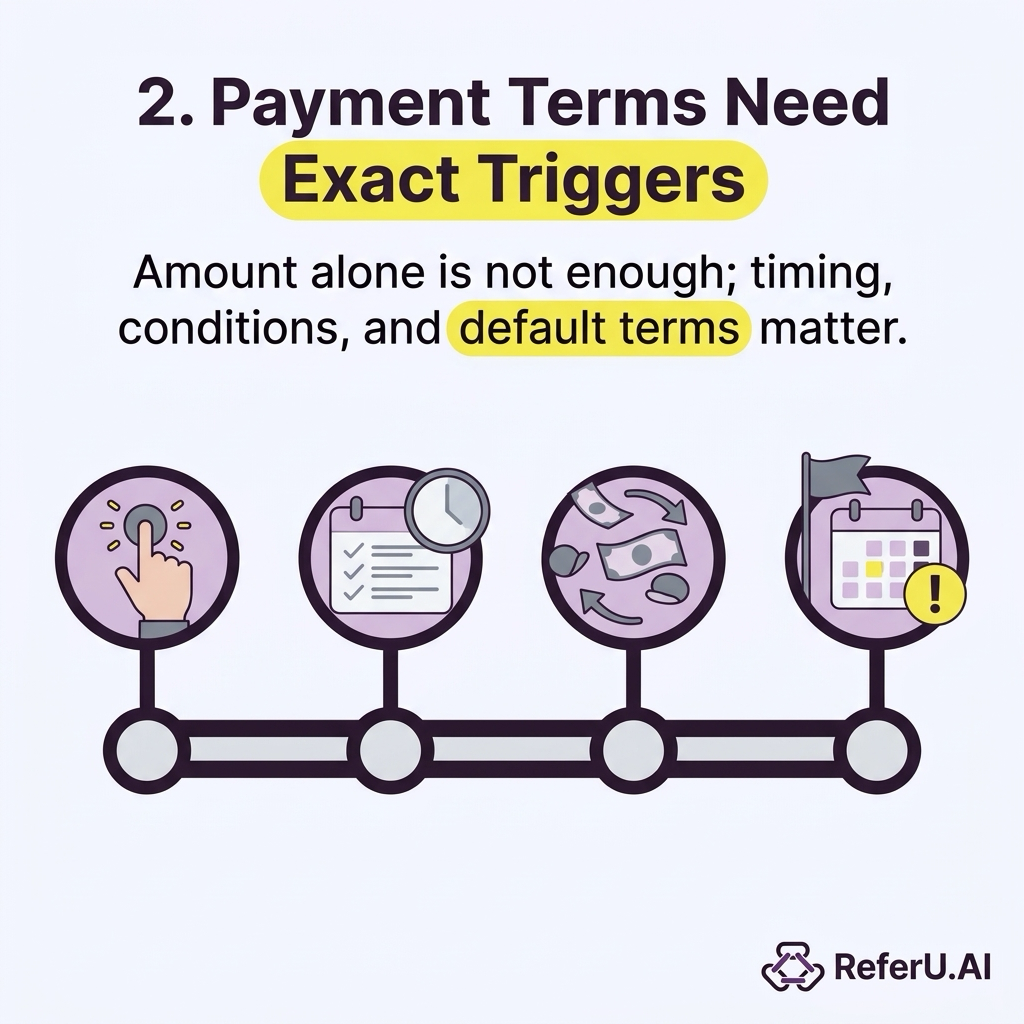
2. Payment Terms
A surprising number of settlement disputes come from clauses that everyone assumed were clear.
Payment terms are not just about the dollar figure. They often include:
- the payment date
- installment structure
- wire instructions
- tax forms
- whether payment is conditioned on dismissal paperwork
- whether interest applies if payment is late
- whether partial payments trigger default remedies
The ABA has highlighted the importance of defining the exact amount, method, and deadline for settlement payment to reduce later interpretive disputes (ABA). In commercial matters, that clarity matters even more when the settlement is being paid over time or funded through insurance, lenders, or multiple entities.
If the company is receiving money, a vague payment clause may leave too much room for delay. If the company is making payments, an aggressive default provision tied to even a minor timing miss may create disproportionate risk. That is often why businesses negotiating a phased payout also spend time on notice-and-cure language, acceleration triggers, and what counts as “received” payment.
This topic also connects naturally with deeper drafting issues around release language, confidentiality terms, and default remedies, but the key takeaway is simple: a payment clause is often doing far more legal work than its length suggests.
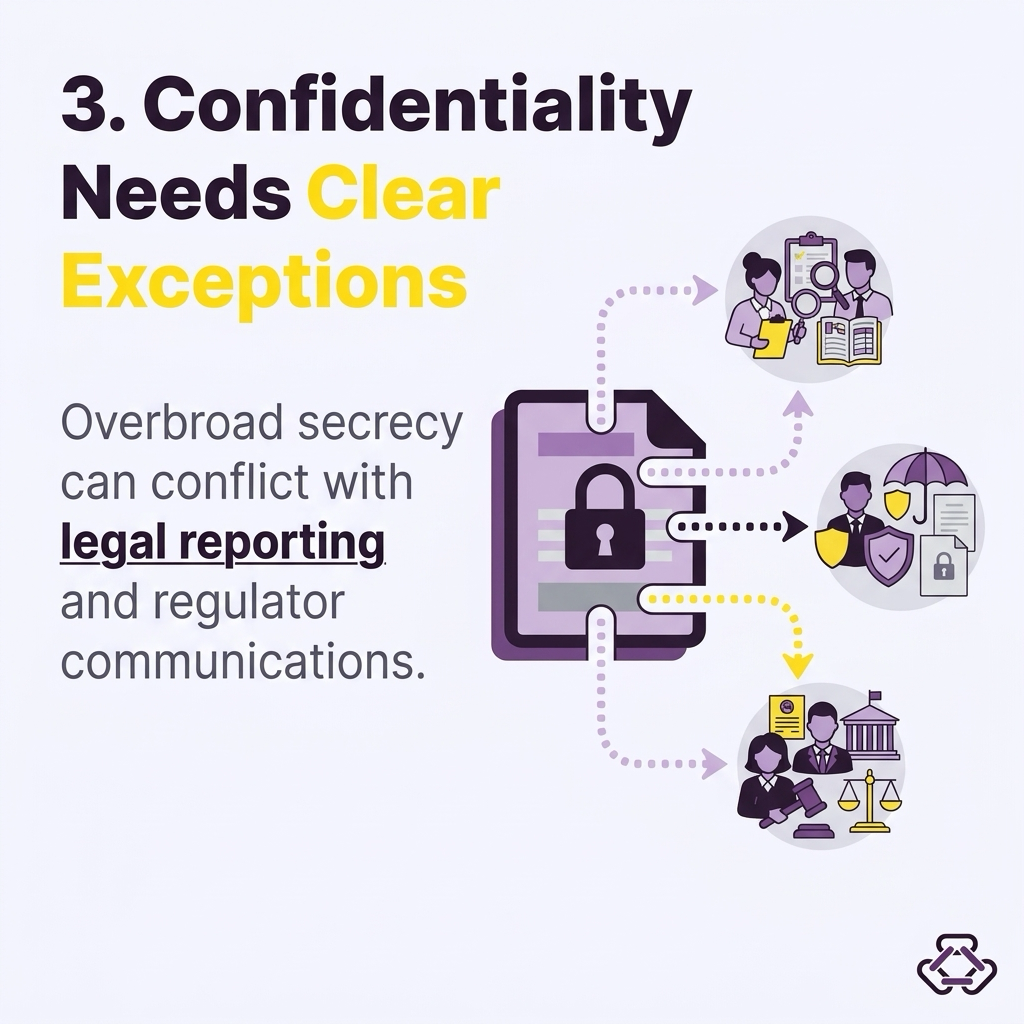
3. Confidentiality And Permitted Disclosures
Many companies assume confidentiality is standard and therefore safe. In reality, confidentiality clauses are often among the most sensitive provisions in a settlement agreement.
A commercial confidentiality clause may cover:
- the settlement amount
- the existence of the agreement
- underlying allegations
- exchanged documents
- internal investigation material
- communications with customers, vendors, investors, employees, regulators, or insurers
The drafting challenge is rarely whether confidentiality exists. The challenge is how broad it is and what exceptions exist.
That matters because overbroad confidentiality restrictions can create problems. The SEC explains that Rule 21F-17 prohibits any person from taking action to impede someone from communicating directly with the Commission staff about possible securities law violations, including by enforcing or threatening to enforce a confidentiality agreement against that communication (SEC). The SEC has also said that even where an agreement appears to permit reporting, other language in the same agreement can still create an impermissible limitation (SEC).
In a different context, the EEOC states that once it has filed suit, it does not enter settlements that impose confidentiality restrictions on disclosure of the suit, facts, allegations, or settlement terms by the EEOC, charging parties, or other aggrieved individuals (EEOC).
For businesses, here’s what this often means in practical terms: the clause usually works better when it is paired with explicit carve-outs for legal compliance, tax reporting, auditors, lenders, insurers, board members, and legally protected communications with regulators. A clause that sounds tougher is not always the clause that creates the most reliable protection.
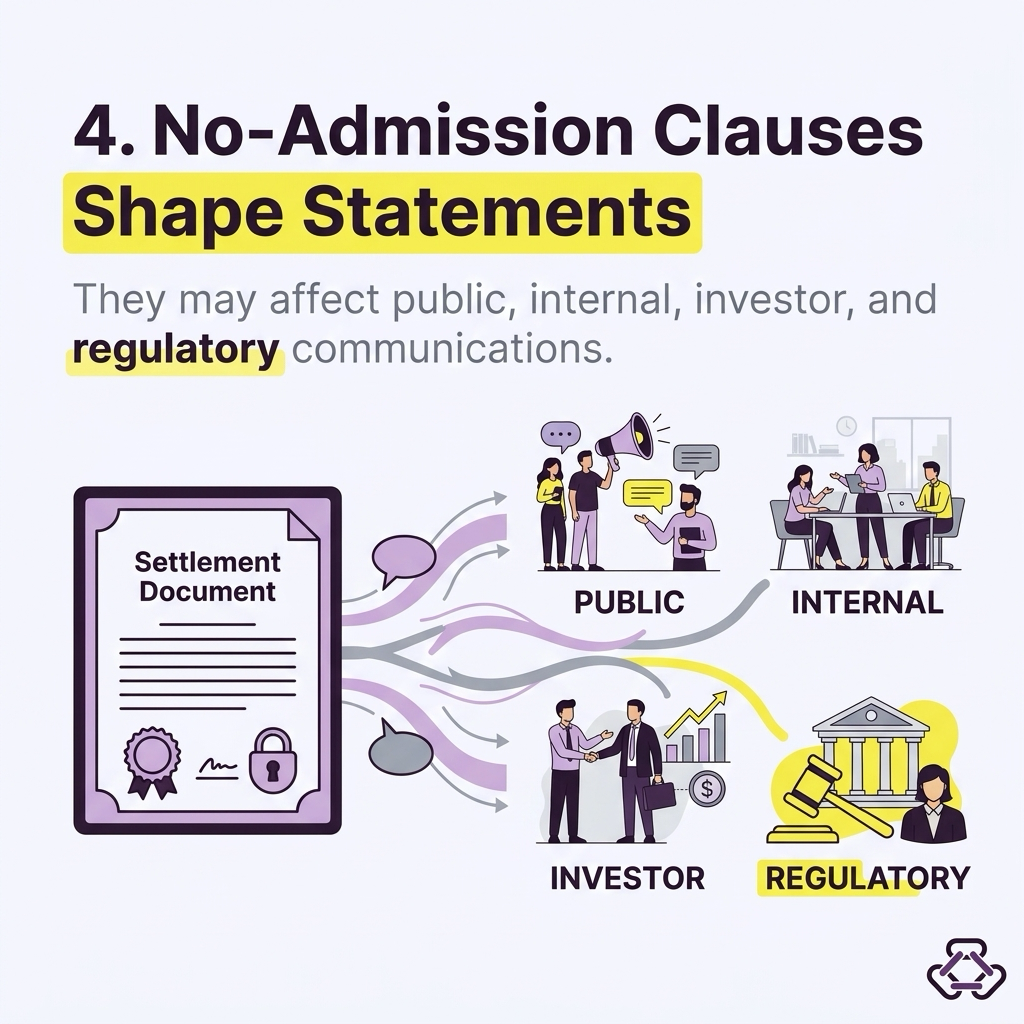
4. No-Admission And Statement Clauses
A “no admission of liability” provision is common, but companies sometimes treat it like PR language when it can have operational significance.
This clause usually says the settlement is a compromise of disputed claims and does not constitute an admission of fault, liability, wrongdoing, or damages. In many cases, it is paired with language controlling what the parties may say publicly about the dispute.
That sounds harmless, but several issues may sit underneath it:
- Does the clause govern only legal admissions, or also public statements?
- Is there a required joint statement or approved talking points?
- Does the clause restrict internal messaging to employees or investors?
- Does it interact with nondisparagement language?
- Could later required disclosures under securities, insurance, tax, lending, or regulatory rules create tension with the clause?
For public companies and regulated businesses, this section may be less about appearances and more about disclosure architecture. A settlement that says “no admission” does not necessarily eliminate disclosure obligations elsewhere. It may simply frame how the event is described.
If the other side is insisting on broad statement controls, that can be a sign the reputational piece is just as important to them as the payment piece.
5. Authority To Sign And Bind The Company
This clause is easy to overlook because it often appears as boilerplate: each signatory represents that they have full authority to enter the agreement and bind the party.
But authority questions can become central if a settlement later unravels.
The IRS’s litigation manual makes the point clearly in the government context: a negotiating attorney does not necessarily have authority to bind the government, and if conditions to final settlement are not clearly stated, parties may still face enforcement consequences once a settlement is reported as reached (IRS). The same contract logic often matters in private commercial disputes. If approval is required from a board, lender, insurer, parent company, investment committee, or bankruptcy court, the agreement usually works better when that condition is stated expressly.
Authority also matters because signatures can have broader consequences than people expect. In Monster Energy Co. v. Schechter, discussed by the ABA, the California Supreme Court held that an attorney’s signature indicating approval “as to form and content” did not automatically prevent a finding that the attorney intended to be bound by the settlement’s confidentiality provision (ABA). That case is a reminder that signature blocks and related language are not always ceremonial.
For companies, authority review often includes two separate questions:
- Can this person bind the company?
- Is anyone else unintentionally being bound too?
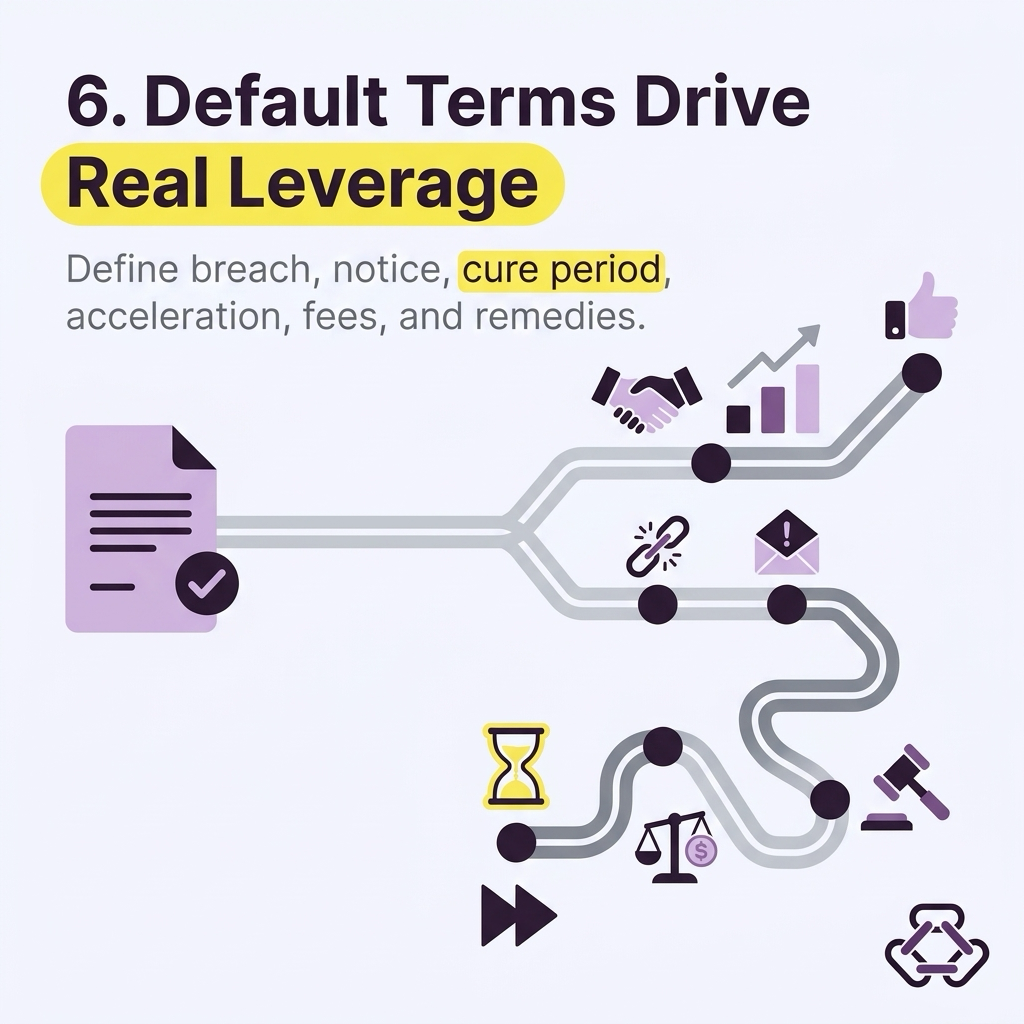
6. Default, Cure Period, And Remedies
A settlement that resolves one dispute can easily become the setup for the next one if the default section is vague or punitive.
This clause addresses what happens if someone does not perform. Common examples include missed installment payments, failure to remove a filing, breach of confidentiality, violation of a non-disparagement term, or refusal to sign dismissal papers.
Important variables often include:
- what counts as a default
- whether notice is required
- whether there is an opportunity to cure
- how long the cure period lasts
- whether the full unpaid balance accelerates
- whether stipulated judgments or consent awards are available
- whether attorney’s fees shift in an enforcement action
The ABA has noted that settlement language often includes future obligations and dispute-resolution provisions so that enforcement is clearer if the deal goes sideways (ABA). And arbitration administrators such as the AAA provide model language that allows parties to route disputes over breach or interpretation into arbitration, with judgment on the award entered in court if appropriate (AAA).
This is where many businesses discover that the “real” leverage in the agreement is not the settlement amount at all. It is the remedy structure attached to nonperformance.
If you are thinking about how settlements fail in real life, it may also help to read about the drafting errors that let business disputes come back after the deal is signed. A weak default section is often near the top of that list.
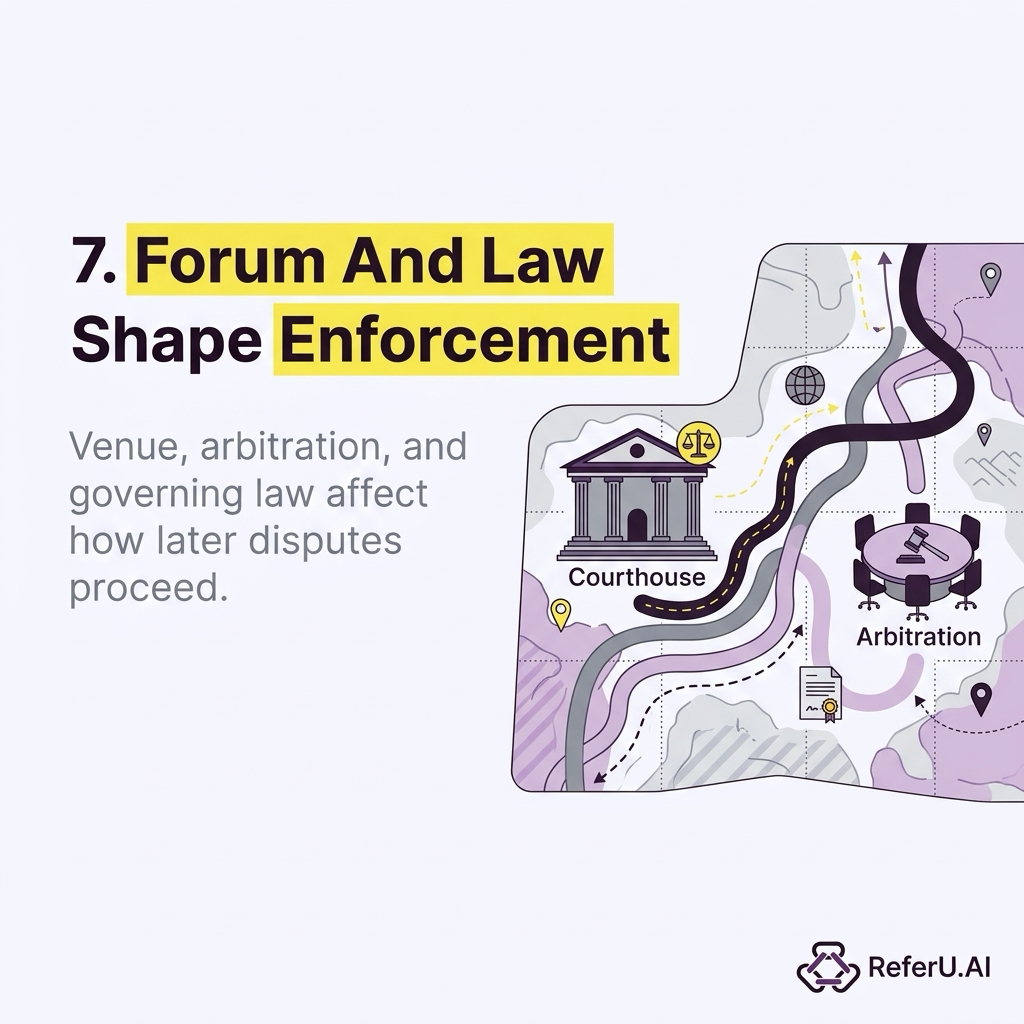
7. Dispute Resolution, Venue, And Governing Law
Commercial parties often settle because they are tired of fighting over process as much as substance. Then the settlement agreement creates a new procedural fight.
This clause usually answers three questions:
- Where will enforcement happen?
- How will enforcement happen?
- Which law will apply?
The AAA’s standard commercial clause provides that disputes arising out of the contract or its breach may be resolved by arbitration administered under its Commercial Arbitration Rules, and that judgment on the award may be entered in a court with jurisdiction (AAA). The AAA has also noted that its commercial rules include provisions addressing confidentiality, consolidation and joinder issues, civility, efficiency, and cybersecurity-related updates (AAA).
Choice-of-law provisions matter too. ABA commercial opinion materials discussing the Restatement approach note that courts generally give effect to parties’ chosen governing law, but there are exceptions, including situations where the chosen state lacks a substantial relationship to the parties or transaction, or where applying that law would contradict a fundamental policy of a state with a materially greater interest (ABA).
In practical terms, that means “Delaware law governs” or “New York courts have exclusive jurisdiction” may not always be as simple as copying language from another agreement. The underlying dispute, party locations, regulatory setting, and remedies being sought can all matter.
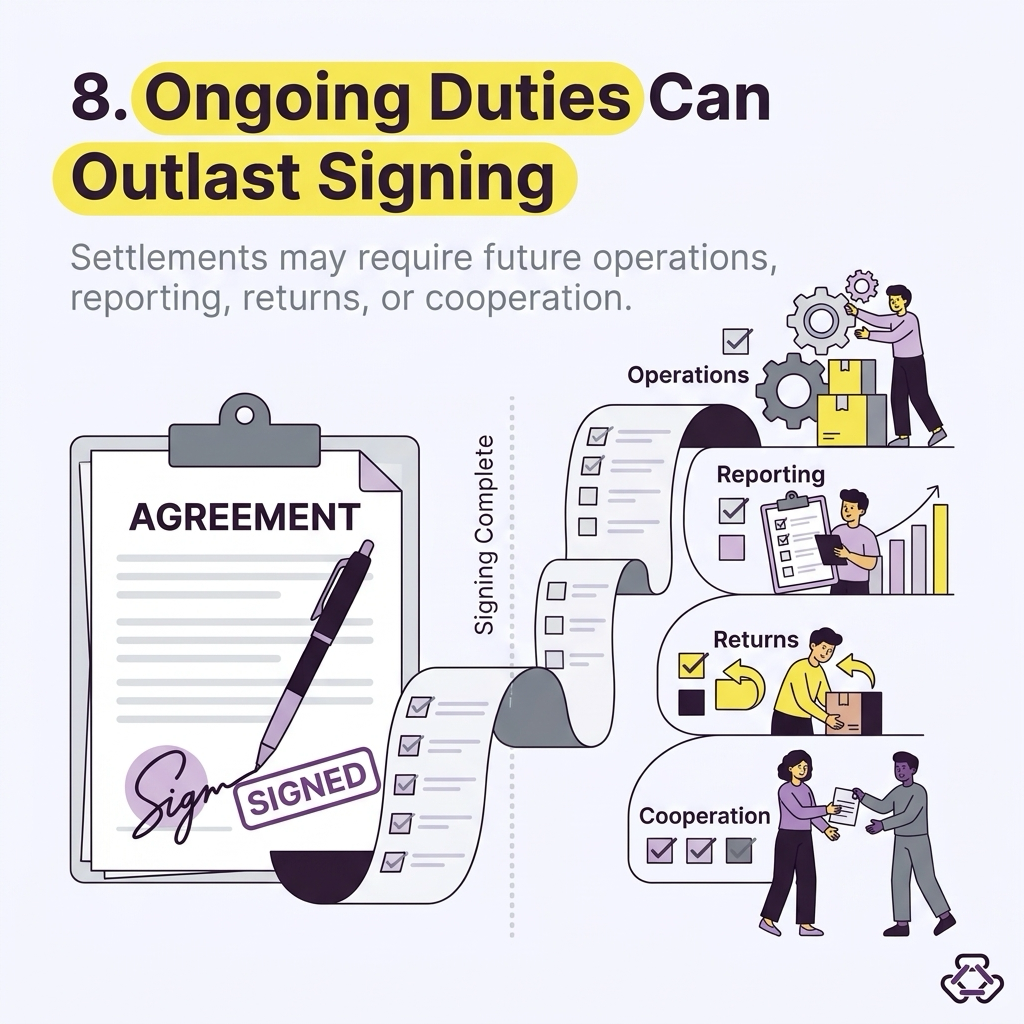
8. Future Conduct And Operational Obligations
Not every commercial settlement is just “pay and release.” Many settlements include obligations that continue after signing.
Examples include:
- delivering remaining goods
- correcting invoices
- updating customer records
- returning property or data
- removing liens or UCC filings
- revising internal policies
- making agreed public statements
- providing transitional services
- honoring continuing supply commitments
- cooperating with insurers, auditors, or regulators
The EEOC’s litigation settlement standards, while arising in a different area of law, are a useful reminder that settlements can include tailored non-monetary obligations designed to address the underlying dispute, such as policy revisions, training, audits, or other corrective measures (EEOC). Commercial settlements can work similarly. A settlement may function partly as a business separation agreement, partly as a short-term operating agreement, and partly as a dispute exit plan.
That is why this clause deserves more attention than it often gets. Future-performance language can quietly extend a business relationship that one or both parties thought they were ending.
Companies that want the dispute to end cleanly often focus not only on the release, but also on whether the settlement creates any new dependency, reporting obligation, or ongoing touchpoint after signature.
9. Tax Allocation, Reporting, And Integration Clauses
These are classic “back-page” clauses that can have front-page consequences.
Tax Allocation And Reporting
Settlement payments can be treated differently depending on what they are intended to compensate for and how the agreement describes them. The IRS has repeatedly analyzed settlement characterization issues in its published materials and internal guidance, which is one reason tax allocation language tends to matter in larger commercial disputes (IRS). In general terms, businesses often want clarity around whether payments are being described as contract damages, purchase-price adjustments, wage-related amounts, penalties, interest, or something else.
A tax clause may also address:
- who issues Forms 1099 or W-2, if any
- allocation among multiple claim categories
- gross-up issues
- indemnity for inconsistent reporting
- treatment of attorney’s fees
- treatment of interest on installment payments
Even where parties agree on economics, mismatched tax reporting can reopen conflict later.
Entire Agreement, Amendment, And Reliance Language
The integration clause says the written agreement is the entire agreement and supersedes prior discussions. It is often paired with language stating that amendments must be in writing and signed.
That can matter a great deal where negotiations were long and messy. Oral side understandings, email assurances, “business solution” language exchanged during mediation, and draft comments may feel important in the moment, but the final integration clause is often intended to shut that door.
This is particularly important in settlement settings because informal communications can create confusion about whether a deal was already reached. The IRS manual warns that if conditions to a binding settlement are not clearly identified, parties may find themselves treated as having an enforceable settlement even before all final paperwork is completed (IRS).
For companies, the closing pages of the agreement often answer an uncomfortable but essential question: if a dispute starts again, what evidence will matter and what conversations will no longer count?
Why These Clauses Matter More Than The Headline Number
Executives often focus first on the settlement amount. That makes sense. It is usually the easiest term to compare.
But experienced business litigators often spend just as much time on release scope, confidentiality carve-outs, authority language, cure periods, and enforcement mechanics because those terms shape what happens after the celebratory email goes out.
A settlement can fail in several familiar ways:
- one side thought the release was broader than it was
- a payment deadline was unclear
- confidentiality language interfered with lawful reporting
- the wrong person signed
- the default remedy was overbroad or toothless
- the agreement created continuing operational duties nobody planned to manage
- the enforcement forum turned out to be expensive or inconvenient
- tax treatment was never aligned
If any of that sounds familiar, it usually means the issue is not whether settlement is possible. It is whether the document actually reflects the business deal the parties thought they reached.
For a broader foundation, this overview of how settlement agreements handle money, releases, secrecy, and litigation exit planning can help frame these clauses in the larger context of resolving a commercial dispute.
Final Takeaway
A commercial settlement is not just the end of a dispute. It is a new contract that can allocate risk, preserve leverage, restrict communications, define future obligations, and determine how the next disagreement gets resolved.
The nine clauses above tend to carry the most weight:
- release of claims
- payment terms
- confidentiality and permitted disclosures
- no-admission and statement clauses
- authority to sign and bind the company
- default, cure period, and remedies
- dispute resolution, venue, and governing law
- future conduct and operational obligations
- tax allocation, reporting, and integration clauses
When a company is evaluating a proposed settlement, one of the most useful questions is often not “Is this number acceptable?” but “What obligations and risks survive after we sign?” An attorney with demonstrable experience in highly similar matters may help identify where a clause is routine, where it is unusually aggressive, and where the wording could affect later enforcement.
Visit ReferU.AI to get matched with an attorney who has demonstrable experience in cases like yours — for free.
