Table of Contents
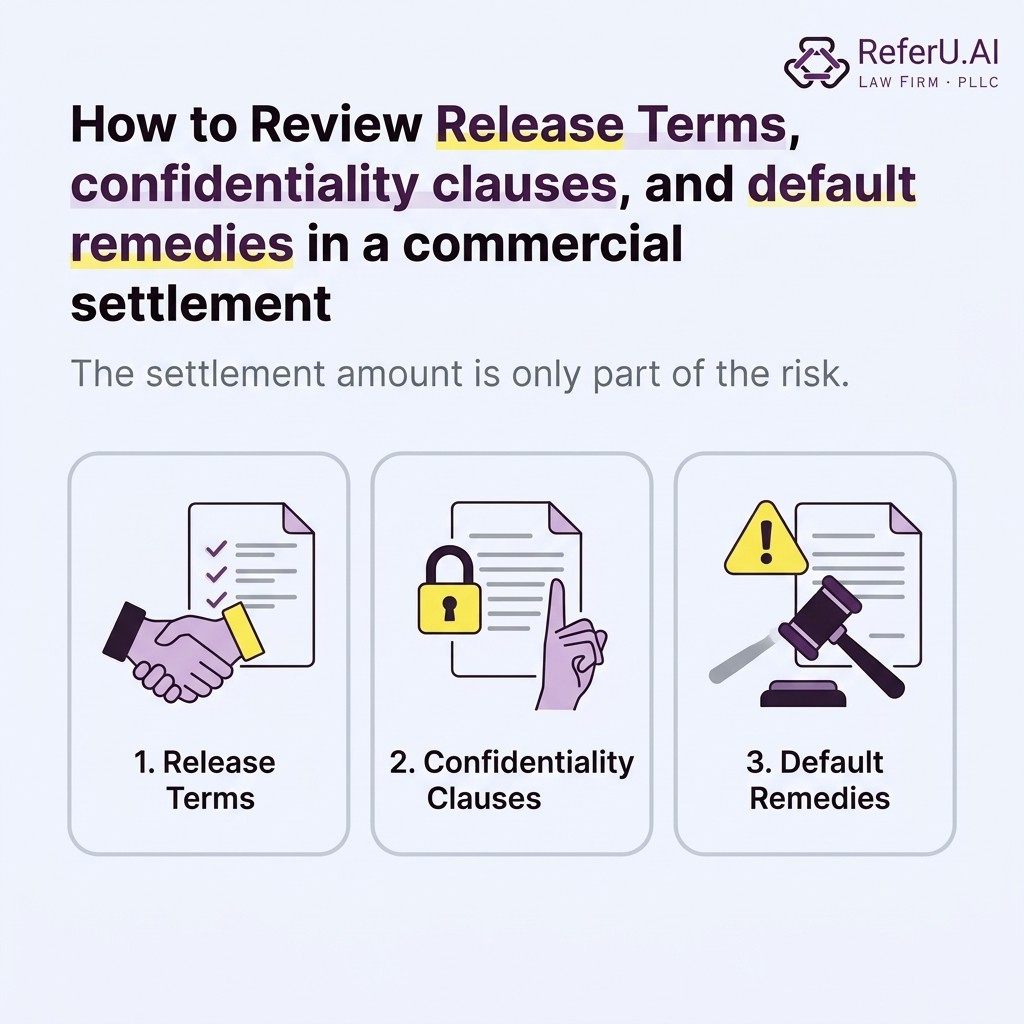
- How to Review Release Terms, confidentiality clauses, and default remedies in a commercial settlement
- Why These Three Clauses Matter So Much
- Step 1: Start By Defining Exactly What The Settlement Is Supposed To End
- Step 2: Review The Release Language Like It Is The Real Price Of The Deal
- What A Release Usually Covers
- Questions To Ask When Reading A Release
- Who Is Giving The Release?
- Who Is Being Released?
- What Claims Are Covered?
- Through What Date?
- Are Unknown Claims Included?
- Are There Carve-Outs?
- Common Release Problems In Commercial Settlements
- Step 3: Review Confidentiality Clauses With Business Reality And Public Policy In Mind
- What A Confidentiality Clause Usually Tries To Do
- Carve-Outs Are Often The Most Important Part
- Why Overreach Creates Problems
- State Law Can Matter A Lot
- A Practical Way To Read A Confidentiality Clause
- Step 4: Review Default Remedies Like You Expect A Payment Problem Later
- What Counts As A Default?
- Why Cure Periods Matter
- Common Default Remedies
- Step 5: Watch Closely For Liquidated Damages And Penalty Issues
- Why Courts Scrutinize These Clauses
- Why This Comes Up In Settlements So Often
- Step 6: Make Sure The Settlement Preserves The Ability To Enforce It
- Step 7: Review The Clause Package Together, Not In Isolation
- Step 8: Use A Practical Review Checklist Before Signing
- Release Checklist
- Confidentiality Checklist
- Default-Remedy Checklist
- When A Lawyer’s Review Can Change The Outcome
- Final Thoughts

Type
Great Grandchild
Status
Approved
Title (YouTube)
Images Failed (Social)
Images Failed (Social)
Do not index
Publish Date (TikTok)
Jan 1, 2027 06:15
Videos Post IDs (Social)
Hashtags (Social)
#LegalAdvice #LegalHelp #BusinessLitigation #SettlementAgreements
Caption
Caption X
Cover

OG Image

Alt Image Text
Flat vector illustration of reviewing release terms and confidentiality clauses in a commercial settlement, with contract analysis icons for release, confidentiality, and default remedies.
Images


Videos
Publish Date (Social)
Dec 13, 2026 11:00
Scheduled (Social)
Scheduled (Social)
Images Posted (Social)
Images Posted (Social)
Videos Posted (Social)
Videos Posted (Social)
Videos Failed (Social)
Videos Failed (Social)
Featured
Created time
Apr 3, 2026 10:14 PM
Sub-item
Authors
CTA Practice Area (Social)
Business Litigation
TikTok Failed (Social)
TikTok Failed (Social)
Videos Post Links (Social)
YT Auto Captions Removed
TikTok Post Links (Social)
Images Post IDs (Social)
YT Post ID
Video Pending Manual (Social)
TikTok Posted (Social)
TikTok Posted (Social)
TikTok Post IDs (Social)
Video Cover (Social)
Images Post Links (Social)
First Comment (Social)
YT Embedded
Images Delete (Social)
Videos Delete (Social)
Carousel Video URL (Social)
How to Review Release Terms, confidentiality clauses, and default remedies in a commercial settlement
Commercial settlements often look simple on the first read: one side pays, the other side releases claims, and the litigation ends. In practice, the real risk often sits in the details. A broad release can wipe out claims a company did not intend to give up. A confidentiality clause can create compliance problems or spark a later enforcement fight. A default-remedy provision can turn one missed payment into a brand-new lawsuit.
That is why reviewing settlement language carefully matters so much in business disputes. If you are working through a commercial settlement, this is often the stage where a document goes from “good enough” to “likely to hold up when something goes sideways.”
In this post you’ll learn how to review three of the clauses that often carry the most long-tail risk in a commercial settlement: release terms, confidentiality clauses, and default remedies. If you want broader context on how these provisions fit into the overall structure of a business resolution, it may help to start with this overview of how settlement agreements typically work from start to finish.
Scroll to the bottom for every post in this series.
Why These Three Clauses Matter So Much
In many commercial cases, the settlement amount gets most of the attention. But the amount is only one part of the deal. The language defining what is being released, what can still be said, and what happens after a breach often determines whether the dispute truly ends.
That is not just a practical drafting point. Courts routinely treat settlement agreements as contracts, which means later disputes often turn on standard contract interpretation principles. Evidence of settlement negotiations may also be limited for certain purposes under Federal Rule of Evidence 408, although Rule 408 generally does not bar settlement evidence when it is offered to prove breach of the settlement itself rather than the merits of the original dispute. That distinction can become important when one side later claims the other violated confidentiality, missed payments, or triggered a default. Law.Cornell LII
A careful review can help surface issues like:
- whether the release is broader than the dispute
- whether the confidentiality promise conflicts with legal reporting obligations
- whether a liquidated-damages clause looks more like a penalty than a reasonable estimate of loss
- whether a missed installment creates acceleration, interest, attorneys’ fees, or revived claims
- whether the agreement identifies the right parties, affiliates, and carve-outs
Step 1: Start By Defining Exactly What The Settlement Is Supposed To End
Before reviewing clause-by-clause language, it helps to define the business objective in plain English.
Ask: What fight is this agreement actually meant to end? Is it one invoice dispute? A failed distribution relationship? A trade secret and unfair competition case? A shareholder or earnout conflict? A multi-forum dispute with threatened future claims?
That framing matters because release language often expands beyond the original pleadings. A settlement might resolve:
- claims actually filed in the case
- claims that could have been filed based on the same facts
- claims involving affiliates, officers, employees, insurers, lenders, or successors
- unknown claims arising before the settlement date
- future claims tied to post-settlement conduct
This is where companies sometimes sign a document that resolves more than they realized. An attorney may help compare the complaint, counterclaims, demand letters, invoices, corporate structure, and insurance issues against the proposed release to see whether the paper matches the intended business deal.
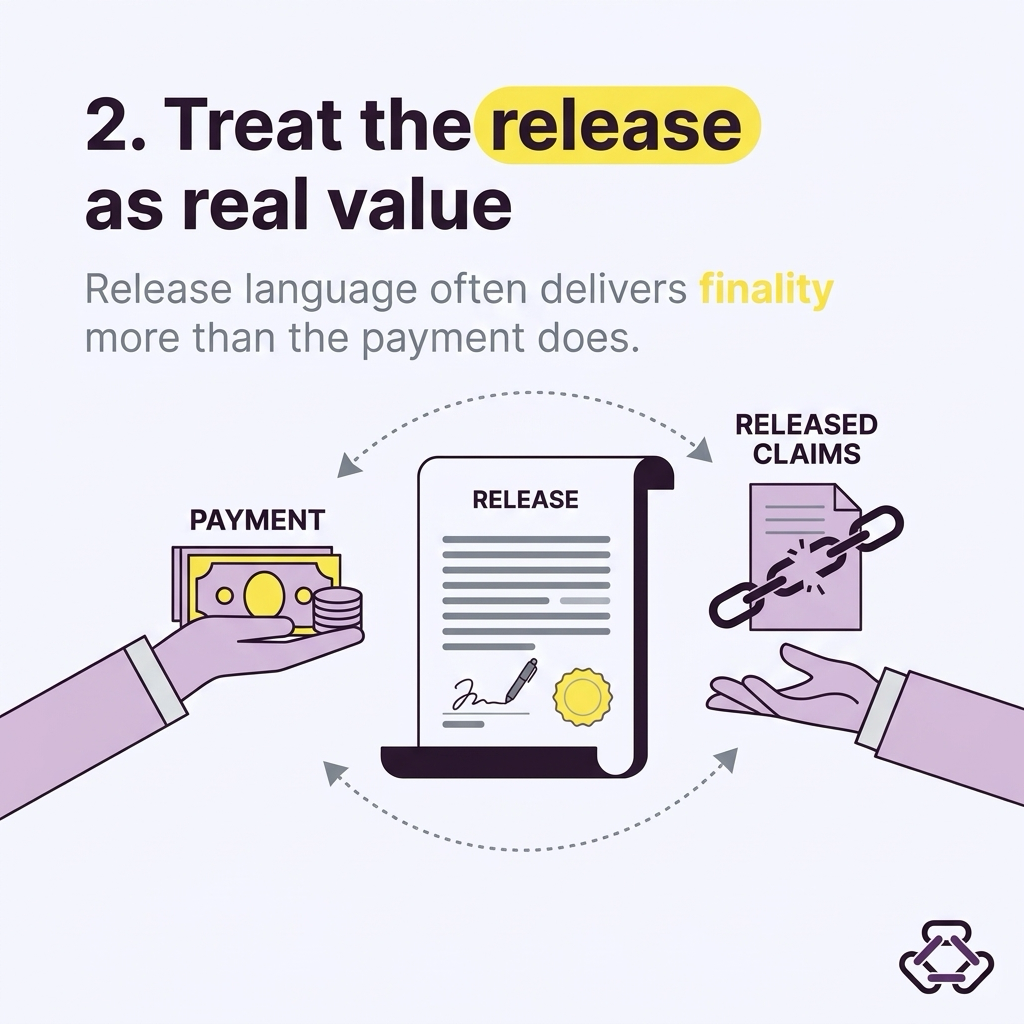
Step 2: Review The Release Language Like It Is The Real Price Of The Deal
In commercial settlements, the release is often the actual exchange of value. One party pays money, but the other party is often delivering finality.
What A Release Usually Covers
A release generally states that one or both parties give up certain claims against the other side. The scope can vary from narrow to extremely broad.
A narrow release might cover only claims asserted in a named lawsuit.
A broader release may cover all claims “arising out of or relating to” the underlying relationship, transaction, or dispute, whether known or unknown, accrued or unaccrued, through a defined date.
That wording matters. Terms like “arising out of,” “relating to,” “known and unknown,” “agents,” “affiliates,” “successors,” and “all claims of every kind” often expand the release materially.
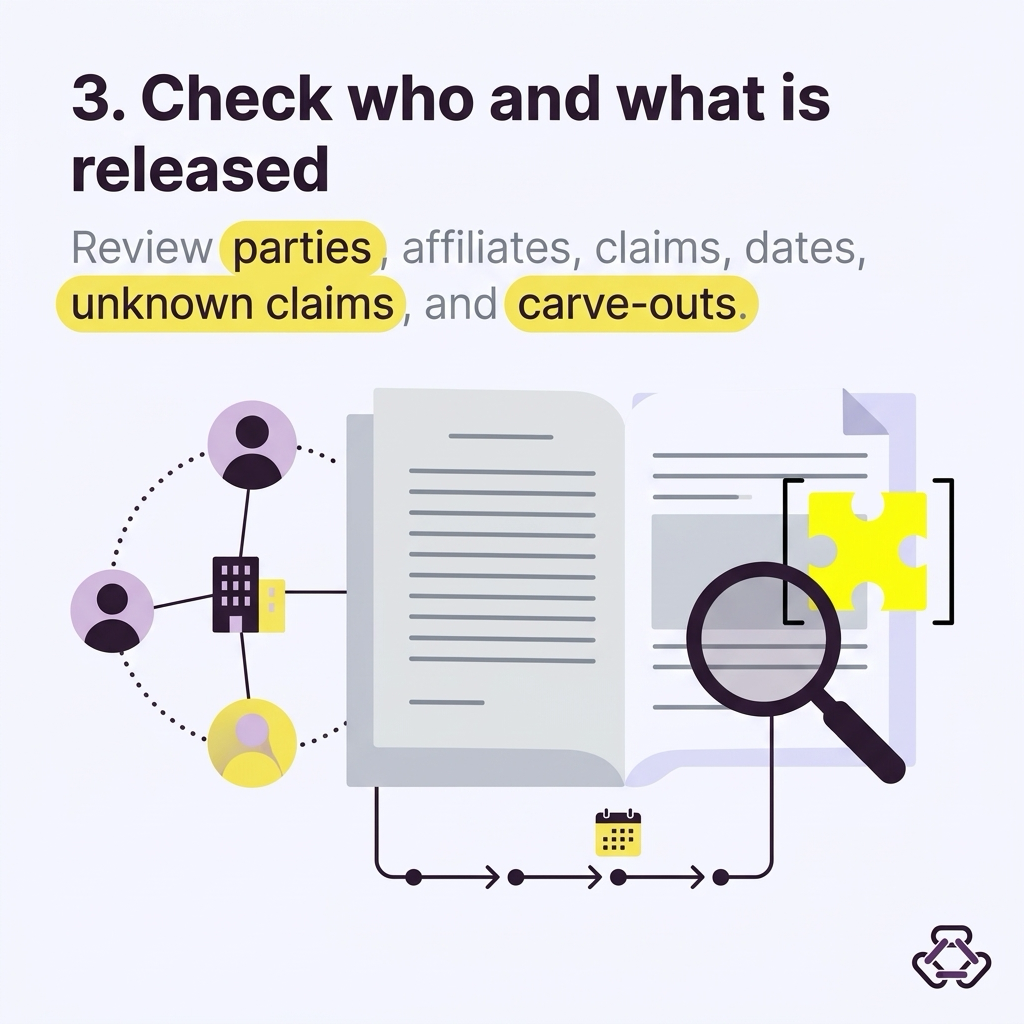
Questions To Ask When Reading A Release
A practical review often focuses on these questions:
Who Is Giving The Release?
Is it one entity, both entities, individual guarantors, officers, members, shareholders, or affiliates? If a parent company is not signing, but the release refers to affiliates, that can create ambiguity.
Who Is Being Released?
Does the definition include only the opposing business, or also its owners, employees, counsel, insurers, lenders, subsidiaries, and successors? Overly broad released-party definitions sometimes sweep in people the releasing party never intended to protect.
What Claims Are Covered?
Does the release cover only the lawsuit, or all business dealings between the parties? Is it limited to a purchase order, one contract, one project, or an entire commercial relationship?
Through What Date?
Many releases are cut off at the execution date or the effective date. That date can matter if there is continuing conduct, continuing payment obligations, post-termination restrictive covenants, or ongoing service issues.
Are Unknown Claims Included?
Some agreements attempt to release unknown claims. In California, that topic often intersects with Civil Code section 1542, which provides that a general release does not extend to claims the releasing party does not know or suspect to exist at the time of signing if those claims would have materially affected the settlement. Because of that statute, California settlements commonly include a specific section 1542 waiver when the parties intend to release unknown claims. California Legislative Information
Are There Carve-Outs?
Many business settlements preserve claims for:
- breach of the settlement itself
- indemnification rights
- insurance rights
- tax obligations
- confidentiality or non-disparagement enforcement
- future conduct after the effective date
- obligations expressly created by the settlement
Without clear carve-outs, parties sometimes argue that the release accidentally extinguished rights they expected to keep.
Common Release Problems In Commercial Settlements
Some of the most common problems include:
- Releasing future claims unintentionally
- Failing to define affiliates clearly
- Using broad “relating to” language without transaction limits
- Releasing unknown claims without understanding the jurisdictional effect
- Not preserving the right to enforce the settlement
- Including attorney or agent language that binds non-parties in unclear ways
The American Bar Association has also discussed how settlement wording can create unintended obligations for lawyers or agents if the agreement is drafted broadly enough and counsel participates in a way that appears to accept those obligations. ABA Litigation
Step 3: Review Confidentiality Clauses With Business Reality And Public Policy In Mind
Confidentiality clauses often receive less scrutiny than payment and release language, but they can create major post-settlement friction.
In commercial disputes, confidentiality may be tied to reputation, customer relationships, proprietary information, investor concerns, or parallel claims. But not every confidentiality provision is equally enforceable, and not every dispute allows the same level of secrecy.
What A Confidentiality Clause Usually Tries To Do
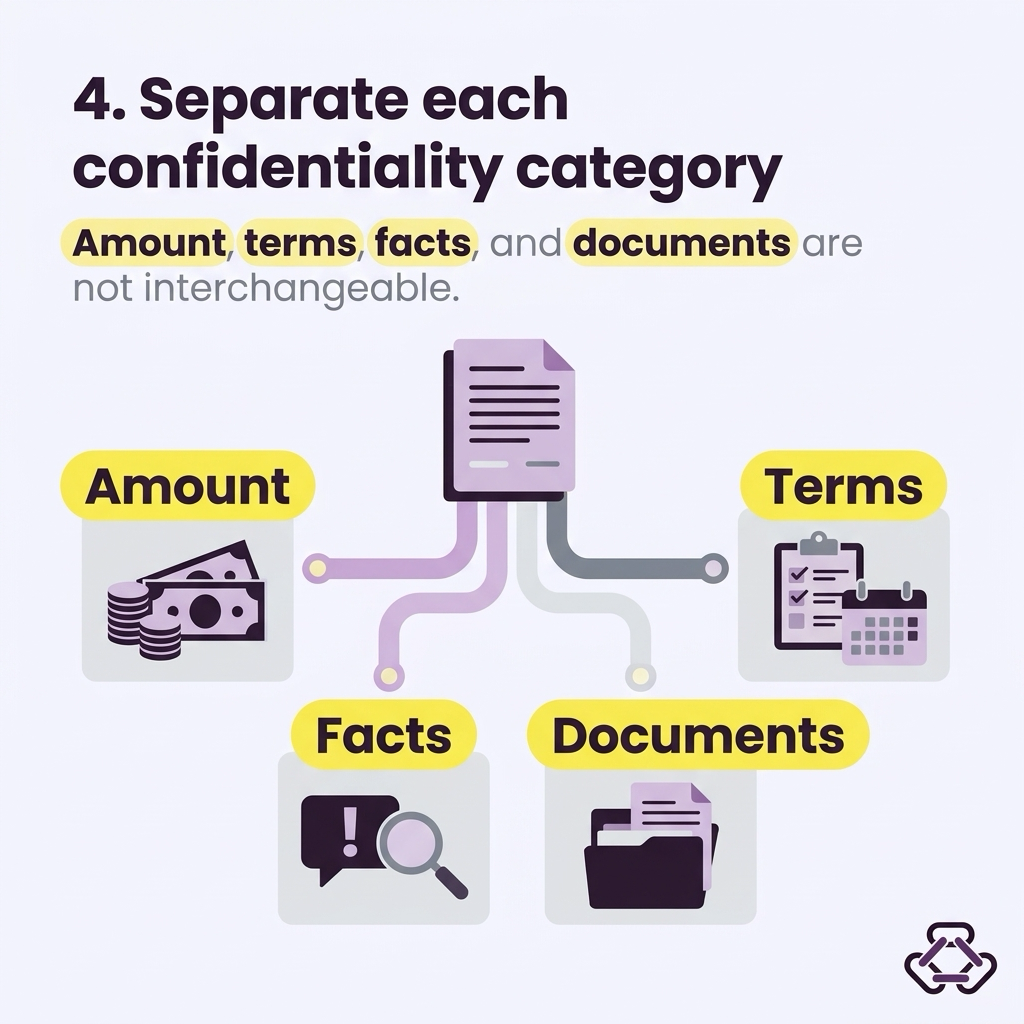
A confidentiality provision may address several different things at once:
- the fact of settlement
- the settlement amount
- the non-monetary terms
- the allegations and underlying facts
- documents exchanged in the case
- statements to employees, vendors, insurers, regulators, or the press
Those categories are not interchangeable. A party may be willing to keep the amount private but not the underlying facts. Or the opposite.
Legal scholars have noted that confidentiality can produce different effects depending on what is hidden and why. In some contexts, partial or “semi-confidential” settlements may preserve privacy while still allowing useful disclosure about the substance of a dispute. Cornell Law Review
Carve-Outs Are Often The Most Important Part
A commercial confidentiality clause often works better when it includes realistic exceptions. Common carve-outs may permit disclosure:
- to accountants, auditors, insurers, and lenders
- to current or prospective investors under confidentiality restrictions
- to board members, officers, and employees with a business reason to know
- as required by subpoena, court order, securities rules, tax law, or other legal process
- to government agencies or regulators
- to enforce the settlement
- to obtain legal or financial advice
Without those carve-outs, a clause can become hard to perform in ordinary business operations.
Why Overreach Creates Problems
Overly aggressive confidentiality language can raise enforceability and public-policy issues, especially where the clause tries to restrict communications with regulators or government agencies.
For example, the EEOC states that once it has filed suit, it will not enter into settlements containing confidentiality provisions restricting disclosure of the suit, facts, allegations, or terms by the EEOC or aggrieved individuals, and it does not permit terms that bar future charges or participation in agency investigations. EEOC The EEOC has also long taken the position that certain employee rights, including the right to file a charge or communicate with the agency, are non-waivable. EEOC Guidance
Although your dispute may be commercial rather than employment-based, those authorities illustrate a broader point: confidentiality terms that attempt to block legally protected reporting activity can create real problems.
Regulators have also been paying attention to restrictive contract language. In July 2024, the FTC issued a policy statement addressing franchisors’ use of non-disparagement, goodwill, and confidentiality clauses, signaling ongoing scrutiny of contractual provisions that may operate unfairly in certain settings. FTC
State Law Can Matter A Lot
Confidentiality in settlements is highly context-specific and can vary significantly by claim type and jurisdiction. For example, New York states that in discrimination-related resolutions, confidentiality regarding underlying facts is permitted only in certain circumstances and only if it reflects the complainant’s preference. New York State FAQ New York’s Division of Human Rights also states that its confirmed settlement stipulations are public documents and that confidentiality does not extend to disclosure of the underlying facts in that administrative setting. New York Division of Human Rights
Even where a business dispute is not an employment case, these rules are a reminder that confidentiality clauses do not operate in a vacuum. Industry regulation, public-records law, securities obligations, tax reporting, whistleblower protections, and agency communication rights can all affect enforceability.
A Practical Way To Read A Confidentiality Clause
When reviewing the clause, it may help to separate the questions:
- What is confidential?
- Who is bound?
- Who can receive disclosures?
- What disclosures are legally protected or required?
- What remedy applies if confidentiality is breached?
That last question often overlaps with default remedies and can become the most heavily negotiated part of the clause.
Step 4: Review Default Remedies Like You Expect A Payment Problem Later
A default-remedy clause is the part parties often hope never matters. But if there is an installment schedule, future cooperation obligation, dismissal sequence, document return provision, or confidentiality promise, this section may become the most litigated part of the settlement.
What Counts As A Default?
A good review starts with the trigger. Does default mean:
- one late payment
- failure to pay after written notice and cure period
- a confidentiality breach
- a tax-form issue
- failure to dismiss claims
- a public statement
- interference with business relations
- failure to deliver releases or corporate approvals
Some agreements define default broadly. Others separate payment default from non-monetary default.
Why Cure Periods Matter
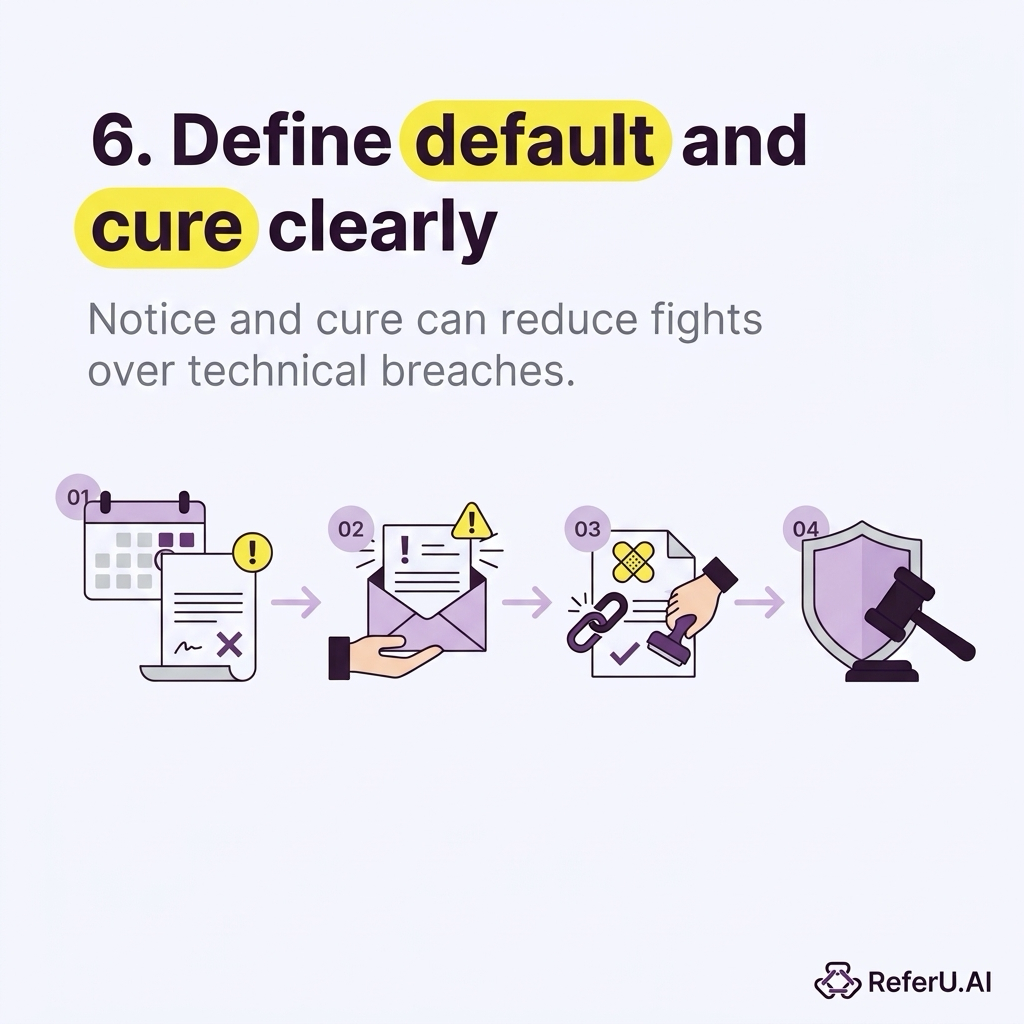
Many commercial settlement agreements include a notice-and-cure mechanism before stronger remedies kick in. That can reduce later disputes over whether the default was technical, material, or disputed in good faith.
Without a cure period, one missed deadline can trigger immediate acceleration, attorneys’ fees, or a consent judgment. With a cure period, there is often more room to resolve performance issues before litigation starts again.
Common Default Remedies
A settlement might provide for one or more of the following after default:
- acceleration of unpaid amounts
- interest on late payments
- stipulated or liquidated damages
- reinstatement of dismissed claims
- entry of judgment for a stated amount
- attorneys’ fees and costs for enforcement
- injunctive relief for confidentiality or non-disparagement breaches
- consent to jurisdiction, venue, or arbitration for enforcement
Each one deserves a separate review.
Step 5: Watch Closely For Liquidated Damages And Penalty Issues
One of the biggest trouble spots in settlement enforcement is the clause that sets a fixed consequence for breach.
Sometimes that clause is framed as liquidated damages for a confidentiality breach. Sometimes it appears as a larger amount that becomes due if one installment is missed. Sometimes it revives the full original claim if the settlement payment is not completed.
Why Courts Scrutinize These Clauses
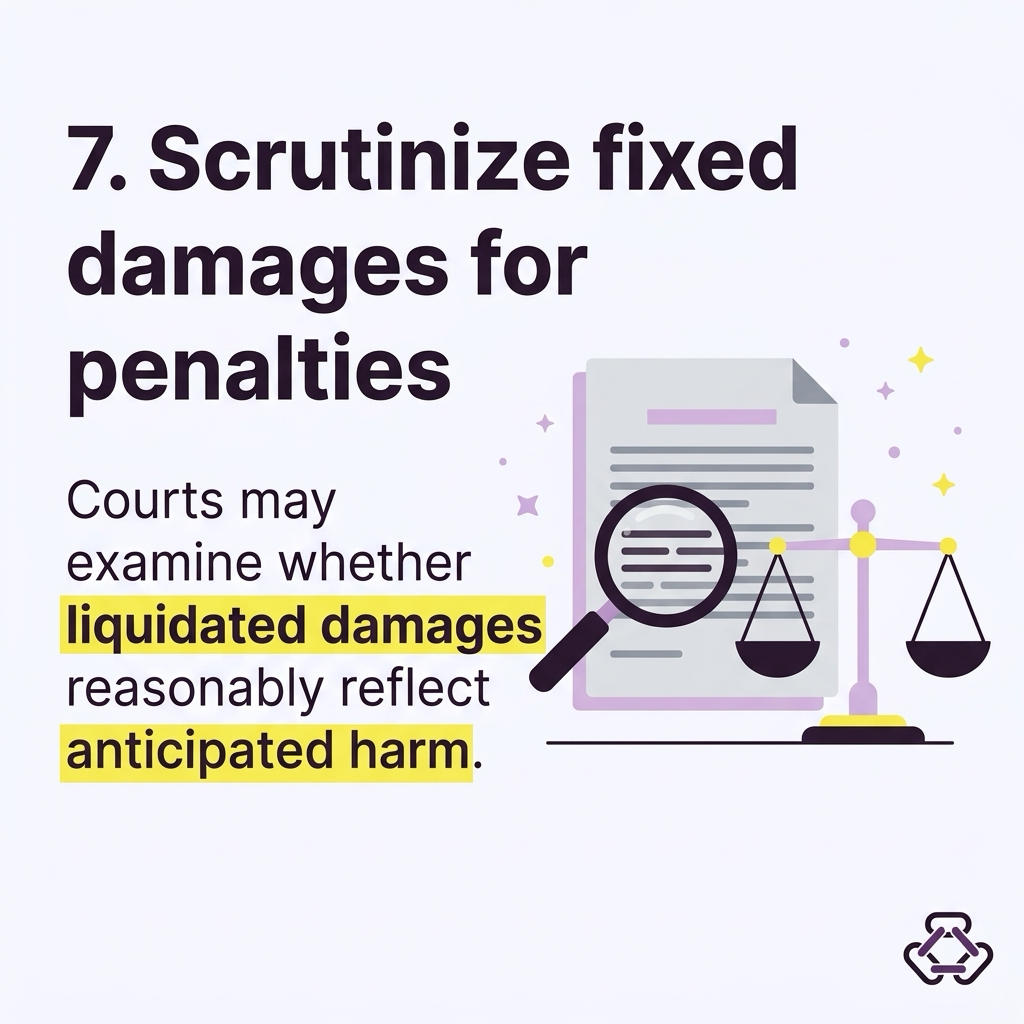
In general contract law, liquidated damages are more likely to be enforced when they are a reasonable estimate of anticipated or actual harm and not an unreasonably large penalty. Under UCC section 2-718, for example, liquidated damages for breach are enforceable only if reasonable in light of anticipated or actual harm, difficulty of proof, and the inconvenience or infeasibility of obtaining another adequate remedy; unreasonably large liquidated damages are void as a penalty. Delaware Code, UCC 2-718
New York courts apply a similar penalty analysis. The state’s courts have repeatedly described liquidated damages as unenforceable where they are grossly disproportionate to probable loss. In one commercial decision involving an agreement to pay money, the New York Court of Appeals discussed the principle that damages for nonpayment of money are often interest rather than a punitive add-on. New York Court of Appeals
Why This Comes Up In Settlements So Often
In settlement agreements, parties sometimes use strong default language to encourage performance. That may be commercially understandable, but courts may still examine whether the remedy reflects a genuine estimate of harm or simply punishes breach.
Examples that often attract scrutiny include:
- a very high fixed amount for any confidentiality breach regardless of actual impact
- immediate liability for the full original lawsuit demand after a minor installment default
- a confession-style judgment amount that far exceeds the unpaid balance
- stacked remedies such as acceleration, interest, fees, and large fixed damages all at once
The ABA has noted that confidentiality provisions sometimes include substantial liquidated-damages amounts, which can later create tax, ethics, and enforceability questions. ABA GPSolo
That does not mean every strong remedy fails. It means the drafting often benefits from a realistic connection between the breach and the harm the clause is trying to address.
Step 6: Make Sure The Settlement Preserves The Ability To Enforce It
An oddly common drafting problem is a settlement that broadly releases claims but does not clearly preserve claims for breach of the settlement itself.
A well-reviewed agreement often addresses:
- whether breach-of-settlement claims are expressly preserved
- where enforcement actions may be filed
- whether the court retains jurisdiction, if applicable
- whether arbitration applies to later enforcement disputes
- whether prevailing-party fees are available
- whether injunctive relief is available for disclosure breaches
- whether evidence of the settlement may be used to prove breach
This is also where procedural language matters. For example, if the underlying case will be dismissed, the settlement may address timing, dismissal with or without prejudice, and whether the court will retain jurisdiction under applicable procedure. Those mechanics can affect how easy or difficult enforcement becomes later.
Step 7: Review The Clause Package Together, Not In Isolation
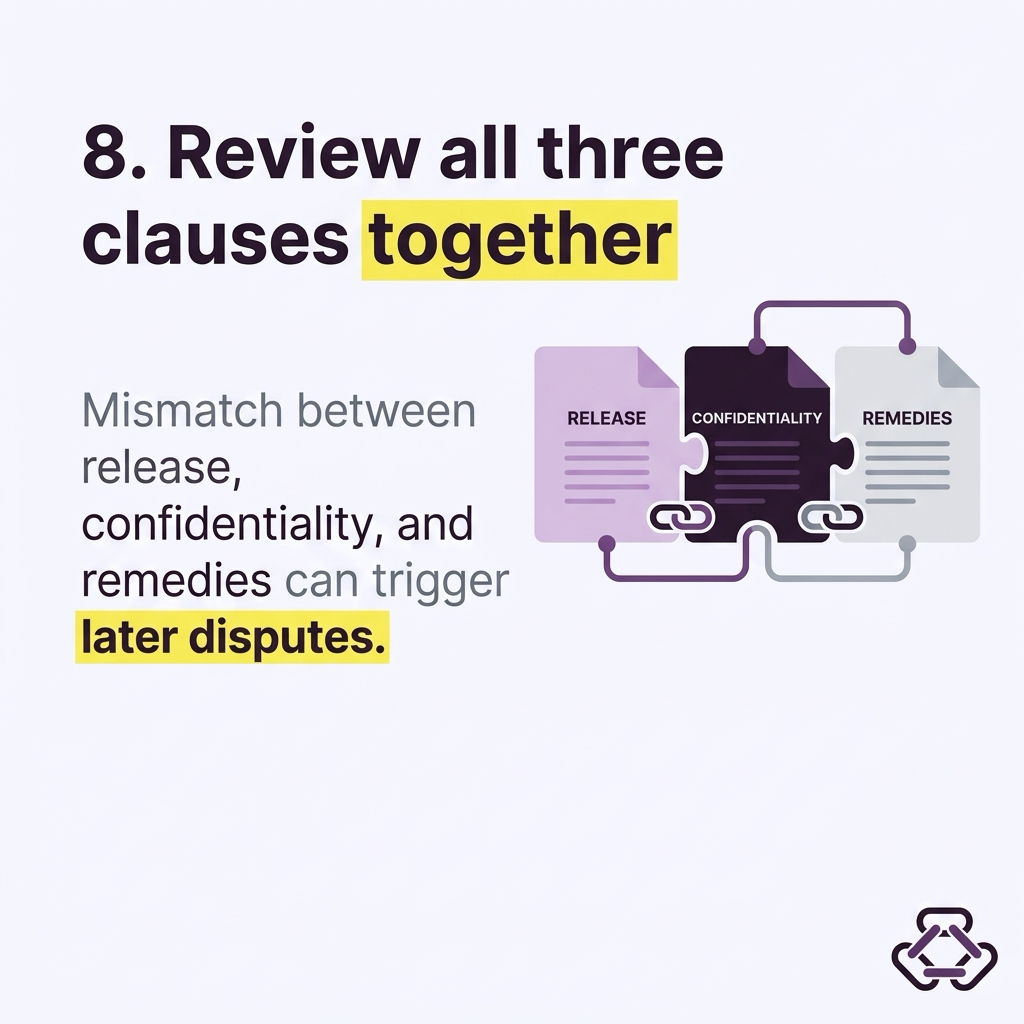
Release terms, confidentiality clauses, and default remedies interact with each other.
For example:
- A broad release paired with a weak enforcement clause may leave a party with fewer practical remedies after breach.
- A strict confidentiality clause paired with a severe liquidated-damages provision may create a penalty argument.
- An installment settlement with immediate dismissal and no retained jurisdiction may make enforcement slower and more expensive.
- A settlement that preserves claims for breach but not injunctive relief may weaken confidentiality enforcement.
- A release that includes affiliates may not match the confidentiality clause’s definition of who is bound.
This is one reason many later settlement disputes come from drafting mismatch rather than bad intent. If you are also looking at the larger drafting risks that make business disputes resurface later, it may help to read more about the kinds of settlement errors that can reignite a commercial fight.
Step 8: Use A Practical Review Checklist Before Signing
Here is a practical way to pressure-test the document.
Release Checklist
- Are the releasing parties identified precisely?
- Are the released parties identified precisely?
- Is the release limited to the intended dispute, transaction, or relationship?
- Does the release cut off at the right date?
- Are unknown claims included, and if so, is that intentional?
- Are important carve-outs preserved?
- Does state-specific law affect unknown-claim waivers?
Confidentiality Checklist
- What exactly is confidential: amount, terms, facts, or all of the above?
- Who is bound by the clause?
- Are business-operational disclosures allowed?
- Are disclosures to agencies, regulators, and legal advisors carved out?
- Does the clause conflict with public policy, statutory rights, or regulatory obligations?
- Is the remedy for breach commercially realistic?
Default-Remedy Checklist
- What events count as default?
- Is there notice and an opportunity to cure?
- Does the remedy scale reasonably with the breach?
- Is interest defined clearly?
- Are attorneys’ fees available for enforcement?
- Does any fixed-damages amount risk looking punitive?
- Is venue, jurisdiction, or arbitration for enforcement identified?
When A Lawyer’s Review Can Change The Outcome
Commercial settlement agreements often look polished because they are built from prior templates. That can create a false sense of safety. Many templates contain broad release wording, aggressive confidentiality language, and default provisions imported from very different disputes.
An attorney reviewing the agreement may help identify whether the document:
- resolves only the claims you intend to resolve
- preserves rights that still matter to the business
- aligns with the governing law and forum
- avoids remedies that are difficult to enforce
- reduces the odds of a second lawsuit over the settlement itself
That kind of review is especially useful when the settlement involves installment payments, parallel claims, guarantors, corporate affiliates, trade-secret concerns, regulatory issues, or jurisdiction-specific waiver language.
Final Thoughts
A commercial settlement is supposed to close a chapter, not open a new one. The clauses that most often decide whether that happens are usually not the headline numbers. They are the provisions that define what is released, what stays private, and what happens if the agreement is breached.
In general terms, a careful review often focuses less on whether the parties reached a deal and more on whether the document actually delivers the finality the business expects. That is where legal language can either reduce future friction or quietly store it up for later.
Visit ReferU.AI to get matched with an attorney who has demonstrable experience in cases like yours — for free.
