Table of Contents
- How to Gather Corroborating Evidence for an Asylum Case
- Why Corroborating Evidence Matters
- What Counts As Corroborating Evidence
- Identity And Civil Records
- Medical And Psychological Evidence
- Witness Statements And Affidavits
- Country Conditions Evidence
- Digital Evidence
- How To Gather Corroborating Evidence For An Asylum Case
- 1. Start With A Detailed Timeline
- 2. Identify Which Facts Need Support
- 3. Gather Primary Documents First
- 4. Build Secondary Evidence Around The Gaps
- 5. Ask Witnesses For Specific Statements
- 6. Preserve Digital Evidence Carefully
- 7. Use Country Conditions To Support The Personal Story
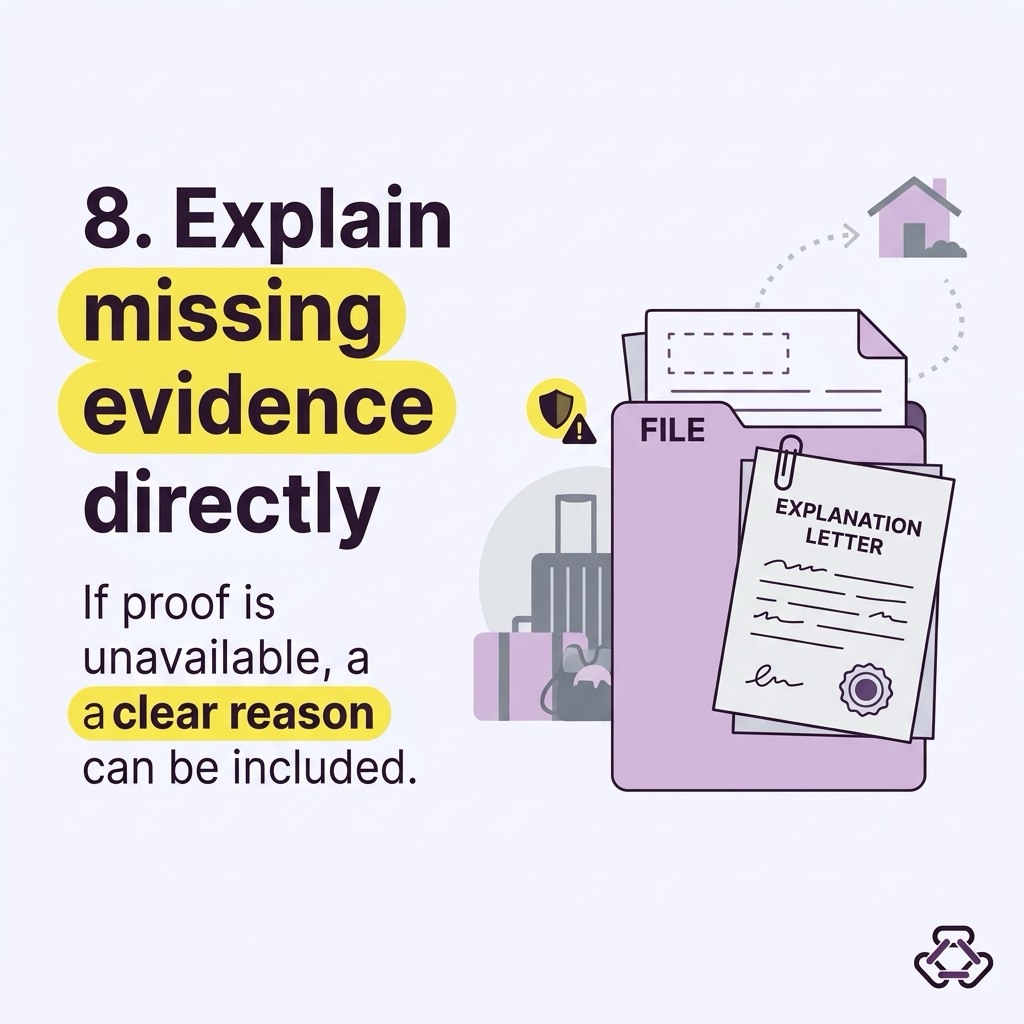
- 8. Explain Missing Evidence Directly
- 9. Organize Everything In A Way The Decision-Maker Can Follow
- 10. Make Sure The Application And Evidence Match
- Common Types Of Corroborating Evidence In Asylum Cases
- Evidence Of Identity
- Evidence Of Harm
- Evidence Of Threats
- Evidence Of Political Or Social Activity
- Evidence Of Country Conditions
- Evidence Explaining Missing Proof
- What If There Is No Official Paper Trail?
- Timing Still Matters
- Why Legal Help Can Change The Quality Of The Evidence Record
- Final Thoughts

Type
Great Grandchild
Status
Approved
Title (YouTube)
Images Failed (Social)
Images Failed (Social)
Do not index
Publish Date (TikTok)
Apr 25, 2027 12:15
Videos Post IDs (Social)
Hashtags (Social)
#LegalAdvice #LegalHelp #Immigration #Asylum
Caption
Caption X
Cover

OG Image

Alt Image Text
Flat vector illustration of corroborating evidence for an asylum case with supporting documents, identity records, witness statements, medical files, photos, and digital evidence organized on a desk.
Images

Videos
Publish Date (Social)
Feb 19, 2027 07:30
Scheduled (Social)
Scheduled (Social)
Images Posted (Social)
Images Posted (Social)
Videos Posted (Social)
Videos Posted (Social)
Featured
Created time
Apr 7, 2026 12:01 AM
Sub-item
Authors
CTA Practice Area (Social)
Immigration
TikTok Failed (Social)
TikTok Failed (Social)
Videos Post Links (Social)
TikTok Post Links (Social)
Images Post IDs (Social)
YT Post ID
Video Pending Manual (Social)
TikTok Posted (Social)
TikTok Posted (Social)
TikTok Post IDs (Social)
Video Cover (Social)
Images Post Links (Social)
First Comment (Social)
Videos Failed (Social)
Videos Failed (Social)
YT Embedded
Images Delete (Social)
Videos Delete (Social)
Carousel Video URL (Social)
How to Gather Corroborating Evidence for an Asylum Case
Applying for asylum often involves telling a story that may be difficult to document in a traditional way. People fleeing persecution do not always leave with police reports, neatly organized medical files, or letters from witnesses. Even so, corroborating evidence can play an important role in showing that an asylum claim is consistent, detailed, and grounded in facts.
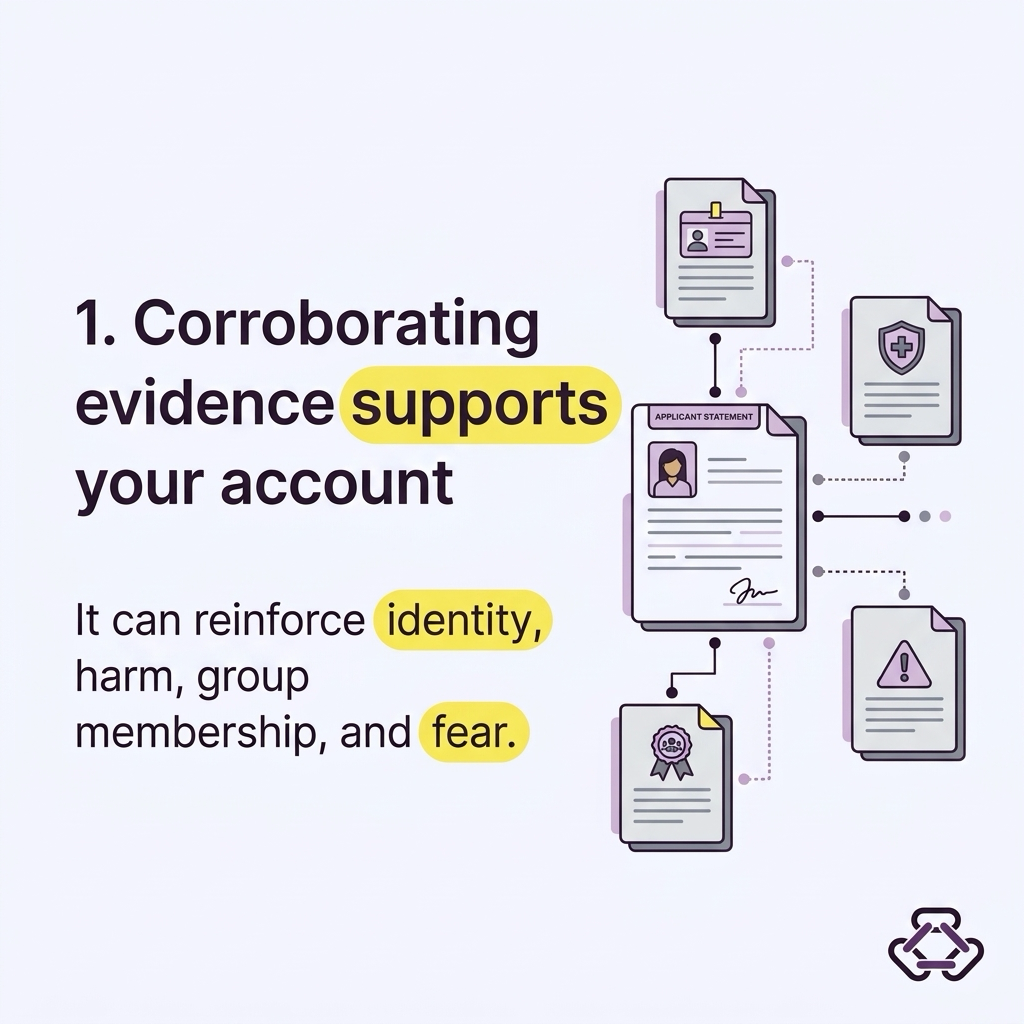
In general terms, corroborating evidence is anything that helps support the applicant’s account: identity records, medical records, witness statements, country conditions reports, photographs, digital evidence, or proof of political, religious, or social-group activity. Federal law says testimony may be enough if it is credible, persuasive, and specific, but immigration adjudicators can also look at whether reasonably available supporting evidence was provided and how the applicant explains any gaps in the record. 8 U.S. § 1158, USCIS Form I-589 Instructions, Matter of L-A-C-
If you are trying to understand the bigger framework around filing deadlines, credibility, and proof, it may help to start with this broader overview of how asylum claims are evaluated. In this post you’ll learn how corroborating evidence works, what kinds of proof can help, how to organize it, and where many applicants run into trouble.
Scroll to the bottom for every post in this series.
Why Corroborating Evidence Matters
An asylum case is often built around the applicant’s own testimony, but asylum officers and immigration judges also evaluate whether the account is internally consistent, consistent with prior statements, and consistent with other evidence in the record, including country conditions material. That framework appears in the asylum statute and in agency guidance. 8 U.S. § 1158, USCIS Credible Fear Lesson Plan
Here’s what that often means in practice:
- Evidence can support the applicant’s identity
- Evidence can support past persecution or threats
- Evidence can support membership in a political, religious, ethnic, or social group
- Evidence can support why relocation inside the home country may not be realistic
- Evidence can help explain inconsistencies, trauma-related memory gaps, or delays in obtaining records
USCIS’s current Form I-589 instructions specifically list possible supporting evidence such as newspaper articles, witness affidavits, expert statements, medical or psychological records, photographs, official documents, and personal statements or live testimony from witnesses or experts. The same instructions also say that if supporting evidence is not reasonably available, the applicant can explain why. USCIS Form I-589 Instructions
What Counts As Corroborating Evidence
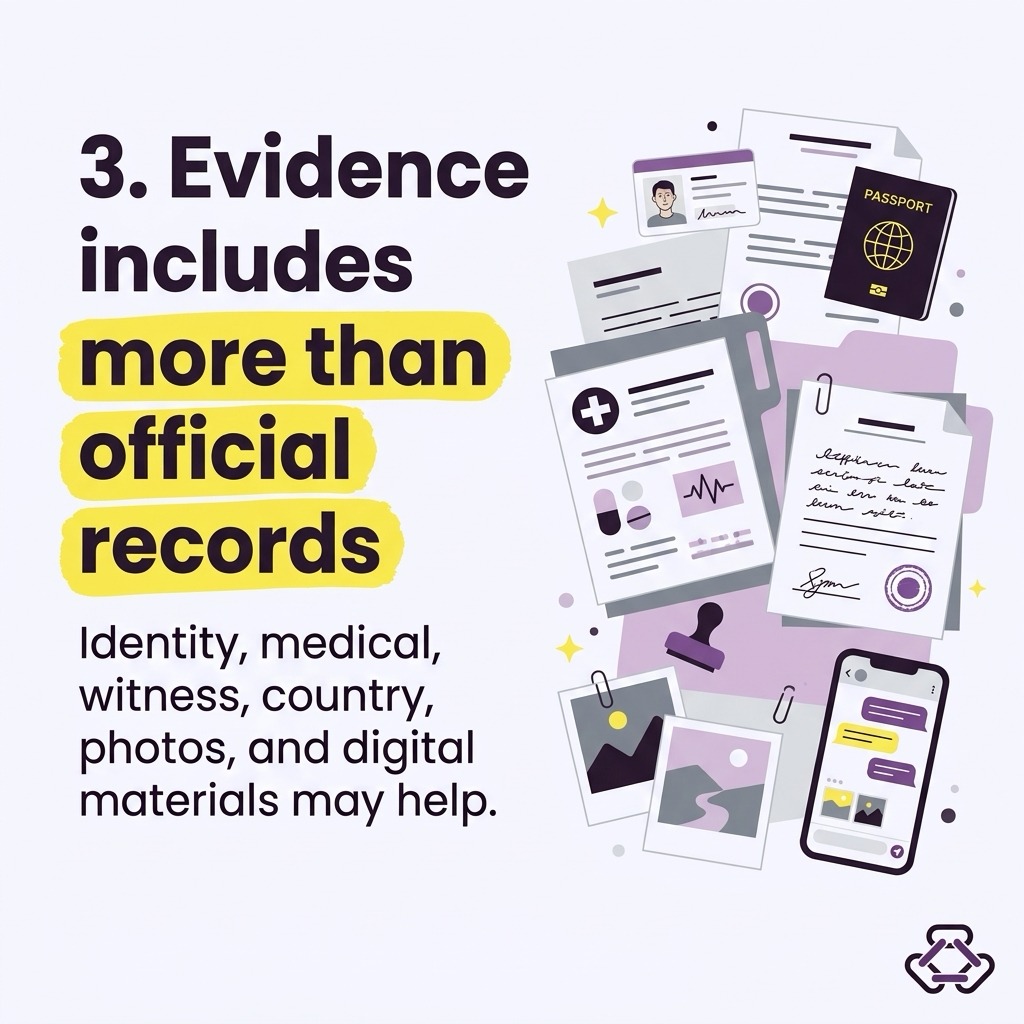
Many people hear “evidence” and think only of official government records. In asylum cases, the picture is much broader.
Identity And Civil Records
Basic identity documents often help establish who the applicant is and where they are from. These can include:
- Passport
- National identity card
- Birth certificate
- Family book or household registration
- Marriage certificate
- School records
- Military records
- Party membership card
- Religious records
Even if these records do not prove persecution by themselves, they can anchor the rest of the case. They may connect the person to a city, religion, ethnicity, language group, family relationship, or organization that later becomes relevant.
Medical And Psychological Evidence
Medical records can sometimes support injuries after an arrest, assault, torture, or sexual violence. Psychological evaluations may also help document trauma symptoms such as PTSD, depression, anxiety, dissociation, or memory fragmentation. That kind of evidence may be particularly helpful when a case involves delayed disclosure, inconsistent recall of dates, or difficulty discussing traumatic events.
International refugee guidance has long recognized that applicants may not be able to prove every part of their claim with documents and that decision-makers often assess credibility together with any corroborative material that is available. UNHCR Handbook And Guidelines, UNHCR Note On Burden And Standard Of Proof
Witness Statements And Affidavits
Statements from family members, friends, colleagues, neighbors, clergy, fellow activists, or other people with personal knowledge can help fill factual gaps. In many cases, these statements are used to support details such as:
- Arrests or detentions
- Threats from police, militias, gangs, or political groups
- Participation in protests, union work, journalism, or religious activities
- Attacks on a home, business, or family member
- Reports made to authorities
- The applicant’s fear of return
Affidavits are often more useful when they are detailed, specific, and tied to firsthand knowledge rather than broad conclusions.
Country Conditions Evidence
Country conditions reports often provide context that supports the applicant’s personal account. The U.S. Department of State publishes annual Country Reports on Human Rights Practices, and those reports are commonly used in immigration proceedings. Other reliable sources may include international organizations, NGO reporting, and academic or expert materials. U.S. Department Of State Reports, 8 U.S. § 1158, UNHCR Refugee Status Determination Guidance
Country conditions evidence usually does not replace personal facts. Instead, it often helps show that the applicant’s story fits a broader documented pattern.
Digital Evidence
In recent years, digital evidence has become more important in asylum matters. This may include:
- Threatening text messages
- Social media posts
- Emails
- WhatsApp or Telegram messages
- Screenshots of threats or doxxing
- News coverage mentioning the applicant or their group
- Photos or videos of protests, injuries, damage, or surveillance
- Metadata, timestamps, account details, or phone logs
Digital evidence can be powerful, but it often raises questions about authenticity, translation, and context. That is one reason organization matters.
How To Gather Corroborating Evidence For An Asylum Case
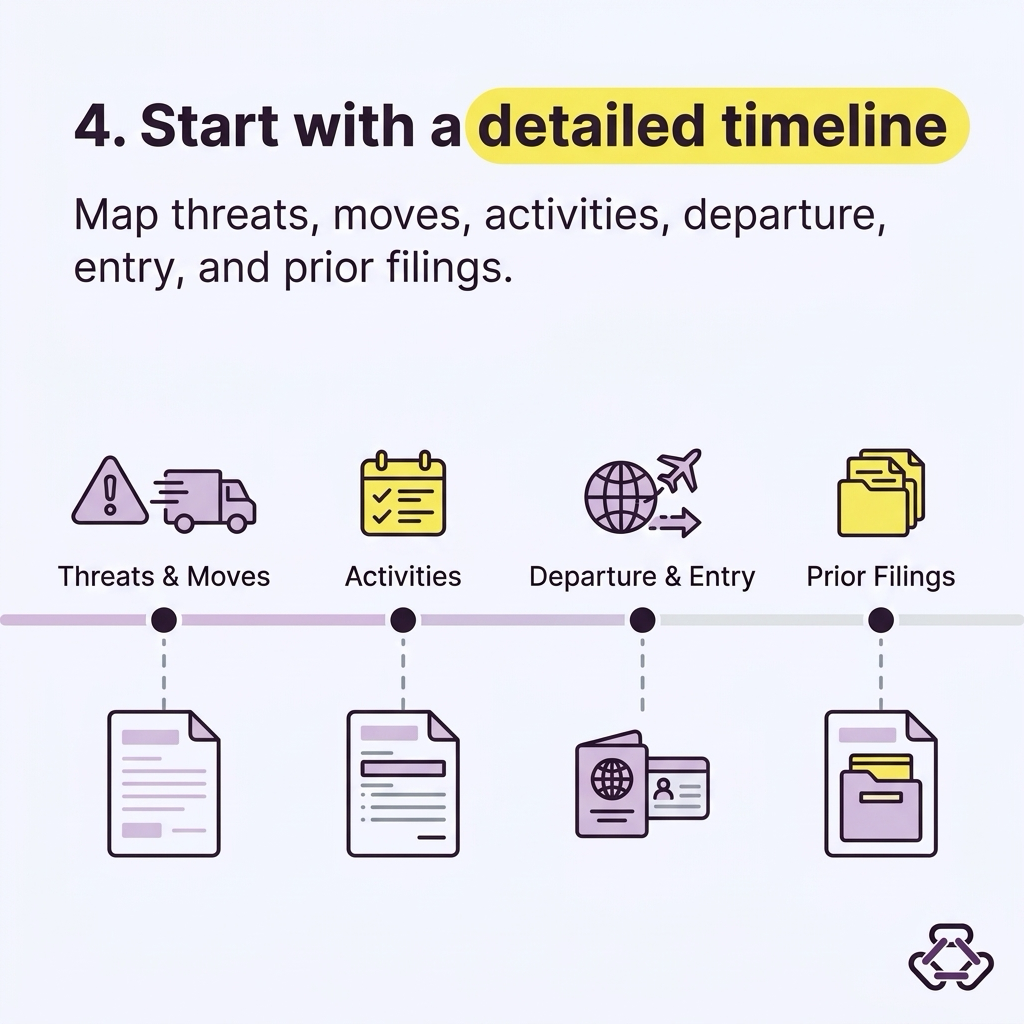
1. Start With A Detailed Timeline
Before collecting documents, it often helps to prepare a timeline of major events:
- Dates of threats, arrests, beatings, detentions, or interrogations
- Moves from one city or region to another
- Political, religious, or community activities
- Family events tied to the claim
- Departure from the home country
- Entry into the United States
- Any prior immigration interviews or filings
A timeline can make it easier to identify what evidence exists and where it may come from. It can also reduce the risk that documents later conflict with the personal statement.
This early step is especially useful because credibility findings can be based on consistency across oral testimony, written applications, prior interviews, and documentary evidence. 8 U.S. § 1158
2. Identify Which Facts Need Support
Not every fact requires the same type of proof. Some parts of a claim are usually more important than others. For example:
- Identity: Who is the applicant?
- Protected ground: Why was the applicant targeted?
- Past harm: What happened?
- Future fear: Why would the danger continue?
- Government involvement or inability to protect: Who caused the harm, and could authorities protect the applicant?
- Reasonable availability: If evidence is missing, why is it missing?
A focused list can help avoid sending a stack of documents that do not connect clearly to the legal claim.
3. Gather Primary Documents First
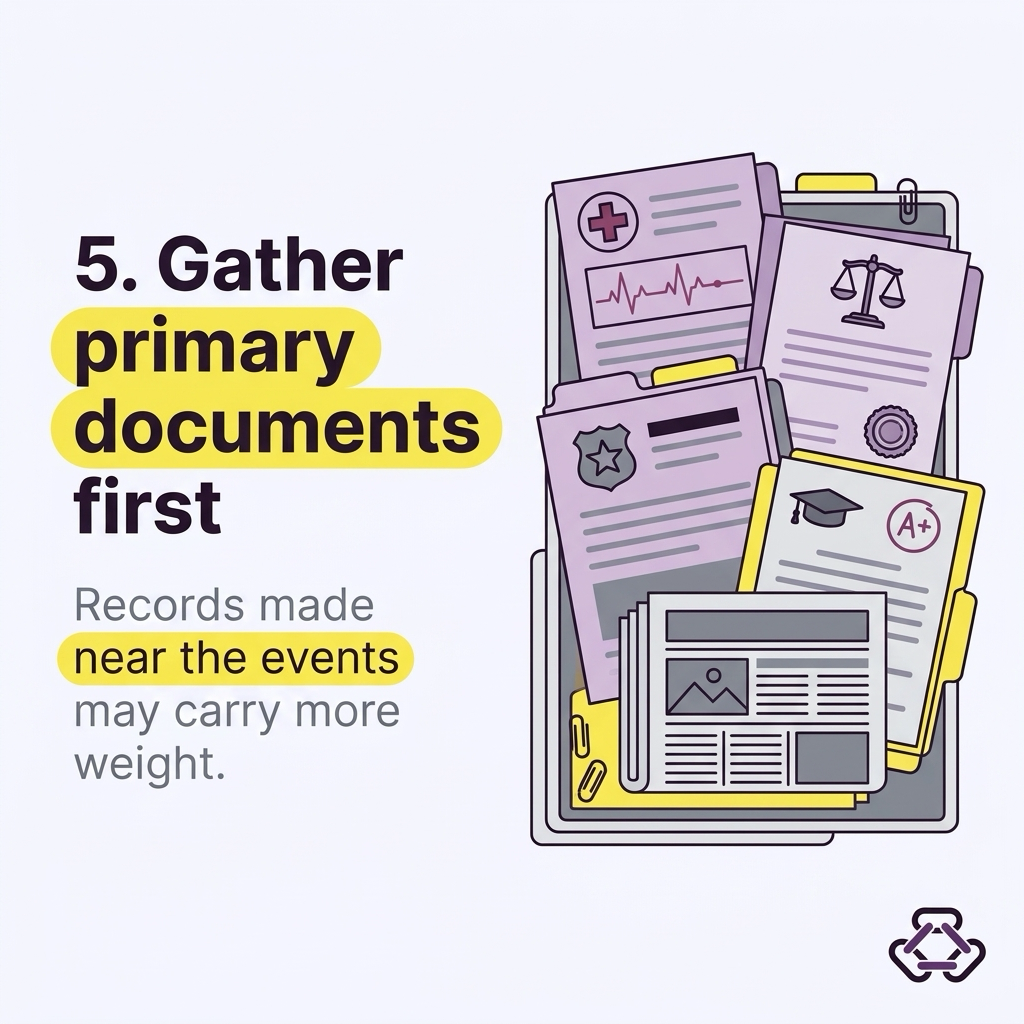
Primary documents are records created close in time to the events. These may carry more weight than later summaries. Examples include:
- Hospital or clinic records
- Police reports
- Court records
- Arrest warrants or summonses
- Death certificates
- Membership cards
- Employment records
- School disciplinary records
- Newspaper articles published at the time of the events
That said, many asylum seekers cannot safely obtain official records from the very government or local authorities they fear. The current USCIS instructions acknowledge that supporting evidence may not always be reasonably available and allow applicants to explain that problem. USCIS Form I-589 Instructions
4. Build Secondary Evidence Around The Gaps
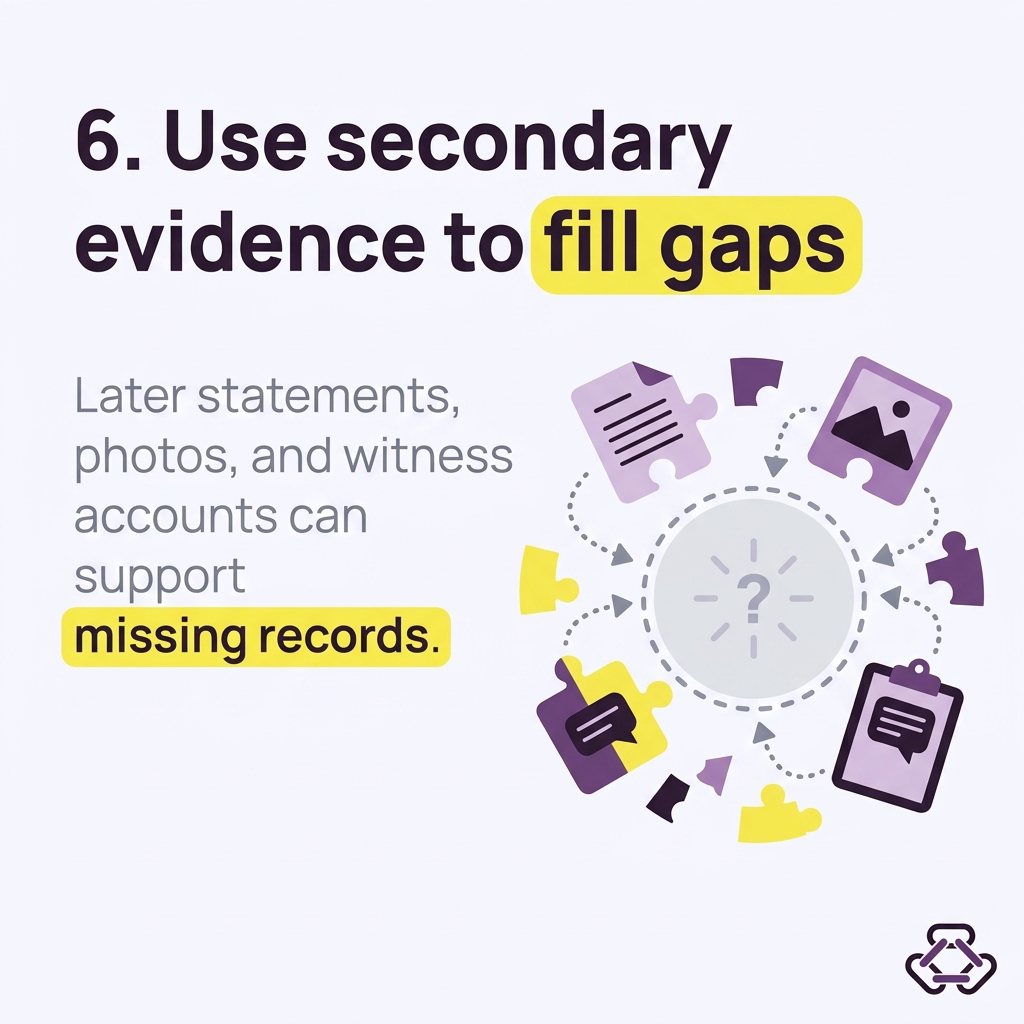
If primary records are missing, secondary evidence may still help show the same point from another angle. For example:
- A hospital record is unavailable, but a treating doctor writes a statement later
- A police report was never issued, but a neighbor describes the attack
- An arrest warrant cannot be obtained, but a family member sends a photo of officers visiting the home
- A protest attendance list is unavailable, but photos, media clips, and organizer statements place the person there
This is where thoughtful case-building becomes important. A claim often looks more credible when multiple smaller pieces line up around the same event.
5. Ask Witnesses For Specific Statements
A witness letter is usually more helpful when it answers practical questions such as:
- How does the witness know the applicant?
- How long have they known them?
- What exactly did they see or hear?
- When and where did it happen?
- How do they know the persecutor’s identity?
- Did they observe injuries, threats, searches, or surveillance?
- Are they attaching their own ID or contact information?
- Why are they able to speak about this event firsthand?
Vague letters often create less value than applicants expect. A short but concrete statement is often more persuasive than a dramatic letter with no dates, no detail, and no explanation of personal knowledge.
6. Preserve Digital Evidence Carefully
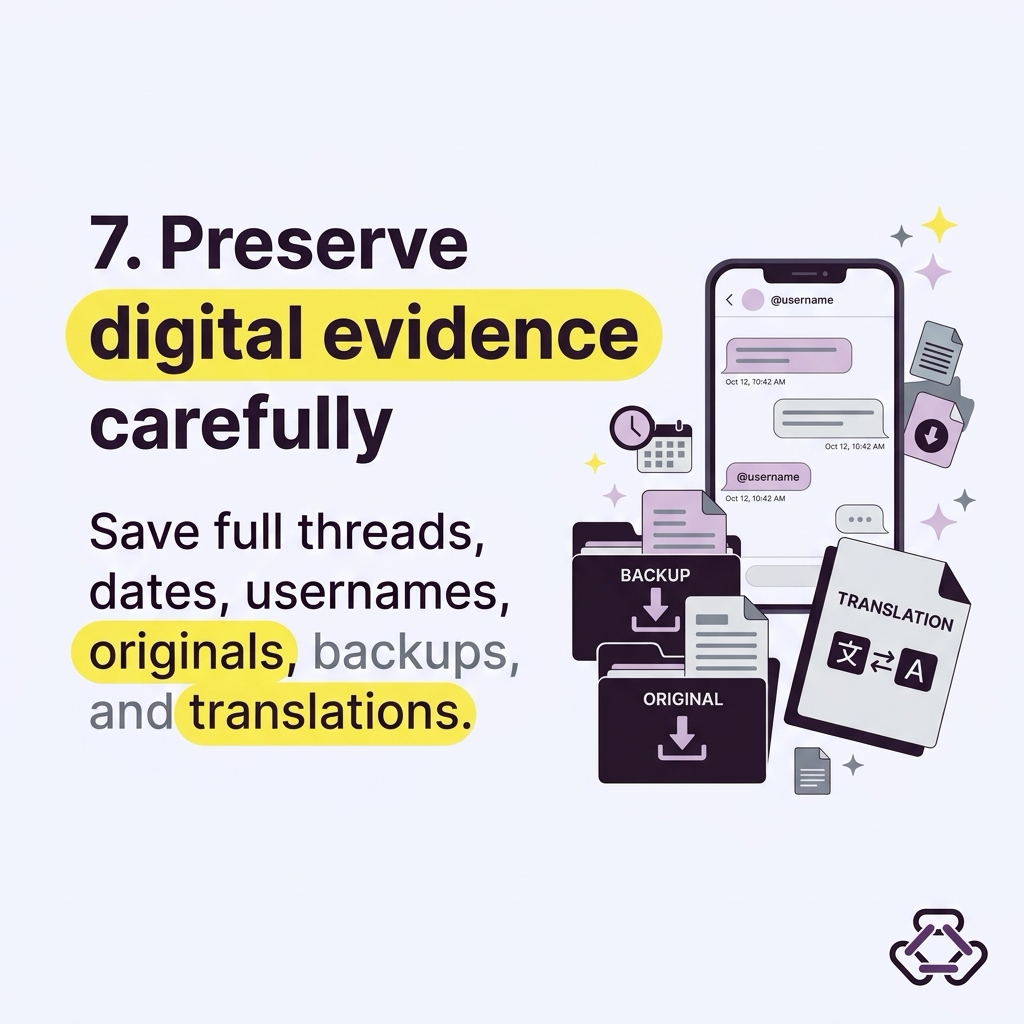
Digital evidence can disappear quickly. Some people in similar situations preserve it by:
- Downloading original files instead of forwarding screenshots only
- Saving full message threads, not isolated excerpts
- Capturing visible dates, usernames, and account identifiers
- Keeping backups in more than one place
- Not editing images or videos
- Not cropping out context unless a full copy is also preserved
- Saving links along with screenshots in case a page is removed later
If the evidence is in another language, certified translation may also become important. If the account owner is using a pseudonym, additional context may help explain who the person is and why the message matters.
7. Use Country Conditions To Support The Personal Story
Country conditions evidence works best when it matches the applicant’s facts instead of flooding the record with generic materials. For example:
- A journalist from a specific region may use reports about press freedom abuses in that region
- An LGBTQ applicant may use evidence about criminalization, social violence, or police inaction affecting LGBTQ people in that country
- A political dissident may use reports showing arrests of opposition members during the relevant period
- A religious minority applicant may use reports documenting attacks on that faith community
The U.S. Department of State’s human rights reports are commonly cited, but they are often stronger when paired with more targeted reporting from UN bodies, NGOs, or regional experts. U.S. Department Of State Reports, UNHCR Refugee Status Determination Guidance
8. Explain Missing Evidence Directly
One of the most overlooked parts of an asylum case is the explanation for what is not in the file.
USCIS’s Form I-589 instructions expressly say that if supporting evidence is not reasonably available, or if the applicant is not providing it at that time, the applicant can explain why. In removal proceedings, Board of Immigration Appeals precedent also says adjudicators consider whether corroborating evidence was reasonably available and what explanation exists for its absence. USCIS Form I-589 Instructions, Matter of L-A-C-
Common explanations may include:
- The applicant fled suddenly
- Contacting witnesses would create danger
- Local authorities refuse to issue records
- Records were destroyed in conflict
- The persecutor is the state itself
- The witness is in hiding
- The applicant is estranged from relatives
- Trauma makes details difficult to retrieve without time and support
A clear explanation often reads better than silence.
9. Organize Everything In A Way The Decision-Maker Can Follow
A well-organized asylum packet may be easier to evaluate than a larger but disorganized one. Many attorneys use a structure like this:
- Index or table of exhibits
- Personal declaration
- Identity and civil documents
- Event-specific records
- Witness statements
- Medical or psychological records
- Country conditions exhibits
- Translations and certificates
- Explanation of unavailable evidence
The point is not just neatness. It is coherence. Each exhibit ideally connects to a factual statement in the declaration.
10. Make Sure The Application And Evidence Match
One recurring issue in asylum cases is inconsistency between the Form I-589, the declaration, witness letters, prior border or credible-fear statements, and later testimony. Federal law allows adjudicators to consider those inconsistencies even when they do not go to the heart of the claim. 8 U.S. § 1158
That is one reason many applicants spend time reviewing the record carefully before filing or testifying. If you are also trying to avoid common filing problems, it may help to read about mistakes that can weaken an asylum claim early in the process.
Common Types Of Corroborating Evidence In Asylum Cases
To make this more concrete, here are examples of evidence people often gather:
Evidence Of Identity
- Passport
- Birth certificate
- National ID
- School records
- Family registry documents
Evidence Of Harm
- Medical records
- Injury photos
- Therapy records
- Death certificates
- Property damage photos
Evidence Of Threats
- Texts and emails
- Audio messages
- Threat letters
- Police visit records
- Screenshots of online threats
Evidence Of Political Or Social Activity
- Membership cards
- Rally photos
- Media coverage
- Social media posts
- Statements from organizers or colleagues
Evidence Of Country Conditions
- State Department reports
- NGO reports
- UN materials
- Expert declarations
- News reports from reliable outlets
Evidence Explaining Missing Proof
- Personal declaration
- Affidavits describing danger in contacting witnesses
- Documentation of destroyed records
- Proof of displacement or conflict in the region
What If There Is No Official Paper Trail?
That is common.
Many valid asylum claims involve abuse by police, military, gangs, militias, political actors, extremist groups, or family members acting in places where institutions are weak or complicit. In those settings, official reports may never be created, or they may be dangerous to request.
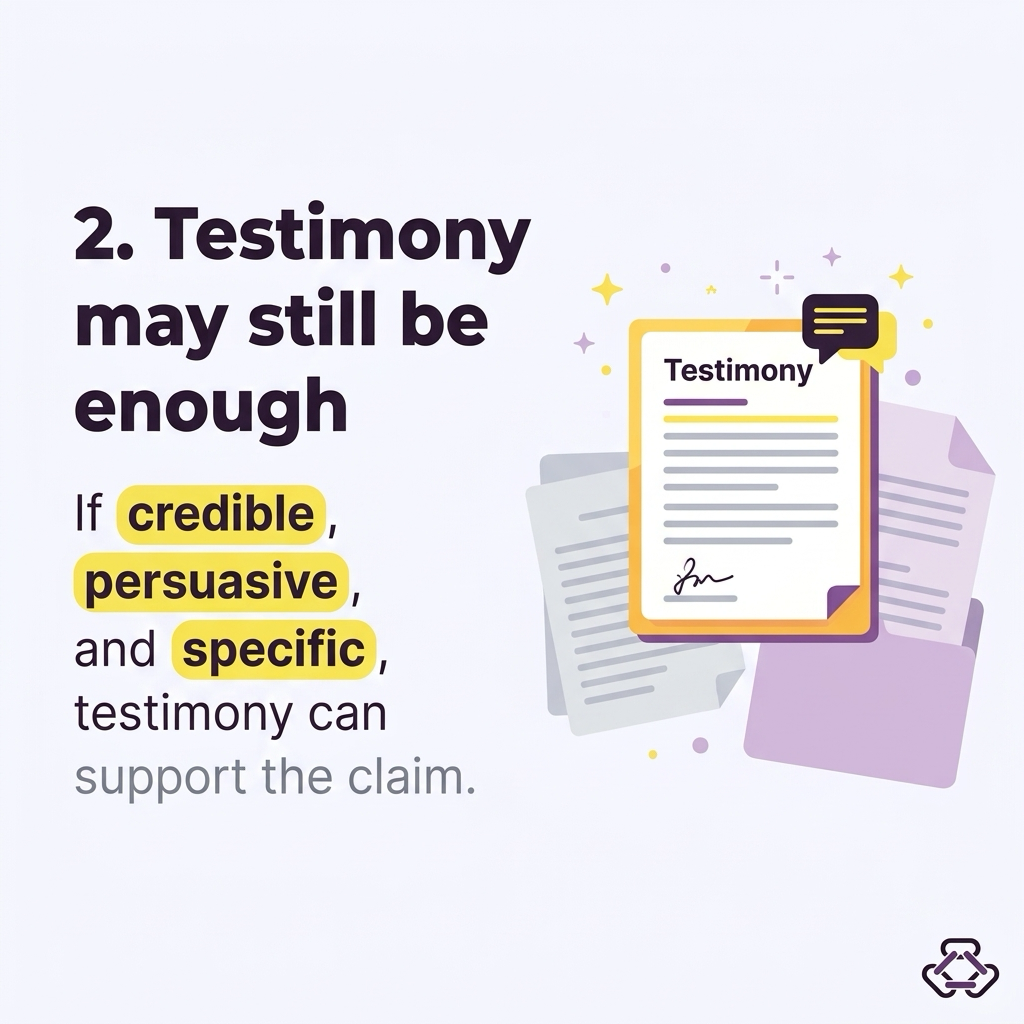
U.S. law does not say every asylum claim fails without official documents. The statute says testimony may be sufficient if it is credible, persuasive, and specific. At the same time, adjudicators may still examine whether supporting evidence was reasonably available. 8 U.S. § 1158, Matter of L-A-C-
So the issue is often not “Do I have the perfect document?” It is closer to: “What proof is realistically available, and how clearly can I explain the rest?”
Timing Still Matters
Corroborating evidence can also affect timing issues. USCIS states that the date it receipts Form I-589 serves as the filing date for the asylum one-year deadline. USCIS: What Happens After You File Form I-589
That matters because some applicants delay filing while trying to collect more evidence. In some cases, that delay can create other complications. People who are trying to understand filing mechanics often also look at how the application process is typically put together from start to finish and the questions people usually ask before filing.
Why Legal Help Can Change The Quality Of The Evidence Record
Corroborating evidence is not just about gathering papers. It is about deciding what facts matter most, what documents support those facts, what explanations are needed for missing proof, and how to present everything consistently.
An experienced asylum attorney may help with:
- Identifying the legally important facts
- Spotting credibility issues before the interview or hearing
- Drafting witness declarations
- Working with translators
- Obtaining expert evaluations
- Selecting country conditions evidence that fits the claim
- Explaining unavailable documents in a way that is clear and fact-specific
- Organizing the record for USCIS or immigration court
That kind of fit can matter because asylum cases are highly fact-dependent, and evidence that looks persuasive in one case may carry less weight in another.
Final Thoughts
Gathering corroborating evidence for an asylum case is rarely about creating a perfect file. It is usually about building a credible, detailed, and consistent record with whatever proof can realistically be obtained. Strong evidence often comes from many sources working together: identity records, witness accounts, medical documentation, digital records, and reliable country conditions materials.
If your asylum claim involves missing records, safety concerns, trauma, prior statements, or complex credibility questions, an attorney may help you determine what evidence is reasonably available and how to present it clearly.
Visit ReferU.AI to get matched with an attorney who has demonstrable experience in cases like yours — for free.
