Table of Contents
- Asylum Explained: Deadlines, Credibility, Evidence, and Protection
- What Is Asylum?
- What Protection Does Asylum Actually Provide?
- Why The One-Year Filing Deadline Matters So Much
- Are There Exceptions To The One-Year Rule?
- What If Someone Misses The Deadline?
- How Credibility Shapes An Asylum Case
- What Often Damages Credibility?
- Can Testimony Alone Be Enough?
- What Counts As Good Evidence In An Asylum Case?
- It Confirms Identity And Timeline
- It Connects Harm To A Protected Ground
- It Supports The Story With External Proof
- It Explains Missing Evidence
- How Do Officers And Judges Evaluate Country Conditions?
- What Are The Main Bars To Asylum?
- What Happens After Filing?
- Why Asylum Cases Often Take So Long
- What Questions Do People Commonly Ask Before Filing?
- Why Preparation Often Changes The Quality Of A Case
- When Legal Representation Can Matter Most
- The Bottom Line

Type
Grandchild
Status
Approved
Title (YouTube)
Images Failed (Social)
Images Failed (Social)
Do not index
Parent item
Publish Date (TikTok)
Apr 25, 2027 15:15
Videos Post IDs (Social)
Hashtags (Social)
#LegalAdvice #LegalHelp #Immigration #Asylum
Caption
Caption X
Cover

OG Image

Alt Image Text
Flat vector illustration of asylum explained with credibility and evidence, showing a person reviewing documents, a deadline calendar, a balance scale, and a protective shield in a minimal legal guidance scene.
Images



Videos

Publish Date (Social)
Feb 19, 2027 09:00
Scheduled (Social)
Scheduled (Social)
Images Posted (Social)
Images Posted (Social)
Videos Posted (Social)
Videos Posted (Social)
Featured
Created time
Apr 7, 2026 12:01 AM
Authors
CTA Practice Area (Social)
Immigration
TikTok Failed (Social)
TikTok Failed (Social)
Videos Post Links (Social)
TikTok Post Links (Social)
Images Post IDs (Social)
YT Post ID
Video Pending Manual (Social)
TikTok Posted (Social)
TikTok Posted (Social)
TikTok Post IDs (Social)
Video Cover (Social)

Images Post Links (Social)
First Comment (Social)
Videos Failed (Social)
Videos Failed (Social)
YT Embedded
YT Embedded
Images Delete (Social)
Videos Delete (Social)
Carousel Video URL (Social)
Asylum Explained: Deadlines, Credibility, Evidence, and Protection
For many people, asylum is one of the most misunderstood areas of U.S. immigration law. It can involve urgent safety concerns, strict filing rules, deeply personal testimony, and a legal process that often turns on credibility and supporting evidence. It also sits within a larger immigration system that includes removal defense, humanitarian relief, and immigration court procedure, which is why it helps to first understand how asylum fits into the broader immigration system.
This post explains the basics of asylum in plain language: what protection asylum offers, the one-year filing deadline, how credibility is evaluated, what kinds of evidence often matter, and where many cases become difficult. In this post you’ll learn how asylum claims are analyzed, why timing can shape a case from the beginning, and how an attorney may help present a claim with more clarity and supporting proof.
Scroll to the bottom for every post in this series.
What Is Asylum?
Asylum is a form of protection available in the United States to some people who are unable or unwilling to return to their home country because of persecution or a well-founded fear of persecution on account of race, religion, nationality, political opinion, or membership in a particular social group. The basic legal framework appears in the Immigration and Nationality Act and federal regulations, and USCIS uses Form I-589 to request asylum and related protection. USCIS’s asylum page and the federal regulation at 8 C.F.R. § 208.13 outline the core eligibility rules.
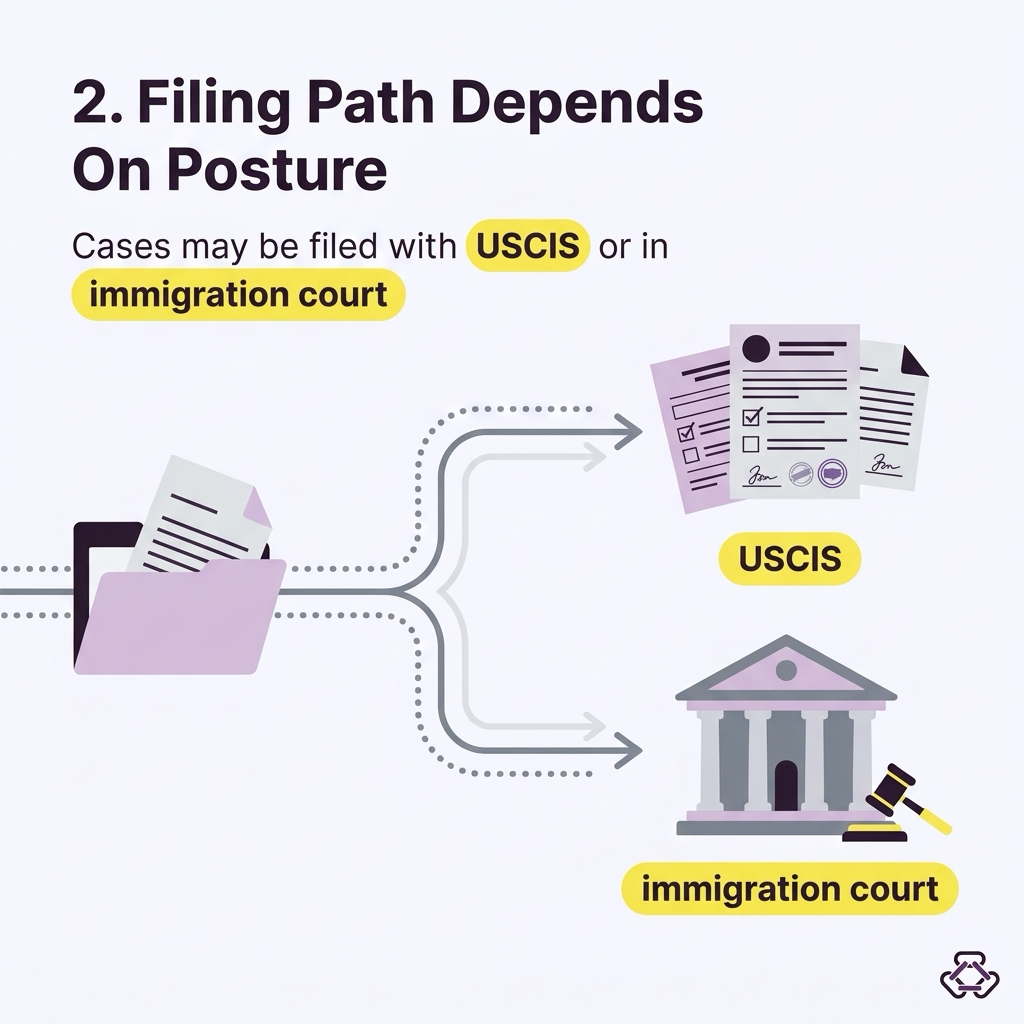
Asylum is different from many other immigration benefits because it is protection-focused rather than family- or employment-sponsored. A person may apply affirmatively with USCIS or defensively in immigration court, depending on posture and procedure. If you want a fuller overview of those two paths, this companion guide on the two main ways asylum cases get filed and decided adds more detail.
If asylum is granted, the person may remain in the United States, may work, and may later seek lawful permanent residence if otherwise eligible. USCIS guidance for employers notes that asylees are employment authorized incident to status.
What Protection Does Asylum Actually Provide?
In practical terms, a grant of asylum can provide protection from removal to the country of feared persecution and can create a path toward longer-term stability in the United States. It may also allow certain family members to be included or later petitioned for through derivative processes, depending on the facts and timing. USCIS describes asylum as humanitarian protection for qualifying applicants who meet the refugee definition under U.S. law.
That said, asylum is only one form of protection. Some applicants also seek withholding of removal or protection under the Convention Against Torture (CAT) through the same Form I-589. Those protections are different from asylum in important ways, especially regarding benefits, eligibility bars, and long-term options. That difference becomes especially important when the one-year asylum deadline is at issue or when a person is in immigration court.
Why The One-Year Filing Deadline Matters So Much
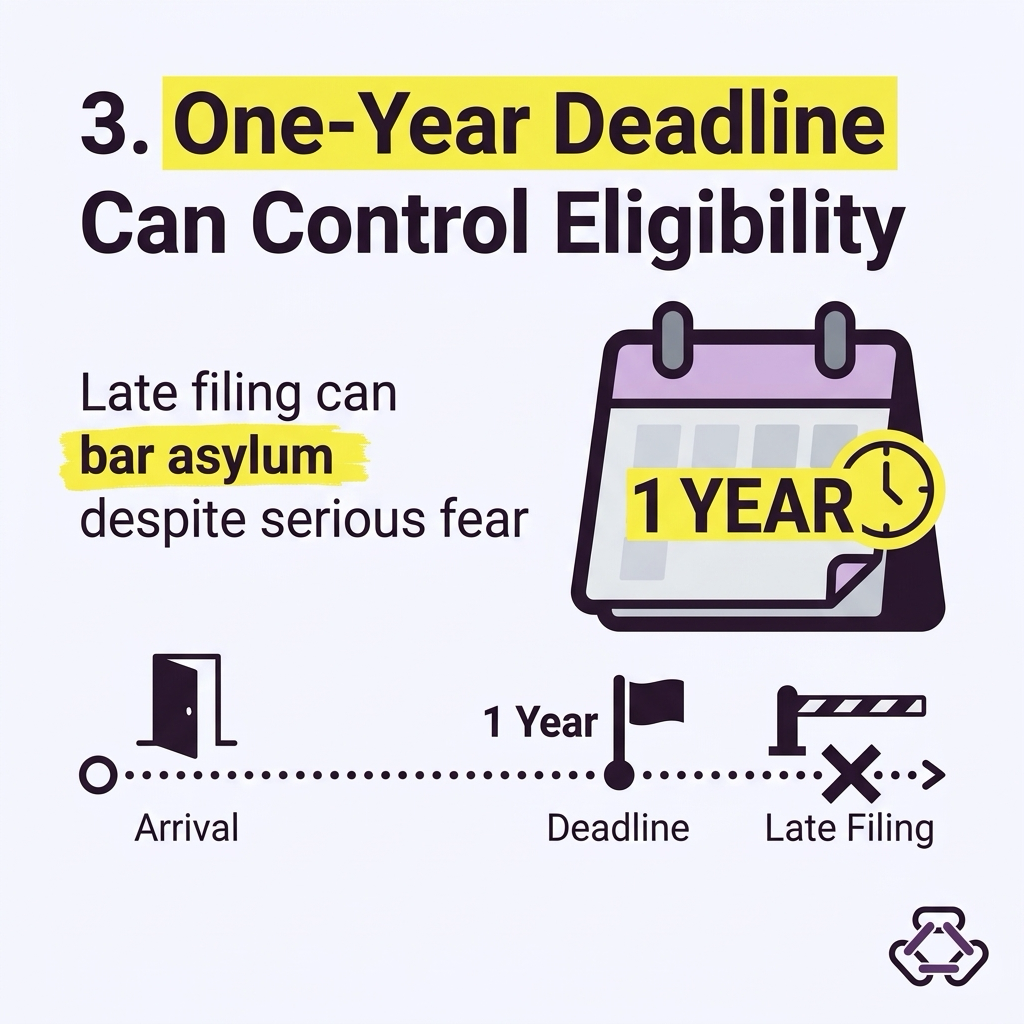
One of the most important asylum rules is the one-year filing deadline. In general, a person is expected to file for asylum within one year of the last arrival in the United States. USCIS explains this on its Asylum Bars page, and the regulation at 8 C.F.R. § 208.4 describes the timing rule and exceptions.
This deadline is a major issue because a late filing can bar asylum even if the underlying fear is real and serious. In immigration court, EOIR’s policy materials also reflect the one-year rule for defensive asylum filings through EOIR guidance on deadlines.
Are There Exceptions To The One-Year Rule?
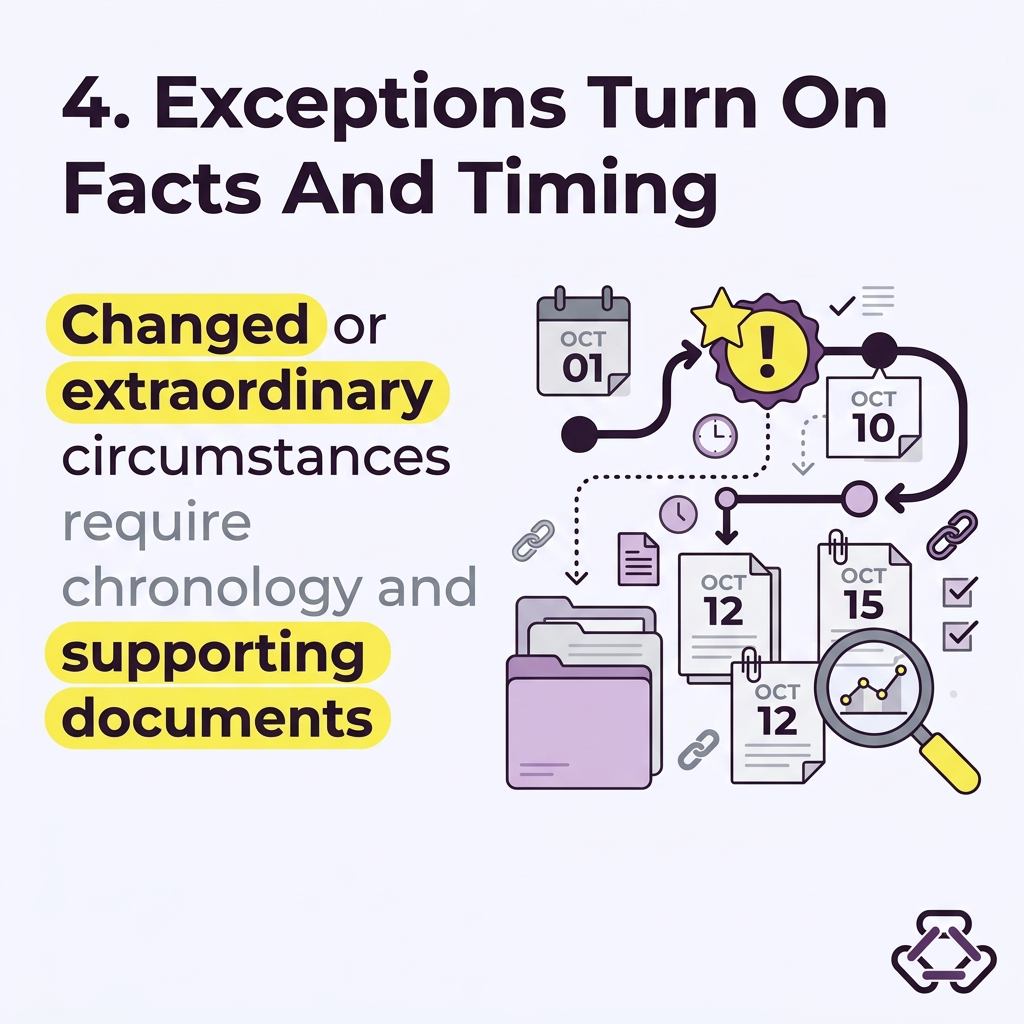
Yes. The law recognizes exceptions for changed circumstances and extraordinary circumstances. Under 8 C.F.R. § 208.4, changed circumstances generally refer to developments that materially affect asylum eligibility, while extraordinary circumstances generally refer to events directly related to the delay in filing.
USCIS also notes in its affirmative asylum FAQ that examples can include certain status issues, serious obstacles, or situations where a timely filing was rejected as improperly filed and then corrected within a reasonable time.
In real cases, the exception analysis can become very fact-specific. The questions often include:
- When exactly did the person last enter the United States?
- When did the changed or extraordinary circumstance occur?
- How quickly did the person file after that?
- What documents support the explanation?
Because late-filed cases often turn on documentation and chronology, many applicants spend considerable time on putting together the application carefully from the start.
What If Someone Misses The Deadline?
Missing the deadline does not always end the conversation, but it can change it dramatically. A person may still pursue withholding of removal or CAT protection in some circumstances, and the exception question may still be litigated. But asylum itself can become unavailable if the judge or asylum officer finds the filing untimely and no exception applies.
That is one reason timing and documentation matter so much. Even a strong fear-based claim can become harder if the record does not explain why the filing happened when it did. For many applicants, the timeline is not just a technical issue. It becomes part of the credibility story.
How Credibility Shapes An Asylum Case
Credibility is central in asylum law. The applicant’s own testimony often sits at the center of the case, especially because persecution frequently happens in private, under chaotic conditions, or in countries where records are hard to obtain. Federal regulations state that an applicant’s testimony, if credible, may be enough to meet the burden of proof without corroboration in some cases. That rule appears in 8 C.F.R. § 208.13.
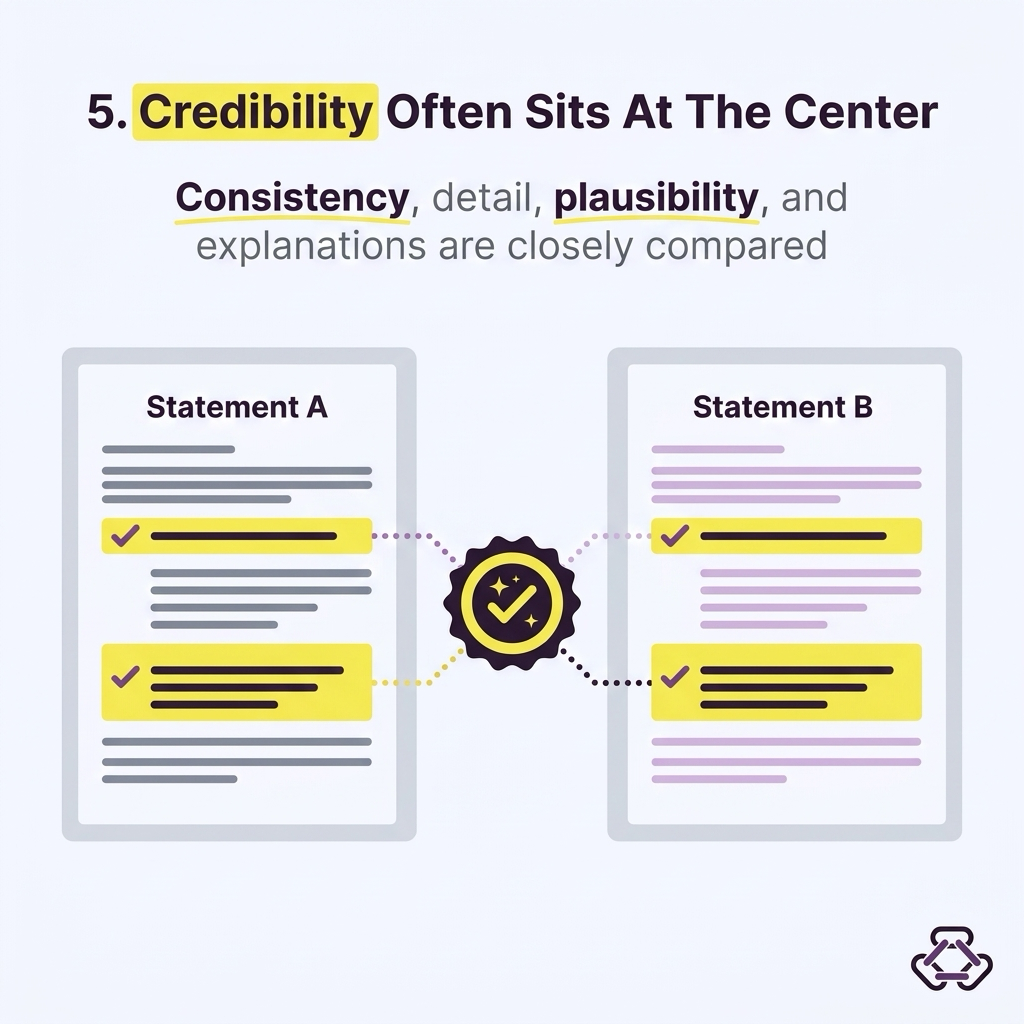
But “credibility” does not simply mean whether a person seems sincere. In asylum cases, officers and judges often look at:
- Internal consistency
- Consistency with prior statements
- Specific detail
- Plausibility in light of country conditions
- Explanations for omissions or discrepancies
- Availability of corroborating evidence
The REAL ID Act influenced how immigration judges evaluate credibility and corroboration, and EOIR training materials discuss those standards in more detail, including the role of consistency and supporting proof in protection claims. See, for example, EOIR material summarizing REAL ID Act provisions.
What Often Damages Credibility?
Small inconsistencies do not automatically destroy a claim, but repeated contradictions can create serious problems. Common trouble spots include:
- Different dates given in interviews, declarations, and testimony
- Omitted arrests, threats, or travel history
- Conflicting explanations about why the person fears return
- Inconsistencies between testimony and country-condition reports
- Filing an application that is vague and only later becoming specific
Trauma, translation issues, memory gaps, and cultural differences can all affect how someone tells a story. Even so, the written application, supporting declaration, interview answers, and court testimony are often compared closely. This is why many people try to learn in advance about common errors that can quietly undermine an asylum filing.
Can Testimony Alone Be Enough?
Sometimes, yes. The regulation says credible testimony may be sufficient without corroboration. But in actual practice, corroborating evidence often plays a major role, especially when it is reasonably available. That means even truthful applicants can face difficulty if the file lacks documents that could have been obtained.
This is one of the most misunderstood parts of asylum law. People often hear that testimony alone can be enough and assume documents do not matter. In reality, many decision-makers look for a combination of:
- A detailed personal declaration
- Country-condition evidence
- Identity documents
- Medical or psychological records, where available
- Police, court, or complaint documents, where available
- Affidavits from witnesses, relatives, or community members
- Proof of political, religious, social, or activist involvement
UNHCR’s resources on country information and guidance also emphasize how objective country-of-origin evidence can help evaluate claims of past persecution and fear of future harm.
What Counts As Good Evidence In An Asylum Case?
There is no single perfect evidence checklist, because asylum claims vary widely. A journalist threatened by state actors, a religious convert facing violence, a domestic-violence survivor, and an LGBTQ applicant from a criminalizing regime may all rely on very different forms of proof.
Still, strong asylum evidence often does a few things at once:
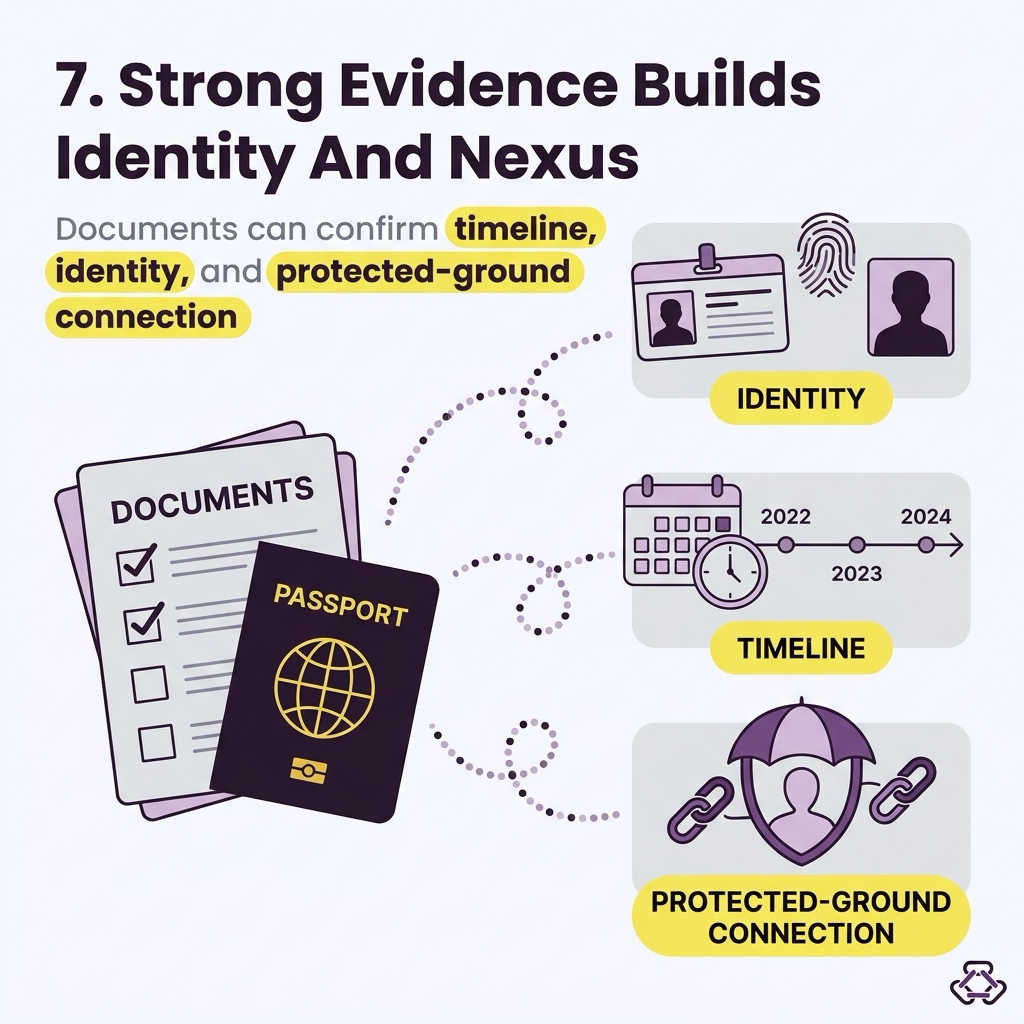
It Confirms Identity And Timeline
Basic documents can help establish who the applicant is and where key events happened. Passports, national IDs, birth certificates, school records, travel records, entry documents, and prior immigration paperwork can all matter.
It Connects Harm To A Protected Ground
Asylum is not available for every dangerous or unfair situation. The case generally has to connect the harm or feared harm to one of the protected grounds. Evidence that a persecutor targeted the applicant for political speech, religious practice, ethnicity, or membership in a particular social group can be especially important.
It Supports The Story With External Proof
Country reports, human-rights documentation, press coverage, NGO reports, and expert declarations can help show that the applicant’s account fits broader conditions in the home country. UNHCR’s Refworld-linked guidance is often used to locate this kind of background material.
It Explains Missing Evidence
Sometimes the most realistic record is incomplete. Police may refuse reports. Hospitals may not preserve records. Family members may be in hiding. Witnesses may be afraid. In those cases, declarations explaining why evidence is unavailable may still be important.
For a deeper practical discussion, this related post on collecting the documents and statements that can back up an asylum claim goes further into corroboration.
How Do Officers And Judges Evaluate Country Conditions?
Country conditions are often the bridge between a personal story and the legal definition of persecution. An officer or judge may ask whether the applicant’s account is consistent with known conditions in the country of origin. That can include:
- Treatment of political dissidents
- Religious persecution
- Violence against LGBTQ people
- Ethnic or tribal conflict
- Gender-based harm
- Government inability or unwillingness to protect
- Armed groups operating with impunity
UNHCR explains that country guidance often includes objective information about security, human rights, and humanitarian conditions and can assist with questions such as past persecution and future risk. Government reports, UN sources, and established human-rights organizations often carry substantial weight in this part of the record.
What Are The Main Bars To Asylum?
Not everyone who fears return is eligible for asylum. USCIS lists several bars on its Asylum Bars page, including the one-year deadline bar, prior-denial issues in some circumstances, and certain safe-third-country issues. USCIS also notes bars from a grant of asylum, such as persecution of others, conviction of a particularly serious crime, serious nonpolitical crimes outside the United States, terrorism-related issues, and security-related concerns.
These bars are highly fact-dependent. In many cases, what looks straightforward at first becomes much more technical once criminal history, prior immigration filings, travel, border encounters, or other countries of residence become part of the analysis.
What Happens After Filing?
The path depends on whether the case is affirmative or defensive. USCIS handles affirmative asylum applications in the first instance for people not already in removal proceedings, while immigration judges decide defensive claims in court.
USCIS’s affirmative asylum FAQ explains several procedural points, including interviews, missed interview consequences, and work authorization timing. As of the current USCIS guidance, a person with a pending asylum application may file Form I-765 after the asylum application has been pending for 150 days, and eligibility to receive the EAD generally begins after 180 days, subject to asylum-clock rules and applicant-caused delays. USCIS also notes that some applicant-caused delays can stop the asylum EAD clock, as described in USCIS guidance on applicant-caused delays.
There are also newer fee-related developments. USCIS’s Form I-589 page states there is no filing fee for the application itself, but it also notes an Annual Asylum Fee for certain pending cases filed on or after October 1, 2024, if the application remains pending for 365 days. USCIS. EOIR’s forms and fees page likewise reflects fee changes for immigration court filings, including an initial filing fee and an annual asylum fee in court proceedings. Because fee rules have changed recently, applicants and attorneys often double-check the current filing instructions close to the filing date.
Why Asylum Cases Often Take So Long
Backlogs remain a major reality. The immigration court system continues to carry millions of pending matters, and asylum is a significant part of that load. According to TRAC’s March 24, 2026 update, the immigration court backlog stood at 3,318,099 active cases at the end of February 2026. On the affirmative side, a federal oversight report found USCIS had more than 1 million asylum cases pending at the end of fiscal year 2023, highlighting the scale of the delay problem. Oversight.gov.
Long delays can affect evidence gathering, witness availability, memory, family stability, and work authorization issues. They can also make consistency even more important, because statements made years apart may be compared closely later.
What Questions Do People Commonly Ask Before Filing?
Many people considering asylum have similar concerns:
- Am I still eligible if I entered a long time ago?
- What if I was never arrested or never reported what happened?
- What if I do not have documents?
- What if my fear involves a gang, family member, or private actor?
- What if my story changed because I was scared or traumatized?
- What if I already had another immigration case?
Those are common questions because asylum law sits at the intersection of timing, personal history, and legal framing. This related article on the most common concerns people raise before starting an asylum case explores those early-stage questions in more detail.
Why Preparation Often Changes The Quality Of A Case
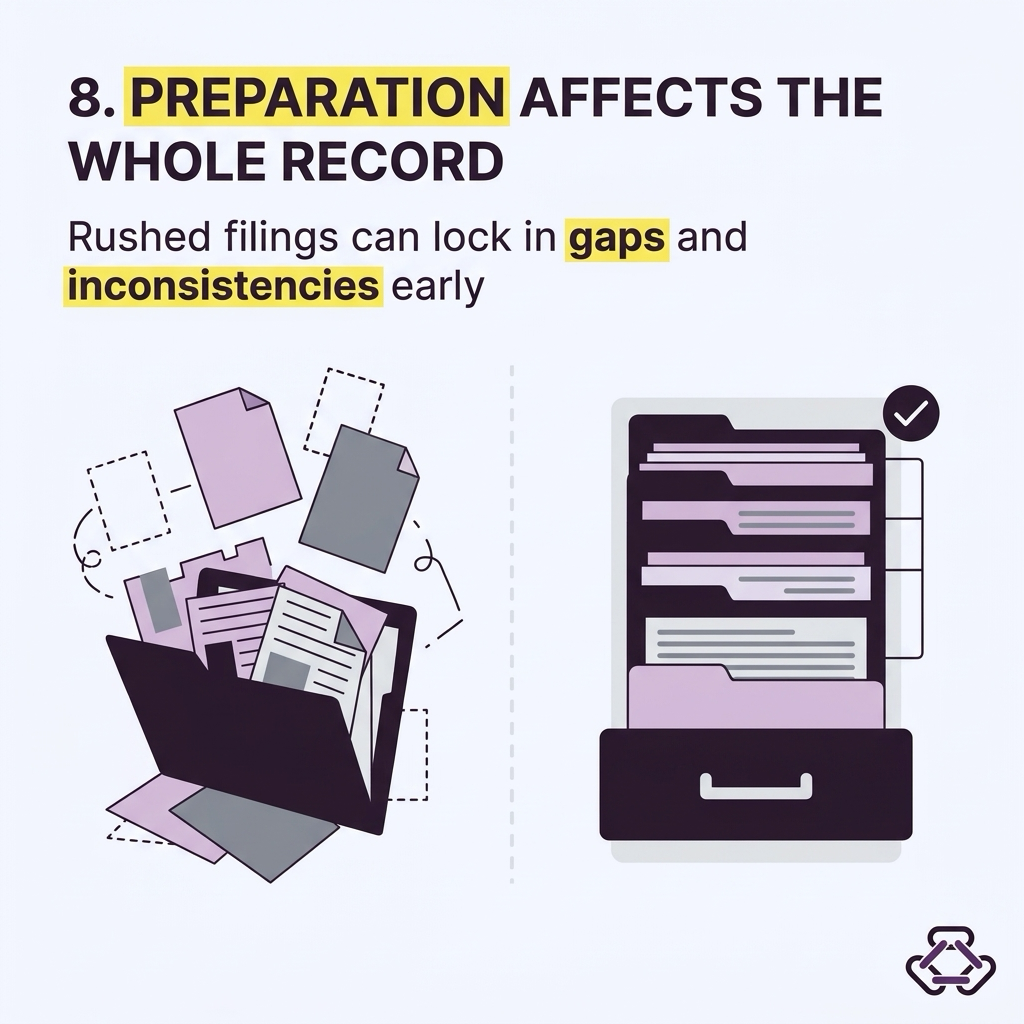
A rushed asylum filing can create problems that follow the case for years. Dates may be incomplete. The declaration may be too short. Protected-ground analysis may be underdeveloped. Supporting records may be missing or untranslated. Inconsistencies can get locked into the record early.
By contrast, a carefully prepared filing often gives the decision-maker a clearer roadmap:
- a coherent timeline,
- a detailed and consistent declaration,
- a legal theory tied to a protected ground,
- corroborating documents where available,
- and country-condition evidence that supports plausibility.
That preparation process can be slow and emotionally difficult, especially when trauma is involved. For many applicants, it helps to review a practical walkthrough on building and organizing an asylum application step by step.
When Legal Representation Can Matter Most
Asylum cases are highly personal, but they are also technical. The legal standard, deadline issues, evidentiary record, country-condition framing, and procedural posture can all shape the outcome. An attorney may help identify the strongest legal theory, organize evidence, prepare declarations, address inconsistencies, and evaluate deadline exceptions or asylum bars.
That can be especially important where the facts involve:
- a possible late filing,
- prior immigration history,
- criminal issues,
- prior statements at the border or in interviews,
- weak documentary proof,
- multiple possible protected grounds,
- or parallel claims for withholding or CAT relief.
Not every immigration lawyer handles asylum cases the same way. In many situations, the key question is not simply whether someone practices immigration law, but whether they have documented experience with highly similar asylum matters, the relevant country conditions, and the procedural setting involved.
The Bottom Line
Asylum law is about protection, but the path to that protection can be complex. Deadlines can limit eligibility. Credibility can shape the entire case. Evidence can determine whether a claim feels persuasive and well-supported. And because the stakes are so personal, the quality of the filing often matters from day one.
If you’re trying to make sense of an asylum issue, it may help to think in four parts: timing, testimony, corroboration, and legal fit. Those pieces often work together. A credible story supported by a clear timeline and objective evidence can be far easier to understand than a rushed filing with avoidable gaps.
Visit ReferU.AI to get matched with an attorney who has demonstrable experience in cases like yours — for free.


