Table of Contents
- How to Prepare an Asylum Application
- Why Preparation Matters So Much In Asylum Cases
- Step 1: Confirm Which Kind Of Asylum Process Applies
- Step 2: Identify The Filing Deadline Early
- Step 3: Use The Current Form And Filing Instructions
- Step 4: Build A Clear Case Theory Before Filling In Boxes
- Step 5: Draft A Detailed Personal Declaration
- Step 6: Make The Timeline Consistent Across Everything
- Step 7: Gather Corroborating Evidence Thoughtfully
- Step 8: Explain Missing Evidence Instead Of Ignoring It
- Step 9: Pay Attention To Translation, Interpretation, And Readability
- Step 10: Prepare For Questions About Delay, Travel, And Prior Statements
- Step 11: Protect Privacy And Keep Your Address Updated
- Step 12: Understand What Happens After Filing
- Common Preparation Mistakes That Can Hurt A Claim
- When Attorney Help Can Change The Entire Process
- A Short Summary

Type
Great Grandchild
Status
Approved
Title (YouTube)
Images Failed (Social)
Images Failed (Social)
Do not index
Publish Date (TikTok)
Apr 25, 2027 13:15
Videos Post IDs (Social)
Hashtags (Social)
#LegalAdvice #LegalHelp #Immigration #Asylum
Caption
Caption X
Cover

OG Image

Alt Image Text
Flat vector illustration of preparing an asylum application with organized documents, evidence, and legal process symbols for USCIS and immigration court
Images

Videos
Publish Date (Social)
Feb 19, 2027 08:00
Scheduled (Social)
Scheduled (Social)
Images Posted (Social)
Images Posted (Social)
Videos Posted (Social)
Videos Posted (Social)
Featured
Created time
Apr 7, 2026 12:01 AM
Sub-item
Authors
CTA Practice Area (Social)
Immigration
TikTok Failed (Social)
TikTok Failed (Social)
Videos Post Links (Social)
TikTok Post Links (Social)
Images Post IDs (Social)
YT Post ID
Video Pending Manual (Social)
TikTok Posted (Social)
TikTok Posted (Social)
TikTok Post IDs (Social)
Video Cover (Social)
Images Post Links (Social)
First Comment (Social)
Videos Failed (Social)
Videos Failed (Social)
YT Embedded
Images Delete (Social)
Videos Delete (Social)
Carousel Video URL (Social)
How to Prepare an Asylum Application
Filing for asylum can feel overwhelming because the application is more than a form. It is often a person’s first chance to explain, in detail, why returning to their home country feels unsafe. The process involves deadlines, personal history, supporting evidence, and careful consistency from beginning to end.
In this post you’ll learn how to prepare an asylum application in a practical, organized way: what USCIS and immigration courts look for, how to build a clear written declaration, what evidence often helps, what mistakes can create problems, and when attorney support may make a major difference. If you want a broader overview of deadlines, credibility issues, and the basic legal framework, this guide on the core parts of an asylum case can help add context.
Scroll to the bottom for every post in this series.
Why Preparation Matters So Much In Asylum Cases
Asylum cases often turn on two things at once: credibility and corroboration. In plain language, the government is trying to understand whether the account is believable, internally consistent, and supported where possible. That is true in affirmative cases filed with USCIS and in defensive cases before an immigration judge.
Under U.S. law, asylum generally relates to persecution or a well-founded fear of persecution tied to one of five protected grounds: race, religion, nationality, political opinion, or membership in a particular social group. That framework reflects the refugee definition used in U.S. asylum law and international refugee protection materials from USCIS and UNHCR.
Good preparation often helps applicants present a claim that is easier to follow and harder to misunderstand. It can also reduce avoidable inconsistencies between the written application, personal declaration, interview, and hearing testimony.
Step 1: Confirm Which Kind Of Asylum Process Applies
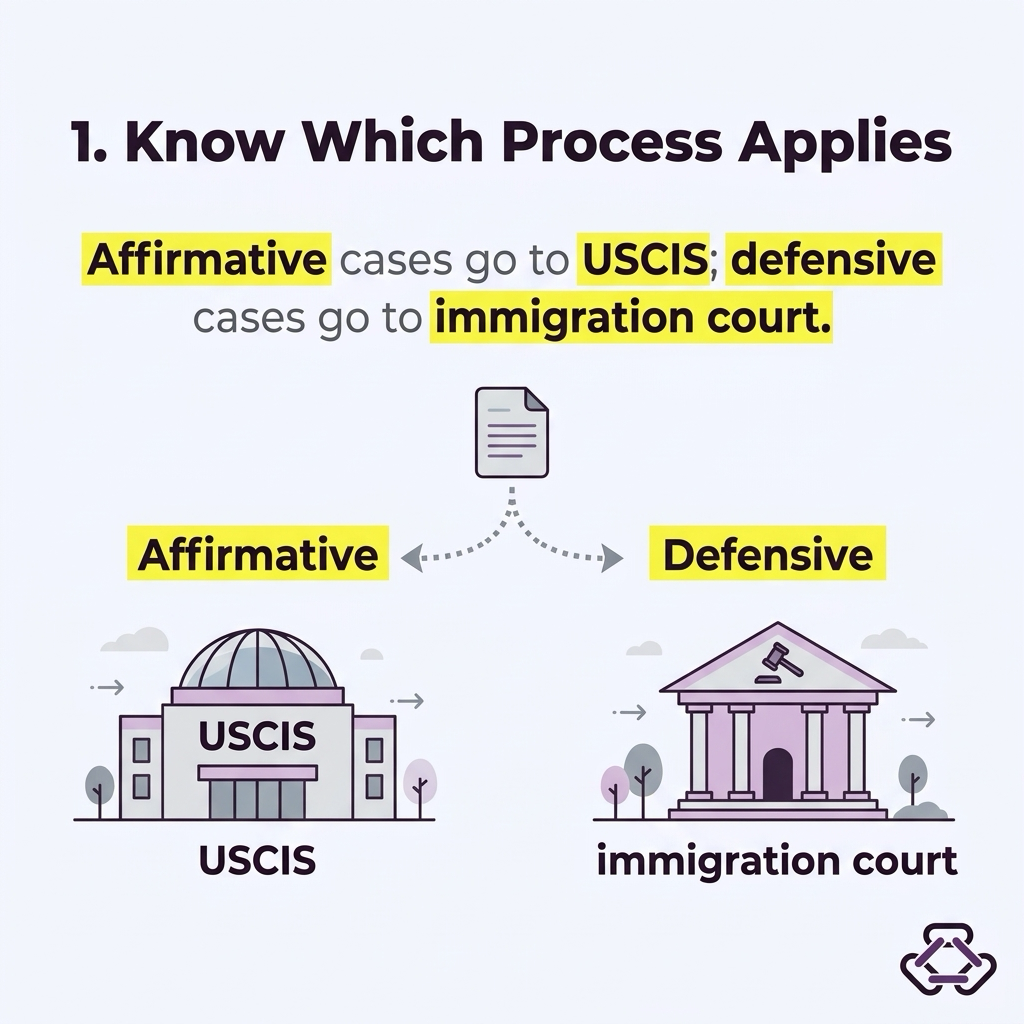
The first question is procedural: Are you filing affirmatively with USCIS, or defensively in immigration court?
An affirmative asylum case is generally filed with USCIS by a person who is physically present in the United States and not currently in removal proceedings. A defensive asylum case is filed in immigration court by someone who is already in removal proceedings. The EOIR Policy Manual describes defensive asylum as an application filed with the immigration court by a person already in proceedings, while affirmative asylum is filed with the DHS asylum office by a person not in proceedings. If USCIS does not grant an affirmative case, it may be referred to immigration court for further proceedings under certain circumstances, according to the Department of Justice.
That distinction matters because filing location, deadlines, hearing procedures, and document formatting can vary. For example, the immigration court has its own filing rules for applications, exhibits, and proof of service, outlined in the EOIR filing guidance.
Step 2: Identify The Filing Deadline Early
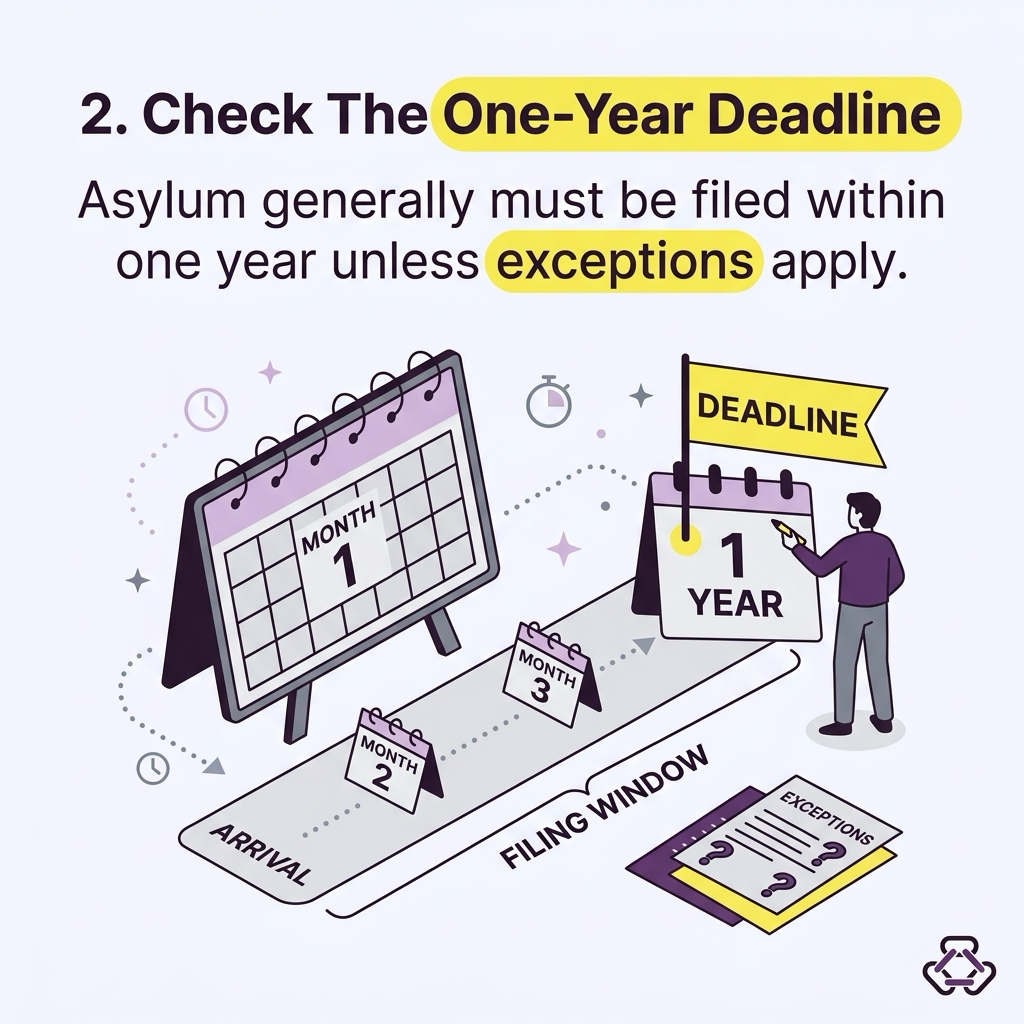
One of the most important parts of preparing an asylum application is determining whether the case fits within the one-year filing deadline.
USCIS and EOIR both state that, in general, an asylum application is expected to be filed within one year after arrival in the United States, unless an exception applies. EOIR says applicants in proceedings should be mindful of that one-year deadline, and USCIS uses the receipted filing date for Form I-589 in evaluating timeliness in affirmative cases, as reflected in EOIR’s policy manual and USCIS’s post-filing process page.
Some applicants may qualify for exceptions based on changed circumstances or extraordinary circumstances. USCIS training materials and form instructions discuss those concepts, but whether an exception applies often depends heavily on facts and documentation, as shown in the Form I-589 instructions.
This is one reason many people in similar situations look for counsel early. A missed deadline does not automatically end every protection claim, but it can significantly affect asylum eligibility and case strategy.
Step 3: Use The Current Form And Filing Instructions
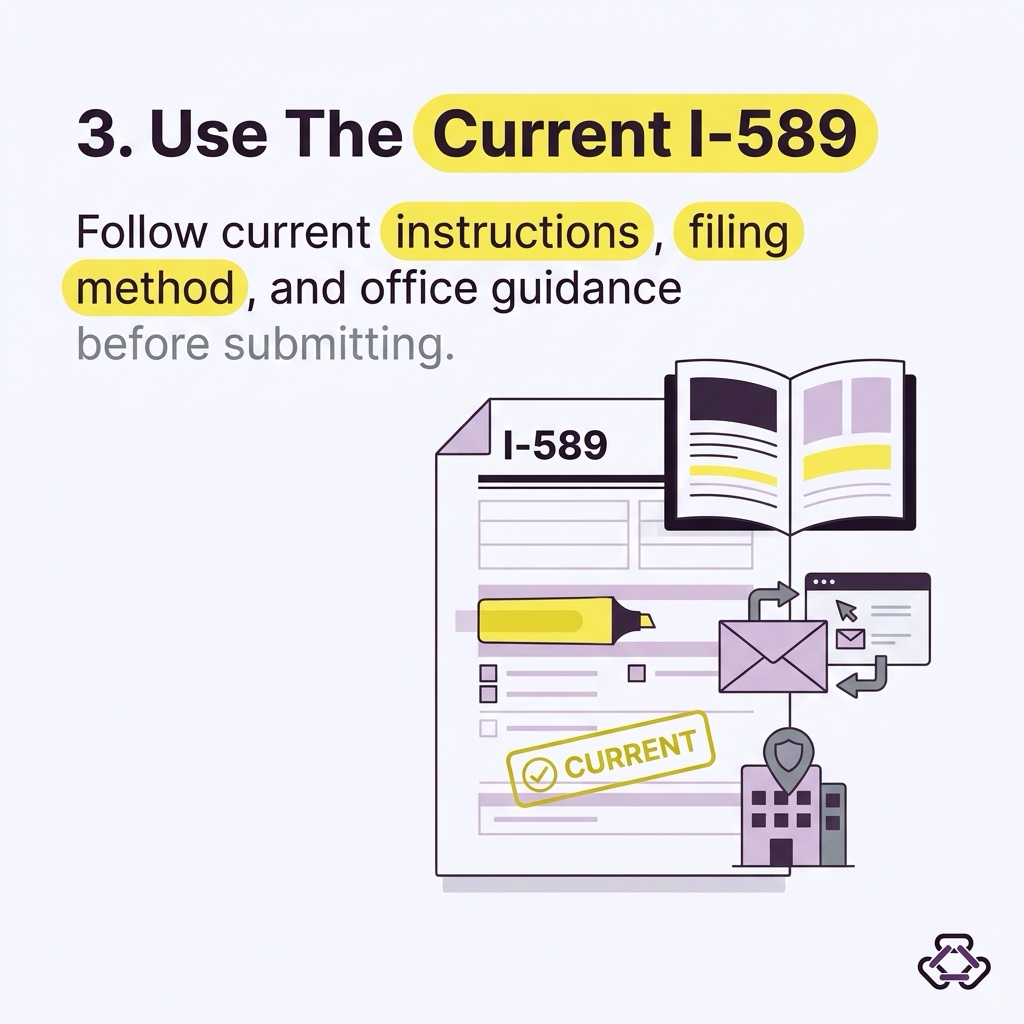
The main application is Form I-589, Application for Asylum and for Withholding of Removal. USCIS states that applicants should use the current edition, follow the official filing instructions, and file with the correct office or method depending on their situation. USCIS also notes that some applicants can file online, while others have to file by mail because of special circumstances, such as certain cases involving prior proceedings or unaccompanied children, according to the Form I-589 page.
A detail many people miss is that the filing process has changed over time. As of USCIS’s current I-589 page, the agency also references an Annual Asylum Fee for certain applications pending with USCIS for 365 days after filing if filed after October 1, 2024. That is separate from the long-standing statement in USCIS materials that there is no base filing fee for Form I-589 itself, as reflected in USCIS’s online filing engagement materials and current I-589 page.
Because filing addresses and special instructions can change, it often helps to verify them immediately before sending anything.
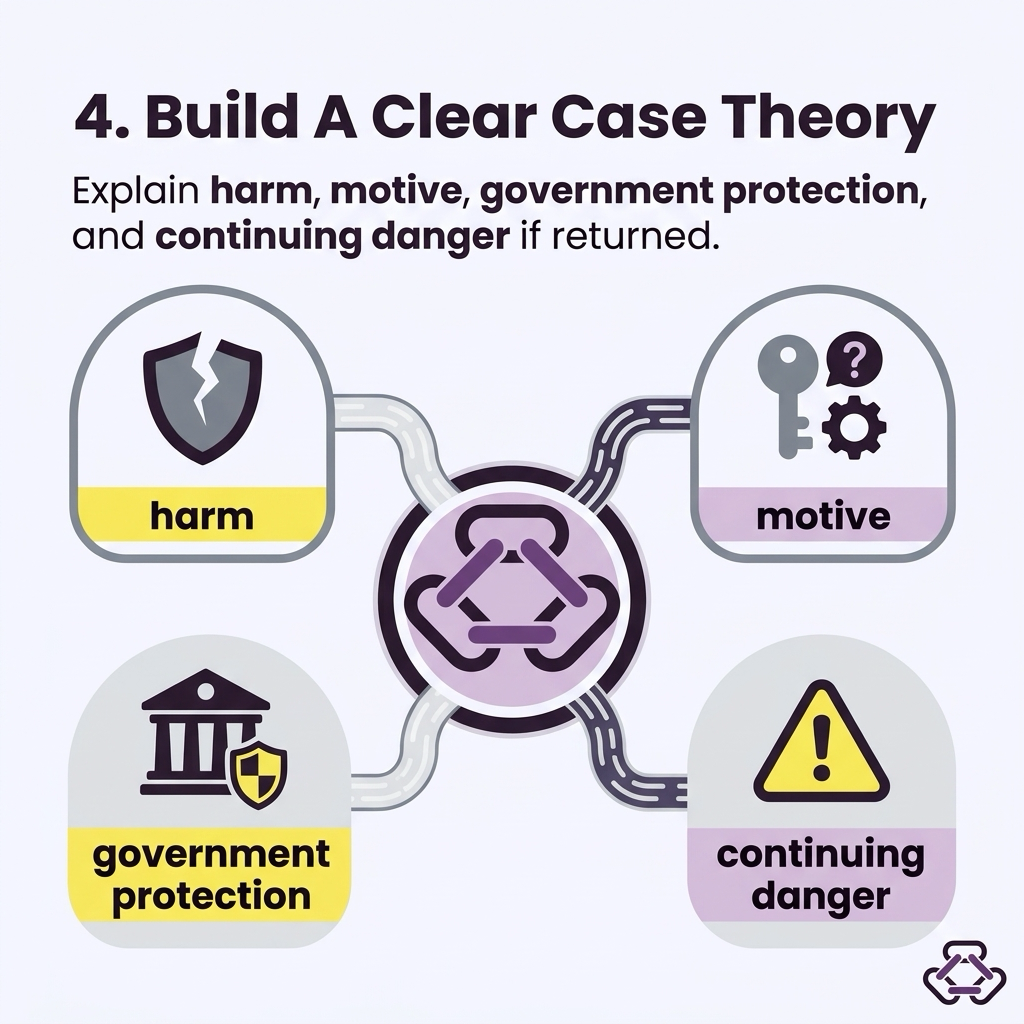
Step 4: Build A Clear Case Theory Before Filling In Boxes
A strong asylum application usually starts before the form is completed.
One useful way to think about preparation is to build a simple case theory that answers five core questions:
- Who harmed you, or who are you afraid will harm you?
- What exactly happened?
- Why did it happen to you?
- Why was your government unable or unwilling to protect you?
- Why would the danger continue if you returned?
These questions sound simple, but they are where many cases become confusing. A person may have experienced serious harm, yet the application becomes difficult if it does not clearly connect the harm to a protected ground. For example, a personal dispute, criminal extortion, or generalized violence may not be enough by itself unless the record explains the legal connection.
An attorney may help identify the legal theory that best fits the facts, especially in cases involving political opinion, religion, or particular social group claims, where the wording and factual framing can matter a great deal.
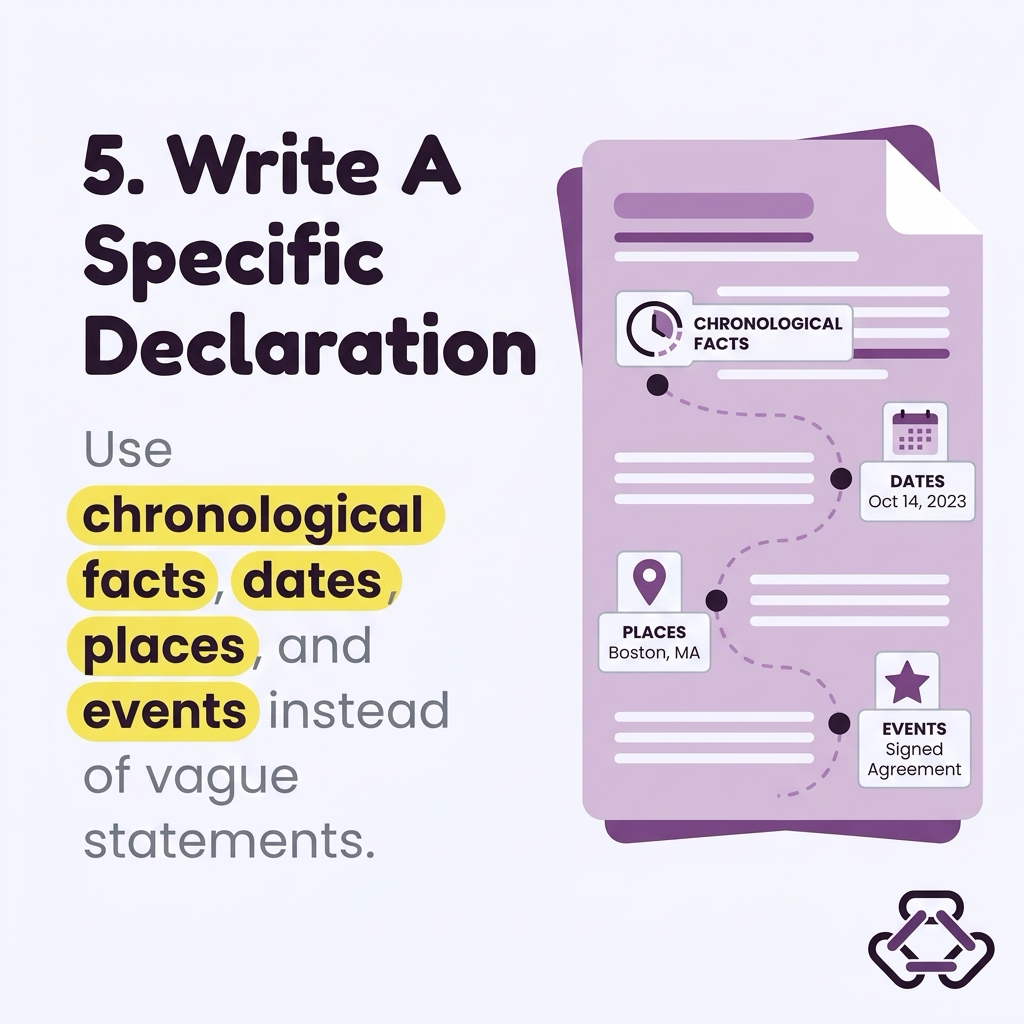
Step 5: Draft A Detailed Personal Declaration
The declaration is often the heart of the case.
Form I-589 includes limited space, so many applicants attach a written statement that explains the story in chronological order. A helpful declaration often includes:
- background information about the applicant
- family, community, political, religious, ethnic, or social identity
- dates and locations of major events
- threats, arrests, assaults, surveillance, detention, or other mistreatment
- reports to police or authorities, if any
- why protection from the government was unavailable
- how and why the applicant left
- why return still feels unsafe
The goal is not dramatic language. The goal is specific, consistent, factual detail.
For example, “I was threatened many times” is much weaker than “On March 12, 2024, two men waited outside my workplace in San Pedro Sula, called me by name, accused me of supporting the opposition party, and said I would disappear if I attended another meeting.”
Specifics often help decision-makers assess credibility. They also give supporting documents somewhere to attach logically.
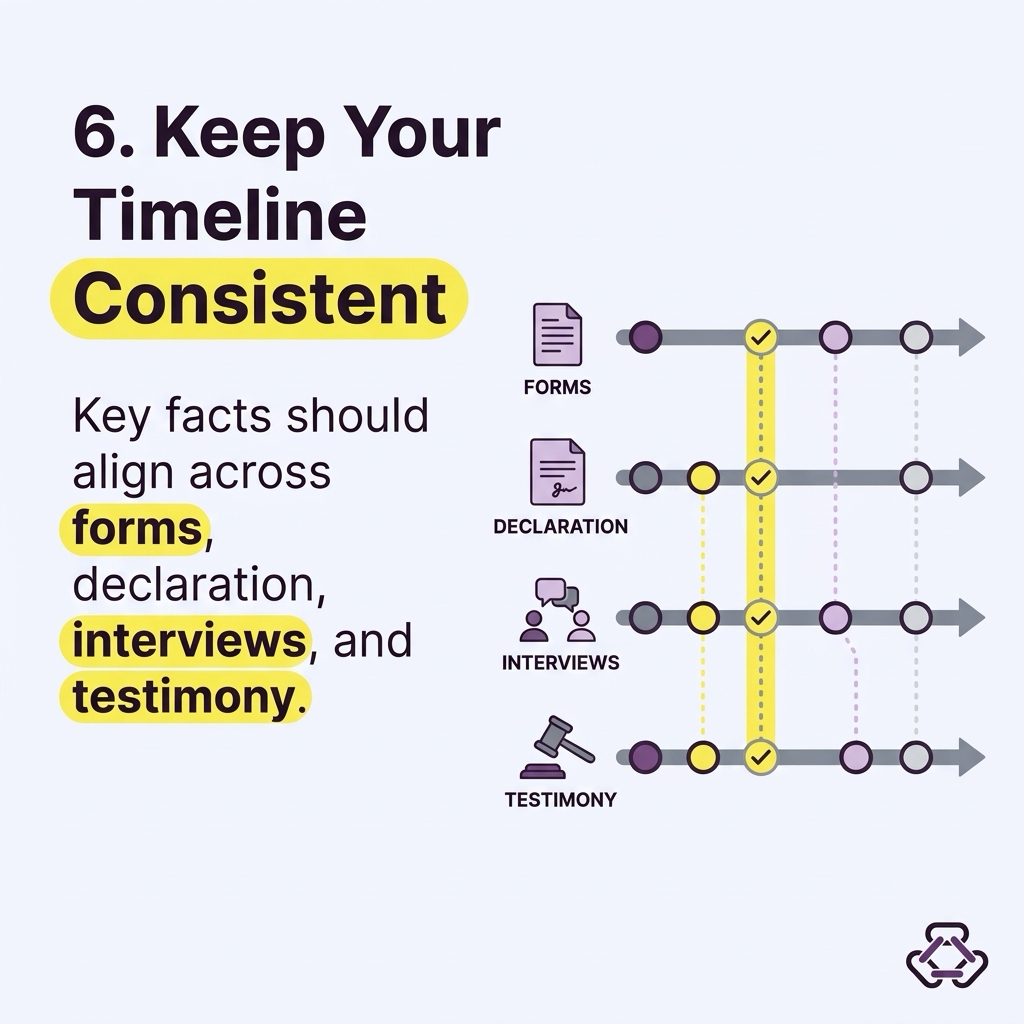
Step 6: Make The Timeline Consistent Across Everything
Consistency matters in asylum cases because officers and judges often compare the applicant’s written form, declaration, interview answers, border records, prior applications, and witness statements.
That does not mean every sentence has to be word-for-word identical. Human memory is not mechanical. But the key facts usually need to line up: dates, locations, sequence of events, identity of persecutors, injuries, threats, reports to police, route of travel, and family details.
A careful timeline can help. Many attorneys build a simple chronology with columns like:
- date
- place
- event
- who was involved
- supporting document
- open questions or uncertainties
That kind of working document can help identify gaps before filing. It can also help avoid one of the most common problems in asylum cases: a story that changes in small but important ways over time. If you want to dig further into the proof side of the case, it can help to read more about collecting evidence that supports an asylum claim once that related post is published.
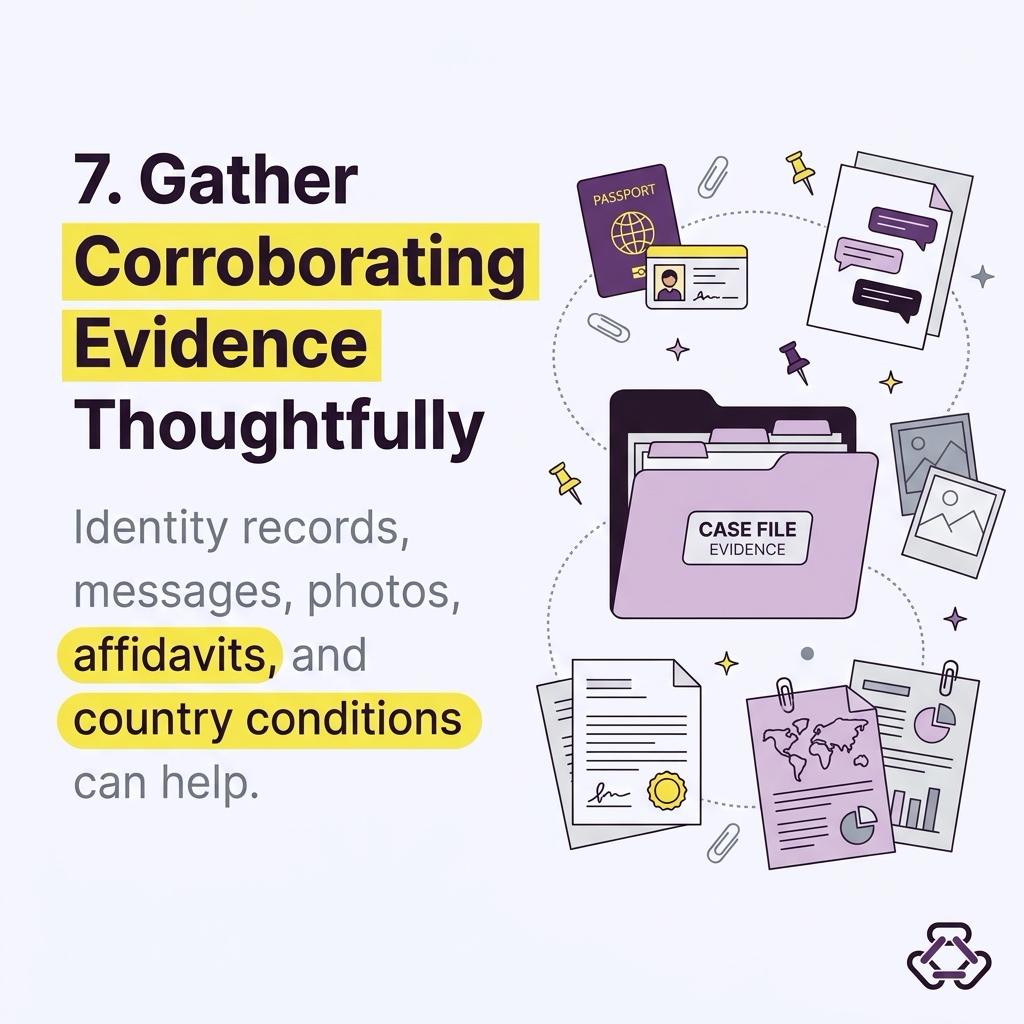
Step 7: Gather Corroborating Evidence Thoughtfully
Supporting evidence does not have to be perfect to be useful.
Many asylum applicants do not have police reports, medical files, or formal court records from the country they fled. That is common. Still, corroboration can come from many places:
- identity documents
- passport and travel records
- political party cards or membership documents
- religious records
- threatening messages, emails, or social media posts
- photographs of injuries, property damage, or protests
- medical or psychological records
- affidavits from witnesses, relatives, colleagues, or neighbors
- news reports about the applicant’s group, region, or persecutors
- human rights reports and country condition evidence
In immigration court, EOIR instructs parties to assemble filings with an application, proposed exhibits, table of contents where appropriate, and proof of service, according to the EOIR document rules. That structure matters because even strong evidence can be harder to use if it is disorganized.
Country conditions evidence is especially important. It does not prove everything by itself, but it can support the plausibility of the applicant’s account and show broader patterns of abuse affecting similar people.
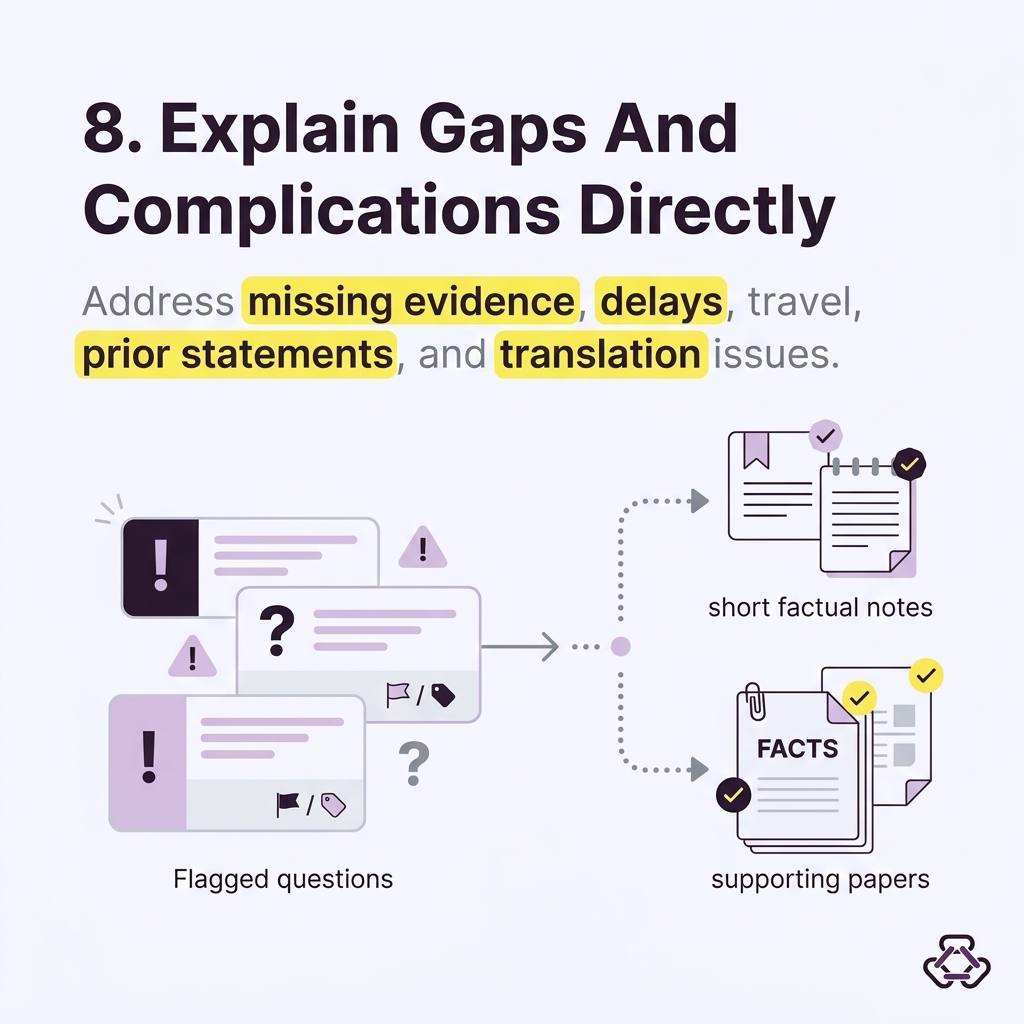
Step 8: Explain Missing Evidence Instead Of Ignoring It
Some cases have obvious evidence gaps. Maybe the applicant never reported the harm to police because police worked with the persecutors. Maybe hospital treatment was impossible. Maybe family members are still in danger and cannot safely write statements.
Those situations can often be addressed, but silence can create problems. It may help to explain:
- what evidence exists
- what evidence does not exist
- why it does not exist
- what steps were taken to try to obtain it
- why obtaining more could create risk
This is one area where credibility and corroboration overlap. A simple explanation may be more persuasive than a thin stack of documents that do not actually address the core claim.
Step 9: Pay Attention To Translation, Interpretation, And Readability
USCIS states that the form should be completed in English, including explanation fields, and the agency accepts only the official English-language version of the form, according to the I-589 page. If supporting records are in another language, certified translations are often part of a proper filing package.
Translation issues can create serious inconsistencies. Dates can switch format. Names can be transliterated differently. Terms like “arrest,” “kidnapping,” “party member,” or “detention” may have different meanings in different contexts.
A careful review of all translated documents can help reduce avoidable confusion. The same is true for interpreter preparation before an asylum interview or merits hearing. USCIS notes that it does not provide interpreters during the asylum interview in affirmative cases, as explained in the agency’s affirmative asylum FAQ.
Step 10: Prepare For Questions About Delay, Travel, And Prior Statements
Many asylum cases include facts that look complicated on paper but may be explainable with context. Common examples include:
- filing after one year
- returning to the home country after an earlier departure
- traveling through other countries
- waiting months before applying
- giving incomplete information during an initial border interview
- having inconsistencies in prior visa applications or immigration paperwork
These facts do not always end a case, but they often become focal points. A well-prepared application usually addresses them directly rather than hoping they will be overlooked.
For some applicants, the legal issue may involve exceptions, procedural history, or strategic choices between asylum and related forms of protection. Those are often the moments when attorney involvement becomes especially valuable.
Step 11: Protect Privacy And Keep Your Address Updated
Asylum cases involve confidentiality concerns. USCIS has specific procedures for people protected by confidentiality provisions and has also published updates on safe address handling and customer service procedures in protected cases, according to the agency’s safe address guidance.
Address updates matter too. USCIS states that if an address changes while Form I-589 is pending with an asylum office, the applicant is expected to notify the agency within 10 calendar days after moving, as noted on USCIS’s asylum process page. Missed mail can lead to missed interviews, missed notices, and major procedural complications.
Step 12: Understand What Happens After Filing
After filing, the next stages can include receipt notices, biometrics, an interview with USCIS in affirmative cases, or hearings in immigration court for defensive cases.
For work authorization, USCIS materials state that a pending asylum applicant may generally file for employment authorization after 150 days have passed since filing, while eligibility to receive the document is tied to the 180-day asylum EAD framework, excluding certain applicant-caused delays, according to USCIS guidance on asylum EAD timing and USCIS materials on applicant-caused delays.
In immigration court, filing deadlines for supporting documents can arrive well before the hearing date. EOIR states that represented and unrepresented respondents in non-detained cases may face deadlines such as 15 days or 30 days in advance of hearings depending on the filing and the type of hearing, under the EOIR policy manual.
Common Preparation Mistakes That Can Hurt A Claim
A few patterns show up again and again in asylum cases:
- filing without understanding the one-year deadline
- telling the story in a vague or disorganized way
- leaving major facts out of the declaration
- submitting documents without explaining why they matter
- overlooking inconsistencies with prior immigration records
- using boilerplate language that does not sound personal or accurate
- failing to connect the harm to a protected ground
- waiting too long to get legal help after receiving a notice or hearing date
If you’re concerned about errors, it may also help to review common filing problems that can damage an asylum case once that related post is available, along with frequently asked questions people raise before applying.
When Attorney Help Can Change The Entire Process
Some asylum applications are relatively straightforward on paper. Many are not.
Cases involving late filing, prior removal proceedings, criminal history, prior misstatements, family derivatives, changed legal theories, or difficult “particular social group” issues often become much easier to manage with experienced counsel. An attorney may help with legal framing, supporting declarations, country conditions research, evidentiary strategy, interview preparation, and court filings.
That is especially important because asylum is not just about telling a painful story. It is about fitting facts into a legal framework while preserving consistency across every stage of the record.
A Short Summary
Preparing an asylum application usually involves much more than filling out Form I-589. It often means identifying the correct process, confirming deadlines, building a clear legal theory, drafting a detailed declaration, organizing corroborating evidence, addressing weak points honestly, and preparing for interviews or hearings with consistency.
For many applicants, the difference between a confusing filing and a well-supported one comes down to preparation and documented legal fit. Visit ReferU.AI to get matched with an attorney who has demonstrable experience in cases like yours — for free.
