Table of Contents
- How to Decide Between Adjustment of Status and Consular Processing
- What Is The Difference Between Adjustment Of Status And Consular Processing?
- 1. Start With Where The Applicant Is Living Now
- 2. Ask Whether Adjustment Of Status Is Actually Available
- 3. Compare Processing Structure, Not Just Processing Time
- 4. Consider Work Authorization And Travel Flexibility
- Adjustment Of Status Often Allows Interim Benefits
- Consular Processing Usually Does Not Provide A Pending U.S. Work Permit
- 5. Look Closely At Costs
- 6. Think About Interview Logistics And Evidence
- 7. Identify Hidden Risk Factors Before Choosing A Path
- Unlawful Presence
- Entry And Status Issues
- Embassy-Specific Delays
- Travel Constraints
- 8. Match The Process To The Person’s Real-Life Priorities
- 9. Know When The Choice Calls For Legal Analysis, Not Guesswork
- 10. A Simple Way To Think About The Decision
- Adjustment Of Status May Be More Attractive When
- Consular Processing May Be More Attractive When
- Short Summary

Type
Great Grandchild
Status
Approved
Title (YouTube)
Images Failed (Social)
Images Failed (Social)
Do not index
Parent item
Publish Date (TikTok)
Apr 28, 2027 09:15
Videos Post IDs (Social)
Hashtags (Social)
#LegalAdvice #LegalHelp #Immigration #ConsularProcessing
Caption
Caption X
Cover

OG Image

Alt Image Text
Flat vector illustration of a person choosing between adjustment of status and consular processing, with a U.S. office path on one side and an embassy travel path on the other.
Images


Videos
Publish Date (Social)
Feb 20, 2027 13:30
Scheduled (Social)
Scheduled (Social)
Images Posted (Social)
Images Posted (Social)
Videos Posted (Social)
Videos Posted (Social)
Featured
Created time
Apr 7, 2026 12:00 AM
Sub-item
Authors
CTA Practice Area (Social)
Immigration
TikTok Failed (Social)
TikTok Failed (Social)
Videos Post Links (Social)
TikTok Post Links (Social)
Images Post IDs (Social)
YT Post ID
Video Pending Manual (Social)
TikTok Posted (Social)
TikTok Posted (Social)
TikTok Post IDs (Social)
Video Cover (Social)
Images Post Links (Social)
First Comment (Social)
Videos Failed (Social)
Videos Failed (Social)
YT Embedded
Images Delete (Social)
Videos Delete (Social)
How to Decide Between Adjustment of Status and Consular Processing
If you are pursuing a green card through marriage, family sponsorship, or employment, one of the biggest early decisions is where the final step happens. For some people, that final step happens inside the United States through Adjustment of Status. For others, it happens at a U.S. embassy or consulate abroad through Consular Processing.
That choice can shape your timeline, travel flexibility, work authorization options, filing costs, and even the legal risks in your case. It is also a decision that often looks simple at first and becomes more complicated once issues like unlawful presence, visa availability, interview backlogs, or travel plans enter the picture.
In this post you’ll learn how Adjustment of Status and Consular Processing work, how they differ, which factors often matter most, and when an immigration attorney may help evaluate the safer path. If you want a broader overview of the consular route itself, this guide on getting through the immigrant visa process abroad pairs well with what follows.
Scroll to the bottom for every post in this series.
What Is The Difference Between Adjustment Of Status And Consular Processing?
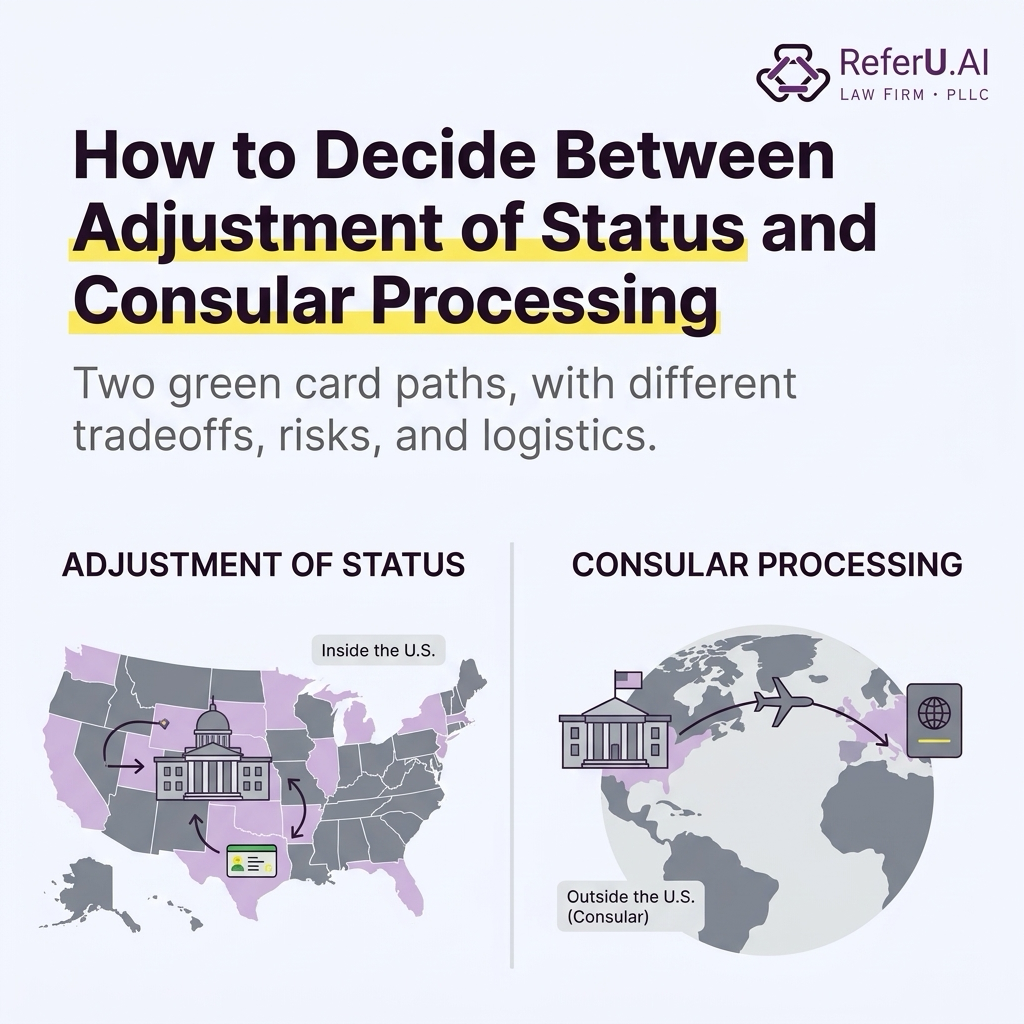
At a basic level, both paths can lead to lawful permanent residence, but they happen through different agencies and in different places.
Adjustment of Status (AOS) is the process of applying for a green card from inside the United States, generally by filing Form I-485 with USCIS. USCIS explains that AOS is for people who are eligible to become permanent residents without leaving the country. USCIS also notes that visa availability and filing-chart rules affect when many applicants can file. For some categories, concurrent filing is possible, meaning the immigrant petition and the I-485 can be filed together when a visa is immediately available, including immediate relatives of U.S. citizens in many family-based cases (USCIS I-485; USCIS concurrent filing).
Consular Processing (CP) is the process of applying for an immigrant visa through the Department of State, usually after USCIS approves the underlying petition. The case then moves through the National Visa Center, fees are paid through CEAC, Form DS-260 is completed, civil and financial documents are submitted, and the applicant attends an interview at a U.S. embassy or consulate abroad (State Department immigrant visa process; NVC fee payment).
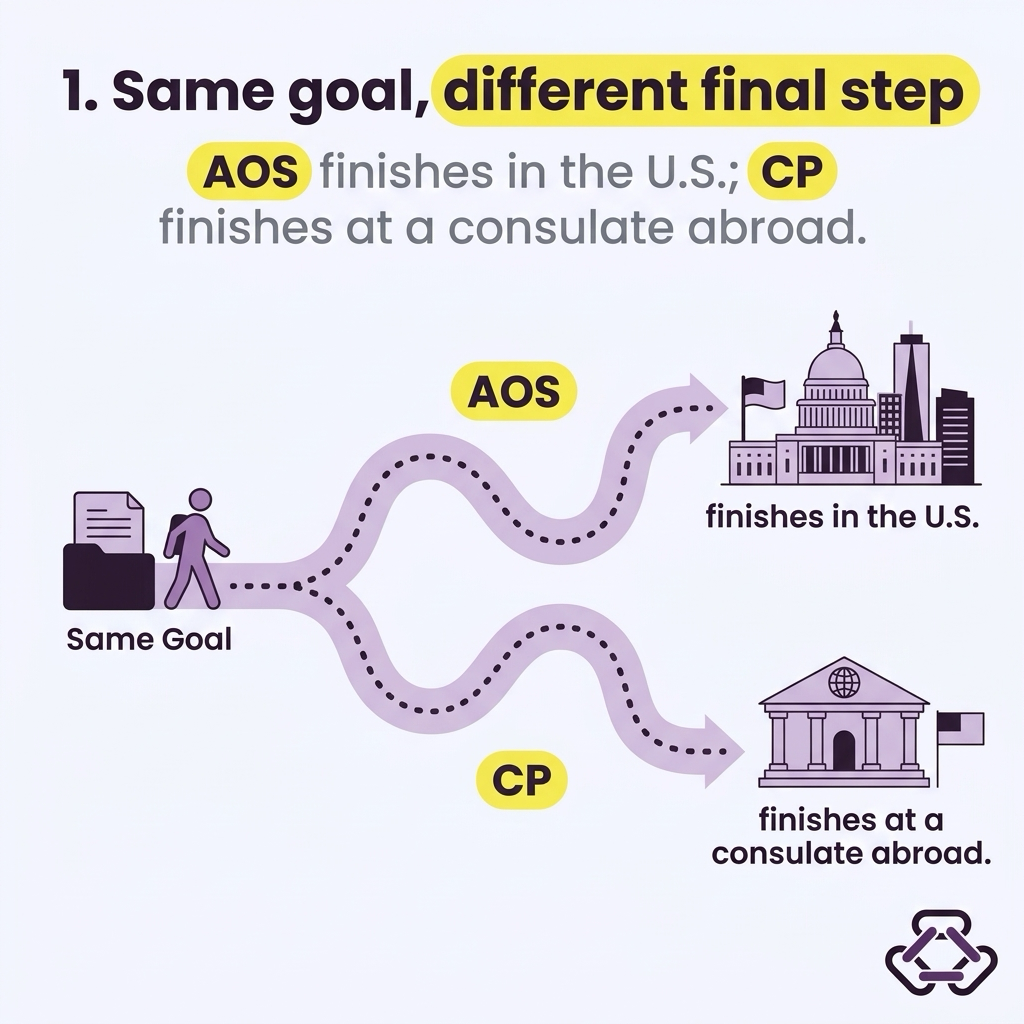
So the short version is this:
- AOS = finish the green card process in the United States with USCIS
- CP = finish the green card process abroad with the State Department
That sounds straightforward, but in real life the better fit often depends on immigration history, timing, and risk tolerance.
1. Start With Where The Applicant Is Living Now
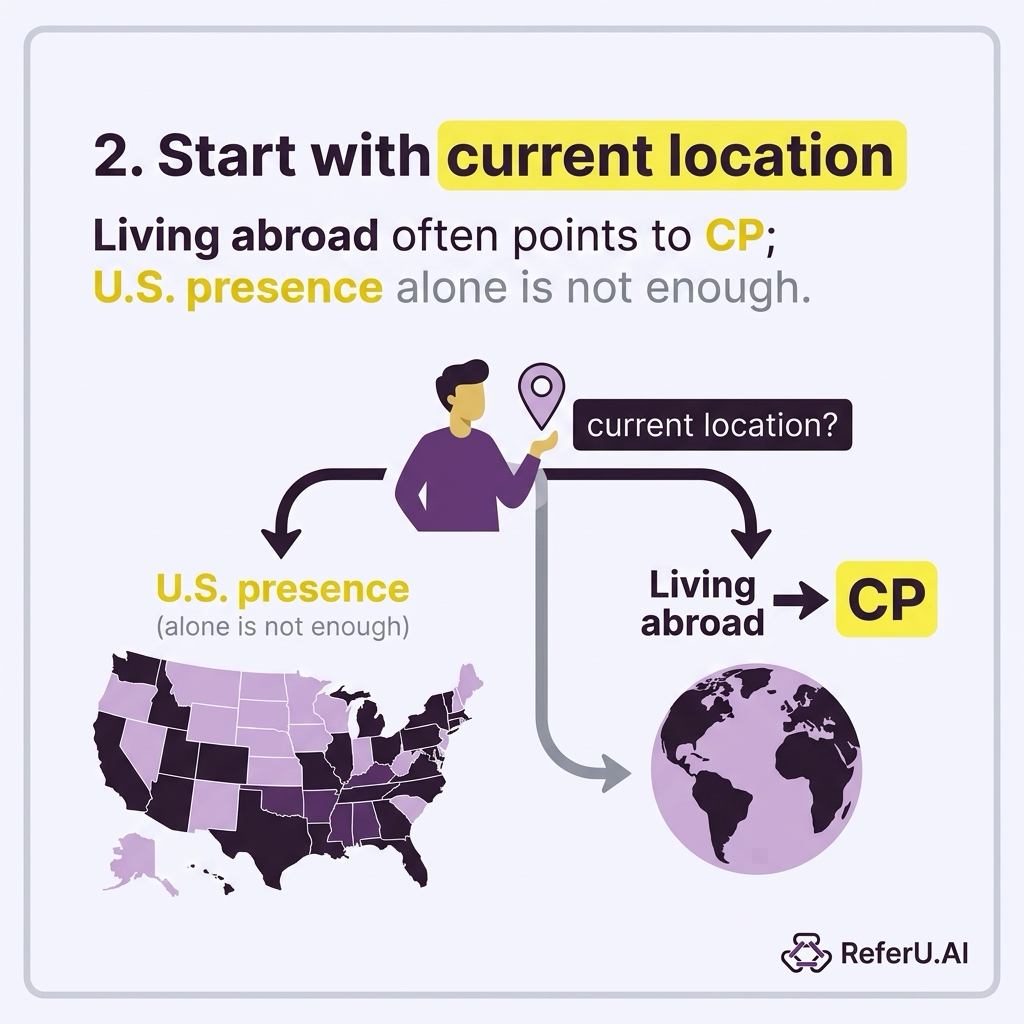
One of the first questions is simple: Is the applicant currently in the United States, or outside it?
If the applicant is already abroad, Consular Processing is often the default route because Adjustment of Status generally requires physical presence in the United States and eligibility to file there under the immigration laws and USCIS rules (USCIS I-485).
If the applicant is in the United States, both paths may appear possible on paper, but that does not mean both are equally available. A person can be physically present in the U.S. and still run into barriers to AOS based on status violations, unauthorized employment, entry issues, or category-specific rules. USCIS’s Policy Manual, for example, explains that many employment-based applicants who are not in lawful nonimmigrant status at the time of filing are barred from adjusting, subject to limited exceptions such as INA 245(k) in some cases (USCIS Policy Manual, INA 245(c)(7)).
That is why “I’m in the U.S.” is only the start of the analysis, not the end of it.
2. Ask Whether Adjustment Of Status Is Actually Available
A lot of people compare AOS and consular processing as if they are simply two interchangeable options. In many cases, they are not.
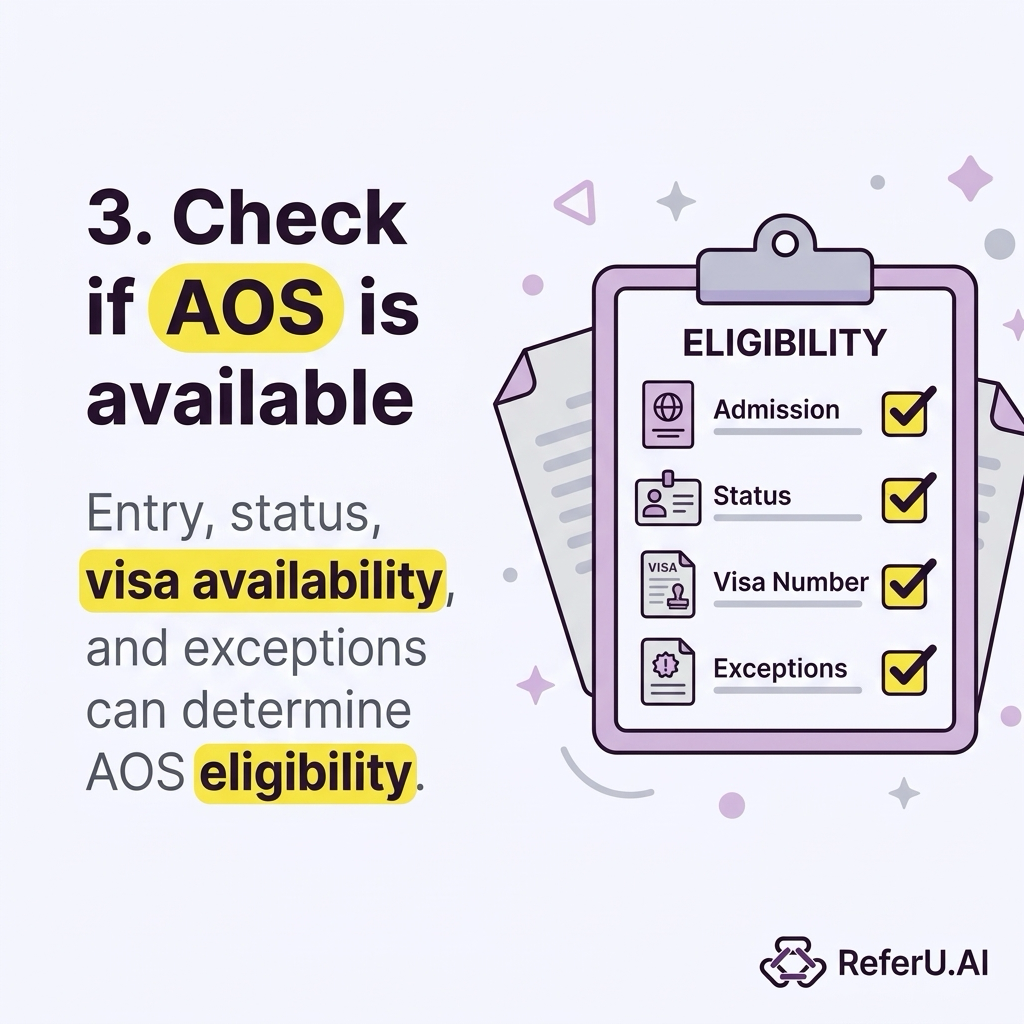
Adjustment of Status usually depends on more than just having an approved family or employment petition. AOS eligibility can turn on:
- Whether the person was inspected and admitted or paroled
- Whether a visa number is currently available
- Whether there are bars to adjustment
- Whether the person maintained qualifying status, depending on category
- Whether special exceptions apply
USCIS’s official I-485 page and form instructions explain that not everyone is eligible to adjust status, and the filing date for many applicants depends on the Visa Bulletin plus USCIS’s monthly filing-chart guidance (USCIS I-485; Visa Bulletin).
By contrast, Consular Processing can sometimes remain available even when AOS is not. That does not automatically make CP easier or safer. It simply means the legal path may differ.
For example, someone who entered the U.S. in a way that complicates AOS eligibility may still be directed toward a consular route. But leaving the U.S. can trigger separate issues, including three-year or ten-year unlawful presence bars, which is one reason attorney analysis can become especially important before any departure.
3. Compare Processing Structure, Not Just Processing Time
People often ask which path is faster. The more accurate question is: Which path is faster for this specific category, location, and fact pattern?
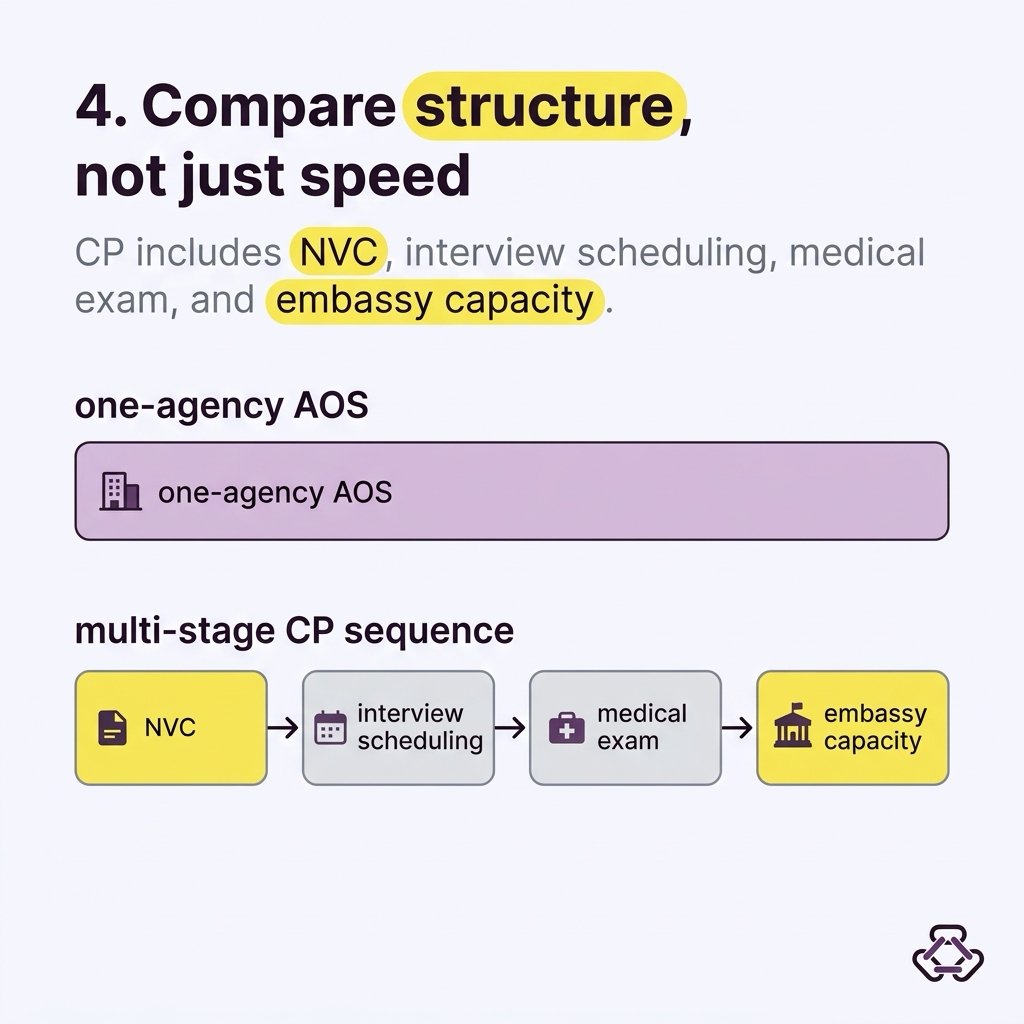
Adjustment of Status is processed by USCIS. Consular Processing moves through several stages: USCIS petition approval, NVC processing, document review, interview scheduling, medical exam, interview, and then entry to the United States after visa issuance (State Department immigrant visa process).
That means Consular Processing timelines can be affected by embassy-specific capacity, not just the strength of the case. The State Department’s Immigrant Visa Scheduling Status Tool now gives post-specific scheduling information, which can vary significantly by location. The State Department also announced in early 2026 that immigrant visa applicants are generally required to interview in the consular district of their residence, or in their country of nationality if requested, with limited exceptions. That policy can reduce flexibility for applicants hoping to move their interview to a faster post (IV Scheduling Status Tool; State Department country-of-residence policy update).
AOS timelines can also vary widely by field office, form type, and case complexity. USCIS offers case-status tools, processing-time resources, and myProgress estimates for some I-485 applicants through online accounts (USCIS I-485; USCIS myProgress expansion).
So when people say one path is “faster,” what they often mean is faster in some places, for some categories, during some time periods. That is a very different claim.
4. Consider Work Authorization And Travel Flexibility
This is one of the biggest practical differences.
Adjustment Of Status Often Allows Interim Benefits
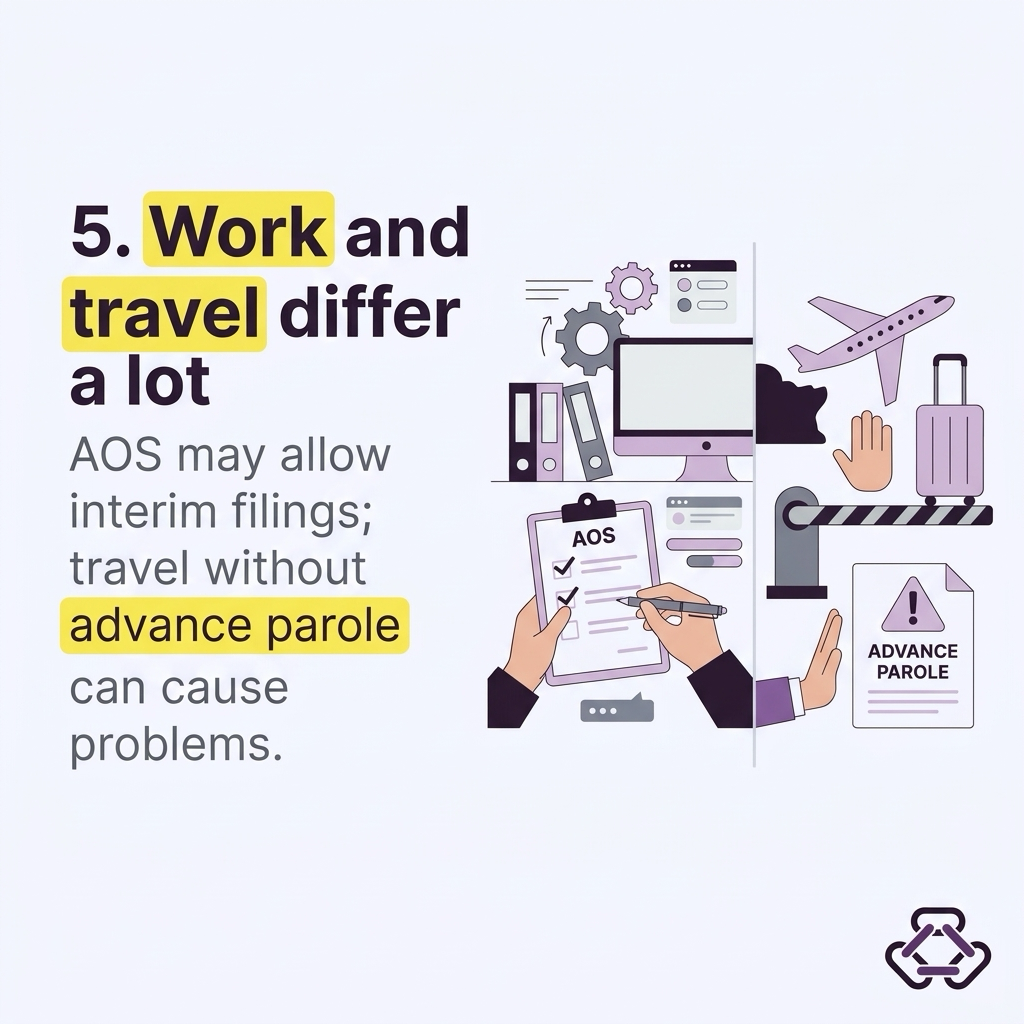
Many AOS applicants can also file for employment authorization and advance parole while the green card case is pending, though separate fees now commonly apply for forms filed with an I-485 on or after April 1, 2024 under the USCIS fee rule (USCIS I-485; USCIS fee rule FAQ).
That can matter a lot for applicants who want a more stable way to work or travel during the waiting period. USCIS also notes that, in general, leaving the United States while an I-485 is pending without advance parole may result in the application being treated as abandoned, subject to exceptions for certain statuses (USCIS 245(i) page discussing pending I-485 travel).
Consular Processing Usually Does Not Provide A Pending U.S. Work Permit
By contrast, a person going through Consular Processing abroad is typically waiting for the immigrant visa process to finish before entering the U.S. as a permanent resident. There is generally no equivalent interim U.S. work authorization benefit created by the pending immigrant visa case itself.
For families deciding between remaining together in the United States during a pending AOS case or waiting abroad for a consular interview, this difference can feel less like a technical rule and more like a daily-life issue involving income, childcare, housing, and international travel.
5. Look Closely At Costs
Cost comparisons are rarely exact because every case is different, but the filing structure differs in meaningful ways.
For AOS, USCIS filing fees can include the I-485 and, depending on strategy, separate fees for related forms such as I-765 and I-131 under the current fee rule (USCIS filing fees; USCIS fee rule FAQ).
For Consular Processing, the State Department explains that applicants generally pay the Immigrant Visa Application Processing Fee and, in many family-based cases, the Affidavit of Support Fee through NVC. The State Department’s fee schedule lists many immigrant visa application fees at $325 and the Affidavit of Support review fee at $120, though category-specific exceptions exist (NVC fee payment page; State Department visa fee schedule).
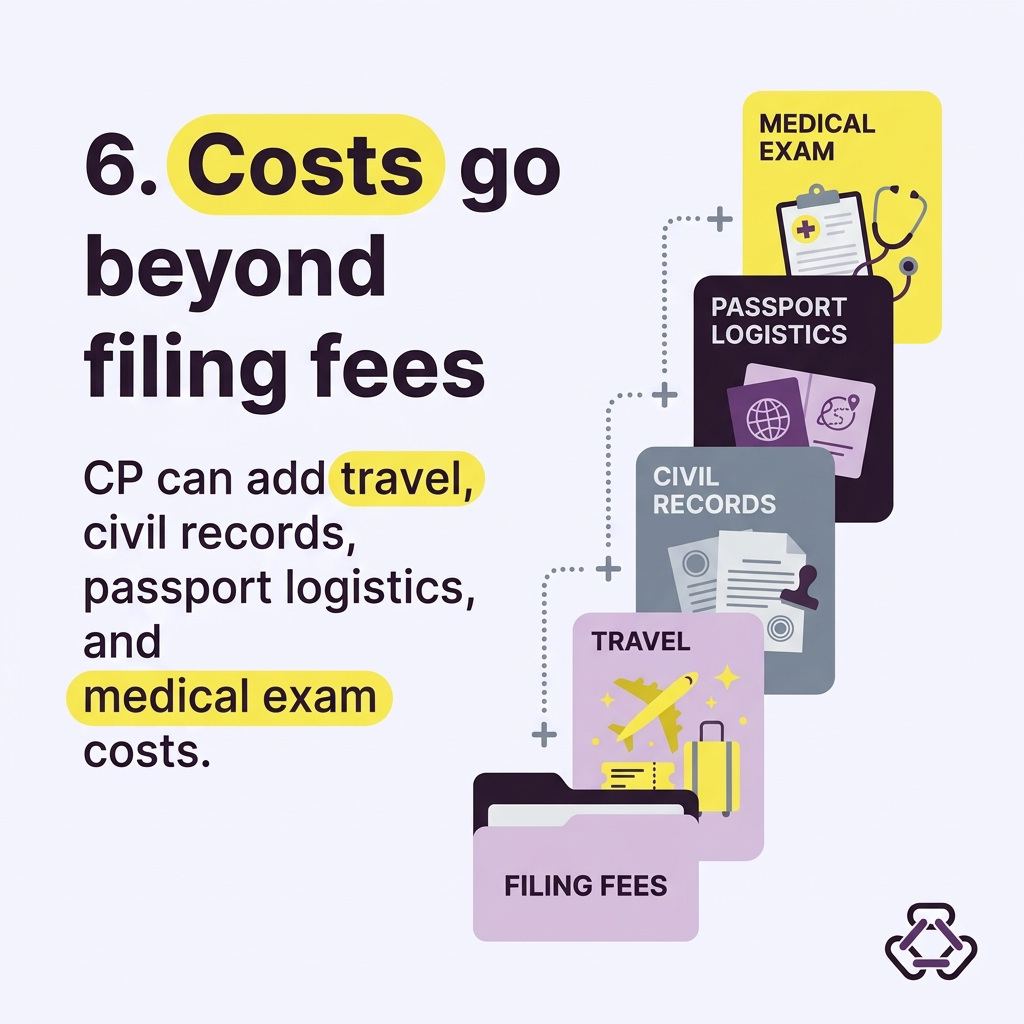
Consular cases also often involve travel costs, passport logistics, obtaining civil records from foreign authorities, and medical exam expenses with panel physicians designated by the embassy or consulate (State Department interview preparation; medical exam FAQs).
For some people, AOS looks more expensive on filing fees but less disruptive in travel costs. For others, CP may look more workable if AOS is not legally available or if the applicant is already abroad.
6. Think About Interview Logistics And Evidence
Both paths can involve an interview, but the setup is different.
With Adjustment of Status, the interview is generally with USCIS in the United States. With Consular Processing, the interview is with a consular officer abroad after NVC document processing. The State Department says immigrant visa applicants generally complete the medical exam before the interview and bring original or certified civil documents to the appointment (State Department interview prep).
That can matter if your case involves:
- difficult-to-obtain civil records
- prior marriages or divorces in multiple countries
- arrest history or police certificates
- prior immigration filings with inconsistent information
- affidavit of support complications
- derivative family members in different locations
If the case is document-heavy, a structured consular document phase through NVC can feel more predictable. On the other hand, if the applicant is already lawfully in the U.S. and can assemble evidence more easily here, AOS may feel more manageable.
7. Identify Hidden Risk Factors Before Choosing A Path
This is where many people get surprised. The legal question is often not “Which option do I prefer?” but “What risks attach to each option in my case?”
Some examples:
Unlawful Presence
Leaving the U.S. for a consular interview can create major complications if the applicant has accrued enough unlawful presence to trigger reentry bars. In those situations, the consular route may involve waiver analysis, timing questions, or strategic concerns that are not obvious from a basic checklist.
Entry And Status Issues
Some applicants are not eligible for AOS because of the way they entered the U.S., a prior overstay, unauthorized employment, or category-specific adjustment bars. USCIS’s policy guidance for employment-based applicants is a reminder that the eligibility analysis can become very technical very quickly (USCIS Policy Manual).
Embassy-Specific Delays
Consular Processing is not one system with one queue. It is a network of posts with different capacities. The State Department’s scheduling tool reflects that reality, and interview availability can shift by month and post (IV Scheduling Status Tool).
Travel Constraints
An AOS applicant who wants to travel internationally while the case is pending may run into problems without advance parole. A consular applicant may be dealing with the opposite challenge: waiting outside the United States for the interview and visa issuance sequence to finish.
Each of these issues can change the practical answer.
8. Match The Process To The Person’s Real-Life Priorities
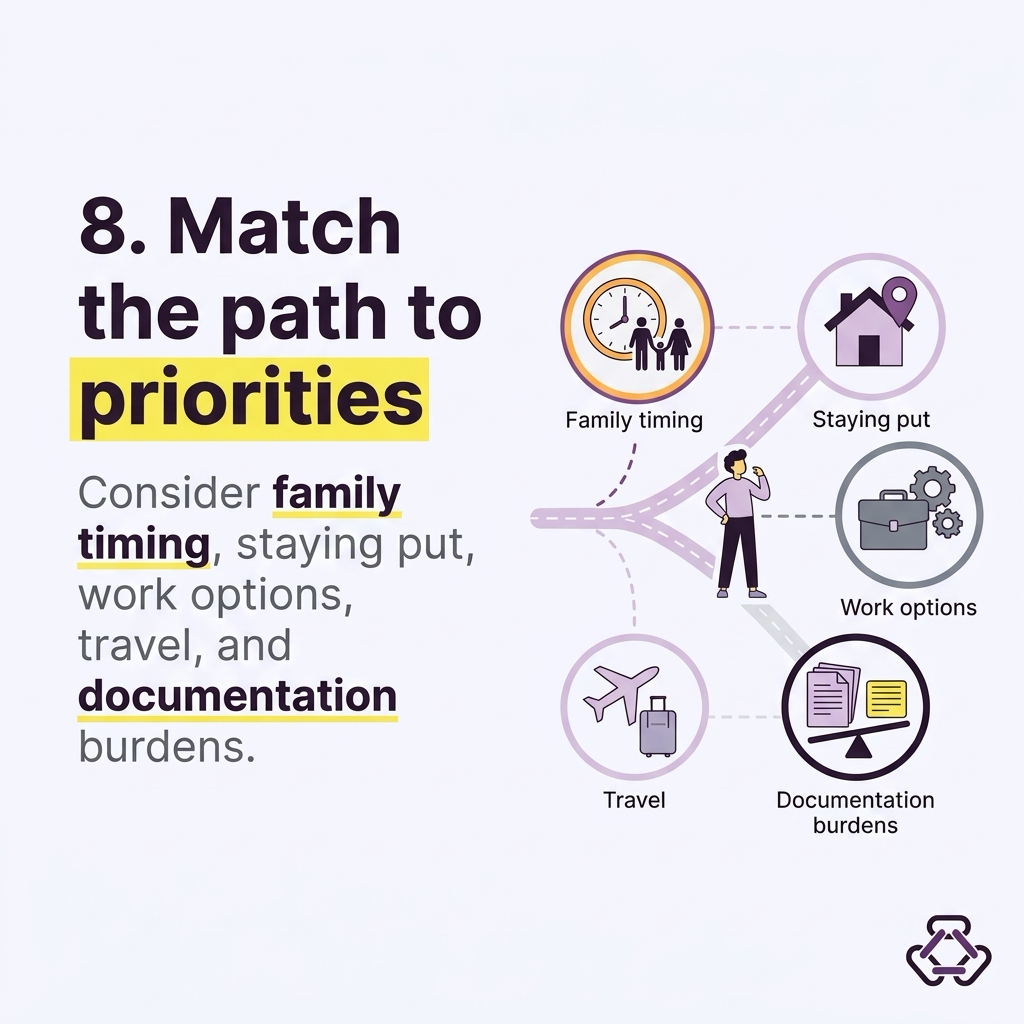
A useful way to evaluate the choice is to ask which of these priorities matters most in your situation:
- staying in the U.S. during the final stage
- avoiding international travel during processing
- preserving the option to apply for work authorization while waiting
- reducing the risk of leaving the U.S. with a complicated immigration history
- moving a case through the embassy linked to the applicant’s residence abroad
- coordinating timing for children, school, work, or caregiving responsibilities
For example, a spouse of a U.S. citizen who entered lawfully and is already in the United States may view AOS as more attractive because it can allow the family to remain together in one place while the case is pending, with possible interim work and travel filings through USCIS (USCIS I-485).
A person living abroad with a straightforward petition and local access to the appropriate consular post may view CP as the cleaner route, especially if there is no current basis to remain in the United States during processing.
Neither conclusion is universal. The better answer often comes from balancing eligibility, delay patterns, travel consequences, and documentary risk rather than looking for a one-size-fits-all rule.
9. Know When The Choice Calls For Legal Analysis, Not Guesswork
There are situations where the AOS-versus-CP decision becomes much more than a filing preference. A consultation with an immigration attorney can be especially helpful where the case involves:
- prior unlawful presence
- entry without inspection
- fraud or misrepresentation concerns
- criminal history
- prior removal proceedings or removal orders
- J-1 two-year home residence issues
- waivers
- inadmissibility questions
- category changes or aging-out risks
- urgent family reunification concerns tied to a specific country or post
In cases like these, the wrong path can lead to delay, extra cost, separation, or unexpected inadmissibility problems. An attorney may help compare not just the form sequence, but the legal exposure attached to each route.
That is one reason many families look for counsel with documented experience in highly similar matters, not just general immigration practice. A marriage-based AOS case with lawful entry is very different from an employment-based filing with status concerns, and both are different from a consular case involving possible unlawful presence bars.
10. A Simple Way To Think About The Decision
If you want a practical framework, here is a simple way to organize the choice:
Adjustment Of Status May Be More Attractive When
- the applicant is already in the U.S.
- AOS is legally available
- staying in the U.S. during processing matters
- interim work or travel filings may be valuable
- avoiding departure-related inadmissibility issues is part of the analysis
Consular Processing May Be More Attractive When
- the applicant is abroad
- AOS is not available or is much more complicated
- the case fits cleanly into the NVC and embassy process
- travel and interview logistics abroad are manageable
- the applicant’s consular post has workable scheduling conditions
If you want more detail on the embassy-stage timeline, interview prep, and entry process, it can help to read more about how the overseas immigrant visa process usually unfolds.
Short Summary
Adjustment of Status and Consular Processing both lead toward permanent residence, but they are not interchangeable in every case. The better path often turns on eligibility, visa availability, embassy conditions, work and travel needs, costs, and hidden inadmissibility risks. For some people, AOS offers stability inside the United States while the case is pending. For others, Consular Processing is the cleaner or only realistic route.
When the facts involve prior overstays, entry issues, waiver questions, or family separation concerns, individualized legal analysis can make a major difference. Visit ReferU.AI to get matched with an attorney who has demonstrable experience in cases like yours — for free.
