Table of Contents
- 9 Documents Workers and Employers Need Before Filing
- 1. The Approved Or Filing-Ready Labor Certification
- 2. Evidence Of The Worker’s Degrees, Diplomas, And Academic Credentials
- 3. Experience Letters That Match The Job Requirements
- 4. Proof That The Employer Can Pay The Offered Wage
- 5. The Signed Form I-140 With Category-Specific Supporting Evidence
- 6. Proof The Priority Date Is Current, If Adjustment Of Status Is Part Of The Plan
- 7. The Worker’s Identity, Status, And Travel Records
- 8. Civil Documents For The Worker And Any Family Members
- 9. The Medical Exam And Other Adjustment-Specific Initial Evidence
- Common Filing Problems That Start With Documents
- Why Early Attorney Review Often Changes The Filing Experience
- Final Thoughts

Type
Great Grandchild
Status
Approved
Title (YouTube)
Images Failed (Social)
Images Failed (Social)
Do not index
Publish Date (TikTok)
Apr 25, 2027 16:15
Videos Post IDs (Social)
Hashtags (Social)
#LegalAdvice #LegalHelp #Immigration #EmploymentBasedGreenCards
Caption
Caption X
Cover

OG Image

Alt Image Text
Flat vector illustration of documents workers and employers need before filing an employment-based green card case, showing organized paperwork, passport, diploma, company records, and government forms.
Images

Videos
Publish Date (Social)
Feb 19, 2027 09:30
Scheduled (Social)
Scheduled (Social)
Images Posted (Social)
Images Posted (Social)
Videos Posted (Social)
Videos Posted (Social)
Featured
Created time
Apr 7, 2026 12:01 AM
Sub-item
Authors
CTA Practice Area (Social)
Immigration
TikTok Failed (Social)
TikTok Failed (Social)
Videos Post Links (Social)
TikTok Post Links (Social)
Images Post IDs (Social)
YT Post ID
Video Pending Manual (Social)
TikTok Posted (Social)
TikTok Posted (Social)
TikTok Post IDs (Social)
Video Cover (Social)
Images Post Links (Social)
First Comment (Social)
Videos Failed (Social)
Videos Failed (Social)
YT Embedded
Images Delete (Social)
Videos Delete (Social)
9 Documents Workers and Employers Need Before Filing
Employment-based green card cases often look paper-heavy from the outside, but the real issue is usually document fit. A filing can be delayed not because the worker is unqualified or the employer is ineligible, but because the packet does not clearly connect the job, the worker’s background, the sponsoring company, and the government forms.
In practical terms, this is why document planning matters so much before anyone mails a petition or submits an adjustment package. USCIS reviews whether the worker qualifies for the category, whether the employer can support the offer, and whether the filing includes the initial evidence tied to that specific route. The Department of State also has separate document rules for consular processing, including civil records, passport pages, and certified translations when required. USCIS, USCIS, and the U.S. Department of State all emphasize that missing initial evidence can slow review or lead to additional requests.
If you are still sorting out the bigger picture, it may help to start with a broader overview of how employment-based permanent residence usually works. In this post, you’ll learn which nine documents usually matter most before filing, why each one matters, and where workers and employers often run into avoidable problems.
Scroll to the bottom for every post in this series.
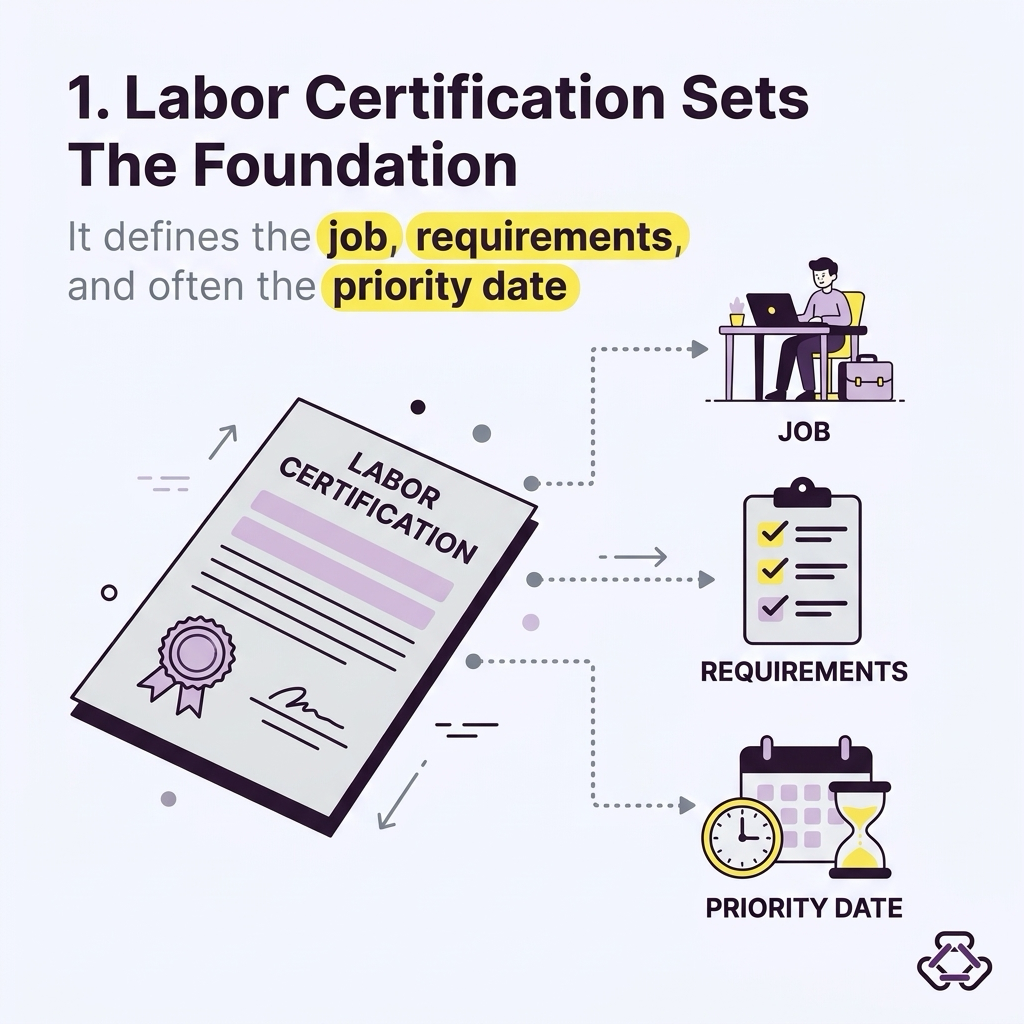
1. The Approved Or Filing-Ready Labor Certification
For many EB-2 and EB-3 cases, the first foundational document is the PERM labor certification, filed with the Department of Labor on ETA Form 9089. USCIS explains that a significant share of Form I-140 employment petitions rely on a permanent labor certification approved by DOL, and USCIS separately reviews whether the worker met the minimum job requirements as of the labor certification filing date. USCIS
Why this document matters:
- It defines the offered job
- It sets the minimum education, training, and experience requirements
- It establishes the priority date in many cases
- It often becomes the roadmap for what the worker must prove later in the I-140 stage
For employers, the labor certification file often includes more than the final approval notice. It may also involve recruitment records, prevailing wage materials, and documents retained in case DOL audits the case. DOL’s PERM guidance reflects that supporting documentation may be requested in an audit or otherwise. U.S. Department of Labor
A recurring issue here is mismatch. If the ETA 9089 says the job requires a particular degree or a set number of years of experience, the later evidence package usually works best when it matches those exact requirements. If you want a deeper look at timing, categories, and priority-date planning, our post on mapping out sponsorship categories and filing strategy gives that larger context.
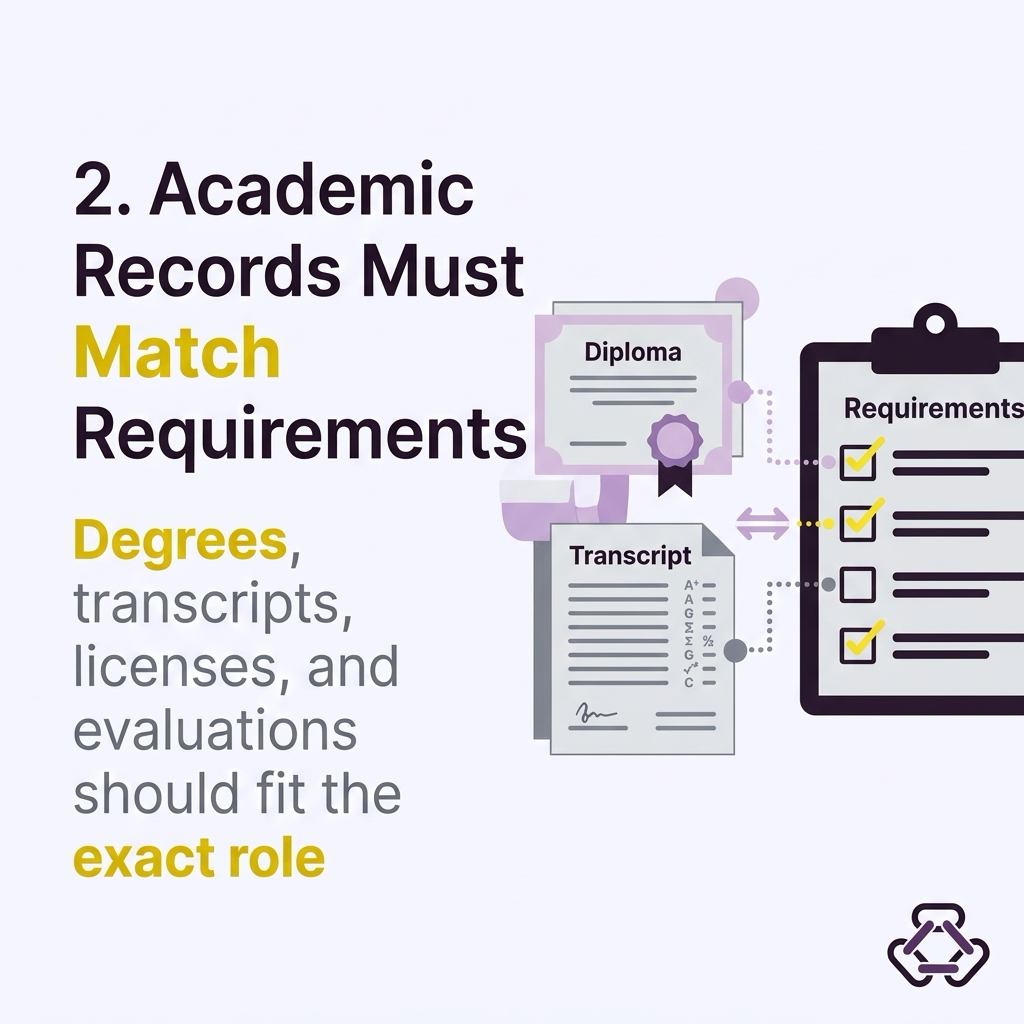
2. Evidence Of The Worker’s Degrees, Diplomas, And Academic Credentials
Once the labor certification or petition category is clear, the next major document set is the worker’s education evidence. This may include diplomas, transcripts, licenses, certifications, and, in some cases, a foreign credential evaluation.
USCIS lists official academic records as core evidence for multiple Form I-140 classifications, including petitions that rely on a U.S. baccalaureate degree or a foreign equivalent degree. USCIS
What usually helps:
- Degree certificate
- Official transcript
- Professional license, if the role requires one
- Credential evaluation for foreign education when equivalency is relevant
- Certified translation if the original is not in English
This category becomes especially important where the job requirements are specific. If the labor certification requires a bachelor’s degree in a narrow field, the filing often turns on whether the academic record actually supports that requirement. In general terms, that is less about having “good credentials” and more about having the right evidence for the exact job description.
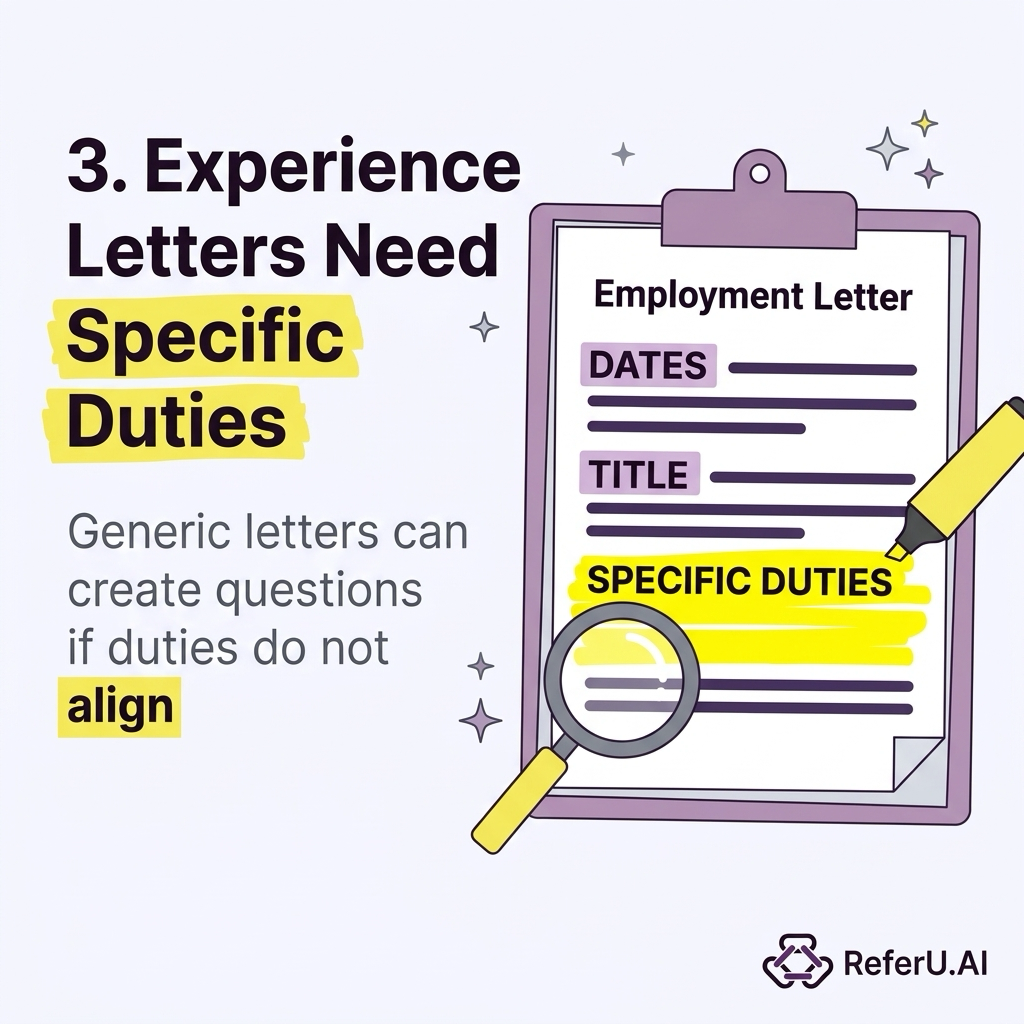
3. Experience Letters That Match The Job Requirements
Experience letters are among the most overlooked documents in employment-based filings. They often become central when a worker qualifies through prior employment rather than education alone.
USCIS policy and filing guidance repeatedly point to employer letters and other records as evidence of qualifying experience. The agency also closely examines whether the worker met the minimum experience requirements by the relevant filing date. USCIS, USCIS
A strong experience letter often includes:
- Employer name and contact information
- Dates of employment
- Job title
- Hours worked, if relevant
- Detailed duties
- Signature from an authorized company representative
The detail matters. Generic letters that simply say someone “worked as an engineer” or “performed management duties” may leave too much room for questions. USCIS often compares these letters against the labor certification’s listed requirements and duties. If the duties don’t line up, the issue may not be the worker’s actual background, but the way the experience was documented.
This is one reason many workers and employers spend time on document review before filing. A separate article on getting ready for an employment-based green card filing would normally fit here, but since your related-post requirement includes one core internal link, the main parent resource above is the one included in this post.
4. Proof That The Employer Can Pay The Offered Wage
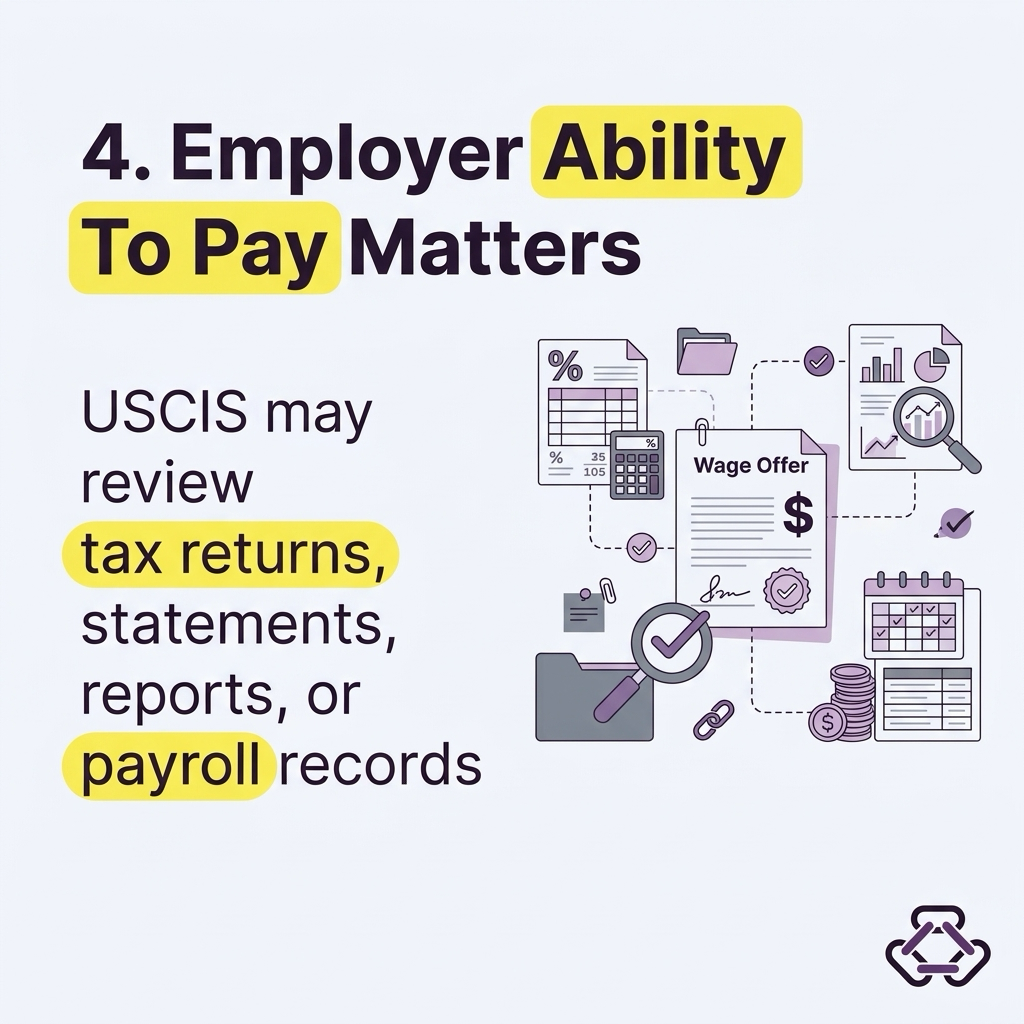
For many I-140 filings involving a permanent job offer, the employer’s ability to pay is a central evidentiary issue. USCIS states that the petition generally includes copies of the petitioner’s annual reports, federal tax returns, or audited financial statements for each available year from the priority date. If the employer has 100 or more workers, USCIS may accept a statement from a financial officer instead. USCIS
This is often where employers are surprised by how much financial documentation may become relevant.
Common documents include:
- Federal corporate tax returns
- Audited financial statements
- Annual reports
- Financial officer letter for qualifying larger employers
- Payroll records showing the worker is already being paid at or above the offered wage, where applicable
USCIS also notes that the employer’s obligation to maintain ability to pay can continue until the beneficiary obtains lawful permanent residence. USCIS
For companies filing multiple cases, this issue can become more complex because USCIS may look at the broader financial picture. In practical terms, a filing strategy sometimes works better when finance documents are gathered early rather than at the last minute.
5. The Signed Form I-140 With Category-Specific Supporting Evidence
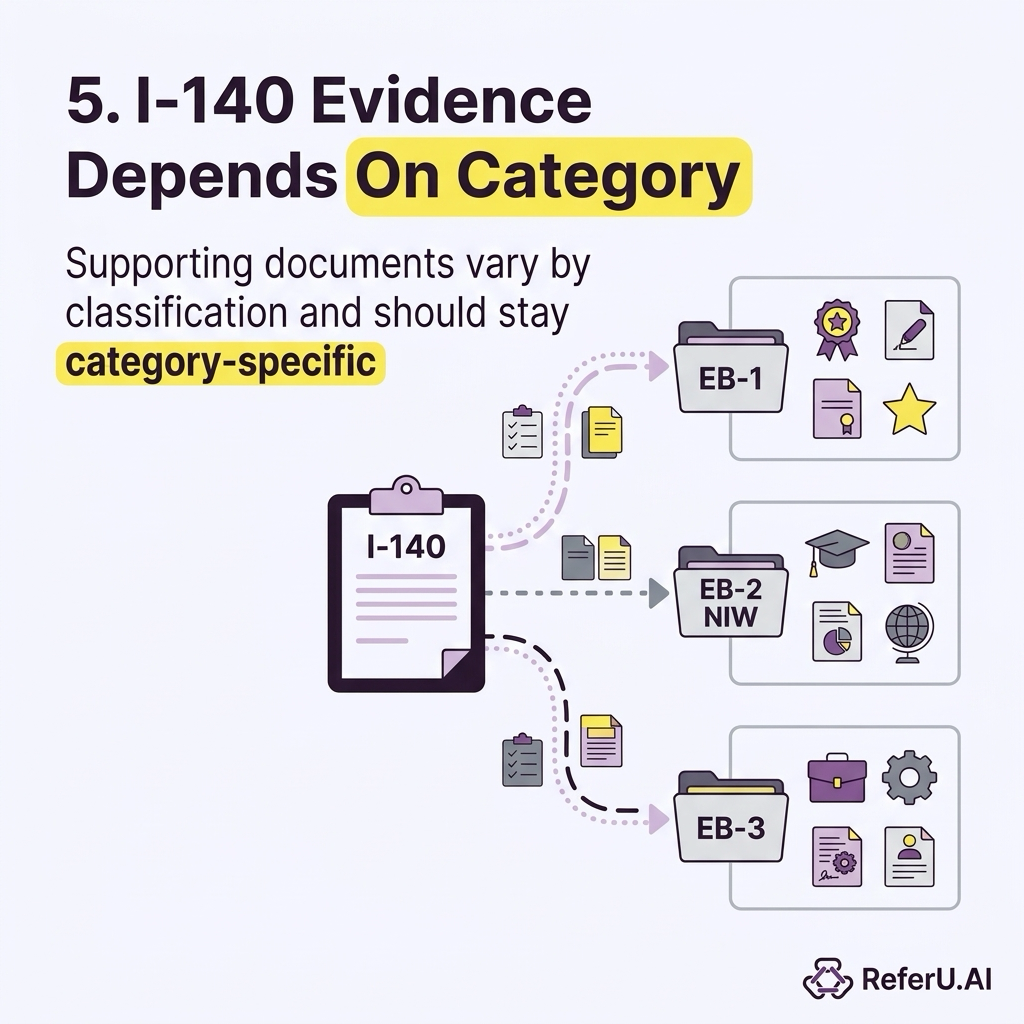
The core petition document in many employment-based cases is Form I-140, Immigrant Petition for Alien Workers. USCIS instructs filers to follow the form instructions closely and not combine I-140 supporting documents with I-485 supporting documents when filing concurrently. USCIS
This is more than an administrative point. The I-140 packet often serves as the legal framework for the case. Depending on the category, the support may differ significantly:
- EB-2 or EB-3 with PERM: labor certification, credentials, experience evidence, and ability-to-pay evidence
- EB-1 multinational manager or executive: qualifying relationship documents and evidence of prior managerial or executive employment
- EB-1 extraordinary ability: extensive documentation of sustained acclaim
- National interest waiver cases: evidence tied to the proposed endeavor and national importance
USCIS’s initial-evidence checklist for I-140 underscores that the required documentation varies by classification. USCIS
Before filing, many workers and employers find it useful to ask a simple question: Does every supporting document fit the exact petition type? A well-organized packet often tells one consistent story from the form through the exhibits.
6. Proof The Priority Date Is Current, If Adjustment Of Status Is Part Of The Plan
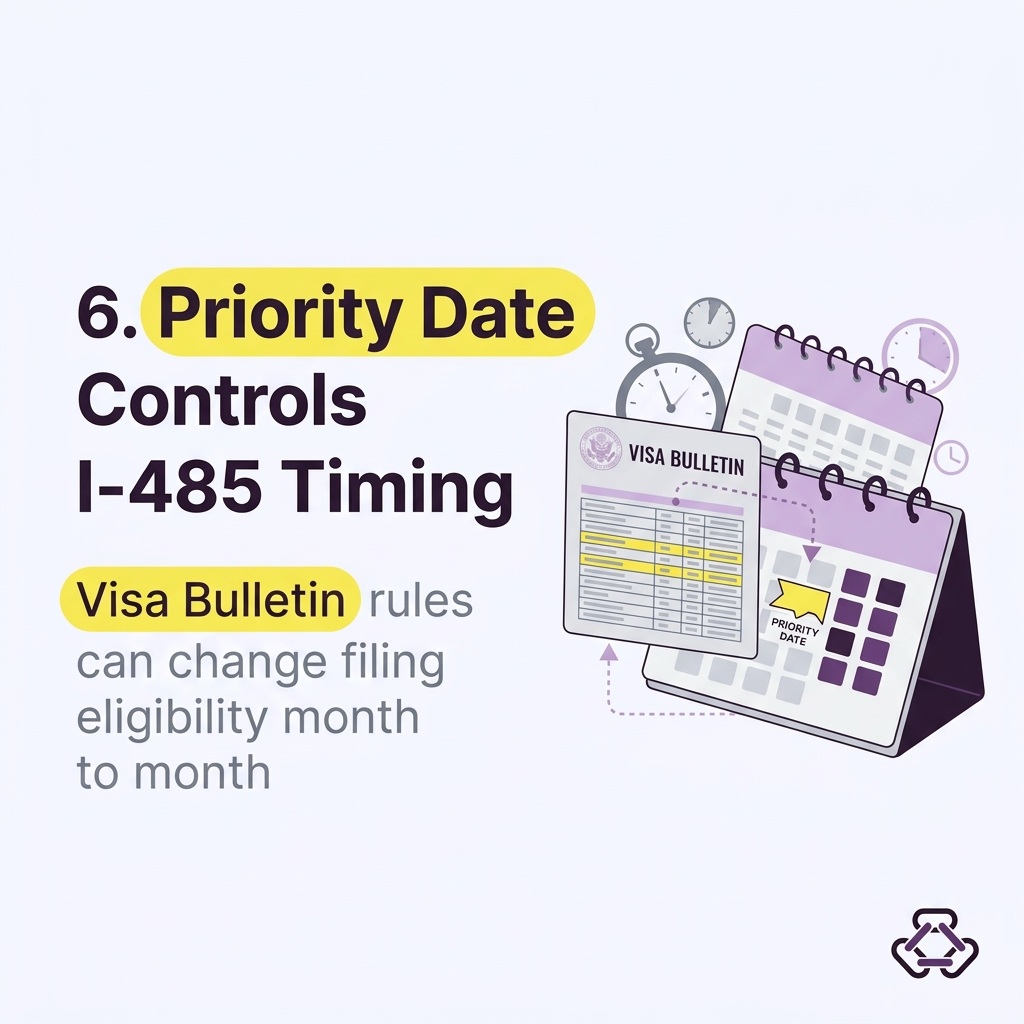
If the worker plans to file Form I-485 from inside the United States, visa availability becomes part of the document checklist. USCIS instructs applicants in family-sponsored and employment-based preference categories to check the Visa Bulletin before filing Form I-485. USCIS
That means one of the most important “documents” before filing may be the current Visa Bulletin chart selection and priority date evidence. In practice, that often includes:
- Copy of the approved or filing-related labor certification showing the priority date
- I-140 receipt or approval notice, if already filed
- A copy of the relevant month’s Visa Bulletin chart
- Evidence showing whether USCIS is using the “Final Action Dates” chart or the “Dates for Filing” chart for that month
This step is often misunderstood because eligibility to file can change month to month. If the filing path involves deciding between adjustment in the United States and consular processing abroad, a separate planning discussion often becomes important because document requirements, travel considerations, and timing can differ. That larger filing-choice analysis connects closely with the same parent guide linked earlier on employment-based green card categories and strategy.
7. The Worker’s Identity, Status, And Travel Records
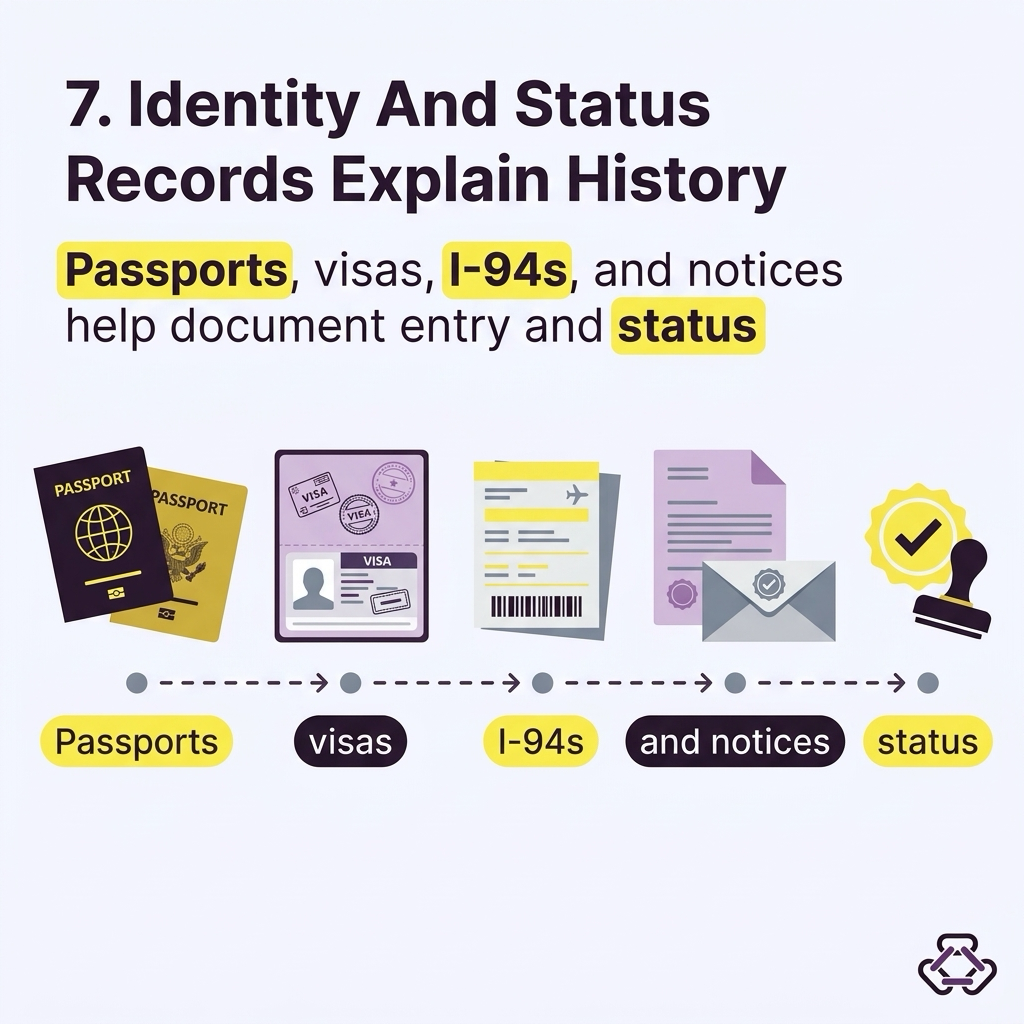
When a case involves adjustment of status, USCIS requires evidence tied to identity and the applicant’s entry and presence in the United States. USCIS states that applicants called for interview bring originals of the documents submitted with Form I-485, including passports, official travel documents, and Form I-94 records, whether or not expired. USCIS also explains that it may issue a request for evidence if required evidence was not submitted or is no longer valid. USCIS
This document set commonly includes:
- Passport biographic page
- Current and prior visas
- Form I-94 arrival/departure record
- Prior approval notices, such as H-1B, L-1, O-1, or F-1 related notices
- Employment authorization documents, if relevant
- Prior immigration correspondence from USCIS
Why these matter:
- They help establish identity
- They help document lawful entry, where required
- They may help explain maintenance of status issues
- They often become essential if USCIS raises timeline questions
Even small inconsistencies can create confusion. Different spellings, missing passport pages, or unexplained status gaps sometimes lead to requests for additional evidence that might have been avoided with a pre-filing review.
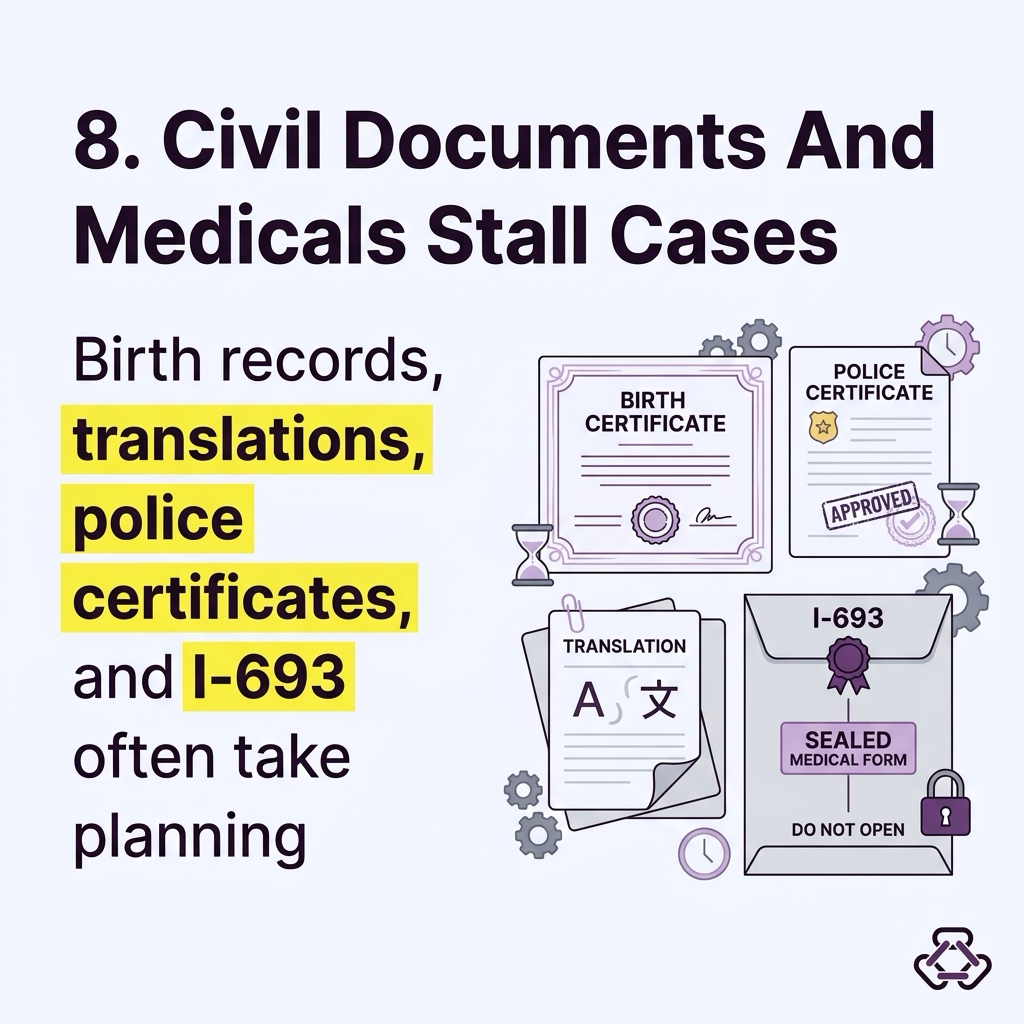
8. Civil Documents For The Worker And Any Family Members
Whether the case is moving through consular processing or includes derivative family members, civil documents often become one of the most time-sensitive categories.
The Department of State explains that immigrant visa applicants and immigrating family members collect civil documents issued by the proper government authority in the relevant country. If documents are not in English, or in the official language of the country from which the person is applying, certified translations are generally required. The State Department also lists common items such as birth certificates, marriage certificates, divorce records, military records, passport biographic pages, and police certificates for many applicants age 16 or older. U.S. Department of State
Typical examples include:
- Birth certificate
- Marriage certificate
- Divorce decree or death certificate from prior marriages
- Passport biographic page
- Police certificates for consular cases where required
- Military records, if applicable
- Certified translations
State Department guidance also notes that country-specific reciprocity rules can affect what is considered available or acceptable. U.S. Department of State
For multinational workforces, this is often where cases stall. The issue may be less about legal eligibility and more about how long it takes to obtain correct government-issued records from multiple countries.
9. The Medical Exam And Other Adjustment-Specific Initial Evidence
If the worker is filing Form I-485, the medical exam documentation can be part of the pre-filing checklist. USCIS identifies immigration medical examinations as part of the green card process, and USCIS has also stated that a Form I-693 signed on or after November 1, 2023 is valid while the application it was submitted with remains pending. USCIS, USCIS
Adjustment filings may also include other initial evidence depending on the case, such as:
- Birth certificate
- Government-issued identity document
- Evidence of the underlying immigrant petition
- Filing fee documentation
- Category-specific eligibility evidence
USCIS’s adjustment guidance explains that incomplete initial evidence can lead to a request for additional evidence, and interview notices may require originals of previously submitted records. USCIS, USCIS
This is one of the reasons filing preparation often extends beyond just filling out forms. A complete package is often about anticipating the records an officer expects to see at the beginning, not months later.
Common Filing Problems That Start With Documents
A surprising number of employment-based delays begin with one of these issues:
- Experience letters that do not describe duties in enough detail
- Education records that do not match the labor certification requirements
- Missing proof of employer ability to pay
- Civil documents that are not issued by the correct authority
- Missing certified translations
- Adjustment filings submitted when the priority date is not current
- Mixed-up I-140 and I-485 supporting exhibits
- Expired or incomplete identity records
In general terms, these problems do not always say anything negative about the worker or employer. Often, they point to a documentation problem, not an eligibility problem. That distinction can matter a lot.
Why Early Attorney Review Often Changes The Filing Experience
Employment-based green card filings are often described as form-driven, but many real issues are evidentiary. Attorneys in this area often spend a substantial amount of time comparing the labor certification, the petition category, the worker’s credentials, and the employer’s records for consistency.
That can be especially important when the case involves:
- Foreign degrees
- Prior immigration history
- Multiple employers
- Job changes after I-140 approval
- Cross-chargeability or derivative family issues
- Consular processing complications
- Prior status violations or gaps
- Tight filing windows tied to the Visa Bulletin
Some people in similar situations look for a lawyer based on advertising, directory placement, or name recognition. Another approach is to look for a lawyer with documented experience in highly-similar matters, based on objective criteria and real case history. That can be a meaningful difference when the question is not just “Who handles immigration?” but “Who has relevant experience with this kind of employment-based filing problem?”
Final Thoughts
Before filing an employment-based green card case, the most important documents usually include the labor certification, education records, experience letters, employer financial evidence, the I-140 support package, priority date evidence, identity and status records, civil documents, and adjustment-specific evidence like the medical exam.
Taken together, these documents do more than fill out a packet. They tell the story of the job offer, the worker’s qualifications, and the legal basis for the filing. When the documents do not line up, delays often follow. When they do line up, the case is often easier for the government to review.
Visit ReferU.AI to get matched with an attorney who has demonstrable experience in cases like yours — for free.
