Table of Contents
- 8 Family Sponsorship Problems That Complicate Green Card Cases
- Why Family Sponsorship Cases Get Complicated So Often
- 1. The Relative Is In The Wrong Sponsorship Category
- 2. Visa Bulletin Backlogs Create Delays Families Did Not Expect
- 3. The Affidavit Of Support Is Incomplete Or Financially Insufficient
- 4. Prior Unlawful Presence Changes The Entire Strategy
- 5. Marriage-Based Cases Raise Fraud And Bona Fide Relationship Concerns
- 6. Children Can “Age Out” While The Case Is Pending
- 7. Stepchild And Adopted Child Cases Have Extra Eligibility Rules
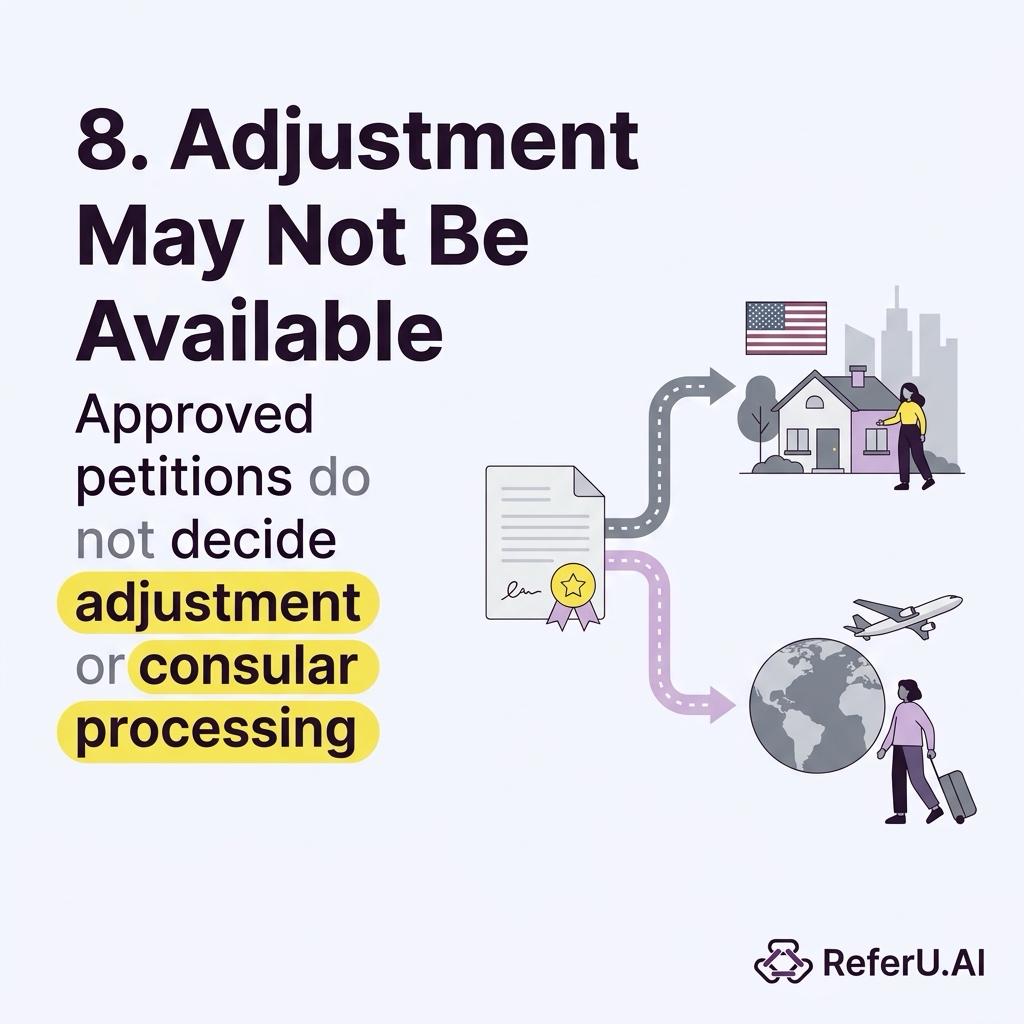
- 8. Adjustment Of Status May Not Be Available Even With An Approved Petition
- Final Tip: Family Sponsorship Problems Often Stack On Top Of Each Other

Type
Great Grandchild
Status
Approved
Title (YouTube)
Images Failed (Social)
Images Failed (Social)
Do not index
Publish Date (TikTok)
Apr 27, 2027 07:15
Videos Post IDs (Social)
Hashtags (Social)
#LegalAdvice #LegalHelp #Immigration #FamilyImmigration
Caption
Caption X
Cover

OG Image

Alt Image Text
Flat vector illustration of family sponsorship problems complicating green card cases, with a family, documents, calendar, passport, and obstacles along an immigration process path.
Images

Videos
Publish Date (Social)
Feb 20, 2027 07:00
Scheduled (Social)
Scheduled (Social)
Images Posted (Social)
Images Posted (Social)
Videos Posted (Social)
Videos Posted (Social)
Featured
Created time
Apr 7, 2026 12:01 AM
Sub-item
Authors
CTA Practice Area (Social)
Immigration
TikTok Failed (Social)
TikTok Failed (Social)
Videos Post Links (Social)
TikTok Post Links (Social)
Images Post IDs (Social)
YT Post ID
Video Pending Manual (Social)
TikTok Posted (Social)
TikTok Posted (Social)
TikTok Post IDs (Social)
Video Cover (Social)
Images Post Links (Social)
First Comment (Social)
Videos Failed (Social)
Videos Failed (Social)
YT Embedded
Images Delete (Social)
Videos Delete (Social)
8 Family Sponsorship Problems That Complicate Green Card Cases
Family-based immigration often sounds simple on paper: one relative files a petition, the government reviews it, and a green card case moves forward. In real life, the process is often much messier. A family relationship may be genuine and well-documented, but sponsorship issues, visa backlogs, age calculations, prior immigration history, or financial paperwork can still create delays, denials, or years of additional waiting.
In this post you’ll learn about eight family sponsorship problems that commonly complicate green card cases, why they matter, and where families often get tripped up. If you want a broader foundation before diving into the problem spots, it may help to start with this overview of how family petitions, preference categories, and sponsorship issues fit together.
Scroll to the bottom for every post in this series.
Why Family Sponsorship Cases Get Complicated So Often
A family-based green card case is rarely just about proving a relationship. In many cases, U.S. Citizenship and Immigration Services (USCIS), the Department of State, or both are looking at multiple issues at the same time: the petitioner’s status, the beneficiary’s admissibility, whether a visa number is available, whether the financial sponsor qualifies, and whether the evidence is consistent across every filing. USCIS describes the process as involving a petition, possible adjustment of status or consular processing, affidavit of support requirements, and public charge-related review, depending on the case path and category. USCIS’s family-based process pages and green card procedures guidance make clear that these cases often involve several agencies and several stages.
That matters because one small problem early in the case can ripple outward. A mismatch in dates on a marriage certificate, a weak Form I-864, an aged-out child, or unlawful presence that affects consular processing may turn what looked like a routine filing into a far more technical case.
1. The Relative Is In The Wrong Sponsorship Category
One of the most common complications is that the relative is eligible, but not in the category the family assumed.
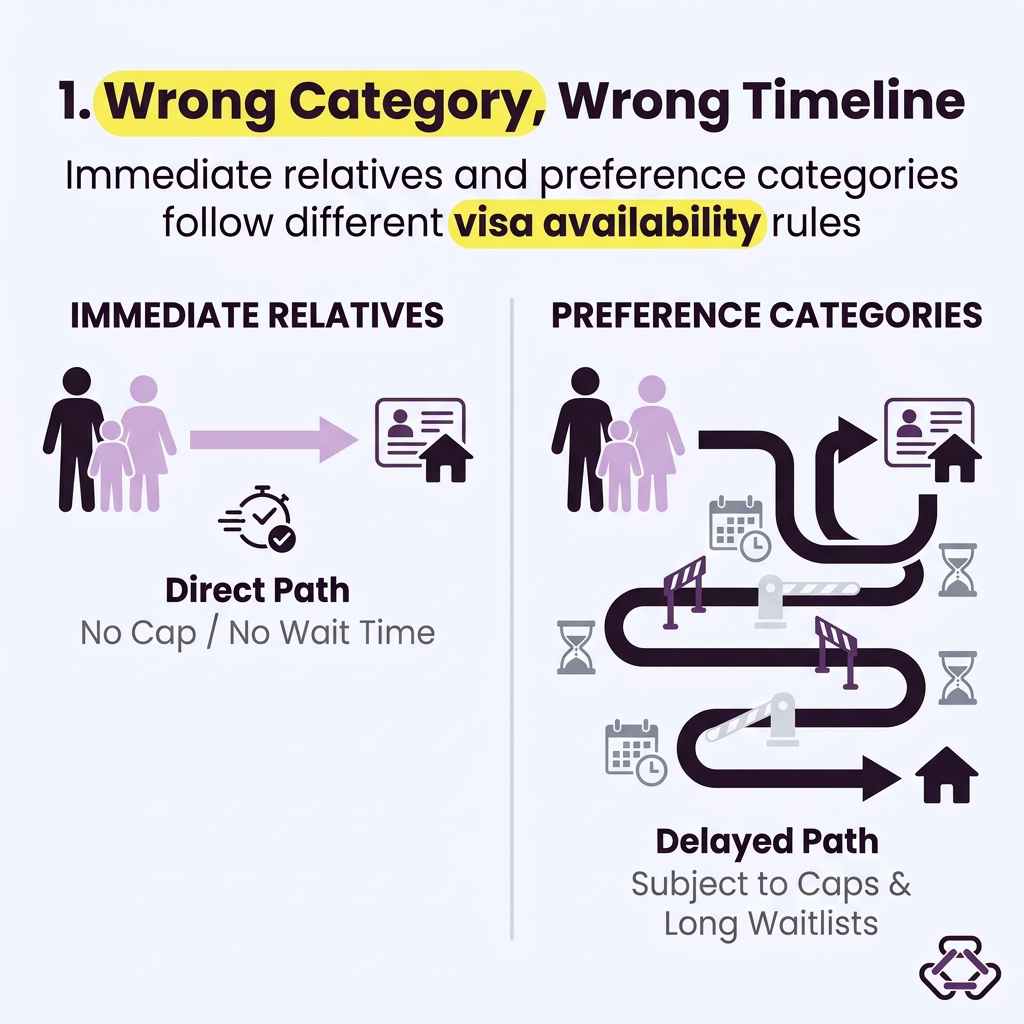
Under immigration law, some relatives of U.S. citizens are considered immediate relatives. That category generally includes spouses, unmarried children under 21, and parents of U.S. citizens who are at least 21. Immediate relatives are not subject to annual numerical visa limits in the same way family preference categories are. By contrast, many other relatives fall into the family-sponsored preference system, where visa numbers are capped and priority-date waiting lines apply. USCIS explains the distinction on its immediate relatives page and its family preference page.
This classification issue often matters more than families expect. If a lawful permanent resident files for a spouse or child, the case is generally in the F2A category rather than the immediate relative category. If a child marries, the category can change. If a petitioner naturalizes, the case may shift again. And if a person is really a “son or daughter” under immigration law rather than a “child,” that can affect both timing and eligibility.
These category questions become especially important when families are trying to estimate waiting time. The State Department’s April 2026 Visa Bulletin confirms that family-sponsored preference visas remain numerically limited and subject to cut-off dates, with the annual worldwide family-sponsored preference level set at 226,000 for fiscal year 2026. That means a filing can be perfectly valid and still face long delays because of the category involved.
2. Visa Bulletin Backlogs Create Delays Families Did Not Expect
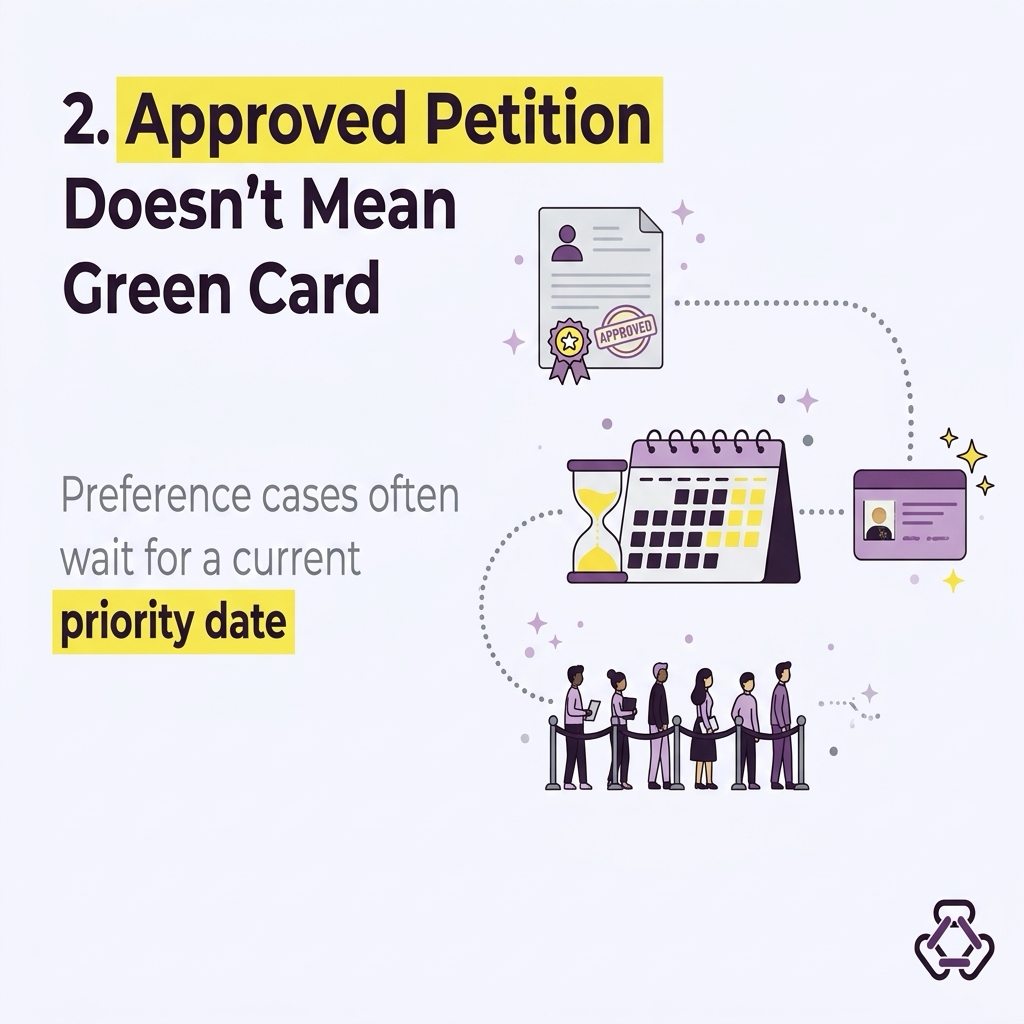
A second major problem is the assumption that approval of the I-130 automatically means the beneficiary can get a green card right away. USCIS states plainly in its Form I-130 page and family guidance that an approved petition does not automatically grant lawful permanent residence. In family preference cases, the beneficiary often has to wait for a visa number to become available based on the priority date.
For many families, this is where confusion and frustration begin. The State Department’s Visa Bulletin controls visa availability, and the cut-off dates vary by family category and country of chargeability. Mexico and the Philippines, for example, have long experienced oversubscription in certain family categories, and the April 2026 bulletin continues to show separate cut-off dates for oversubscribed countries.
This issue can complicate cases in several ways:
- Families may file too early or expect immediate adjustment when the priority date is not current
- Children listed as derivatives may age during the wait
- A petitioner’s naturalization can alter the category and change strategy
- Life events such as marriage, divorce, or turning 21 can affect classification while the case is pending
If a family has questions about wait lines, category changes, or whether a case is really current, the legal analysis often becomes more technical than people expect. For a simpler introduction to these distinctions, many readers also find it helpful to review a plain-language discussion of whether their case falls into immediate relative or family preference territory.
3. The Affidavit Of Support Is Incomplete Or Financially Insufficient
A large share of family green card delays come from the financial sponsorship stage, not from the family relationship itself.
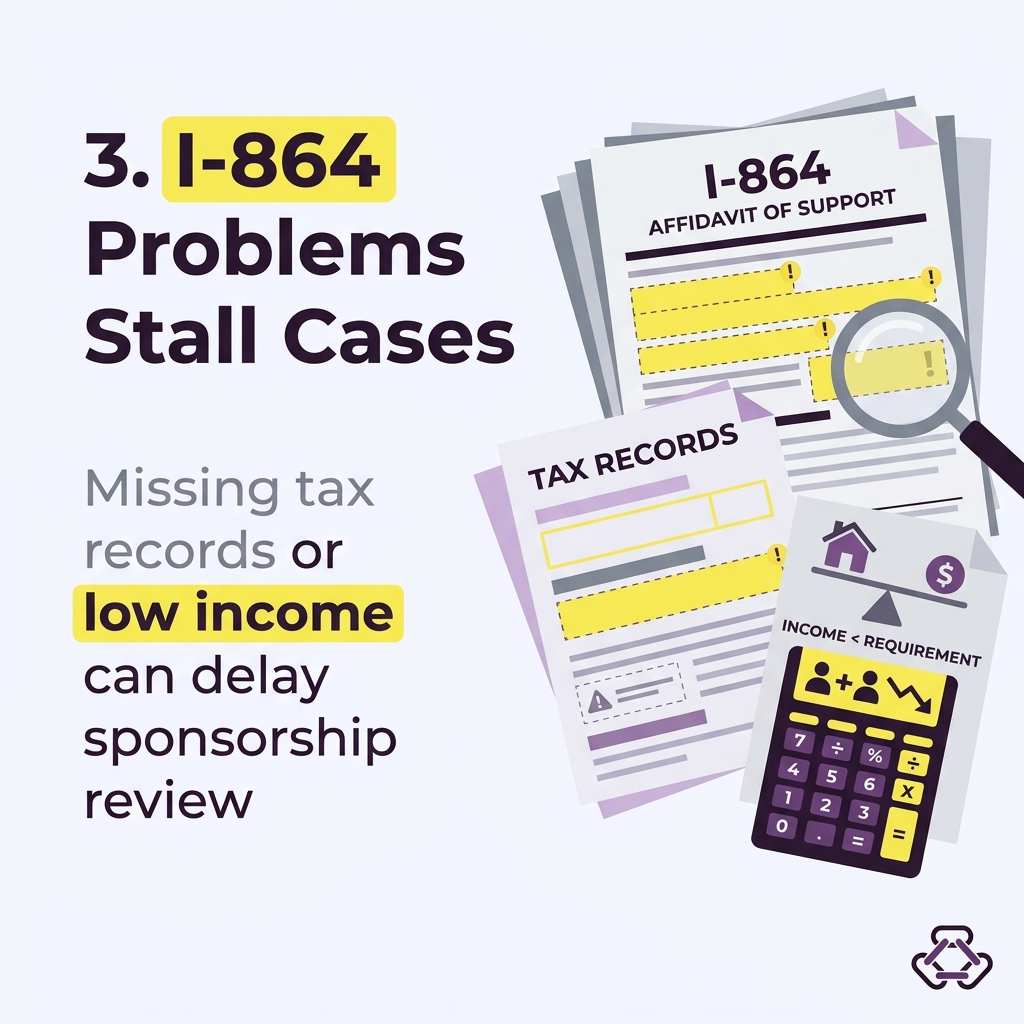
Most family-based immigrants must submit Form I-864, Affidavit of Support, showing adequate financial support and addressing public-charge-related concerns. USCIS says this form is required for most family-based immigrants, and the agency’s I-864 instructions and filing tips explain that common issues include missing tax documentation, incorrect household-size calculations, and confusion about when household-member income or a joint sponsor can be counted. The State Department’s affidavit of support information and I-864 FAQs also note that the affidavit is only one part of the overall public charge review.
In practice, family sponsorship cases often run into problems like:
- The sponsor’s income is too low
- Tax returns are missing or inconsistent
- The sponsor used the wrong household size
- A joint sponsor is offered, but their paperwork is incomplete
- The family is counting income that immigration rules do not allow them to count
- Assets are listed, but not documented properly
This can be particularly stressful because families often view the I-864 as a routine form. It rarely is. A case may be documentarily qualified on the relationship side and still stall because the financial sponsorship record is weak.
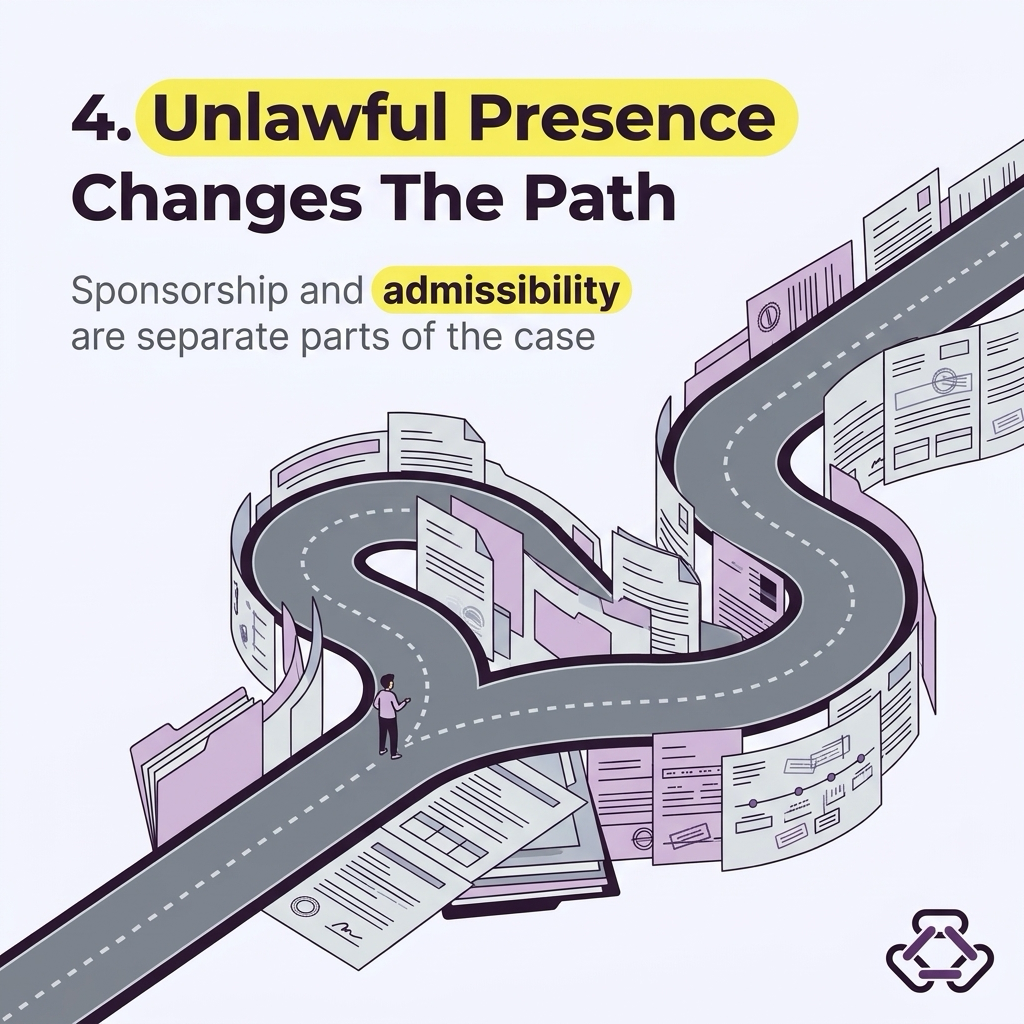
4. Prior Unlawful Presence Changes The Entire Strategy
Another major complication appears when the intending immigrant has prior unlawful presence in the United States.
USCIS explains in its unlawful presence guidance and provisional waiver page that a person who accrued more than 180 days of unlawful presence and then departs the United States may trigger a 3-year or 10-year bar under INA section 212(a)(9)(B). In some cases, a provisional unlawful presence waiver may be available before the immigrant visa interview abroad, but USCIS also notes that approval of a provisional waiver does not itself make someone eligible to adjust status in the United States and does not replace the immigrant visa process.
This is one of the most misunderstood areas in family sponsorship law. Many people hear that a spouse or parent can “sponsor” them and assume the sponsorship erases prior unlawful presence. In general terms, sponsorship and admissibility are separate questions. The relationship may qualify. The petition may even be approved. But the person’s immigration history can still create a serious obstacle when it is time to apply for permanent residence.
That is often where case-specific legal analysis becomes crucial, especially if the person may have:
- Entered without inspection
- Departed after accruing unlawful presence
- Been removed previously
- Triggered other inadmissibility grounds in addition to unlawful presence
5. Marriage-Based Cases Raise Fraud And Bona Fide Relationship Concerns
Marriage-based family sponsorship remains one of the most heavily scrutinized areas of immigration law. USCIS’s Form I-130 instructions say petitioners may submit documents such as joint property records, joint leases, combined financial records, birth certificates of children, third-party affidavits, and other evidence showing an ongoing marital union. In some situations, USCIS requires clear and convincing evidence that the marriage was entered in good faith.
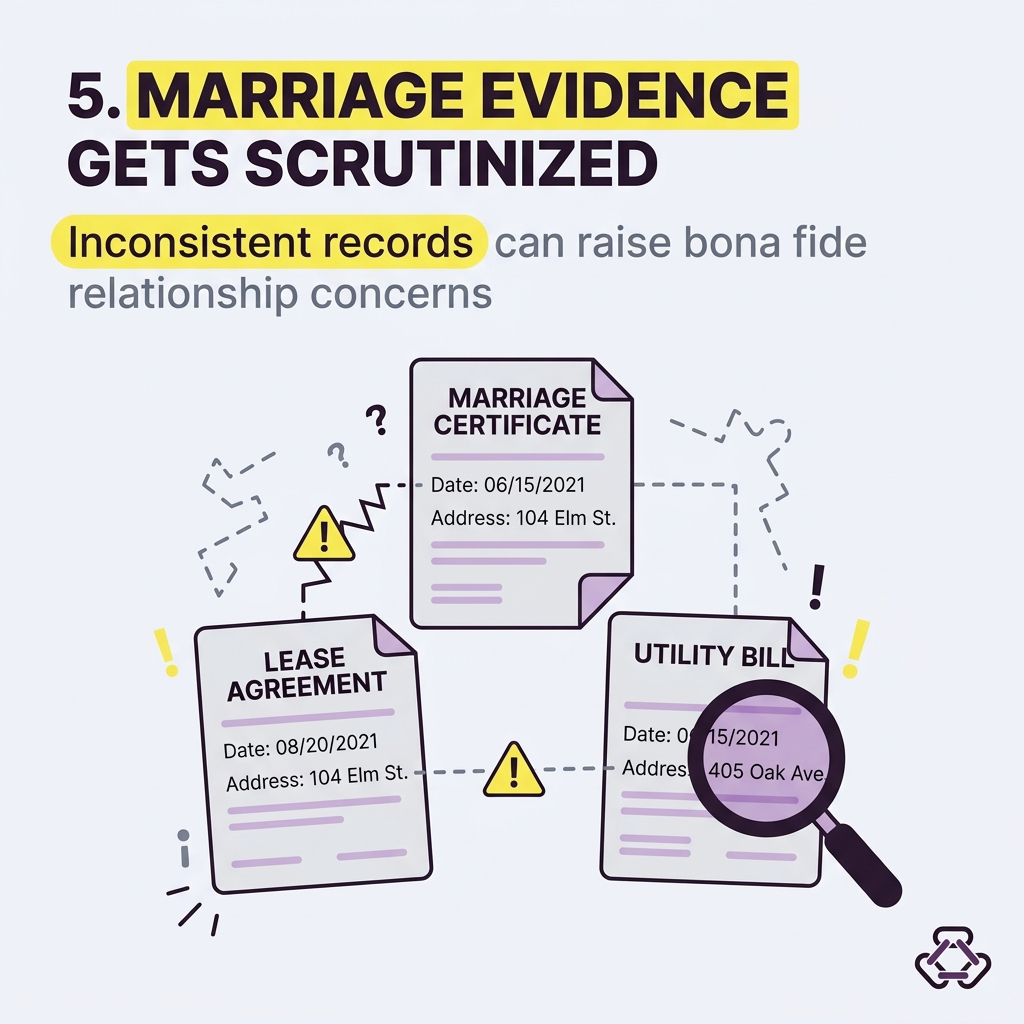
That level of scrutiny becomes much more serious if there is any suggestion of prior marriage fraud. Immigration law includes a bar under INA section 204(c) for certain petition beneficiaries tied to fraudulent marriages, and agency and case-law materials reflect that this issue can block approval of future petitions in some circumstances. Even where there is no formal fraud finding, inconsistent evidence, prior petitions, rushed marriages, separate addresses, or conflicting interview answers can raise concern.
Families often underestimate how small inconsistencies can snowball. A marriage certificate may be valid, yet the case can still get delayed if:
- The couple’s addresses do not match across filings
- Prior immigration records contain contradictory statements
- Divorce records are incomplete
- The relationship timeline is confusing
- The evidence shows little co-mingling of daily life
For people preparing a filing, it can help to compare the relationship evidence against the document checklists and see whether the case record actually tells a coherent story. A practical walkthrough on putting together a family petition without overlooking core proof can make these issues easier to spot before USCIS does.
6. Children Can “Age Out” While The Case Is Pending
Children turning 21 during the immigration process is one of the most painful complications in family sponsorship cases.
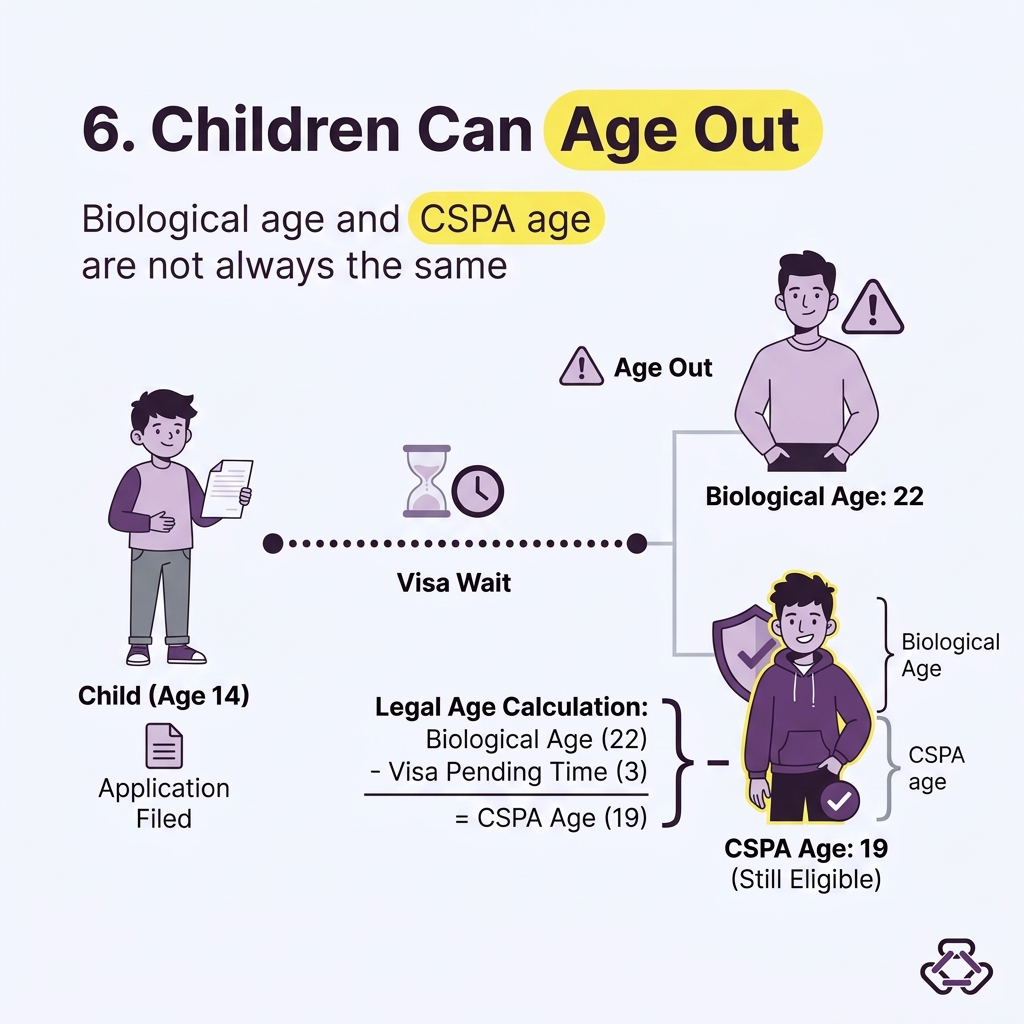
Congress passed the Child Status Protection Act (CSPA) because children were aging out during long government processing times and visa backlogs. USCIS explains on its CSPA page that CSPA does not change the definition of “child,” but it provides a method for calculating age in some categories so certain applicants can remain classified as children beyond their 21st birthday. USCIS also makes clear that the applicant generally still has to remain unmarried, and family-sponsored preference principal and derivative applicants may need to satisfy additional timing requirements tied to visa availability.
This issue often becomes complicated because families tend to track only the child’s biological age, not the CSPA age. Those are not always the same. The difference can determine whether the person stays in a faster category, shifts into a slower one, or loses derivative eligibility altogether.
Typical age-out complications include:
- A child turns 21 while the I-130 is pending
- A derivative child turns 21 while waiting on a visa number
- The family misses the “sought to acquire” timing requirement after visa availability
- A child marries during the process and loses child classification
When long waits are involved, age calculations may deserve close review early rather than late, particularly in preference-category cases.
7. Stepchild And Adopted Child Cases Have Extra Eligibility Rules
Another common complication is assuming that every family relationship recognized socially is automatically recognized the same way under immigration law.
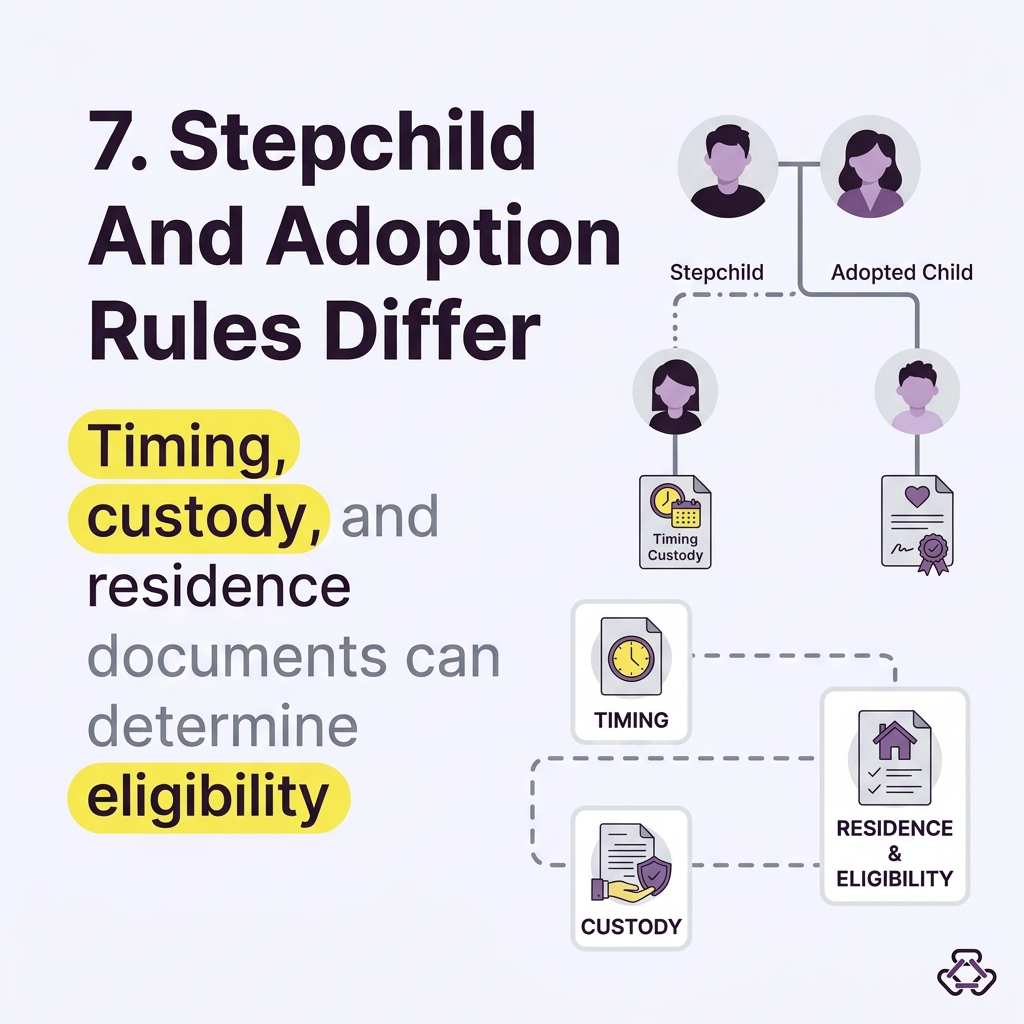
For stepchildren, immigration eligibility often depends on the marriage creating the step relationship having occurred before the child turned 18. USCIS says this on its children and stepchildren guidance and related materials. If the marriage took place after the child’s 18th birthday, the emotional family bond may be real, but the immigration category may not exist.
For adopted children, the rules can be even more technical. USCIS explains in its family-based adoption process guidance that, in the family-based I-130 context, the adoptive parent generally must show a full and final adoption, plus 2 years of legal custody and joint residence with the child, subject to limited exceptions. USCIS also notes that Hague Convention issues may affect whether the family-based process is available at all.
These cases often become complicated because families understandably focus on the fact of parenthood, while immigration law focuses on timing, custody, residence, and documentary proof. Missing one date or one custody document can change the entire case.
8. Adjustment Of Status May Not Be Available Even With An Approved Petition
A final major problem is the belief that an approved family petition automatically means the beneficiary can finish the case inside the United States through adjustment of status.
USCIS makes clear in its green card procedures page and I-485 instructions that eligibility for adjustment depends on more than petition approval. Admission or parole, visa availability, and multiple inadmissibility and adjustment bars can matter. USCIS policy materials also explain that some bars tied to unlawful status or unauthorized employment do not apply the same way to immediate relatives as they do to other categories, but that does not eliminate every possible issue. See, for example, USCIS’s adjustment eligibility guidance and unauthorized employment policy chapter.
This distinction matters because two family cases can look almost identical on the surface and still require very different strategies:
- One person may be able to file adjustment in the United States
- Another may have to complete consular processing abroad
- Another may require a waiver analysis first
- Another may be blocked by entry history, removal history, or inadmissibility issues unrelated to sponsorship
In short, petition eligibility is only one part of green card eligibility.
Final Tip: Family Sponsorship Problems Often Stack On Top Of Each Other
The most difficult family-based green card cases are often not built around one dramatic issue. They are built around several modest issues interacting at once: a valid relationship, a preference-category backlog, an aging-out child, a weak affidavit of support, and a prior unlawful presence problem all in the same file.
That is why families often spend months focusing on the petition itself while the real complications sit elsewhere in the record. If you’re trying to make sense of timelines, documents, and category questions, it may help to review some of the common questions families ask before starting the petition process and compare them against the facts of your own case.
A family sponsorship case can be valid and still be difficult. It can be well-intentioned and still require a careful legal strategy. And it can look straightforward until one date, one missing document, or one prior immigration event changes the entire path.
Visit ReferU.AI to get matched with an attorney who has demonstrable experience in cases like yours — for free.
