Table of Contents
- Family-Based Immigration Explained: Immediate Relatives, Preference Categories, and Sponsorship Issues
- What Family-Based Immigration Actually Covers
- Who Counts As An Immediate Relative
- What The Family Preference Categories Are
- Why Some Family Members Wait And Others Do Not
- What A Priority Date Is
- What Sponsorship Means In A Family Case
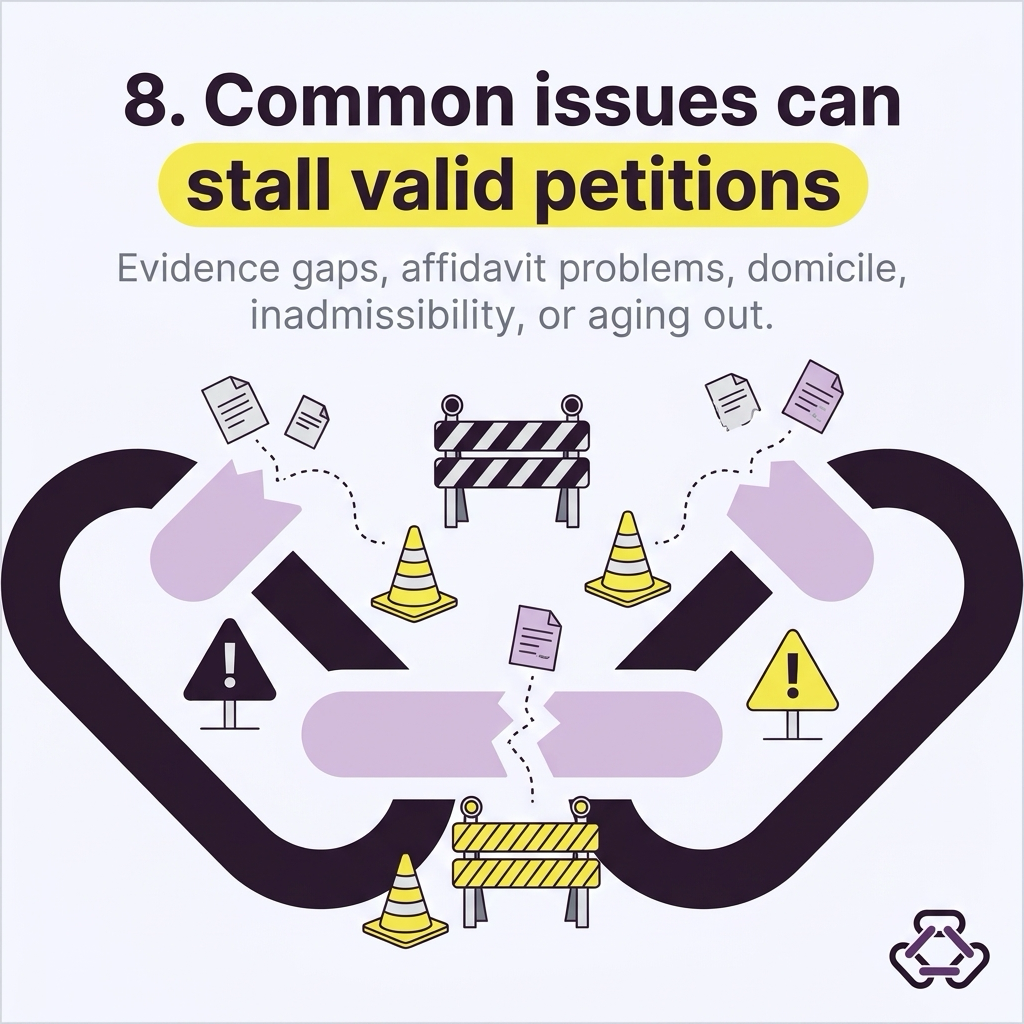
- Common Sponsorship Issues That Can Derail Progress
- Missing Or Inconsistent Relationship Evidence
- Category Misclassification
- Aging Out Concerns
- Changes In The Petitioner’s Status
- Affidavit Of Support Problems
- Domicile Issues
- Prior Immigration Violations Or Inadmissibility Issues
- Death Or Family Changes During The Process
- Why The April 2026 Visa Bulletin Matters Right Now
- How Family Petitions Usually Move Through The System
- Why Families Often Look For Legal Help Earlier Than Expected
- Final Takeaway

Type
Grandchild
Status
Approved
Title (YouTube)
Images Failed (Social)
Images Failed (Social)
Do not index
Parent item
Publish Date (TikTok)
Apr 27, 2027 11:15
Videos Post IDs (Social)
Hashtags (Social)
#LegalAdvice #LegalHelp #Immigration #FamilyImmigration
Caption
Caption X
Cover

OG Image

Alt Image Text
Flat vector illustration of family-based immigration showing immediate relatives and preference categories with sponsorship issues, including family members, petition pathways, and waiting-line visuals.
Images

Videos

Publish Date (Social)
Feb 20, 2027 09:00
Scheduled (Social)
Scheduled (Social)
Images Posted (Social)
Images Posted (Social)
Videos Posted (Social)
Videos Posted (Social)
Featured
Created time
Apr 7, 2026 12:01 AM
Authors
CTA Practice Area (Social)
Immigration
TikTok Failed (Social)
TikTok Failed (Social)
Videos Post Links (Social)
TikTok Post Links (Social)
Images Post IDs (Social)
YT Post ID
Video Pending Manual (Social)
TikTok Posted (Social)
TikTok Posted (Social)
TikTok Post IDs (Social)
Video Cover (Social)

Images Post Links (Social)
First Comment (Social)
Videos Failed (Social)
Videos Failed (Social)
YT Embedded
YT Embedded
Images Delete (Social)
Videos Delete (Social)
Carousel Video URL (Social)
Family-Based Immigration Explained: Immediate Relatives, Preference Categories, and Sponsorship Issues
Family-based immigration is one of the most common ways people pursue lawful permanent residence in the United States. But for many families, the process feels confusing right away: Who counts as an immediate relative? What is a preference category? Why do some people wait years while others can move forward much sooner? And what happens when sponsorship problems get in the way?
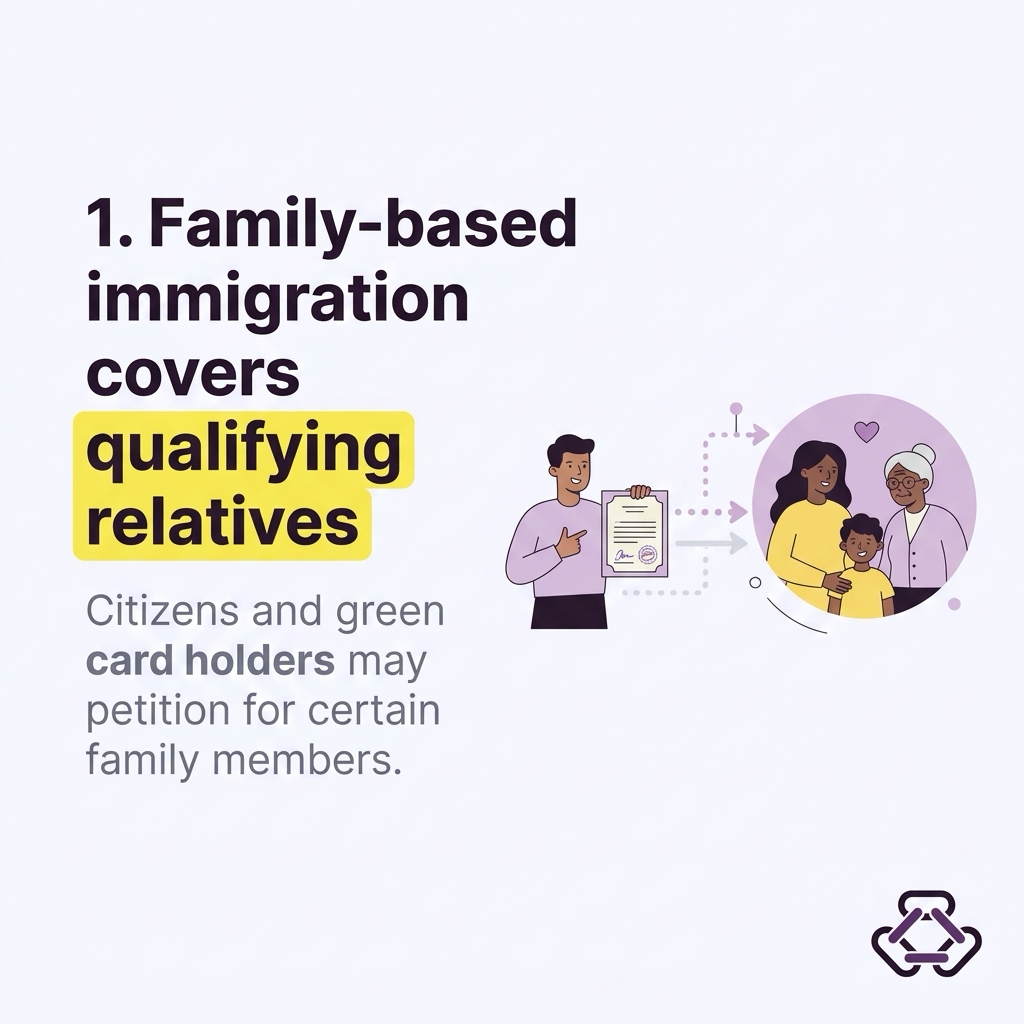
In general terms, family-based immigration is the system that allows certain U.S. citizens and lawful permanent residents to petition for qualifying relatives. Some categories are not subject to annual visa caps, while others are limited by statute and move according to the monthly Visa Bulletin published by the U.S. Department of State. That difference often shapes the entire timeline of a case. The USCIS family-based green card overview and the State Department’s Visa Bulletin for April 2026 are two of the most important starting points for understanding how the system works.
If you’re looking for the bigger picture first, it may help to start with this broader guide to the main areas of immigration law and how they fit together. In this post, you’ll learn how family-based immigration is organized, how immediate relatives differ from family preference categories, what “priority dates” and “visa availability” often mean, and why sponsorship issues can complicate even otherwise valid petitions.
Scroll to the bottom for every post in this series.
What Family-Based Immigration Actually Covers
At a high level, family-based immigration lets a qualifying petitioner ask the government to recognize a family relationship and, if all eligibility rules are satisfied, allow the relative to immigrate or obtain a green card. USCIS explains that family-based green card eligibility includes immediate relatives of U.S. citizens and other relatives in family-based preference categories. Immediate relatives include a U.S. citizen’s spouse, unmarried child under 21, and parent if the U.S. citizen is at least 21. Preference categories cover additional relatives, including certain adult children, siblings, and some spouses and children of green card holders, but those categories are numerically limited each year through the immigration statute’s allocation system described in the Visa Bulletin and summarized by USCIS.
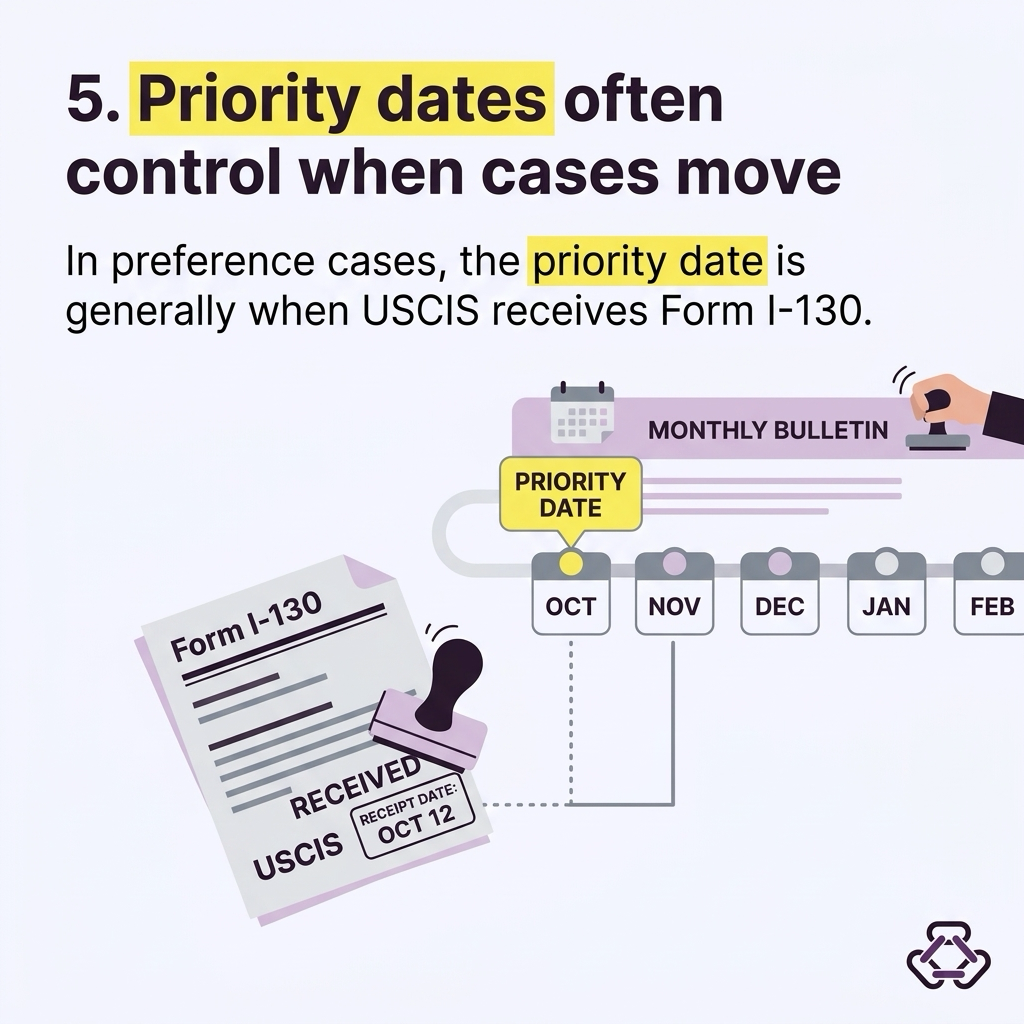
That difference is not just technical. It often affects whether a person can move directly into a green card filing stage or whether the case enters a waiting line tied to the petition’s priority date, which is generally the date USCIS receives the qualifying immigrant petition in a preference case, as reflected in the USCIS Policy Manual.
For readers who want a more introductory walkthrough before getting into the category breakdown, this overview of how petitions, eligibility, and waiting often fit together can be a useful companion.
Who Counts As An Immediate Relative
In family-based immigration, immediate relative is a term of art. It does not simply mean “close family member” in the everyday sense.
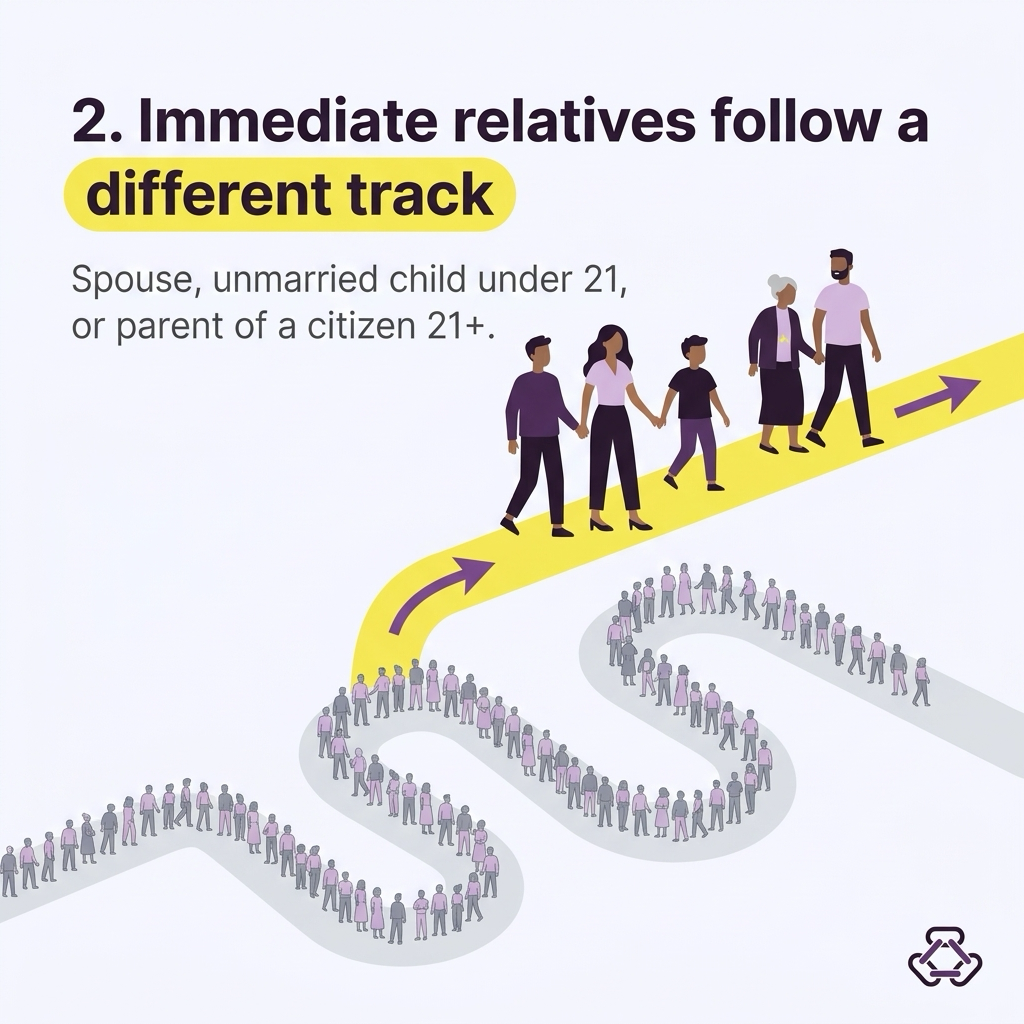
According to USCIS, immediate relatives of U.S. citizens generally include:
- a spouse of a U.S. citizen
- an unmarried child under 21 of a U.S. citizen
- a parent of a U.S. citizen, if the citizen is at least 21 years old
USCIS policy materials repeat the same framework and distinguish these cases from the preference system used for other family relationships. One practical reason this category matters so much is that immediate relatives are generally not subject to the annual numerical limits that apply to preference categories, which often makes visa availability much simpler than it is for other relatives, as reflected in the USCIS family guidance and the structure of the Visa Bulletin.
That said, a case being classified as “immediate relative” does not automatically resolve every issue. Families may still run into questions about lawful entry, admissibility, affidavit of support obligations, prior immigration history, missing civil documents, or whether the claimed relationship is adequately documented.
If you are trying to sort out which side of the line your case falls on, this post on figuring out whether a case is immediate relative or family preference goes deeper into that classification question.
What The Family Preference Categories Are
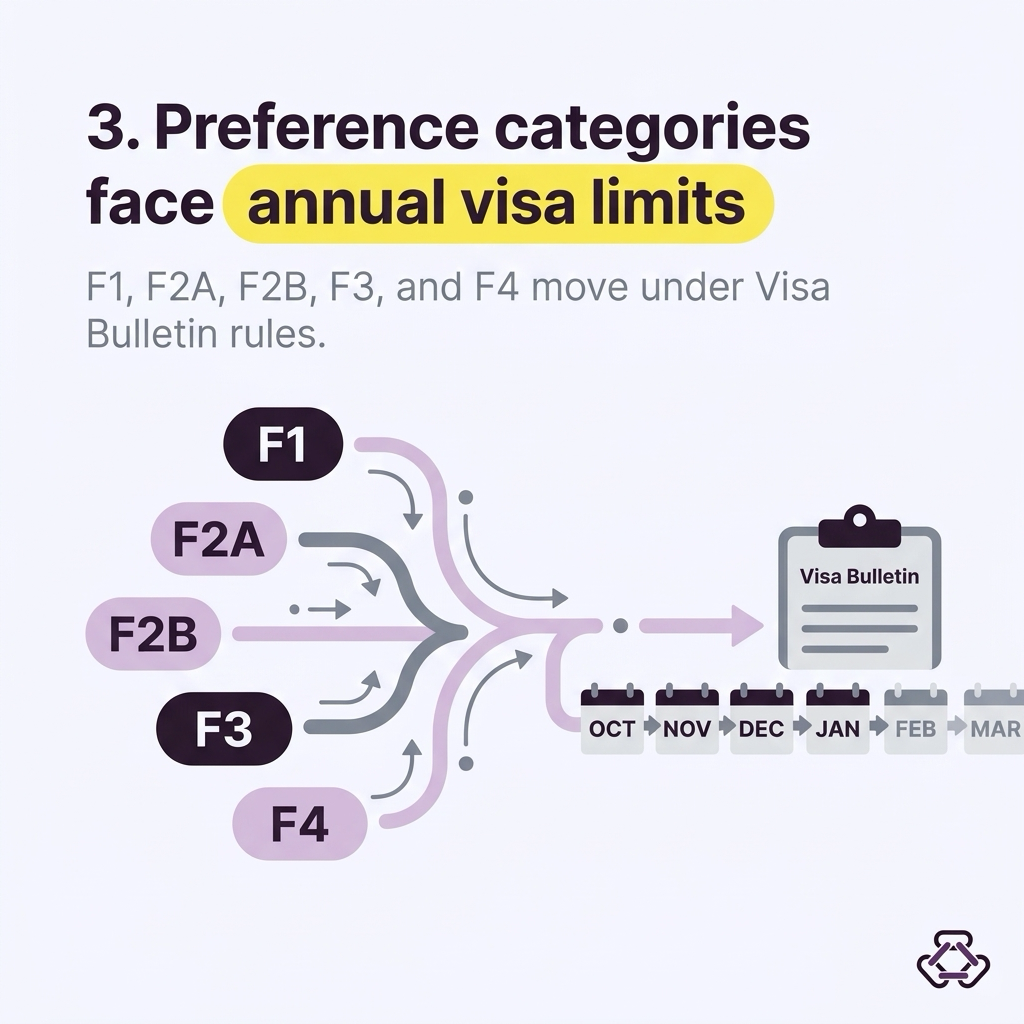
When a qualifying relative does not fit the immediate-relative definition, the case may fall into one of the family-sponsored preference categories. USCIS and the State Department identify the main categories as follows:
- F1: unmarried sons and daughters, age 21 or older, of U.S. citizens
- F2A: spouses and unmarried children under 21 of lawful permanent residents
- F2B: unmarried sons and daughters, age 21 or older, of lawful permanent residents
- F3: married sons and daughters of U.S. citizens
- F4: brothers and sisters of U.S. citizens, where the petitioner is at least 21
These categories are listed in USCIS family-based materials and reflected in the April 2026 Visa Bulletin, which publishes both Final Action Dates and Dates for Filing for family-sponsored immigrant visa categories.
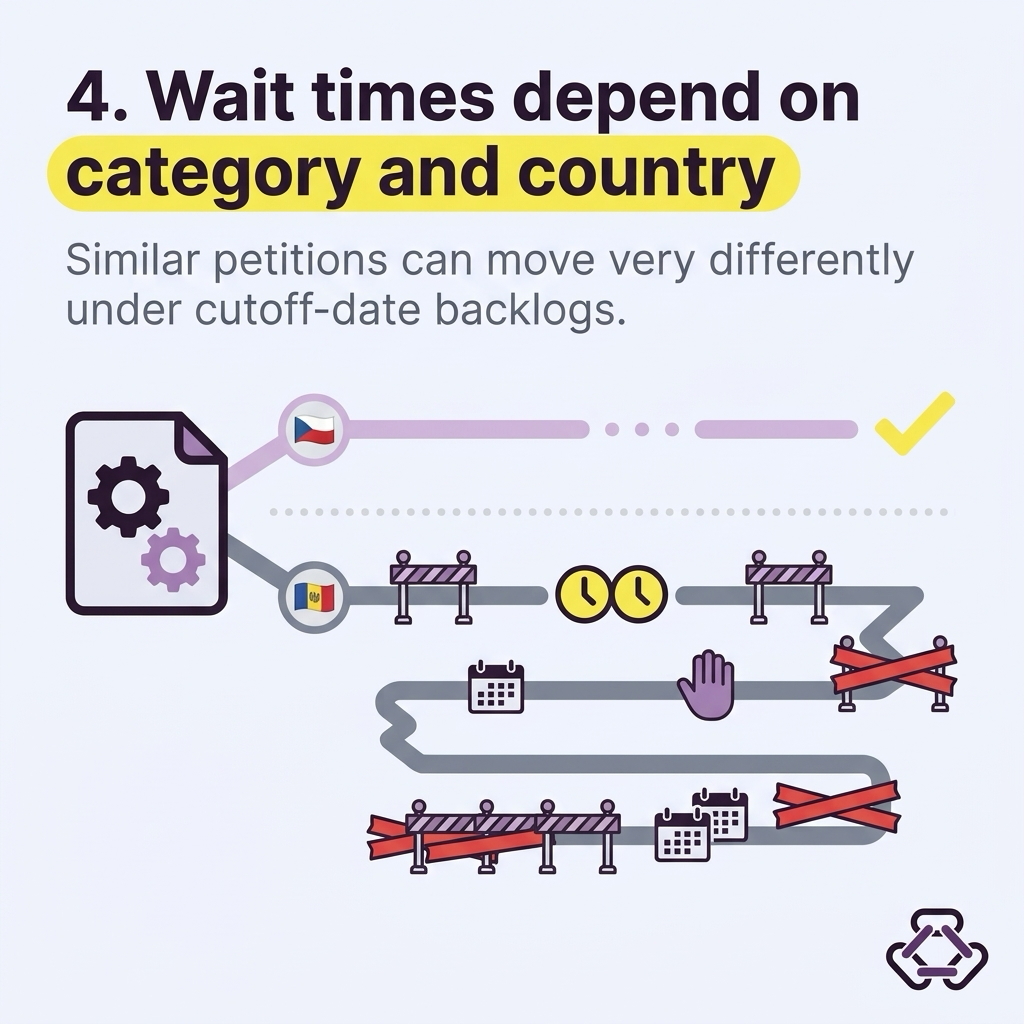
The categories matter because they are tied to annual visa limits and country-based allocation rules. That is why two families may file similar-looking petitions and then experience very different wait times. A spouse of a U.S. citizen and a sibling of a U.S. citizen are both family-based cases, but they move through entirely different legal tracks.
Why Some Family Members Wait And Others Do Not
This is one of the biggest points of confusion in family-based immigration.
In general terms, a family petition does not always mean a green card is immediately available. In preference-category cases, the petition may be approvable, but the intending immigrant often cannot complete the permanent-residence process until a visa number becomes available under the Visa Bulletin system.
The April 2026 Visa Bulletin shows this clearly. For example, in the family-sponsored Final Action Dates chart for April 2026, F1, F2B, F3, and F4 all have cutoff dates rather than being current for most chargeability areas, and some countries have significantly older cutoffs. Mexico and the Philippines, in particular, continue to show longer waits in several family-sponsored categories according to the State Department’s published chart.
By contrast, immediate-relative cases typically do not hinge on those same annual quota backlogs. That does not make them “easy,” but it often removes one major source of delay.
USCIS also notes that for relatives of green card holders, the preference category determines how long the family member may wait for an immigrant visa number to become available. That is a core reason many families spend months or years tracking bulletin movement and trying to understand whether their priority date is “current.”
What A Priority Date Is
A priority date is often the place where waiting begins.
For family-sponsored preference cases, the priority date is generally the date USCIS receives the immigrant petition, usually Form I-130. Later, the State Department compares that date to the applicable cutoff date in the monthly Visa Bulletin. If the priority date is earlier than the listed date for the relevant category and chargeability area, the applicant may be able to move forward depending on the procedural stage and whether USCIS is using the filing chart or final action chart that month.
The April 2026 Visa Bulletin explains this directly: a listed date means numbers are authorized only for applicants whose priority date is earlier than the date shown, and a category marked “C” is current.
This is also why families often hear two different phrases:
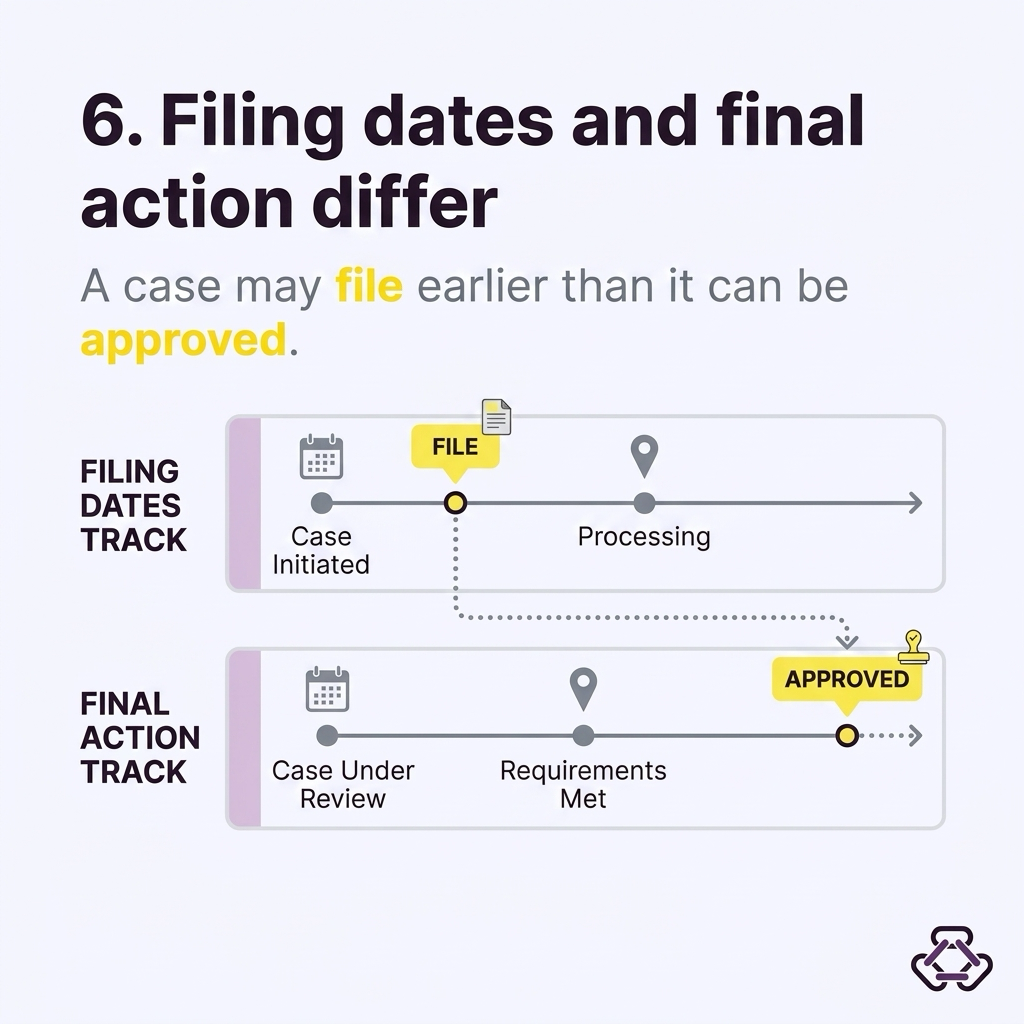
- Dates for Filing
- Final Action Dates
They are related, but not interchangeable. In many months, the filing chart allows document collection or adjustment filing earlier than the final action chart would allow case approval. Whether USCIS accepts the filing chart for adjustment cases in a given month depends on a separate USCIS determination.
What Sponsorship Means In A Family Case
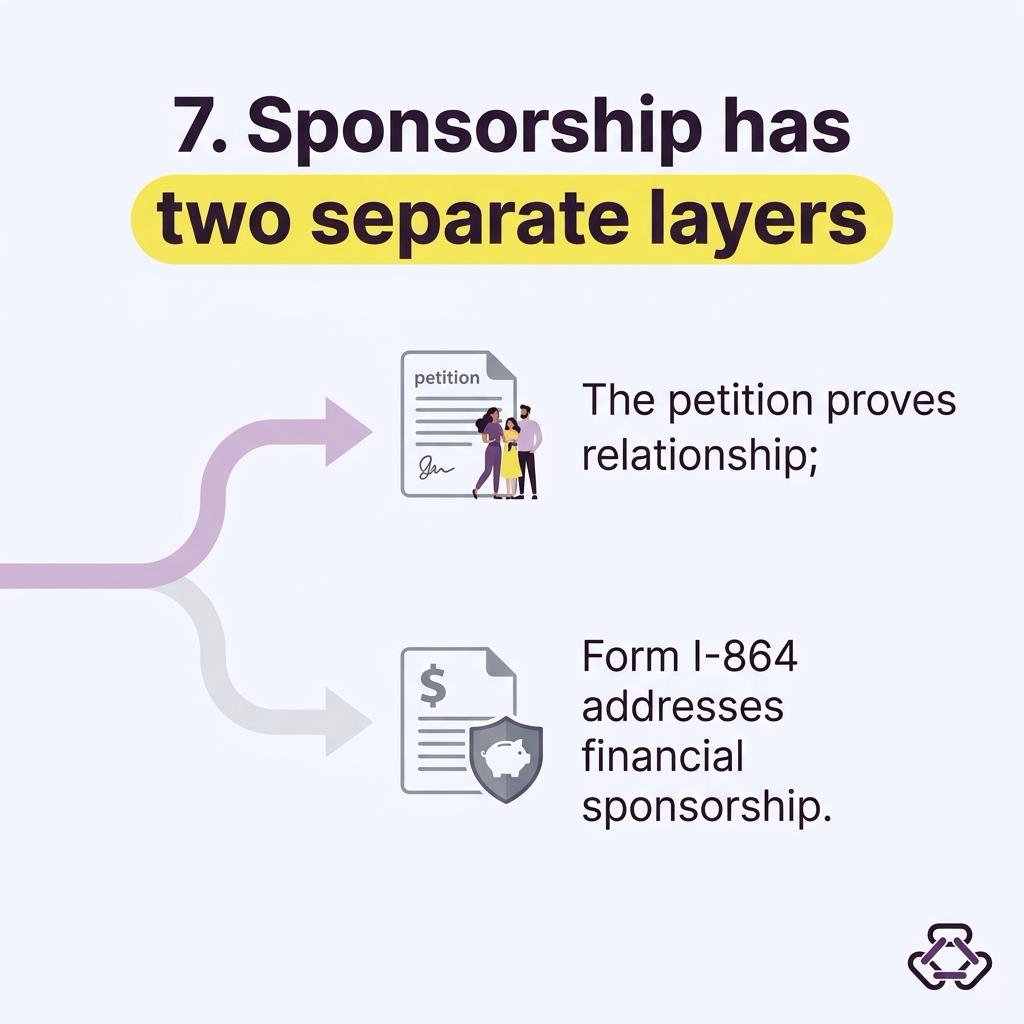
Many people use the word “sponsorship” to mean “filing for a family member.” Legally, though, the concept often has two separate layers:
- The immigrant petition, usually proving the qualifying family relationship
- The financial sponsorship, usually through Form I-864, Affidavit of Support
That second layer can be more serious than families expect. USCIS describes Form I-864 as a legally binding contract in most family-based cases, and the agency notes that if a sponsored immigrant receives certain means-tested public benefits, the government agency that provided them may seek repayment from the sponsor. USCIS also states that the sponsor may face liability for costs and legal fees in some circumstances through enforcement of the support obligation, according to the Form I-864 page and Affidavit of Support guidance. The State Department’s I-864 FAQs add that financial evidence and domicile issues can become important during immigrant visa processing through the National Visa Center.
This is where some cases become more complicated than families expected. A petition may be valid, yet the case can still stall over income documentation, household size, joint sponsor questions, incomplete tax records, or whether the petitioner is domiciled in the United States.
For a practical look at documentation problems that come up early, this piece on preparing a petition packet without leaving out core proof can help frame the common issues.
Common Sponsorship Issues That Can Derail Progress
Family-based cases often slow down for reasons that have little to do with whether two people are actually related. Some of the more common problems include:
Missing Or Inconsistent Relationship Evidence
Birth certificates, marriage certificates, divorce decrees, legitimation records, adoption records, and name-change records often become central in family cases. If dates conflict across documents, or if key records are unavailable, extra explanation and substitute evidence may become necessary.
Category Misclassification
A case may be filed in the wrong framework if the parties misunderstand whether the beneficiary is a “child” under the INA, whether a marriage changes the category, or whether a green card holder can petition for a relative who actually falls outside that petitioner’s allowed relationships.
Aging Out Concerns
In some situations, a beneficiary who was once under 21 may later move into a different category, which can affect visa availability and strategy. Families often find that the Child Status Protection Act analysis is more technical than expected.
Changes In The Petitioner’s Status
If a lawful permanent resident naturalizes, the preference category may change. In some cases that helps. In others, the effect may depend on the family relationship and procedural posture.
Affidavit Of Support Problems
USCIS says most family-based immigrants are required to submit an affidavit of support unless a specific exemption applies, such as certain applicants with 40 qualifying quarters or certain children who automatically acquire citizenship after admission, as explained in the USCIS affidavit guidance. Families can run into issues involving insufficient income, incomplete tax filings, household member forms, or joint sponsor eligibility.
Domicile Issues
The State Department notes in its I-864 FAQs that if domicile evidence is not submitted when required, the petitioner may later need to provide proof showing U.S. domicile. This comes up often in consular cases where the petitioner has been living abroad.
Prior Immigration Violations Or Inadmissibility Issues
A family petition and green card eligibility are not exactly the same thing. A person can have an approved family petition and still face separate issues involving unlawful presence, fraud allegations, entry without inspection, removal history, or other inadmissibility grounds.
Death Or Family Changes During The Process
USCIS has specific guidance on relief for certain surviving relatives under INA 204(l), and some cases can continue under limited circumstances, as described in the agency’s surviving relatives guidance. These cases can become highly technical very quickly.
For a more focused rundown of the obstacles families frequently run into, it may help to read about the sponsorship problems that often complicate green card cases.
Why The April 2026 Visa Bulletin Matters Right Now
Because today is April 7, 2026, the current official bulletin is the April 2026 Visa Bulletin. For family-sponsored categories, it shows that several classifications remain backlogged, with cutoffs varying by category and country. For example:
- F1 is at May 1, 2017 for most chargeability areas, February 15, 2007 for Mexico, and May 1, 2013 for the Philippines
- F2A is at February 1, 2024 for most chargeability areas, with a separate exempt/per-country explanation and February 1, 2023 reflected for Mexico in the final action chart structure
- F3 is at December 22, 2011 for most chargeability areas and May 1, 2001 for Mexico
- F4 is at June 8, 2008 for most chargeability areas and April 8, 2001 for Mexico
Those dates come directly from the State Department’s April 2026 bulletin. In practical terms, that means many approved family petitions remain in line for years before final immigrant visa issuance or green card approval becomes available.
The bulletin also includes Dates for Filing, where F2A is listed as current in April 2026. Whether that translates into immediate filing options for a particular adjustment applicant inside the United States depends on the separate monthly USCIS chart-selection announcement, so families often benefit from checking both agencies’ guidance before making procedural assumptions.
How Family Petitions Usually Move Through The System
A typical family-based case often involves several stages:
- A qualifying petitioner files Form I-130 with USCIS
- USCIS reviews the family relationship and supporting evidence
- If approved, the case either moves forward right away or waits for visa availability, depending on the category
- The beneficiary may then pursue adjustment of status in the United States or consular processing abroad, depending on eligibility and location
- The case may also require Form I-864 financial sponsorship, civil documents, medical exam processing, and an interview
That is the general roadmap, but real cases often become more fact-specific once immigration history, family structure, prior marriages, custody issues, or income questions enter the picture.
If you want a more detailed answer to the threshold questions families often ask before filing, this guide to the common questions that come up before starting a petition is a useful next read.
Why Families Often Look For Legal Help Earlier Than Expected
Family-based immigration can look simple from a distance because it is built around personal relationships. But the legal system evaluates those relationships through statutes, forms, timing rules, and evidence standards. A spouse may also have stepchildren. A parent-child relationship may involve adoption, legitimation, or age questions. A petitioner may be living abroad. A beneficiary may have entered without inspection years ago. An approved petition may still leave the person waiting under the Visa Bulletin for a long time.
That is often where families begin looking for counsel with documented experience in highly similar matters, not just general familiarity with immigration forms. In many situations, the most useful question is not “Who handles immigration?” but “Who has demonstrable experience with this kind of family relationship, timeline issue, and sponsorship complication based on evidence and court-linked records?”
Final Takeaway
Family-based immigration is often presented as a straightforward process, but the reality is more layered. Immediate relatives of U.S. citizens are treated differently from family preference categories. Preference cases often depend on priority dates and the Visa Bulletin. And even where the relationship is valid, sponsorship issues can create serious delays or additional legal questions.
For families trying to make sense of the process, a careful review of category, timeline, relationship evidence, and financial sponsorship often changes the conversation. And when a case involves backlogs, prior immigration history, or affidavit-of-support concerns, many people look for an attorney with verified, relevant experience based on objective criteria and documented case similarity.
Visit ReferU.AI to get matched with an attorney who has demonstrable experience in cases like yours — for free.


