Table of Contents
- 12 Questions Families Ask Before Starting the Petition Process
- 1. Who Can File A Family Petition?
- 2. Is Our Relative An Immediate Relative Or In A Preference Category?
- 3. How Long Is The Wait Right Now?
- 4. Can We File Everything At The Same Time?
- 5. What Documents Do We Have To Gather First?
- 6. How Much Proof Of The Relationship Is Enough?
- 7. Do We Have To Show Income, And What If The Sponsor Does Not Earn Enough?
- 8. What If The Relative Is In The United States Without Clear Status?
- 9. Will The Case Stay With USCIS, Or Go Through The National Visa Center And A Consulate?
- 10. How Much Does It Cost To Start?
- 11. What Happens If USCIS Sends A Request For Evidence?
- 12. Is It Worth Talking To An Attorney Before We File?
- A Final Word Before You Start

Type
Great Grandchild
Status
Approved
Title (YouTube)
Images Failed (Social)
Images Failed (Social)
Do not index
Publish Date (TikTok)
Apr 27, 2027 06:15
Videos Post IDs (Social)
Hashtags (Social)
#LegalAdvice #LegalHelp #Immigration #FamilyImmigration
Caption
Caption X
Cover

OG Image

Alt Image Text
Flat vector illustration of a family reviewing documents and a branching roadmap for family petition process questions in family-based immigration
Images

Videos
Publish Date (Social)
Feb 20, 2027 06:30
Scheduled (Social)
Scheduled (Social)
Images Posted (Social)
Images Posted (Social)
Videos Posted (Social)
Videos Posted (Social)
Featured
Created time
Apr 7, 2026 12:01 AM
Sub-item
Authors
CTA Practice Area (Social)
Immigration
TikTok Failed (Social)
TikTok Failed (Social)
Videos Post Links (Social)
TikTok Post Links (Social)
Images Post IDs (Social)
YT Post ID
Video Pending Manual (Social)
TikTok Posted (Social)
TikTok Posted (Social)
TikTok Post IDs (Social)
Video Cover (Social)
Images Post Links (Social)
First Comment (Social)
Videos Failed (Social)
Videos Failed (Social)
YT Embedded
Images Delete (Social)
Videos Delete (Social)
Carousel Video URL (Social)
12 Questions Families Ask Before Starting the Petition Process
Starting a family-based immigration case often feels less like filling out a form and more like trying to map a long road with unfamiliar rules, waiting periods, and paperwork. Families often want a simple answer to a simple question: where do we begin?
The challenge is that “the petition process” can mean several different things at once. It may involve proving the family relationship, figuring out whether a visa is immediately available, deciding between adjustment of status and consular processing, and preparing financial and civil documents that will be reviewed by more than one agency. The government’s own materials reflect that complexity: the process can start with Form I-130, but what happens next depends heavily on the petitioner’s status, the beneficiary’s relationship, and whether a visa number is available under the Visa Bulletin.
In this post you’ll learn the 12 questions families ask before starting the petition process, what those questions often mean in practical terms, and where legal help can make a difference when the facts are not straightforward. If you want a broader overview first, it may help to read our guide on how family sponsorship categories and eligibility rules fit together.
Scroll to the bottom for every post in this series.
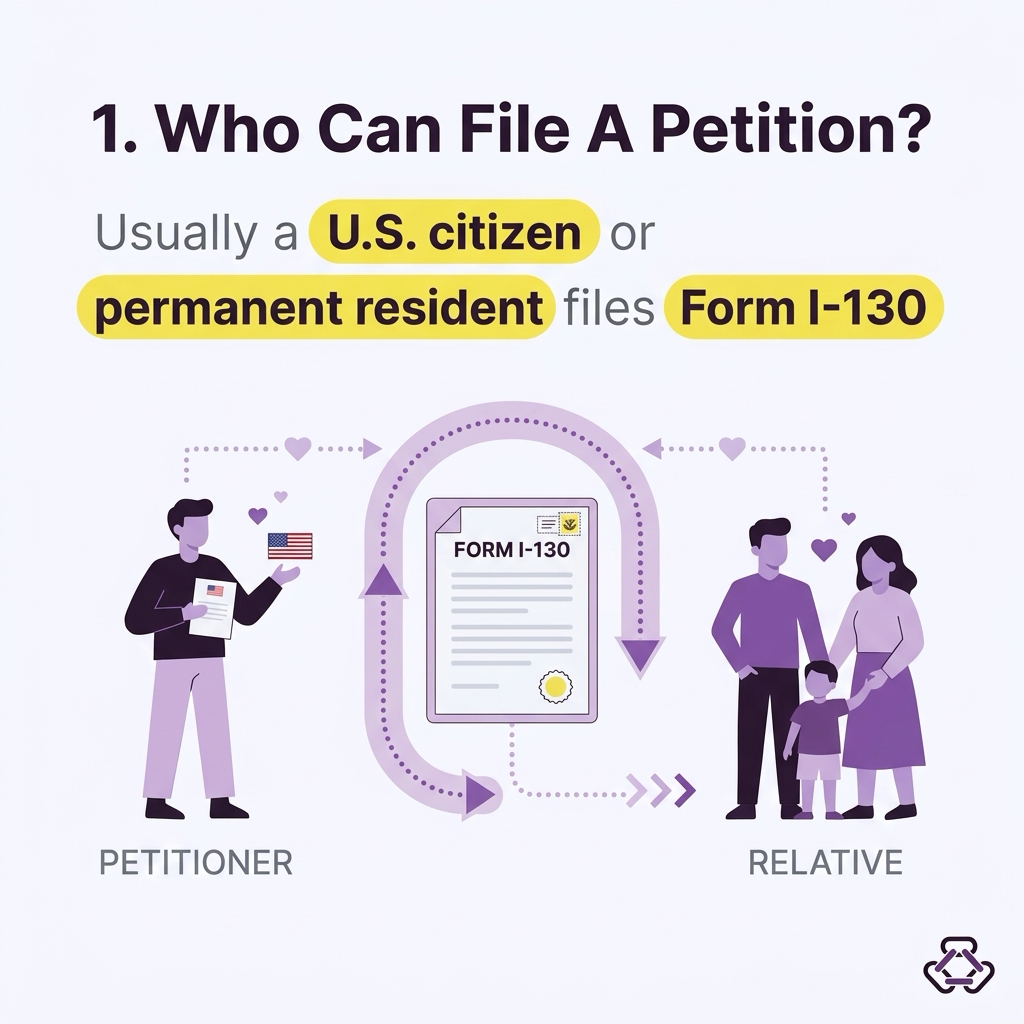
1. Who Can File A Family Petition?
In general terms, a family-based case begins with a petitioner who is either a U.S. citizen or a lawful permanent resident. USCIS explains that the usual starting point is Form I-130, Petition for Alien Relative, which is used to ask the government to recognize a qualifying family relationship.
That first question sounds simple, but it quickly branches out:
- Is the petitioner a U.S. citizen or a green card holder?
- Is the relative a spouse, parent, child, or sibling?
- Is the child under or over 21, and married or unmarried?
Those details matter because not every family relationship is treated the same way. USCIS separates some relatives into immediate relative categories and others into family preference categories, and that distinction can affect waiting time, filing strategy, and what happens after the petition is approved. USCIS also notes that parents can be petitioned only by a U.S. citizen who is at least 21 years old, and siblings can be petitioned only by U.S. citizens, not by permanent residents, through the family category pages at Family of U.S. Citizens.
For many families, the real concern behind this question is: “Are we even eligible to start?” An attorney can often help clarify whether the relationship fits a recognized immigration category before filing fees and months of waiting are invested.
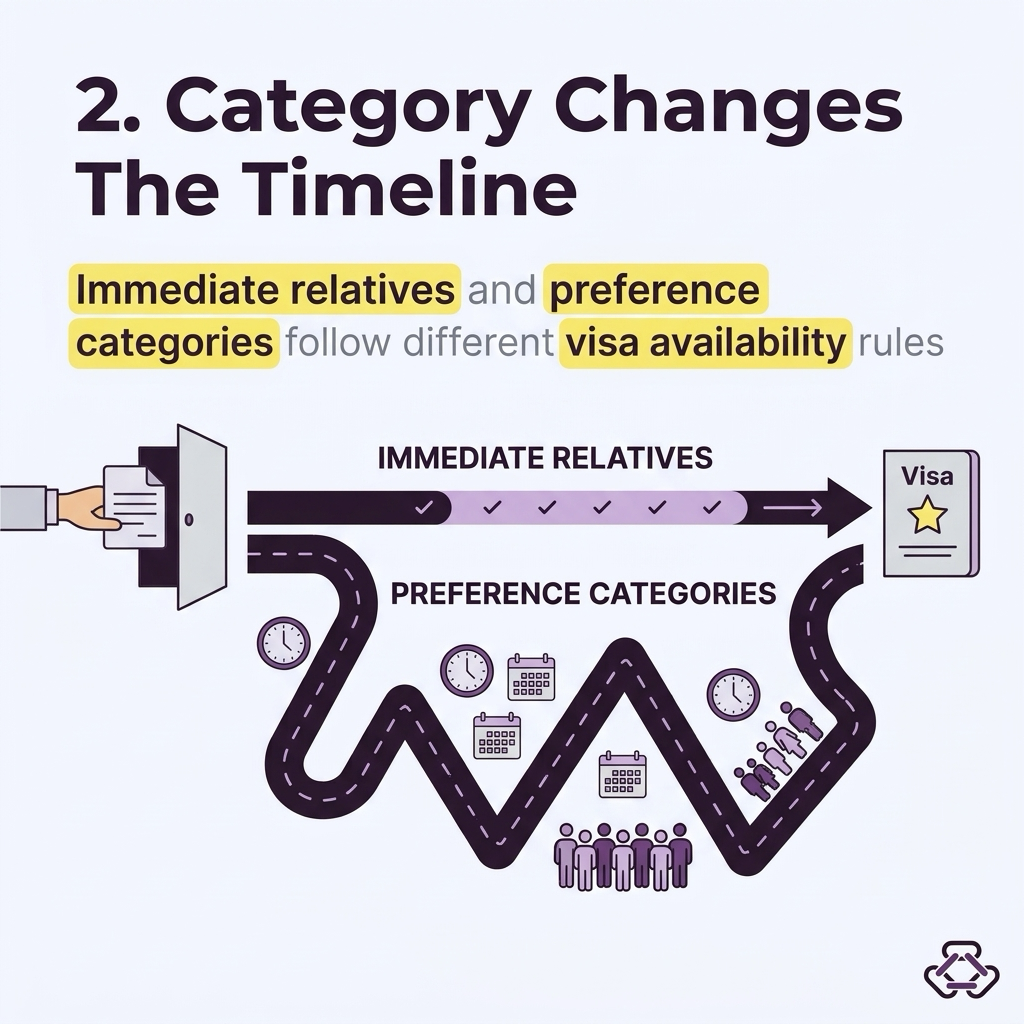
2. Is Our Relative An Immediate Relative Or In A Preference Category?
This is one of the most important questions in the entire process.
Under U.S. immigration law, certain close relatives of U.S. citizens are considered immediate relatives, including spouses, unmarried children under 21, and parents of U.S. citizens who are at least 21. These cases are especially significant because they are not subject to annual numerical visa caps in the same way family preference categories are, which often makes the path more direct, according to USCIS’s concurrent filing guidance and family pages.
By contrast, many other relationships fall into family-sponsored preference categories, where applicants often wait for a visa number to become available. The U.S. Department of State’s April 2026 Visa Bulletin shows that family-sponsored categories are still governed by cut-off dates, and the total family-sponsored preference limit for fiscal year 2026 is listed as 226,000.
This distinction often affects:
- whether adjustment of status may be filed right away,
- whether there may be a long queue after I-130 approval,
- whether the family is planning around months or years.
Families who are still sorting out the category may also find it useful to compare the relationship type, age, and marital-status rules before filing, because a small fact change can move a case from one category to another.
3. How Long Is The Wait Right Now?
This is usually the first emotional question, even when it is not the first legal question.
There are actually two different waiting systems in many family-based cases:
- USCIS processing time for the petition itself, and
- Visa availability if the case is in a capped family preference category.
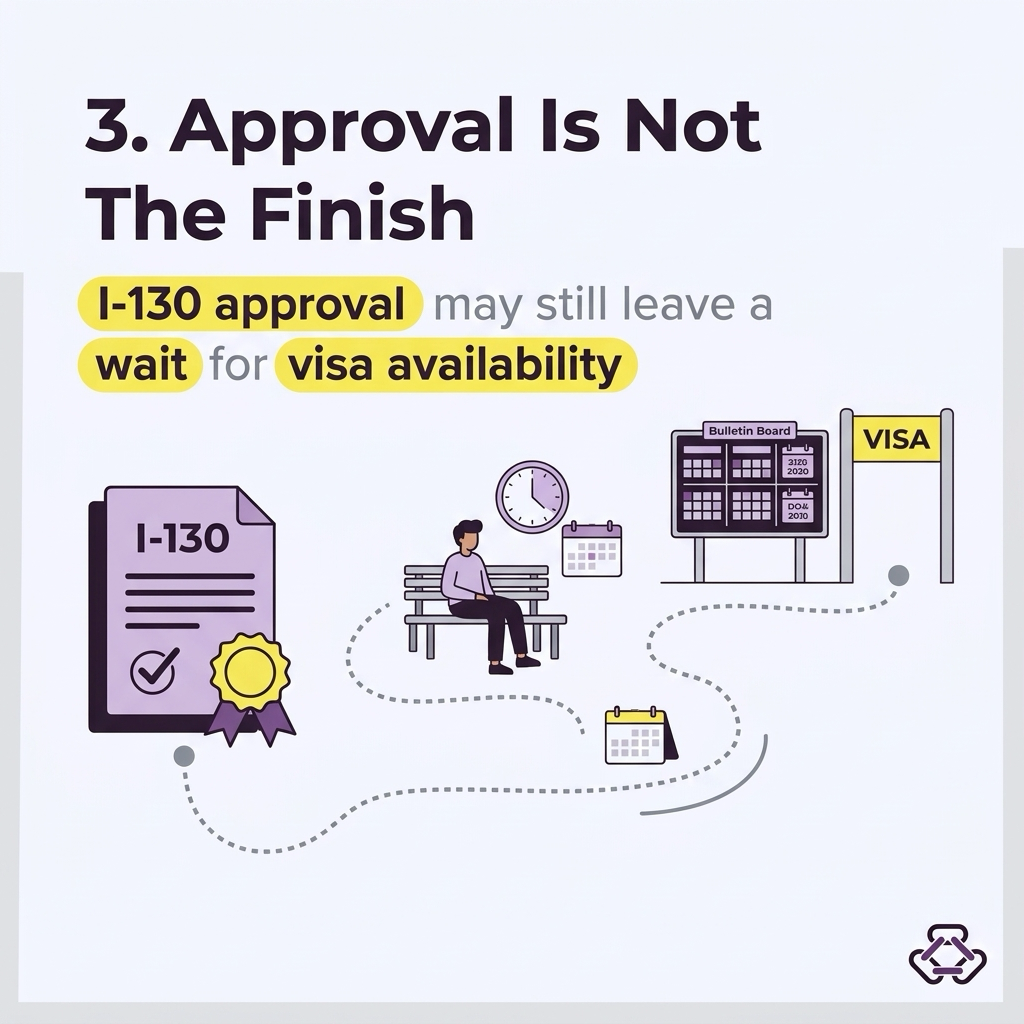
USCIS allows petitioners to track case status and provides processing-time tools for forms including I-130 through its Form I-130 page. But approval of the I-130 is not the same as immediate green-card eligibility in preference cases. For those cases, the family usually also has to watch the monthly Visa Bulletin, which controls when a visa number becomes available.
The April 2026 bulletin shows how much variation there can be between categories and chargeability areas. For example, some family-sponsored categories are moving with dates in 2024 or 2017, while others have cut-off dates many years earlier depending on category and country. That is why two families who both say “we filed for a relative” may be dealing with completely different timelines.
Here’s what this often means in practice: the petition stage and the green-card stage are related, but they are not always the same stage.
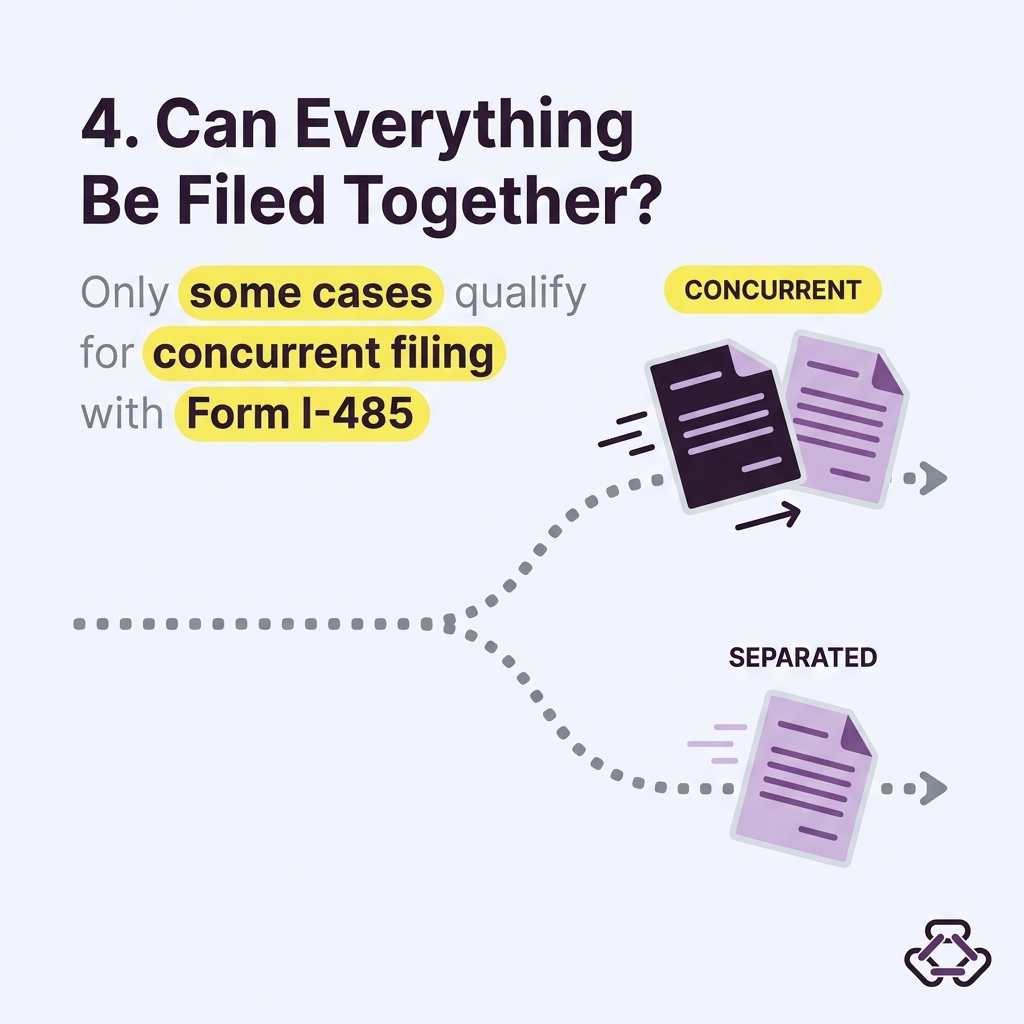
4. Can We File Everything At The Same Time?
Sometimes yes, sometimes no.
USCIS explains that concurrent filing of Form I-485 may be available when a visa number is immediately available and USCIS has jurisdiction over the adjustment application. Immediate relatives of U.S. citizens are a major example, because USCIS states that concurrent filing is always allowed for them when the case otherwise qualifies for adjustment in the United States.
But there are important limits:
- Consular processing cases do not use concurrent filing with USCIS for the immigrant visa application.
- Preference-category cases may file concurrently only when the visa category is current and the filing rules for that month allow it.
- The chart a family may use can change by month depending on USCIS’s visa bulletin filing guidance.
This is one reason families often ask whether they are “doing USCIS or the embassy.” In reality, some cases start with USCIS and later move to the State Department’s National Visa Center and consular interview process. Others remain in the United States as adjustment cases.
If your family is comparing those two routes, it may also help to read more about the broader structure of family sponsorship categories and sponsorship issues, because the filing path often turns on category and visa availability.
5. What Documents Do We Have To Gather First?
Most families want a checklist. The government does provide document instructions, but the practical challenge is that the required evidence depends on the relationship and the processing path.
USCIS’s I-130 page explains that petitioners file evidence showing the qualifying relationship. That often includes civil records such as:
- birth certificates,
- marriage certificates,
- divorce decrees,
- proof of citizenship or permanent residence,
- and, in some marriage cases, evidence supporting the legitimacy of the relationship.
If the case goes through consular processing, the State Department also requires civil documents, and it notes that documents not in English, or not in the official language of the country of application, may require certified translations.
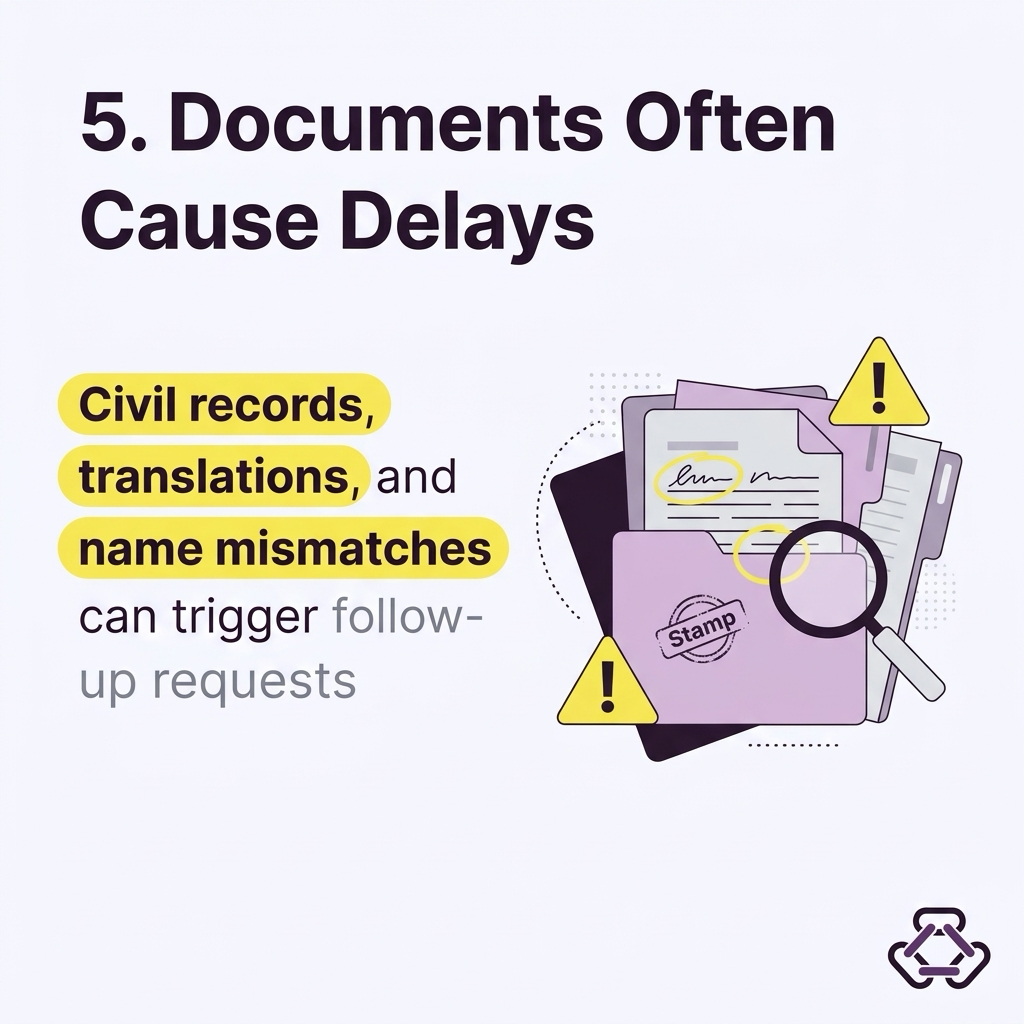
This is often where preventable delays begin. Missing identity records, incomplete translation certifications, and inconsistent names across documents can all create follow-up requests. Families trying to reduce that risk often spend extra time on the evidence package up front, especially if there are prior marriages, adoptions, step-relationships, or foreign civil records that are difficult to obtain.
6. How Much Proof Of The Relationship Is Enough?
This is a major source of anxiety, especially in marriage-based cases.
USCIS’s Policy Manual explains that a family-based petition can run into problems where evidence is missing or the record suggests that a marriage is not bona fide. USCIS also notes that it may deny a petition without first issuing an RFE or NOID when there is no legal basis for approval, according to Chapter 5 of the Policy Manual on Adjudication of Family-Based Petitions.
In everyday terms, families are often asking:
- Do wedding photos matter?
- Do we need leases, bank statements, or insurance records?
- What if we live apart because of work, school, or immigration status?
- What if our documents are real, but our timeline is unusual?
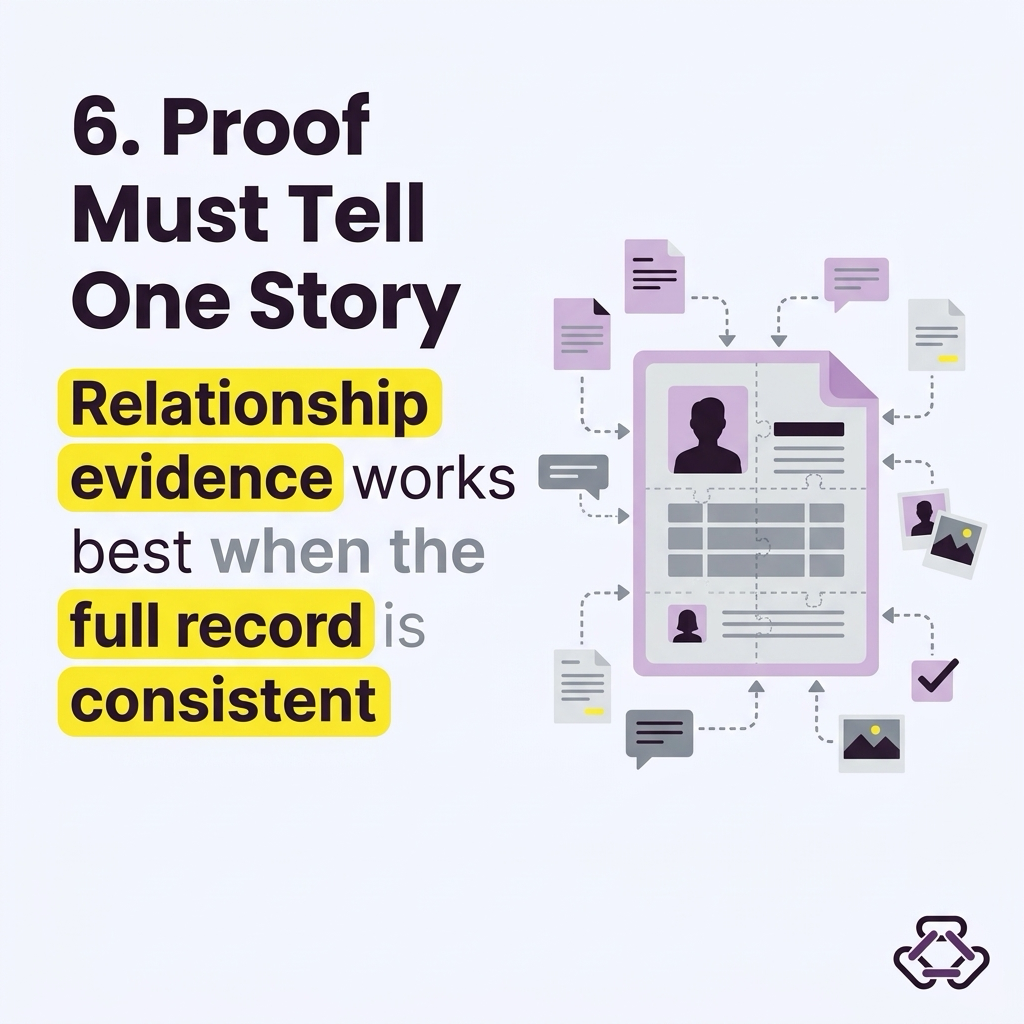
The answer is often less about one magic document and more about whether the overall record tells a consistent, credible story. For spousal cases, USCIS materials repeatedly focus on whether the marriage was entered into in good faith and not solely for an immigration benefit, as reflected in USCIS policy and relationship-based filing guidance.
Some families can prepare a clean package on their own. Others may want legal help if the relationship history is complicated, if the couple has limited joint documentation, or if there are prior filings, criminal issues, or allegations of fraud in the record.
7. Do We Have To Show Income, And What If The Sponsor Does Not Earn Enough?
In many family-based green-card cases, yes, financial sponsorship becomes part of the process.
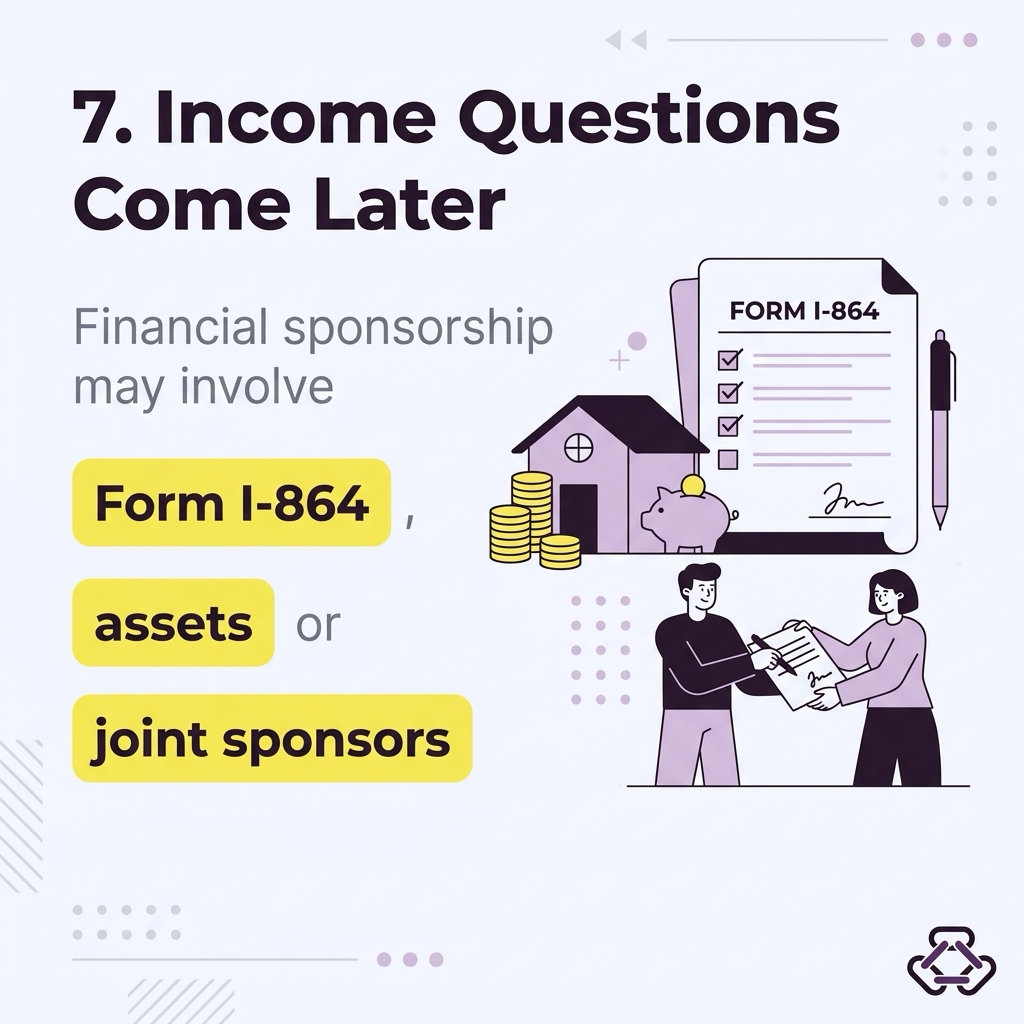
USCIS explains that Form I-864, Affidavit of Support is a legally binding contract in which the sponsor agrees to use financial resources to support the intending immigrant. USCIS also warns that if a sponsored immigrant receives certain means-tested public benefits, a benefit-granting agency may seek repayment from the sponsor. USCIS separately explains the broader affidavit-of-support framework, including situations involving substitute sponsors and related obligations.
USCIS publishes poverty guideline figures for affidavit-of-support cases, and those numbers are used to assess whether the sponsor meets the required threshold for household size. When the sponsor’s income is not enough, families sometimes look at:
- qualifying assets,
- a household member’s contribution through Form I-864A,
- or a joint sponsor, where the law allows one.
What families often worry about here is not just numbers, but risk. Signing the affidavit is not symbolic paperwork. USCIS describes it as a real contractual obligation. That is one reason families often pause at this stage and ask for counsel, especially where the income history is variable, tax filing is incomplete, or household size is disputed.
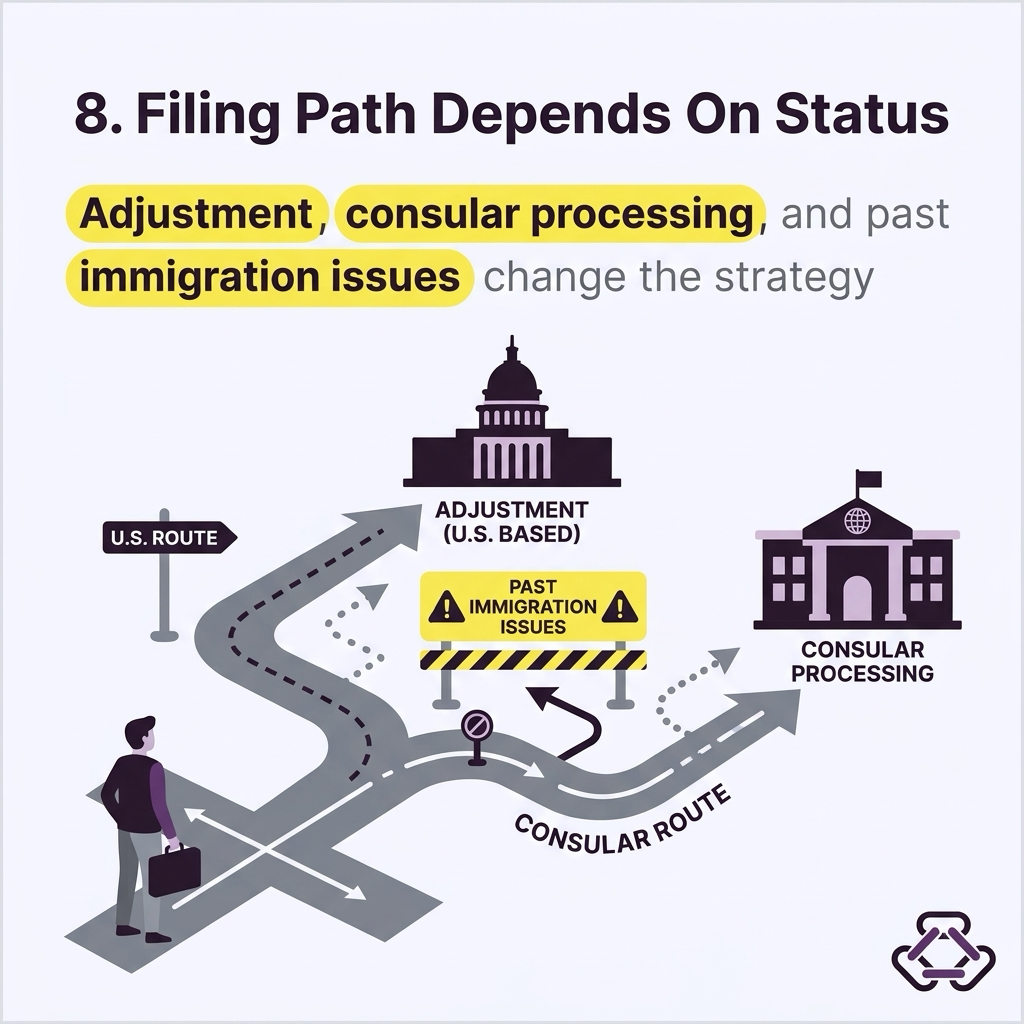
8. What If The Relative Is In The United States Without Clear Status?
This is where family cases often shift from paperwork questions to legal-risk questions.
Some families assume that having a qualifying U.S. citizen relative automatically fixes unlawful presence, visa overstays, unauthorized employment, prior entries, or past immigration violations. In reality, the existence of a family relationship and even an approved I-130 may be only one piece of a much bigger eligibility picture.
USCIS explains that concurrent filing is available only when the person is eligible to adjust status and a visa number is available through its adjustment guidance. That means the path can turn on how the person entered the U.S., whether bars apply, whether waivers may exist, and whether consular processing would trigger additional consequences.
This is also where families often discover that “starting the petition” and “getting the green card” are legally distinct steps. Filing the petition may establish the relationship. It does not automatically resolve inadmissibility issues, removal history, fraud allegations, or unlawful presence concerns.
When a family is dealing with overstay, prior denials, removal proceedings, criminal history, or misrepresentation concerns, many people in similar situations look for legal review before anything is filed, because a mistaken filing strategy can create a harder record to unwind later.
9. Will The Case Stay With USCIS, Or Go Through The National Visa Center And A Consulate?
That depends mainly on where the beneficiary is located and whether adjustment of status is available.
If the beneficiary is abroad, or if adjustment of status is not available in the United States, the case often moves after I-130 approval to the Department of State’s National Visa Center. The State Department’s immigrant visa process materials explain that applicants later submit financial evidence, civil documents, and the DS-260, and then prepare for an immigrant visa interview abroad. The agency’s civil document guidance outlines part of that document-collection stage, and its IV scheduling and wait-time tool notes that visa availability in preference cases still depends on the Visa Bulletin.
Families often underestimate how different these two tracks can feel:
- Adjustment of status is handled with USCIS inside the United States.
- Consular processing involves NVC document review and a consular interview abroad.
The evidence overlaps, but the logistics are different. So are the risks when unlawful presence or prior immigration issues are involved.
10. How Much Does It Cost To Start?
Government filing costs change from time to time, so this question is worth checking with current official sources before filing.
USCIS states on its Form I-130 page that there is a filing fee and that online filing receives a $50 discount. USCIS fee guidance and FAQs reflect the current amounts as $625 for online Form I-130 filing and $675 for paper filing, and USCIS notes that separate forms generally require separate payments through the fee schedule and fee FAQs.
That is only the opening cost in many cases. Depending on the route, families may also encounter:
- adjustment-of-status filing fees,
- affidavit-of-support or visa-processing fees,
- medical exam costs,
- translation costs,
- document retrieval costs,
- and legal fees if counsel is involved.
This is one reason families often try to file once, carefully. A rejected filing, a denied filing, or a long-delayed filing can make the total cost much higher than the initial form fee suggested.
11. What Happens If USCIS Sends A Request For Evidence?
An RFE is not automatically a sign that the case is lost. In many family cases, it means the officer wants more information before deciding. But USCIS’s Policy Manual also makes clear that not every weak case gets an RFE; in some situations, USCIS may deny without one if there is no legal basis for approval and additional information could not cure the problem, according to the Policy Manual chapter on family-based petitions.
Families often receive RFEs involving:
- missing civil records,
- inconsistent biographical details,
- insufficient relationship evidence,
- incomplete financial sponsorship proof,
- or translation and signature problems.
What matters is often not just responding quickly, but responding coherently. If the original filing told one version of the facts and the RFE response tells another, the inconsistency can create a larger credibility issue than the missing document alone.
That is why families sometimes bring in an attorney at the RFE stage even if they filed the petition themselves. A legal review can help frame the response around the issue USCIS actually raised, rather than sending a stack of unrelated records.
12. Is It Worth Talking To An Attorney Before We File?
For some straightforward cases, families may feel comfortable handling the first steps themselves using official USCIS and State Department instructions. For other cases, an attorney can be especially helpful when there are facts that raise legal or evidentiary questions, such as:
- prior overstays or unlawful presence,
- criminal history,
- prior marriage-based filings,
- conflicting documents,
- adoption or stepchild complications,
- sponsor income issues,
- prior denials,
- removal history,
- or uncertainty about whether the case belongs in adjustment or consular processing.
The reason many families ask this question is not because the forms are impossible. It is because the stakes are personal, the timelines are long, and a filing can create a record that follows the family throughout the case.
If you are still comparing the bigger picture, our article on how family sponsorship works and where sponsorship problems often arise can help put these questions into context before the first filing goes out.
A Final Word Before You Start
The petition process often begins with one form, but it rarely begins with only one issue. Families are usually sorting out eligibility, category, timing, evidence, visa availability, financial sponsorship, and filing strategy all at once. And when a case includes prior immigration history, complicated family records, or uncertain adjustment eligibility, the gap between a basic filing and a well-planned filing can become significant.
In general terms, the smartest starting point is often not “Which form do we send?” but rather “What case are we actually trying to build?” That question can affect every step that follows.
Visit ReferU.AI to get matched with an attorney who has demonstrable experience in cases like yours — for free.
