Table of Contents
- How to Transition From a K-1 Visa to a Marriage-Based Green Card
- What Happens After A K-1 Visa Holder Enters The United States?
- What Is Adjustment Of Status In A K-1 Marriage Case?
- Step 1: Get Married Within 90 Days Of Entry
- Step 2: Prepare The Main Green Card Filing Package
- Step 3: Include The Financial Sponsorship Documents
- Step 4: Handle The Medical Exam And Vaccination Record Correctly
- Step 5: Consider Work Authorization And Travel Timing
- Step 6: Gather Real Evidence Of A Bona Fide Marriage
- Step 7: Prepare For Biometrics, Possible RFEs, And The Interview
- What If The Marriage Is Less Than Two Years Old When The Green Card Is Approved?
- Common Reasons K-1 To Green Card Cases Get Delayed
- Missing Or Outdated Forms
- Weak Affidavit Of Support Evidence
- Medical Exam Confusion
- Travel Problems During Adjustment
- Thin Relationship Documentation
- When An Attorney May Be Especially Helpful
- The Bottom Line

Type
Great Grandchild
Status
Approved
Title (YouTube)
Images Failed (Social)
Images Failed (Social)
Do not index
Publish Date (TikTok)
Apr 27, 2027 14:15
Videos Post IDs (Social)
Hashtags (Social)
#LegalAdvice #LegalHelp #Immigration #FianceVisa
Caption
Caption X
Cover

OG Image

Alt Image Text
Flat vector illustration of a couple, wedding ring, passport, and immigration paperwork showing the transition from a K-1 visa to a marriage-based green card
Images

Videos
Publish Date (Social)
Feb 20, 2027 10:30
Scheduled (Social)
Scheduled (Social)
Images Posted (Social)
Images Posted (Social)
Videos Posted (Social)
Videos Posted (Social)
Featured
Created time
Apr 7, 2026 12:00 AM
Sub-item
Authors
CTA Practice Area (Social)
Immigration
TikTok Failed (Social)
TikTok Failed (Social)
Videos Post Links (Social)
TikTok Post Links (Social)
Images Post IDs (Social)
YT Post ID
Video Pending Manual (Social)
TikTok Posted (Social)
TikTok Posted (Social)
TikTok Post IDs (Social)
Video Cover (Social)
Images Post Links (Social)
First Comment (Social)
Videos Failed (Social)
Videos Failed (Social)
YT Embedded
Images Delete (Social)
Videos Delete (Social)
How to Transition From a K-1 Visa to a Marriage-Based Green Card
For many couples, the K-1 visa feels like the hard part. Then the wedding happens, the paperwork starts again, and a new question shows up fast: what comes next after marriage?
That next step is usually adjustment of status — the process that allows a K-1 visa holder who married the U.S. citizen petitioner to apply for lawful permanent residence from inside the United States. The process is common, but it is also detail-heavy. Filing timing, medical records, financial sponsorship, work authorization, travel issues, and proof of a real marriage can all affect how smoothly the case moves.
In this post, you’ll learn how the transition from a K-1 visa to a marriage-based green card generally works, what forms are often involved, where couples run into delays, and when an attorney may be especially helpful. If you want a broader overview of the fiancé visa timeline before diving into adjustment, this guide on what happens before and after the wedding in the K-1 process adds useful context.
Scroll to the bottom for every post in this series.
What Happens After A K-1 Visa Holder Enters The United States?
A K-1 visa allows a foreign national fiancé(e) of a U.S. citizen to enter the United States for one specific purpose: to marry that U.S. citizen petitioner. According to USCIS, the marriage is expected to take place within 90 days of admission. After that marriage, the K-1 entrant may apply for a green card through Form I-485, Application to Register Permanent Residence or Adjust Status.
That 90-day point matters in a very specific way. USCIS explains that a K-1 entrant becomes eligible to adjust status after a bona fide marriage with the same U.S. citizen petitioner within 90 days of entry. USCIS also notes that marriage to someone else does not create the same adjustment path for a K-1 entrant under this category, a point reflected in both USCIS guidance for fiancé(e)s and eligibility guidance for K-1 green cards.
In practical terms, the transition usually looks like this:
- The K-1 visa holder enters the U.S.
- The couple marries within 90 days
- The foreign spouse files for adjustment of status
- USCIS processes the application
- USCIS may schedule biometrics and an interview
- If approved, the applicant receives lawful permanent resident status
What Is Adjustment Of Status In A K-1 Marriage Case?
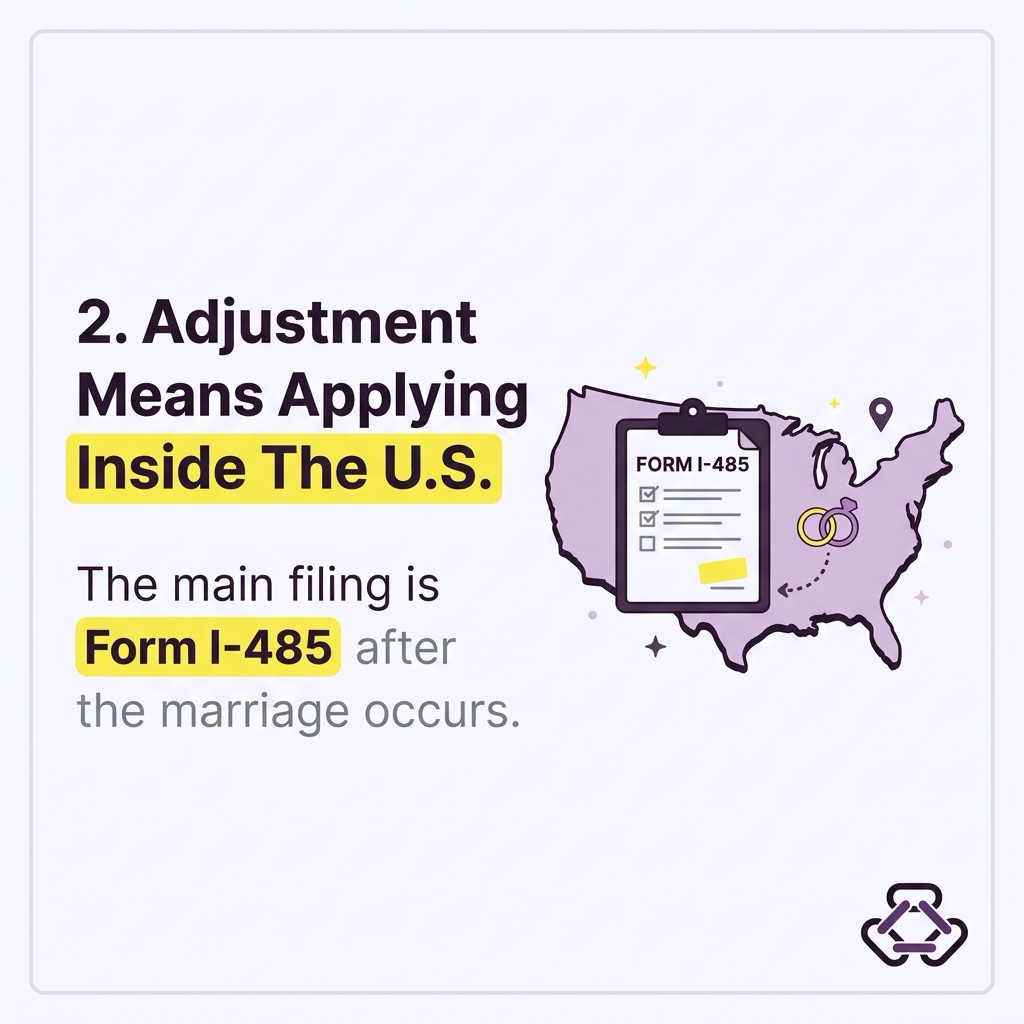
Adjustment of status is the process of applying for permanent residence without leaving the United States. USCIS describes adjustment of status as the pathway that allows eligible applicants to get a green card from inside the country rather than completing immigrant visa processing abroad through a U.S. consulate, as explained on the agency’s adjustment of status overview.
For K-1 couples, that distinction matters because the visa holder already entered legally on the fiancé(e) visa. Once the marriage takes place, the spouse generally applies from within the U.S. through the family-based adjustment process tied to the original K-1 admission and the marriage to the petitioner, as USCIS explains on its K-1 green card eligibility page.
This is often described casually as “going from a K-1 visa to a marriage green card,” but technically the key filing is Form I-485.
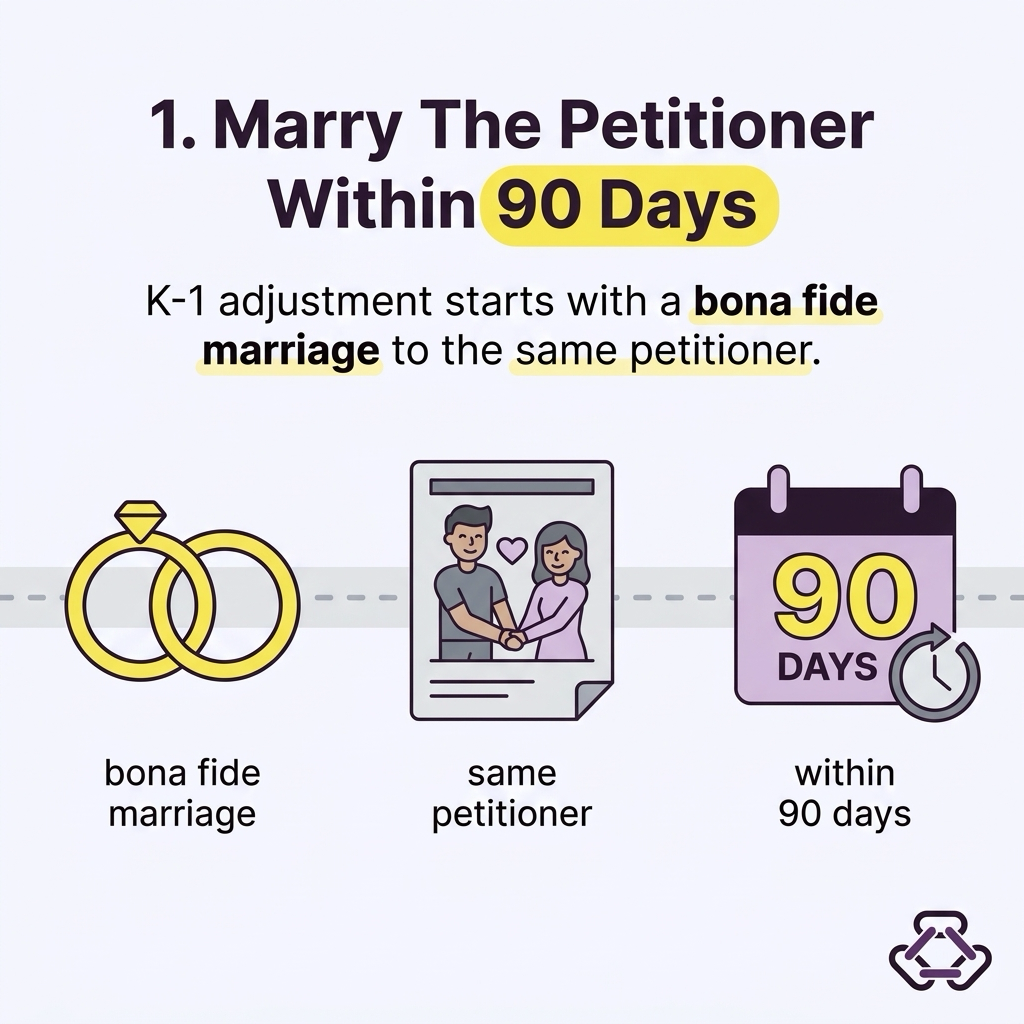
Step 1: Get Married Within 90 Days Of Entry
This is the foundation of the entire transition.
USCIS states that if the fiancé(e) is admitted as a K-1 nonimmigrant, the couple has 90 days to marry each other. If they marry within that period, the foreign national spouse may then apply for a green card through Form I-485, according to the agency’s K-1 visa page.
Couples often wonder whether the adjustment application also has to be filed within those same 90 days. In many cases, the more important legal trigger is that the marriage itself occurred within 90 days of admission. USCIS eligibility language focuses on that timely marriage to the original U.S. citizen petitioner when describing who may adjust through the K-1 route on the green card for fiancé(e) of U.S. citizen page.
That said, many couples choose to file as soon as reasonably possible after the wedding because delays can affect employment authorization, travel planning, and general case stability.
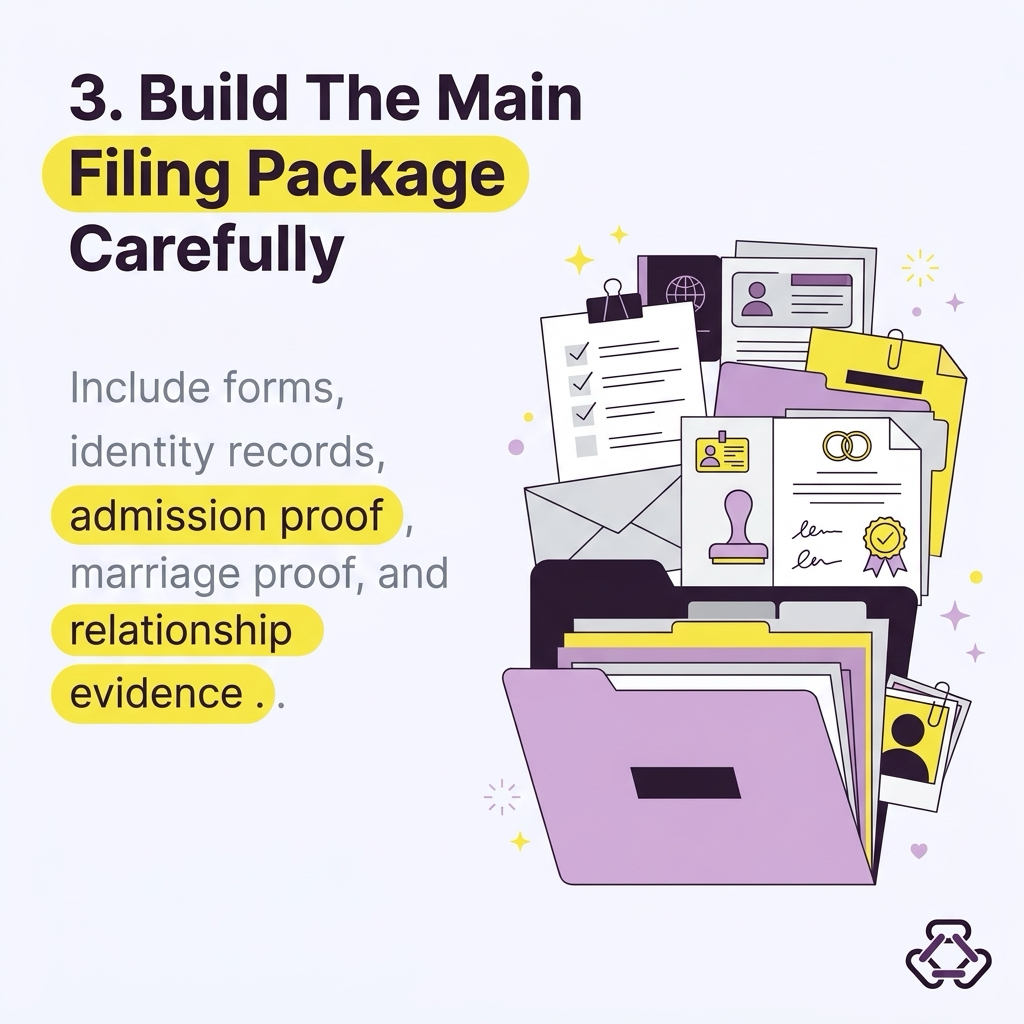
Step 2: Prepare The Main Green Card Filing Package
For most K-1 adjustment cases, the core filing is Form I-485. USCIS identifies Form I-485 as the application a K-1 spouse files after entering on a K-1 visa and marrying the U.S. citizen petitioner within 90 days, as described on the official eligibility page.
A typical package may include:
- Form I-485
- Form I-864, Affidavit of Support
- Form I-693, Report of Immigration Medical Examination and Vaccination Record, if required
- Supporting identity and civil documents
- Proof of lawful K-1 admission
- Proof of the marriage
- Evidence the marriage is genuine
In many cases, couples also file:
- Form I-765 for work authorization
- Form I-131 for advance parole travel permission
USCIS’s filing fees page and fee rule FAQ indicate that for adjustment applications filed on or after April 1, 2024, Forms I-765 and I-131 are no longer bundled into the I-485 filing fee. That fee change has mattered for many couples budgeting their post-wedding filings.
USCIS also announced that, starting February 10, 2025, the agency accepts only the 10/24/24 edition of Form I-485, according to the USCIS alert on the revised I-485. Because USCIS updates forms periodically, many applicants check the current edition date and filing instructions immediately before submission.
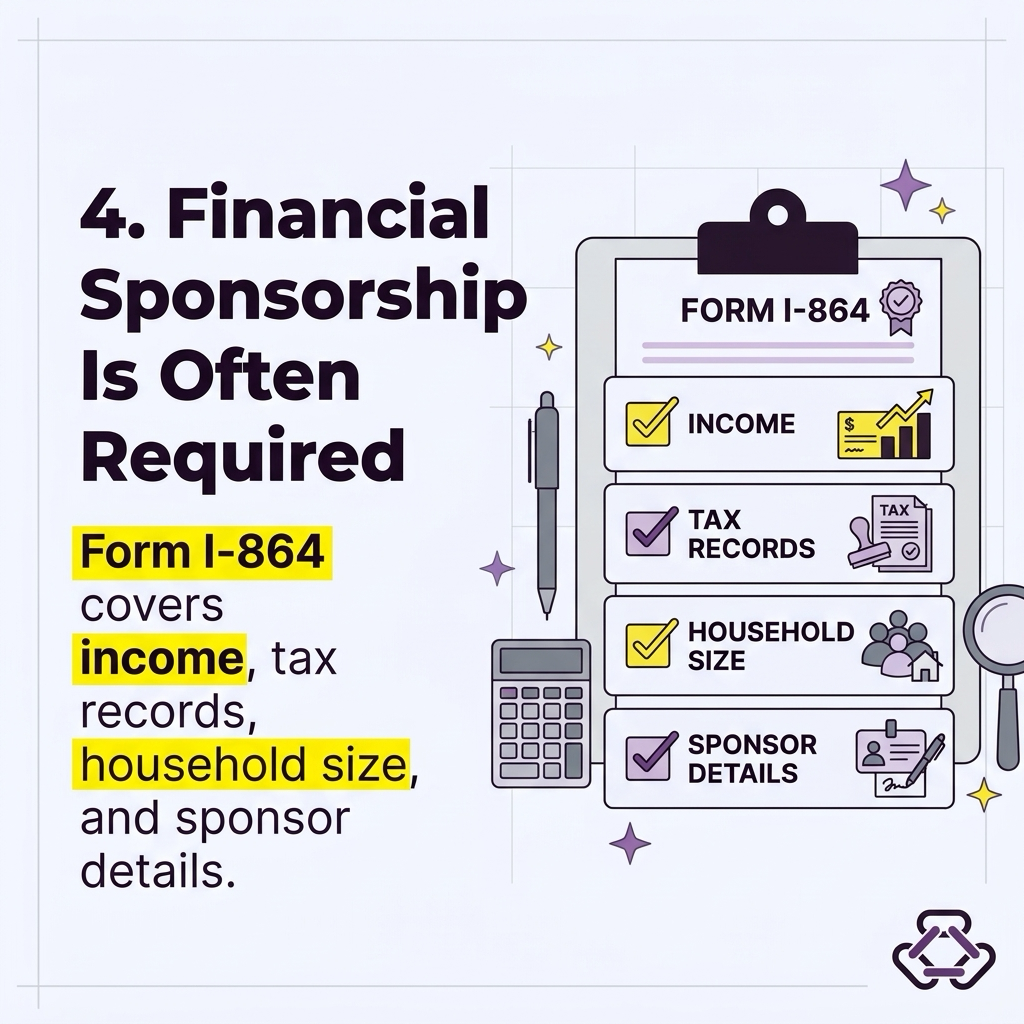
Step 3: Include The Financial Sponsorship Documents
Most marriage-based adjustment cases require Form I-864, Affidavit of Support. USCIS explains that this form is generally required by law when a petitioner sponsors a relative seeking permanent residence through an immigrant visa or adjustment of status, as outlined on the agency’s Affidavit of Support overview and Form I-864 page.
In plain language, the affidavit of support is the financial sponsorship piece of the case. It is designed to show that the intending immigrant is not likely to become primarily dependent on certain public benefits. The U.S. citizen petitioner is usually the primary sponsor, and some cases also involve a joint sponsor if income documentation is not enough.
This is one of the more technical parts of the package because it involves:
- tax returns or IRS transcripts
- W-2s or 1099s in some cases
- employment verification
- pay records
- proof of status for any joint sponsor
- household-size calculations tied to the federal poverty guidelines
USCIS also highlights on its I-864 page that unsigned forms can be rejected and that sponsors face continuing legal obligations after signing. For that reason, couples often spend extra time reviewing this section carefully.
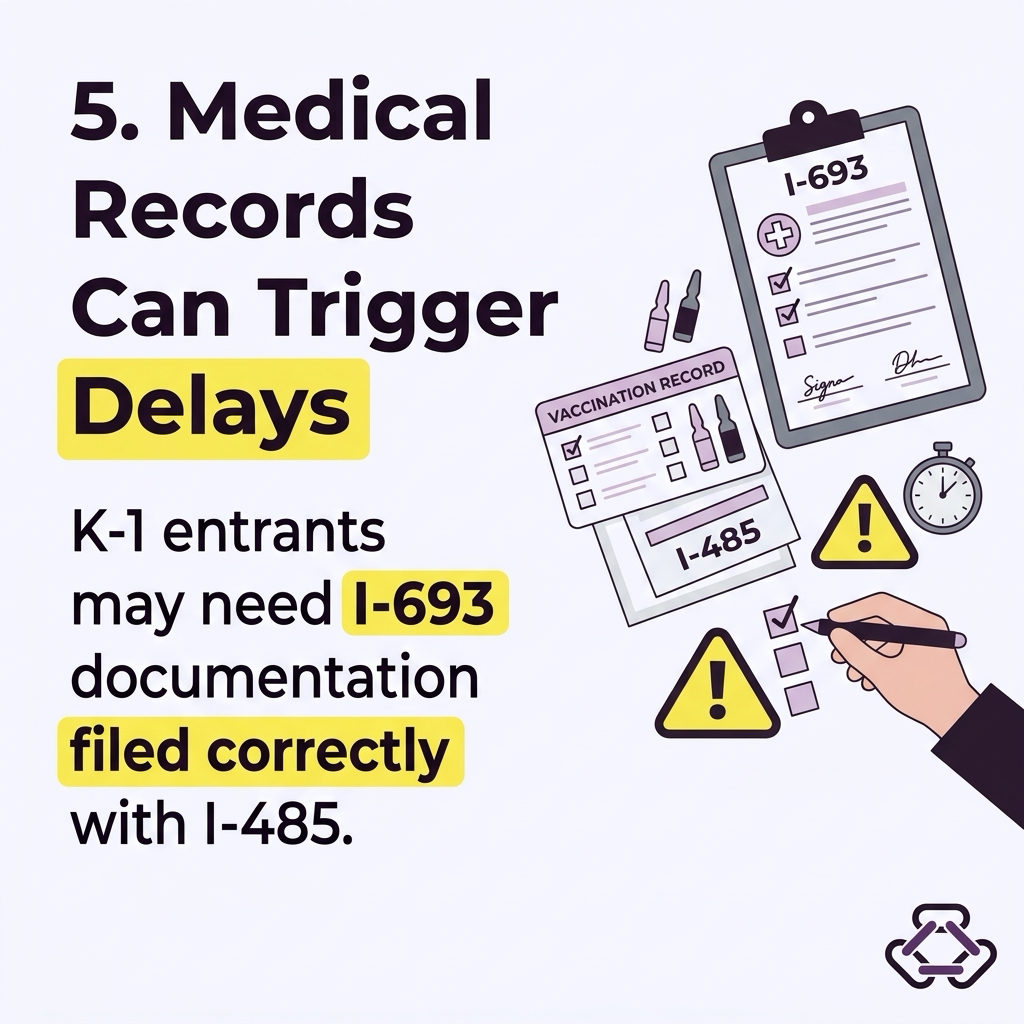
Step 4: Handle The Medical Exam And Vaccination Record Correctly
Medical exam issues are a common source of confusion in K-1 cases because some applicants already completed a medical exam overseas as part of the visa process.
USCIS explains on the Form I-693 page that certain adjustment applicants, including some K visa entrants, may have to submit a partial I-693 vaccination record if the overseas medical documentation was not completed properly for adjustment purposes. USCIS also states that if an applicant is required to submit Form I-693 or a partial I-693, it generally has to be filed with Form I-485, or the application may be rejected. The agency reiterated this filing rule in a USCIS alert about medical exams for adjustment applicants.
USCIS separately announced that, as of January 22, 2025, adjustment applicants no longer have to present COVID-19 vaccination documentation on Form I-693, according to the agency’s COVID-19 vaccination requirement update.
Because this area changes over time and because K-1 medical records can be fact-specific, many couples look closely at:
- the date of the overseas medical exam
- whether the DS-3025 vaccination record was completed properly
- whether a full civil surgeon exam or partial supplement is required
An attorney may be especially useful here when a couple is unsure whether the prior exam still works for adjustment or whether a missing vaccination entry could trigger a rejection.
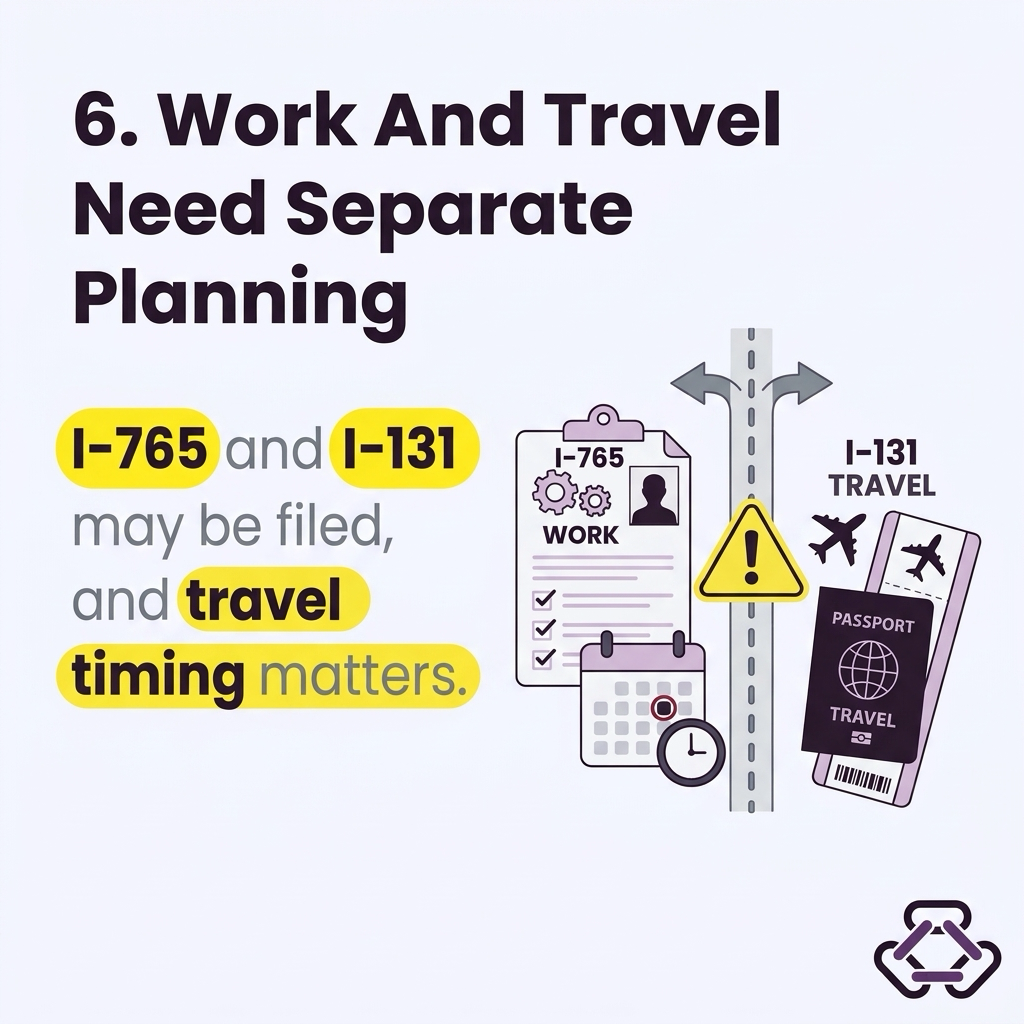
Step 5: Consider Work Authorization And Travel Timing
A pending green card application does not automatically provide the right to work or travel internationally.
Many K-1 applicants file Form I-765 to request an employment authorization document and Form I-131 to request advance parole. USCIS’s fee FAQ notes that these forms now generally require separate fees when filed with an I-485 submitted on or after April 1, 2024.
Travel raises particular issues. In many adjustment cases, leaving the United States before advance parole is approved can create serious problems for the pending application. The exact consequences can vary depending on the person’s status history and the travel document situation, which is one reason couples often seek legal guidance before making international travel plans during the adjustment period.
Work authorization timing also affects everyday life quickly. Employment, driver’s license issues, Social Security follow-up, and health insurance planning all tend to become more urgent once the wedding is over and the foreign spouse is waiting for USCIS to move the case.
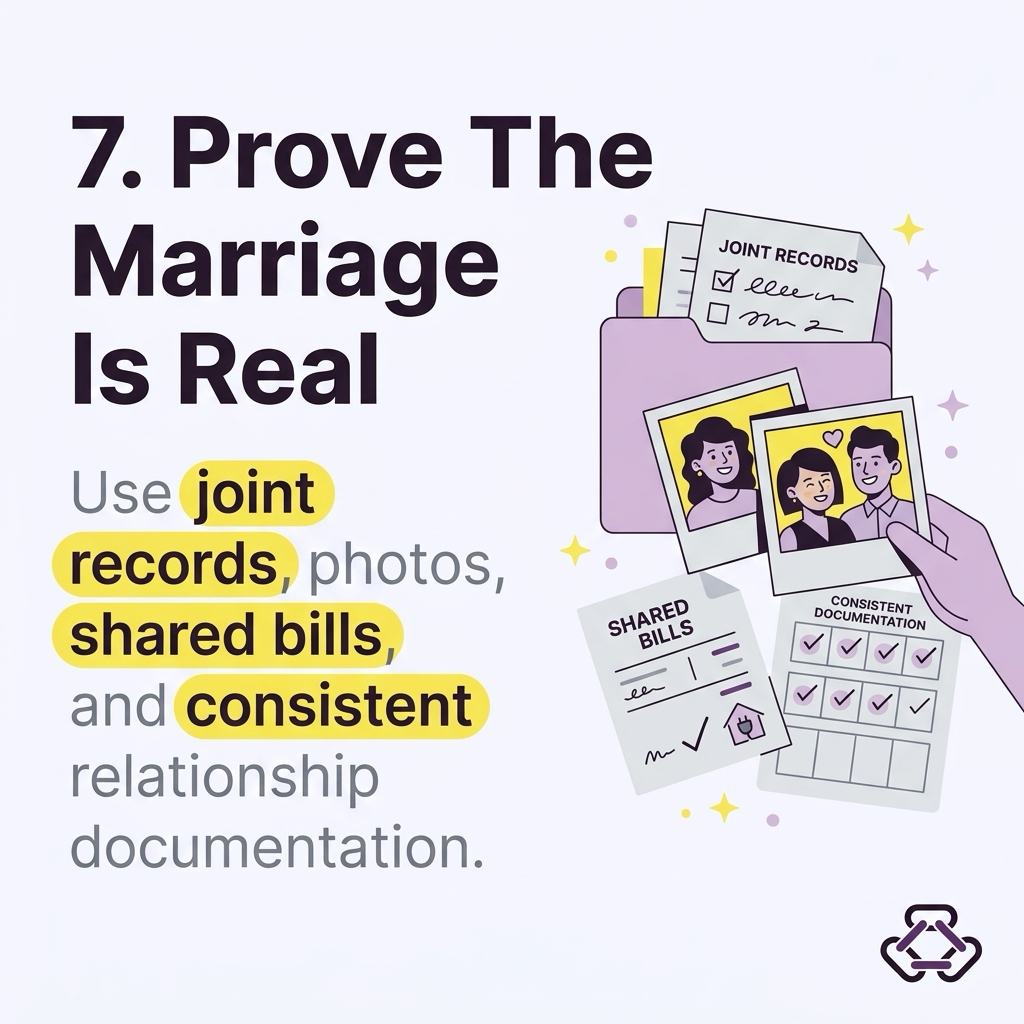
Step 6: Gather Real Evidence Of A Bona Fide Marriage
USCIS repeatedly emphasizes that the marriage has to be bona fide. In other words, the couple has to show the marriage is real and not entered into only for immigration purposes, as reflected in USCIS guidance on fiancé visas and K-1 green card eligibility.
This part of the process often includes documents such as:
- marriage certificate
- lease or mortgage records
- joint bank statements
- insurance policies
- utility bills
- photographs together over time
- travel records
- correspondence
- affidavits from people who know the relationship
- evidence of shared responsibilities or a shared household
For couples who moved quickly because of the K-1 timeline, the file may not yet contain years of joint records. That is common. In those situations, the focus often shifts to consistent, credible, and well-organized evidence rather than sheer volume.
If you’re still early in the process, it may also help to review broader planning issues in this overview of the K-1 path from petition through the post-marriage stage.
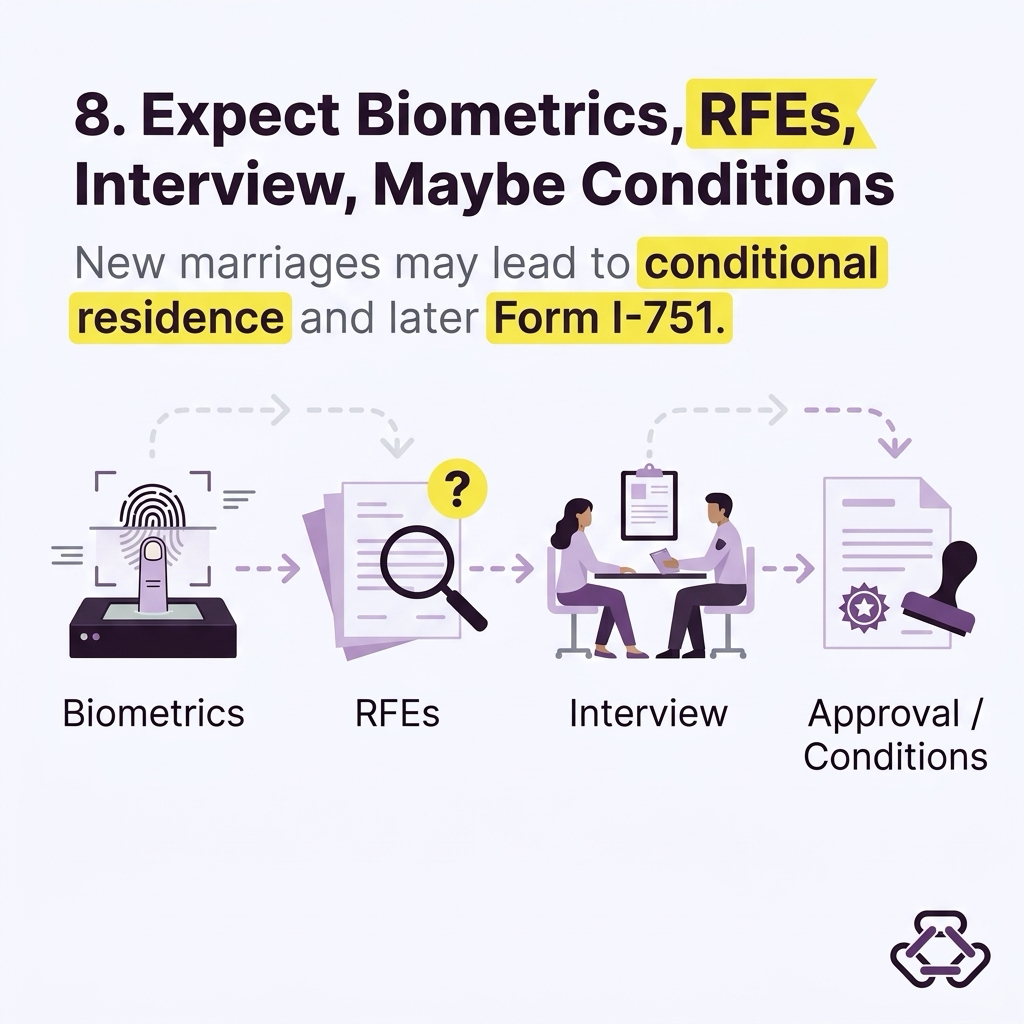
Step 7: Prepare For Biometrics, Possible RFEs, And The Interview
After filing, USCIS may schedule a biometrics appointment and later may issue a Request for Evidence (RFE) if the agency wants more documents. USCIS notes on the fiancé visa page that it may mail an RFE if additional information is required for the I-485.
Marriage-based green card interviews are also common. At the interview, the officer may review:
- identity and immigration history
- wedding and relationship details
- living arrangements
- financial sponsorship
- prior marriages
- criminal or immigration issues
- documentation submitted with the packet
Many straightforward cases are approved without major trouble, but several issues can complicate the path:
- prior visa overstays or status concerns outside the K-1 framework
- criminal history
- incomplete medical records
- weak financial sponsorship
- inconsistent relationship evidence
- prior marriages that were not fully documented as terminated
- mistakes or omissions in the forms
When any of those issues are present, representation can make a noticeable difference in how the case is prepared and presented.
What If The Marriage Is Less Than Two Years Old When The Green Card Is Approved?
In a large share of K-1 adjustment cases, the marriage is still relatively new when USCIS grants permanent residence. USCIS explains that if the couple has been married less than two years on the day permanent resident status is granted, the immigrant spouse receives conditional permanent residence rather than a standard 10-year green card, as described on the agency’s spousal immigration page, the K-1 green card page, and the removal of conditions page.
That conditional status generally lasts two years. After that, the couple typically files Form I-751 during the 90-day period before the card expires to ask USCIS to remove conditions, according to the USCIS removal of conditions guidance.
This catches many couples off guard because the initial green card approval can feel like the finish line. In many marriages formed through the K-1 route, it is more accurate to think of the process as having two major immigration stages after entry:
- adjustment of status
- later removal of conditions, if the marriage was under two years old at approval
Common Reasons K-1 To Green Card Cases Get Delayed
Even very real couples with valid marriages can run into delays. Some of the more common issues include:
Missing Or Outdated Forms
USCIS regularly updates editions and filing instructions. Using an older edition, sending the wrong fee, or forgetting signatures can lead to rejection. USCIS has specifically warned applicants to use the correct current edition of Form I-485 and to verify fees on the official filing fees page.
Weak Affidavit Of Support Evidence
Income calculations, tax paperwork, and household-size errors often create RFEs. USCIS’s I-864 instructions and guidance outline detailed supporting-document expectations.
Medical Exam Confusion
K-1 entrants sometimes assume the visa medical automatically covers adjustment without checking whether the vaccination record was completed in the way USCIS expects. The agency’s I-693 page makes clear that certain applicants have to submit the required medical documentation with the I-485.
Travel Problems During Adjustment
International travel before advance parole approval can complicate a pending case. This is one of the most common situations where individualized immigration advice becomes important.
Thin Relationship Documentation
A short dating history, long-distance relationship, or recent move can make the evidence file look lighter than average. That does not automatically mean there is a fraud concern, but it often means the presentation of the evidence matters more.
When An Attorney May Be Especially Helpful
Some K-1 to green card cases are fairly direct. Others involve legal or factual issues that benefit from experienced review.
Couples often look for legal help when there is:
- a prior overstay, removal issue, or visa problem
- criminal history for either spouse
- a prior marriage with incomplete records
- financial sponsorship problems
- concern about medical inadmissibility
- children in K-2 status with related filings
- a prior fraud allegation or misrepresentation issue
- fear that a rushed filing contains mistakes
In those situations, people often want more than a directory listing or advertisement. They want a lawyer with documented experience in highly similar matters — someone whose background is grounded in real cases, objective criteria, and evidence from court or case records where available.
That’s where fit matters. A lawyer who handles immigration law broadly may be a very different fit from one with demonstrable experience in marriage-based filings involving K-1 entrants, adjustment complications, waivers, RFEs, or conditional residence issues.
The Bottom Line
Transitioning from a K-1 visa to a marriage-based green card usually starts with one key requirement: the marriage to the U.S. citizen petitioner takes place within 90 days of entry. From there, the case generally moves into adjustment of status through Form I-485, along with financial sponsorship documents, medical records, and evidence showing the marriage is genuine. Depending on the timing of approval, the result may be either permanent residence or conditional residence that later requires Form I-751.
For many couples, the process is manageable but paperwork-heavy. For others, small mistakes can create expensive delays or difficult questions about eligibility, travel, sponsorship, or documentation. In general terms, those are the moments when working with an attorney can be especially valuable.
Visit ReferU.AI to get matched with an attorney who has demonstrable experience in cases like yours — for free.
