Table of Contents
- Immigration Appeals: A Beginner’s Guide to Challenging an Adverse Decision
- What Is An Immigration Appeal?
- What Counts As An Adverse Immigration Decision?
- Who Reviews Immigration Appeals?
- The Board Of Immigration Appeals
- The Administrative Appeals Office
- When Is An Appeal Different From A Motion?
- What Are The Main Filing Deadlines?
- BIA Appeal Deadlines
- USCIS / AAO Deadlines
- Motion Deadlines
- What Does An Immigration Appeal Usually Argue?
- What Documents Are Usually Involved?
- What Happens After You File?
- The Case Is Reviewed For Jurisdiction And Timeliness
- A Brief May Be Filed
- The Reviewing Authority Issues A Decision
- How Long Do Immigration Appeals Take?
- What Are Common Reasons Appeals Run Into Trouble?
- Does Filing An Appeal Automatically Stop Removal Or Other Consequences?
- Can You File Without A Lawyer?
- How Do People Choose The Right Immigration Appeal Lawyer?
- What Is A Good First Step After A Denial?
- The Bottom Line For Beginners

Type
Great Grandchild
Status
Approved
Title (YouTube)
Images Failed (Social)
Images Failed (Social)
Do not index
Publish Date (TikTok)
Apr 22, 2027 10:45
Videos Post IDs (Social)
Hashtags (Social)
#LegalAdvice #LegalHelp #Immigration #ImmigrationAppeals
Caption
Caption X
Cover

OG Image

Alt Image Text
Flat vector illustration of immigration appeals and an adverse decision guide, showing a person reviewing documents, branching appeal paths, and deadline symbols.
Images

Videos
Publish Date (Social)
Feb 17, 2027 09:00
Scheduled (Social)
Scheduled (Social)
Images Posted (Social)
Images Posted (Social)
Videos Posted (Social)
Videos Posted (Social)
Featured
Created time
Apr 7, 2026 12:03 AM
Sub-item
Authors
CTA Practice Area (Social)
Immigration
TikTok Failed (Social)
TikTok Failed (Social)
Videos Post Links (Social)
TikTok Post Links (Social)
Images Post IDs (Social)
YT Post ID
Video Pending Manual (Social)
TikTok Posted (Social)
TikTok Posted (Social)
TikTok Post IDs (Social)
Video Cover (Social)
Images Post Links (Social)
First Comment (Social)
Videos Failed (Social)
Videos Failed (Social)
YT Embedded
Images Delete (Social)
Videos Delete (Social)
Carousel Video URL (Social)
Immigration Appeals: A Beginner’s Guide to Challenging an Adverse Decision
Getting an immigration denial can feel disorienting. For many people, the first question is simple: what happens now? The answer depends on who issued the decision, what kind of case it involved, and whether the problem is something that can be reviewed on appeal, addressed through a motion, or handled through a different filing strategy.
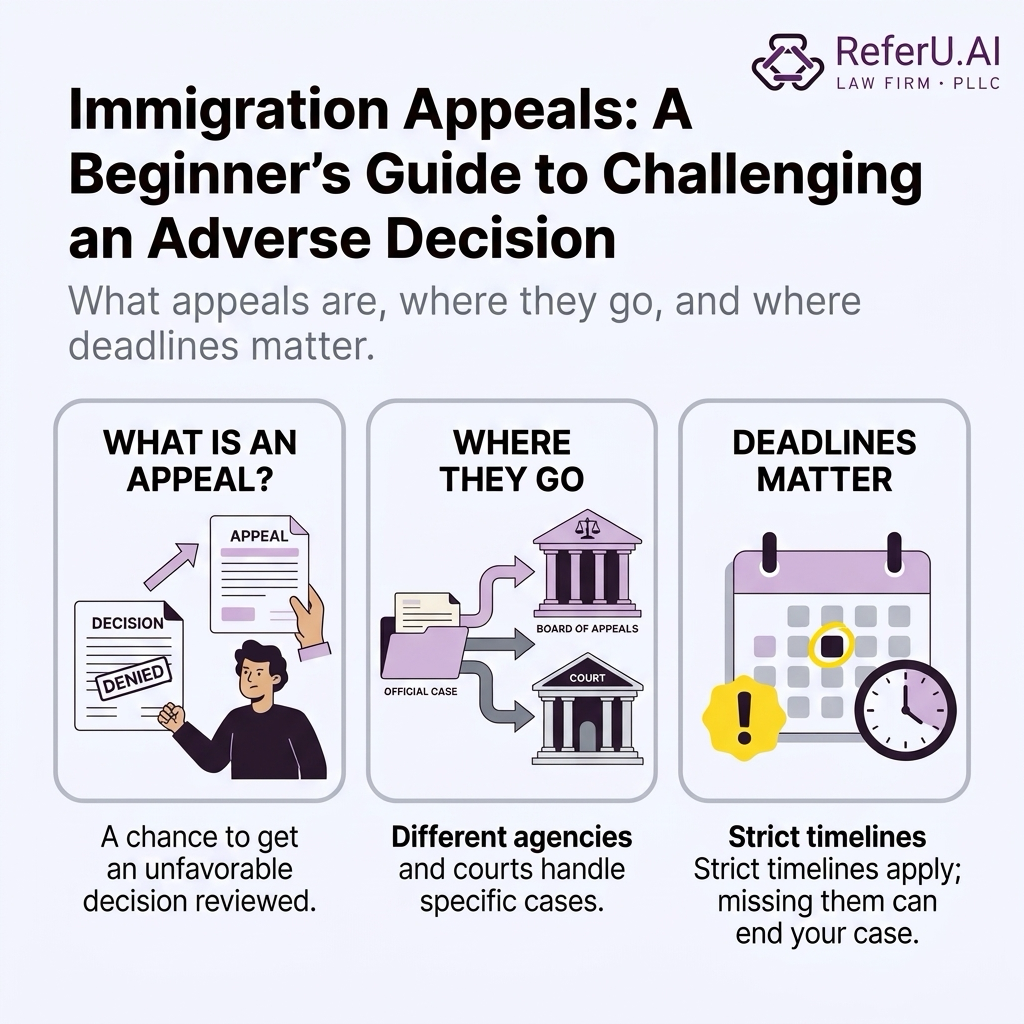
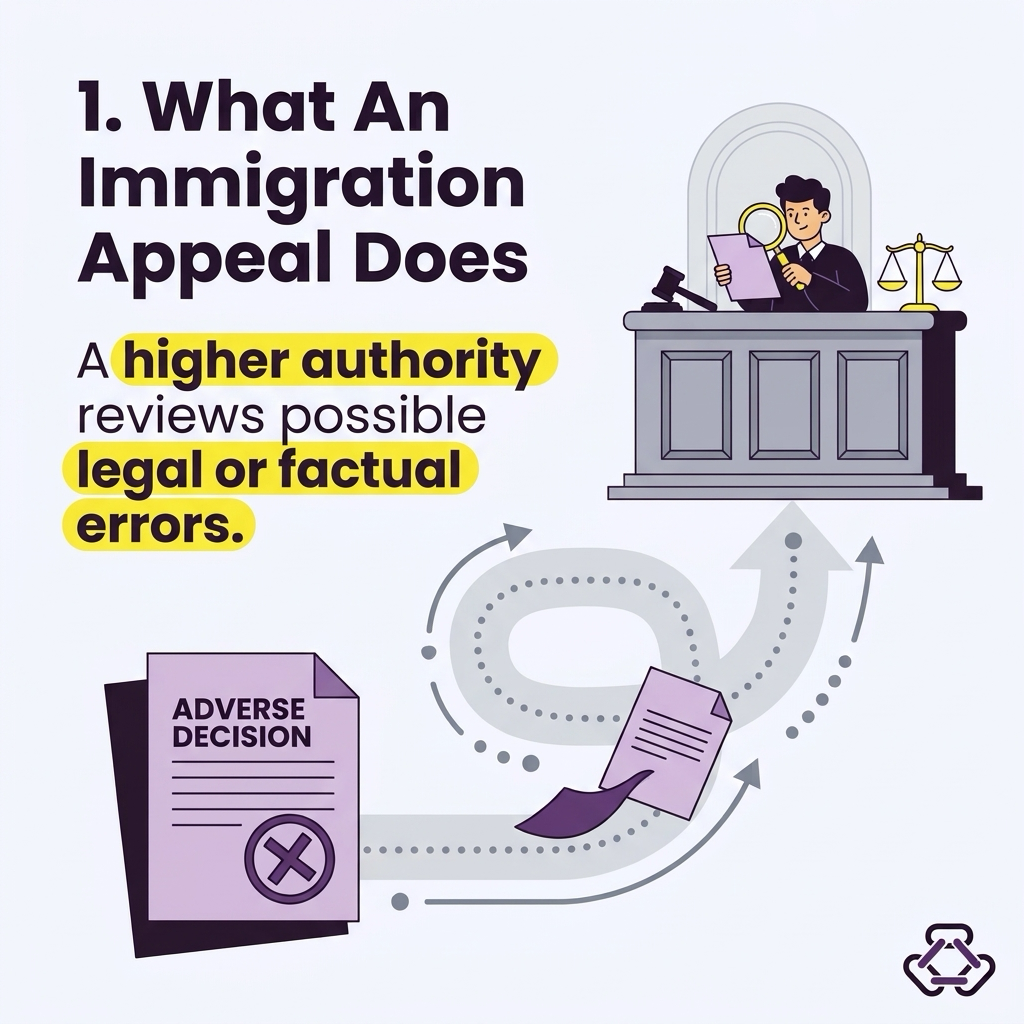
In general terms, an immigration appeal is a request for a higher authority to review a negative decision and decide whether the original office or judge got the law or facts wrong. Some appeals go to the Board of Immigration Appeals (BIA) within the Department of Justice, while others go to the Administrative Appeals Office (AAO) within USCIS. In other situations, an appeal may not be available at all, and a motion to reopen or reconsider may be the more relevant path. The filing rules can be strict, especially on timing. The BIA generally requires Form EOIR-26 to be received within 30 calendar days after an immigration judge renders an oral decision or mails a written one, and many USCIS appeals or motions on Form I-290B are due within 30 calendar days, or 33 days if the decision was mailed by USCIS, depending on the case type and instructions (EOIR, USCIS, USCIS AAO Practice Manual).
In this post you’ll learn what an immigration appeal is, when it may apply, what the process often looks like, where deadlines create problems, and how people often evaluate whether to appeal, file a motion, or pursue another option. If you want a broader overview of the framework first, this guide on what happens after a denial and how appeals and motions fit together can help set the stage.
Scroll to the bottom for every post in this series.
What Is An Immigration Appeal?
An immigration appeal is a formal review of an adverse decision by a different immigration authority. It is not usually a chance to start over from scratch. Instead, the reviewing body typically examines whether the earlier decision involved legal error, factual error, or another issue that makes the decision unsound under the governing rules.
Two of the most common administrative appeal paths are:
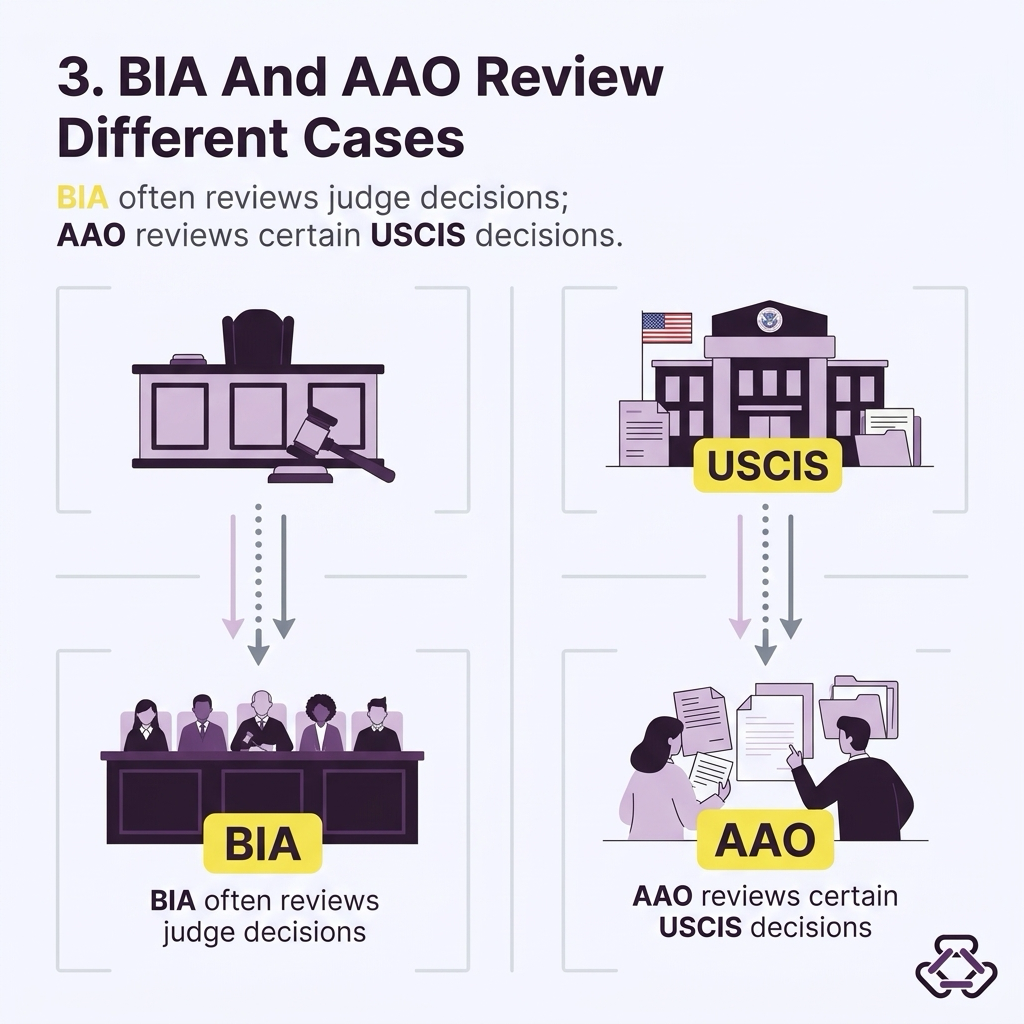
- BIA appeals, which often involve decisions made by immigration judges and certain DHS decisions
- AAO appeals, which involve certain USCIS decisions and are commonly filed on Form I-290B
The Department of Justice explains that the BIA has nationwide jurisdiction over appeals from certain immigration judge decisions and certain DHS decisions in a wide range of matters (EOIR BIA Overview). USCIS explains that certain unfavorable agency decisions can be appealed to the AAO or, in some case types, to the BIA, and that many of these appeals use Form I-290B (USCIS Appeals And Motions Q&A).
What Counts As An Adverse Immigration Decision?
An adverse decision is any negative outcome that affects an immigration benefit, status, protection request, or removal case. Common examples include:
- A denial of an application or petition by USCIS
- An immigration judge’s order denying relief
- A removal order entered by an immigration judge
- A revocation or other unfavorable USCIS determination in a case type that allows review
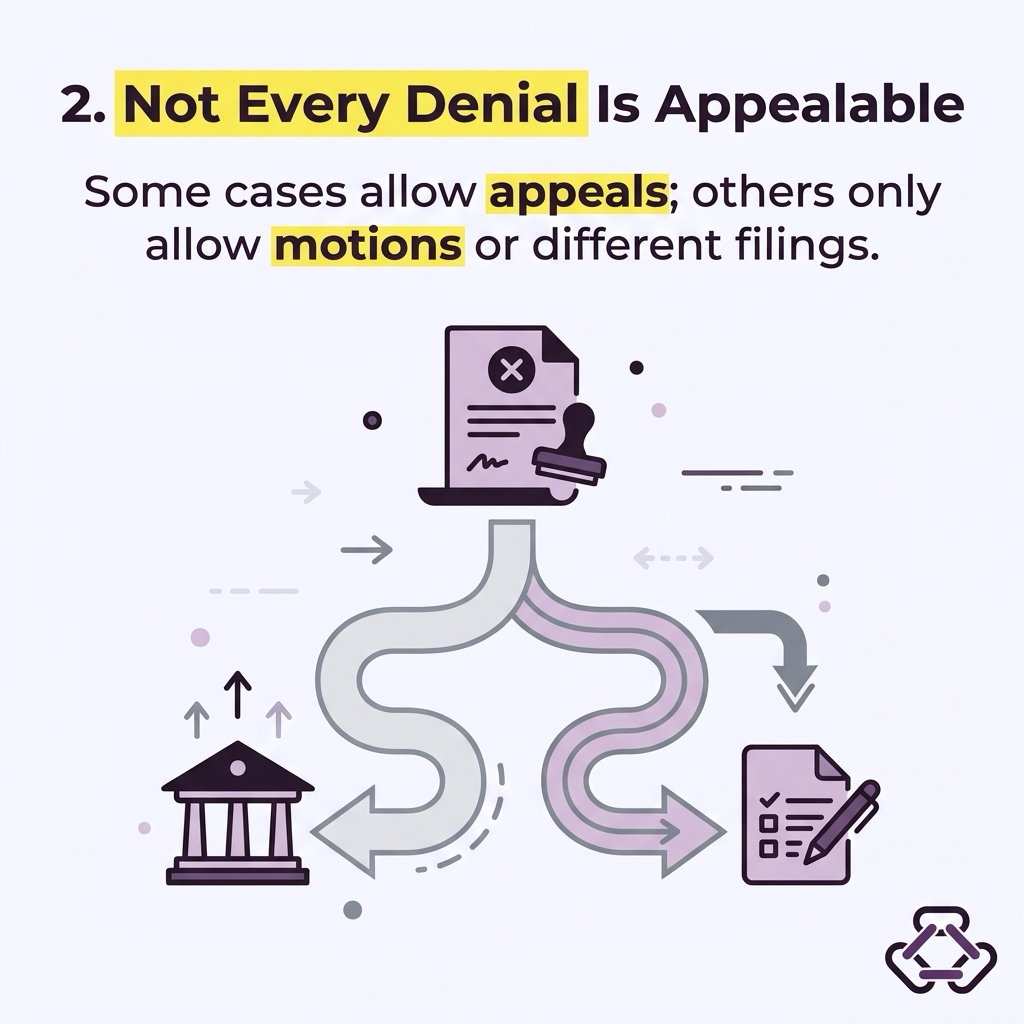
That said, not every denial is appealable. USCIS maintains a case-type-specific chart for when Form I-290B can be used for an appeal or motion, and some matters are limited to motions rather than appeals (USCIS I-290B, USCIS Policy Manual). EOIR also distinguishes between direct appeals and motions, and it expressly notes that the EOIR-26 appeal form is not the form used for motions before the immigration courts or BIA (EOIR Forms).
Who Reviews Immigration Appeals?
The Board Of Immigration Appeals
The Board of Immigration Appeals is part of the Executive Office for Immigration Review, which is within the U.S. Department of Justice. It reviews certain decisions made by immigration judges and some DHS officers. According to EOIR, most BIA decisions are also subject to judicial review in the federal courts, depending on the case and legal posture (EOIR BIA Overview).
The Administrative Appeals Office
The Administrative Appeals Office is within USCIS. It reviews certain USCIS decisions, often involving petitions and applications where the regulations provide for AAO review. USCIS states that an appeal to the AAO generally has to specifically identify an erroneous conclusion of law or statement of fact in the unfavorable decision (USCIS AAO Practice Manual, USCIS Appeals And Motions Q&A).
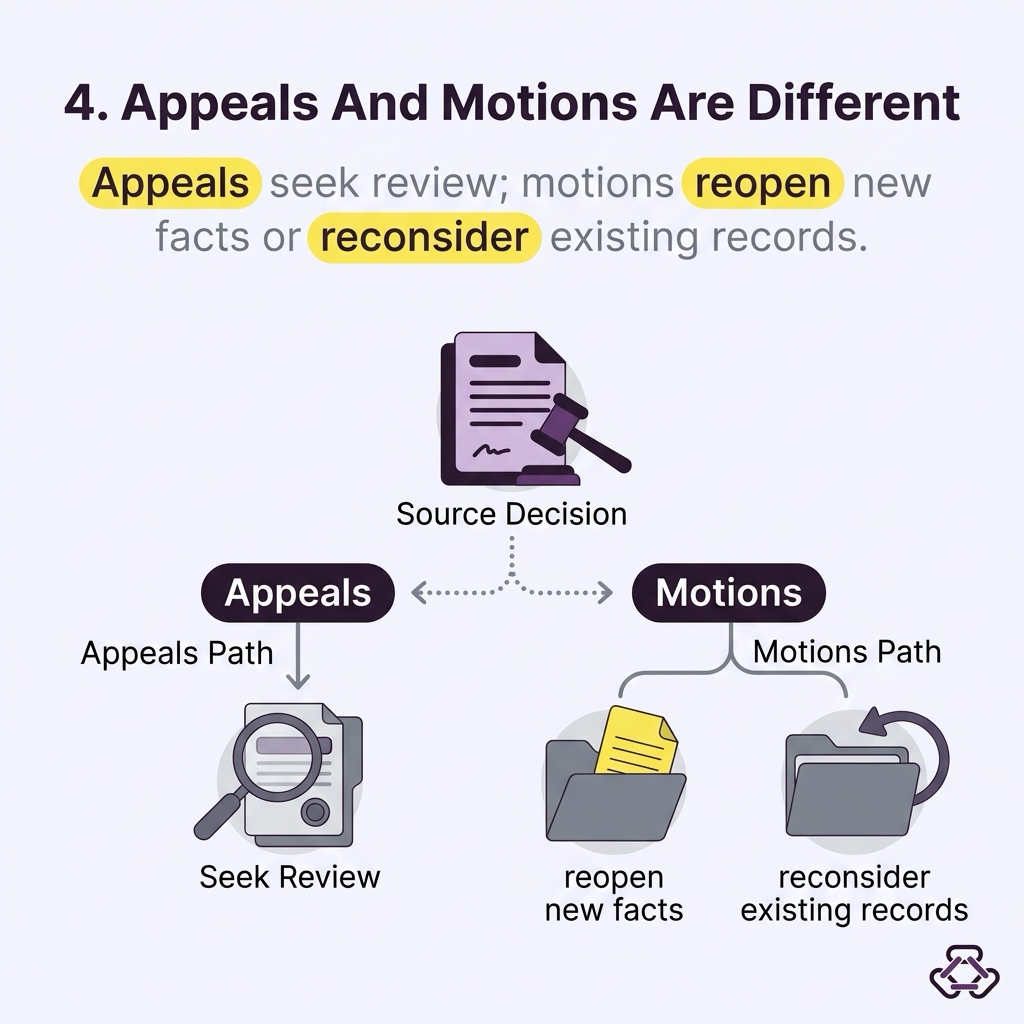
When Is An Appeal Different From A Motion?
This is one of the most common points of confusion.
An appeal generally asks a higher authority to review the earlier decision.
A motion to reopen usually asks the same decision-maker or tribunal to look at the case again because there are new facts or evidence that were not previously considered.
A motion to reconsider usually argues that the original decision was legally or factually wrong based on the existing record and controlling law.
EOIR’s deadline appendix states that, in many situations, a motion to reconsider is due within 30 days of the final administrative order, while a motion to reopen before the BIA is often due within 90 days, subject to exceptions (EOIR Deadline Appendix). USCIS similarly explains that Form I-290B can be used for both appeals and certain motions, depending on the decision involved (USCIS Policy Manual, USCIS I-290B).
Because these options can overlap but are not interchangeable, many readers also look for guidance on how to sort out whether the situation calls for an appeal, a motion, or a different filing approach before sending anything in.
What Are The Main Filing Deadlines?
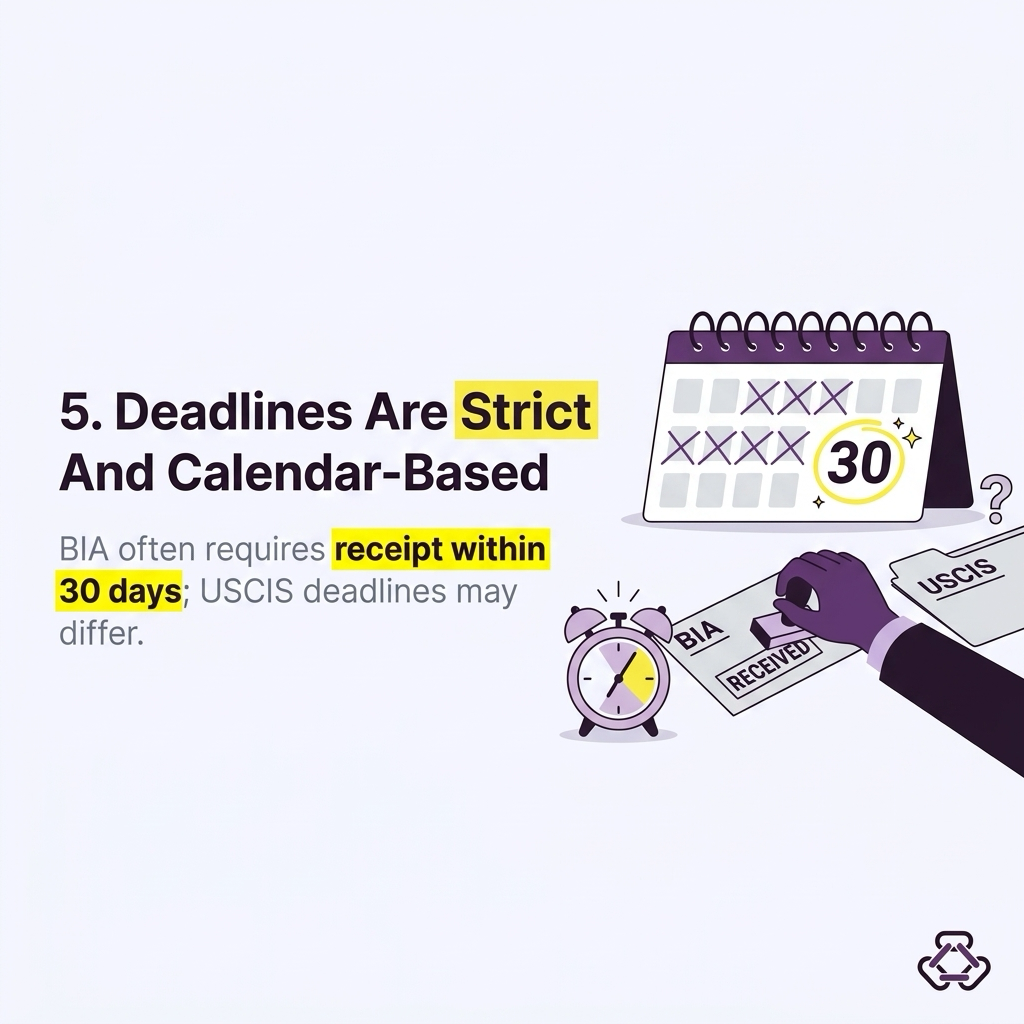
Deadlines are often the first major issue in an immigration appeal.
BIA Appeal Deadlines
EOIR states that Form EOIR-26 must be received by the BIA no later than 30 calendar days after the immigration judge renders an oral decision or mails a written decision. If appeal rights are waived, or the filing is not made on time, the immigration judge’s decision becomes final (EOIR Appeal An Immigration Judge’s Decision, EOIR Policy Manual 3.5).
That word received matters. In general terms, the filing deadline is not just about mailing something before the due date; it is about the Board getting it on time.
USCIS / AAO Deadlines
USCIS states that, in most cases, Form I-290B appeals or motions are due within 30 calendar days of service of the adverse decision, or 33 calendar days if USCIS mailed the decision. USCIS also counts calendar days, including weekends and legal holidays, starting the day after mailing of the decision (USCIS I-290B, USCIS AAO Practice Manual).
Motion Deadlines
As noted above, reopening and reconsideration deadlines can differ from appeal deadlines. EOIR’s published deadline appendix is a useful starting point, but exceptions and tolling arguments can become highly fact-specific (EOIR Deadline Appendix).
For readers worried about timing mistakes, it often helps to review a more detailed breakdown of preparing an immigration appeal without losing time on deadline issues.
What Does An Immigration Appeal Usually Argue?
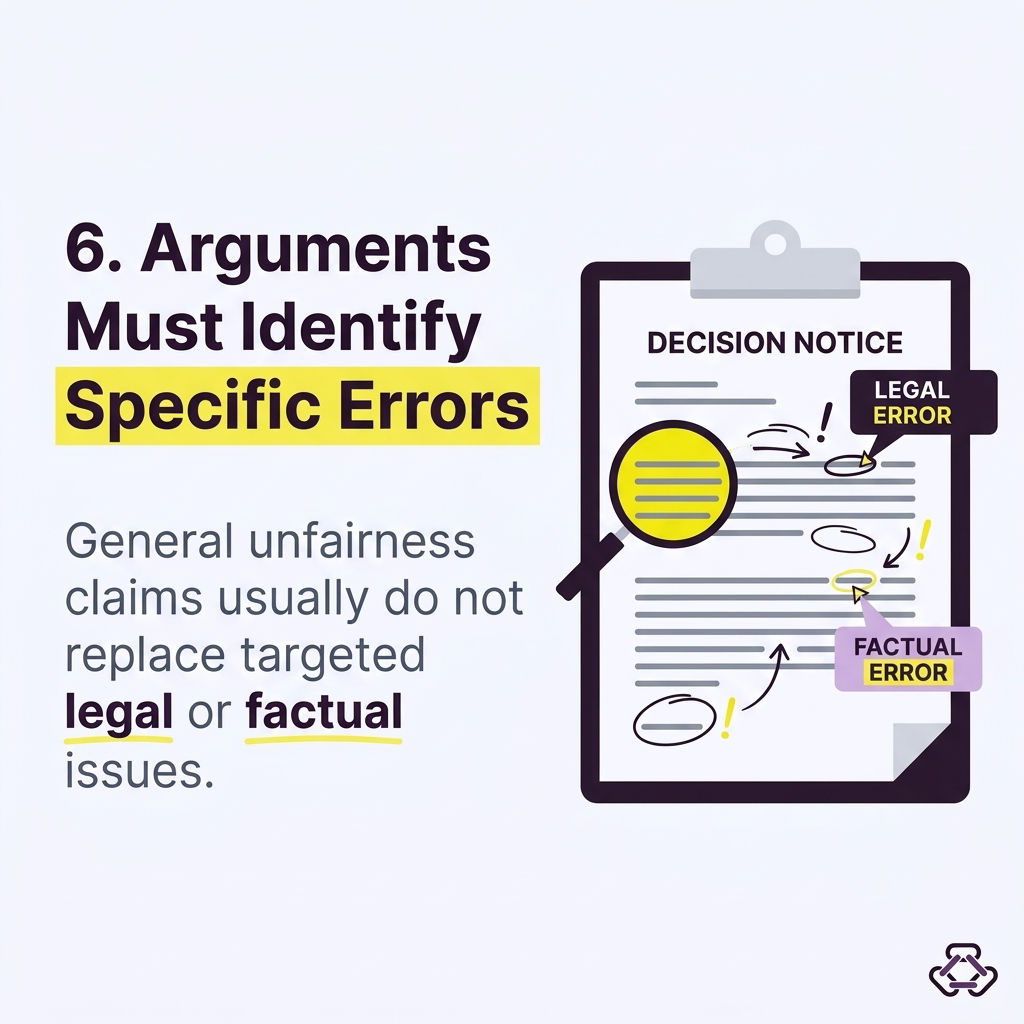
A successful appeal is rarely just a statement that the outcome felt unfair. Administrative appeals usually focus on specific errors. Common arguments include:
- The judge or officer applied the wrong legal standard
- The decision misunderstood or overlooked evidence already in the record
- The decision relied on a factual finding that is unsupported or incomplete
- The agency failed to follow its own rules or procedures
- The written explanation does not match the record or governing law
USCIS expressly states that an appeal must specifically identify an erroneous legal conclusion or factual statement in the underlying decision (USCIS AAO Practice Manual). That requirement gives a good sense of what appeals are for: targeted review of identifiable error.
What Documents Are Usually Involved?
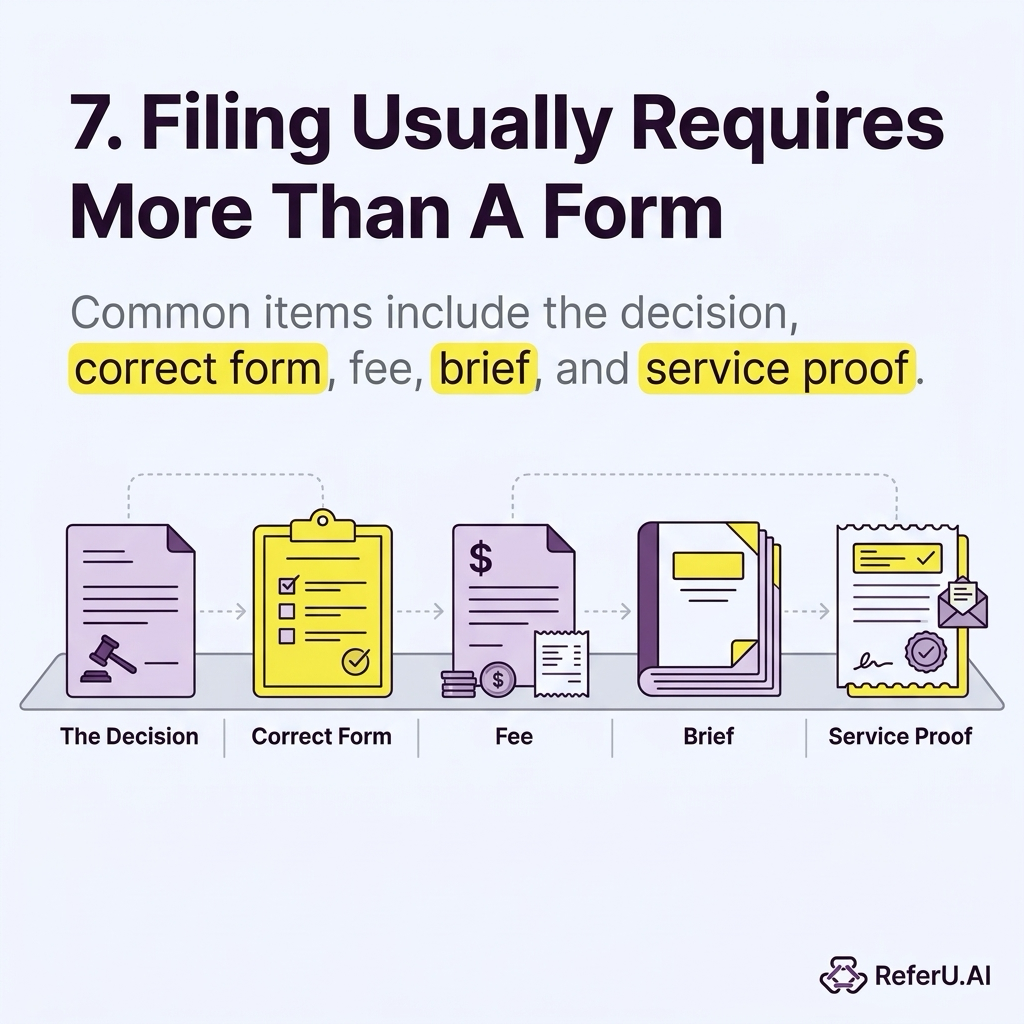
The required documents depend on the kind of case, but the process often includes:
- The denial or adverse decision
- The correct appeal or motion form
- Filing fee or fee waiver request, where allowed
- A written statement or legal brief
- Supporting documents, if the rules permit additional submissions
- Proof of service, mailing, or delivery when required
For USCIS appeals, the agency explains that an appellant can indicate on Form I-290B that a brief or additional evidence will be submitted within 30 days of filing the appeal, and the AAO may grant an additional extension for good cause in some situations (USCIS AAO Practice Manual).
For BIA matters, form selection and filing mechanics are different, so many people find it helpful to confirm exactly which tribunal is involved before preparing the packet.
What Happens After You File?
The timeline varies by tribunal and case type, but several things often happen next.
The Case Is Reviewed For Jurisdiction And Timeliness
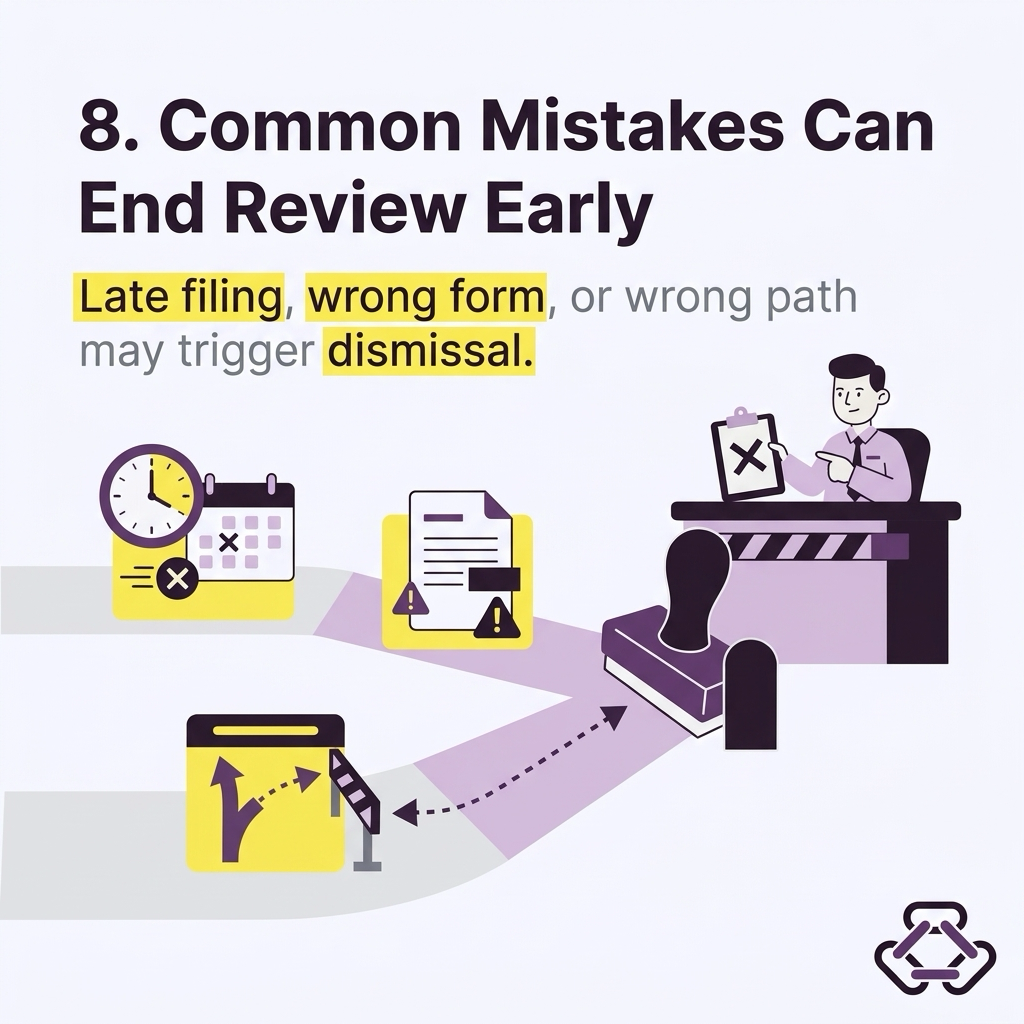
The reviewing body usually checks whether the filing was made on time, on the correct form, and in a case that is actually appealable. If the filing is late or procedurally defective, the case may be dismissed without reaching the merits.
A Brief May Be Filed
In some cases, the initial filing includes the legal argument. In others, a separate brief follows. USCIS states that appellants who elect to submit a brief or extra evidence after filing generally have 30 days to do so (USCIS AAO Practice Manual).
The Reviewing Authority Issues A Decision
Possible outcomes may include:
- Dismissal of the appeal
- Sustaining the appeal
- Remand for further proceedings
- Reopening or reconsideration in some procedural settings
EOIR notes that many BIA decisions are later reviewable in federal court, although judicial review questions can be complicated and depend on the case posture and statute involved (EOIR BIA Overview).
How Long Do Immigration Appeals Take?
There is no single timeline that fits every immigration appeal. Processing times depend on the agency, case type, backlog, briefing schedule, and whether the case raises narrow legal issues or fact-heavy record questions.
As broader context, EOIR announced in 2025 that the immigration court system had reduced its pending caseload by more than 447,000 cases from January 20, 2025, bringing the pending caseload down from more than 4.18 million to under 3.75 million. Even with that reduction, the overall system remains very large, which helps explain why appeals and related proceedings can still take substantial time (EOIR Press Release).
In practice, timing often depends less on a generic estimate and more on the forum, the issue presented, and whether a filing is complete and properly framed from the start.
What Are Common Reasons Appeals Run Into Trouble?
A few problems show up again and again:
- Filing after the deadline
- Using the wrong form
- Sending an appeal where no appeal is authorized
- Raising broad complaints without identifying legal or factual error
- Failing to preserve arguments clearly in the written submission
- Confusing an appeal with a motion to reopen or reconsider
- Overlooking service, fee, signature, or mailing requirements
USCIS and EOIR guidance both make clear that immigration review procedures are technical and form-specific (USCIS I-290B, EOIR Forms). For people trying to avoid preventable errors, it may also help to read about the kinds of appeal mistakes that can quietly reduce options or create delays.
Does Filing An Appeal Automatically Stop Removal Or Other Consequences?
Not always. This is a highly case-specific issue, and the effect of filing can vary based on the type of proceeding, the source of the decision, the relief sought, and whether a stay is available or required separately.
Because the consequences can be serious, this is one of the areas where people often look for individual legal analysis rather than relying on general information. An attorney might help determine whether a filing affects enforcement, work authorization, or related deadlines in a particular posture.
Can You File Without A Lawyer?
Some people do file appeals on their own. The agencies publish forms, manuals, and instructions to make the process accessible in a basic sense. But the actual task usually involves more than filling in blanks. It often requires identifying reviewable error, understanding the right standard, organizing the record, and matching the filing to the proper procedural vehicle.
That is especially true in cases involving:
- Removal orders
- Criminal history
- Prior fraud or misrepresentation findings
- Multiple prior filings
- Missed deadlines
- Prior appeal dismissals
- New evidence that may point toward reopening rather than appeal
In those situations, documented, case-specific legal experience can make a meaningful difference in how the options are assessed and presented.
How Do People Choose The Right Immigration Appeal Lawyer?
When someone is considering an appeal, the key question is often not just “Who handles immigration law?” but “Who has demonstrable experience with highly similar matters?”
An immigration appeal can involve a narrow body of law, a specific tribunal, and a record-sensitive strategy. Some attorneys focus on family-based USCIS denials. Others concentrate on removal defense and BIA briefing. Others have extensive federal court experience after administrative review is exhausted.
A useful search often focuses on objective fit, including:
- Experience with the same agency or tribunal
- Work on the same visa, relief, or removal issue
- Familiarity with motions versus appeals
- Documented experience visible in public court or agency records where available
- Ability to evaluate timing and procedural posture quickly
That is also why many people ask practical follow-up questions after a denial, such as timing, next steps, and whether a fresh filing might make more sense than review. If that sounds familiar, this overview of common questions people ask after a judge or USCIS says no may help frame the issues.
What Is A Good First Step After A Denial?
For beginners, the first step is often not drafting arguments immediately. It is getting clear on the type of decision, the date on the notice, the issuing agency or judge, and whether the notice itself identifies appeal rights or motion options.
Many people start by gathering:
- The full denial or decision notice
- Prior filings and supporting evidence
- Hearing transcripts or written orders, if relevant
- Mailing envelope and service details, where timing matters
- Any notices that mention appeal rights, motions, or deadlines
From there, the main question becomes whether the case is best framed as:
- an appeal,
- a motion to reopen,
- a motion to reconsider, or
- a new filing strategy.
That distinction often shapes everything that follows.
The Bottom Line For Beginners
Immigration appeals are real opportunities for review, but they are also technical, deadline-driven, and highly dependent on the exact kind of decision involved. Some cases go to the BIA. Others go to the AAO. Some denials are not appealable at all and may call for a motion or a different filing path instead. The agencies’ own rules make clear that timing, form selection, and specific error identification are central to the process (EOIR, USCIS, USCIS AAO Practice Manual).
If you’re facing an adverse immigration decision, one of the most useful things to clarify early is which review path actually fits the case and whether the lawyer you speak with has demonstrable experience in highly similar matters, based on objective criteria and documented case history.
Visit ReferU.AI to get matched with an attorney who has demonstrable experience in cases like yours — for free.
