Table of Contents
- Marriage Green Cards Explained: Petitions, Evidence, Interviews, and Adjustment of Status
- What A Marriage Green Card Case Is Really Proving
- The Two Core Parts Of The Case: The Petition And The Green Card Application
- Form I-130: The Family Petition
- Form I-485: Adjustment Of Status
- When Adjustment Of Status Is Available And When It Is Not
- What Forms And Supporting Documents Commonly Appear In A Marriage Case
- Filing Fees And Why Couples Often Miscalculate The Cost
- What USCIS Looks For In Relationship Evidence
- The Medical Exam, Affidavit Of Support, And Other Frequently Missed Details
- The Medical Exam
- The Affidavit Of Support
- Accuracy Across The Entire Packet
- What Happens After Filing
- The Marriage Green Card Interview: What It Is And Why It Matters
- Conditional Residence: Why Some Green Cards Last Two Years First
- Red Flags That Often Lead To Delay Or Scrutiny
- Why Legal Help Often Changes The Experience Of The Case
- A Short Summary Of The Process

Type
Grandchild
Status
Approved
Title (YouTube)
Images Failed (Social)
Images Failed (Social)
Do not index
Parent item
Publish Date (TikTok)
Apr 29, 2027 13:15
Videos Post IDs (Social)
Hashtags (Social)
#LegalAdvice #LegalHelp #Immigration #MarriageGreenCards
Caption
Caption X
Cover

OG Image

Alt Image Text
Flat vector illustration of a couple organizing marriage green cards evidence and adjustment of status documents for a petition and interview.
Images

Videos

Publish Date (Social)
Feb 21, 2027 12:00
Scheduled (Social)
Scheduled (Social)
Images Posted (Social)
Images Posted (Social)
Videos Posted (Social)
Videos Posted (Social)
Featured
Created time
Apr 7, 2026 12:00 AM
Authors
CTA Practice Area (Social)
Immigration
TikTok Failed (Social)
TikTok Failed (Social)
Videos Post Links (Social)
TikTok Post Links (Social)
Images Post IDs (Social)
YT Post ID
Video Pending Manual (Social)
TikTok Posted (Social)
TikTok Posted (Social)
TikTok Post IDs (Social)
Video Cover (Social)

Images Post Links (Social)
First Comment (Social)
Videos Failed (Social)
Videos Failed (Social)
YT Embedded
YT Embedded
Images Delete (Social)
Videos Delete (Social)
Carousel Video URL (Social)
Marriage Green Cards Explained: Petitions, Evidence, Interviews, and Adjustment of Status
A marriage-based green card case can look straightforward from the outside: get married, file paperwork, attend an interview, wait for a decision. In real life, the process is usually more layered than that. There are different filing paths, different forms, different evidence expectations, and different risks depending on immigration history, timing, and where the immigrant spouse is located.
In general terms, a marriage green card case combines two big ideas: the qualifying family relationship and the immigrant’s eligibility to become a lawful permanent resident. One part of the case focuses on proving the marriage is real. Another part focuses on whether the immigrant spouse can adjust status in the United States or may need to finish the process through a U.S. consulate abroad. The details matter, and small mistakes can create months of delay. The broader immigration overview here helps place marriage-based cases in the larger family immigration system.
In this post you’ll learn how the petition works, what evidence USCIS typically looks for, how interviews are handled, when adjustment of status may be available, and where couples often run into avoidable complications.
Scroll to the bottom for every post in this series.
What A Marriage Green Card Case Is Really Proving
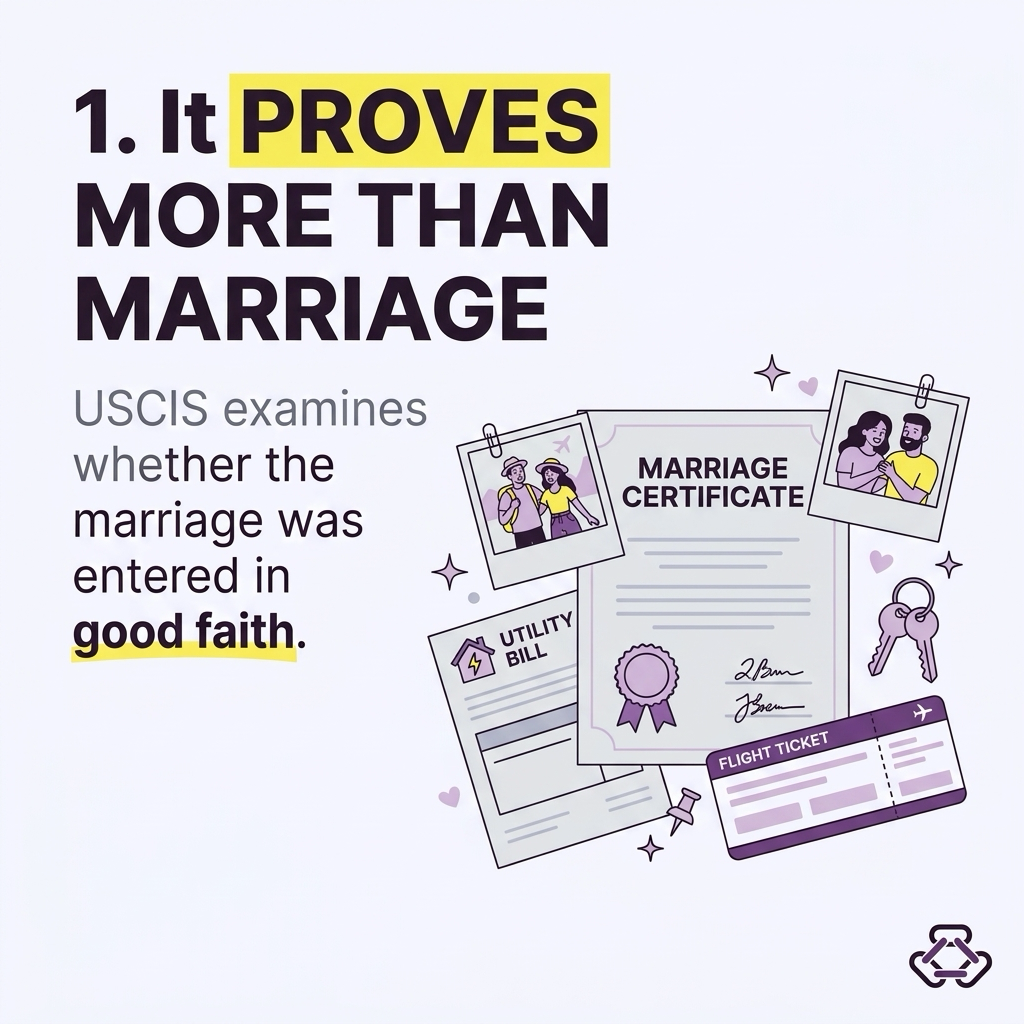
A marriage green card case is not only about showing that a legal marriage exists. It also involves showing that the marriage was entered into in good faith, rather than for immigration purposes alone. USCIS describes this as a bona fide marriage and evaluates the total record when reviewing family-based filings and later, if applicable, removal of conditions on residence. USCIS’s family page for spouses and the USCIS Policy Manual on conditional residence both reflect that focus.
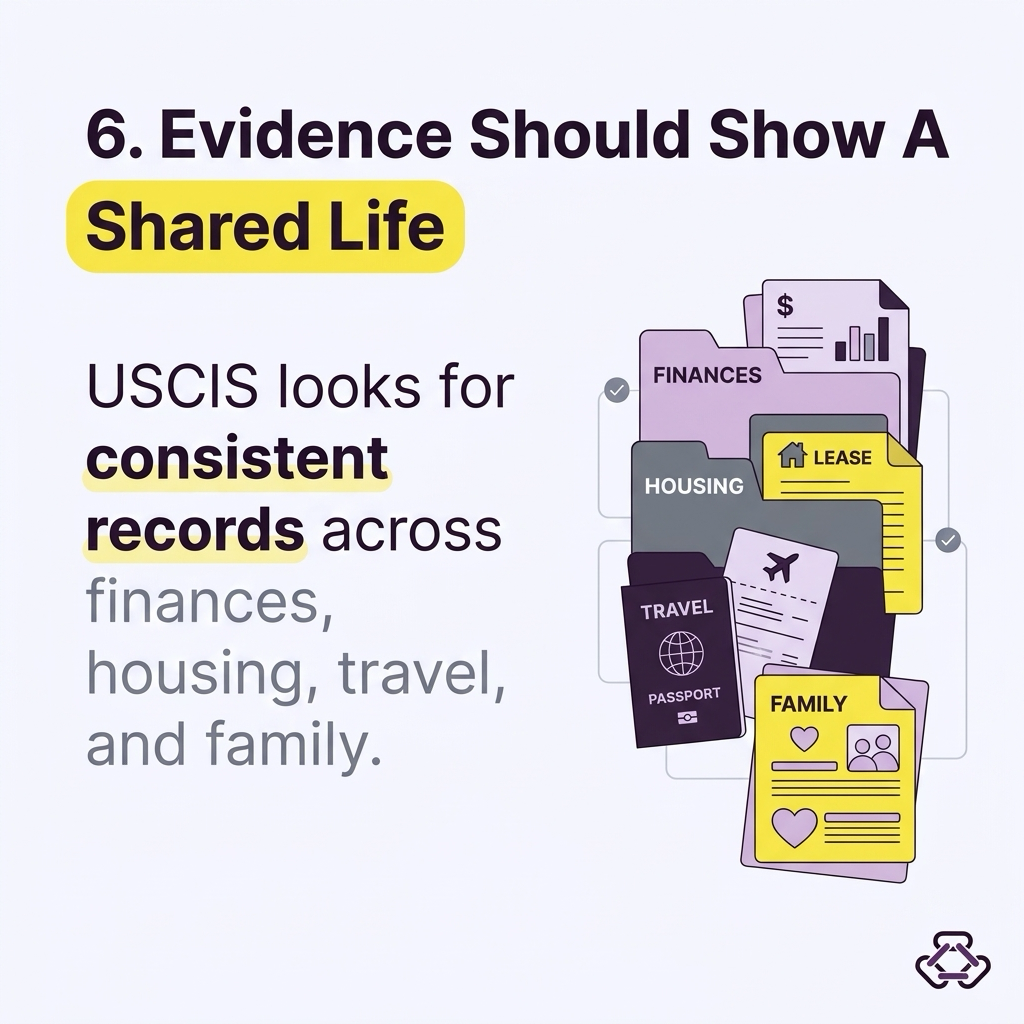
That is why couples often submit more than a marriage certificate. A certificate may prove the marriage happened. It does not, by itself, show how the couple built a shared life. USCIS often looks for records tied to day-to-day life together, such as joint financial documents, shared housing records, insurance, tax records, photographs, travel records, children’s records when relevant, and affidavits from people with personal knowledge of the relationship. The government’s review is usually about consistency across the whole file, not a single “perfect” document. USCIS interview guidance also reflects that officers use the interview and record to verify eligibility.
For a more step-by-step overview of the family route itself, readers often find it helpful to start with this plain-English walkthrough of the marriage-based process.
The Two Core Parts Of The Case: The Petition And The Green Card Application
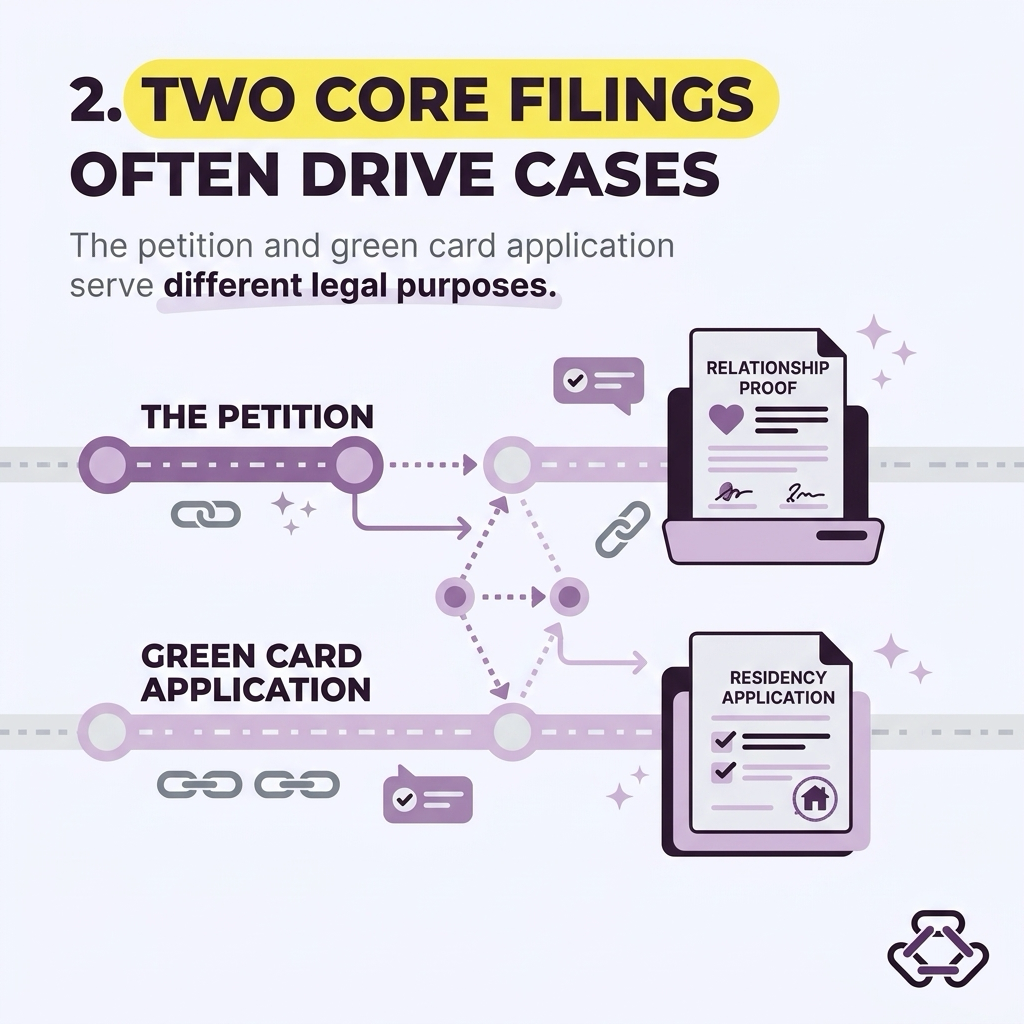
In many marriage-based cases, there are two separate filings or stages.
Form I-130: The Family Petition
Form I-130, Petition for Alien Relative, is the filing used to establish that a qualifying relationship exists between the U.S. citizen or lawful permanent resident petitioner and the immigrant spouse. USCIS explains that some relatives can move forward once the petition is approved and a visa is available, while immediate relatives of U.S. citizens are treated differently from family preference categories because visa availability works differently for them. USCIS’s I-130 page and the State Department’s April 2026 Visa Bulletin explain that immediate relatives are not subject to the same numerical visa limits that apply to family-sponsored preference categories.
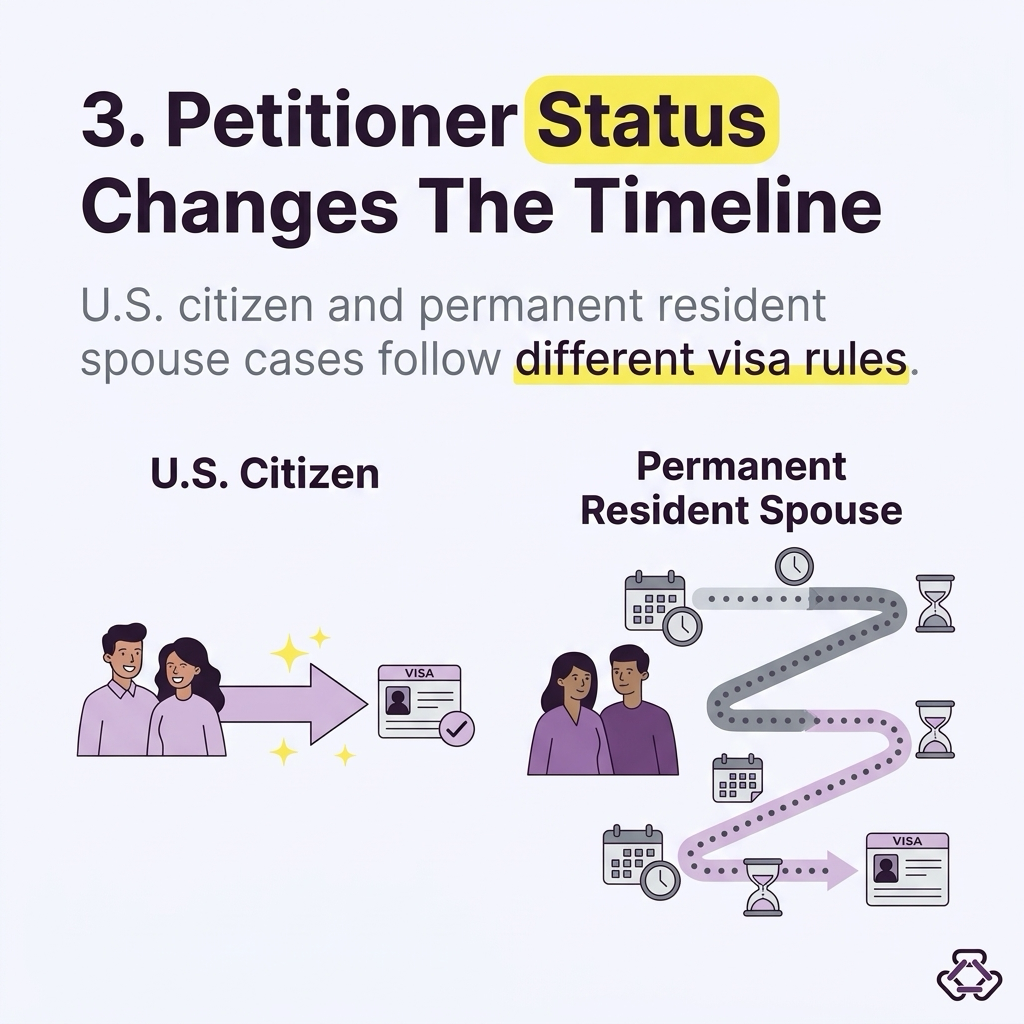
That distinction matters a lot. If the petitioner is a U.S. citizen, a spouse is generally classified as an immediate relative. If the petitioner is a lawful permanent resident, the spouse is generally in a family-sponsored preference category, where waiting for visa availability can become part of the timeline. The latest visa bulletin remains one of the main tools for tracking whether a priority date is current for preference-category spouses. State Department Visa Bulletin guidance is the authoritative source for that issue.
Form I-485: Adjustment Of Status
Form I-485 is the application to register permanent residence or adjust status. This is the filing used when the immigrant spouse is eligible to apply for the green card from inside the United States. USCIS explains that adjustment is only available to people who meet the legal requirements for that specific basis and who are not barred by status issues, inadmissibility issues, or other disqualifying factors. USCIS’s I-485 page, the general adjustment of status page, and the USCIS Policy Manual on eligibility requirements all emphasize that eligibility is highly fact-specific.
When the immigrant spouse is in the United States and eligible to adjust, a U.S. citizen petitioner can often file the I-130 and I-485 together, commonly called concurrent filing. USCIS explicitly notes that a U.S. citizen filing for a spouse who was lawfully admitted or paroled may file the I-130 and I-485 at the same time. USCIS spouse guidance covers that filing structure.
When Adjustment Of Status Is Available And When It Is Not
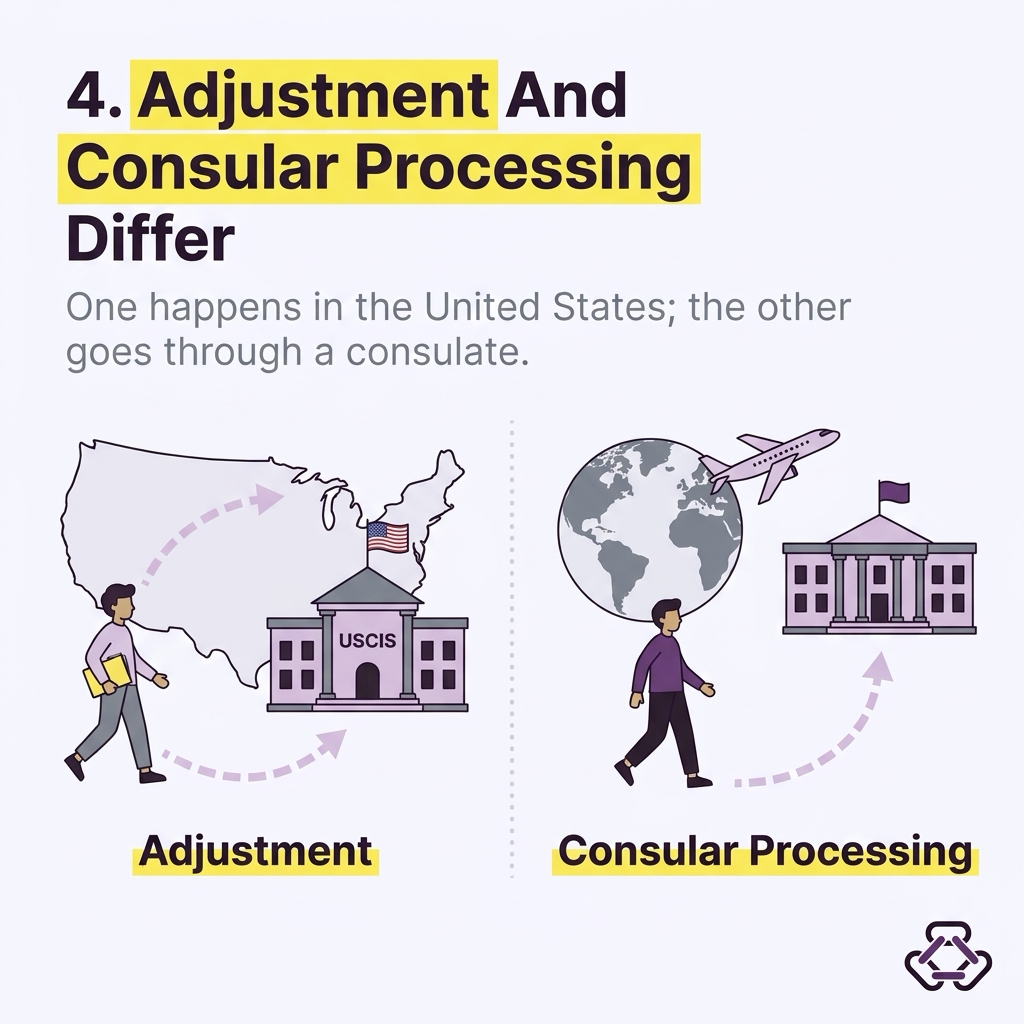
One of the most misunderstood parts of a marriage green card case is the difference between adjustment of status and consular processing.
Adjustment of status is an inside-the-United-States process. Consular processing is the immigrant visa route handled through the Department of State and a U.S. embassy or consulate abroad after petition approval and National Visa Center processing. USCIS notes that some relatives may adjust in the United States, while others may instead request an immigrant visa abroad. USCIS’s I-130 page and the State Department’s immigrant visa scheduling information help show that these are distinct tracks.
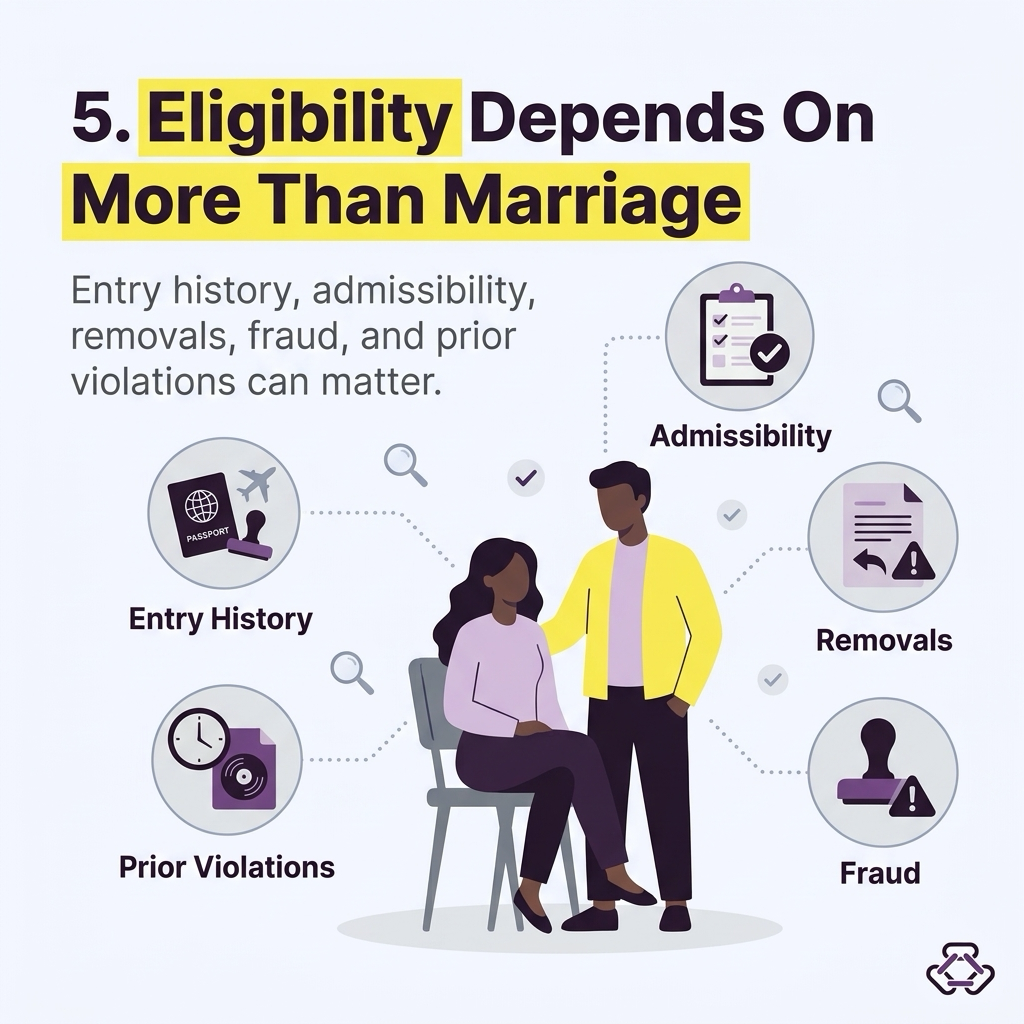
In general terms, adjustment questions often turn on issues like:
- whether the immigrant spouse entered the United States lawfully or was paroled
- whether a visa is immediately available
- whether there are bars to adjustment
- whether there are inadmissibility concerns
- whether prior immigration violations or prior removal issues exist
A marriage to a U.S. citizen can help some people pursue adjustment even after certain status violations, but that does not erase every possible issue. Unlawful entry, fraud concerns, prior removal orders, criminal history, misrepresentation, public charge issues in applicable cases, and prior immigration filings can all affect the strategy. USCIS’s adjustment eligibility guidance and public charge policy guidance make clear that adjustment remains a separate legal analysis from the marriage itself.
This is one reason some couples spend time reviewing how to prepare the case without creating unnecessary delays before filing. A filing path that looks simple on paper can become more complicated once prior entries, visa overstays, travel history, or prior petitions are involved.
What Forms And Supporting Documents Commonly Appear In A Marriage Case
The exact package depends on the case, but many marriage-based filings involve some combination of the following:
- Form I-130 for the family relationship
- Form I-130A for supplemental spousal information
- Form I-485 for adjustment of status, if eligible
- Form I-864 affidavit of support from the petitioner and sometimes a joint sponsor
- Form I-693 medical exam and vaccination record when required
- Form I-765 for work authorization, if requested
- Form I-131 for travel authorization, if requested
USCIS’s pages for Form I-130, Form I-485, Form I-864, and Form I-693 provide the current official framework and instructions for these filings.
Document gathering is often where couples first realize how document-heavy the process can become. Identity documents, marriage records, proof of lawful entry when relevant, tax records, birth certificates, prior divorce decrees, financial records, medical exam paperwork, and relationship evidence can all become part of the file. If you want a practical checklist, this guide to the documents couples usually gather before filing is often the easiest place to start.
Filing Fees And Why Couples Often Miscalculate The Cost
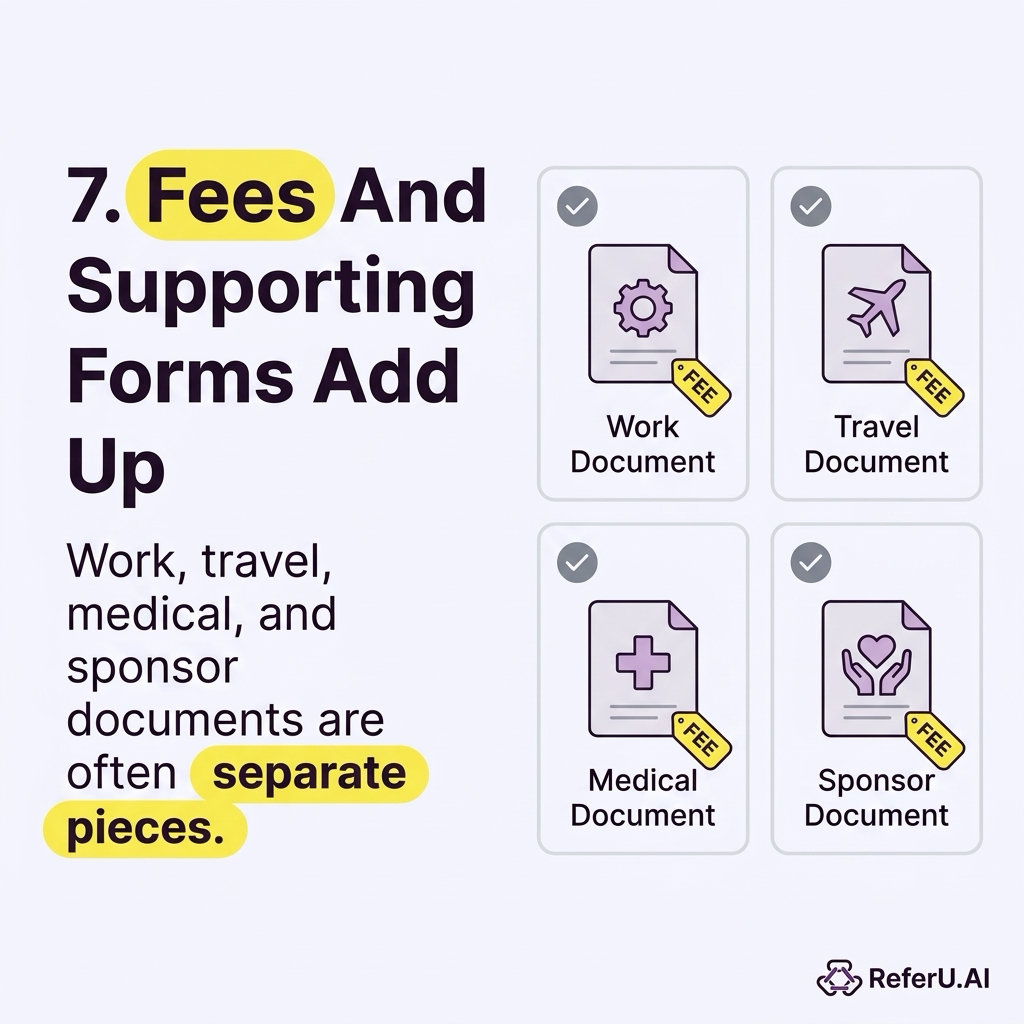
USCIS fee changes over the last few years have created confusion, especially for adjustment applicants who assumed work and travel applications were still included with the I-485 fee. USCIS now states that applicants who filed Form I-485 on or after April 1, 2024, generally pay separate fees for Forms I-765 and I-131 rather than receiving bundled filing at no additional cost. USCIS also notes that Form I-130 has different pricing depending on whether it is filed online or on paper, with an online discount. USCIS filing fees, the USCIS fee-rule FAQ, and the I-130 page reflect these current fee structures.
That matters because couples often budget for the petition and the green card application, but overlook:
- separate fees for work authorization and travel documents in many newer filings
- medical exam costs paid to the civil surgeon, not USCIS
- translation costs
- courier, copying, or document retrieval expenses
- joint sponsor documentation if the petitioner’s income is not enough
USCIS also warns that filing fees are generally final and non-refundable, and that submitting one combined payment for multiple forms can create rejection issues because filings may be processed in different systems. USCIS fee guidance addresses both points.
What USCIS Looks For In Relationship Evidence
A lot of couples ask the same question: How much relationship evidence is enough?
There is rarely a fixed number. USCIS tends to look at the quality, consistency, and timing of the evidence. A bona fide marriage case is often built through records showing a genuine shared life over time rather than a last-minute pile of generic documents. USCIS policy on marriage-based conditional residence specifically refers to evidence that the qualifying marriage “is or was bona fide,” which reflects the agency’s broader approach to assessing marital good faith. USCIS Policy Manual.
Common examples include:
- joint lease or mortgage records
- utility bills listing both spouses
- bank accounts and credit cards used by both spouses
- tax returns and W-2s
- health, dental, life, or auto insurance records
- photographs across different times and settings
- travel itineraries and hotel records
- messages, call logs, or correspondence where relevant
- birth certificates for children, if applicable
- affidavits from relatives or friends with direct knowledge
Not every couple will have the same paper trail. Newlyweds, long-distance couples, military families, religious marriages, couples living with relatives, and couples who merged finances gradually may all present different types of evidence. The issue is usually whether the file makes coherent sense as a whole.
If evidence organization feels overwhelming, this practical guide to putting relationship proof in order can help couples think about chronology, categories, and how officers often review a package.
The Medical Exam, Affidavit Of Support, And Other Frequently Missed Details
Some of the most frustrating delays come from documents that are not emotionally dramatic but are legally central.
The Medical Exam
USCIS requires Form I-693 in many adjustment cases and has changed its policies over time. USCIS states that certain adjustment applicants filing Form I-485 must submit the medical exam with the adjustment filing or risk rejection, and USCIS has also updated validity rules for medicals signed on or after November 1, 2023. USCIS’s I-693 page, USCIS alert on submitting medicals with I-485, and USCIS’s validity guidance explain those requirements.
The Affidavit Of Support
Form I-864 is often treated as a side form, but it is one of the most important parts of many family-based green card filings. USCIS uses it to evaluate the sponsor’s financial commitment under immigration law, and the agency publishes the current poverty-guideline framework used in affidavit review. USCIS’s I-864 page explains the form and references the current poverty-guideline publication.
Accuracy Across The Entire Packet
A marriage case can also stall when dates, addresses, employment history, prior marriages, prior immigration filings, or names appear differently across forms and exhibits. Even small inconsistencies can lead to requests for evidence, interview questions, or broader credibility concerns. That is part of why many couples try to review common filing mistakes that can trigger extra scrutiny or delay before anything gets mailed or submitted online.
What Happens After Filing
After filing, many adjustment applicants receive receipt notices, a biometrics appointment notice, and then either requests for evidence, an interview notice, or eventually a decision. USCIS also allows applicants to track case status online and notes that some petitioners with online accounts may see estimated progress information for certain form types. USCIS adjustment guidance and USCIS information on myProgress describe those tracking options.
Processing times can vary widely by field office, service center, form type, and the specifics of the case. USCIS publishes processing-time tools and historical trend data, but those are better viewed as broad reference points than promises. USCIS historical processing trends and the official USCIS processing-time tools remain the best starting points for current estimates.
The Marriage Green Card Interview: What It Is And Why It Matters
The interview is one of the most stressful stages for many couples, even in legitimate marriages. USCIS states that all adjustment applicants are interviewed unless USCIS waives the interview, and for family-based applications the petitioner generally appears with the principal adjustment applicant. The agency uses the interview to verify information, address incomplete or changed answers, and evaluate eligibility. USCIS interview guidelines.
In practical terms, officers often use the interview to look at:
- identity and background
- prior immigration history
- the timeline of the relationship
- living arrangements
- finances
- daily routines
- major life events
- whether the paperwork matches the testimony
Some couples are interviewed together. In some higher-scrutiny cases, officers may separate the spouses for more detailed questioning. The existence of an interview does not automatically signal a problem. It is often simply part of the process. At the same time, inconsistencies, missing records, prior filings, fraud indicators, or unexplained relationship gaps can make the interview far more important.
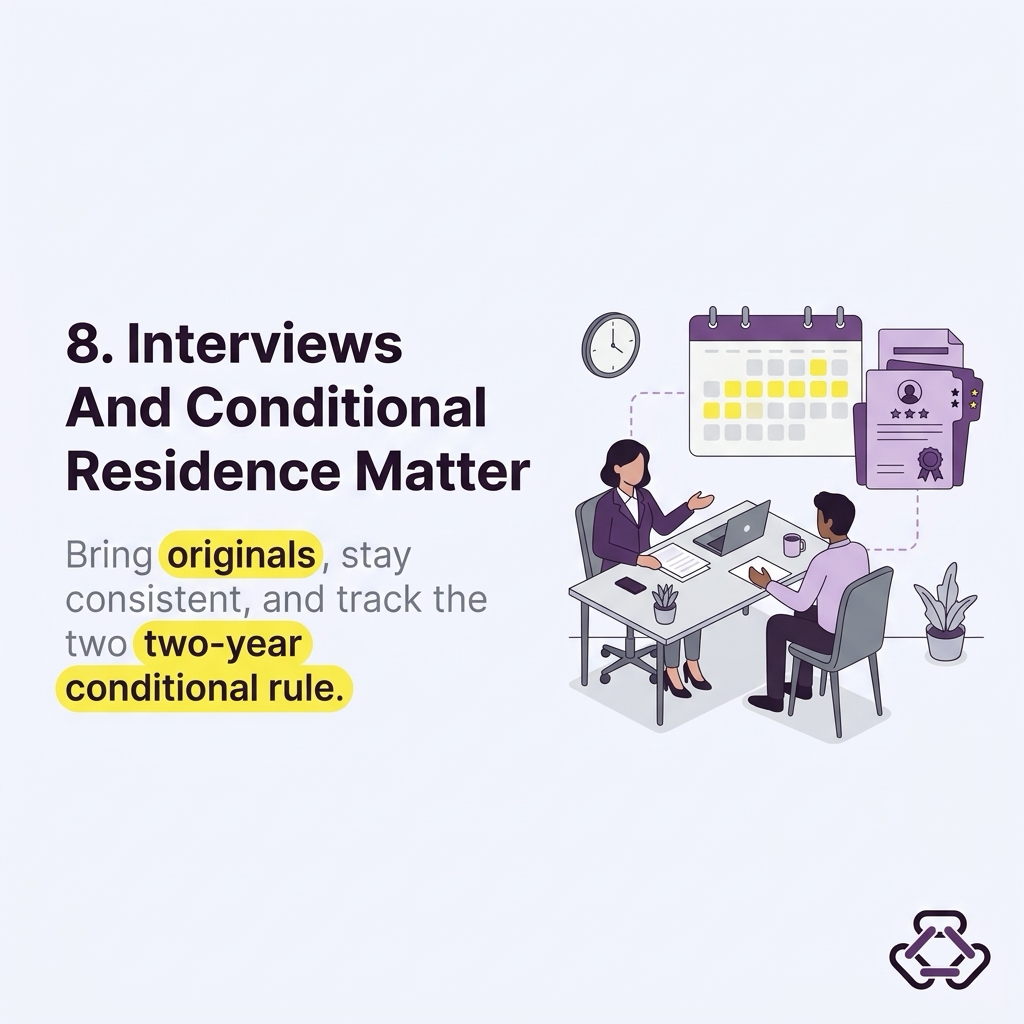
USCIS also notes that applicants coming to an adjustment interview are expected to bring original versions of submitted documents, including passports, travel documents, and Form I-94 records, even if expired. USCIS adjustment page covers that point.
Conditional Residence: Why Some Green Cards Last Two Years First
If the marriage is less than two years old on the day permanent residence is granted, USCIS states that the immigrant spouse generally receives conditional permanent residence rather than a standard ten-year green card. That conditional status lasts two years, and the couple usually later files Form I-751 to request removal of conditions during the 90-day period before the card expires. USCIS spouse page, USCIS page on removing conditions, and USCIS policy guidance explain this framework.
That later filing often surprises couples who assumed the first approval finished the marriage-based process entirely. In reality, many marriage-based cases involve two separate evidentiary moments:
- proving the marriage is genuine at the green card stage
- proving the marriage is genuine again, or was genuine, at the removal-of-conditions stage
That is another reason couples often benefit from organized records from the beginning rather than trying to recreate a two-year paper trail much later.
Red Flags That Often Lead To Delay Or Scrutiny
USCIS officers review the totality of the record, and there is no single formula for what creates concern. That said, some patterns tend to invite closer review:
- sparse joint documentation
- contradictory addresses or timelines
- prior petitions for another spouse
- major factual inconsistencies across forms
- unexplained prolonged separations
- prior immigration fraud findings or allegations
- criminal history
- prior removal proceedings or prior removal orders
- entry without inspection or possible unlawful presence issues
- weak affidavit of support documentation
None of these automatically ends a case. In many situations, they simply mean the filing strategy and evidence presentation become more important. Some couples in more complex situations spend time comparing their facts against these frequent mistakes that create added scrutiny before filing or before attending interview.
Why Legal Help Often Changes The Experience Of The Case
Marriage-based immigration filings are often marketed online as easy forms. For some couples, the filing may indeed be fairly clean. For others, what looks like a paperwork project is actually a legal screening exercise involving admissibility, prior entries, waivers, unlawful presence, sponsor issues, public charge questions where applicable, or the risk that a mistaken filing path could create long-term consequences.
An attorney may help identify issues such as:
- whether adjustment is legally available
- whether consular processing creates separate inadmissibility concerns
- whether a waiver issue may be developing
- whether prior filings or prior statements create inconsistencies
- whether certain evidence is likely to carry more weight than other evidence
- how to prepare for interview questions without overcomplicating the record
That kind of case analysis is especially important where the couple has any unusual facts, including prior marriages, criminal allegations, gaps in cohabitation, long-distance history, undocumented entry, prior visa overstays, prior denials, or prior encounters with immigration enforcement.
A Short Summary Of The Process
A marriage green card case usually involves more than proving that two people got married. It often requires a persuasive record showing that the marriage is genuine, that the filing path is legally correct, that the immigrant spouse is eligible to become a permanent resident, and that all supporting records align. The petition, the evidence, the interview, and the adjustment analysis all work together.
For some couples, the main challenge is organization. For others, it is legal eligibility. For many, it is both.
If your case involves uncertainty about entry history, prior overstays, interview preparation, sponsor issues, or evidence strategy, an experienced immigration attorney can help identify what the record shows, what may be missing, and what risks may not be obvious from the forms alone.
Visit ReferU.AI to get matched with an attorney who has demonstrable experience in cases like yours — for free.


