Table of Contents
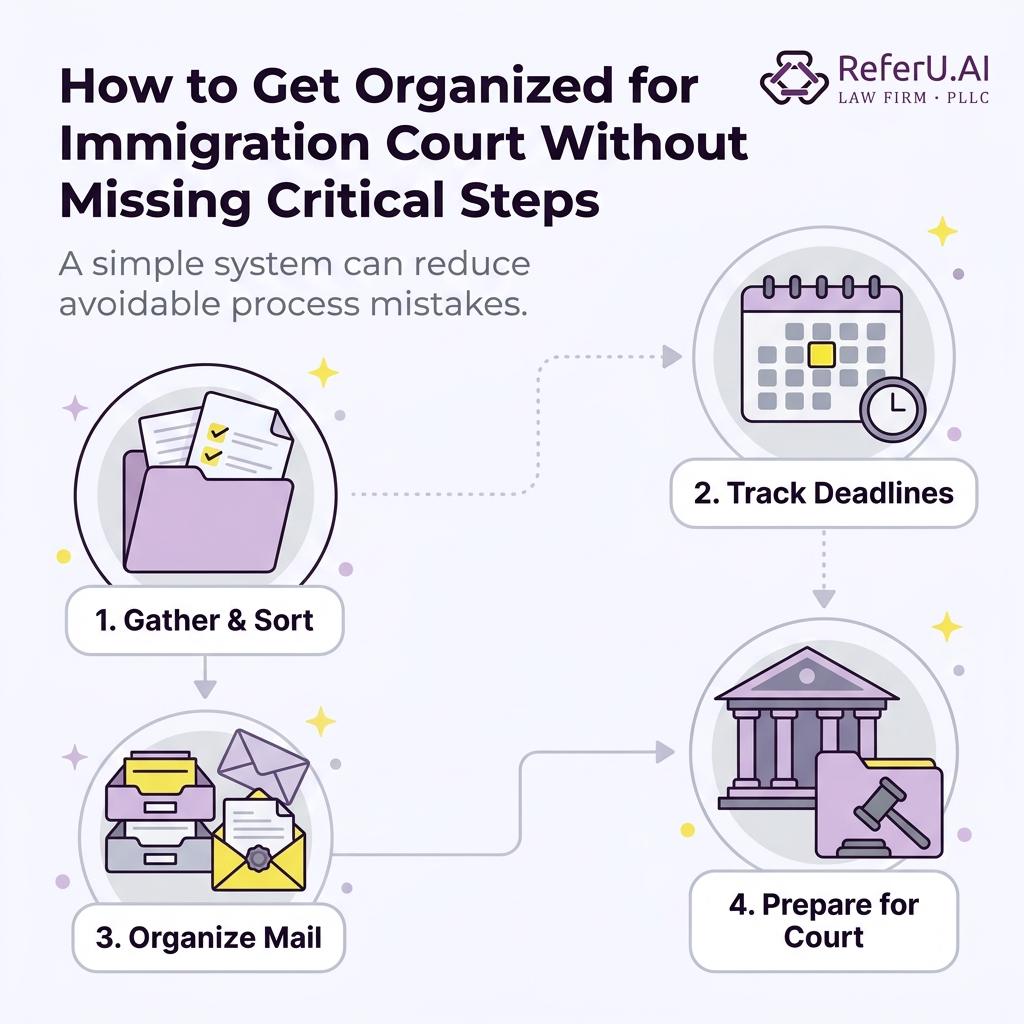
- How to Get Organized for Immigration Court Without Missing Critical Steps
- Why Organization Matters So Much In Immigration Court
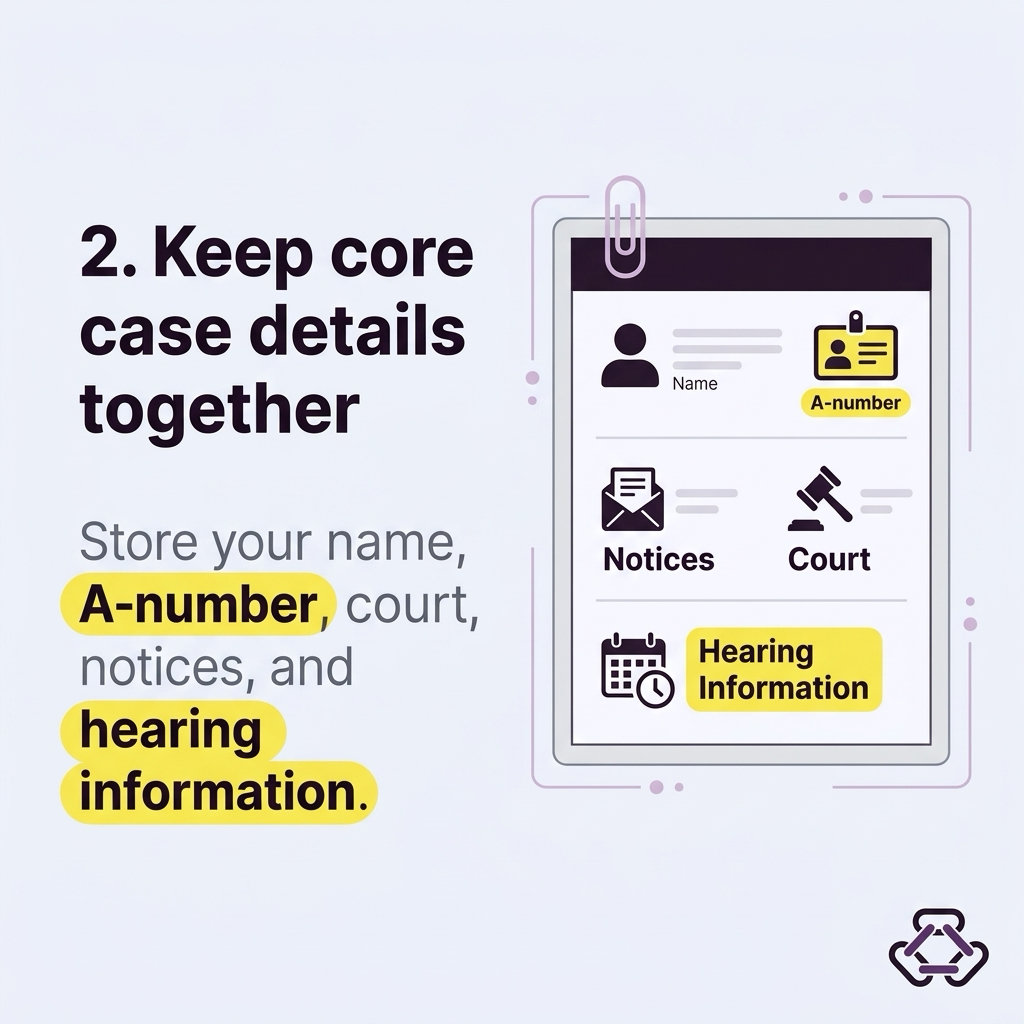
- 1. Start With The Basic Case Details
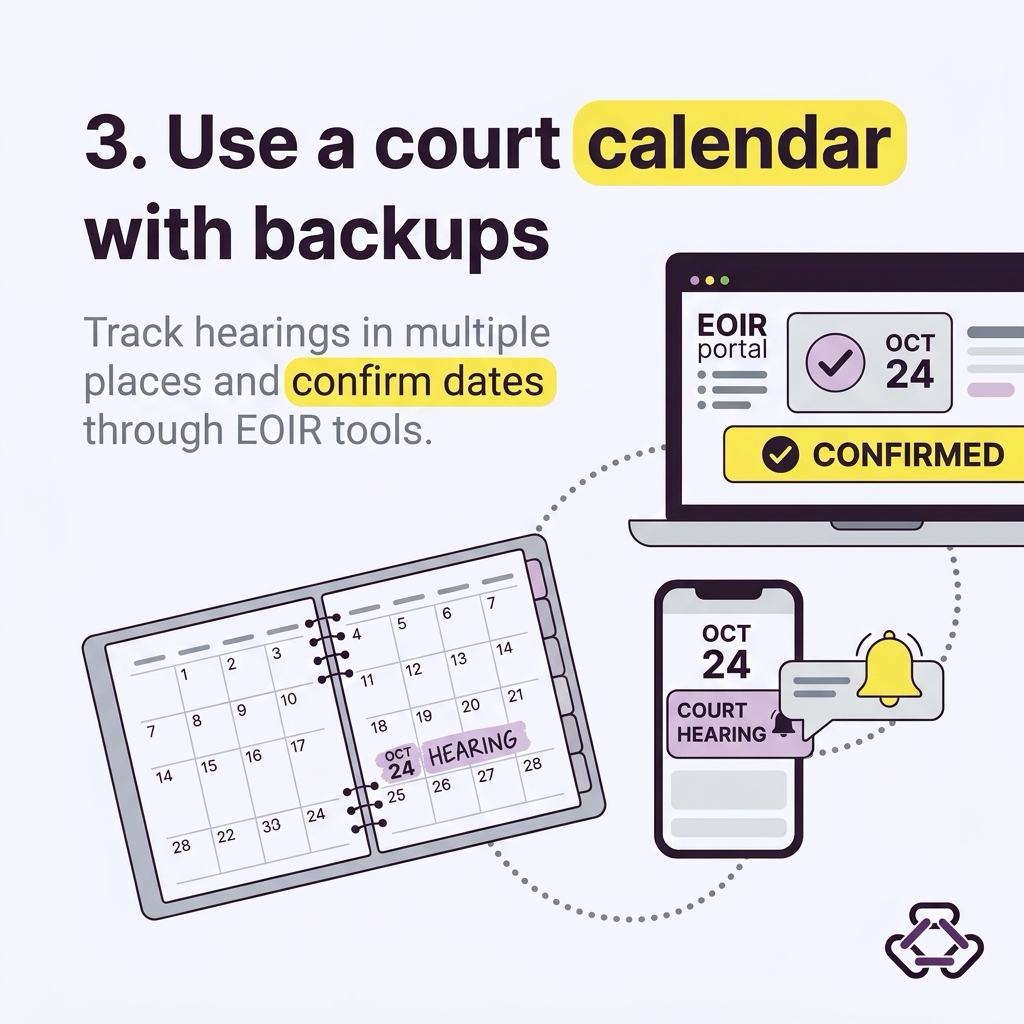
- 2. Set Up A Court Calendar With Redundancy
- A Simple Calendar System That Often Helps
- 3. Keep Your Address Updated In The Right Places
- 4. Build One Master Immigration Court Folder
- Paper Folder Sections
- Digital Folder Sections
- 5. Gather Identity And Immigration Records Early
- 6. Create A Timeline Of Your Life And Immigration History
- 7. Match Each Fact To Supporting Evidence
- 8. Make A Filing Checklist For Every Submission
- 9. Keep A Hearing Prep Packet Ready At All Times
- 10. Track Every Communication
- 11. Be Careful About Getting Help From The Wrong Person
- 12. Prepare Questions For A Lawyer Before The First Meeting
- 13. Understand That Court Organization Is Also Emotional Organization
- Common Mistakes That Create Problems Fast
- A Short Summary

Type
Great Grandchild
Status
Approved
Title (YouTube)
Images Failed (Social)
Images Failed (Social)
Do not index
Publish Date (TikTok)
Apr 25, 2027 07:15
Videos Post IDs (Social)
Hashtags (Social)
#LegalAdvice #LegalHelp #Immigration #RemovalProceedings
Caption
Caption X
Cover

OG Image

Alt Image Text
Flat vector illustration of a person organizing immigration court documents with a checklist, calendar, folders, mail notice, and courthouse icon in a clean, minimal workspace.
Images

Videos
Publish Date (Social)
Feb 18, 2027 14:30
Scheduled (Social)
Scheduled (Social)
Images Posted (Social)
Images Posted (Social)
Videos Posted (Social)
Videos Posted (Social)
Featured
Created time
Apr 7, 2026 12:02 AM
Sub-item
Authors
CTA Practice Area (Social)
Immigration
TikTok Failed (Social)
TikTok Failed (Social)
Videos Post Links (Social)
TikTok Post Links (Social)
Images Post IDs (Social)
YT Post ID
Video Pending Manual (Social)
TikTok Posted (Social)
TikTok Posted (Social)
TikTok Post IDs (Social)
Video Cover (Social)
Images Post Links (Social)
First Comment (Social)
Videos Failed (Social)
Videos Failed (Social)
YT Embedded
Images Delete (Social)
Videos Delete (Social)
Carousel Video URL (Social)
How to Get Organized for Immigration Court Without Missing Critical Steps
Immigration court can feel overwhelming fast. One notice arrives, deadlines start stacking up, documents are suddenly important, and every small detail seems like it could affect the future. That stress is real. It is also one reason organization matters so much in removal proceedings.
The immigration court system is under heavy strain. The Executive Office for Immigration Review (EOIR) reported record case completions in fiscal year 2025, while the broader court system has continued dealing with a backlog measured in the millions. In practical terms, that can translate into schedule changes, long delays, rushed hearings, and a process where missed mail or missing paperwork can create serious problems if no one catches them early (EOIR, Congressional Research Service).
If you are trying to understand the bigger picture first, it may help to read this overview of how immigration court proceedings usually unfold. In this post you’ll learn how to build a simple, reliable system for tracking your case, protecting your deadlines, organizing evidence, and preparing for hearings without letting critical steps slip through the cracks.
Scroll to the bottom for every post in this series.
Why Organization Matters So Much In Immigration Court
Immigration court is not just about telling your story. It is also about procedure.
A case can involve hearing notices, address updates, filing deadlines, document translations, service requirements, applications for relief, evidence packets, and communications with both the court and the Department of Homeland Security (DHS). EOIR also makes clear that respondents can use its online and phone systems to track case information, and that address changes with the court require a specific immigration court form rather than informal notice (EOIR Immigration Court Information, EOIR Respondent Access).
In general terms, organization does not guarantee a result. What it often does is reduce avoidable mistakes: missed hearing dates, lost notices, incomplete filings, and evidence that never gets submitted in the correct format.
1. Start With The Basic Case Details
Before building a document folder or calendar, gather the core facts of the case in one place.
Create a one-page case sheet with:
- Full legal name exactly as used in immigration paperwork
- A-number
- Current address
- Safe mailing address, if different
- Phone number and email
- Immigration court location
- Upcoming hearing date and time
- DHS/ICE check-in information, if any
- Attorney contact information, if represented
- Names and dates for every notice received
If you have a Notice to Appear (NTA), keep a copy at the front of your file. The NTA is often the document that starts removal proceedings. It may list allegations, the charge or charges of removability, and hearing information, although hearing details are sometimes added later through a separate notice. EOIR’s online case tools and automated hotline can help people confirm hearing information connected to their A-number (EOIR, Automated Case Information).
2. Set Up A Court Calendar With Redundancy
One calendar is good. Two or three is better.
Some people use:
- A phone calendar with alerts
- A paper planner
- A trusted family member’s reminder system
- A folder labeled by hearing date
- A shared calendar with counsel, if represented
EOIR provides case information online and through the automated hotline at 800-898-7180, which can be useful when trying to confirm the next hearing date, time, or case status (EOIR Immigration Court Information, EOIR Policy Manual).
This step matters because in absentia removal orders can happen when a person does not appear for court. Recent reporting and court-backlog analysis have pointed to a sharp rise in removal orders entered after nonappearance, which makes reliable notice tracking especially important in the current environment (AP News, EOIR-related case data discussed by CRS).
A Simple Calendar System That Often Helps
For each hearing or filing deadline, add:
- The event itself
- A reminder 30 days before
- A reminder 14 days before
- A reminder 7 days before
- A reminder 48 hours before
- A same-day reminder
Also note transportation plans, childcare plans, interpreter questions, and what documents to bring.
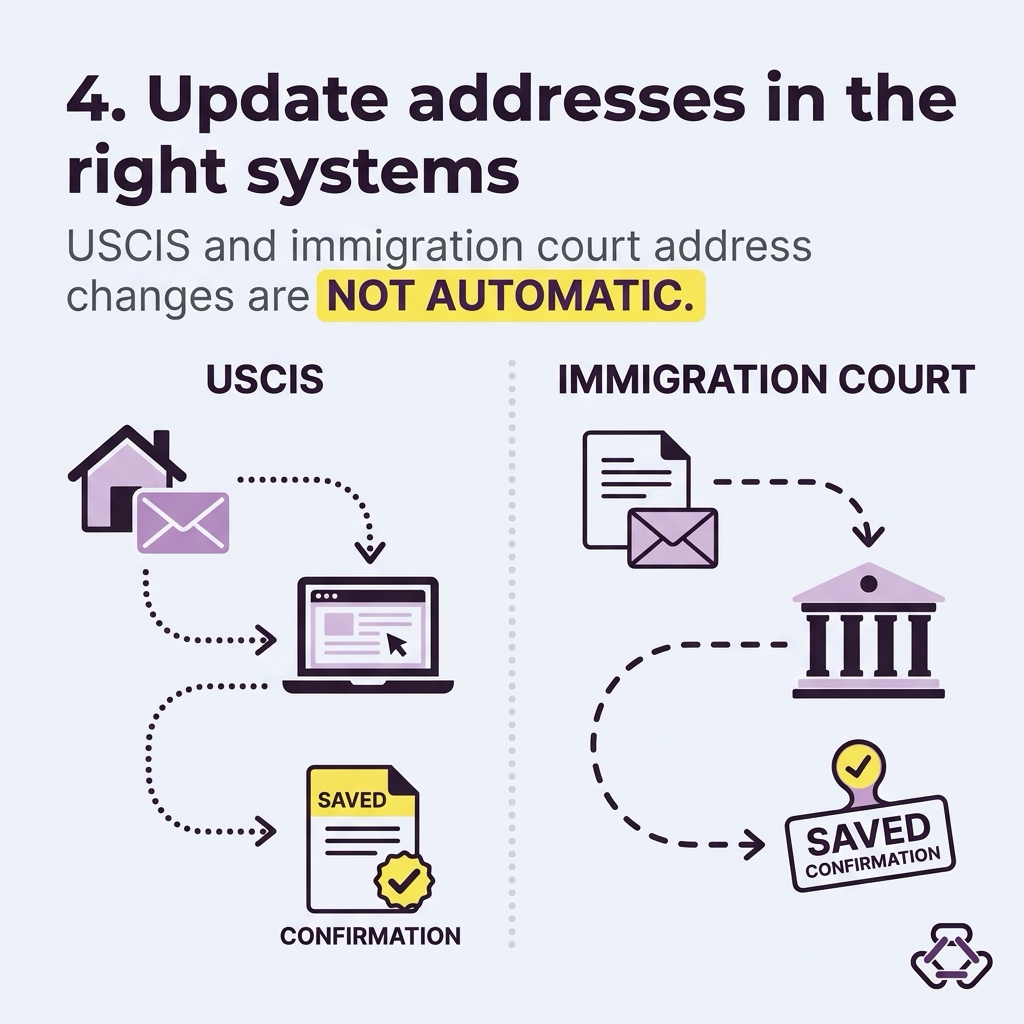
3. Keep Your Address Updated In The Right Places
This is one of the most common sources of trouble.
If your address changes, immigration agencies do not necessarily update each other automatically. USCIS explains that changing your address with USCIS through Form AR-11 or the online change-of-address tool does not update your address with the immigration court. The immigration court uses Form EOIR-33/IC for address changes in cases before the court (USCIS AR-11, USCIS Form AR-11 PDF, EOIR Change Of Address, EOIR-33/IC Online Form).
That distinction catches many people off guard.
A practical checklist may include:
- Update USCIS if you have a pending matter there
- Update the immigration court using EOIR-33/IC if you are in court proceedings
- Keep proof of submission
- Check that the new address appears correctly in the relevant system
- Save screenshots, confirmation numbers, and mailing receipts
Here’s what this often means: even if one agency has your new address, another part of the system may still be sending notices to the old one.
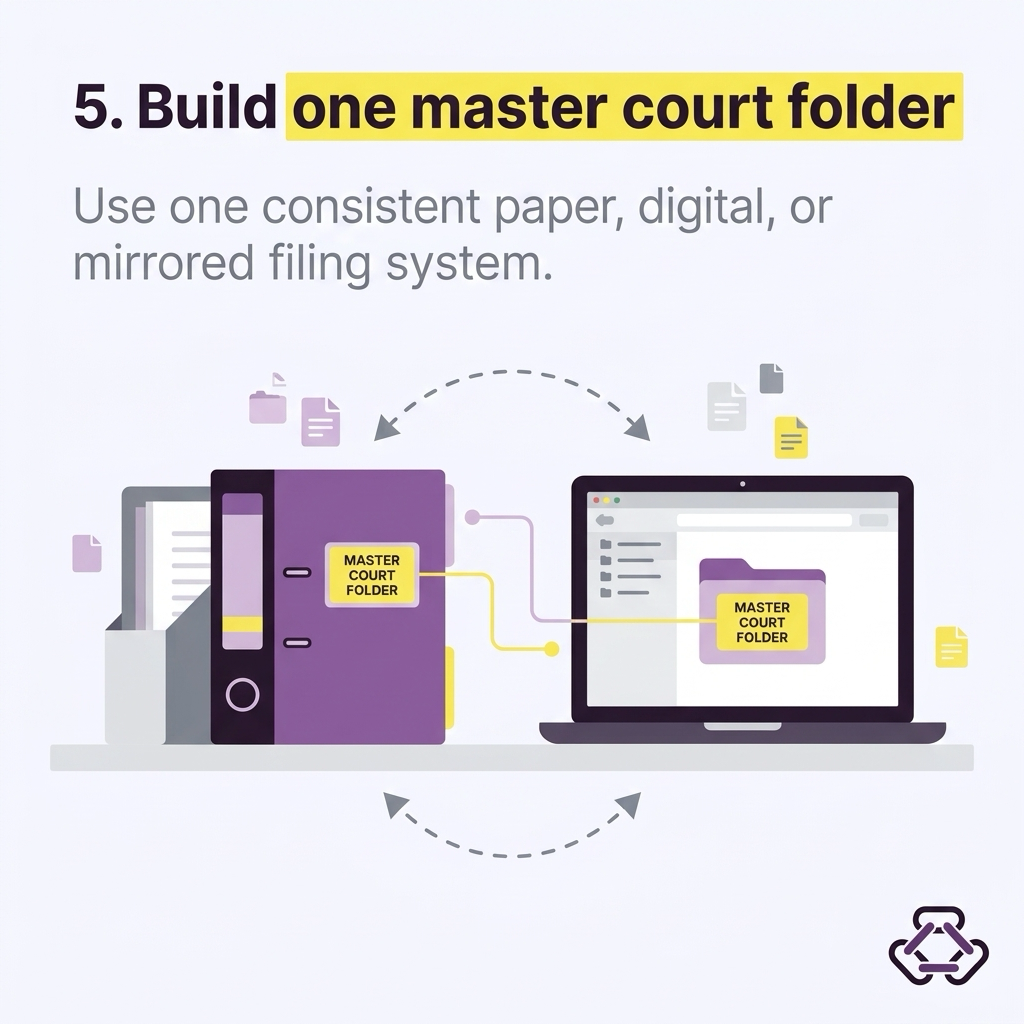
4. Build One Master Immigration Court Folder
Use one system only: paper, digital, or both. The key is consistency.
Paper Folder Sections
A physical binder or accordion folder can include:
- Court Notices
- Government Filings
- Applications
- Identity Documents
- Immigration History
- Evidence
- Medical Or Hardship Records
- Country Conditions Materials
- Attorney Communications
- Receipts And Mailing Proof
Digital Folder Sections
Mirror the same structure in cloud storage or on a secure drive. Name files clearly:
2026-03-14_Hearing_Notice.pdf
Passport_Translation.pdf
I589_Draft_v2.pdf
EOIR33_SubmissionConfirmation.pdf
The goal is not to create a perfect archive. The goal is to make every important paper easy to find in minutes, not hours.
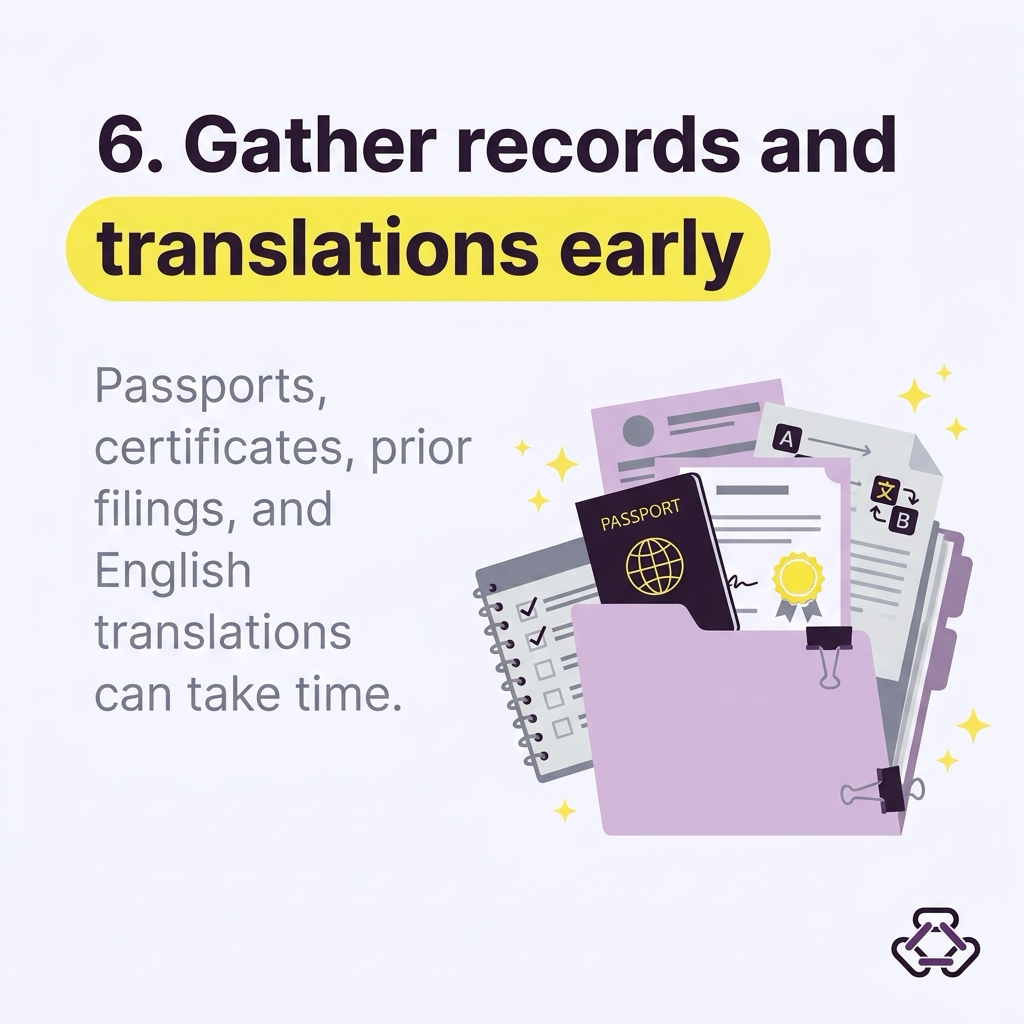
5. Gather Identity And Immigration Records Early
Some documents can take time to replace or obtain from family, former counsel, or overseas contacts.
Common records people gather include:
- Passport
- Birth certificate
- Marriage certificate
- Divorce records
- Children’s birth certificates
- Prior visas
- I-94 records
- Work permits
- Prior USCIS receipts and approvals
- Prior removal or border documents
- Copies of any applications already filed
If a document is not in English, immigration court filings often require an English translation and a translator certification. EOIR’s filing rules and court practice materials are important here because formatting and submission details can affect whether evidence is accepted in the way you expect (EOIR Forms And Fees, EOIR Immigration Court Online Resource).
6. Create A Timeline Of Your Life And Immigration History
This is one of the most useful steps, especially for asylum, cancellation, adjustment, waivers, and other relief-related issues.
Write out a chronological timeline with:
- Dates of entry and exits
- Addresses lived at in the United States
- Family milestones
- Jobs and schools
- Arrests or citations, if any
- Immigration applications filed
- Important incidents connected to fear, harm, or hardship
- Medical events
- Dates of marriage, divorce, births, and deaths
An attorney often uses this kind of timeline to identify legal issues, spot missing evidence, and compare the facts against forms, prior statements, border interviews, or earlier filings. Even small date inconsistencies can become important later.
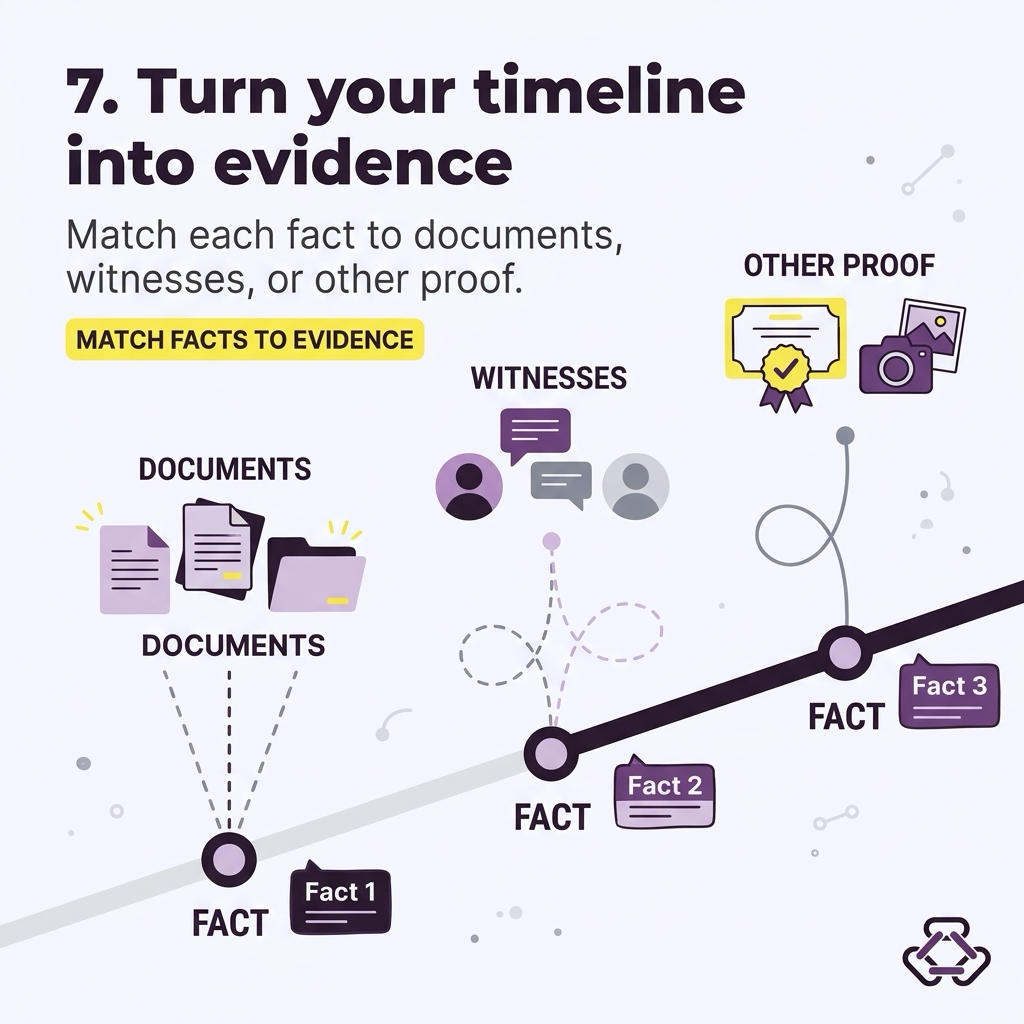
7. Match Each Fact To Supporting Evidence
After creating the timeline, connect each important fact to a document, witness, or other proof.
For example:
- Identity → passport, birth certificate
- Marriage → marriage certificate, photos, lease, tax records
- Presence In The U.S. → rent receipts, school records, pay stubs, medical bills
- Hardship To Family → medical letters, therapy records, special education records, financial documents
- Fear Of Return → declarations, police records, medical records, news reports, country reports
The U.S. Department of State, USCIS, and other official sources may provide country or procedural materials, while EOIR’s online resource hub centralizes court-related information for respondents and representatives (EOIR ICOR, Access EOIR).
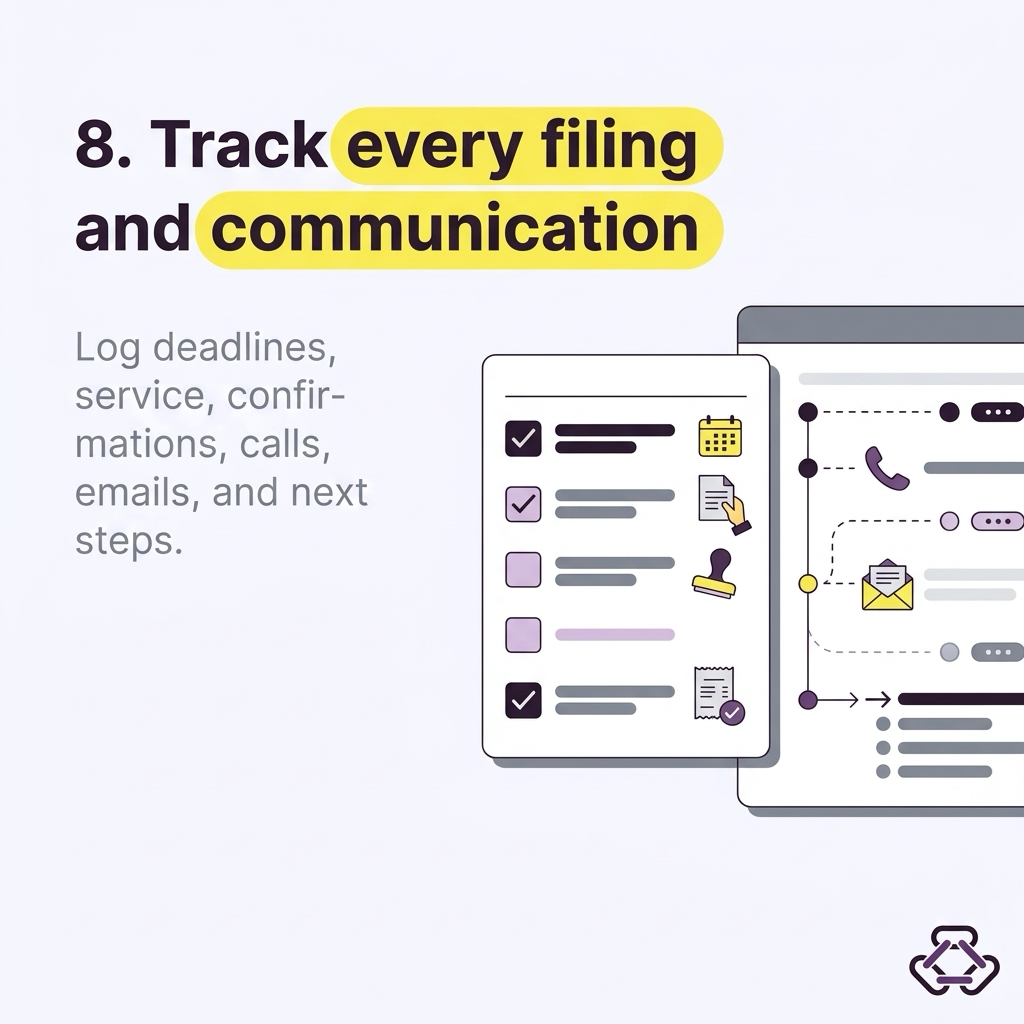
8. Make A Filing Checklist For Every Submission
A lot of immigration court problems begin with one assumption: “I think we sent everything.”
A filing checklist may help break that habit. For each filing, track:
- Name of document
- Court where it is filed
- Due date
- Date sent
- Method of filing
- Whether a copy was served on DHS
- Supporting exhibits included
- Translation included, if needed
- Certificate of service included, if required
- Delivery confirmation or submission proof
If you are unrepresented, EOIR’s self-help materials and ICOR can provide general procedural information and links to forms, though they are not a substitute for legal advice tailored to the case (EOIR Self-Help Materials, ICOR).
9. Keep A Hearing Prep Packet Ready At All Times
A hearing packet can make the week before court much less chaotic.
Include:
- Government-issued ID
- Hearing notice
- A-number
- Attorney contact information
- A short case summary
- List of open questions
- Copies of the main filings
- Notebook and pen
- Interpreter notes, if relevant
- Medication list or medical items, if relevant
If the hearing is virtual, add:
- Login details
- Backup device
- Charger
- Quiet location plan
- Internet backup plan
- Paper copies nearby in case technology fails
Given the pace and volume of immigration court dockets, having a ready-to-go packet can make it easier to respond if a hearing is rescheduled, advanced, or shifted in format.
10. Track Every Communication
Keep a communication log. This can be simple but very valuable.
Record:
- Date
- Who you contacted
- Office or agency
- Phone number or email
- What was discussed
- Any next step mentioned
- Deadline created by that conversation
This is especially helpful when dealing with address updates, filing issues, hearing confirmation, DHS check-ins, or document requests. If there is ever confusion later, a written log can help reconstruct what happened and when.
11. Be Careful About Getting Help From The Wrong Person
USCIS warns people to be cautious about “notarios,” immigration consultants, and others who are not authorized to provide immigration legal services. Only attorneys and EOIR-accredited representatives working through EOIR-recognized organizations can provide authorized immigration legal help in those settings (USCIS Find Legal Services, EOIR Learn About Legal Representation).
That warning matters even more in court cases, where a bad filing, bad deadline, or bad strategic decision can affect relief options for years.
Some people in similar situations start with EOIR’s pro bono legal service provider list while also looking for private counsel with documented experience handling highly similar matters.
12. Prepare Questions For A Lawyer Before The First Meeting
If you are speaking with an attorney, organization can make that consultation much more productive.
Bring:
- Your NTA and hearing notices
- Any prior filings
- Criminal records, if any
- Immigration history timeline
- Address history
- Family information
- Questions written down in advance
Helpful questions often include:
- What relief options may be available in general terms?
- What deadlines are coming up first?
- What documents matter most right now?
- Are there inconsistencies in the record?
- What risks come with filing or not filing certain applications?
- What happens at the next hearing?
A lawyer may be able to identify issues that are easy to miss when a person looks only at the most recent notice.
13. Understand That Court Organization Is Also Emotional Organization
Immigration court stress is not only administrative. It is personal.
People in proceedings are often balancing work, parenting, fear about removal, language barriers, trauma, transportation problems, and uncertainty about the future. A simple organization system can create some stability in a process that otherwise feels unpredictable.
That may include:
- One trusted contact who knows your hearing dates
- One folder that always stays in the same place
- One digital backup
- One running list of questions
- One weekly time to review the case status
When the process feels too big, reducing it to repeatable routines can help.
Common Mistakes That Create Problems Fast
A few patterns come up again and again:
- Assuming USCIS and immigration court share address changes automatically
- Losing track of the A-number
- Missing mail because of a move
- Bringing originals to court but keeping no copies
- Filing documents without keeping proof
- Waiting too long to gather records from abroad
- Trusting unauthorized immigration service providers
- Showing up to court without reviewing the latest notice
Here’s what this often means in practice: many immigration court problems do not begin with the legal merits alone. They begin with a missed process step.
A Short Summary
Getting organized for immigration court is really about building a system: track the case details, confirm hearing dates, update addresses in the right places, gather records early, connect facts to evidence, and keep proof of every filing and communication.
That system may not remove the uncertainty of removal proceedings. It can, however, reduce the risk that a case gets derailed by paperwork, timing, or avoidable confusion.
If you are looking for help with an immigration court case, ReferU.AI can help you find an attorney based on documented experience in highly similar matters, using objective criteria based on court records rather than advertising. Visit ReferU.AI to get matched with an attorney who has demonstrable experience in cases like yours — for free.
