Table of Contents
- How to Prepare After Receiving a Notice to Appear
- Why A Notice To Appear Matters
- Step 1: Read The NTA Carefully From Top To Bottom
- Step 2: Confirm Whether A Hearing Has Been Scheduled
- Step 3: Make Sure The Court Has The Right Address
- Step 4: Start A Court File Of Your Own
- Step 5: Figure Out What Kind Of Case This Appears To Be
- Step 6: Prepare For The First Hearing
- Step 7: Be Cautious About Getting Help From The Wrong Person
- Step 8: Understand Why Representation Often Changes The Process
- Step 9: Gather Evidence Early, Even If Relief Is Still Unclear
- Step 10: Keep Track Of Every Deadline, Notice, And Filing
- Step 11: Know That The NTA Is The Beginning, Not The End
- Step 12: Look For Relevant Experience, Not Generic Promises
- A Short Summary Of What To Do After An NTA Arrives

Type
Great Grandchild
Status
Approved
Title (YouTube)
Images Failed (Social)
Images Failed (Social)
Do not index
Publish Date (TikTok)
Apr 25, 2027 06:15
Videos Post IDs (Social)
Hashtags (Social)
#LegalAdvice #LegalHelp #Immigration #RemovalProceedings
Caption
Caption X
Cover

OG Image

Alt Image Text
Flat vector illustration of a person preparing after receiving a notice to appear, reviewing immigration court documents, deadlines, and organized case materials.
Images




Videos
Publish Date (Social)
Feb 18, 2027 14:00
Scheduled (Social)
Scheduled (Social)
Images Posted (Social)
Images Posted (Social)
Videos Posted (Social)
Videos Posted (Social)
Featured
Created time
Apr 7, 2026 12:02 AM
Sub-item
Authors
CTA Practice Area (Social)
Immigration
TikTok Failed (Social)
TikTok Failed (Social)
Videos Post Links (Social)
TikTok Post Links (Social)
Images Post IDs (Social)
YT Post ID
Video Pending Manual (Social)
TikTok Posted (Social)
TikTok Posted (Social)
TikTok Post IDs (Social)
Video Cover (Social)
Images Post Links (Social)
First Comment (Social)
Videos Failed (Social)
Videos Failed (Social)
YT Embedded
Images Delete (Social)
Videos Delete (Social)
How to Prepare After Receiving a Notice to Appear
Getting a Notice to Appear, often called an NTA, can feel overwhelming. For many people, it is the first time the immigration court system becomes real. The document may arrive with legal language, allegations, charges, and hearing information that can be hard to process in one sitting.
The short version: an NTA is the document the Department of Homeland Security uses to begin removal proceedings in immigration court, and it lists the factual allegations and legal charges the government is relying on. If the first hearing date is not on the form, the immigration court may send a later hearing notice, and case details may also appear through EOIR’s case information systems. The Executive Office for Immigration Review explains that here.
In this post you’ll learn how to prepare after receiving a Notice to Appear, what information to review first, how to avoid missing important deadlines, what to gather for your case, and where legal help often fits into the process. If you want a broader overview of what happens once immigration court starts, this guide on how removal proceedings usually unfold from the NTA through possible defenses and relief can help connect the bigger picture.
Scroll to the bottom for every post in this series.
Why A Notice To Appear Matters
A Notice to Appear is not just a warning letter. It is the document that starts an immigration court case once it is filed with the court. EOIR describes Form I-862 as the document DHS provides to immigration court to explain why it believes a person is removable from the United States, including the allegations and charges involved. EOIR’s page on the NTA and USCIS policy materials both frame it as the beginning of formal removal proceedings.
That matters because immigration court has its own procedures, filing rules, hearing notices, address-update requirements, and consequences for not appearing. Missing a hearing can create serious problems, including the possibility of an order being entered when the person is not present. A person who just received an NTA is often dealing with both a legal issue and a logistics issue at the same time.
The system is also under strain. EOIR announced it completed more than 722,000 cases in the first 11 months of fiscal year 2025, a record pace, while publicly emphasizing backlog reduction efforts. EOIR’s announcement and broader public reporting on pending caseloads show why hearing schedules, notice tracking, and case organization have become especially important in practice.
Step 1: Read The NTA Carefully From Top To Bottom
The first step is simple but important: read every page slowly.
An NTA commonly includes:
- your A-number
- factual allegations about identity, entry, status, or immigration history
- the legal charges of removability
- hearing information, if available
- the immigration court location, if already assigned
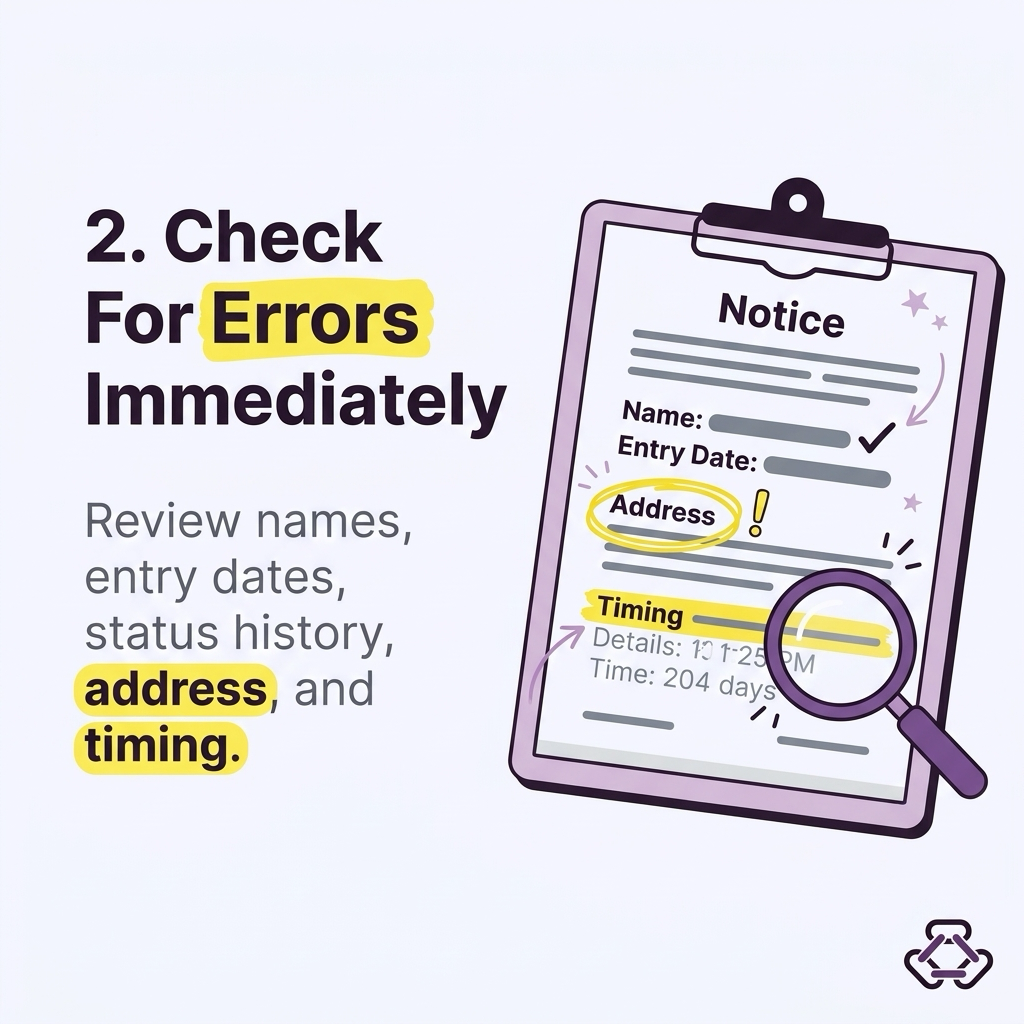
EOIR notes that the immigration judge may later ask whether the allegations are true and whether you admit or deny the charges, and if there is an error in the NTA, that issue can be raised in court. EOIR’s explanation of the NTA is useful here because it lays out exactly how the document functions in proceedings.
As you review it, look for obvious issues such as:
- misspelled name
- wrong date of entry
- incorrect citizenship information
- inaccurate statements about status or prior applications
- missing hearing date or time
- wrong address
Some people annotate a copy line by line and keep a second clean copy in a folder. That can make later conversations with an attorney more efficient.
Step 2: Confirm Whether A Hearing Has Been Scheduled
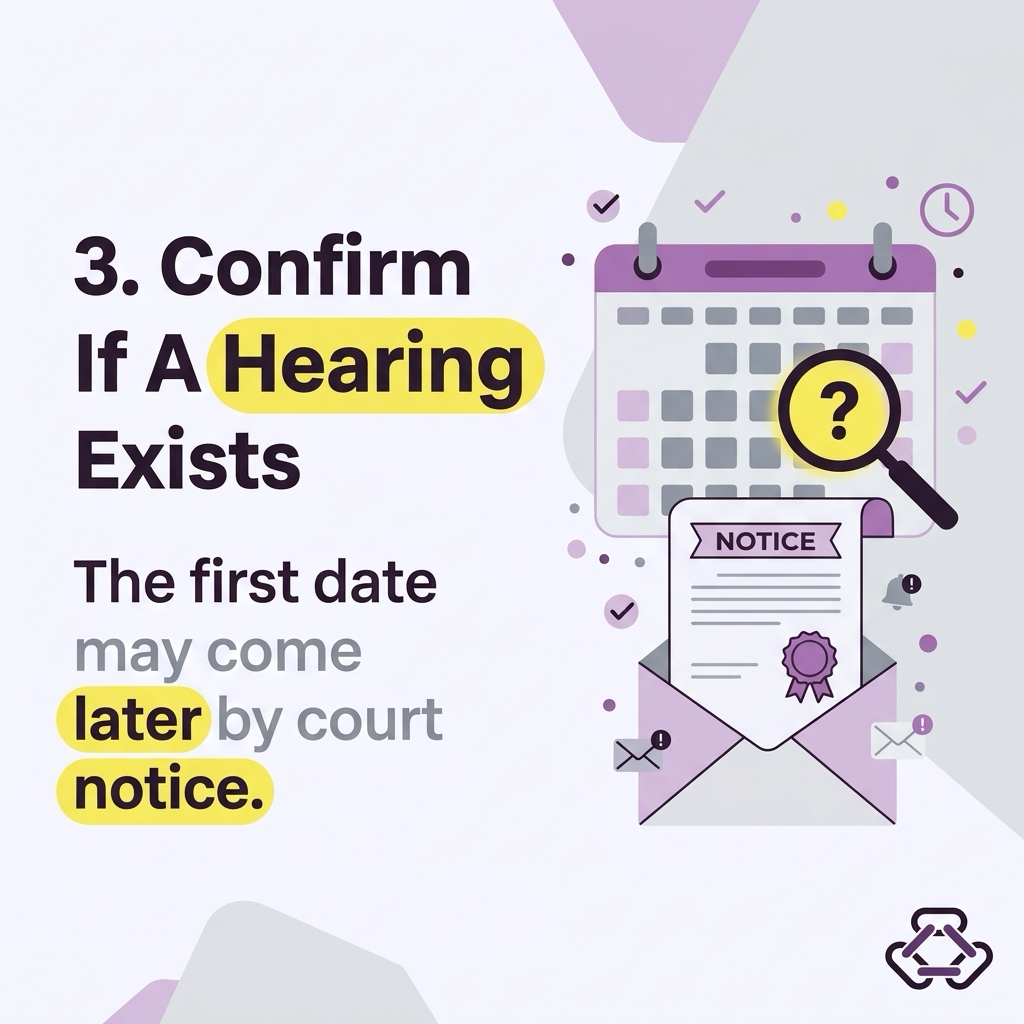
One of the more confusing parts of an NTA is that it may or may not include the first hearing date and time. EOIR states that if this information is missing, the immigration court may later send a Notice of Hearing, and case information may also be checked through the Automated Case Information System online or by phone at 1-800-898-7180. EOIR’s NTA page, EOIR’s operational status page, and EOIR customer service information all discuss these tools.
In practical terms, many people keep track of hearings in several ways at once:
- the paper notice received by mail
- online case information through EOIR
- the case information hotline
- updates from counsel, if represented
That kind of redundancy can be helpful because hearing dates, locations, and formats sometimes change.
Step 3: Make Sure The Court Has The Right Address
This is one of the most important administrative pieces of the case.
EOIR states that official correspondence such as notices and decisions will go to the address on file, and pro se respondents can use the EOIR-33/IC Change of Address Form through Respondent Access to update contact information in immigration court cases. EOIR’s online change-of-address form, the Respondent Access forms page, and EOIR guidance all reinforce how central address updates are.
If you moved recently, are staying with family temporarily, or expect to relocate, this is often one of the first issues an attorney looks at. Missed mail can turn into missed hearings, missed filing deadlines, or missed decisions.
Even if a person already updated an address with another immigration agency, that does not always mean immigration court has the same update. Immigration agencies use different systems, and court-specific updates often matter separately.
Step 4: Start A Court File Of Your Own
Once the NTA arrives, organization becomes part of case preparation.
A basic immigration court file often includes:
- the NTA and all envelopes it came in
- any later Notice of Hearing
- passport and identity documents
- copies of visas, I-94 records, work permits, and prior USCIS notices
- prior applications filed with USCIS or DHS
- marriage, birth, or divorce records
- criminal court records, if any exist
- proof of residence in the United States
- proof of family relationships
- school, medical, tax, or employment records
- evidence tied to any possible relief or defense
EOIR also offers self-help legal materials and explains that respondents can request a copy of their court file, called the Record of Proceedings, which can become important when the procedural history is complicated.
A well-organized file does not resolve the legal issues by itself, but it often makes the next step far easier: evaluating what options may exist.
Step 5: Figure Out What Kind Of Case This Appears To Be
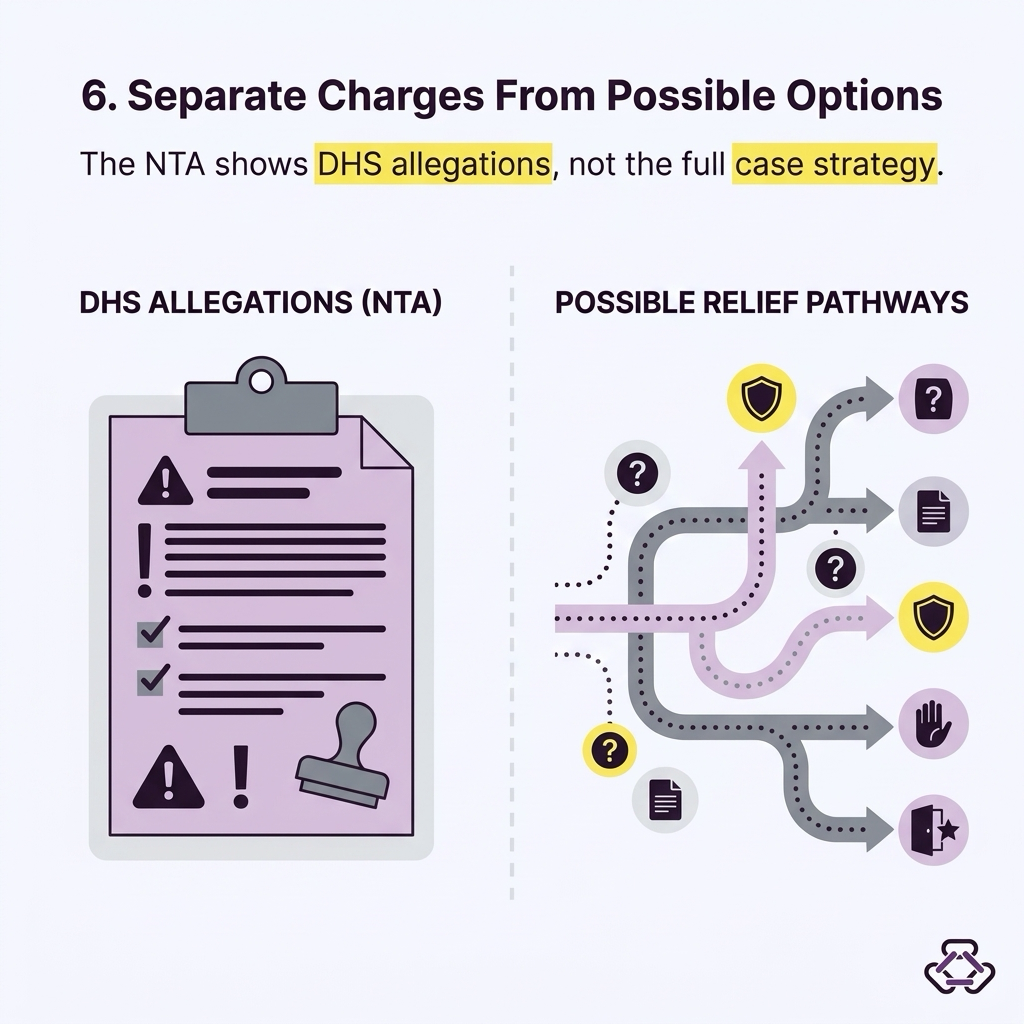
An NTA does not automatically tell you the full strategy for the case. It tells you the government’s starting position.
That is why it can help to separate two questions:
- What is DHS alleging?
- What forms of relief, protection, or procedural defenses may be available?
For example, one person may be exploring asylum-related protection. Another may be looking at cancellation of removal, adjustment of status, waivers, voluntary departure, termination arguments, or other forms of relief depending on facts and immigration history. EOIR’s public materials on legal representation and self-help resources are helpful starting points, but they are not substitutes for individualized legal analysis.
This is also why early assumptions can be risky. The wording on the NTA may sound definitive, but immigration court cases often turn on details that are not obvious from the first document alone.
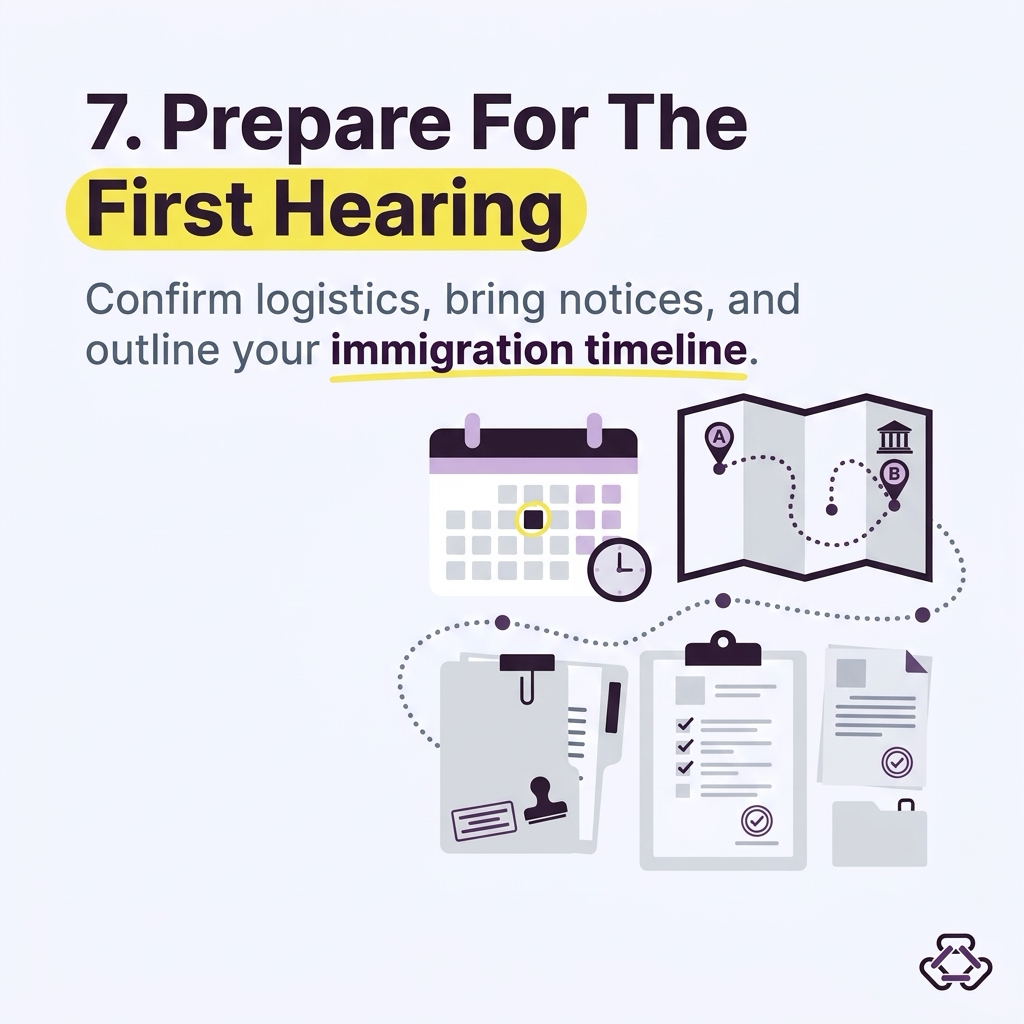
Step 6: Prepare For The First Hearing
For many people, the first hearing is a Master Calendar Hearing. That is generally a preliminary court hearing where issues such as pleadings, scheduling, legal representation, and possible forms of relief are discussed.
What preparation often looks like before that hearing:
- knowing the court location
- confirming the date and time
- bringing the NTA and later hearing notices
- preparing a timeline of immigration history
- writing down questions about allegations and charges
- gathering names and contact information for prior attorneys, if any
- identifying possible interpreters or language issues
- thinking through any pending applications with USCIS or DHS
EOIR’s Immigration Court Online Resource on legal representation explains that people in proceedings have the right to obtain legal representation at no cost to the government, and that notarios, visa consultants, and non-lawyer “immigration specialists” are not authorized to represent parties before immigration court.
That warning is especially important right after an NTA arrives, because that is often when people are under stress and vulnerable to bad guidance.
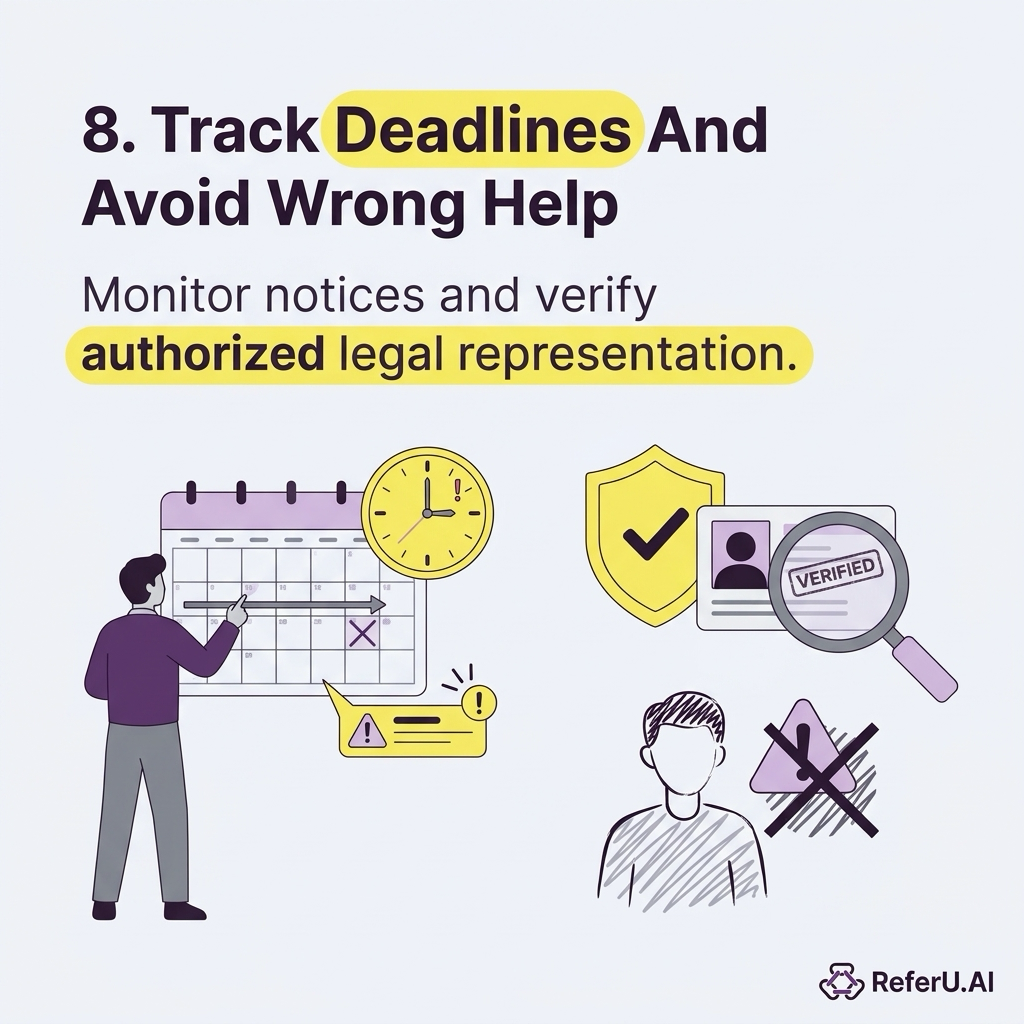
Step 7: Be Cautious About Getting Help From The Wrong Person
Immigration law has a long history of problems involving unauthorized practice.
EOIR explicitly warns that non-lawyer immigration specialists, visa consultants, and notarios are not authorized to represent parties before the immigration court or the Board of Immigration Appeals. EOIR says that directly here. It also provides information on who can represent someone before EOIR, including attorneys and certain accredited representatives working through recognized organizations.
In some cases, help may come from:
- a private immigration attorney
- a DOJ-accredited representative through a recognized nonprofit organization
- legal orientation or self-help resources offered through approved programs
EOIR’s materials on recognized organizations and accredited representatives and self-help resources can help people verify whether a legal services provider is operating within the formal system.
Step 8: Understand Why Representation Often Changes The Process
Immigration court is civil, not criminal, so the government generally does not appoint counsel for respondents who cannot afford one. EOIR states that respondents have the right to obtain representation at no cost to the government. EOIR’s legal representation page explains that framework.
Research and policy reporting have repeatedly found that representation can affect how cases are presented and resolved. For example, the American Immigration Council’s analysis of EOIR data found a significant association between legal representation and lower removal-order rates in many completed cases. Academic work on access to counsel has also documented long-term gaps in representation across immigration court proceedings. Recent scholarship on access to counsel discusses those trends in detail.
That does not make any individual outcome predictable. It does suggest that legal representation often changes the quality of issue-spotting, evidence gathering, procedural compliance, and strategic decision-making.
For people comparing lawyers, documented experience with highly similar matters can be more useful than generic marketing language. In immigration court, facts such as prior entries, criminal history, family ties, prior applications, country-conditions issues, and the exact charges on the NTA may all affect the case path.
Step 9: Gather Evidence Early, Even If Relief Is Still Unclear
Many people wait to collect documents until the court sets a filing deadline. In practice, evidence collection often becomes harder with time.
Depending on the case, early evidence gathering may include:
- proof of how long you have lived in the United States
- tax filings and employment records
- marriage and birth certificates
- medical records
- school records for children
- proof of hardship involving qualifying relatives
- police reports or certified criminal dispositions
- records of prior immigration filings
- country-condition evidence tied to fear-based claims
Even where the final legal theory is still being evaluated, collecting records early may save time later. Some documents take weeks or months to retrieve, especially from courts, schools, hospitals, or agencies.
If you want a companion piece focused more on practical case management, a separate article on keeping your immigration court paperwork and deadlines under control would fit naturally alongside this stage of preparation. Likewise, many readers also benefit from reviewing common pitfalls, such as the kinds of removal-defense errors that can make a hard case harder. And once the facts are organized, it often becomes easier to assess the different kinds of protection or relief people sometimes explore in immigration court.
Step 10: Keep Track Of Every Deadline, Notice, And Filing
Immigration court cases often involve multiple moving parts:
- hearing notices
- biometrics instructions
- filing deadlines
- service requirements
- requests for continuances
- appeal deadlines
- deadlines tied to related USCIS matters
EOIR’s case systems and forms help with logistics, but the burden of tracking the case often still falls heavily on the respondent and counsel. EOIR’s case information page, Respondent Access forms, and operational status updates are all relevant tools.
Many attorneys tell clients to keep:
- a paper calendar
- a phone calendar with alerts
- a dedicated email folder
- a physical case binder
- a log of all calls, mail, and filings
That kind of system can feel repetitive, but it often reduces risk in a process where a single missed notice can have outsized consequences.
Step 11: Know That The NTA Is The Beginning, Not The End
Receiving an NTA can feel like the government has already decided everything. In reality, the NTA is typically the start of the court process, not the final determination.
EOIR’s own description of the NTA makes this clear: it is the document laying out allegations and charges for the immigration court process. EOIR’s page also notes that the immigration judge will ask about those allegations and charges, and respondents can raise errors.
The bigger legal questions often come later:
- whether the charges are legally sufficient
- whether the facts are accurate
- whether the person is eligible for relief
- whether the person qualifies for bond, if detained and eligible
- whether a procedural motion is appropriate
- whether there are humanitarian or family-based avenues worth analyzing
- whether appellate options exist later
That is one reason many people look for counsel early, even if they are still trying to understand what kind of defense or relief may apply.
Step 12: Look For Relevant Experience, Not Generic Promises
When people search for an immigration lawyer after receiving an NTA, they often encounter broad claims that do not say much about actual fit.
A more useful framework often focuses on questions like:
- Has this lawyer handled similar removal proceedings?
- Do they have documented experience with the same type of charge or relief?
- Have they worked on cases involving similar facts, procedural posture, or court location?
- Can they explain the next court steps in plain language?
- Do they have a process for reviewing the NTA, hearing notices, prior filings, and evidence quickly?
Those questions are especially relevant now because the immigration court system remains high-volume and procedurally demanding. Public reporting, EOIR announcements, and legal-services commentary all point to a system where preparation and case-specific knowledge matter a great deal.
A Short Summary Of What To Do After An NTA Arrives
After receiving a Notice to Appear, the most useful next steps often include:
- Read the NTA carefully
- Confirm whether a hearing is already scheduled
- Update your address with immigration court if anything has changed
- Create a file with every immigration and identity document you can locate
- Start evaluating what defenses or relief may apply
- Prepare for the first hearing
- Be cautious about unauthorized representatives
- Look for legal help with demonstrable experience in highly similar matters
- Collect evidence early
- Track every notice and deadline
An NTA can be the start of a complicated process, but it is also the point where careful preparation begins to matter most. For many people, the difference between confusion and clarity comes down to whether they can quickly connect with someone who understands the exact kind of case now in front of the court.
Visit ReferU.AI to get matched with an attorney who has demonstrable experience in cases like yours — for free.
