Table of Contents
- 12 Relief Options People Explore in Immigration Court
- Why Relief Options Matter In Immigration Court
- Table Of Contents
- 1. Asylum
- 2. Withholding Of Removal
- 3. Protection Under The Convention Against Torture
- 4. Adjustment Of Status
- 5. Cancellation Of Removal For Lawful Permanent Residents
- 6. Cancellation Of Removal For Nonpermanent Residents
- 7. Special Rule Cancellation Under VAWA
- 8. Registry
- 9. Certain Waivers Of Inadmissibility Or Deportability
- 10. Temporary Protected Status In Proceedings
- 11. Prosecutorial Discretion, Administrative Closure, Or Termination
- 12. Voluntary Departure
- Why So Many Cases Involve More Than One Relief Theory
- Why Representation Can Change The Conversation
- Final Tip

Type
Great Grandchild
Status
Approved
Title (YouTube)
Images Failed (Social)
Images Failed (Social)
Do not index
Publish Date (TikTok)
Apr 24, 2027 15:15
Videos Post IDs (Social)
Hashtags (Social)
#LegalAdvice #LegalHelp #Immigration #RemovalProceedings
Caption
Caption X
Cover

OG Image

Alt Image Text
Flat vector illustration of immigration court relief options and removal proceedings, showing a person and legal advocate navigating multiple legal pathways in a courthouse setting.
Images

Videos
Publish Date (Social)
Feb 18, 2027 13:00
Scheduled (Social)
Scheduled (Social)
Images Posted (Social)
Images Posted (Social)
Videos Posted (Social)
Videos Posted (Social)
Featured
Created time
Apr 7, 2026 12:02 AM
Sub-item
Authors
CTA Practice Area (Social)
Immigration
TikTok Failed (Social)
TikTok Failed (Social)
Videos Post Links (Social)
TikTok Post Links (Social)
Images Post IDs (Social)
YT Post ID
Video Pending Manual (Social)
TikTok Posted (Social)
TikTok Posted (Social)
TikTok Post IDs (Social)
Video Cover (Social)
Images Post Links (Social)
First Comment (Social)
Videos Failed (Social)
Videos Failed (Social)
YT Embedded
Images Delete (Social)
Videos Delete (Social)
12 Relief Options People Explore in Immigration Court
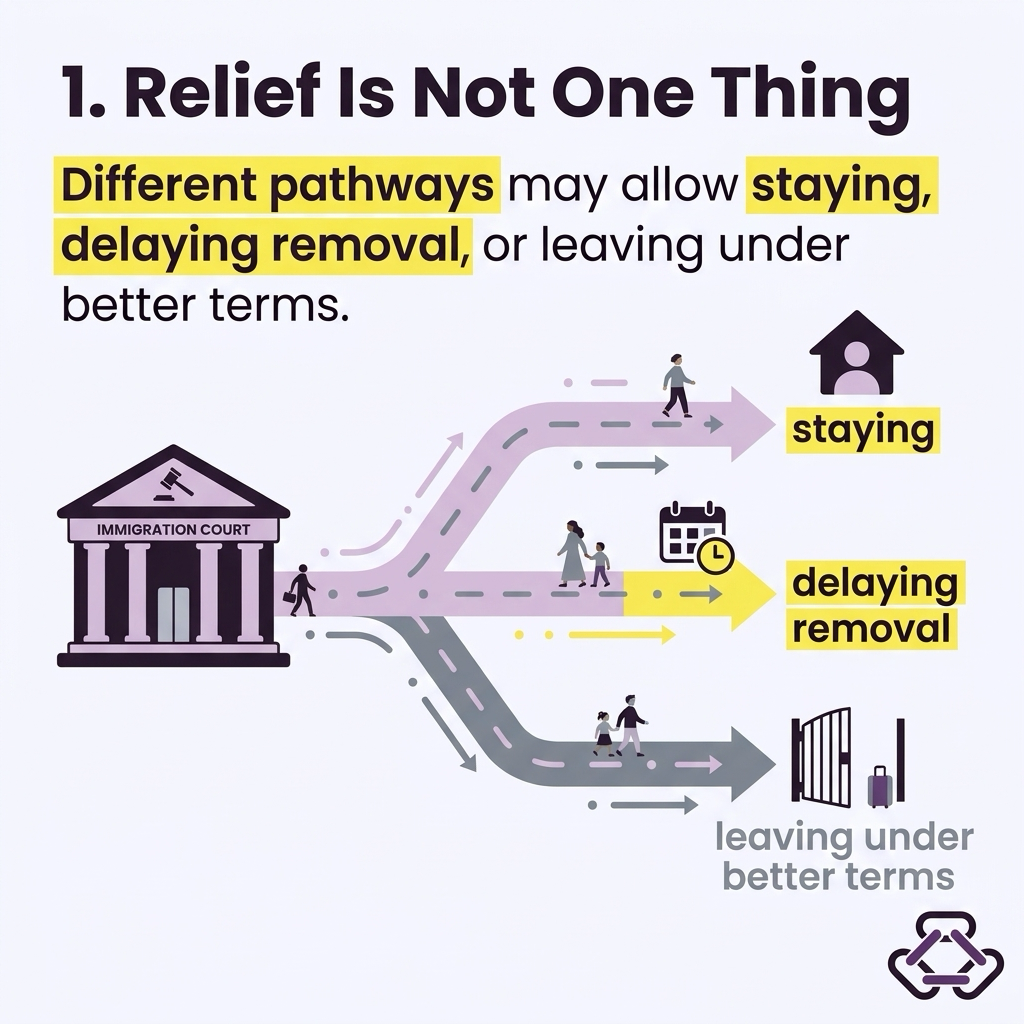
Immigration court can feel overwhelming fast. One of the biggest reasons is that “relief” is not just one thing. It’s a broad term for different legal pathways that may allow a person to stay in the United States, avoid removal for a period of time, or leave under more favorable terms than a removal order. The immigration judge can decide some forms of relief directly, while other options involve USCIS, ICE, or later appeals. The court itself notes that its online resource is only a starting point and does not cover every possible form of relief or replace legal advice from a qualified professional (EOIR).
In this post, you’ll learn about 12 relief options people commonly explore in immigration court, what each one generally involves, and why legal strategy can matter so much when more than one path may be in play at the same time. If you’re looking for a broader walkthrough of how the process fits together, this overview of what happens after removal proceedings begin can help frame where relief requests usually come into the case.
Scroll to the bottom for every post in this series.
Why Relief Options Matter In Immigration Court
In general terms, a removal case has two major parts: first, whether the government can prove removability; and second, whether the person in proceedings may qualify for a defense or form of relief. Immigration judges adjudicate a wide range of relief applications, including asylum, withholding of removal, CAT protection, cancellation of removal, adjustment of status, registry, and some waivers (EOIR Policy Manual).
That matters because the stakes are high. According to TRAC’s March 24, 2026 update, the immigration court backlog stood at 3,318,099 active cases at the end of February 2026, and about 70% of those pending cases involved people who had already filed formal asylum applications (TRAC). The same update reported that only 33.3% of immigrants had attorney representation when removal orders were issued in February 2026 (TRAC). In a system this crowded and technical, identifying the right relief theory early can shape filing deadlines, evidence gathering, witness preparation, and even whether a person asks the court to continue, terminate, or administratively close part of a case.
Table Of Contents
1. Asylum
Asylum is one of the best-known forms of protection in immigration court. It is generally based on a fear of persecution in the home country on account of race, religion, nationality, political opinion, or membership in a particular social group. USCIS explains that people who are already in removal proceedings typically pursue asylum defensively before the immigration judge rather than through the affirmative process with USCIS (USCIS Form I-589).
For many people, asylum is the first relief option discussed because it can lead to asylee status and later permanent residence if granted. EOIR groups asylum together with withholding of removal and CAT protection because these claims often arise from the same underlying fear of return (EOIR Explore Relief Options).
A few practical points often matter here:
- filing deadlines can be complicated;
- the legal theory has to match the facts closely;
- country-condition evidence often becomes central;
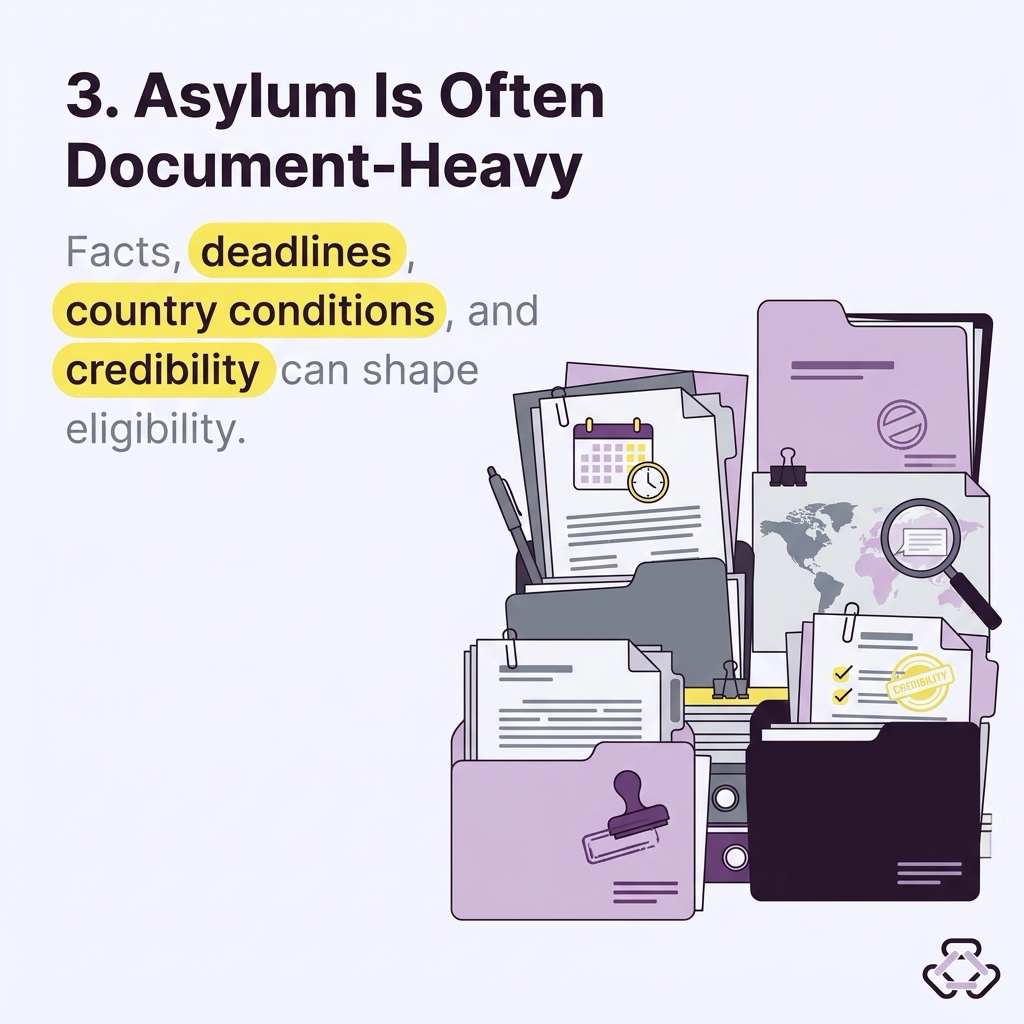
- criminal history, prior immigration history, and credibility issues can affect eligibility.
Because asylum claims are document-heavy and fact-sensitive, some people explore legal help even before the first individual hearing. That can be especially important where the same facts might support multiple forms of protection, not just asylum.
2. Withholding Of Removal
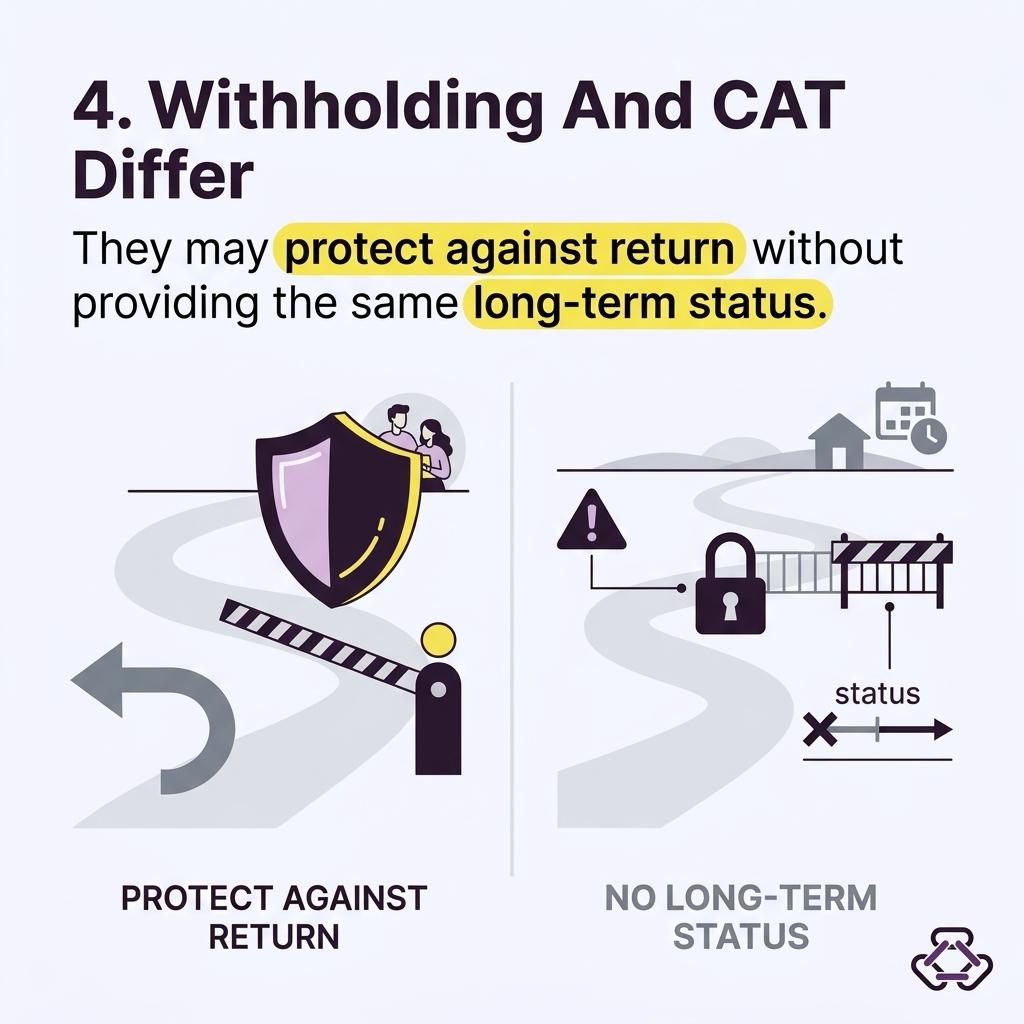
Withholding of removal is related to asylum, but it is different in important ways. It can protect a person from being removed to a country where their life or freedom would be threatened on a protected ground. Unlike asylum, though, withholding is generally considered more limited. The American Immigration Council notes that some forms of relief, including withholding of removal, can provide protection from deportation without granting permanent lawful status (American Immigration Council).
That distinction can matter a lot. A person may pursue withholding when asylum is unavailable because of timing issues or other bars, but withholding does not carry the same long-term immigration benefits. It is often better understood as protection against removal to a particular country, not a complete immigration solution.
Here’s what this often means in real life: a case may look like an “asylum case” from the outside, but the legal team may be evaluating withholding as a fallback or parallel theory from the beginning.
3. Protection Under The Convention Against Torture
Protection under the Convention Against Torture, often called CAT, is another form of humanitarian relief that can come up when a person fears severe harm upon return. EOIR specifically lists CAT alongside asylum and withholding of removal in its public relief materials (EOIR Explore Relief Options).
CAT claims focus on the risk of torture and whether it would occur with government involvement, consent, or acquiescence. In some cases, CAT becomes the central issue when the facts do not fit neatly into one of the protected-ground categories required for asylum or withholding. In others, it functions as a critical backup claim.
This is one of those areas where legal framing can change the direction of the case. The same history of abuse, detention, extortion, gang violence, or political targeting may be analyzed very differently depending on whether the court is looking at asylum, withholding, CAT, or all three.
4. Adjustment Of Status
Adjustment of status is often explored when a person in removal proceedings has an immediately available immigrant visa, such as through an approved family-based or employment-based petition, a special immigrant category, or a diversity visa case. EOIR’s relief tool explains that people with an immediately available immigrant visa may be eligible to adjust status to lawful permanent resident status in court proceedings (EOIR Explore Relief Options).
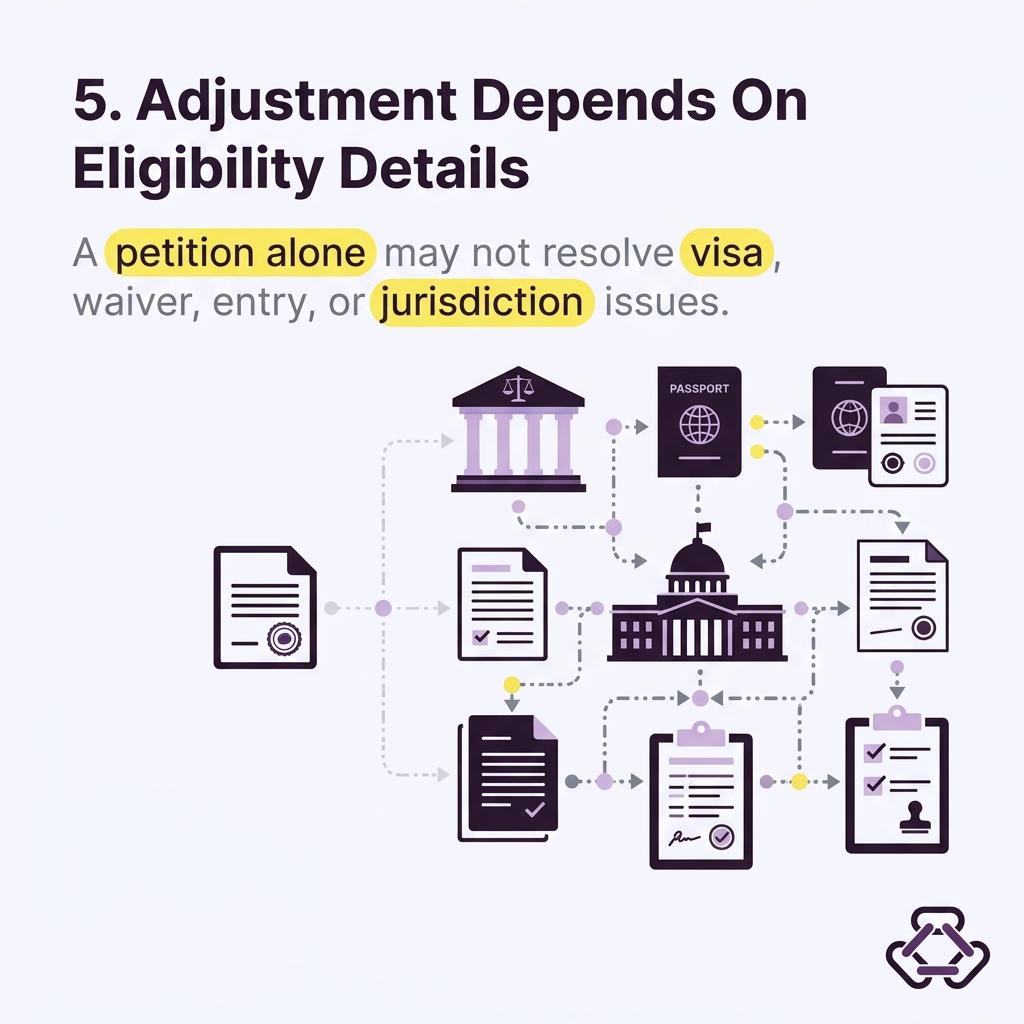
This option can be deceptively complex. The existence of an approved petition does not automatically resolve removability. Issues involving entry, inadmissibility, unlawful presence, criminal history, fraud allegations, and jurisdiction between EOIR and USCIS can all affect whether adjustment is actually available. USCIS also notes that immigration benefits in EOIR proceedings can involve coordination between the court, ICE, and USCIS after relief is granted or proceedings are terminated for USCIS adjudication (USCIS).
In practical terms, adjustment cases often turn on eligibility details that are easy to underestimate. A person may have the family relationship, but still face a waiver issue. Another may have an approved petition, but no visa currently available. Another may qualify only if the court first grants a procedural request that changes who has jurisdiction.
5. Cancellation Of Removal For Lawful Permanent Residents
Some lawful permanent residents placed in removal proceedings explore LPR cancellation of removal. EOIR lists this option for people who are already green card holders and are trying to preserve that status in court (EOIR Explore Relief Options).
This form of relief often comes up after criminal allegations or certain other grounds of removability. It is not available in every green card case, and the legal analysis can become highly technical very quickly, especially where the government argues that a conviction fits a removal ground or bars relief altogether.
The court’s public materials also emphasize how technical criminal-immigration analysis can be, including when determining whether an offense triggers immigration consequences (EOIR Explore Relief Options). For longtime permanent residents, that can make case-specific legal analysis especially valuable, because the underlying question is often not just “Was there a conviction?” but what exactly was the statute, record, sentence, and immigration consequence?
6. Cancellation Of Removal For Nonpermanent Residents
Non-LPR cancellation of removal is one of the most discussed forms of relief for people who have been in the United States for a long time but do not have lawful permanent resident status. EOIR explains that this option may be available to someone who has been continuously physically present in the United States for at least ten years (EOIR Explore Relief Options).
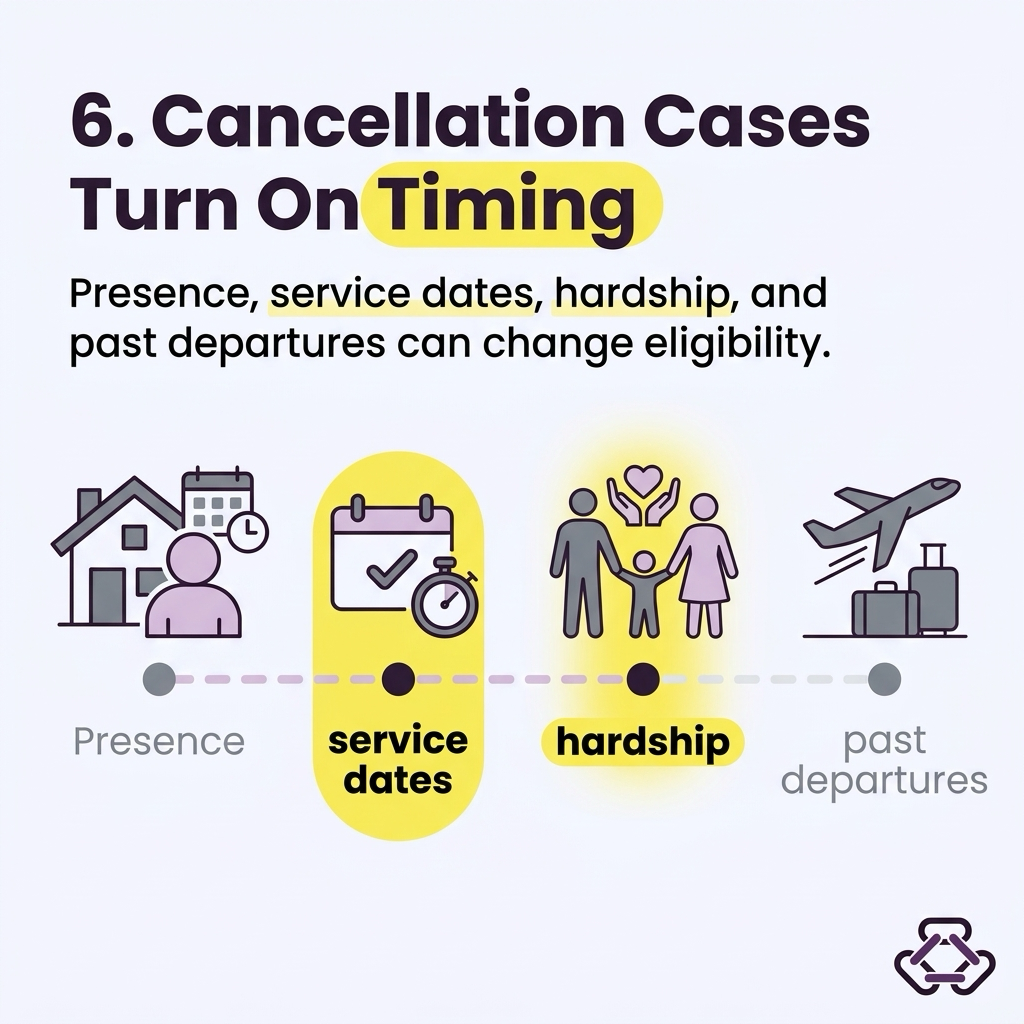
But that ten-year point is only part of the picture. EOIR’s glossary explains that continuous physical presence can be broken by certain departures and can also stop when a Notice to Appear is served or certain offenses occur (EOIR Explore Relief Options). The case may also involve good moral character, qualifying relatives, and the very demanding hardship standard of “exceptional and extremely unusual hardship” (EOIR Explore Relief Options).
This is often where people realize how important timing can be. Two families may look similar on the surface, yet one case may turn on a child’s medical condition, another on a service date on the NTA, and another on whether a past trip interrupted presence. Small factual differences can affect the entire eligibility analysis.
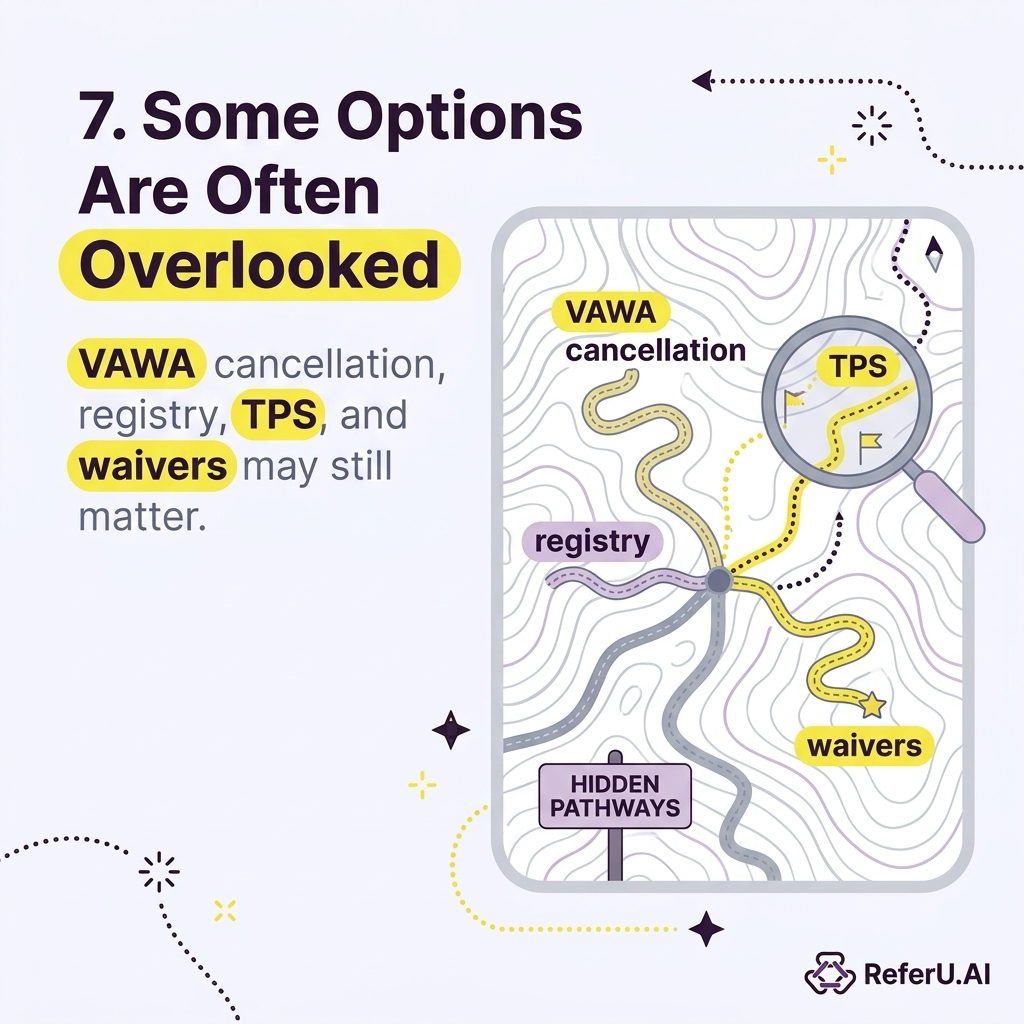
7. Special Rule Cancellation Under VAWA
Some people in proceedings may explore special rule cancellation of removal under the Violence Against Women Act framework. EOIR explains that this relief can apply to individuals who were battered or subjected to extreme cruelty by a U.S. citizen or lawful permanent resident spouse or parent, or in some cases where a child was the victim (EOIR Special Rule Cancellation).
EOIR’s current page says this form of relief generally requires proof of:
- battery or extreme cruelty by a qualifying relative,
- at least three years of continuous physical presence,
- good moral character during that period,
- no disqualifying offenses,
- extreme hardship, and
- a favorable exercise of discretion (EOIR Special Rule Cancellation).
If granted, the person’s status is adjusted to that of a lawful permanent resident (EOIR Special Rule Cancellation). For survivors, this option can be life-changing, but many people do not initially realize it exists, especially when the abuse involved coercive control, threats, psychological abuse, or immigration-related manipulation rather than only visible physical violence.
8. Registry
Registry is one of the lesser-known relief options, but it remains part of the immigration judge’s authority. EOIR’s policy manual lists registry among the applications immigration judges may adjudicate in removal proceedings (EOIR Policy Manual).
Registry is generally a pathway for certain long-term residents who meet a very specific statutory residence date and other requirements. Because Congress sets that date by statute, registry is not broadly available to most people currently entering proceedings. But for the narrower group who may qualify, it can be a significant option.
This is a good example of why individualized screening matters. Registry often does not come up in casual online discussions, yet in the right fact pattern it may become one of the most relevant forms of relief on the table.
9. Certain Waivers Of Inadmissibility Or Deportability
Immigration court cases often involve waivers, even when the “main” relief is something else like adjustment of status or cancellation. EOIR’s policy manual notes that immigration judges can adjudicate certain waivers as part of relief proceedings (EOIR Policy Manual).
A waiver is not usually the whole case by itself. Instead, it often functions as the legal bridge that allows another benefit to move forward despite an inadmissibility or deportability issue. Depending on the statute involved, the waiver may require proof of hardship, rehabilitation, equities, or a particular family relationship.
From a strategy perspective, waiver issues are often where cases become more document-intensive than people expect. The question is not just whether a person qualifies for the main relief. It may also be whether a separate legal obstacle can be waived, and if so, under what standard and with what evidence.
10. Temporary Protected Status In Proceedings
Temporary Protected Status, or TPS, is not always thought of as an immigration-court relief option, but it can become relevant in proceedings. USCIS states that if a TPS application is denied and the person is in removal proceedings, the individual may request immigration judge review of the TPS application in that setting (USCIS TPS).
TPS is country-specific and changes over time depending on DHS designations and litigation, so eligibility can be especially date-sensitive. That temporal instability is one reason many people benefit from getting current legal information rather than relying on old online articles or social media posts. Recent federal notices and litigation have also made TPS rules and country designations a moving target in some categories (EOIR Federal Register Notices 2026).
For some respondents, TPS is not the final answer, but it may affect removability, work authorization, timing, or a broader defense strategy.
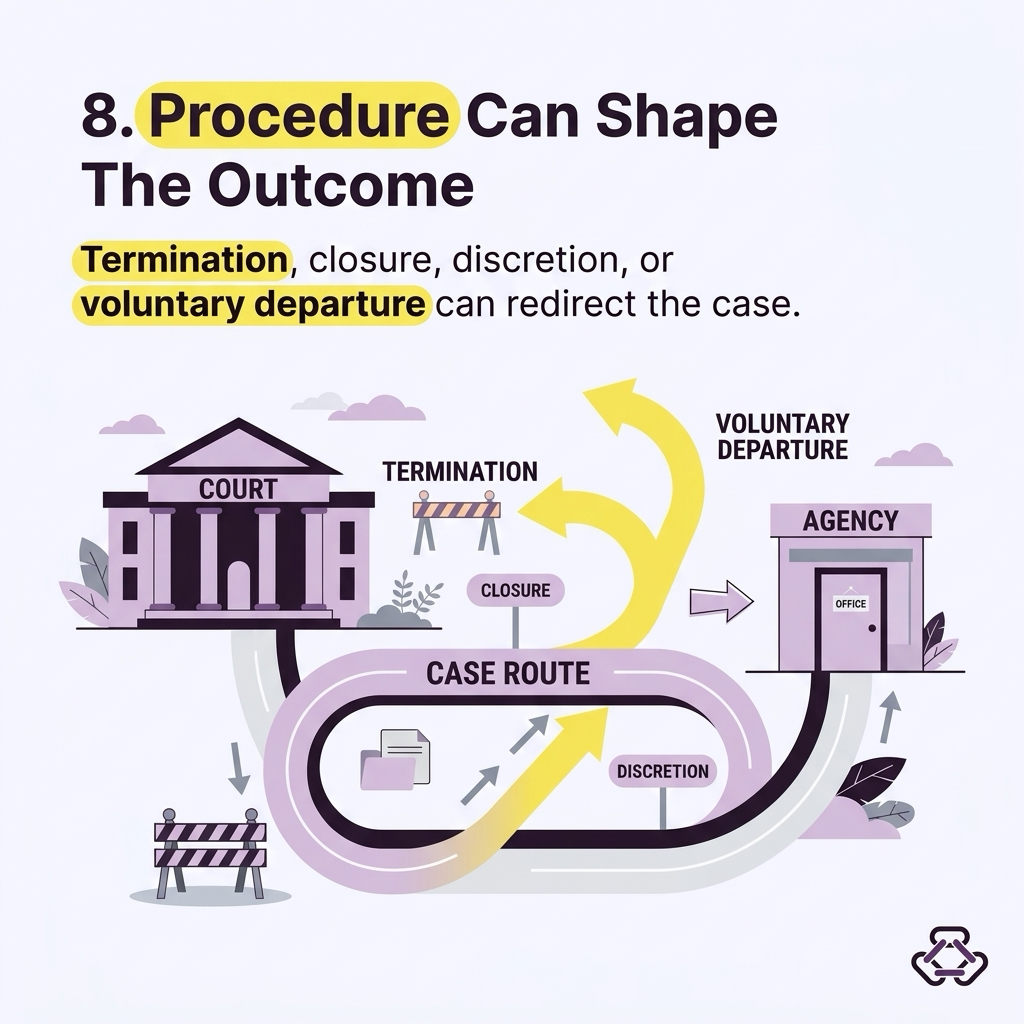
11. Prosecutorial Discretion, Administrative Closure, Or Termination
Not every favorable outcome in immigration court comes from winning a full individual hearing on the merits. Sometimes people explore prosecutorial discretion, administrative closure, or termination depending on the posture of the case and the relief being pursued elsewhere. USCIS acknowledges situations in which EOIR terminates removal proceedings so that USCIS can adjudicate an adjustment application (USCIS).
These procedural outcomes are not identical, and they do not erase underlying immigration issues automatically. Still, they can be central in the right case. A family-based adjustment matter, a pending humanitarian application, or an evidentiary issue in the charging document may all lead counsel to explore whether the case belongs in front of the judge at all, or whether another agency has primary jurisdiction.
This category is easy to overlook because it sounds procedural rather than substantive. In practice, though, procedure often decides whether someone gets a meaningful chance to pursue relief in the right forum.
12. Voluntary Departure
Voluntary departure is often discussed last, but it remains an important option in some cases. EOIR explains that voluntary departure allows a person to leave the United States voluntarily so they may later apply for admission from abroad, rather than leaving under a formal removal order (EOIR Explore Relief Options).
That does not make it a simple or casual choice. The timing, eligibility requirements, penalties for failing to depart, appeal consequences, and effect on future immigration options can all be significant. The American Immigration Council notes that if a judge grants voluntary departure at the end of proceedings, the person still has appeal rights, and a removal order does not become final until the appeal period runs or the Board acts (American Immigration Council).
For some people, voluntary departure is explored as a fallback when stronger relief is unavailable. For others, it may be part of a longer-term immigration plan involving consular processing later. The key point is that it is still a legal decision with lasting consequences, not just a travel arrangement.
Why So Many Cases Involve More Than One Relief Theory
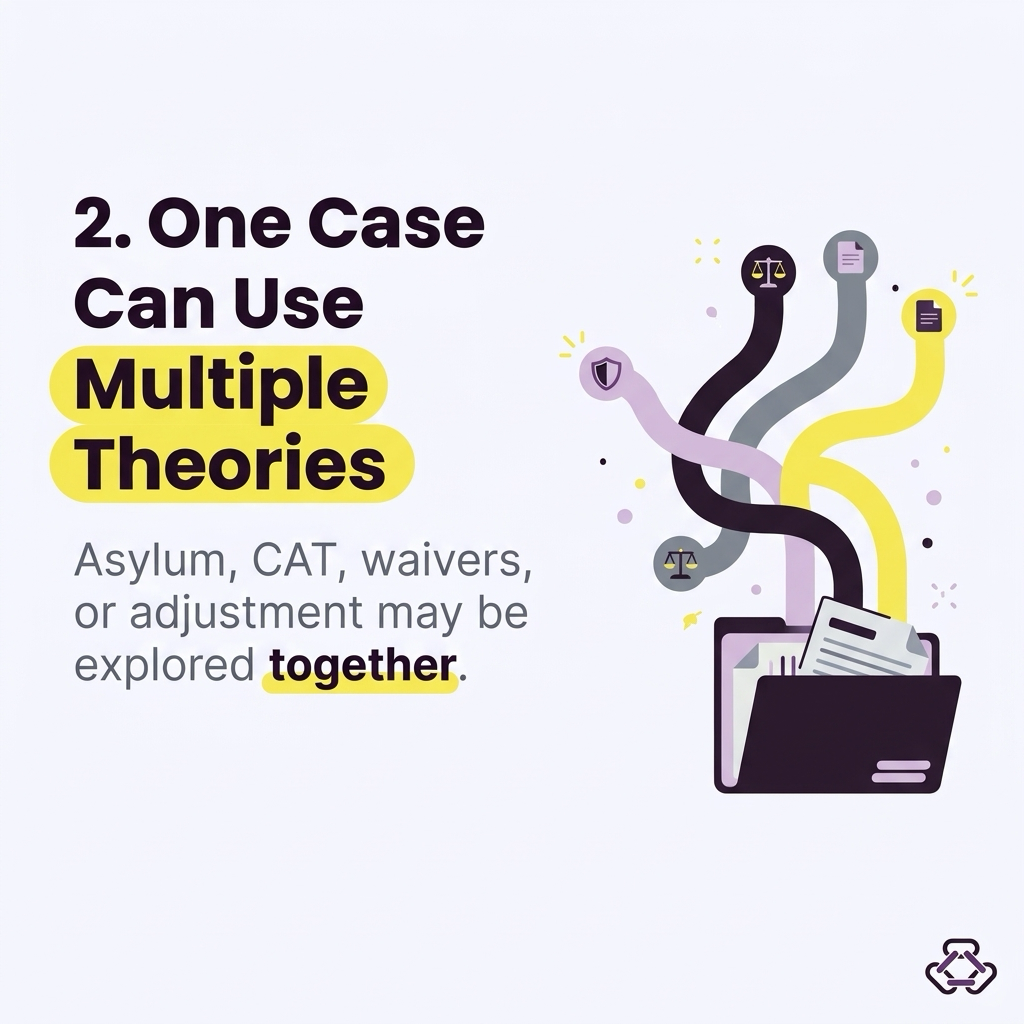
One of the most important things to understand about immigration court is that many cases are not “an asylum case” or “an adjustment case” in a neat, single-track sense. A person may pursue asylum, withholding, and CAT together. Another may seek adjustment plus a waiver. Another may be evaluating cancellation while also asking DHS to exercise discretion. Another may qualify for a procedural path that moves part of the case back to USCIS.
That’s part of why immigration court can feel confusing. Even the government’s own public resource says it does not provide the universe of relief that may be available (EOIR). The legal answer often depends on:
- how the person entered the U.S.;
- whether there is a qualifying family relationship;
- whether a visa is immediately available;
- whether there are criminal or fraud allegations;
- what deadlines have passed;
- what happened before USCIS or at the border;
- and what evidence can actually be presented credibly and on time.
Why Representation Can Change The Conversation
Relief from removal is rarely just about filling out the right form. It often involves statutory interpretation, burdens of proof, corroborating evidence, witness preparation, procedural motions, and a realistic comparison of all available options. In the current court environment, that matters even more. TRAC reported that through February 2026, immigration judges ordered deportation in 79.6% of completed cases, while relief was granted in only a small fraction of cases completed that month (TRAC).
That statistic does not tell you what will happen in any individual case. It does suggest that immigration court is not an environment where most people feel comfortable improvising. Some people are trying to preserve lawful status they already have. Others are presenting trauma-based claims, hardship evidence, or technical arguments about convictions, admissions, or jurisdiction. Those are very different problems, and the right attorney fit often depends on the specific type of relief being explored.
Final Tip
If immigration court is already underway, one practical question often matters more than people expect: Which relief options are actually realistic in this specific fact pattern, and which ones are just theoretical? That kind of screening can affect the entire roadmap of a case — from filing strategy to evidence collection to hearing preparation.
Immigration relief is rarely one-size-fits-all. Some options offer permanent status. Some offer limited protection. Some depend on family petitions, some on years of residence, and some on fear-based evidence tied to current country conditions. The closer the attorney’s documented experience is to the actual relief being pursued, the easier it can be to evaluate fit on objective criteria rather than guesswork.
Visit ReferU.AI to get matched with an attorney who has demonstrable experience in cases like yours — for free.
