Table of Contents
- 7 Work Visa Mistakes That Put Status and Employment at Risk
- Why Small Work Visa Errors Can Become Big Problems
- 1. Confusing Visa Expiration With Status Expiration
- 2. Keeping Working After a Layoff or Termination Without Confirming Authorization
- 3. Changing Employers or Roles Without Checking Whether a New Filing Is Required
- 4. Assuming Remote Work Automatically Fits the Original Filing
- 5. Failing To Report an Address Change or Keep Records Current
- 6. Thinking A Pending Green Card Case Automatically Protects Work Authorization or Status
- 7. Relying On Informal Advice Instead of Case-Specific Legal Review
- What To Watch Closely If Your Work Visa Situation Changes
- Final Thoughts

Type
Great Grandchild
Status
Approved
Title (YouTube)
Images Failed (Social)
Images Failed (Social)
Do not index
Publish Date (TikTok)
Apr 26, 2027 12:15
Videos Post IDs (Social)
Hashtags (Social)
#LegalAdvice #LegalHelp #Immigration #WorkVisas
Caption
Caption X
Cover

OG Image

Alt Image Text
Flat vector illustration of work visa mistakes and status risk, showing a professional reviewing visa and I-94 documents with travel, employment, and timing warning symbols.
Images

Videos
Publish Date (Social)
Feb 19, 2027 13:00
Scheduled (Social)
Scheduled (Social)
Images Posted (Social)
Images Posted (Social)
Videos Posted (Social)
Videos Posted (Social)
Featured
Created time
Apr 7, 2026 12:01 AM
Sub-item
Authors
CTA Practice Area (Social)
Immigration
TikTok Failed (Social)
TikTok Failed (Social)
Videos Post Links (Social)
TikTok Post Links (Social)
Images Post IDs (Social)
YT Post ID
Video Pending Manual (Social)
TikTok Posted (Social)
TikTok Posted (Social)
TikTok Post IDs (Social)
Video Cover (Social)
Images Post Links (Social)
First Comment (Social)
Videos Failed (Social)
Videos Failed (Social)
YT Embedded
Images Delete (Social)
Videos Delete (Social)
Carousel Video URL (Social)
7 Work Visa Mistakes That Put Status and Employment at Risk
For many foreign professionals, a work visa is tied to more than a job title. It can affect housing, travel, family plans, and long-term immigration strategy. The difficult part is that status problems do not always start with dramatic events. In many cases, they begin with small misunderstandings about timing, paperwork, travel, or a job change.
In this post, you’ll learn about seven common work visa mistakes that can place both status and employment at risk, especially in employer-sponsored cases such as H-1B matters. If you want a broader overview first, this guide on how employer sponsorship and visa timing usually work can help frame the bigger picture.
Scroll to the bottom for every post in this series.
Why Small Work Visa Errors Can Become Big Problems
Employment-based immigration in the United States is heavily document-driven. A worker may still have a valid visa stamp in their passport, but their authorized stay is often governed by the I-94 record issued by Customs and Border Protection, not the visa foil itself. The U.S. Department of State explains that the I-94 “admitted until” date is the official record of how long a nonimmigrant may remain in the country, and CBP makes I-94 records available online for travelers who need to verify their status history and admit-until date (State Department, CBP).
That distinction alone causes a surprising amount of confusion. Add in layoffs, remote work, amended petitions, address changes, portability rules, and travel timing, and it becomes easier to see why seemingly routine decisions can create immigration exposure.
Below are seven mistakes that come up often.
1. Confusing Visa Expiration With Status Expiration
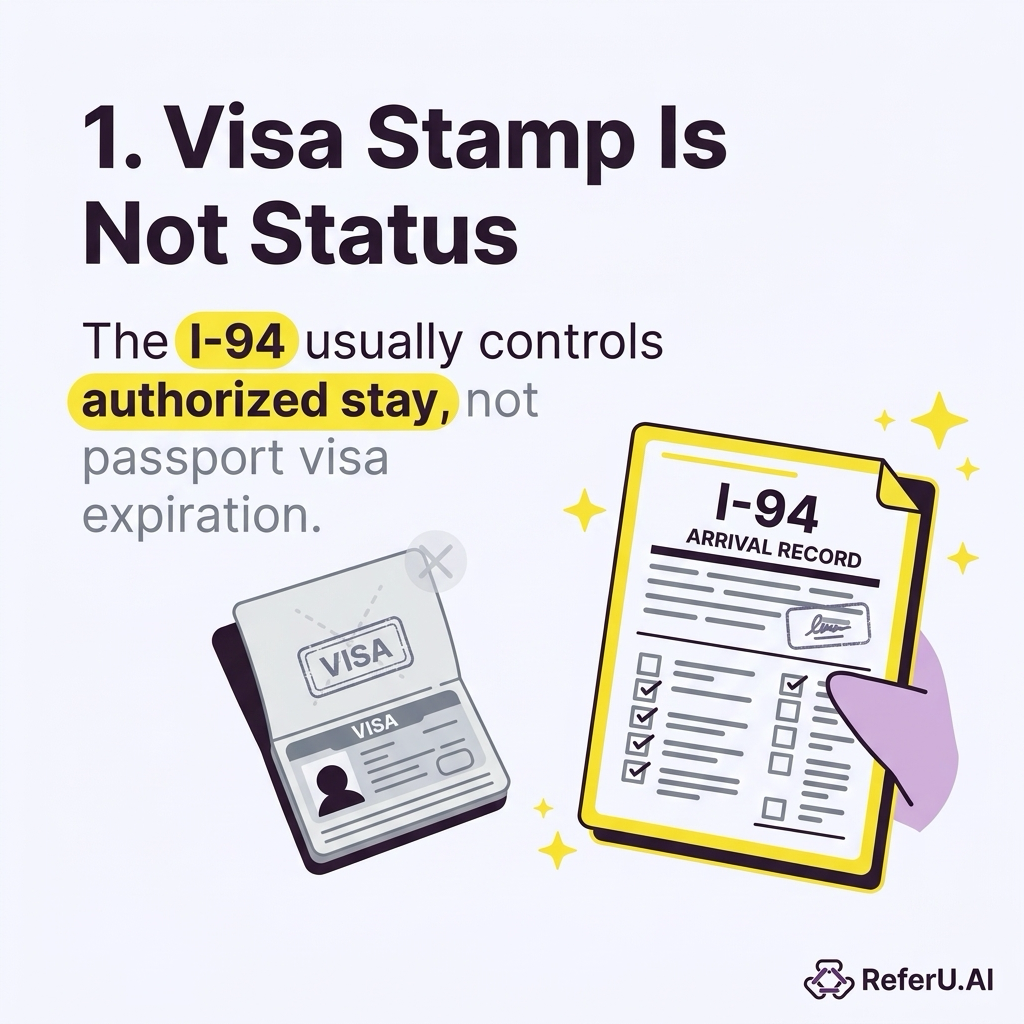
One of the most common mistakes is assuming that a visa stamp in the passport controls how long someone can stay and work in the United States. In general terms, it does not. The visa is primarily an entry document. Once admitted, the key record is usually the I-94, including the class of admission and admit-until date or “D/S” notation, depending on the category. The State Department states this directly: the I-94, not the visa expiration date, determines the authorized period of stay (State Department).
This misunderstanding can surface in several ways:
- a passport visa stamp remains valid, but the I-94 expires earlier
- a petition approval notice shows one end date, but CBP admitted the worker only until passport expiration
- a worker believes they are “fine” because the visa sticker has time left, while their actual period of admission is shorter
Here’s what this often means: a person can be in status trouble even with a still-valid visa stamp, and a person can also remain lawfully present in the U.S. with an expired visa stamp if the I-94 and underlying status remain valid.
Some people in similar situations periodically check the CBP I-94 system after every international entry and compare it with their approval notice and passport validity. An attorney may help determine whether a shortened I-94, data mismatch, or entry issue calls for corrective action.
2. Keeping Working After a Layoff or Termination Without Confirming Authorization
Another major risk point is job loss. Many workers have heard of the “60-day grace period” and assume it works like a built-in work authorization extension. That is not how USCIS describes it.
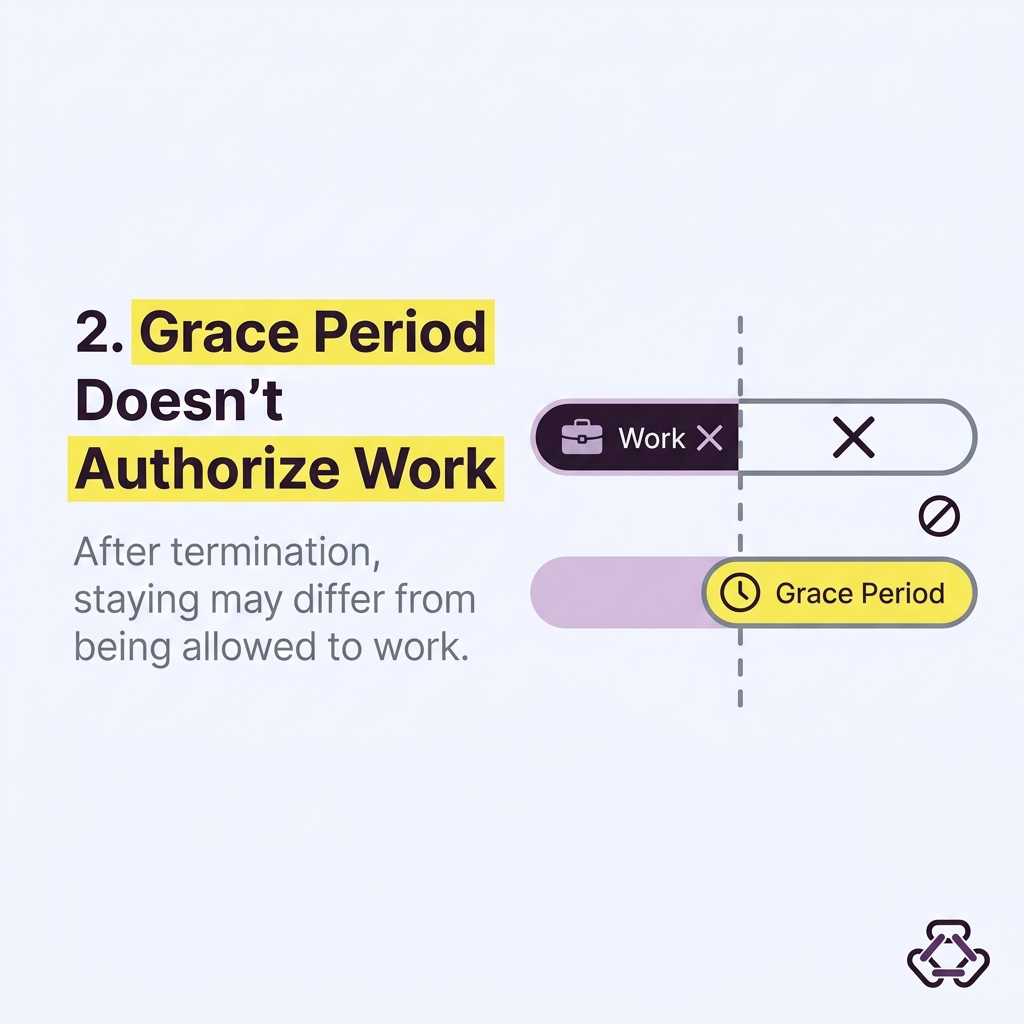
USCIS explains that certain employment-based nonimmigrants, including H-1B workers, may receive a discretionary grace period of up to 60 consecutive days following termination, or until the end of the authorized validity period, whichever is shorter. But USCIS also states that employment is prohibited during that grace period unless separately authorized (USCIS).
That matters because many workers understandably focus on staying in the country and overlook the separate employment question. The grace period may provide time to pursue options such as:
- a change of employer petition
- a change of status
- adjustment-related options, where available
- departure planning
USCIS also notes that an eligible H-1B worker may begin working for a new employer once that employer properly files a non-frivolous H-1B petition, if portability requirements are met (USCIS, USCIS).
The practical problem is timing. The grace period is not always a simple 60-day buffer, and it can end sooner if the underlying validity period ends first. USCIS also says the grace period is generally available once during each authorized petition validity period (USCIS).
For people navigating layoffs or a fast employer transition, the legal and employment timelines often move at different speeds. That is one reason many workers look for counsel quickly when sponsorship changes unexpectedly.
3. Changing Employers or Roles Without Checking Whether a New Filing Is Required
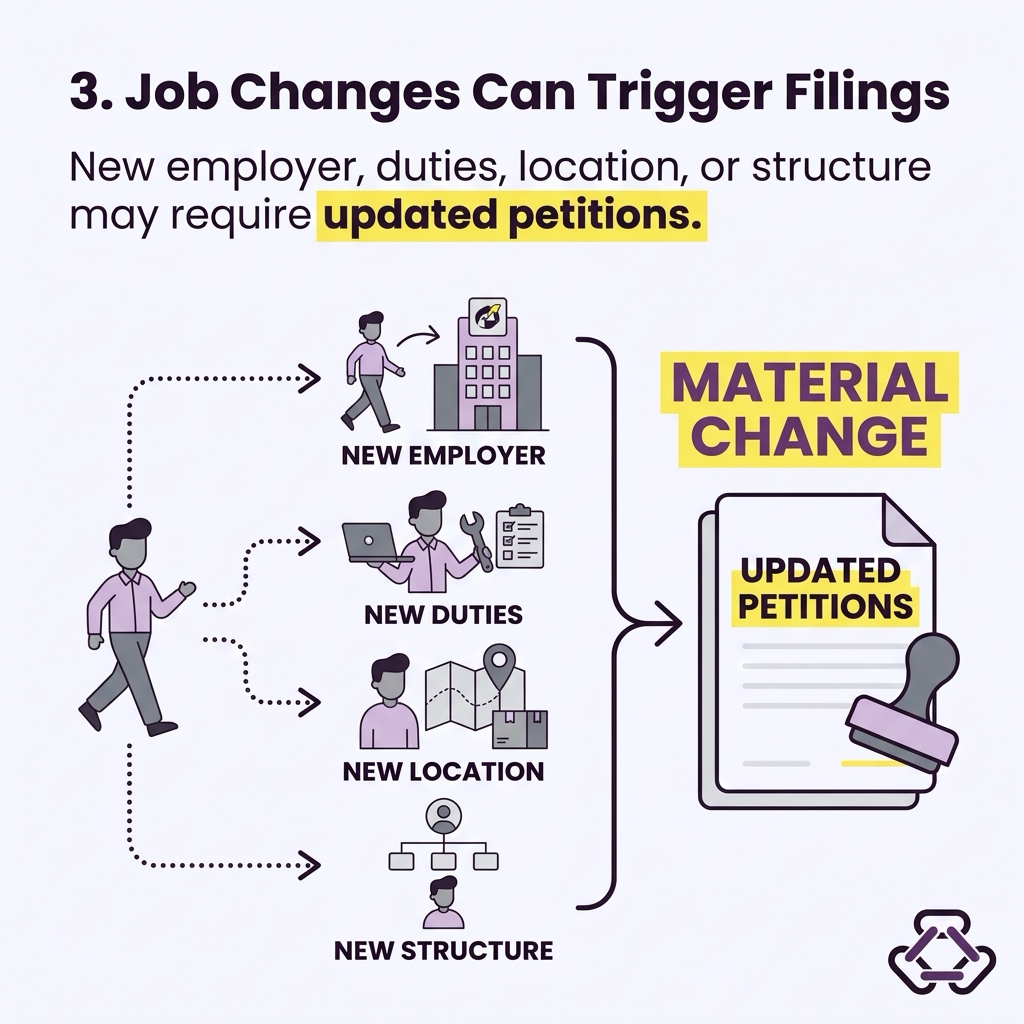
A new employer, new location, promotion, major duty change, or restructuring can create immigration consequences even when the worker remains in the same general field. In H-1B cases especially, the question often turns on whether there has been a material change in the terms and conditions of employment.
USCIS guidance tied to Matter of Simeio Solutions explains that when there is a material change, the petitioner generally files an amended or new H-1B petition with the corresponding Labor Condition Application. USCIS also explains that a worksite move outside the same metropolitan statistical area or “area of intended employment” can trigger new LCA and amended petition issues, while a move within the same area may be treated differently (USCIS, USCIS PDF).
This comes up frequently with:
- remote or hybrid work arrangements
- relocation to a different city or state
- client-site changes for consulting roles
- significant changes in job duties or compensation structure
- acquisitions, mergers, or corporate reorganizations
The Department of Labor also requires LCAs for H-1B, H-1B1, and E-3 cases and explains that the employer attests to wage and working-condition obligations through that filing process (DOL FLAG).
A common misconception is that if payroll stays the same, nothing immigration-related changes. In reality, a role can look “the same” internally while appearing materially different for visa compliance purposes. If you are looking deeper into mobility issues, it may help to read more about switching employers without creating status problems alongside case-specific legal guidance, because the facts often matter a great deal.
4. Assuming Remote Work Automatically Fits the Original Filing
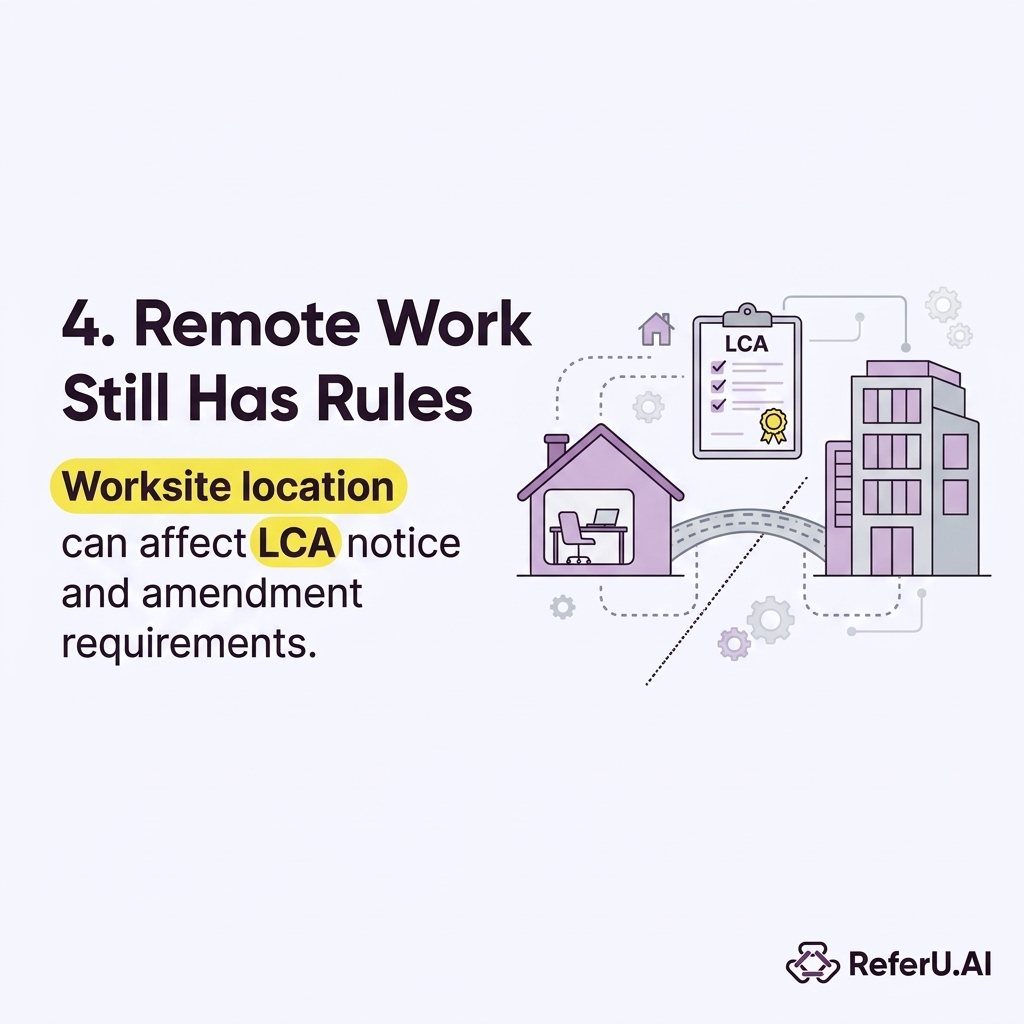
Remote work changed the way many employers operate, but it did not erase immigration filing requirements. In H-1B matters, the worksite listed in the Labor Condition Application still matters because wage obligations and notice requirements are tied to the area of intended employment.
The Department of Labor explains that H-1B employers have notice obligations connected to the LCA, and it addresses what happens when a worker is placed at a worksite not originally contemplated when the LCA was filed (DOL Fact Sheet 62M). USCIS’s amended-petition guidance likewise focuses on whether a location change is material and whether a new LCA is required (USCIS).
That may affect workers whose situation looks harmless on the surface, such as:
- moving temporarily to another state to be near family
- working from a home office far from the original jobsite
- rotating between employer offices and client locations
- converting a fully in-office role into a remote-first role
Some remote arrangements can be compliant. Others may call for updated notices, a new LCA, or an amended petition. The answer often depends on geography, duration, and how the employer documented the arrangement.
This is one of those areas where “everyone at the company is doing it” is not always a reliable immigration rule.
5. Failing To Report an Address Change or Keep Records Current
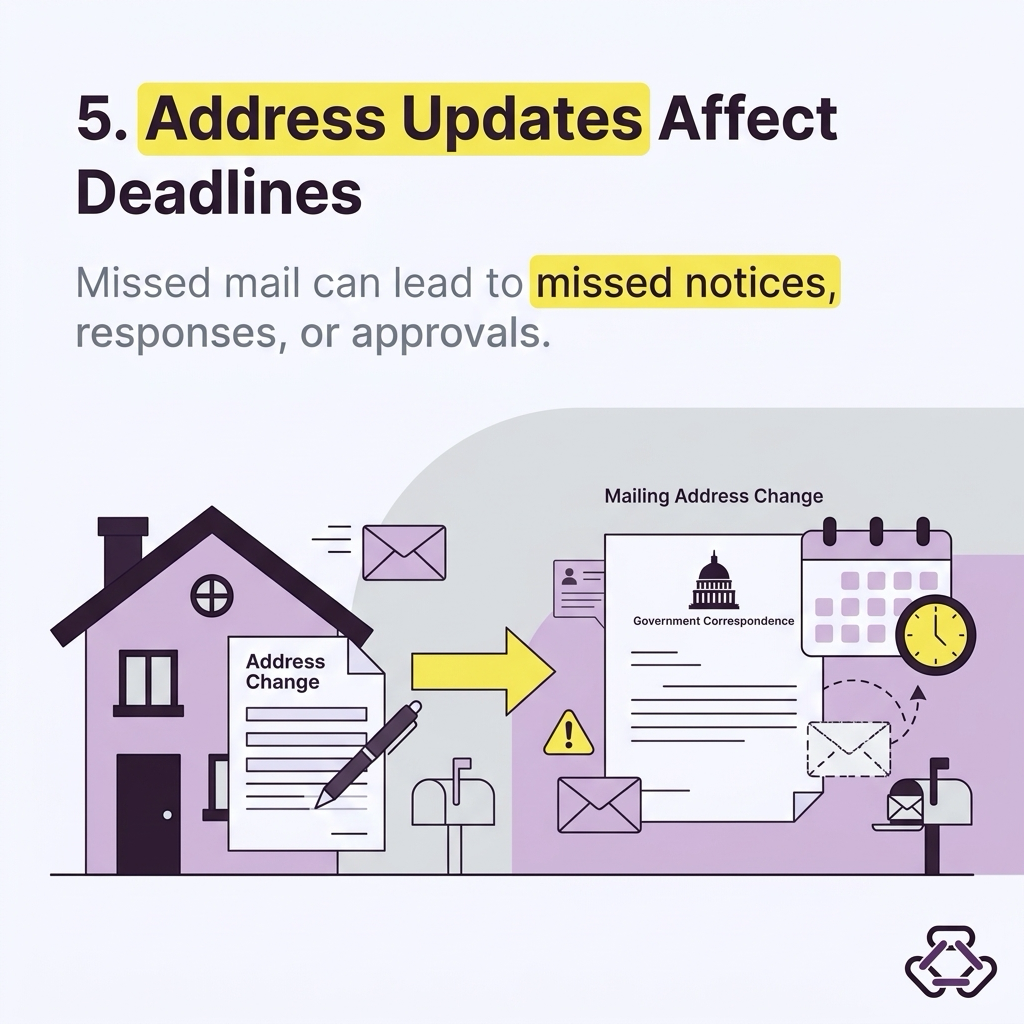
Change-of-address issues can seem minor, but they often become serious when a receipt notice, biometrics notice, request for evidence, approval notice, or other government correspondence never reaches the intended recipient.
USCIS states that most non-U.S. citizens who are required to register must report a change of address within 10 days of moving, and it directs individuals to the AR-11 process or online account tools for that purpose (USCIS AR-11, USCIS PDF Form AR-11).
Problems in this area commonly involve:
- moving apartments and forgetting to update USCIS
- assuming mail forwarding through the postal service is enough
- believing an employer’s immigration counsel has automatically updated every pending matter
- overlooking separate updates needed for dependent family members or related agencies
In general terms, status problems are often made worse by missed deadlines. A late response to a government notice can create a separate complication on top of the original issue. Some people also discover too late that an address was updated in one place but not across all pending filings.
For workers managing sponsorship logistics, this is another reminder that immigration compliance is partly about substance and partly about administrative accuracy.
6. Thinking A Pending Green Card Case Automatically Protects Work Authorization or Status
Employment-based workers sometimes assume that once a green card process reaches a certain stage, temporary visa compliance becomes less important. USCIS has explicitly warned against part of that assumption.
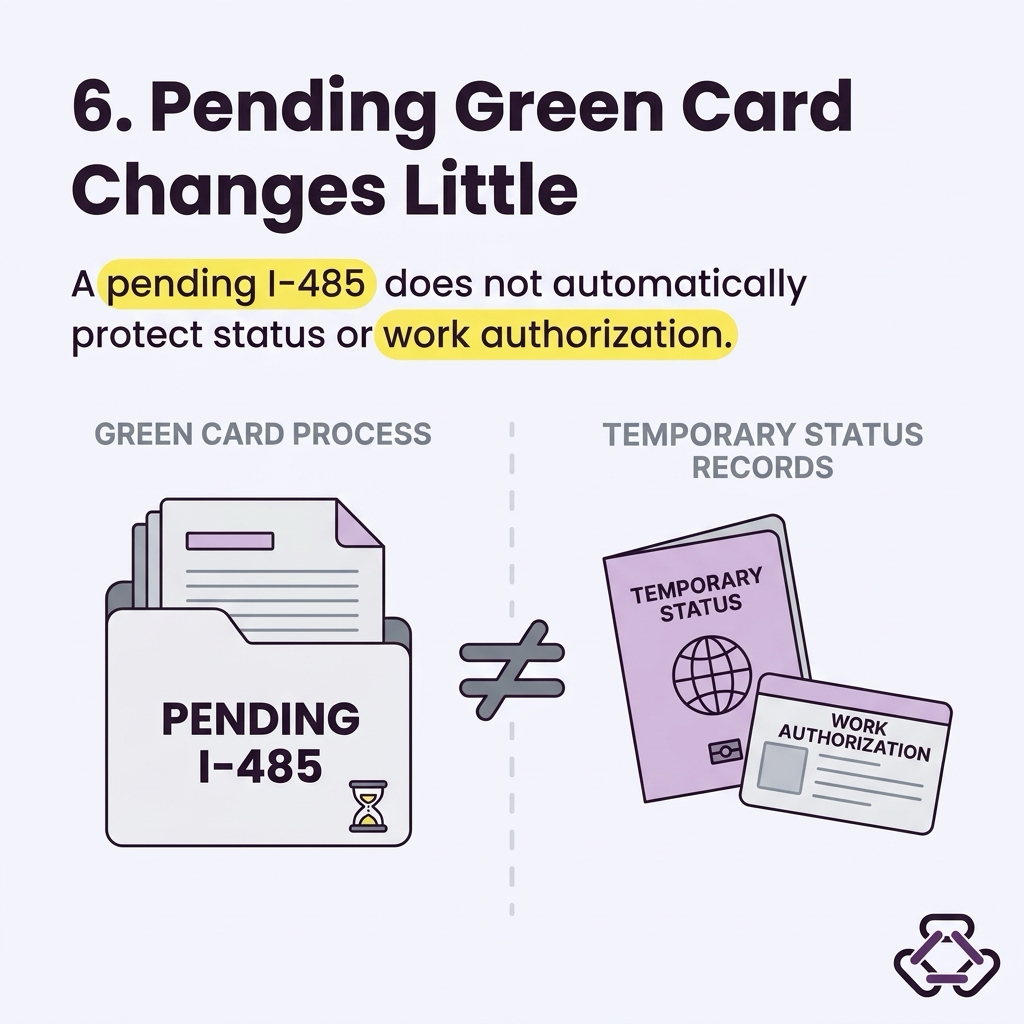
In its H-1B FAQs, USCIS says that a pending adjustment of status application does not provide lawful status or cure a violation of nonimmigrant visa status. USCIS also states that a pending Form I-485 does not automatically confer employment authorization and does not, by itself, serve as a basis for readmission after travel (USCIS).
That distinction matters in several situations:
- the worker assumes the I-485 filing made H-1B compliance irrelevant
- the worker starts a new job before receiving an EAD or before using a valid portability path
- the worker travels assuming the pending adjustment case is enough for reentry
- the worker overlooks the separate question of maintaining nonimmigrant status while the green card case is pending
For some people, maintaining H-1B or another valid nonimmigrant status while the immigrant case proceeds can create flexibility. For others, the strategy may differ based on travel plans, dependents, backlogs, or employer changes. An attorney might help map those options against the actual filing history instead of general internet advice.
7. Relying On Informal Advice Instead of Case-Specific Legal Review
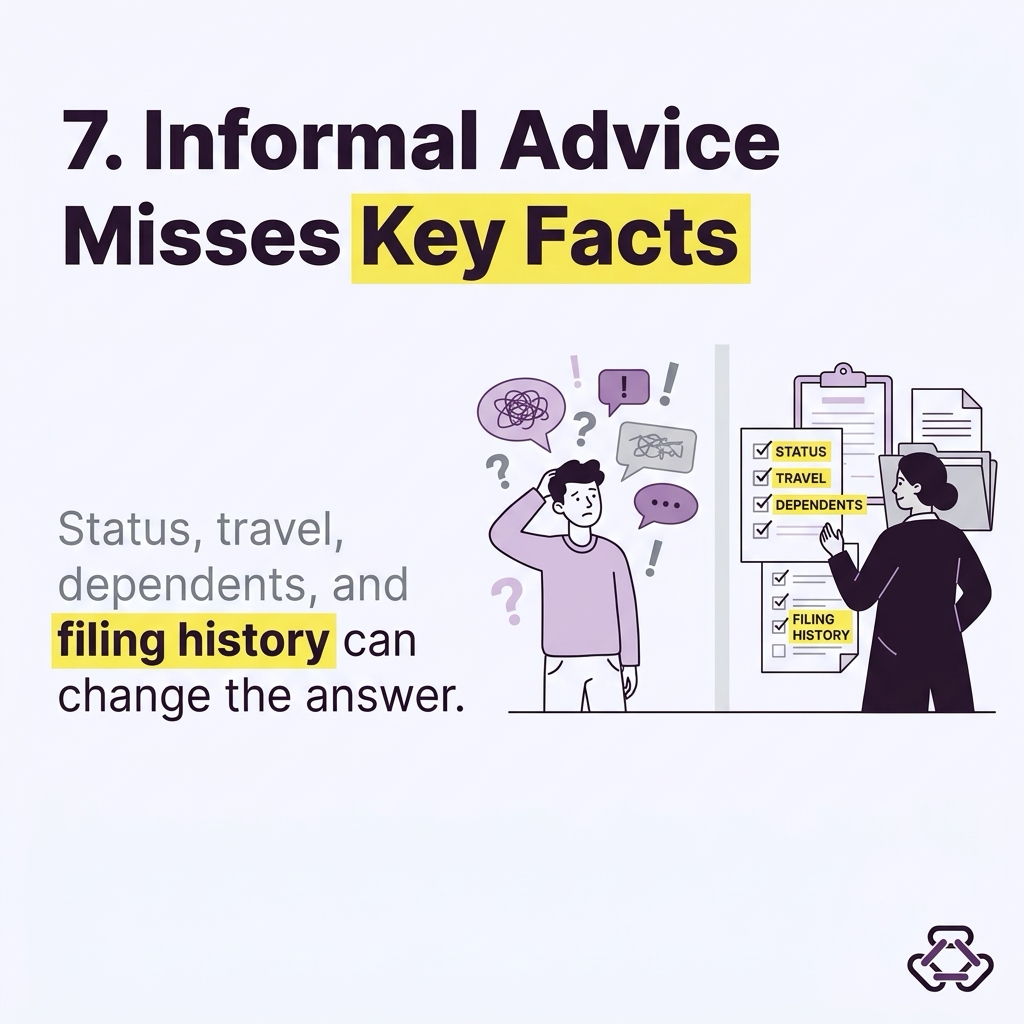
A final and very common mistake is treating Reddit threads, office rumors, social media clips, or generalized HR comments as a substitute for legal analysis. Immigration law contains broad rules, but outcomes often turn on narrow facts:
- whether the person is in H-1B, L-1, O-1, TN, E, or F-1 status
- whether the issue involves extension, amendment, portability, transfer, or reinstatement
- whether the person traveled recently and what CBP issued on entry
- whether a dependent spouse or child is affected
- whether a layoff happened before or after another filing
- whether the employer’s corporate structure changed
- whether the person has a pending or approved I-140 or I-485
Even among H-1B workers, one person may be able to start with a new employer upon proper filing under portability rules, while another may not qualify for the same timing depending on status history and petition posture (USCIS, DOL Fact Sheet 62W).
That is also why general planning articles can help, but they do not replace legal review. If you are comparing options, it may also help to read about how employer-sponsored cases are usually prepared and the practical questions foreign professionals often ask before changing jobs, filing, or traveling.
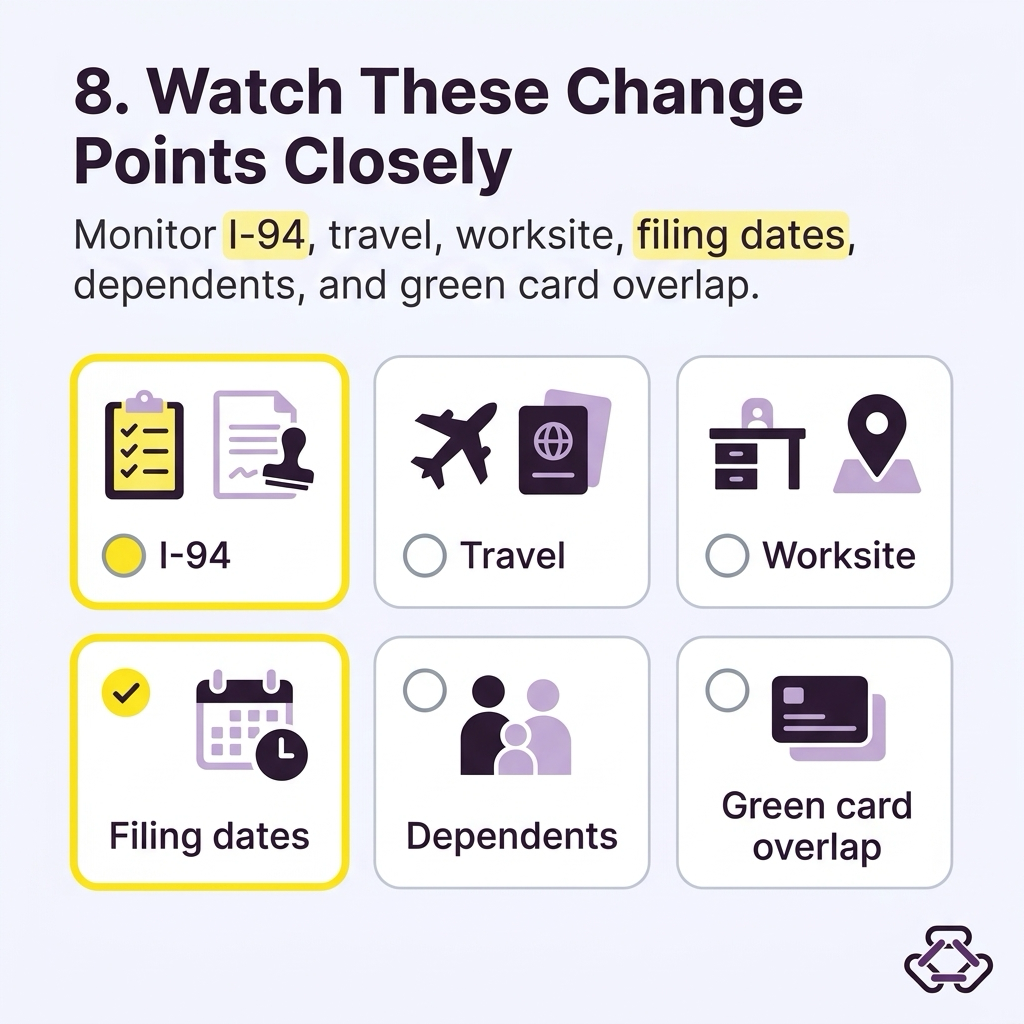
What To Watch Closely If Your Work Visa Situation Changes
When employment conditions change, the most sensitive areas usually involve:
- I-94 timing
- termination date versus last payroll date
- whether work is still authorized
- new employer filing dates
- worksite location
- LCA coverage
- travel plans
- address updates
- dependent status
- overlap with any green card filings
USCIS also implemented an H-1B final rule and revised Form I-129 effective January 17, 2025, which is another reminder that employment-based immigration rules and filing mechanics can change over time (USCIS). In other words, older advice from a friend or even an older blog post may not line up with the current filing environment.
Final Thoughts
Work visa problems are often less about one dramatic mistake and more about a chain of smaller assumptions: confusing the visa stamp with the I-94, treating the grace period like unrestricted work authorization, moving worksites without checking amendment rules, overlooking address updates, or assuming a pending green card case solves everything.
For many professionals, the real challenge is not finding information online. It is figuring out which information applies to their exact facts. That is where documented, case-specific legal experience can matter most.
Visit ReferU.AI to get matched with an attorney who has demonstrable experience in cases like yours — for free.
