Table of Contents
- Work Visas: A Beginner’s Guide to Employer Sponsorship and Common Options
- What Does Employer Sponsorship Mean?
- Why Employer Sponsorship Matters So Much
- Which Work Visas Commonly Involve Employer Sponsorship?
- What Is The H-1B Visa?
- The Employer Usually Starts The Process
- Not Every Professional Job Qualifies
- Timing Can Be A Big Issue
- Some Employers Are Cap-Exempt
- What Is The L-1 Visa?
- What Is The O-1 Visa?
- What Is The TN Visa?
- What Is The E-3 Visa?
- What Is The H-2B Visa?
- Is A Work Visa The Same Thing As A Green Card Sponsorship Case?
- How Does Employer Sponsorship Usually Work?
- 1. The Employer Identifies A Role
- 2. The Visa Category Is Evaluated
- 3. Supporting Documents Are Collected
- 4. Required Labor Filings Or Agency Steps Are Completed
- 5. The Employer Files With USCIS Or The Worker Applies Through A Consular Process
- 6. The Worker Starts Or Continues Employment Under The Approved Terms
- What Documents Do Employers Usually Ask For?
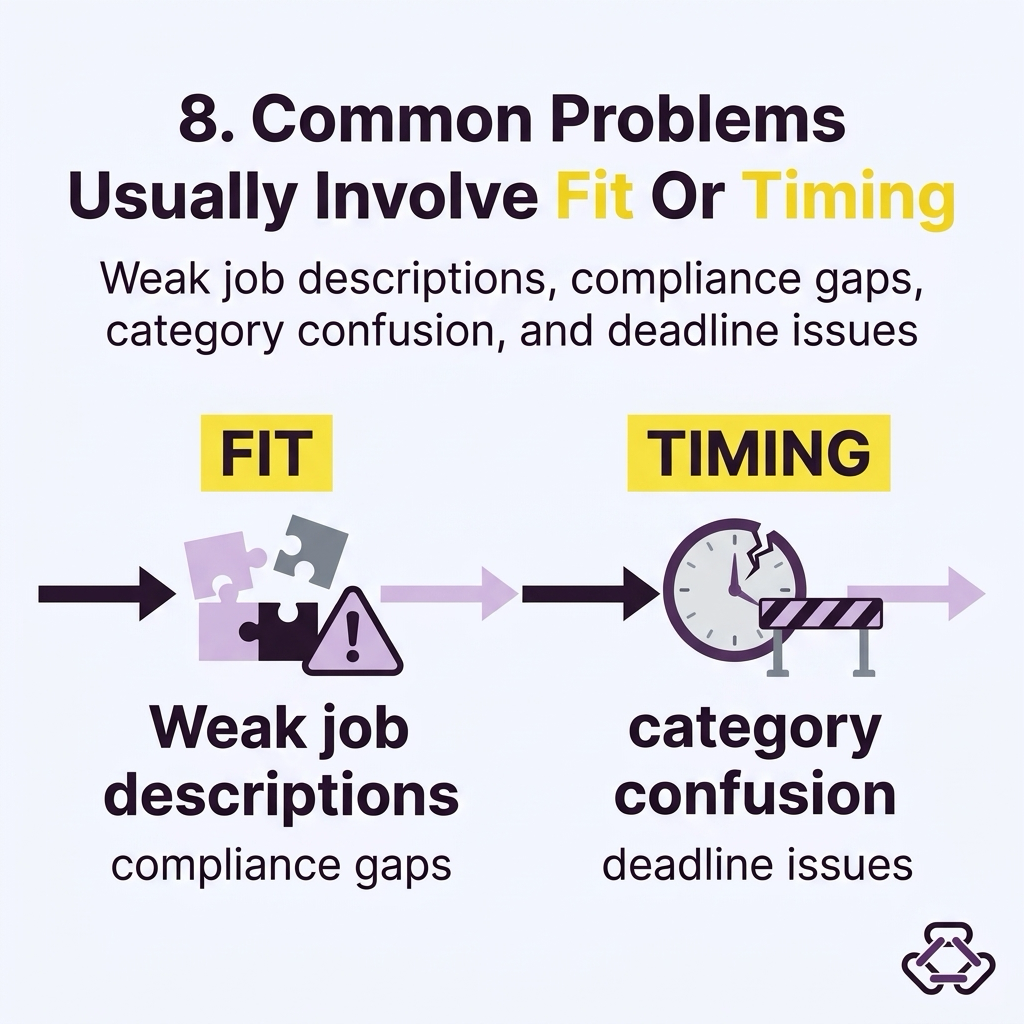
- What Are The Most Common Problems In Sponsored Work Visa Cases?
- Confusing Visa Categories
- Weak Job Descriptions
- Timing Mistakes
- Employer Compliance Gaps
- Assuming A Prior Approval Guarantees A New One
- When Does An Immigration Attorney Become Especially Helpful?
- How Can You Tell Whether An Attorney Has Relevant Experience?
- A Short Summary For Beginners

Type
Great Grandchild
Status
Approved
Title (YouTube)
Images Failed (Social)
Images Failed (Social)
Do not index
Publish Date (TikTok)
Apr 26, 2027 14:45
Videos Post IDs (Social)
Hashtags (Social)
#LegalAdvice #LegalHelp #Immigration #WorkVisas
Caption
Caption X
Cover

OG Image

Alt Image Text
Flat vector illustration of work visas and employer sponsorship common options, showing a job candidate, sponsoring employer, documents, and branching visa pathways.
Images

Videos
Publish Date (Social)
Feb 19, 2027 14:30
Scheduled (Social)
Scheduled (Social)
Images Posted (Social)
Images Posted (Social)
Videos Posted (Social)
Videos Posted (Social)
Featured
Created time
Apr 7, 2026 12:01 AM
Sub-item
Authors
CTA Practice Area (Social)
Immigration
TikTok Failed (Social)
TikTok Failed (Social)
Videos Post Links (Social)
TikTok Post Links (Social)
Images Post IDs (Social)
YT Post ID
Video Pending Manual (Social)
TikTok Posted (Social)
TikTok Posted (Social)
TikTok Post IDs (Social)
Video Cover (Social)
Images Post Links (Social)
First Comment (Social)
Videos Failed (Social)
Videos Failed (Social)
YT Embedded
Images Delete (Social)
Videos Delete (Social)
Carousel Video URL (Social)
Work Visas: A Beginner’s Guide to Employer Sponsorship and Common Options
If you’re exploring a U.S. work visa for the first time, the process can feel like a maze of acronyms, deadlines, forms, and employer policies. That’s especially true when the phrase “employer sponsorship” gets used as if everyone already knows what it means.
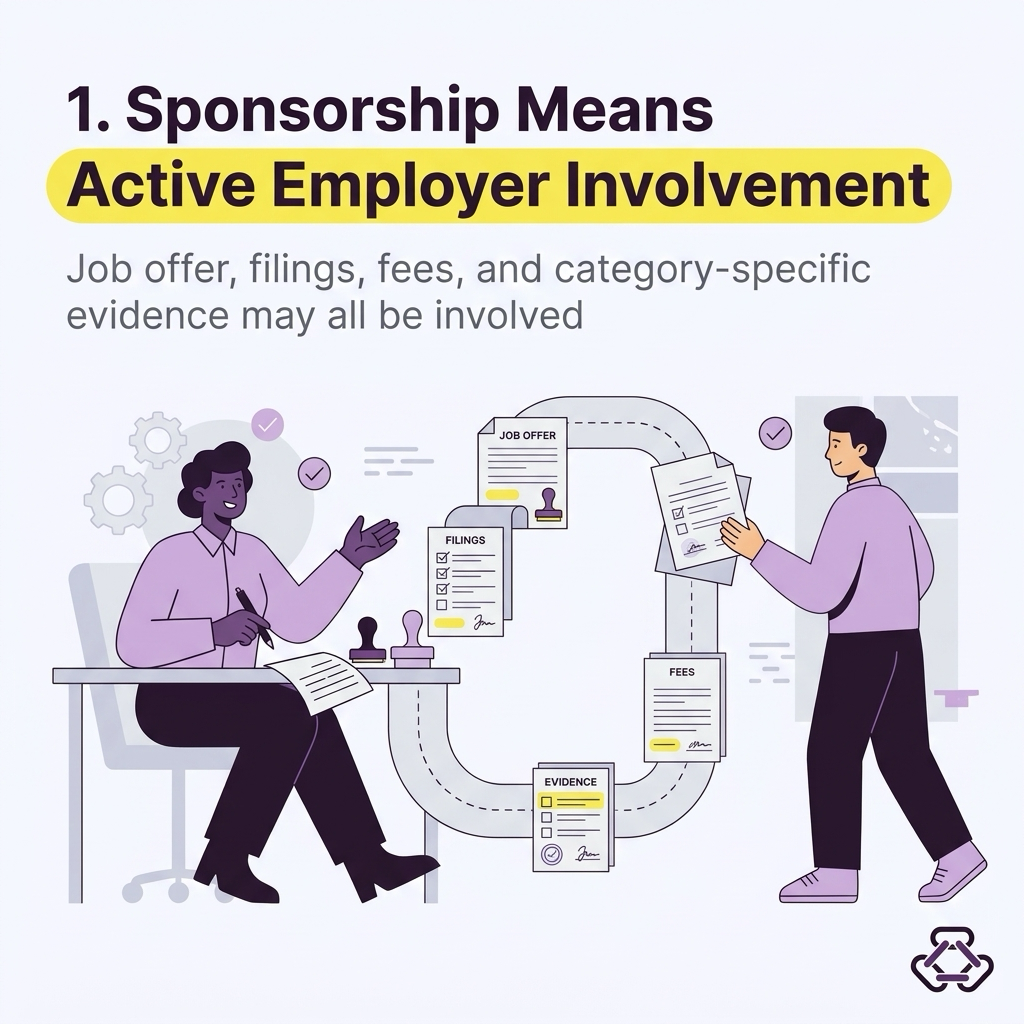
In general terms, employer sponsorship usually refers to a U.S. company taking an active role in a foreign national’s immigration process. That role may include offering a qualifying job, filing paperwork with the government, paying certain required fees, and documenting that the position and worker fit a particular visa category. Depending on the visa, the employer’s involvement can be central, optional, or ongoing.
In this post you’ll learn what employer sponsorship means, which work visa options are most common, how the process often works, what timelines and risks people run into, and where an immigration attorney may add real value. If you’d like a broader overview before getting into specifics, this more general guide to employer-driven work immigration and timing can help frame the bigger picture.
Scroll to the bottom for every post in this series.
What Does Employer Sponsorship Mean?
For many work visas, a foreign national cannot simply apply alone and start working in the United States. A U.S. employer often serves as the petitioner by filing a case with U.S. Citizenship and Immigration Services, commonly using Form I-129. USCIS describes Form I-129 as the petition employers use for several temporary worker categories, including H-1B, L-1, O-1, and H-2B.
Employer sponsorship can involve several different pieces:
- A real job offer
- A position that fits a specific visa category
- Documentation about wages, duties, and work location
- Government filings by the employer
- In some categories, a labor condition application or labor certification
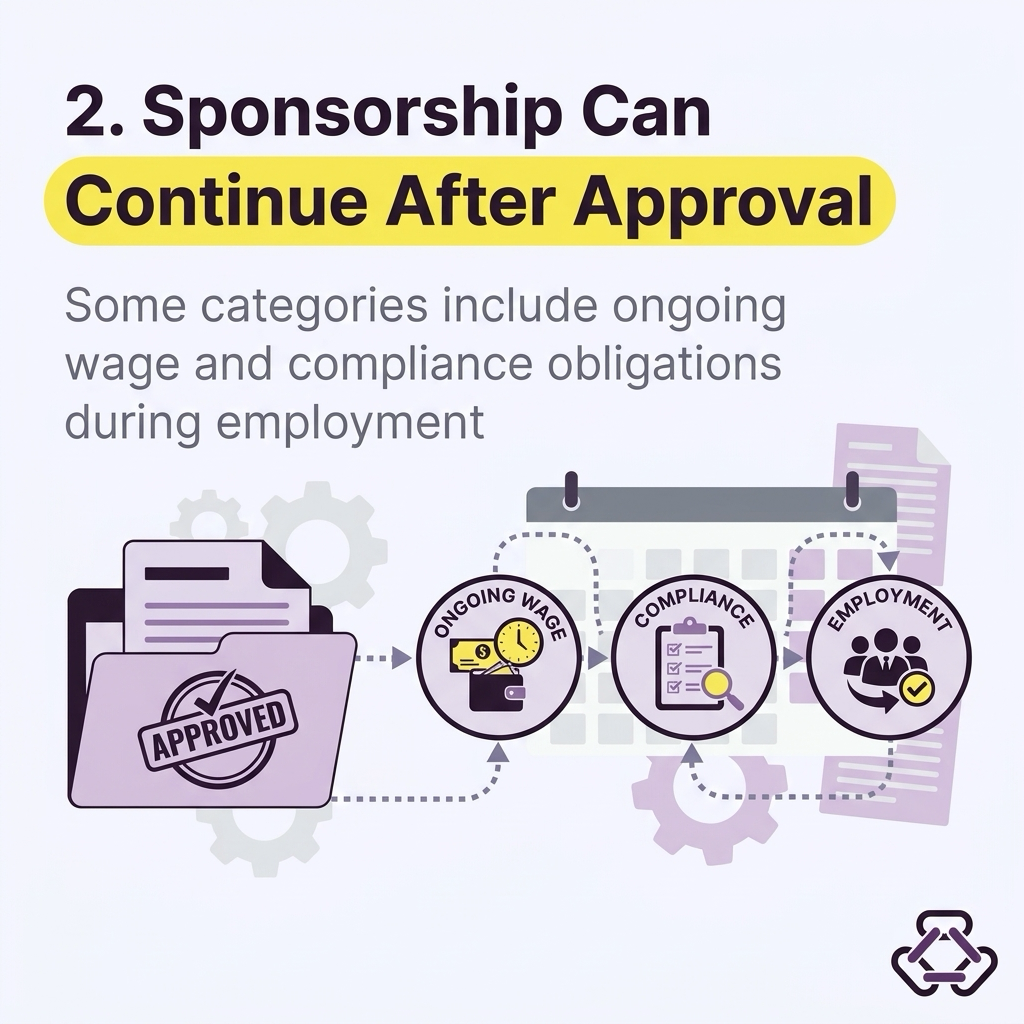
- In some cases, ongoing compliance after approval
That last point matters. Sponsorship is not always a one-time signature. In categories like H-1B and H-2B, the employer’s obligations can continue during the worker’s employment, including wage and compliance requirements enforced by federal agencies such as USCIS and the U.S. Department of Labor.
Why Employer Sponsorship Matters So Much
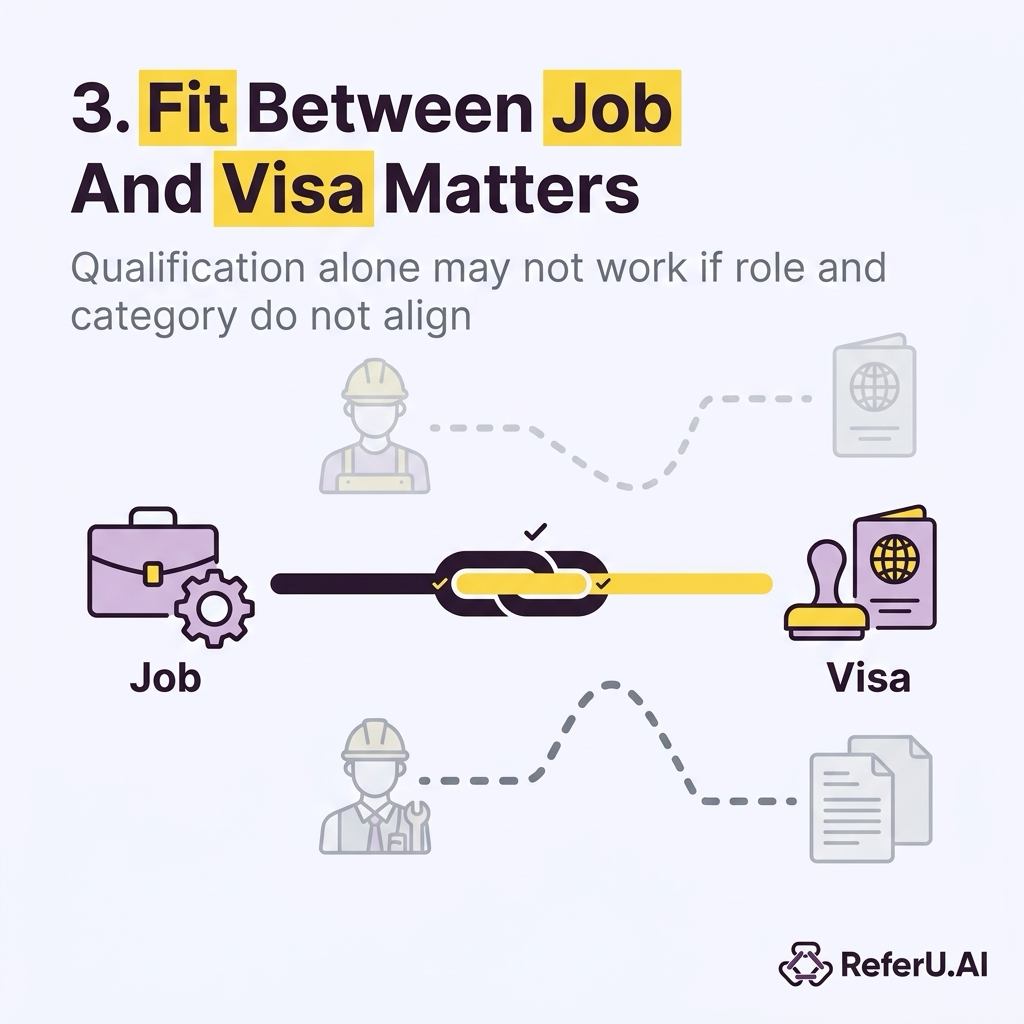
A work visa case often turns on the relationship between the job, the employer, and the worker’s background. Even highly qualified professionals can run into problems if the offered role does not match the visa rules, if the employer files too late, or if the government views the evidence as incomplete.
That is one reason people often talk about “finding a sponsor” as if it is the main challenge. In reality, sponsorship is only part of the equation. The more complete question is often:
Does this employer have a real position that fits a real visa category, with evidence that matches the legal standard?
An attorney may help evaluate that fit early, before time and filing fees are spent on a strategy that may not align well with the facts.
Which Work Visas Commonly Involve Employer Sponsorship?
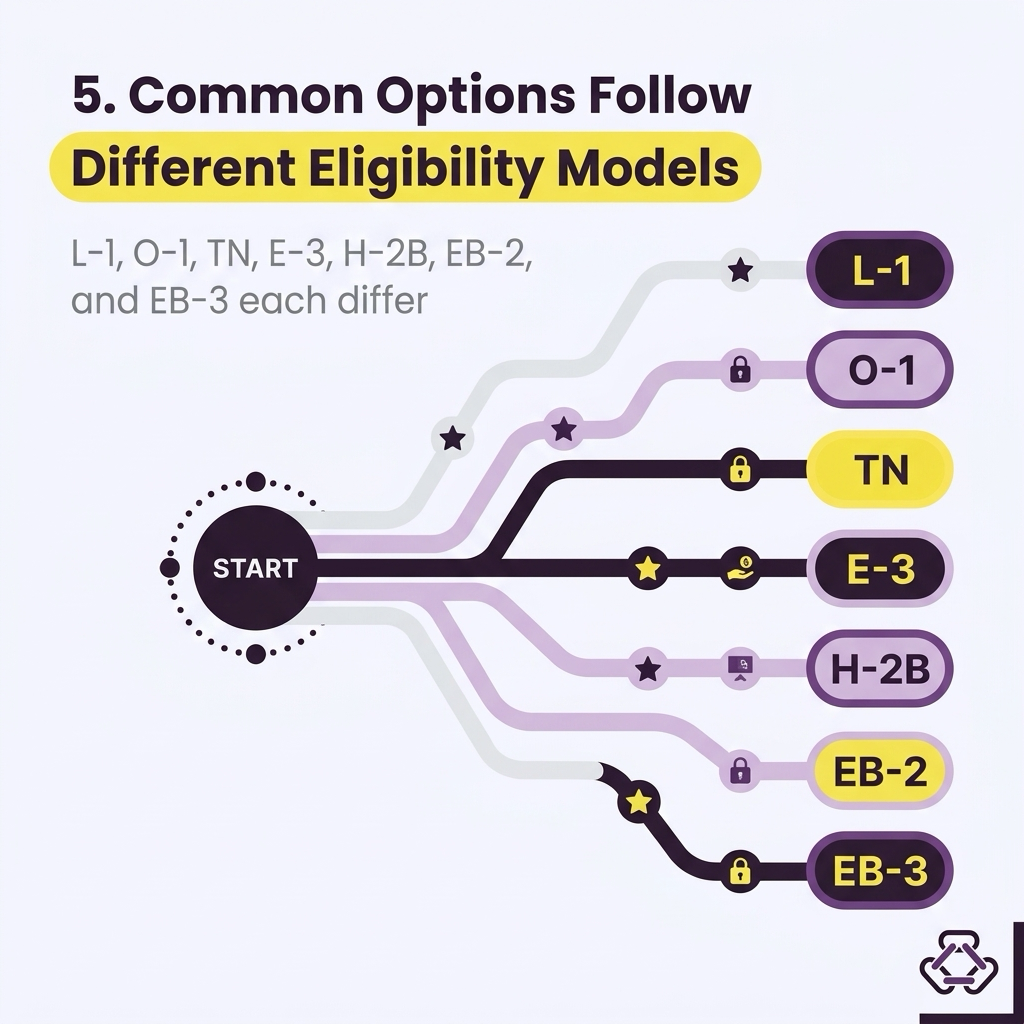
There are many employment-based visa categories, but a beginner-friendly starting point usually includes H-1B, L-1, O-1, TN, E-3, H-2B, and employer-sponsored green card paths such as EB-2 or EB-3. USCIS maintains an official overview of temporary nonimmigrant worker categories, and the State Department also lists visa categories in its visa directory.
Here’s how the most common options generally break down.
What Is The H-1B Visa?
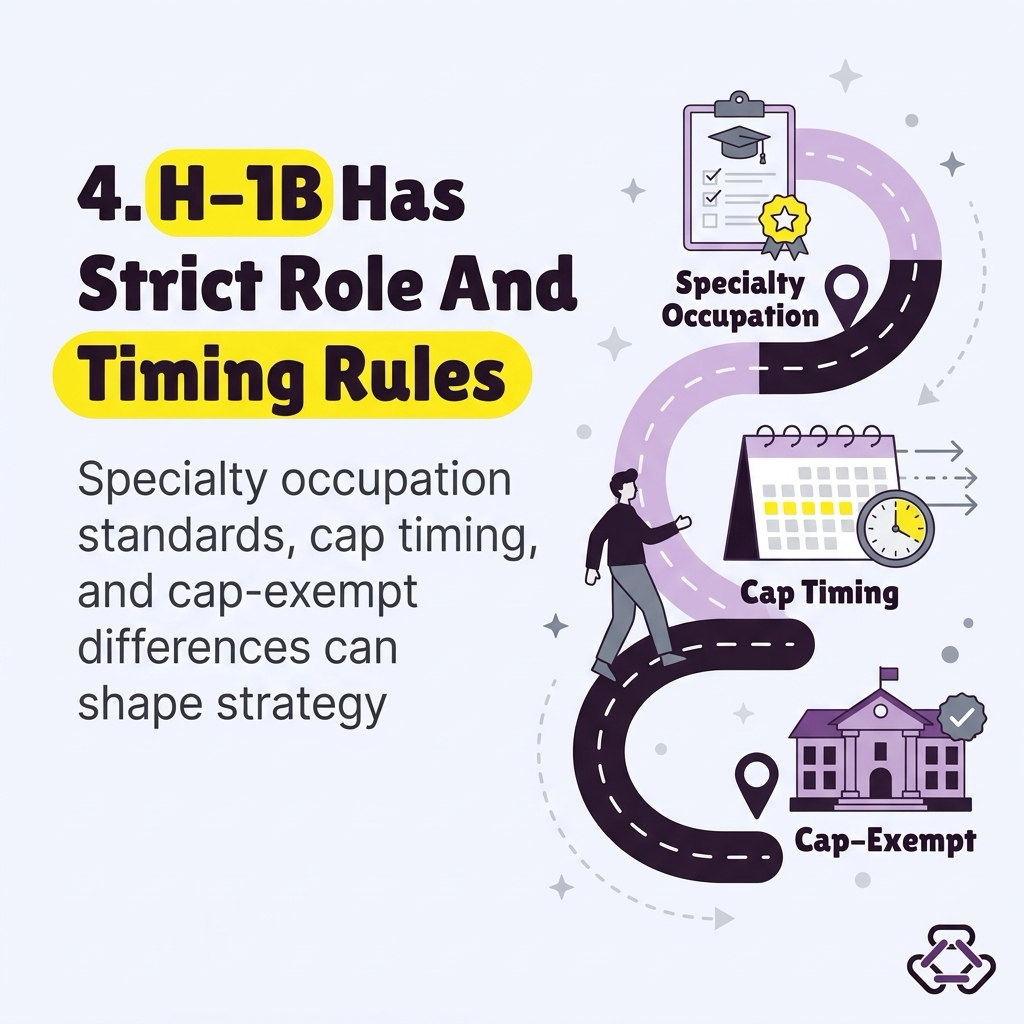
The H-1B is one of the most recognized employer-sponsored work visas. USCIS explains that it is used for specialty occupations, meaning jobs that generally require at least a U.S. bachelor’s degree or equivalent in a directly related specific specialty. USCIS also notes that the regular annual cap is 65,000, with an additional 20,000 available under the U.S. advanced degree exemption, often called the master’s cap, and that the FY 2026 cap was reached. USCIS’s electronic registration process also required a $215 registration fee per beneficiary for cap-subject filings in that cycle, with selected petitions eligible to be filed beginning April 1, 2025, for FY 2026 cases. See USCIS’s H-1B specialty occupation page, its H-1B electronic registration page, and the agency’s FY 2026 cap update.
For beginners, a few H-1B basics often stand out:
The Employer Usually Starts The Process
The employer generally registers the worker during the cap season if the case is cap-subject, and later files the petition if selected.
Not Every Professional Job Qualifies
The role usually has to be a true specialty occupation, not just a job where a degree is helpful.
Timing Can Be A Big Issue
Many H-1B filings revolve around annual cap registration windows, which can affect hiring plans months in advance.
Some Employers Are Cap-Exempt
Certain universities, nonprofit research organizations, and related entities may be outside the annual cap rules, which can change strategy significantly.
Because H-1B cases often turn on exact job duties, degree fields, wage levels, and employer structure, they are one of the clearest examples of where legal review may shape the outcome.
What Is The L-1 Visa?
The L-1 category is for intracompany transferees. It generally applies when a company transfers a worker from a related foreign office to a U.S. office. USCIS explains that L-1A is for executives and managers, while L-1B is for employees with specialized knowledge. USCIS’s L-1B page highlights that the worker’s knowledge has to relate to the organization’s products, services, research, equipment, techniques, management, or processes.
For many multinational companies, the L-1 can be a practical option because it does not depend on the H-1B cap lottery structure. But it comes with its own evidentiary demands, especially around:
- The qualifying relationship between the foreign and U.S. entities
- The worker’s employment abroad
- The employee’s managerial, executive, or specialized-knowledge role
- Whether the U.S. position matches the claimed classification
This is one area where “sponsorship” can look different from the H-1B model. Instead of proving a specialty occupation, the employer may be proving a cross-border corporate structure and qualifying prior employment.
What Is The O-1 Visa?
The O-1 visa is for individuals with extraordinary ability or achievement. USCIS describes O-1A as covering sciences, education, business, or athletics, and O-1B as covering the arts and the motion picture or television industry. USCIS also states that the petition is generally filed by a U.S. employer, U.S. agent, or foreign employer through a U.S. agent, and that O-1 beneficiaries do not self-petition in the usual sense. See USCIS’s O-1 overview and its O classification Q&A.
People often associate the O-1 with celebrities, but it can also come up for researchers, founders, artists, athletes, and highly accomplished professionals with a strong record of recognition.
What makes O-1 cases different is that the legal question is less about a standard degree-based job and more about documented distinction or acclaim, plus a qualifying U.S. work arrangement. That often makes evidence strategy especially important.
What Is The TN Visa?
The TN visa comes from the United States-Mexico-Canada Agreement (USMCA) and is available to certain Canadian and Mexican citizens in designated professional occupations. USCIS explains that TN classification permits qualified Canadian and Mexican citizens to seek temporary entry for business activities at a professional level and that the person will work in a prearranged full-time or part-time job for a U.S. employer or entity. See USCIS’s TN page.
The TN is notable because it may be more streamlined than some other categories for eligible professionals. Still, it is not open to everyone. It depends on nationality, profession, qualifications, and the structure of the U.S. job offer.
What Is The E-3 Visa?
The E-3 category is a specialty occupation visa available to Australian nationals. USCIS includes E-3 among employment-based temporary worker classifications and has specific policy guidance on how it is processed. The category resembles H-1B in some ways because it involves a specialty occupation framework, but it is distinct and nationality-specific. See USCIS’s temporary worker overview and USCIS policy guidance on E-3 specialty occupation workers.
For eligible Australian professionals, E-3 can sometimes be part of the conversation when H-1B timing or cap issues create friction.
What Is The H-2B Visa?
The H-2B visa allows U.S. employers to bring foreign nationals to the United States for temporary nonagricultural jobs. USCIS explains that the employer must show, among other things, that there are not enough U.S. workers who are able, willing, qualified, and available, that employing H-2B workers will not adversely affect similarly employed U.S. workers, and that the employer’s need is temporary. USCIS also notes the statutory cap of 66,000 per fiscal year, typically split into 33,000 for each half of the fiscal year. See USCIS’s H-2B page.
Unlike many professional visa discussions, H-2B often comes up in industries such as hospitality, landscaping, construction support, seafood processing, and seasonal operations. The sponsorship model here is heavily employer-driven and often tied to labor certification steps involving the Department of Labor.
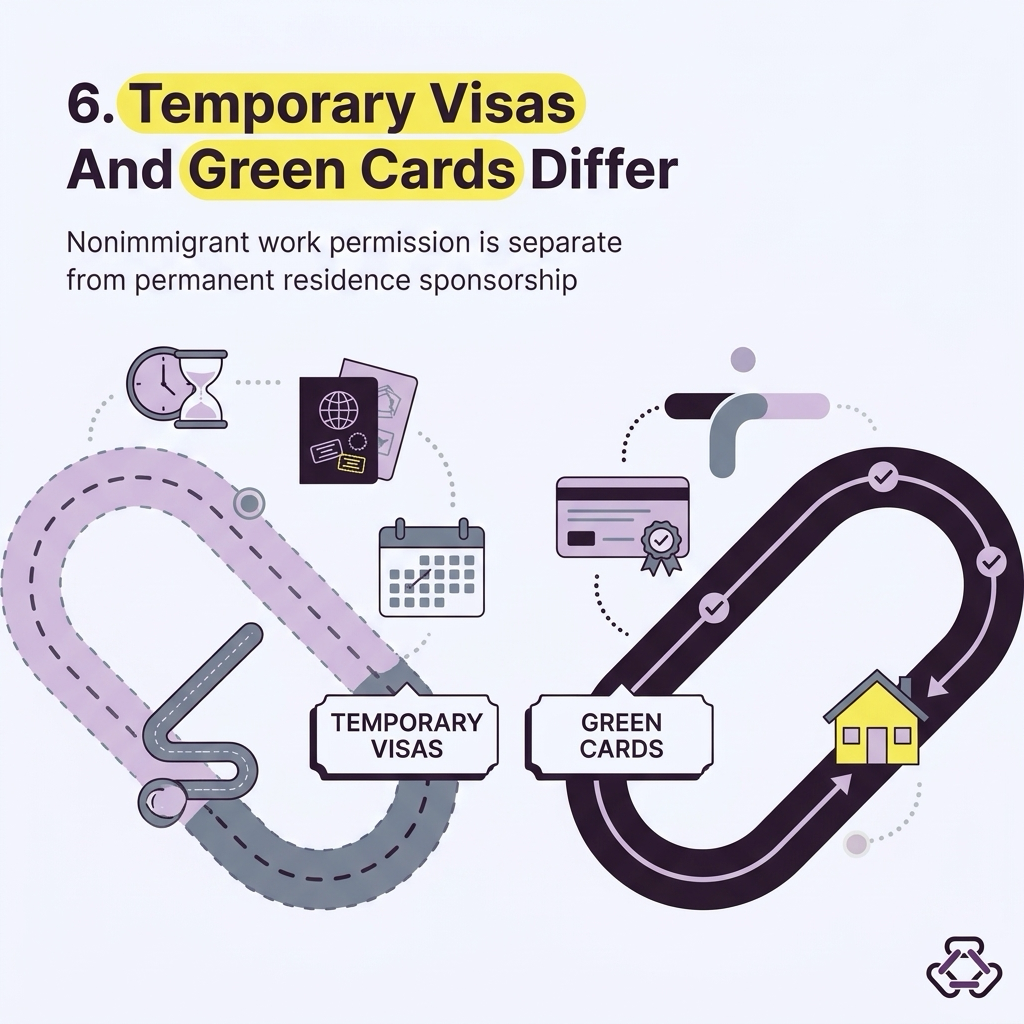
Is A Work Visa The Same Thing As A Green Card Sponsorship Case?
No. That distinction is one of the biggest areas of confusion.
A temporary work visa allows someone to work in the United States for a defined period under a nonimmigrant classification. By contrast, an employment-based green card is part of the permanent residence system.
USCIS explains that employment-based immigrant visas are divided among five preference categories, and for many EB-2 and EB-3 cases, the employer generally first obtains a labor certification from the Department of Labor before filing an immigrant petition. See USCIS’s permanent workers overview and USCIS’s EB-2 page. The Department of Labor similarly explains that a permanent labor certification allows an employer to hire a foreign worker to work permanently in the United States and that filing is the employer’s responsibility.
In practical terms, that means someone may have:
- A temporary employer-sponsored visa only
- A temporary visa plus an employer-sponsored green card process
- A green card path without the same kind of temporary work visa
- A self-petition option in limited categories, such as certain national interest waiver or EB-1 cases
This distinction often affects strategy, timelines, portability, and long-term career planning.
How Does Employer Sponsorship Usually Work?
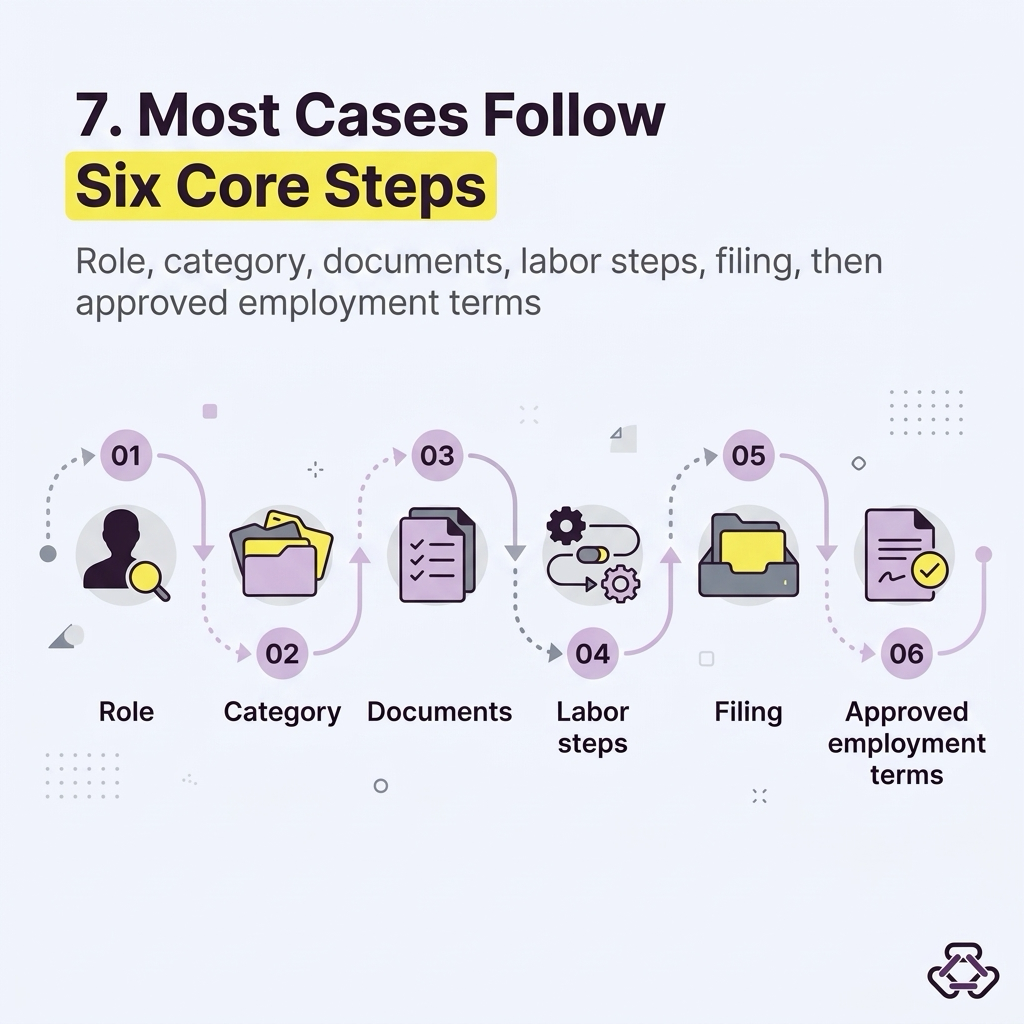
Although each category is different, a beginner-friendly version of the process often looks like this:
1. The Employer Identifies A Role
There is a job opening or transfer opportunity with defined duties, salary, location, and reporting structure.
2. The Visa Category Is Evaluated
The question becomes whether the facts fit H-1B, L-1, O-1, TN, E-3, H-2B, or a permanent sponsorship route.
3. Supporting Documents Are Collected
This may include degrees, evaluations, résumés, passports, offer letters, organizational charts, prior employment records, contracts, and evidence about the company.
4. Required Labor Filings Or Agency Steps Are Completed
For example, some categories involve Department of Labor filings; others do not.
5. The Employer Files With USCIS Or The Worker Applies Through A Consular Process
The exact procedure depends on the classification and where the worker is physically located.
6. The Worker Starts Or Continues Employment Under The Approved Terms
At that point, compliance becomes important. Changes in worksite, duties, pay structure, ownership, or employer can sometimes trigger new legal analysis.
If you’re trying to understand the process at a broader level, this overview of how employer sponsorship and visa timing fit together pairs well with the category-by-category summary here.
What Documents Do Employers Usually Ask For?
That varies by visa, but common requests include:
- Passport biographical page
- Current immigration documents, if already in the U.S.
- Diploma and transcripts
- Credential evaluation for foreign degrees
- Updated résumé or CV
- Pay records or immigration history
- Prior employer letters
- Publications, awards, press, or judging evidence for O-1 cases
- Corporate records for L-1 matters
- Profession-specific licenses, where relevant
A missing or inconsistent document does not automatically end a case, but it can change the legal framing and the amount of explanation required.
What Are The Most Common Problems In Sponsored Work Visa Cases?
Even strong candidates can run into avoidable issues. Some of the most common include:
Confusing Visa Categories
A person may be qualified, but not for the category being pursued.
Weak Job Descriptions
Vague or generic roles can create problems, especially in H-1B and TN cases.
Timing Mistakes
Annual registration windows, expiration dates, international travel plans, and job start dates can all matter.
Employer Compliance Gaps
Corporate changes, wage issues, and worksite changes can complicate an otherwise valid case.
Assuming A Prior Approval Guarantees A New One
Each petition stands on its own facts and evidence.
That is often where legal counsel becomes more than paperwork support. A well-developed filing strategy can help identify whether the issue is eligibility, timing, documentation, or employer process.
When Does An Immigration Attorney Become Especially Helpful?
In some situations, people handle early information gathering internally with HR or a company’s immigration team. In others, an immigration attorney may become central very early on.
That tends to be especially true when:
- The job title and degree field do not match neatly
- The worker has prior status issues or gaps
- The case involves a startup, founder, or unusual ownership structure
- The employer is navigating a transfer, layoff, merger, or acquisition
- The worker wants to change employers
- There is a request for evidence, denial risk, or prior denial
- The case may involve both temporary visa planning and permanent residence strategy
In situations like these, the “right attorney” is often less about advertising and more about documented experience in highly similar matters. That kind of fit can be difficult to assess from a generic directory or paid placement site.
How Can You Tell Whether An Attorney Has Relevant Experience?
For business immigration matters, experience is often more nuanced than “does immigration law.” A person may be looking for counsel with demonstrable experience in cases involving:
- H-1B specialty occupation disputes
- Startup founder sponsorship structures
- L-1 new office filings
- O-1 evidence strategy for researchers or creatives
- Employment-based green card planning tied to a specific visa
- Status maintenance issues after a job change
That is where a platform built around objective criteria and court-record-based matching may be useful. Instead of relying on slogans, people often want a clearer way to identify attorneys with documented experience in similar fact patterns.
A Short Summary For Beginners
Employer sponsorship usually means a U.S. employer is doing more than offering a job. The employer is often playing an active legal role in a visa or green card process. The most common options include H-1B, L-1, O-1, TN, E-3, H-2B, and employment-based green card categories like EB-2 and EB-3, but each one has different rules, timing, and evidence requirements.
For many people, the hardest part is not just understanding what each visa is called. It is figuring out which path actually fits the facts, whether the employer’s role is realistic, and how to evaluate legal help based on evidence rather than marketing claims.
Visit ReferU.AI to get matched with an attorney who has demonstrable experience in cases like yours — for free.
