Table of Contents
- 9 Questions People Ask After Losing a Probate Hearing
- 1. Is The Judge’s Ruling Final?
- 2. Can I Appeal A Probate Hearing Loss?
- 3. How Much Time Do I Have To Do Something?
- 4. What If The Judge Only Announced The Decision In Court?
- 5. Can I Present New Evidence On Appeal?
- 6. Do I Need The Transcript And Court Record?
- 7. Does An Appeal Stop The Estate From Moving Forward?
- 8. What Are The Chances Of Reversing The Decision?
- 9. What Kind Of Lawyer Handles This After A Probate Hearing Loss?
- Final Thoughts On What People Ask After Losing A Probate Hearing

Type
Great Grandchild
Status
Approved
Title (YouTube)
Images Failed (Social)
Images Failed (Social)
Do not index
Publish Date (TikTok)
Feb 21, 2027 11:15
Videos Post IDs (Social)
Hashtags (Social)
#LegalAdvice #LegalHelp #ProbateLitigation #ProbateAppeals
Caption
Caption X
Cover

OG Image

Alt Image Text
Minimal flat vector illustration of a concerned person leaving a courthouse with legal papers, surrounded by probate-related symbols like a gavel, scales, house, and estate document, suggesting uncertainty after losing a probate hearing.
Images

Videos
Publish Date (Social)
Jan 13, 2027 07:00
Scheduled (Social)
Scheduled (Social)
Images Posted (Social)
Images Posted (Social)
Videos Posted (Social)
Videos Posted (Social)
Featured
Created time
Apr 8, 2026 06:05 PM
Sub-item
Authors
CTA Practice Area (Social)
Probate Litigation
TikTok Failed (Social)
TikTok Failed (Social)
Videos Post Links (Social)
TikTok Post Links (Social)
Images Post IDs (Social)
YT Post ID
Video Pending Manual (Social)
TikTok Posted (Social)
TikTok Posted (Social)
TikTok Post IDs (Social)
Video Cover (Social)
Images Post Links (Social)
First Comment (Social)
Videos Failed (Social)
Videos Failed (Social)
YT Embedded
Images Delete (Social)
Videos Delete (Social)
Carousel Video URL (Social)
9 Questions People Ask After Losing a Probate Hearing
Losing a probate hearing can feel surreal. One minute you’re waiting for the judge to rule on a will contest, fiduciary dispute, accounting objection, property issue, or distribution question. The next minute, you’re walking out of court wondering what just happened, whether the ruling is final, and whether anything can still be done.
That confusion is common. Probate hearings often involve family conflict, unfamiliar court procedures, emotionally charged facts, and deadlines that move faster than many people expect. And because probate cases can involve homes, business interests, inheritances, creditor claims, or control over an estate, one ruling can have immediate financial consequences.
In this post, you’ll learn the nine questions people often ask after losing a probate hearing, what those questions often mean in practical terms, and where a probate appeal may fit into the picture. If you want a broader overview of the appellate process in estate cases, it may help to start with this guide on what probate appeals usually involve after a court ruling.
Scroll to the bottom for every post in this series.
1. Is The Judge’s Ruling Final?
This is usually the first and most important question.
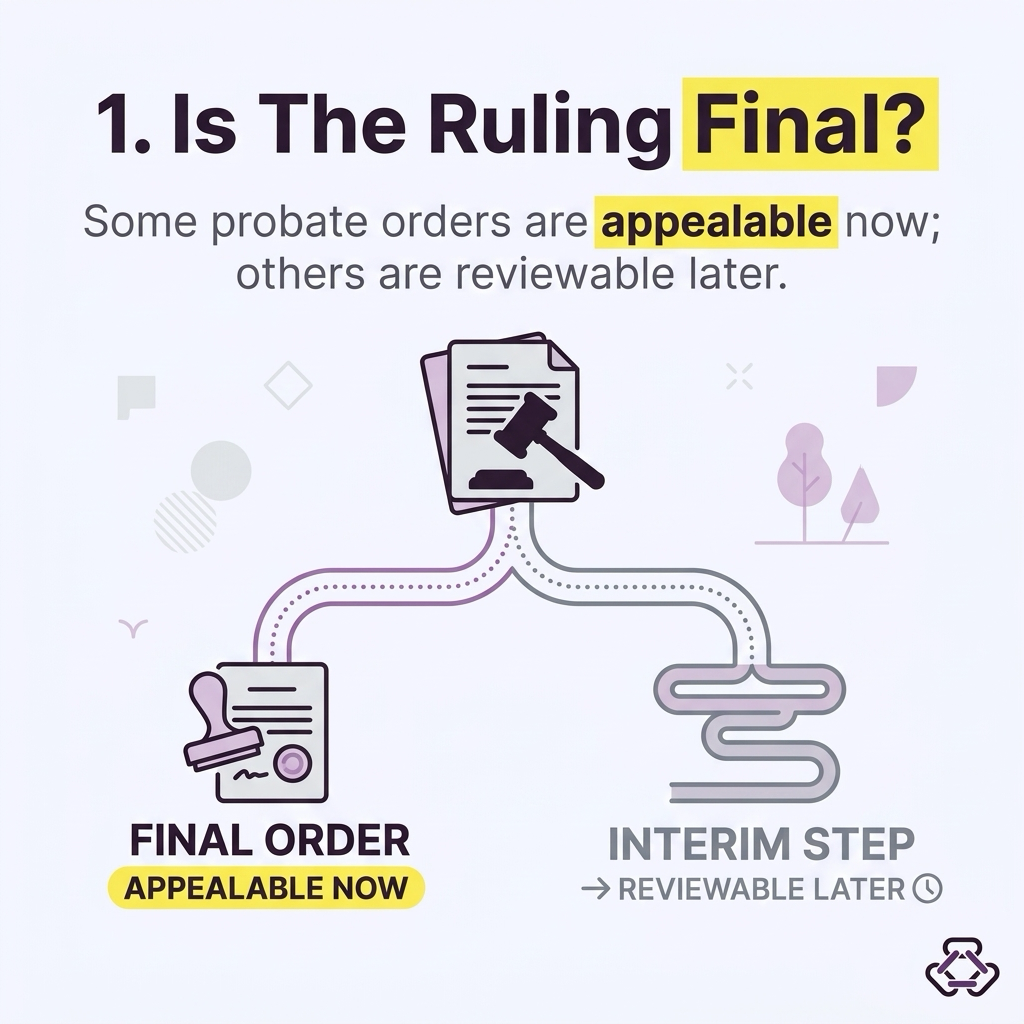
In probate court, not every unfavorable ruling is immediately appealable. Some orders are considered final orders, while others are interim or procedural rulings that may only become reviewable later. That distinction matters because appeal rights often turn on whether the order actually resolves a particular issue or merely moves the case along.
For example, in some states, probate statutes specifically identify categories of appealable orders. California, for instance, has a statutory framework listing appealable probate orders in its Probate Code, including certain orders concerning distributions, fiduciary compensation, account settlements, and other estate matters. The effect of an appeal on the underlying order is also addressed by statute. See California Probate Code sections 1300–1305 and section 1310. Courts and commentators regularly note that probate appealability can differ from the “one final judgment” model used in other civil cases. Plaintiff Magazine
In general terms, people often leave a hearing thinking they “lost the case” when they may have lost only one motion, one objection, or one step in a larger estate proceeding. On the other hand, some probate orders become appealable right away, even if administration of the estate continues.
That’s one reason people often look more closely at whether a ruling is truly appealable before making any move. Questions like that are at the heart of the larger probate-appeals discussion in this overview of final orders, standards of review, and post-judgment strategy.
2. Can I Appeal A Probate Hearing Loss?
Sometimes yes, but not every loss leads to an appeal.
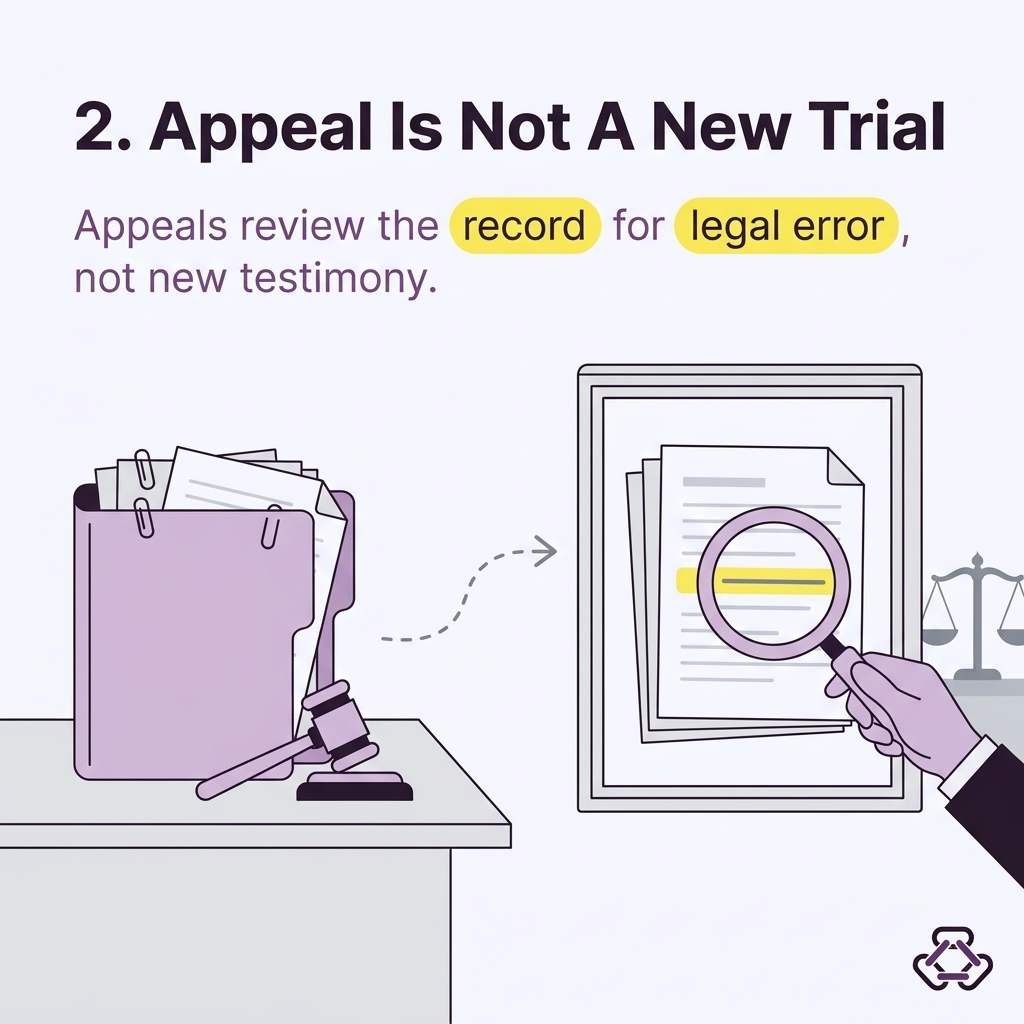
An appeal is not a new trial. Appellate courts generally review what happened in the lower court based on the written record, transcripts, exhibits, and legal arguments preserved below. They usually do not hear new witnesses or consider new evidence that was never presented to the probate judge.
That difference surprises many people. They may believe an appeal is a second chance to fully retell the story. In reality, an appeal usually asks a higher court whether the probate court made a reversible legal error.
That might involve issues such as:
- interpreting a statute incorrectly
- applying the wrong legal standard
- excluding or admitting evidence in a way the law does not support
- making a ruling outside the court’s discretion
- entering an order that the record does not support
Appellate courts use different standards of review depending on the issue. Questions of law are often reviewed de novo, meaning the appellate court looks at the legal issue anew. Discretionary decisions are often reviewed for abuse of discretion, a much more deferential standard. Findings of fact may receive substantial deference as well. The U.S. Department of Justice’s appellate guidance and The Florida Bar’s discussion of appellate standards both describe these distinctions in practical terms. DOJ Justice Manual The Florida Bar
Here’s what that often means in probate litigation: being unhappy with the outcome is not the same as identifying an appealable error. An attorney handling probate appeals may help evaluate whether the ruling involves a legal issue, a factual issue, or a discretionary call by the trial judge.
3. How Much Time Do I Have To Do Something?
Often, not much.
Appeal deadlines are some of the least forgiving deadlines in the legal system, and probate matters are no exception. The specific time limit depends on the jurisdiction and the type of order, but many probate appeals operate on a 30-day timeline or something close to it.
Official court sources show just how quickly these deadlines can run. In New York civil matters, including cases in Surrogate’s Court, a notice of appeal is generally due within 30 days after service of the order or judgment with notice of entry. New York Courts South Carolina’s appellate rule similarly provides a 30-day period for certain probate appeals. South Carolina Judicial Branch Connecticut probate appeal provisions also impose statutory timing requirements. Connecticut General Assembly
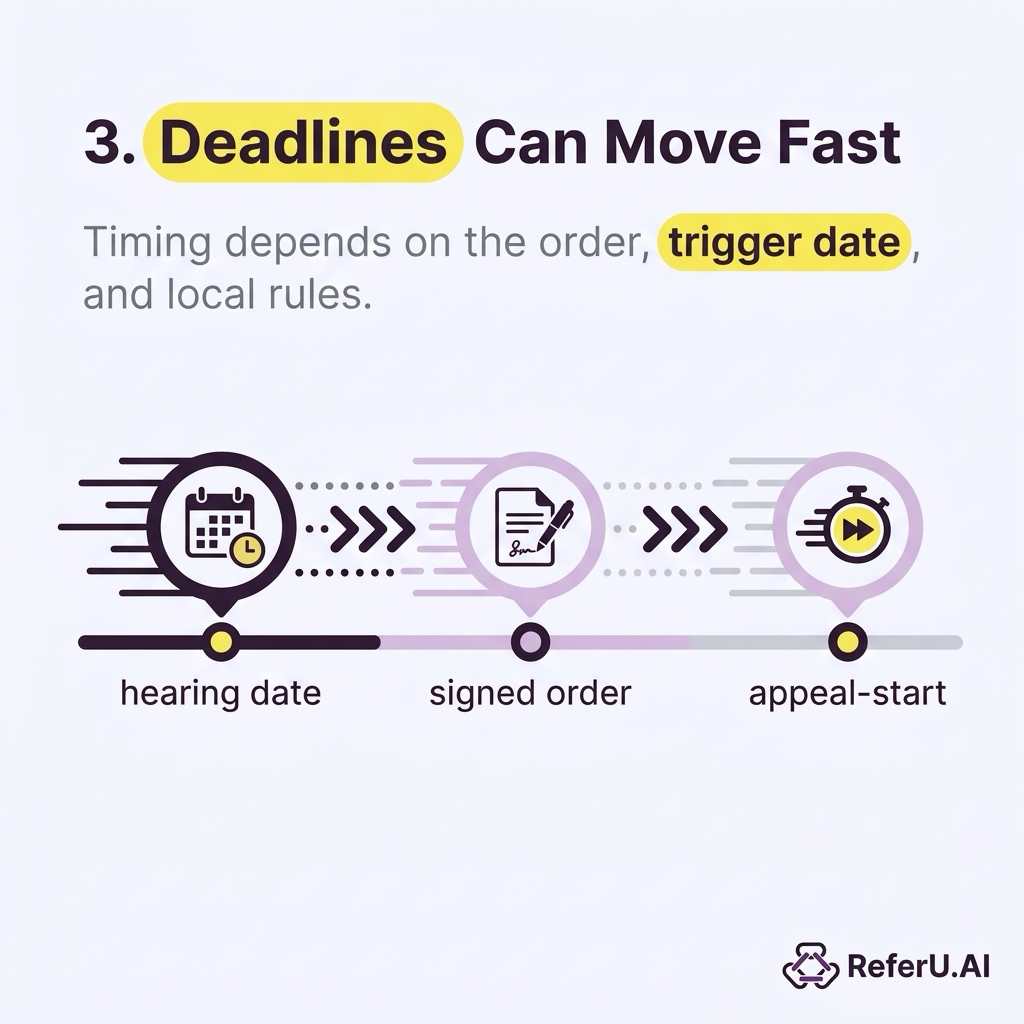
The exact trigger date can vary. Sometimes the clock starts when the signed order is entered. Sometimes it starts after service of notice of entry. Sometimes post-trial motions affect timing. Sometimes they do not. That procedural variation is one reason people often miscalculate the deadline after a difficult hearing.
A lot of post-hearing confusion comes from mixing up three different dates:
- The hearing date
- The date the judge signs or files the order
- The date the appeal period actually begins under local law
Those are not always the same thing.
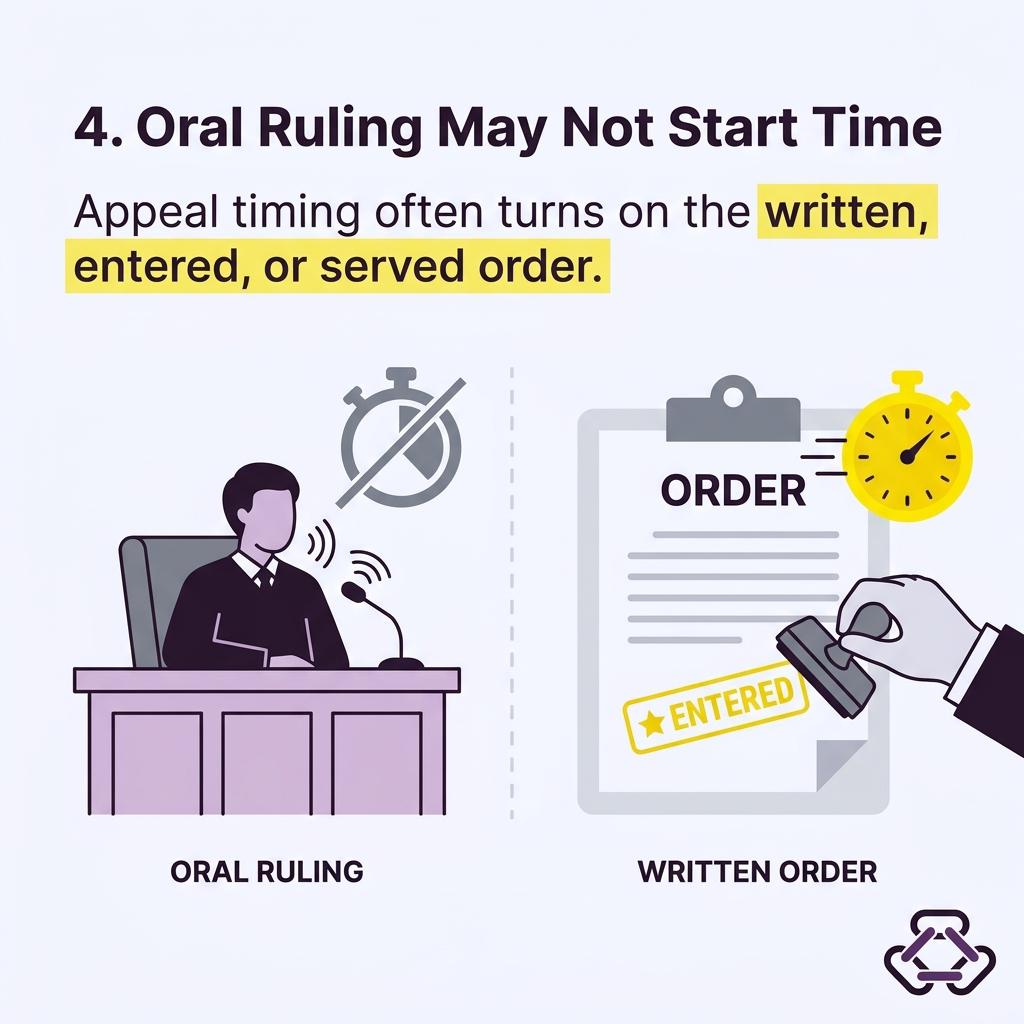
4. What If The Judge Only Announced The Decision In Court?
A bench ruling and an appealable written order are not always the same.
Many probate litigants leave a hearing after the judge announces a decision orally and assume the deadline has already started. In some jurisdictions, the appellate timeline is tied to a written, entered, or served order, not simply what was said from the bench. In others, the rules can be more nuanced.
That distinction matters because oral comments from the judge may explain the reasoning, but the appeal often focuses on the actual written order and the record supporting it. If the written order differs from the oral ruling, even slightly, that difference can become important.
This is also where post-hearing strategy begins to matter. Some litigants start thinking about transcripts, objections, notices of entry, and record preservation only after the order arrives. By then, valuable time may already be gone.
For readers trying to understand the bigger procedural picture, this deeper discussion of probate appeal strategy after judgment offers useful context on why the written order matters so much.
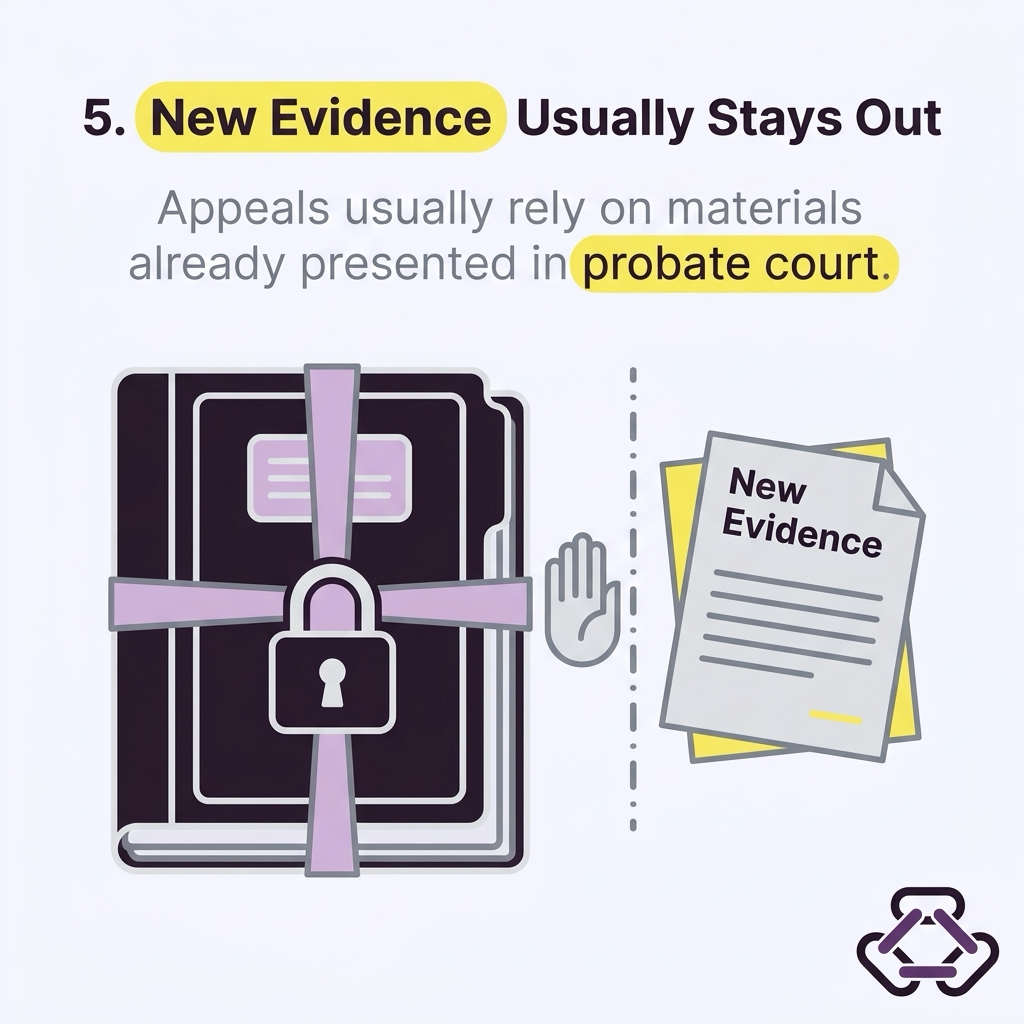
5. Can I Present New Evidence On Appeal?
Usually, no.
Appeals are generally limited to the record created in the probate court. That means the appellate court usually reviews:
- pleadings
- motions
- exhibits admitted below
- hearing transcripts
- written orders
- other materials that are properly part of the record
If someone discovers new bank statements, new medical records, a new witness, or new family communications after the hearing, that information may feel extremely important. But an appeal is often not the vehicle for introducing that new material.
Instead, the legal question may become whether there is some other procedure available in the trial court, such as a motion for reconsideration, relief from order, or a new petition depending on the state’s rules and the nature of the evidence. Whether that path exists can be highly fact-specific.
This is one reason losing a probate hearing can lead to two very different conversations:
- Is there an appeal?
- Or is there a trial-court motion based on something new or overlooked?
Those are not the same remedy, and they operate on different rules and timelines.
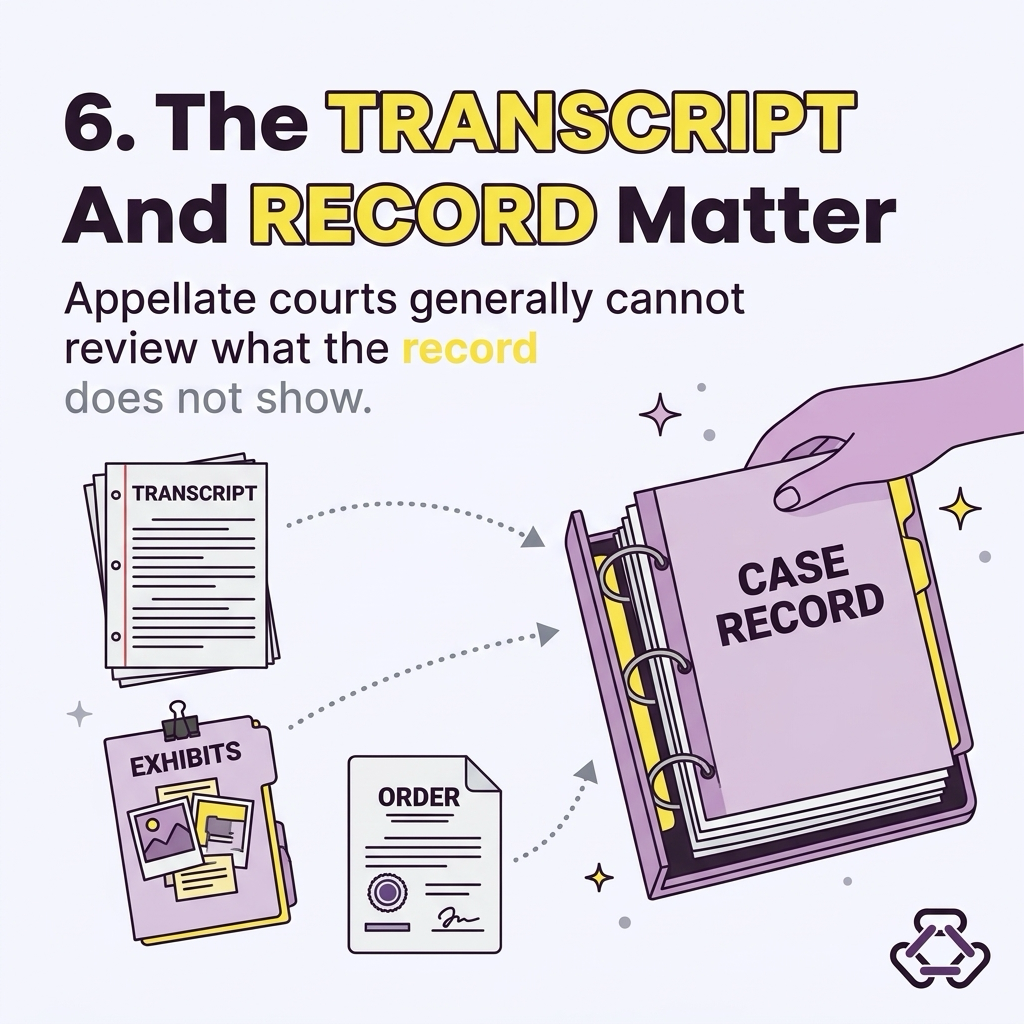
6. Do I Need The Transcript And Court Record?
In many appeals, the answer is effectively yes.
Appellate courts review what is in the record. If a key argument was made orally at the hearing, the transcript may be the only reliable way to show exactly what happened. If an exhibit mattered, it often has to be properly included in the record. If an objection preserved an issue, the record is usually where that preservation appears.
That may sound technical, but the concept is simple: an appellate court generally cannot evaluate what it cannot see.
This issue has become more significant as court systems face recording and reporting challenges. Los Angeles Superior Court publicly launched a dashboard highlighting that hundreds of thousands of family law, probate, and unlimited civil proceedings occurred without a verbatim record during a recent reporting period, underscoring how transcript problems can affect appellate rights in real-world cases. Daily Journal
Official rules also show how central the record is to appellate review. For example, federal probate-related administrative appeal rules require preparation and forwarding of the record and, when necessary, transcripts. Legal Information Institute
For probate litigants, this often raises practical questions such as:
- Was a court reporter present?
- Was the hearing electronically recorded?
- How do I order the transcript?
- Which exhibits made it into the record?
- Did the court actually rule on every objection?
Those questions can shape what an appeal looks like long before any brief is filed.
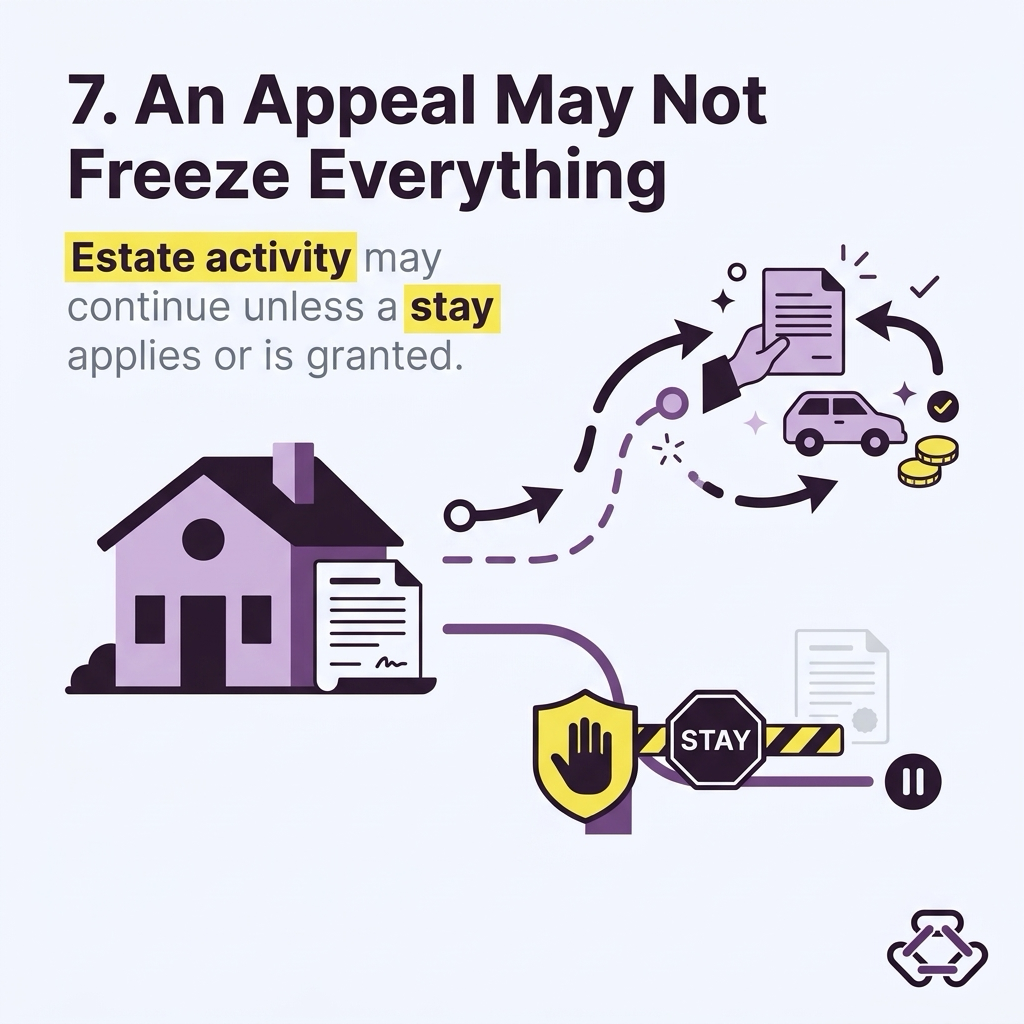
7. Does An Appeal Stop The Estate From Moving Forward?
Not always.
A lot of people assume that filing an appeal freezes the probate case automatically. Sometimes that happens in part. Sometimes it doesn’t. The answer often depends on the jurisdiction, the type of order, and whether a stay is requested or granted.
California provides a useful example. Under Probate Code section 1310, an appeal generally stays the operation and effect of the order, but the statute contains exceptions and also allows certain actions to proceed to prevent injury or loss to a person or property. That statutory structure shows why “we filed an appeal, so everything stops” is not always an accurate assumption.
In practical probate disputes, this question can be urgent. If the order authorizes sale of a house, payment of fees, removal of a fiduciary, distribution of assets, or transfer of estate property, timing matters. Once property changes hands or estate administration advances, the legal and strategic landscape can change quickly.
That’s part of why probate appeal strategy is often about more than just filing a notice. It may also involve evaluating whether a stay, bond, emergency relief, or other protective filing is part of the picture.
8. What Are The Chances Of Reversing The Decision?
People ask this question immediately, but the honest answer usually depends on why the probate judge ruled the way they did.
Appeals are often hardest when the issue is mainly factual and the probate judge heard conflicting testimony live. Trial judges usually receive substantial deference on fact-intensive questions because they saw the witnesses and assessed credibility firsthand. Legal questions can be different, especially when the issue is statutory interpretation or application of the wrong legal standard. De novo review gives the appellate court more room to disagree. The Florida Bar DOJ Justice Manual
That’s why two probate losses that feel equally unfair may look very different on appeal:
- “The judge believed my sibling instead of me.”
- “The judge applied the wrong burden of proof.”
- “The judge treated a nonfinal issue as resolved.”
- “The judge excluded evidence based on an incorrect legal interpretation.”
Those are very different appellate postures.
The broader context also matters. Probate litigation is likely to remain a significant source of conflict as more wealth passes through estates and trusts. The American Bar Association has cited Cerulli Associates’ estimate that roughly $84.4 trillion is expected to transfer through 2045, much of it to heirs. ABA report As more wealth moves between generations, disputes over validity, control, distributions, and fiduciary conduct may continue to produce more contested probate proceedings.
That does not tell anyone whether a particular appeal will succeed. It does help explain why probate appeals can involve complicated records, serious financial stakes, and highly contested family narratives.
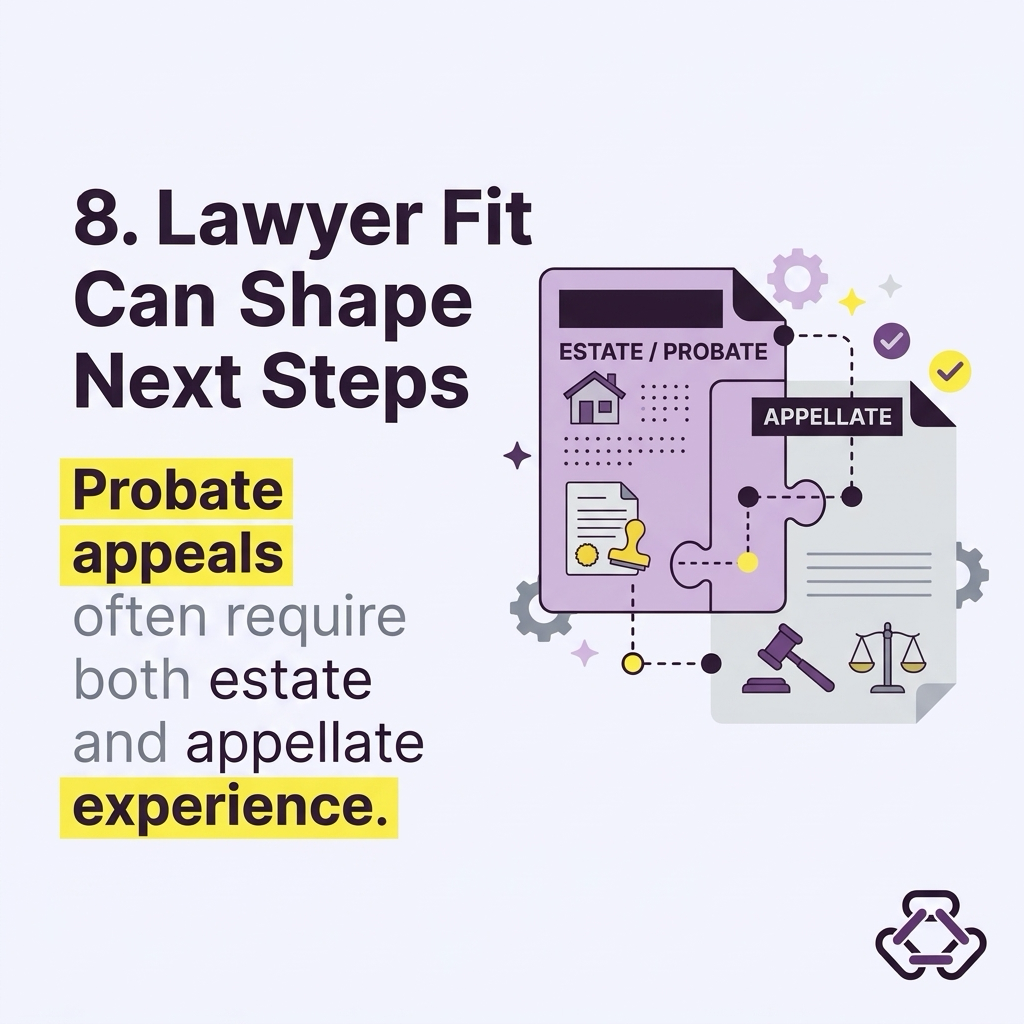
9. What Kind Of Lawyer Handles This After A Probate Hearing Loss?
Not every probate lawyer handles appeals, and not every appellate lawyer regularly works with probate issues.
That distinction matters because probate appeals sit at the intersection of estate law and appellate procedure. A strong fit often involves someone who understands both the underlying probate subject matter and the technical demands of appeals, including deadlines, record designation, issue preservation, briefing standards, and standards of review.
Some people assume the next step is simply to call any attorney who lists “probate” on a website. Others assume a general appellate lawyer can step into any estate dispute without context. In reality, post-hearing probate matters often call for a more tailored match based on the type of ruling involved:
- will contest
- trust dispute
- executor or administrator removal
- accounting objections
- fiduciary surcharge
- heirship determination
- asset ownership dispute
- creditor claim ruling
- fee order
- distribution order
The more specific the issue, the more useful it can be to find counsel with documented experience in highly similar matters. That is especially true when the order is already entered and the appeal window may be narrowing.
Final Thoughts On What People Ask After Losing A Probate Hearing
After a probate hearing loss, most people are not asking abstract legal questions. They’re asking practical ones:
- Is this final?
- Is there an appeal?
- How fast is the deadline?
- What happens to the estate now?
- What kind of lawyer handles this?
Those questions are reasonable, and they tend to arise fast because probate orders can affect property, inheritance rights, fiduciary authority, and family relationships all at once.
If you’re trying to make sense of where your hearing loss fits within the bigger appellate landscape, it may help to read more about how probate rulings are analyzed for appealability and post-judgment options.
Visit ReferU.AI to get matched with an attorney who has demonstrable experience in cases like yours — for free.
