Table of Contents
- Probate Appeals Explained: Final Orders, Standards of Review, and Post-Judgment Strategy
- Why Probate Appeals Are Different From Probate Hearings
- What Is A “Final Order” In A Probate Appeal?
- Orders That Often Trigger Appeal Questions
- Final Enough Versus Truly Final
- Why The Appealability Question Comes First
- Standards Of Review: The Part Of Probate Appeals People Often Miss
- De Novo Review
- Substantial Evidence Review
- Abuse Of Discretion Review
- Why Standards Of Review Shape Post-Judgment Strategy
- Post-Judgment Strategy After An Adverse Probate Order
- Timing Is Often The First Risk
- Not Every Motion Stops The Appeal Clock
- Stays Matter More Than Many People Expect
- The Record Often Decides The Appeal Before Briefing Starts
- Common Probate Appeal Scenarios
- “The Judge Got The Facts Wrong”
- “The Judge Applied The Wrong Legal Rule”
- “The Order Is Unclear”
- “I Lost The Hearing, So I’ll Appeal Later”
- Choosing The Right Probate Appeal Strategy
- Final Thoughts

Type
Grandchild
Status
Approved
Title (YouTube)
Images Failed (Social)
Images Failed (Social)
Do not index
Publish Date (TikTok)
Feb 21, 2027 16:15
Videos Post IDs (Social)
Hashtags (Social)
#LegalAdvice #LegalHelp #ProbateLitigation #ProbateAppeals
Caption
Caption X
Cover

OG Image

Alt Image Text
Minimal flat vector illustration of a probate courtroom scene with a gavel, legal papers, scales of justice, a clock, and estate-related symbols, representing probate appeals, final orders, standards of review, and post-judgment strategy.
Images

Videos

Publish Date (Social)
Jan 13, 2027 09:30
Scheduled (Social)
Scheduled (Social)
Images Posted (Social)
Images Posted (Social)
Videos Posted (Social)
Videos Posted (Social)
Featured
Created time
Apr 8, 2026 06:05 PM
Authors
CTA Practice Area (Social)
Probate Litigation
TikTok Failed (Social)
TikTok Failed (Social)
Videos Post Links (Social)
TikTok Post Links (Social)
Images Post IDs (Social)
YT Post ID
Video Pending Manual (Social)
TikTok Posted (Social)
TikTok Posted (Social)
TikTok Post IDs (Social)
Video Cover (Social)

Images Post Links (Social)
First Comment (Social)
Videos Failed (Social)
Videos Failed (Social)
YT Embedded
YT Embedded
Images Delete (Social)
Videos Delete (Social)
Carousel Video URL (Social)
Probate Appeals Explained: Final Orders, Standards of Review, and Post-Judgment Strategy
Probate litigation often feels personal because it usually is. A dispute over a will, trust, executor, creditor claim, or distribution plan rarely looks like an ordinary business case. It tends to involve grief, family tension, money, and a court order that can reshape an estate for years.
When a probate judge rules against you, the first question is often simple: Can this be appealed? The next questions get harder: Was the order final? What standard of review applies? Is a motion in the trial court smarter than an immediate appeal? Does the order stay in effect while the appeal is pending?
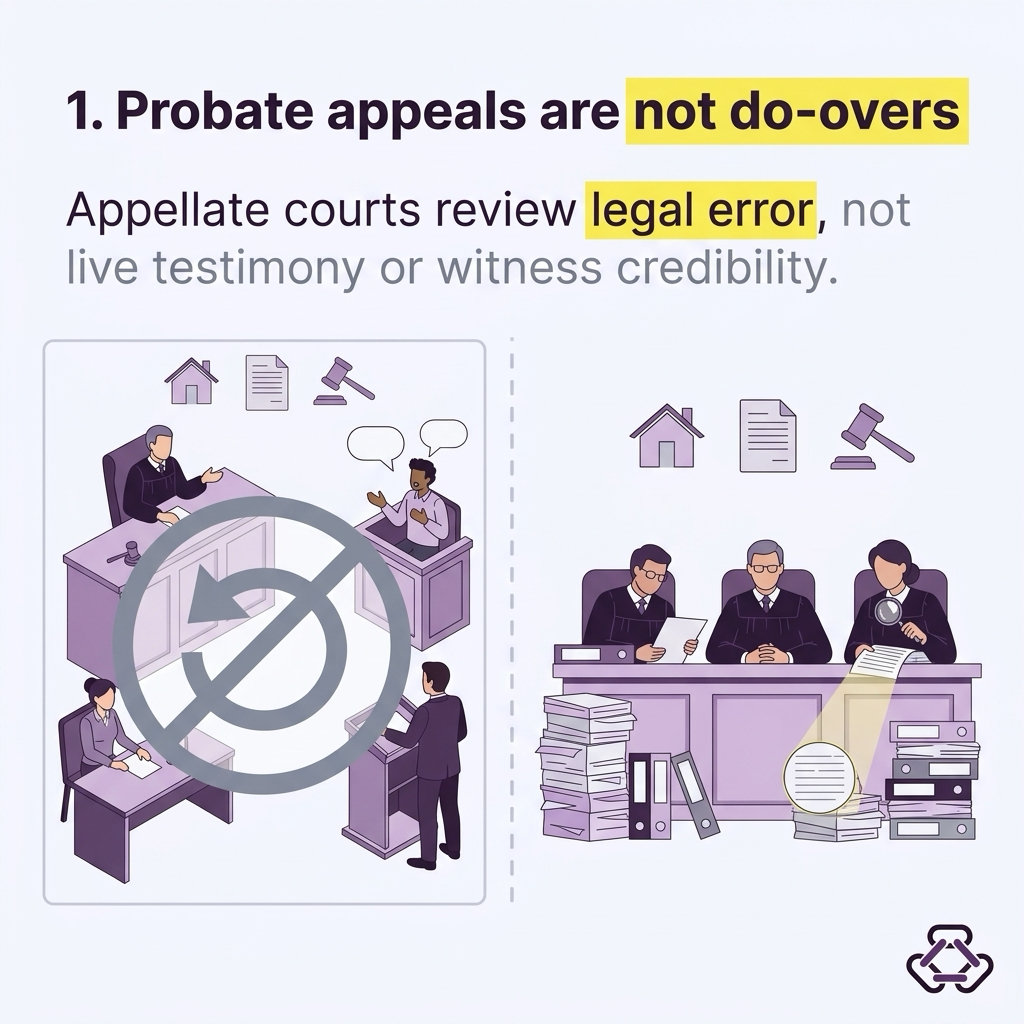
Those questions matter because appeals are not do-overs. An appellate court usually does not hear live testimony, reweigh credibility, or start fresh. Instead, it reviews a written record and applies a particular standard of review to a particular ruling. That framework often controls the result.
This post breaks down the core ideas behind probate appeals: what counts as a final or appealable order, how standards of review shape the court’s analysis, and what post-judgment strategy can look like after an adverse ruling. In this post you’ll learn how probate appeals are different from ordinary dissatisfaction with a hearing, why timing and record preservation matter so much, and how an attorney may evaluate the next move.
If you’re looking for a broader overview first, it may help to start with a plain-English introduction to probate appeal basics.
Scroll to the bottom for every post in this series.
Why Probate Appeals Are Different From Probate Hearings
A probate appeal is not a second hearing in front of a new judge. In general terms, it is a review of whether the lower court committed a legal error that affected the outcome. Appellate courts typically presume the trial court’s ruling was correct, and the person appealing has the burden to show error and prejudice. California’s appellate self-help materials explain that the reviewing court starts with that presumption of correctness, and reversal in civil cases generally depends on showing both error and a reasonable probability of a more favorable result absent that error (California Courts, California Courts Self-Help).
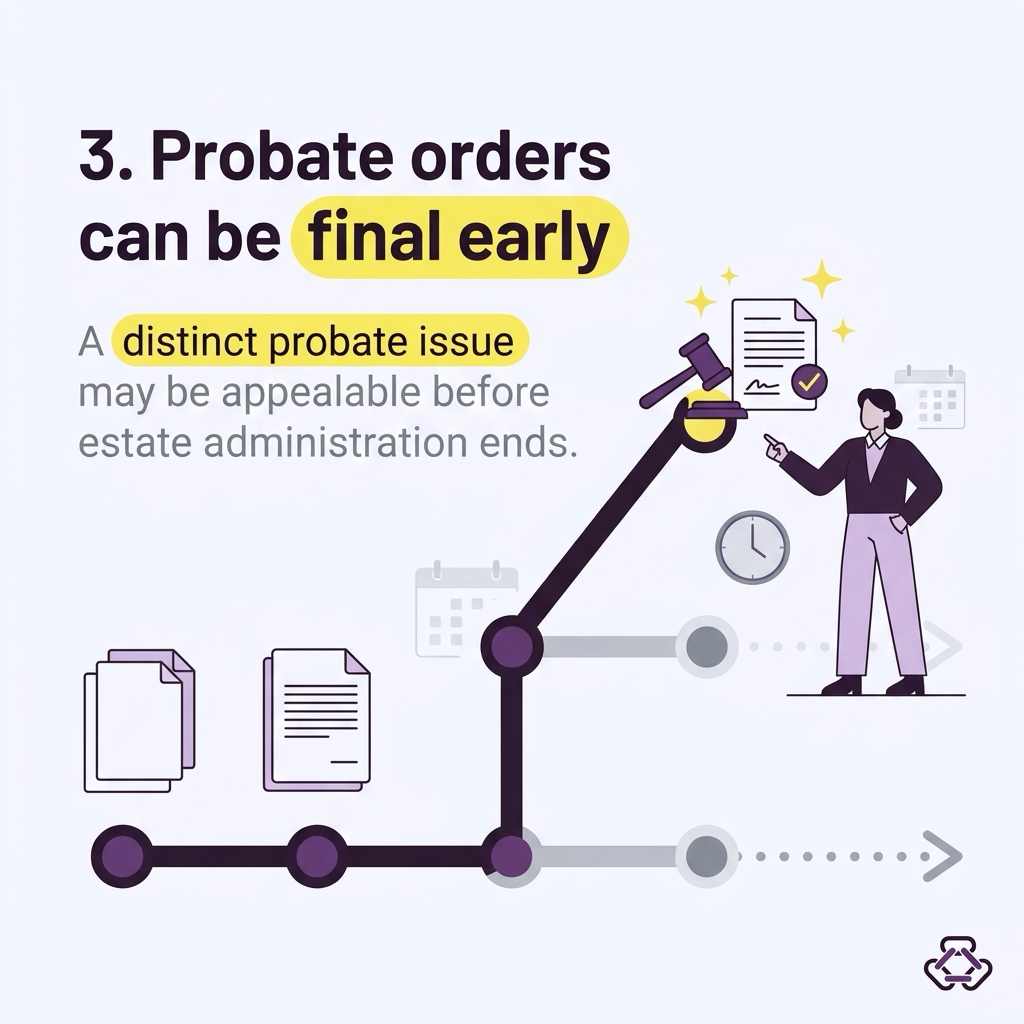
That distinction is especially important in probate because estate cases can generate many separate orders over time. Unlike the classic “one final judgment” model in ordinary civil litigation, probate often allows appeals from certain orders before the entire estate administration is over. California courts and probate statutes recognize that many probate orders are separately appealable, which is one reason probate appellate timing can become complicated (California Courts Self-Help, California Probate Code, Division 3, Part 3).
That means a party can lose appeal rights by assuming everything can wait until the estate closes. If you want a deeper discussion of that issue, this guide on figuring out whether a probate ruling can actually be appealed is a useful companion.
What Is A “Final Order” In A Probate Appeal?
In ordinary civil litigation, appeals usually follow a final judgment that resolves the whole case. Probate is more fragmented. Depending on the state and the type of proceeding, a ruling may be appealable if a statute specifically identifies it as appealable, or if it finally resolves a distinct probate issue.
California offers a good example. The Probate Code identifies categories of appealable probate orders in sections 1300 through 1304, rather than relying only on the standard final-judgment rule used in many civil cases (California Probate Code, Division 3, Part 3). California appellate guidance also notes that in family law and probate matters, many orders are appealable even though the broader case continues (California Courts Self-Help Manual PDF).
Here’s what that often looks like in practice:
Orders That Often Trigger Appeal Questions
Probate appeals frequently arise from orders involving:
- admission or rejection of a will
- appointment, removal, or powers of a personal representative
- approval or denial of accountings
- creditor claims
- trust-related rulings in probate court
- surcharge orders
- distribution orders
- fee awards
- orders determining heirship or ownership issues
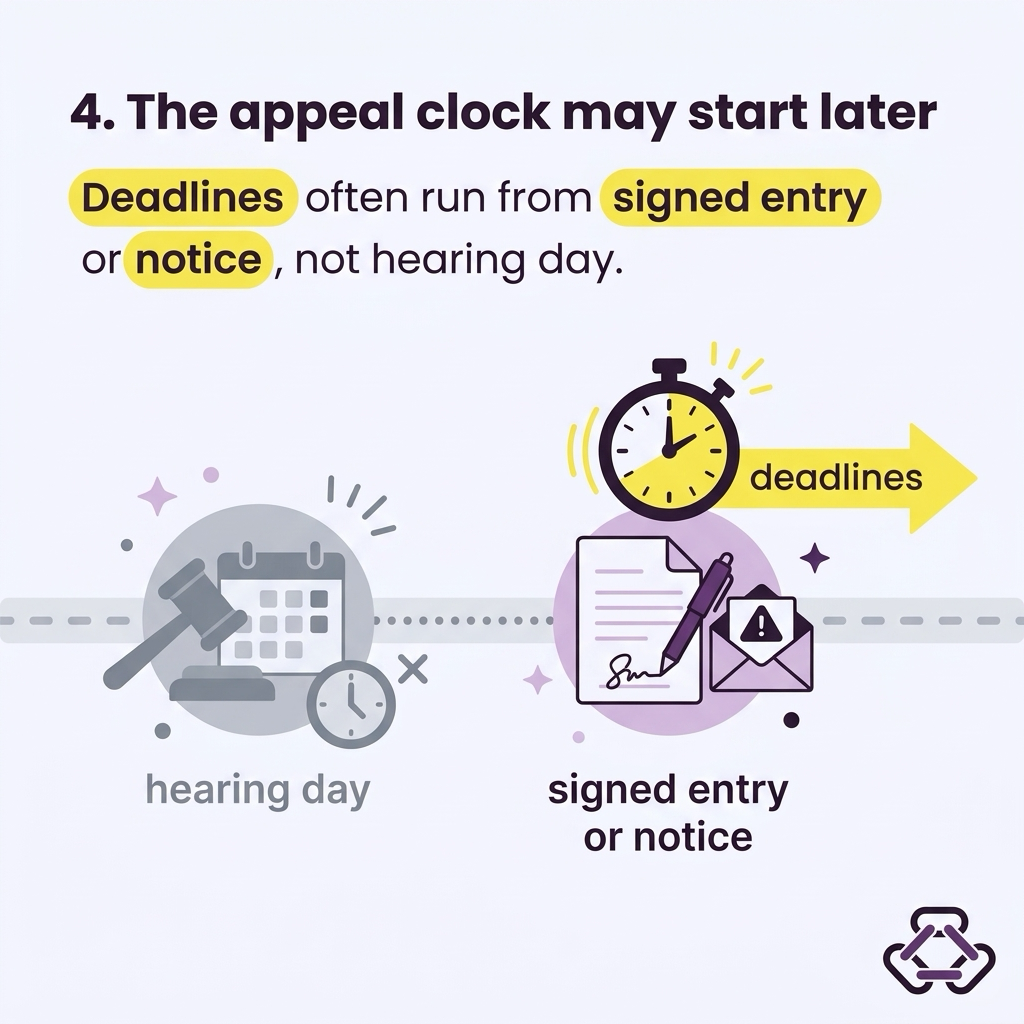
Whether one of these is immediately appealable depends on the governing statute and the procedural posture of the case. A ruling announced orally at a hearing is not always enough by itself. In many cases, the appeal clock runs from entry of the signed order or a notice of entry, not merely from the hearing date. California appellate materials repeatedly emphasize that the order being appealed has to be identifiable and timely noticed, and that a late notice of appeal typically leads to dismissal (California Courts, California Courts Self-Help).
Final Enough Versus Truly Final
One source of confusion is that an order may be “final” for appeal purposes even if the overall estate remains open. In general terms, appellate courts often ask whether the order effectively resolved the rights of the parties on that particular issue. Probate can involve a series of mini-proceedings inside one larger case, so one contested matter may become appealable before everything else is done.
This is one reason litigants often miscalculate deadlines after an unfavorable probate hearing. For a practical breakdown of the common confusion points, it may help to read these questions people tend to ask right after losing in probate court.
Why The Appealability Question Comes First
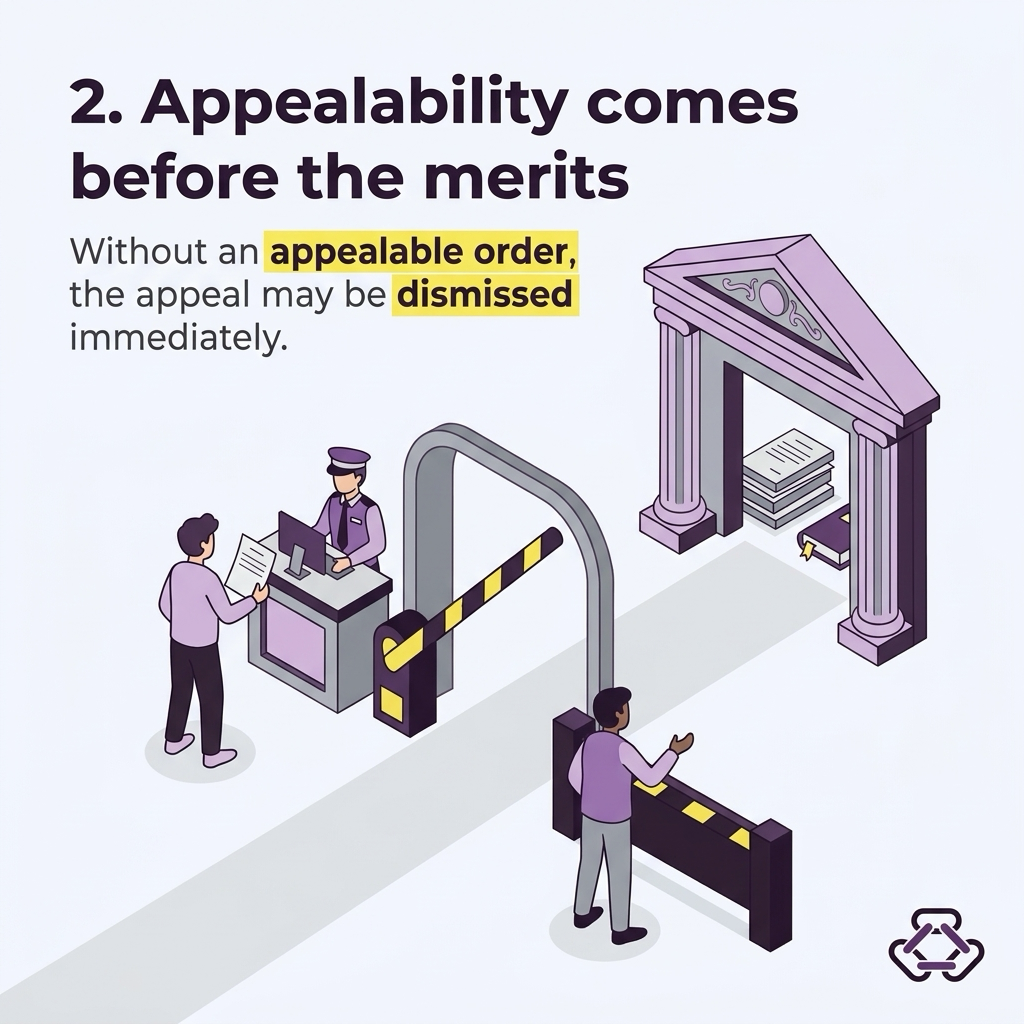
Before anyone gets to legal arguments, the appellate court usually asks a threshold question: Is there an appealable order or judgment? If not, the appeal may be dismissed without reaching the merits. California’s self-help guidance says exactly that: if there is no appealable order or judgment, the Court of Appeal dismisses the case (California Courts Self-Help).
That can happen even where the underlying complaint seems legitimate. A litigant may sincerely believe the probate judge got it wrong, but appellate jurisdiction is technical. The existence of error and the existence of appellate jurisdiction are different issues.
This is also why post-hearing strategy matters. Sometimes the better immediate question is not “How do I appeal?” but “What, exactly, was entered, and when?” Along with that, parties often look at whether the record is complete, whether objections were preserved, and whether a post-judgment motion could clarify or narrow the issues.
For more on the mechanics that can quietly shape the entire appeal, see this discussion on protecting the record, deadlines, and legal issues before review is lost.
Standards Of Review: The Part Of Probate Appeals People Often Miss
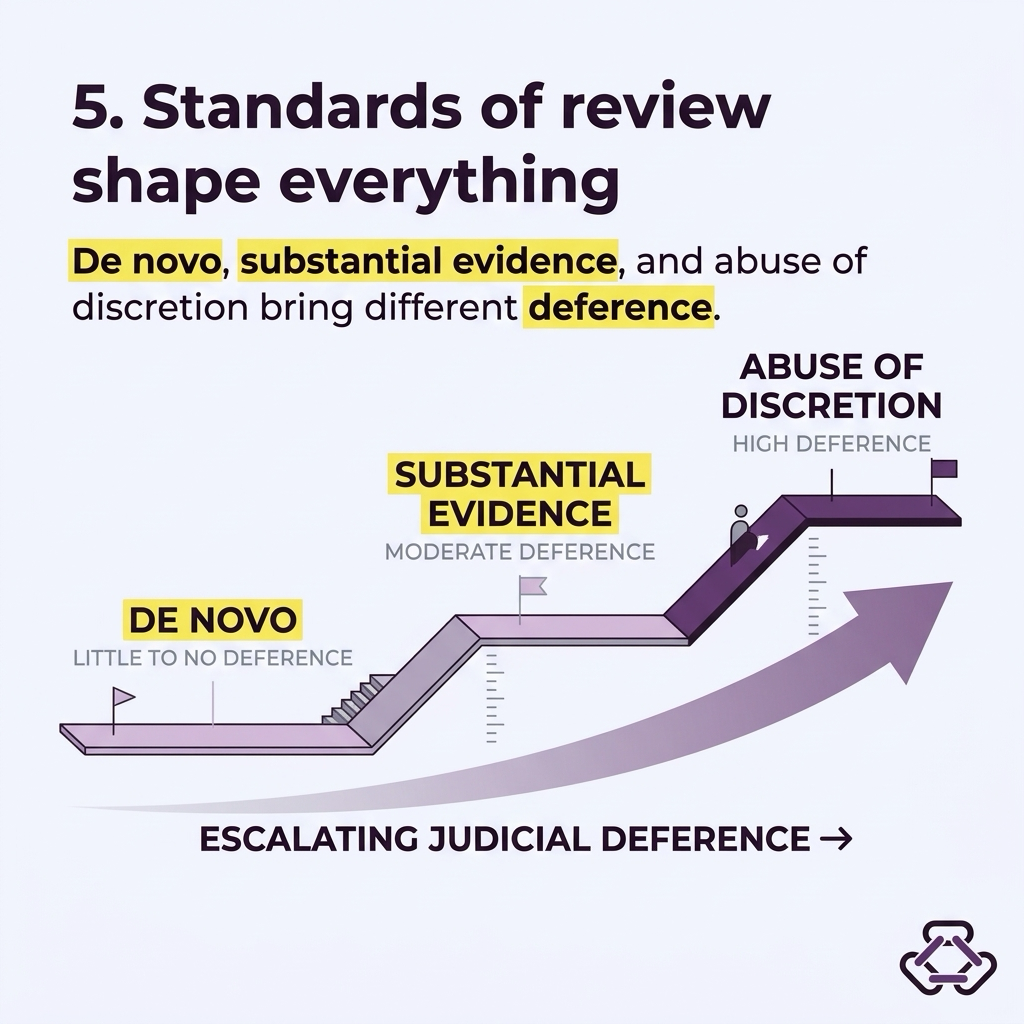
Even when an order is appealable, the appellate court does not examine every issue the same way. The standard of review determines how much deference the appellate court gives the probate judge. That is not a side issue. It often drives the odds, the briefing strategy, and the value of the appeal itself.
California Courts identifies three common standards of review in civil appeals: de novo, abuse of discretion, and substantial evidence (California Courts Self-Help). California appellate manuals use the same framework (California Courts Self-Help Manual PDF). Federal appellate materials and court guidance reflect a similar structure for legal questions, factual findings, and discretionary rulings (Ninth Circuit Standards Guide, Cornell LII, FRCP Rule 53).
De Novo Review
De novo review is the least deferential standard. The appellate court considers the legal issue independently, without relying on the trial court’s legal conclusion. California Courts explains that de novo review applies to legal questions and treats the issue as though the lower court had not ruled on it (California Courts Self-Help).
In probate, de novo review may apply to issues such as:
- statutory interpretation
- construction of a written instrument in some contexts
- legal sufficiency of pleadings
- whether the trial court applied the correct legal rule
For an appellant, this standard can be significant because the argument does not have to overcome as much deference. But it still depends on identifying a genuine legal issue, not simply disagreeing with the judge’s conclusion.
Substantial Evidence Review
If the probate court made factual findings, the appellate court often asks whether those findings are supported by substantial evidence. California Courts describes this as a highly deferential standard: the reviewing court does not decide whether it would have reached the same conclusion, only whether enough evidence supports the ruling (California Courts Self-Help).
That matters in probate disputes involving:
- witness credibility
- testamentary capacity evidence
- undue influence facts
- valuation disputes
- accounting disputes grounded in evidence
- tracing or ownership disputes
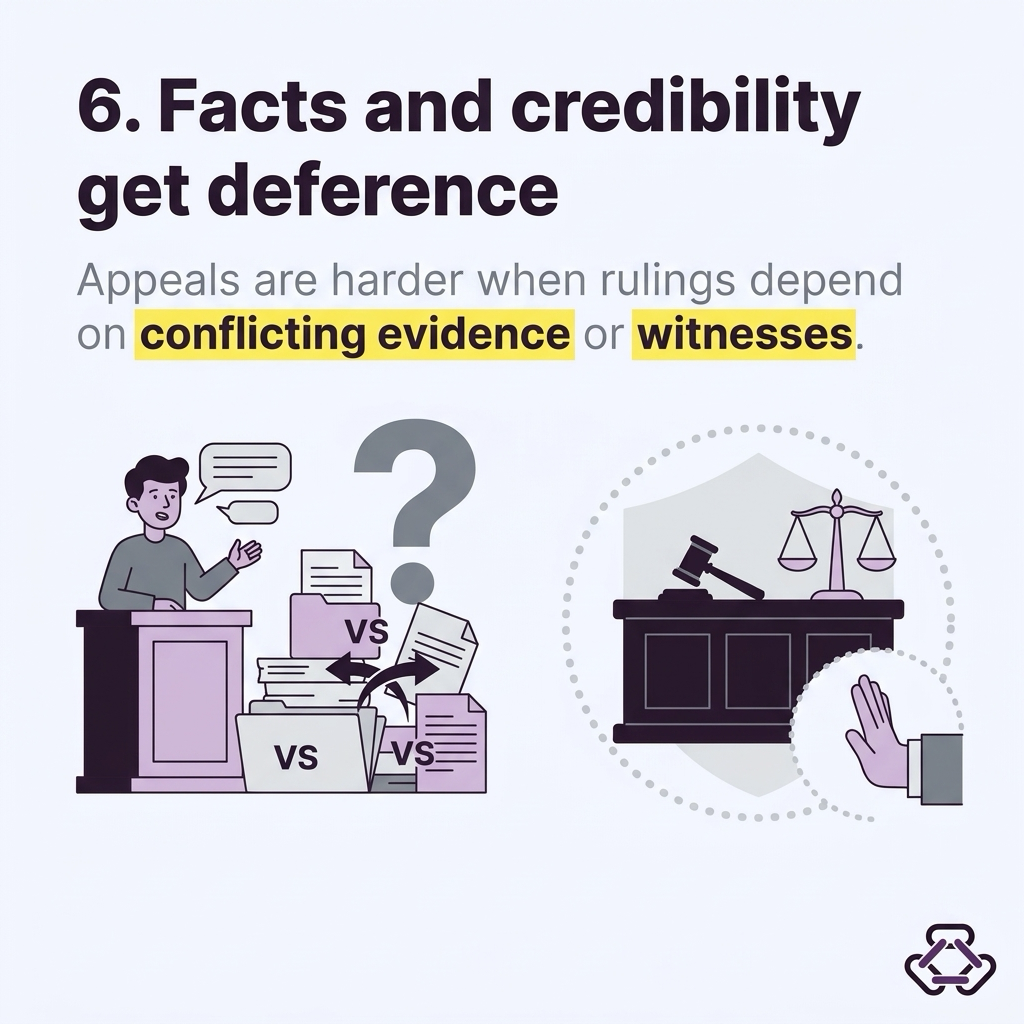
In practical terms, a party arguing “the judge believed the wrong witness” often faces an uphill appeal. Appellate courts generally do not retry credibility.
Abuse Of Discretion Review
Many probate rulings involve judgment calls by the trial court, and those decisions are often reviewed for abuse of discretion. California Courts notes that this standard applies when the trial judge had latitude to make a decision, such as evidentiary or procedural rulings, and that appeals under this standard can be difficult because the court gives substantial leeway to the trial judge (California Courts Self-Help).
In probate, abuse-of-discretion review may appear in disputes about:
- continuances
- evidentiary rulings
- approval of fees
- management of hearings
- sanctions
- some fiduciary administration decisions
An important nuance is that a single appellate issue can involve multiple standards of review. A probate judge’s legal interpretation might be reviewed de novo, factual findings for substantial evidence, and the ultimate equitable decision for abuse of discretion. That layered review framework is common enough that experienced appellate counsel often start by mapping each issue to its likely standard before drafting a brief.
Why Standards Of Review Shape Post-Judgment Strategy
The standard of review does more than frame the appeal. It also influences what parties do immediately after the ruling.
For example:
- If the problem is a legal interpretation, appellate counsel may view the issue as cleaner and more suited to prompt appeal.
- If the problem is a vague order or incomplete findings, a party may consider post-judgment clarification or other trial-court motions.
- If the problem is factual, counsel may focus heavily on the record, exhibits, transcripts, and preserved objections because the appellate court is likely to defer to the trial court’s factfinding.
This is where many litigants make costly assumptions. They focus on whether the ruling felt wrong rather than how the appellate court will review it. That disconnect can shape everything from issue selection to settlement leverage.
If you want to see where litigants commonly lose traction, this article on mistakes that can quietly destroy probate review rights is worth reading.
Post-Judgment Strategy After An Adverse Probate Order
Losing a probate ruling often creates a narrow decision window. In many cases, the key strategic questions include:
- Is the order appealable now?
- When does the deadline run?
- Would any post-judgment motion alter or extend deadlines?
- Is enforcement stayed automatically, or does separate relief matter?
- What issues were actually preserved in the record?
Those questions are closely related, but not interchangeable.
Timing Is Often The First Risk
Appellate deadlines are notoriously strict. California courts warn that untimely notices of appeal are subject to dismissal (California Courts). Federal appellate rules follow a similar deadline-based structure, and certain post-judgment motions can alter the time to appeal in federal civil cases under Federal Rule of Appellate Procedure 4 (Cornell LII, FRAP Rule 4, U.S. Courts).
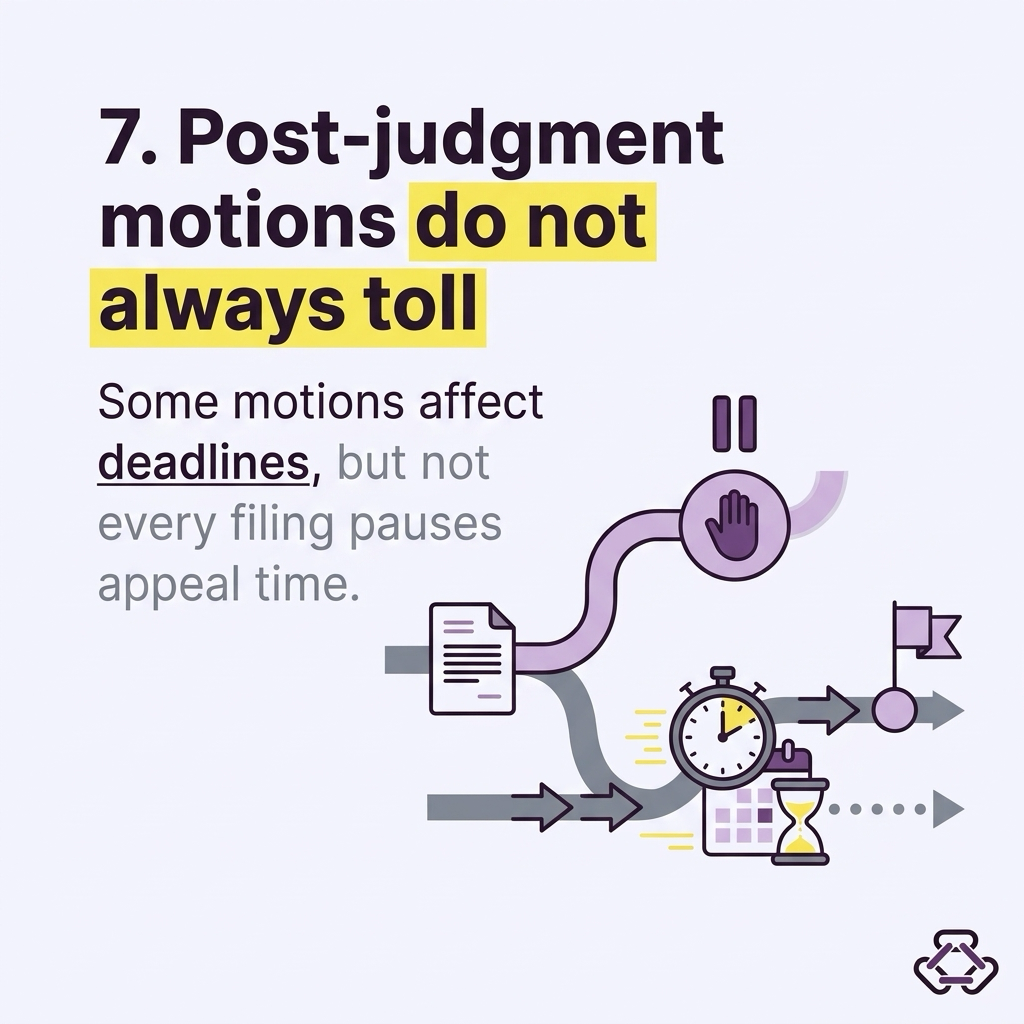
The exact tolling effect of post-judgment motions varies by jurisdiction and by rule. That makes local procedural analysis critical in probate matters, where one wrong assumption about a reconsideration motion, amended order, or notice of entry can change the appellate calendar.
Not Every Motion Stops The Appeal Clock
A common misunderstanding is that filing a post-judgment motion automatically pauses appeal deadlines. That is not universally true. In federal practice, only certain listed motions toll the appeal time under FRAP 4(a)(4), and timing matters (Cornell LII, FRAP Rule 4). State systems use their own rules, which may differ.
In practical terms, litigants often consider motions for reconsideration, motions to vacate, motions to amend findings, fee motions, or requests to correct clerical issues. Whether those filings help, hurt, preserve, narrow, or complicate the appeal depends heavily on the jurisdiction and the specific order involved.
Stays Matter More Than Many People Expect
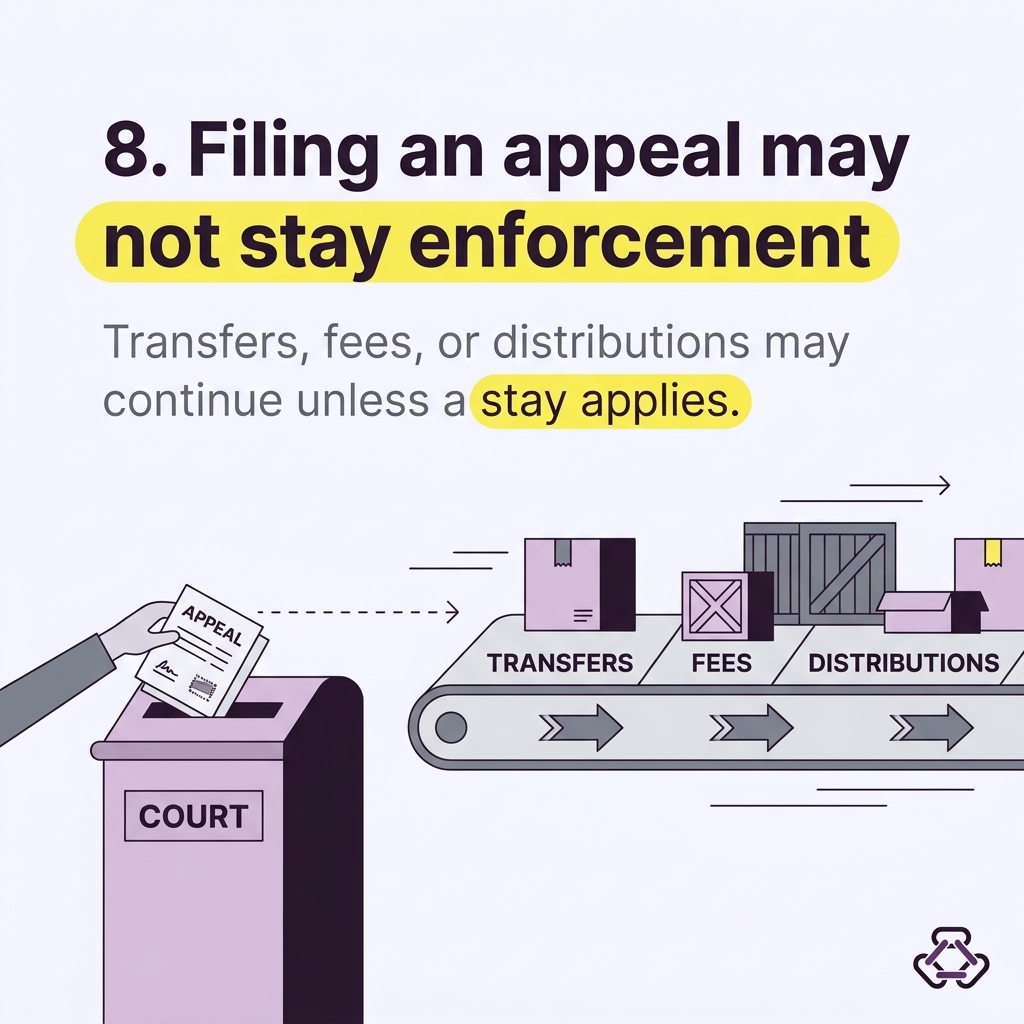
Filing an appeal does not automatically stop enforcement of the order in every probate case. California trial-court guidance notes this point plainly in discussing appeals: filing a notice of appeal does not itself stop enforcement (Superior Court of California, San Luis Obispo County). Federal practice likewise addresses stays separately under Rule 62, including security or bond issues in some circumstances (Cornell LII, FRCP Rule 62).
In probate, that can be consequential. Property may be transferred, fiduciaries may continue to act, fees may be paid, or distributions may move forward unless a stay applies or is obtained. So post-judgment strategy is often not just about preserving appellate rights. It can also involve evaluating whether interim relief is necessary to keep the dispute from becoming harder to unwind later.
The Record Often Decides The Appeal Before Briefing Starts
An appeal lives or dies on the record. If key objections, offers of proof, exhibits, transcripts, or written rulings are missing, the appellate court may presume the lower court acted correctly. California appellate forms and self-help materials emphasize the importance of designating the record and using the proper appellate forms after the notice of appeal is filed (California Courts Forms, California Courts Self-Help).
Probate appeals can be especially record-intensive because many disputes involve accountings, petitions, objections, declarations, and hearing transcripts spread over time. A strong appellate issue may weaken quickly if the record does not clearly show:
- what the judge ruled
- the legal basis for the ruling
- what objection was made
- where the supporting evidence appears
- whether the issue was preserved below
That is why experienced appellate lawyers often review the order, minute entry, hearing transcript status, notices of entry, and docket before giving any meaningful assessment.
Common Probate Appeal Scenarios
Although every state handles probate appeals through its own statutes and rules, several recurring patterns show up again and again.
“The Judge Got The Facts Wrong”
That reaction is common, but it often signals a substantial-evidence problem. If the ruling rested on conflicting testimony or competing inferences, the appeal may be more difficult because appellate courts generally defer to factual findings supported by the record (California Courts Self-Help).
“The Judge Applied The Wrong Legal Rule”
That may present a stronger appellate structure because legal questions are commonly reviewed de novo. Examples might include the interpretation of a probate statute, burden-shifting rule, or pleading standard.
“The Order Is Unclear”
Sometimes the immediate issue is not whether the ruling was right or wrong, but whether the order is sufficiently clear, entered, and appealable. In that situation, post-judgment clarification can become part of the strategy.
“I Lost The Hearing, So I’ll Appeal Later”
That can be risky in probate. Some orders are immediately appealable, and waiting may waive review. This is one of the reasons a prompt appealability analysis matters.
Choosing The Right Probate Appeal Strategy
A thoughtful probate appeal strategy often starts with a narrow, disciplined review:
- What exact order was entered?
- Is it appealable now?
- What standard of review likely applies to each issue?
- Was the alleged error preserved?
- Is there a transcript?
- Is there a practical reason to seek a stay?
- Are there post-judgment motions worth considering?
- Does the economics of the appeal make sense in light of the estate, trust, or fiduciary dispute?
Those questions are less dramatic than a courtroom showdown, but they often matter more.
And because probate appeals combine technical deadlines with emotionally charged family disputes, many people find that the most difficult part is simply identifying counsel with documented experience in highly similar matters. General probate familiarity is helpful, but appeals bring a different skill set: issue preservation, standard-of-review analysis, appellate briefing, and record strategy.
Final Thoughts
Probate appeals revolve around structure as much as substance. The order has to be appealable. The notice has to be timely. The issue has to be preserved. The standard of review has to fit the argument. And post-judgment strategy often begins before the appellate brief is ever written.
If you’re sorting through an adverse estate or trust ruling, a focused evaluation of the final order, the likely standard of review, and the available post-judgment options can reveal whether the dispute is really an appeal problem, a record problem, a timing problem, or some combination of all three.
Visit ReferU.AI to get matched with an attorney who has demonstrable experience in cases like yours — for free.


