Table of Contents
- Trade Secret Misappropriation Explained: Confidential Data, Departures, Injunctions, and Competitive Harm
- What Is Trade Secret Misappropriation?
- What Counts As Confidential Data In A Trade Secret Case?
- Why Departing Employees So Often Trigger Trade Secret Claims
- What Makes Information Legally Protectable Instead Of Just Sensitive?
- How Misuse Is Proven When No One Admits Anything
- When Injunctions Become The Main Event
- What “Competitive Harm” Looks Like In Plain English
- Lost Head Start
- Compromised Pricing
- Customer Relationship Disruption
- Product Development Leapfrogging
- Market Confusion And Reputational Damage
- Can A Court Order Seizure Of Devices Or Data?
- What About Whistleblowers And Employees Reporting Misconduct?
- Why Early Strategy Often Shapes The Entire Case
- A Short Summary

Type
Grandchild
Status
Approved
Title (YouTube)
Images Failed (Social)
Images Failed (Social)
Do not index
Publish Date (TikTok)
Jan 8, 2027 10:15
Videos Post IDs (Social)
Hashtags (Social)
#LegalAdvice #LegalHelp #BusinessLitigation #TradeSecret
Caption
Caption X
Cover

OG Image

Alt Image Text
Flat vector illustration of trade secret misappropriation involving confidential data, employee departure, injunctions, and competitive harm.
Images


Videos

Publish Date (Social)
Dec 18, 2026 06:00
Scheduled (Social)
Scheduled (Social)
Images Posted (Social)
Images Posted (Social)
Videos Posted (Social)
Videos Posted (Social)
Videos Failed (Social)
Videos Failed (Social)
Featured
Created time
Apr 3, 2026 10:11 PM
Authors
CTA Practice Area (Social)
Business Litigation
TikTok Failed (Social)
TikTok Failed (Social)
Videos Post Links (Social)
YT Auto Captions Removed
TikTok Post Links (Social)
Images Post IDs (Social)
YT Post ID
Video Pending Manual (Social)
TikTok Posted (Social)
TikTok Posted (Social)
TikTok Post IDs (Social)
Video Cover (Social)

Images Post Links (Social)
First Comment (Social)
YT Embedded
YT Embedded
Images Delete (Social)
Videos Delete (Social)
Carousel Video URL (Social)
Trade Secret Misappropriation Explained: Confidential Data, Departures, Injunctions, and Competitive Harm
When confidential business information walks out the door, the damage can move faster than most companies expect. A pricing model lands with a competitor. Source code appears in a new product. A departing executive downloads files the night before resigning. A customer list starts resurfacing in targeted outreach from a rival. In many situations, the legal issue is not just “data theft” in the everyday sense. It may be trade secret misappropriation.
Trade secret disputes sit at the intersection of business strategy, employment transitions, cybersecurity, and emergency litigation. They also tend to be intensely fact-specific. Whether a company is looking at a former employee, a vendor, a founder, or a competitor, the first questions often revolve around the same themes: Was the information really secret? Who had access? What was taken? How quickly can a court intervene? And how do you show competitive harm before the damage spreads further?
In this post you’ll learn how trade secret misappropriation is generally defined, what kinds of confidential data may qualify, how departures often trigger disputes, when injunctions enter the picture, and why companies often move quickly when competitive harm is on the line. If you want broader context on how these cases fit into larger commercial disputes, this overview of business and contract litigation issues companies often face can help frame the bigger picture.
Scroll to the bottom for every post in this series.
What Is Trade Secret Misappropriation?
At a high level, a trade secret is information that has economic value because it is not generally known and is subject to reasonable efforts to keep it secret. The U.S. Patent and Trademark Office describes trade secrets in similar terms and notes that all three elements matter: value from secrecy, lack of general public knowledge, and reasonable measures to maintain secrecy. (USPTO)
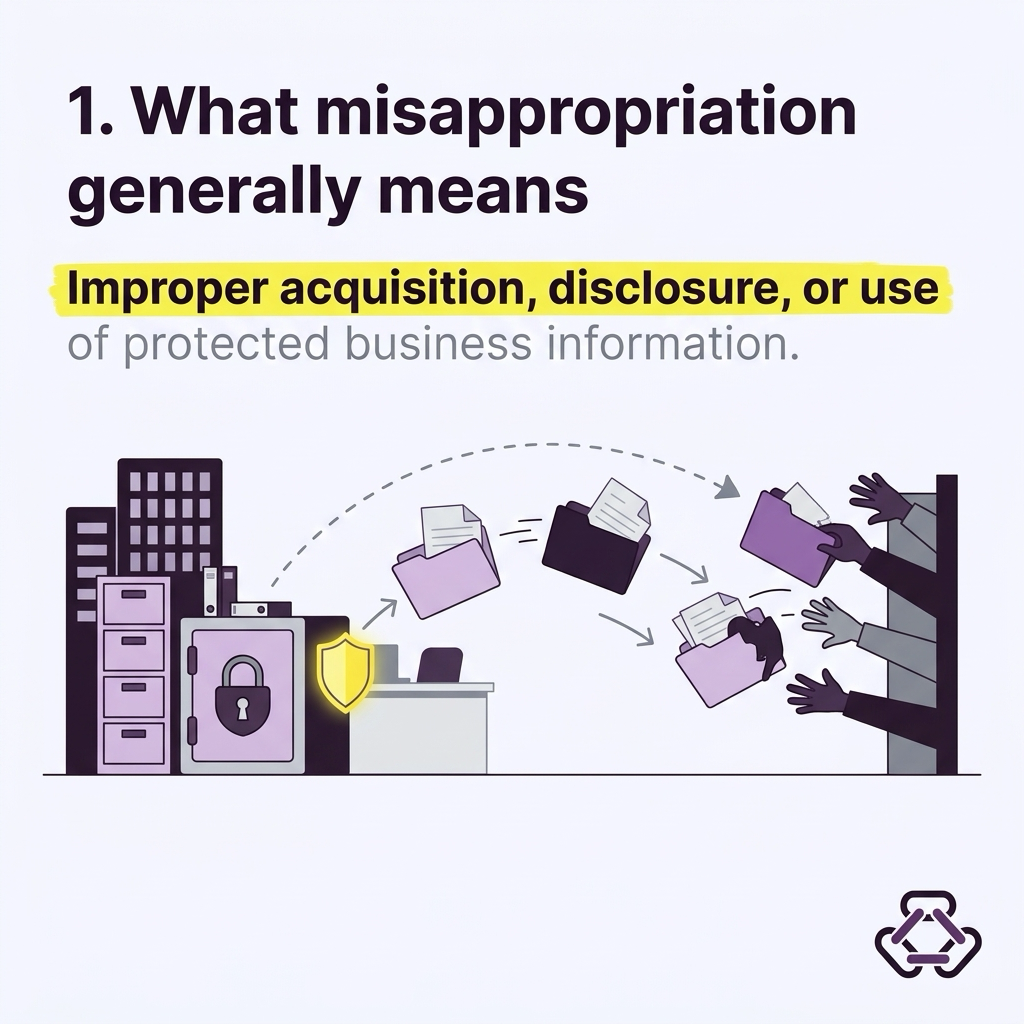
Misappropriation usually refers to improper acquisition, disclosure, or use of that protected information. In practice, that can look very different from case to case. It may involve copying engineering documents, forwarding confidential files to a personal account, using internal pricing models for a competing bid, disclosing formulas or manufacturing processes, or taking structured internal data that gives a rival a shortcut it did not earn.
Trade secret claims often arise under state law, commonly through versions of the Uniform Trade Secrets Act, and also under federal law through the Defend Trade Secrets Act of 2016, often called the DTSA. The DTSA gives federal courts authority to hear civil trade secret claims involving trade secrets related to products or services used in interstate or foreign commerce. (Cornell Legal Information Institute)
If you want a broader foundation before getting into misappropriation mechanics, it may help to start with this plain-language guide on how businesses protect proprietary information in trade secret cases.
What Counts As Confidential Data In A Trade Secret Case?
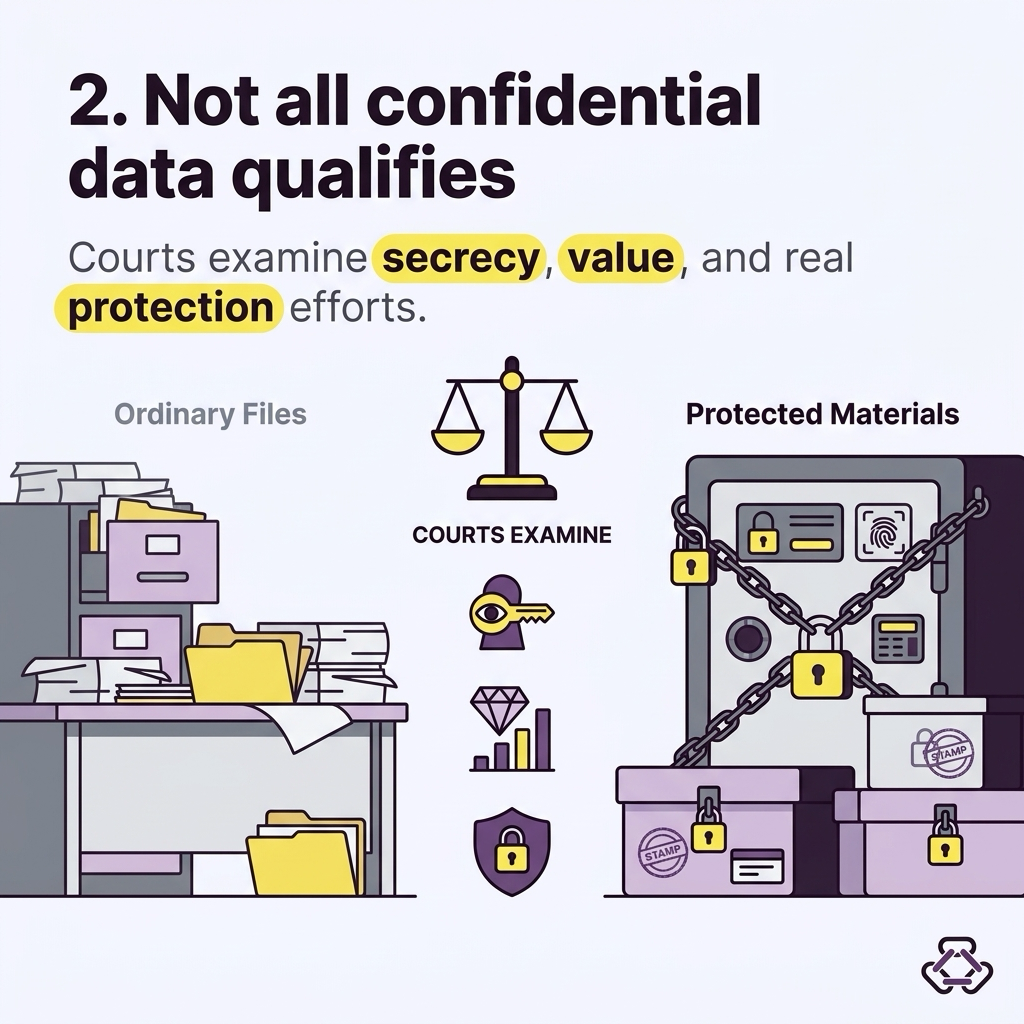
Not every confidential document is a trade secret, and not every internal file carries the same legal weight. That distinction matters.
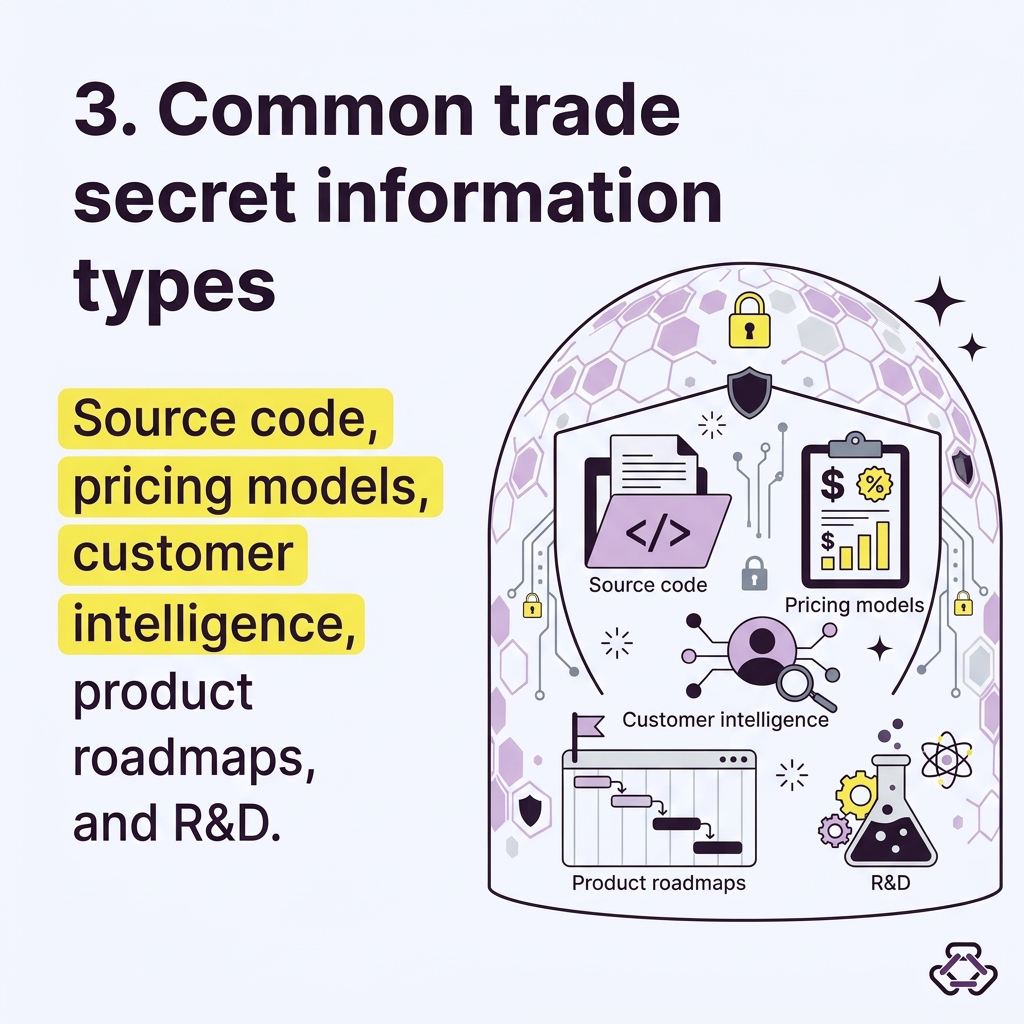
Trade secret claims often involve information such as:
- source code and software architecture
- product formulas and technical specifications
- manufacturing methods and process know-how
- pricing models and cost data
- customer lists with nonpublic intelligence
- sales pipelines and strategic business plans
- vendor terms and sourcing information
- research and development materials
- unreleased product roadmaps
- datasets that took substantial effort to build
Courts typically look beyond labels like “confidential” and focus on facts. A file marked secret is not automatically a trade secret. On the other hand, information can still qualify even if it sits inside ordinary business systems, as long as the company limited access and treated it as protected. Cornell’s Wex notes that customer information stored on a restricted-access computer and subject to confidentiality provisions may qualify in the right circumstances. (Cornell Wex)
That is one reason companies in these disputes often spend so much time documenting how the information was created, where it was stored, who could access it, and why it mattered competitively. The legal fight is often less about broad labels and more about careful proof. For a closer look at that proof structure, this article on showing secrecy, access, and misuse in a business dispute digs into the evidence issues these cases often turn on.
Why Departing Employees So Often Trigger Trade Secret Claims
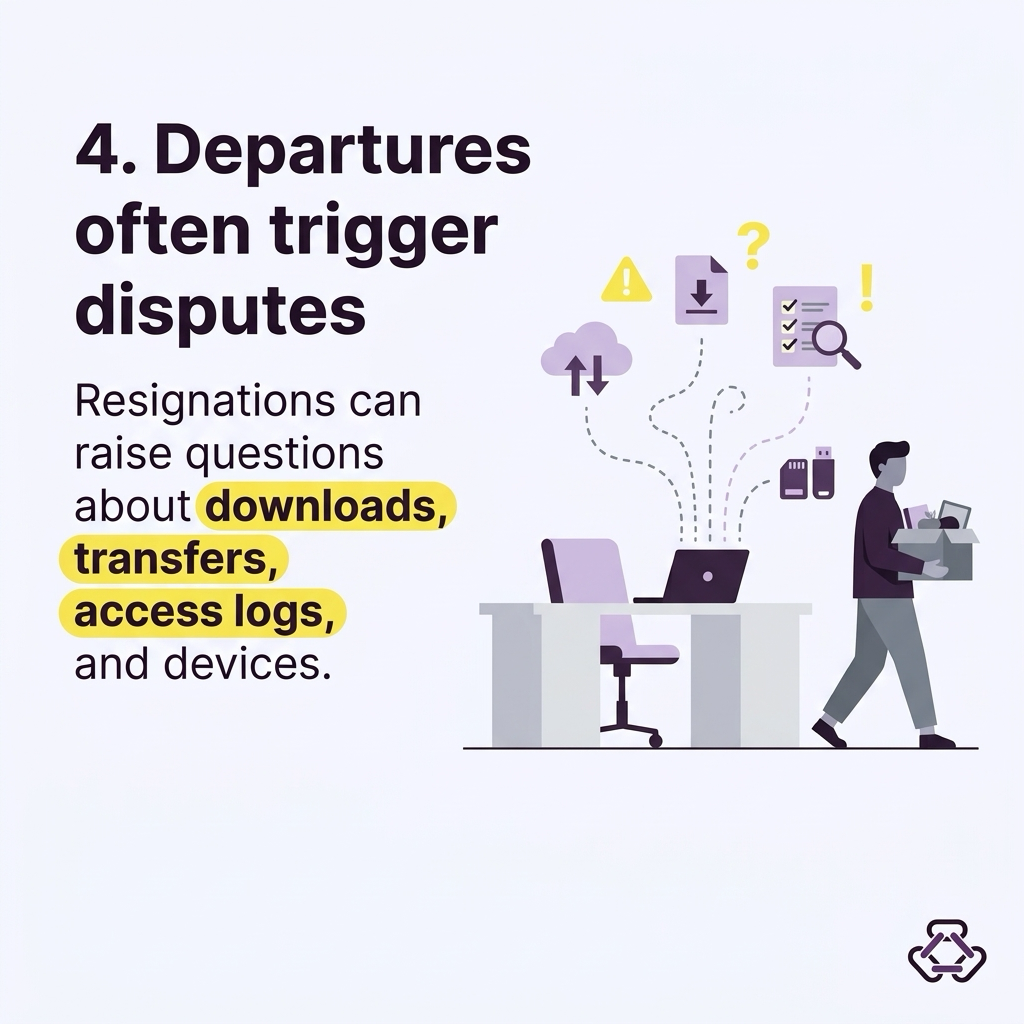
A large share of trade secret disputes begin around a departure. That is not necessarily because every departing employee does something improper. It is because transitions create a moment when access, loyalty, urgency, and competition all collide.
A departing employee may still know the company’s systems, customer strategy, technical architecture, and internal playbook. If that employee joins a competitor, launches a competing venture, or starts contacting the same accounts, a business may begin asking hard questions:
- Were files downloaded shortly before resignation?
- Did anyone send documents to a personal email or cloud account?
- Did the employee copy customer, pricing, or product materials?
- Did access logs spike right before departure?
- Did devices get wiped, reset, or replaced?
- Are former customers suddenly hearing a very familiar pitch?
These concerns are not hypothetical. Recent Department of Justice trade secret cases continue to involve insiders and former personnel alleged to have used their access to remove large volumes of confidential information. In one 2025 case, DOJ alleged a former Google engineer uploaded more than 1,000 unique files containing confidential information, including trade secrets, to a personal cloud account. (DOJ) In another 2025 case, a former manager at a defense contractor pleaded guilty to theft of trade secrets tied to misuse of secure-network access. (DOJ)
Civil cases are different from criminal prosecutions, of course. But these examples reflect a pattern businesses know well: trusted access can become the path by which protected information leaves the company.
For companies trying to understand the first moves after files go missing, this guide on responding when a former employee or competitor takes internal information covers the early-stage issues that often matter most.
What Makes Information Legally Protectable Instead Of Just Sensitive?
This is often the core dispute.
Businesses sometimes assume that because information is important, it is automatically protected as a trade secret. Courts usually take a narrower view. The company often has to show that it made reasonable efforts to maintain secrecy. The USPTO expressly identifies reasonable secrecy measures as one of the essential elements of trade secret protection. (USPTO)
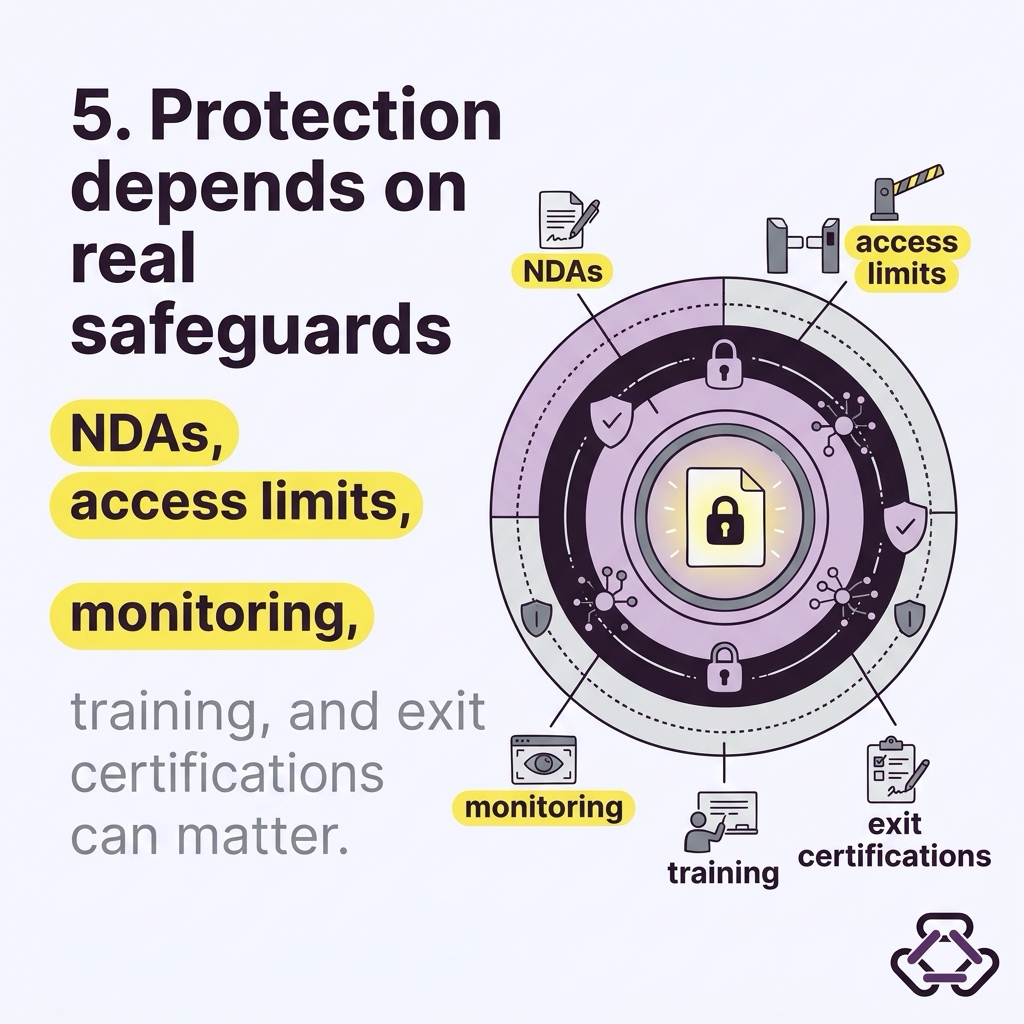
In general terms, evidence of reasonable efforts may include:
- confidentiality agreements
- access restrictions by role or department
- password protections and authentication controls
- document labeling practices
- training on confidential information handling
- device and download monitoring
- return-of-property and exit certifications
- vendor NDAs and restricted data rooms
- segmentation of highly sensitive technical information
Cybersecurity evidence can also become part of the story. NIST’s guidance on data confidentiality highlights the financial, reputational, and legal impacts data breaches can create and focuses on identifying and protecting valuable data assets. (NIST) In some trade secret cases, that kind of information supports a broader narrative: the company did not merely say the data was important, it structured protections around it.
That said, reasonable efforts do not necessarily require perfect secrecy. Companies still lose points when sensitive files sit in shared drives open to broad internal audiences, when there is no onboarding or exit process, or when no one can explain who had access and why.
How Misuse Is Proven When No One Admits Anything
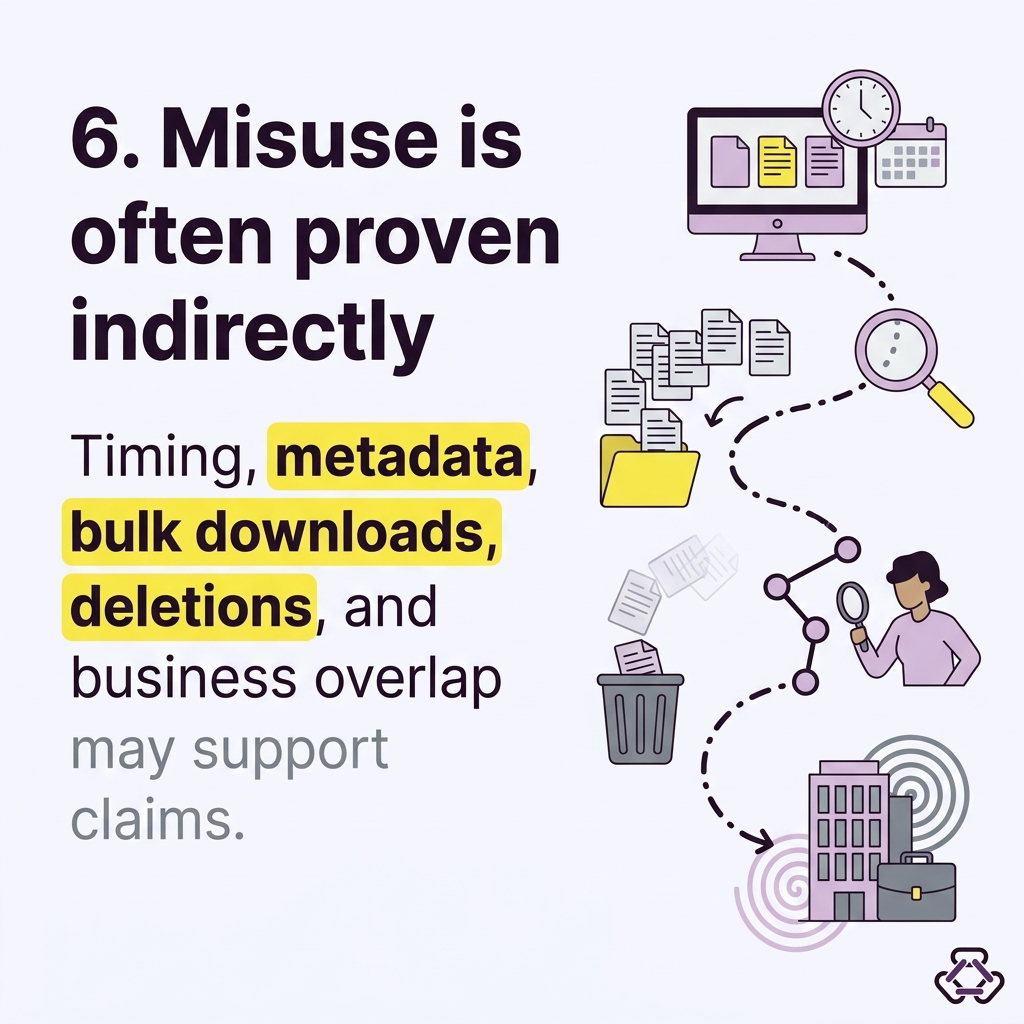
Direct evidence is not always available. Rarely does a defendant send a message saying, “I took the trade secret and used it.” Many cases are built through timing, access, forensic evidence, business overlap, and circumstantial proof.
Examples may include:
- audit logs showing bulk downloads before resignation
- use of USB devices, personal drives, or unsanctioned cloud sync
- deletion activity or wiping behavior
- metadata connecting copied files to later business activity
- suspiciously fast product development by a competitor
- bid strategies that mirror internal pricing logic
- customer solicitations reflecting nonpublic account intelligence
- overlap between taken files and later competitive conduct
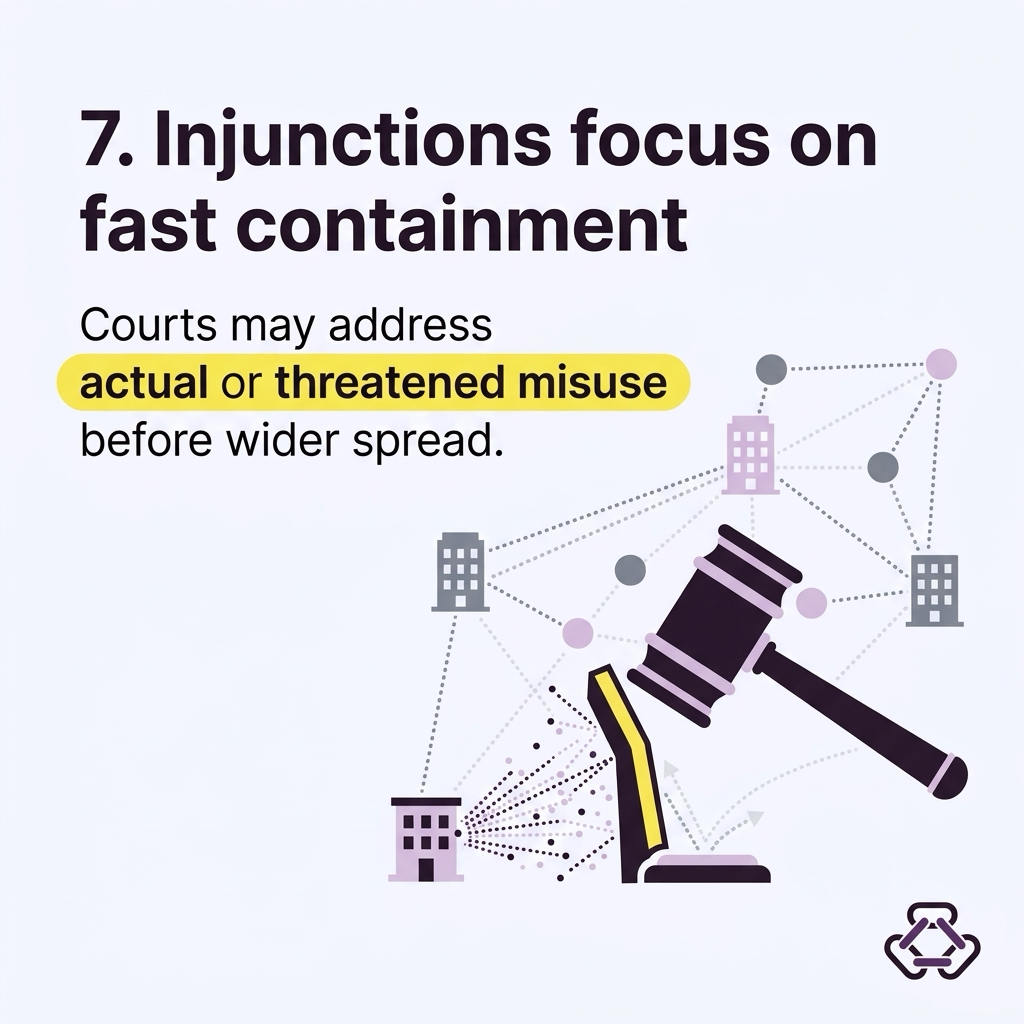
The DTSA also authorizes injunctions against actual or threatened misappropriation, which means some cases move before full downstream use is visible. (Cornell Legal Information Institute) That is one reason forensic preservation and speed often matter so much. If a company waits too long, the evidence may become harder to isolate, and the argument for urgency may weaken.
If you are trying to understand how lawyers build that evidentiary chain, this explainer on proving trade secret status, access, and misuse gets into the nuts and bolts.
When Injunctions Become The Main Event
In trade secret litigation, money is often not the first concern. Containment is.
Once confidential information is disclosed or used, the commercial harm can spread quickly. A rival may undercut bids, accelerate a launch, target accounts more effectively, or integrate proprietary know-how into operations. That is why these cases frequently revolve around requests for temporary restraining orders, preliminary injunctions, expedited discovery, and other forms of emergency relief.
Under the DTSA, a court may grant an injunction to prevent actual or threatened misappropriation, order affirmative steps to protect the trade secret, and in certain exceptional circumstances condition future use on payment of a reasonable royalty. The same statute also limits injunctions that would function as broad restraints on employment; restrictions must be based on evidence of threatened misappropriation, not merely what a person knows. (Cornell Legal Information Institute)
That balance is important. Courts often try to protect legitimate trade secrets without turning every job change into a de facto noncompete. The FTC has also emphasized that trade secret law and NDAs are among the established alternatives employers use to protect proprietary information, while its nationwide noncompete rule is not in effect and not enforceable as of its current public guidance. (FTC)
In real-world litigation, injunction fights often focus on questions like:
- Is the information specific enough to identify?
- Is there evidence of access and threatened use?
- What competitive harm is likely if nothing changes?
- Were secrecy measures real and consistent?
- Is the requested order narrowly tailored?
- Has the plaintiff moved quickly enough to justify emergency relief?
For judges, these issues are significant enough that the Federal Judicial Center maintains a dedicated Trade Secret Case Management Judicial Guide on handling trade secret litigation. (Federal Judicial Center)
And if emergency relief is a particular concern, this article on mistakes that can make urgent court intervention harder to get may help clarify why some cases lose momentum early.
What “Competitive Harm” Looks Like In Plain English
Competitive harm is not always immediate lost revenue on a spreadsheet. Often, it is the unfair acceleration or distortion of competition that follows unauthorized access to secret information.
Some common examples include:
Lost Head Start
A competitor may save years of research, testing, or relationship-building by obtaining information it did not independently develop.
Compromised Pricing
If internal pricing logic, discount thresholds, or margin targets are exposed, future bids can become less predictable and more vulnerable.
Customer Relationship Disruption
Customer lists by themselves are not always trade secrets, but customer intelligence often carries greater value when it includes decision-maker preferences, renewal timing, buying history, pain points, or nonpublic contract details.
Product Development Leapfrogging
Technical files, source code, formulas, or manufacturing methods may allow a rival to close gaps much faster than normal competition would allow.
Market Confusion And Reputational Damage
If confidential files appear in a former employee’s new venture or in a competitor’s offering, the original business may face internal disruption, customer questions, and trust erosion.
In litigation, companies often try to convert these harms into a persuasive story for the court: this is not ordinary competition; this is competition enhanced by confidential information that was not supposed to be in the other side’s hands.
Can A Court Order Seizure Of Devices Or Data?
Sometimes, but the remedy is unusual.
The DTSA includes a civil seizure mechanism designed for extraordinary circumstances. It allows courts to order the seizure of property necessary to prevent propagation or dissemination of a trade secret, but the statute builds in safeguards. Service and seizure are carried out by law enforcement, not the applicant, and the party who obtained the order bears the burden at a prompt hearing to justify it. The statute also provides a cause of action for wrongful or excessive seizure. (Cornell Legal Information Institute)
Because seizure is so sensitive, courts and litigants often treat it as a last-resort remedy rather than a standard opening move. The Federal Judicial Center even provides specific materials on trade secret seizure best practices under the DTSA, which reflects how exceptional and carefully managed this remedy tends to be. (Federal Judicial Center)
In many cases, companies instead pursue narrower forms of relief first, such as preservation orders, device imaging protocols, access restrictions, or expedited discovery.
What About Whistleblowers And Employees Reporting Misconduct?
Trade secret law is not absolute.
The DTSA contains a whistleblower immunity provision for certain confidential disclosures made to government officials or attorneys solely for the purpose of reporting or investigating suspected legal violations, as well as certain sealed court filings. The same statute also includes a notice requirement for employers: if an employer does not provide notice of this immunity in agreements governing trade secrets or confidential information, the employer may lose access to exemplary damages and attorney’s fees in certain employee cases. (Cornell Legal Information Institute)
This becomes important in departure disputes because not every retention or transfer of internal documents is framed the same way. Sometimes an employee says the documents were retained to report wrongdoing, defend against claims, or consult counsel. That does not automatically resolve the dispute, but it often changes the analysis.
An attorney may help separate legitimate whistleblower issues from opportunistic after-the-fact explanations, especially when the facts are mixed and the stakes are high.
Why Early Strategy Often Shapes The Entire Case
Trade secret disputes can harden quickly. The first days often affect leverage, evidence quality, and remedy options.
Early issues often include:
- preserving logs, devices, and accounts
- deciding whether to send a demand letter
- assessing whether to file in state or federal court
- considering emergency motion practice
- narrowing the list of alleged trade secrets
- coordinating HR, IT, management, and outside counsel
- managing customer communications
- avoiding overstatement that can undermine credibility later
One common tension is breadth. Companies sometimes want to claim everything as a trade secret. Courts often react better to precision. Specific, defensible identification can be more persuasive than sweeping accusations that make the case feel untethered.
For companies working through the practical uncertainties after files leave the building, this post answering common questions about client lists, pricing files, and internal documents that disappear may be a useful companion.
A Short Summary
Trade secret misappropriation cases are about more than secret files. They are about business advantage, evidence, urgency, and control over confidential know-how. The central questions usually include whether the information truly qualified for protection, whether the company took reasonable steps to keep it secret, how the information was acquired or used, and what competitive harm may follow if a court does not intervene quickly.
Departures often trigger these disputes because access and competition collide at the same moment. Injunctions often matter because once a secret spreads, damages alone may not fully contain the problem. And the details matter enormously: access controls, download history, device activity, confidentiality policies, customer overlap, and the speed of the company’s response can all affect how a court sees the case.
If your business is dealing with confidential data exposure, a former employee dispute, or suspected misuse by a competitor, an attorney with demonstrable experience in highly-similar matters may help evaluate the facts, preserve evidence, and assess what relief may be available. Visit ReferU.AI to get matched with an attorney who has demonstrable experience in cases like yours — for free.


