Table of Contents
- Temporary Protected Status Explained: Eligibility, Re-Registration, Travel, and Risk
- What Is Temporary Protected Status?
- Who May Be Eligible For TPS?
- Nationality And Country Designation Matter
- Continuous Residence And Continuous Physical Presence Are Not The Same
- Criminal History Can Change The Analysis Fast
- Does TPS Apply Automatically If A Country Is Designated?
- What Is Re-Registration And Why Does It Matter So Much?
- Re-Registration Is Not The Same As Initial Filing
- Employment Authorization Can Involve Separate Timing Questions
- Can A Person Travel With TPS?
- Leaving Without Permission Can Be A Major Problem
- Travel Authorization Is Not A Promise Of Reentry
- Prior Unlawful Presence Or Other Immigration Issues Can Affect Travel Risk
- What Are The Biggest Risks For People With TPS?
- Country-Level Risk
- Filing Risk
- Travel Risk
- Hidden-History Risk
- Does TPS Lead To A Green Card?
- What Happens If TPS Ends For A Country?
- Why Attorney Screening Matters In TPS Cases
- The Bottom Line On TPS

Type
Grandchild
Status
Approved
Title (YouTube)
Images Failed (Social)
Images Failed (Social)
Do not index
Parent item
Publish Date (TikTok)
Apr 23, 2027 07:15
Videos Post IDs (Social)
Hashtags (Social)
#LegalAdvice #LegalHelp #Immigration #TemporaryProtectedStatus
Caption
Caption X
Cover

OG Image

Alt Image Text
Flat vector illustration of Temporary Protected Status with re-registration, travel, and risk concepts shown through a protected immigrant figure, passport, calendar, and airplane icons.
Images

Videos

Publish Date (Social)
Feb 17, 2027 12:30
Scheduled (Social)
Scheduled (Social)
Images Posted (Social)
Images Posted (Social)
Videos Posted (Social)
Videos Posted (Social)
Featured
Created time
Apr 7, 2026 12:02 AM
Authors
CTA Practice Area (Social)
Immigration
TikTok Failed (Social)
TikTok Failed (Social)
Videos Post Links (Social)
TikTok Post Links (Social)
Images Post IDs (Social)
YT Post ID
Video Pending Manual (Social)
TikTok Posted (Social)
TikTok Posted (Social)
TikTok Post IDs (Social)
Video Cover (Social)

Images Post Links (Social)
First Comment (Social)
Videos Failed (Social)
Videos Failed (Social)
YT Embedded
YT Embedded
Images Delete (Social)
Videos Delete (Social)
Carousel Video URL (Social)
Temporary Protected Status Explained: Eligibility, Re-Registration, Travel, and Risk
Temporary Protected Status, or TPS, is one of the most misunderstood forms of immigration protection in the United States. It can offer temporary protection from removal and temporary work authorization to people from countries facing armed conflict, environmental disaster, or other extraordinary and temporary conditions. But TPS also comes with deadlines, country-specific rules, travel complications, and real uncertainty when designations change or litigation intervenes.
If you are trying to understand where TPS fits within the broader immigration system, it may help to start with this overview of immigration options and defense issues. And if you want a simpler foundation before diving into the details here, this plain-language introduction to humanitarian protection under TPS can help frame the basics.
In this post, you’ll learn who may qualify for TPS, how re-registration works, what travel can put at risk, and why legal guidance often matters when a person’s immigration history is more complicated than it first appears.
Scroll to the bottom for every post in this series.
What Is Temporary Protected Status?
TPS is a temporary immigration status created by Congress in 1990. It applies only to nationals of countries that the U.S. government has formally designated for TPS. The Secretary of Homeland Security may designate a country when conditions there make return unsafe or impracticable, including ongoing armed conflict, environmental disaster, or extraordinary and temporary conditions. Designations, extensions, and terminations are published in the Federal Register and revisited periodically. USCIS explains the program here, and the American Immigration Council’s overview provides a helpful policy summary.
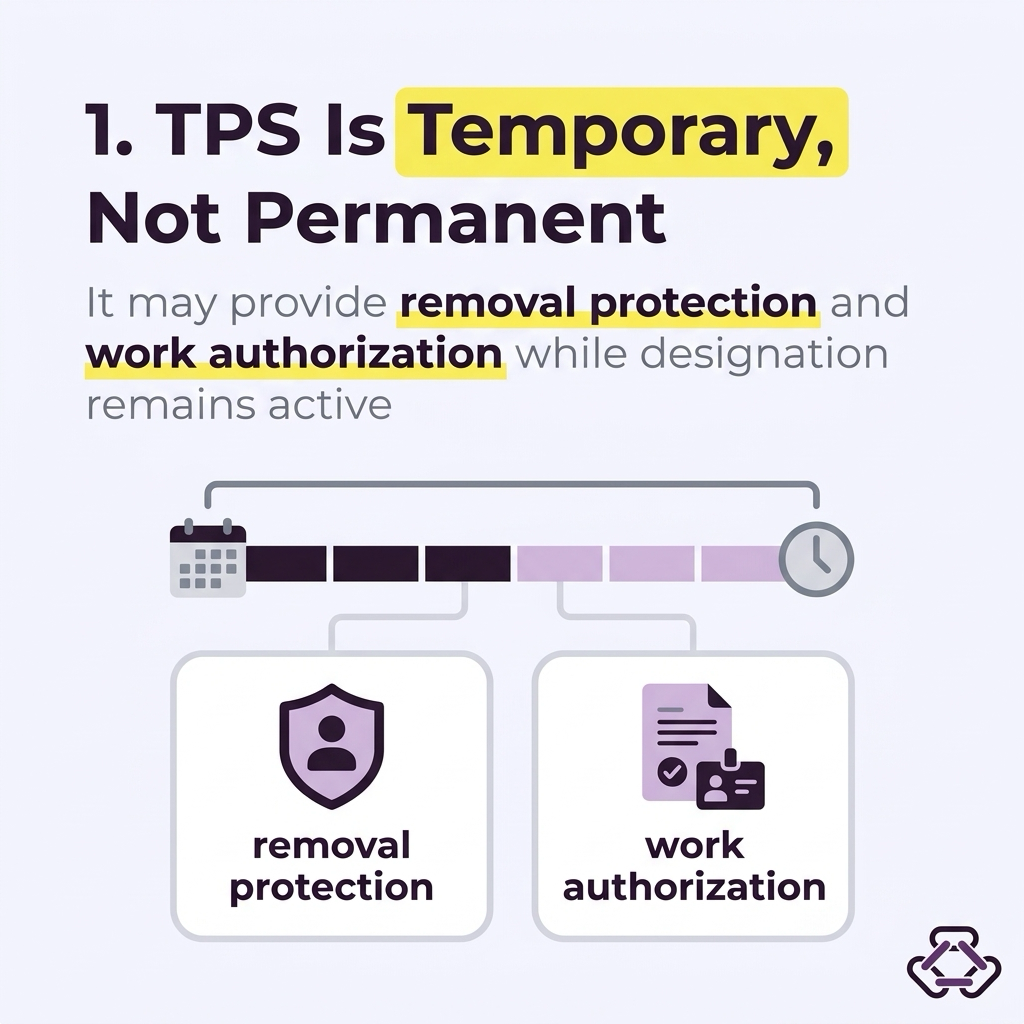
TPS can provide two major protections while it remains in effect:
- Protection from removal
- Employment authorization, if approved
That said, TPS is not the same as asylum, a green card, or citizenship. It is also not a permanent solution on its own. USCIS states that a person with TPS may apply for another immigration benefit if independently eligible, but TPS by itself does not create a direct path to lawful permanent residence or citizenship. The USCIS TPS page and the American Immigration Council both make that distinction clear.
Who May Be Eligible For TPS?
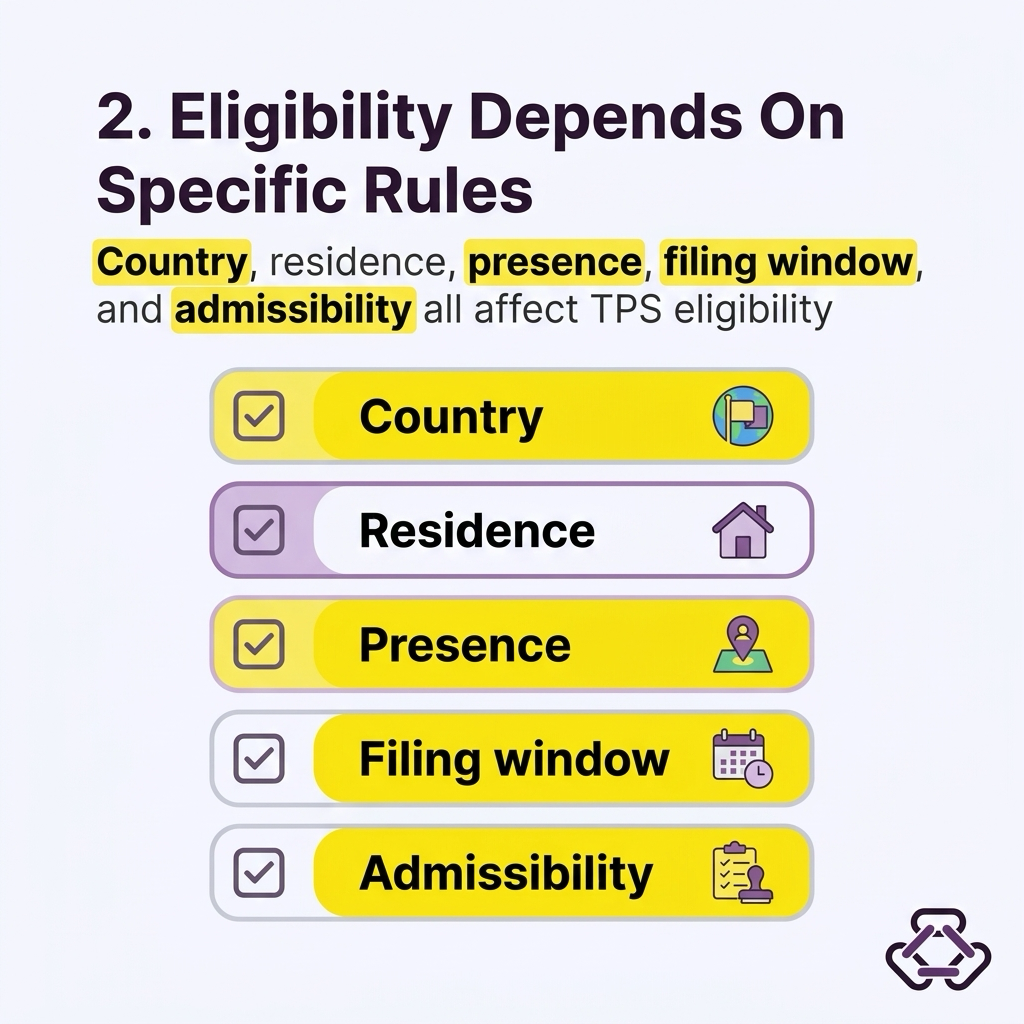
Eligibility for TPS is more specific than many people expect. In general terms, a person may qualify only if they meet the country requirement, the physical presence and residence requirements, the filing requirement, and the admissibility and criminal-history rules.
According to USCIS, a TPS applicant generally has to show that they:
- Are a national of a designated country, or a person without nationality who last habitually resided in that country
- Have been continuously physically present in the United States since the effective date tied to that designation
- Have continuously resided in the United States since the date specified for that country
- File during the proper registration or re-registration window, unless a late filing basis applies
- Are not barred by certain criminal, security, or inadmissibility grounds
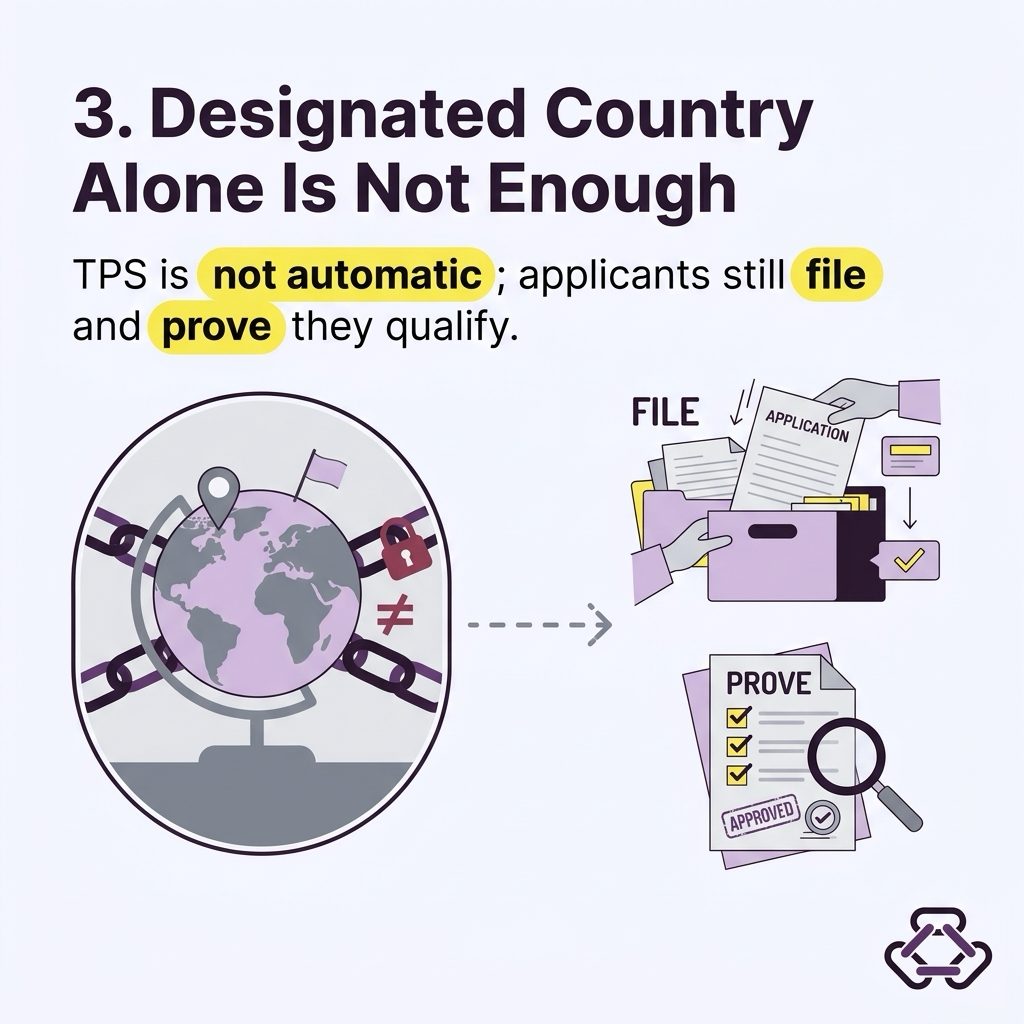
The American Immigration Council notes that TPS is not automatic even for someone from a designated country. A person still has to apply and prove eligibility.
Nationality And Country Designation Matter
TPS is entirely country-specific. A person may be from a country that once had TPS but no longer does. Another person may be from a country whose designation is extended, redesignated, terminated, or tied up in litigation. That changing landscape is one reason TPS questions often require current legal review rather than assumptions based on older advice.
As of March 2026, the American Immigration Council reported that multiple TPS designations and terminations were active or under court challenge, and that litigation was affecting the practical status of some countries. USCIS also maintains the official country-by-country TPS information on its TPS page.
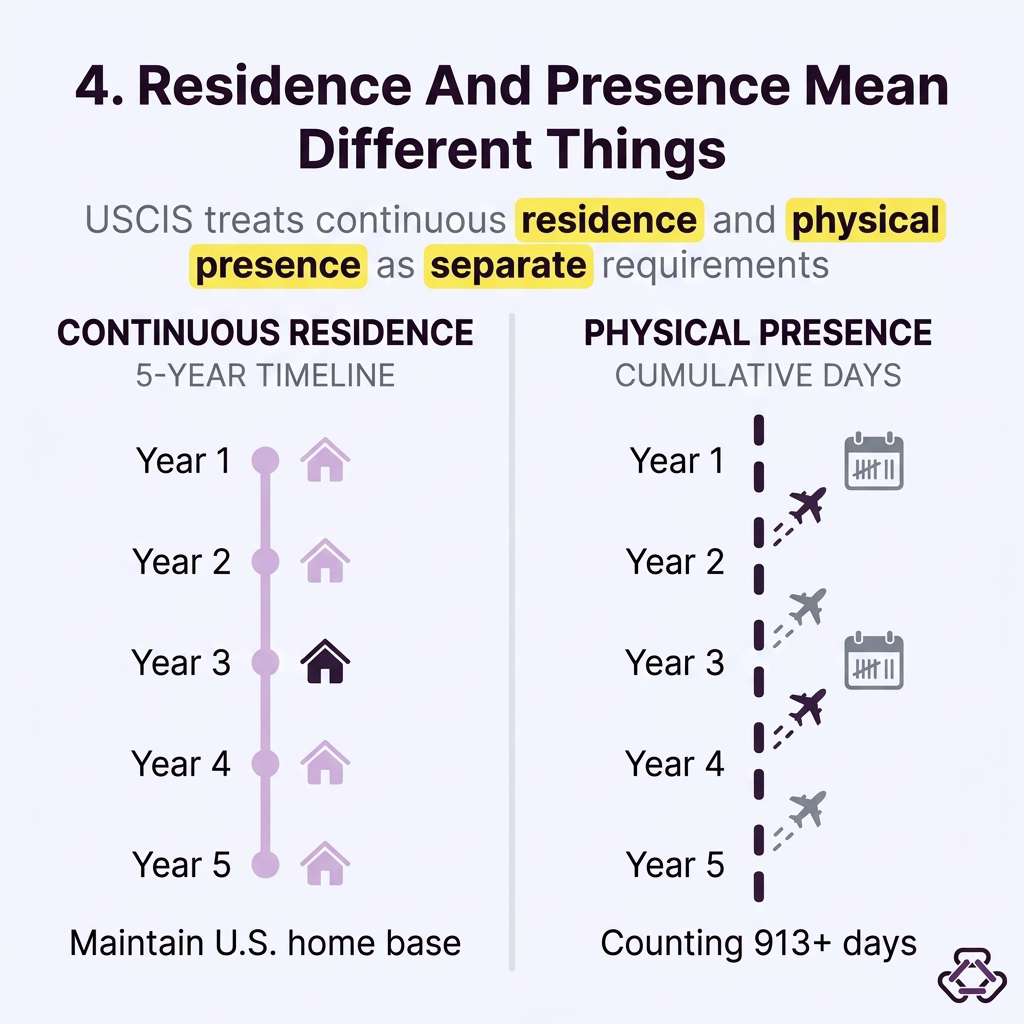
Continuous Residence And Continuous Physical Presence Are Not The Same
Many people use these phrases interchangeably, but immigration law treats them differently. USCIS distinguishes between:
- Continuous residence in the United States since a specified date
- Continuous physical presence in the United States since the effective date of designation
A short trip abroad, a late arrival, or confusion about the exact date tied to a country’s designation can create problems. This is especially true when someone assumes that being from a designated country is enough by itself.
Criminal History Can Change The Analysis Fast
TPS may be unavailable to people with certain criminal issues. USCIS states that people may be barred if they have been convicted of any felony or two or more misdemeanors in the United States, among other disqualifying factors. Questions about what counts as a misdemeanor, whether a disposition is final, or how a plea is classified often call for careful attorney review because the immigration consequences do not always line up neatly with state criminal labels. See USCIS and the American Immigration Council.
Does TPS Apply Automatically If A Country Is Designated?
No. TPS generally requires a filing with USCIS during the correct period. Some people apply during the initial registration period. Others may qualify for late initial filing under limited categories recognized by USCIS, such as certain people who had another qualifying immigration status or were children of someone eligible for TPS during an initial registration period. The exact rules are laid out on the USCIS TPS page.
That filing process often includes Form I-821 and, where relevant, Form I-765 for work authorization. Travel requests involve Form I-131. The exact filing package can vary depending on whether a person is filing initially, re-registering, or requesting a TPS-related travel document.
If you want a more practical walkthrough of assembling forms, evidence, and timing, this guide on getting a TPS application or re-registration packet ready goes deeper into the paperwork side.
What Is Re-Registration And Why Does It Matter So Much?
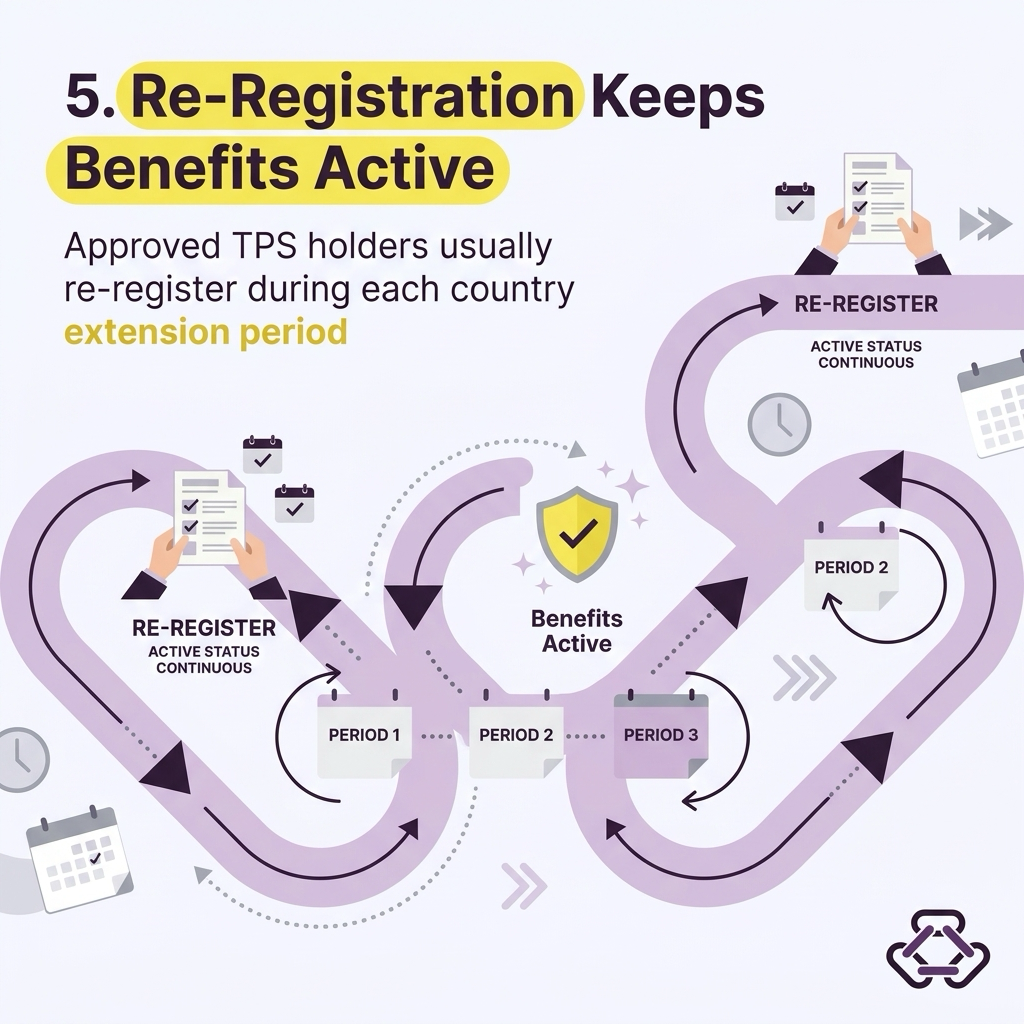
Re-registration is the process TPS holders use to keep TPS benefits active when DHS extends a country’s designation. This is one of the most important parts of maintaining protection.
USCIS explains that even people who already have TPS generally have to re-register during each extension period to continue receiving TPS-related benefits. USCIS has also emphasized in TPS-related notices that a person who has not re-registered under the most recent extension may lose the ability to keep those benefits in place. See USCIS TPS guidance and USCIS information on TPS and EAD extensions.
Re-Registration Is Not The Same As Initial Filing
This is where people often get tripped up. A person with approved TPS is not filing a brand-new TPS case every time. Instead, they are usually filing within a re-registration period announced for their country. The dates can be narrow, and they are not always intuitive.
Missing that window can create serious complications. In some cases, a late filing explanation may be relevant. In others, the delay may lead to a denial or a gap in benefits.
Employment Authorization Can Involve Separate Timing Questions
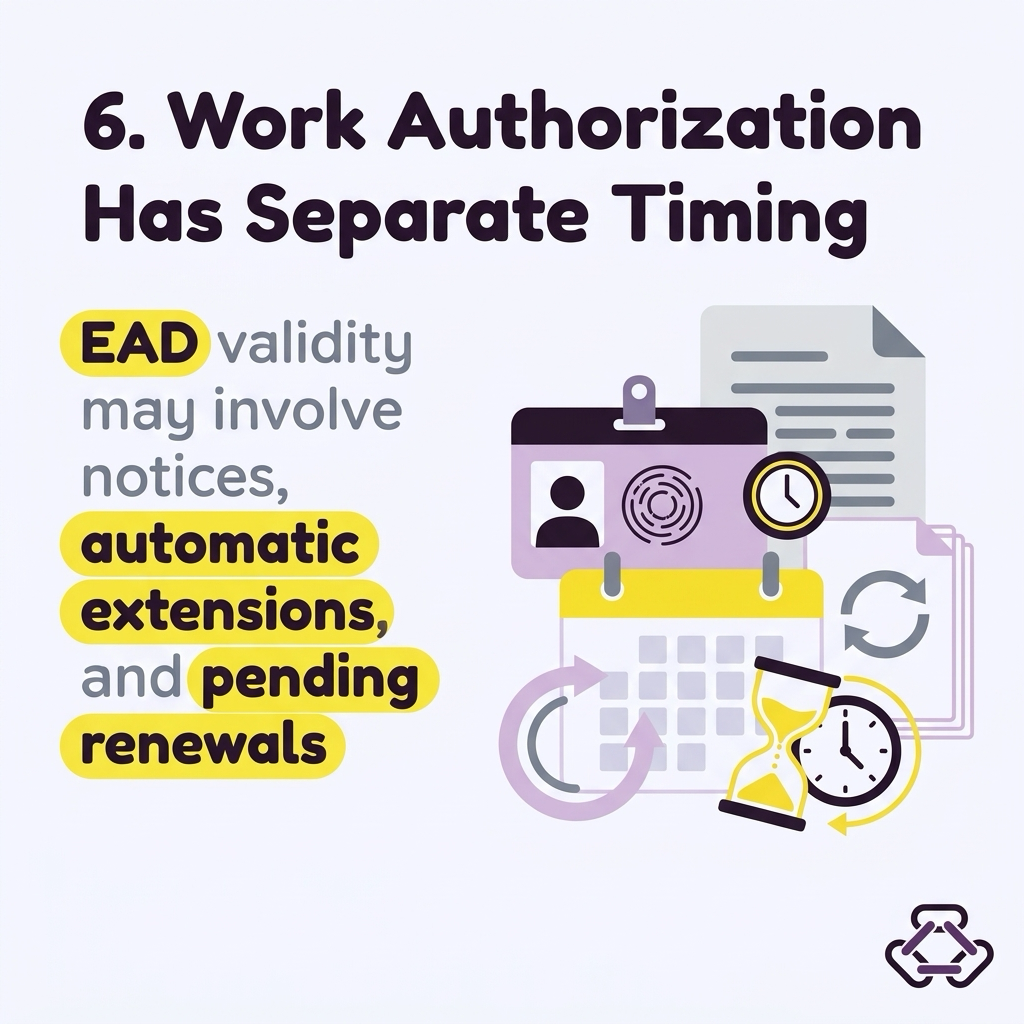
TPS and work authorization are related, but they are not identical. USCIS may automatically extend certain Employment Authorization Documents through a Federal Register notice while re-registration filings are pending. Employers also rely on specific TPS and EAD rules for Form I-9 purposes. See USCIS I-9 Central guidance on TPS and DED and USCIS’s automatic EAD extension page.
This can be confusing in real life because a person may still have TPS protection while waiting for an updated EAD card, or may have automatic work authorization tied to a notice even though the physical card shows an older expiration date.
For a deeper look at day-to-day issues after approval, including recordkeeping and staying current while status remains active, take a look at this article on keeping TPS in good standing over time.
Can A Person Travel With TPS?
Yes, in some situations, but travel is one of the riskiest TPS topics.
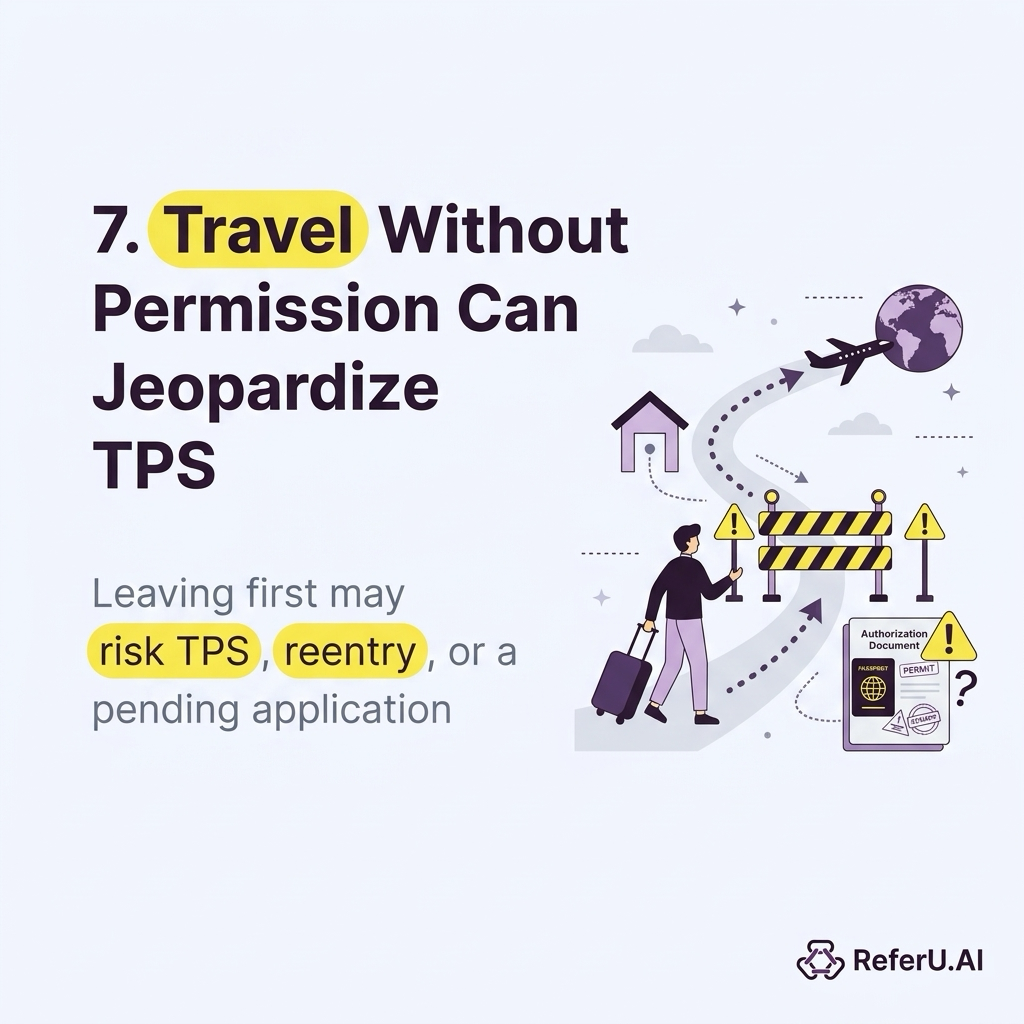
USCIS states that if a person with TPS wants to travel outside the United States, they generally have to apply first for travel authorization. If approved, USCIS issues Form I-512T, Authorization for Travel by an Alien to the United States, as evidence of DHS’s prior consent to travel. If the TPS application is still pending, USCIS states that the person generally has to request advance parole, and approval would be reflected on a different document. These rules are described on the official USCIS TPS page.
Leaving Without Permission Can Be A Major Problem
USCIS warns that if a TPS holder leaves the United States without first obtaining TPS travel authorization, the person may lose TPS and may not be able to reenter. USCIS also warns that if someone with a pending TPS application departs without first obtaining advance parole, USCIS may deny the TPS application and the person may not be able to return. Those points come directly from USCIS.
That risk is one reason travel planning under TPS often deserves more than a quick online search or a casual answer from a friend.
Travel Authorization Is Not A Promise Of Reentry
Even with prior authorization, inspection at the port of entry still matters. USCIS explains that a Customs and Border Protection officer determines whether the returning traveler is eligible for admission in TPS upon return. In other words, the travel document is important, but it is not the same thing as a guaranteed outcome. See USCIS.
Prior Unlawful Presence Or Other Immigration Issues Can Affect Travel Risk
This is where the legal analysis often becomes highly fact-specific. The American Immigration Council explains that some TPS recipients may later become eligible to adjust status after authorized travel and admission, while also noting the major limits imposed by the Supreme Court’s 2021 decision in Sanchez v. Mayorkas for people who originally entered without inspection. USCIS also notes on its TPS materials that people may want legal advice before requesting TPS travel authorization.
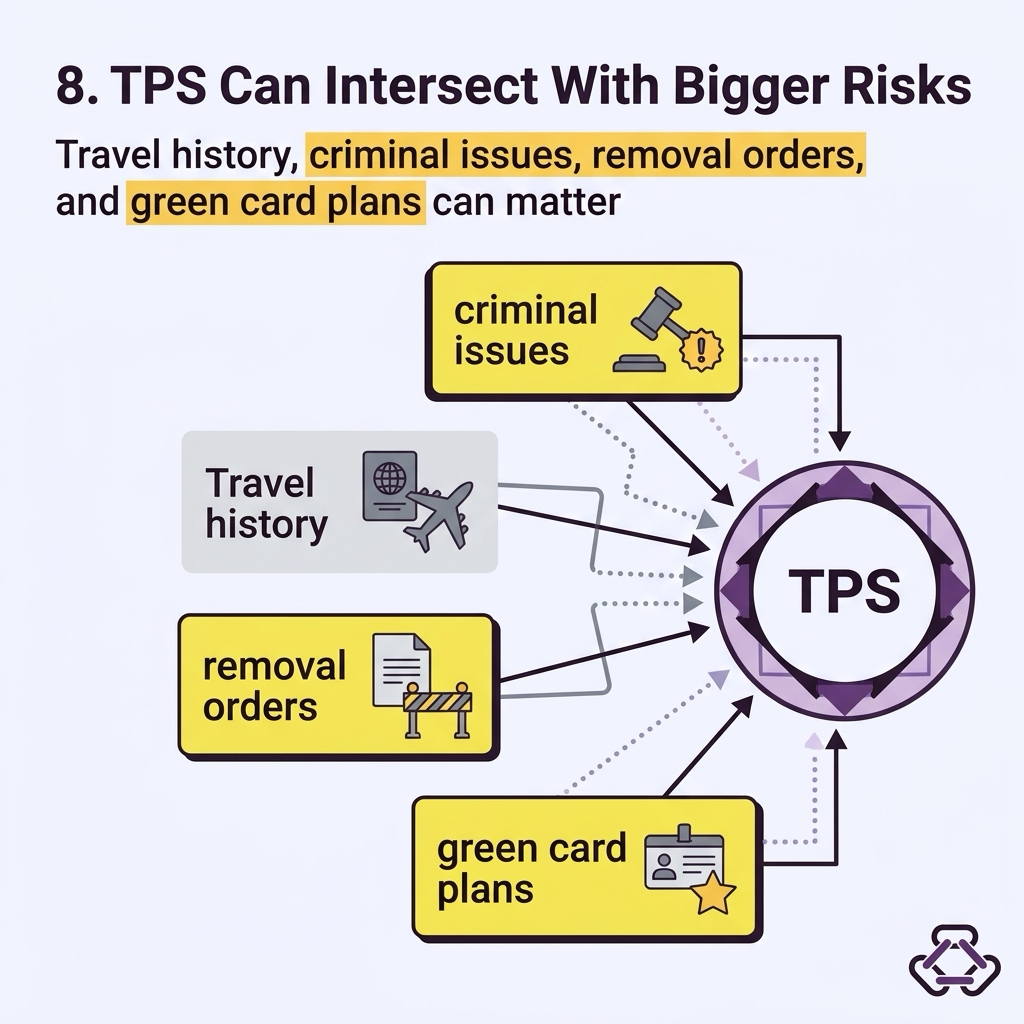
In practical terms, travel may interact with:
- Prior unlawful presence
- A prior removal order
- Grounds of inadmissibility
- Pending applications in another category
- Questions about how a person last entered the United States
- Plans to pursue a green card through family or employment
If travel is part of a larger immigration strategy, the details can matter a great deal.
If you want answers to common work-and-travel concerns in a simpler format, this post on the TPS questions people ask most often may be useful as a companion read.
What Are The Biggest Risks For People With TPS?
TPS can be life-changing protection, but it is also inherently temporary. The main risks usually fall into four categories: country-level risk, filing risk, travel risk, and hidden-history risk.
Country-Level Risk
TPS depends on the government continuing a country’s designation or extension. The American Immigration Council reported that, as of March 31, 2025, about 1.3 million people with TPS were living in the United States, and that multiple country designations had been terminated or targeted for termination, with several of those actions facing court challenges. That combination of agency action and litigation has made TPS unusually fluid in recent years.
A person may have valid TPS today and still face uncertainty if their country’s designation is shortened, terminated, or suspended by litigation developments later.
Filing Risk
A missed deadline, an incomplete form set, or failure to respond to USCIS can turn an otherwise manageable case into a much harder one. Filing risk tends to be especially high during re-registration periods, when people assume that prior approval makes the process automatic.
Travel Risk
Travel is often where people unknowingly expose themselves to serious immigration consequences. Departure without the right document can jeopardize TPS. Even approved travel can raise broader admissibility questions depending on the person’s history.
Hidden-History Risk
Sometimes the most important issue is not TPS itself, but what sits underneath it. That might include:
- A prior removal or voluntary departure issue
- An old arrest or conviction
- Entry without inspection
- Inconsistent addresses or dates
- A prior asylum, family-based, or employment-based filing
- Use of different names or identity records
Those issues may not matter in every TPS case, but when they do matter, they often matter a lot.
For a practical warning list, this roundup of common TPS errors that create avoidable status problems highlights the kinds of mistakes that can become expensive later.
Does TPS Lead To A Green Card?
Not by itself.
USCIS states that a person with TPS may apply for lawful permanent residence if eligible under another category, but TPS alone is not a direct path to permanent resident status. The American Immigration Council similarly explains that TPS does not independently create a pathway to a green card or citizenship.
That said, some TPS holders may also qualify through:
- A U.S. citizen or lawful permanent resident family member
- Employment-based immigration
- Another humanitarian form of protection
- A separate legal process tied to admission after authorized travel
The path, if there is one, often depends on facts that are easy to overlook. For some people, TPS is primarily short-term protection. For others, it may interact with a broader immigration strategy that requires careful sequencing.
What Happens If TPS Ends For A Country?
When a TPS designation ends, the person generally returns to the immigration status they had before TPS, unless they obtained another status in the meantime. If that prior status expired, or if the person had no lawful status before TPS, they may become removable again. The American Immigration Council explains this clearly, and USCIS makes the same basic point in its broader TPS guidance.
This is one reason TPS holders often explore whether any other immigration avenue may exist while protection remains in place. Some people have family petitions, adjustment possibilities, removal defenses, or waivers that may intersect with their history. Others may not. An attorney can often help identify whether there is a second layer of protection beyond TPS itself.
Why Attorney Screening Matters In TPS Cases
On paper, TPS can look straightforward: designated country, forms, filing fees, biometrics, and renewal. In real life, many TPS cases are not just TPS cases. They are also:
- Family-based immigration cases
- Adjustment strategy cases
- Waiver cases
- Removal defense cases
- travel-risk cases
- criminal-immigration overlap cases
That is where attorney fit matters. Not every immigration lawyer handles the same mix of issues, and not every TPS case raises the same kind of risk.
A person looking for legal help may want to consider whether a lawyer has documented experience with highly similar matters, not just general immigration practice. When TPS intersects with travel, removal history, criminal history, or a possible path to permanent residence, case similarity and demonstrable experience can be especially important.
The Bottom Line On TPS
Temporary Protected Status can provide critical protection, but it is rarely “simple” for long. Eligibility depends on country-specific rules, residence and presence dates, filing timing, and admissibility concerns. Re-registration can be essential to keeping benefits alive. Travel can be helpful in some situations and dangerous in others. And the biggest risks often come from facts outside the TPS application itself.
For people trying to protect their status, evaluate travel, or understand whether TPS connects to a broader immigration option, experienced legal review can make the picture much clearer.
Visit ReferU.AI to get matched with an attorney who has demonstrable experience in cases like yours — for free.


